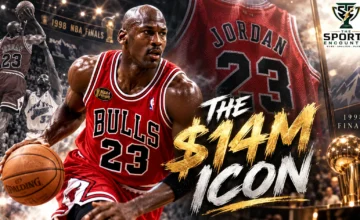
NEW YORK, United States, October 16, 2026: Cristiano Ronaldo has become the world’s highest-paid athlete for the sixth time, earning an estimated $300 million in the 12 months ending May 1, 2026, and matching Floyd Mayweather’s 2015 record for the largest nominal annual total recorded by Forbes. The Portuguese soccer superstar earns more in one measured year than Mike Tyson, the world’s highest-paid athlete in 1990, earned at $28.6 million that year by a factor of more than 10. Yet the biggest financial story of the past 46 years belongs to another sporting icon: Michael Jordan, whose inflation-adjusted lifetime earnings reached an estimated $4.5 billion by the end of 2025.
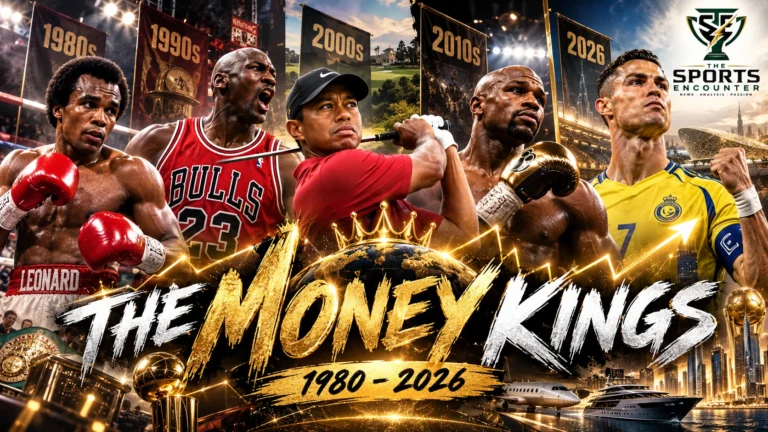
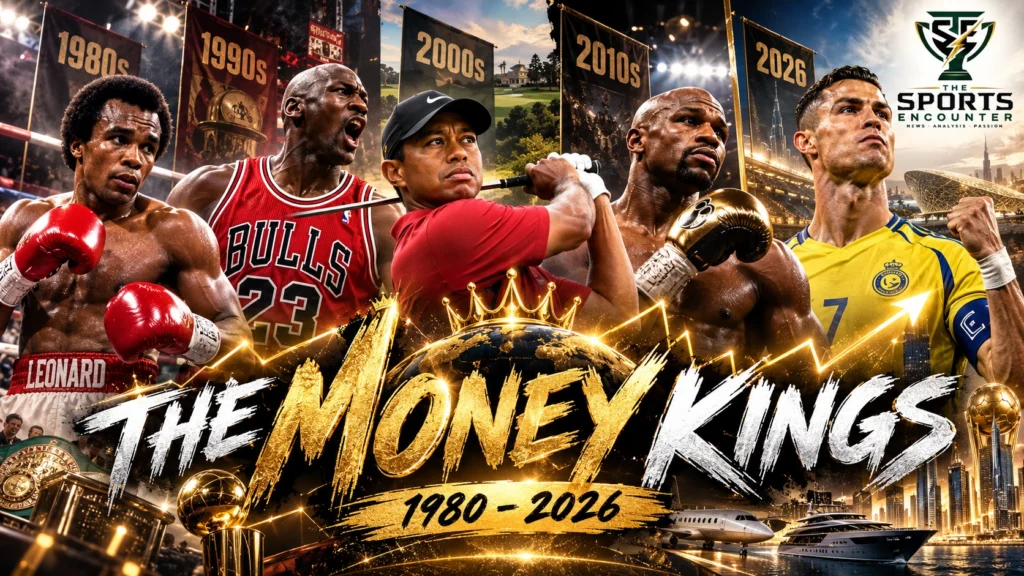
The transformation began long before Ronaldo’s Saudi Arabian contract. Sugar Ray Leonard collected enormous boxing purses during the 1980s. Jordan changed the economics of endorsements through Nike. Tiger Woods dominated annual earnings rankings for an unprecedented 11 years. Mayweather demonstrated how one blockbuster fight could generate a record payday, while Lionel Messi, LeBron James, Roger Federer and other global stars built fortunes across salaries, sponsorships and business ventures. From 1980 to 2026, the financial ceiling in professional sport has risen dramatically, but the latest numbers reveal a more complicated story about inflation, television money, commercial influence and the growing separation between the richest athletes and everyone else.
Highest-Paid Athletes in the World: The Essential Numbers
| Record or Measure | Athlete or Group | Amount |
|---|---|---|
| Highest-paid athlete in 2026 | Cristiano Ronaldo | $300 million |
| First documented Forbes annual leader, 1990 | Mike Tyson | $28.6 million |
| Largest nominal annual earnings recorded by Forbes | Floyd Mayweather, 2015; Cristiano Ronaldo, 2026 | $300 million each |
| Mayweather’s 2015 total in 2026 dollars | Floyd Mayweather | Approximately $427 million |
| Most annual Forbes No. 1 finishes | Tiger Woods | 11 |
| Most annual No. 1 finishes after Woods | Michael Jordan and Cristiano Ronaldo | 6 each |
| Highest inflation-adjusted lifetime earnings | Michael Jordan | $4.5 billion |
| Combined earnings of the 2026 top 10 | Ten athletes | $1.4159 billion |
| Combined earnings of the 2026 top 50 | Fifty athletes | Approximately $4.1 billion |
Sources: Forbes’ May 2026 annual ranking, historical Forbes annual lists and Sportico’s April 2026 inflation-adjusted lifetime earnings study. Annual earnings, inflation-adjusted lifetime earnings and net worth are separate measures and should not be compared as if they represent the same calculation.
Who Is the Highest-Paid Athlete in the World in 2026?
For the fourth consecutive year, Cristiano Ronaldo leads Forbes’ annual athlete earnings ranking.
Story at a glance
Highest-Paid Athletes in the World: The Essential Numbers
Sources: Forbes’ May 2026 annual ranking, historical Forbes annual lists and Sportico’s April 2026 inflation-adjusted lifetime earnings study. Annual earnings, inflation-adjusted lifetime earnings and net worth are separate measures and should not be compared as if they represent the same calculation.
Who Is the Highest-Paid Athlete in the World in 2026?
For the fourth consecutive year, Cristiano Ronaldo leads Forbes’ annual athlete earnings ranking.
The World’s 10 Highest-Paid Athletes in 2026
Forbes’ latest ranking was published on May 22, using estimated income from May 1, 2025, through May 1, 2026.
What the 1980s Actually Tell Us About Athlete Earnings
The modern annual Forbes athlete earnings series began in 1990.
Every Documented Forbes Annual Earnings Leader From 1990 to 2026
The following table reconstructs the annual No. 1 finishers from the established Forbes ranking era.
His estimated $300 million total consists of $235 million in playing-related income associated with Saudi Pro League club Al Nassr and $65 million from endorsements and other commercial activities.
The Portuguese forward, now 41, first topped the ranking in 2016.
He repeated the achievement in 2017 and returned to first place in 2023, beginning a four-year run through 2026.
His six first-place finishes match Michael Jordan’s historical total.
Only Tiger Woods, who topped the annual rankings 11 times, remains ahead of them.
The official Forbes 2026 highest-paid athletes report confirms the latest earnings estimates and explains the financial composition of Ronaldo’s record year.
Ronaldo’s Playing Income Accounts for Most of His Record Earnings
The $235 million playing-related portion represents approximately 78.3 percent of Ronaldo’s annual total.
His off-field income supplies the remaining 21.7 percent.
That balance differs substantially from athletes such as Michael Jordan and Shohei Ohtani, whose commercial earnings have become central to their financial positions.
Ronaldo’s exceptional football contract reflects Saudi Arabia’s considerable investment in attracting internationally recognized sporting personalities.
His continued competitive presence also helps sustain Al Nassr’s visibility beyond the Saudi domestic market.
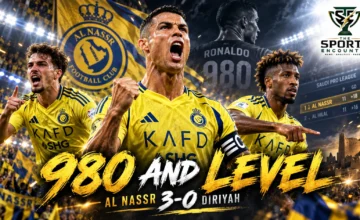
On October 9, Ronaldo scored his 980th career goal as Al Nassr defeated Diriyah 3-0.
The Sports Encounter’s examination of Ronaldo’s 980th goal illustrates how his record pursuit continues generating sporting attention alongside his extraordinary earning power.
His 2026 income should not be confused with his personal net worth, total career earnings or the complete face value of his contract.
Forbes measured income during a defined 12-month period rather than everything Ronaldo has ever earned.
The World’s 10 Highest-Paid Athletes in 2026
Forbes’ latest ranking was published on May 22, using estimated income from May 1, 2025, through May 1, 2026.
| Rank | Athlete | Sport | Annual Earnings | On-Field | Off-Field |
|---|---|---|---|---|---|
| 1 | Cristiano Ronaldo | Soccer | $300M | $235M | $65M |
| 2 | Canelo Álvarez | Boxing | $170M | $160M | $10M |
| 3 | Lionel Messi | Soccer | $140M | $70M | $70M |
| 4 | LeBron James | Basketball | $137.8M | $52.8M | $85M |
| 5 | Shohei Ohtani | Baseball | $127.6M | $2.6M | $125M |
| 6 | Stephen Curry | Basketball | $124.7M | $59.7M | $65M |
| 7 | Jon Rahm | Golf | $107M | $97M | $10M |
| 8 | Karim Benzema | Soccer | $104M | $100M | $4M |
| 9 | Kevin Durant | Basketball | $103.8M | $54.8M | $49M |
| 10 | Lewis Hamilton | Formula 1 | $100M | $70M | $30M |
All amounts are Forbes estimates in nominal US dollars, before taxes and agent fees. On-field income can include salaries, bonuses, competition winnings and eligible playing-related arrangements. Off-field income includes endorsements and other commercial earnings.
Three Sports Supply Six of the Top 10 Places
Soccer and basketball each have three athletes on the 2026 list.
Boxing, baseball, golf and Formula 1 supply the other four positions.
The leading 10 athletes earned a combined $1.4159 billion.
Approximately $902.9 million came from playing-related income, while $513 million came from off-field sources, based on the published breakdown.
That means commercial income accounted for approximately 36.2 percent of the top 10’s combined total.
The balance illustrates why an athlete’s market value can no longer be explained solely through competitive salaries or prize money.
Shohei Ohtani Has the Most Unusual Earnings Breakdown
Ohtani earned an estimated $127.6 million, but only $2.6 million was attributed to on-field income during Forbes’ reporting window.
His off-field earnings reached approximately $125 million.
That represents nearly 98 percent of his estimated total.
The structure reflects both lucrative commercial relationships and the unusual payment arrangement associated with his Los Angeles Dodgers contract.
Deferred contract payments affect when salary is received, while his global commercial appeal generates substantial endorsement income.
Ohtani’s 2026 breakdown therefore provides a particularly strong warning against treating an athlete’s contract face value as equivalent to annual cash earnings.
What the 1980s Actually Tell Us About Athlete Earnings
The modern annual Forbes athlete earnings series began in 1990.
Consequently, there is no directly equivalent Forbes dataset identifying the world’s highest-paid athlete for every year from 1980 through 1989.
Historical visualizations sometimes assign precise annual or continuously changing rankings to that period.
Those numbers require particular caution because contemporary information was uneven, reporting standards differed and endorsement contracts were not consistently disclosed.
Nevertheless, the decade contains the foundations of the modern athlete earnings economy.
Sugar Ray Leonard Helped Establish Boxing’s Blockbuster Paydays
Boxing was one of the clearest examples of how individual sporting personalities could command substantial income before modern global sponsorship markets reached their present scale.
Sugar Ray Leonard earned enormous purses against Roberto Durán, Thomas Hearns and Marvin Hagler.
A contemporary Los Angeles Times account published in June 1989 listed approximately $83.5 million in Leonard’s cumulative professional boxing earnings.
That total included reported purses of approximately $10 million for his first fight with Durán in 1980, $12 million against Hearns in 1981 and $12 million against Hagler in 1987.
These were fight-specific and cumulative figures, not standardized annual Forbes estimates.
Leonard also developed commercial income through endorsements and business relationships.
His career illustrated a model that would later become familiar: a major athlete could build an economic identity around personal popularity rather than depend entirely on a team employer.
Martina Navratilova Demonstrated Tennis’s Early Commercial Potential
Tennis offered another important example.
According to the Women’s Tennis Association’s historical account, Martina Navratilova exceeded $2 million in season prize earnings in 1984.
That was more than the leading men’s prize-money earner, John McEnroe.
Navratilova also received a $1 million bonus connected with holding all four Grand Slam singles titles simultaneously.
By 1986, she had surpassed $10 million in cumulative career prize money.
These achievements did not establish that women and men earned equally across professional sport.
They demonstrated that elite women’s tennis could support remarkable individual financial success even during a period of substantial inequality between sports and competitions.
Michael Jordan’s 1984 Nike Deal Changed the Financial Trajectory
Jordan’s first Nike agreement in 1984 became one of the defining commercial partnerships in sports history.
The original arrangement was worth approximately $500,000 annually, plus royalties, according to Forbes.
Its importance emerged over subsequent decades as the Air Jordan business expanded beyond basketball footwear.
Jordan eventually generated far more money through licensing and endorsements than through his NBA playing salary.
That distinction became central to his position as the highest-earning athlete in history.
By the close of the 1980s, boxing had established the enormous value of individual marquee events, tennis had demonstrated growing prize-money potential, and basketball was beginning to show how an athlete’s personal brand could become a lasting global business.
Every Documented Forbes Annual Earnings Leader From 1990 to 2026
The following table reconstructs the annual No. 1 finishers from the established Forbes ranking era.
It uses reported nominal earnings rather than adjusting each historical amount for inflation.
There is no 2001 entry. Forbes changed its reporting window, leaving a gap between the calendar-year 2000 ranking and the July 2002 list covering approximately June 2001 through June 2002.
| Year | Highest-Paid Athlete | Sport | Estimated Earnings |
|---|---|---|---|
| 1990 | Mike Tyson | Boxing | $28.6M |
| 1991 | Evander Holyfield | Boxing | $60.5M |
| 1992 | Michael Jordan | Basketball | $35.9M |
| 1993 | Michael Jordan | Basketball | $36M |
| 1994 | Michael Jordan | Basketball / Baseball | Approximately $30M |
| 1995 | Michael Jordan | Basketball | $43.9M |
| 1996 | Mike Tyson | Boxing | $75M |
| 1997 | Michael Jordan | Basketball | $78.3M |
| 1998 | Michael Jordan | Basketball | $69M |
| 1999 | Michael Schumacher | Formula 1 | $49M |
| 2000 | Michael Schumacher | Formula 1 | $59M |
| 2001 | No comparable annual Forbes list published | ||
| 2002 | Tiger Woods | Golf | $69M |
| 2003 | Tiger Woods | Golf | $78M |
| 2004 | Tiger Woods | Golf | $80.3M |
| 2005 | Tiger Woods | Golf | $87M |
| 2006 | Tiger Woods | Golf | $90M |
| 2007 | Tiger Woods | Golf | $100M |
| 2008 | Tiger Woods | Golf | $115M |
| 2009 | Tiger Woods | Golf | $110M |
| 2010 | Tiger Woods | Golf | $105M |
| 2011 | Tiger Woods | Golf | $75M |
| 2012 | Floyd Mayweather | Boxing | $85M |
| 2013 | Tiger Woods | Golf | $78.1M |
| 2014 | Floyd Mayweather | Boxing | $105M |
| 2015 | Floyd Mayweather | Boxing | $300M |
| 2016 | Cristiano Ronaldo | Soccer | $88M |
| 2017 | Cristiano Ronaldo | Soccer | $93M |
| 2018 | Floyd Mayweather | Boxing | $285M |
| 2019 | Lionel Messi | Soccer | $127M |
| 2020 | Roger Federer | Tennis | $106.3M |
| 2021 | Conor McGregor | Mixed Martial Arts | $180M |
| 2022 | Lionel Messi | Soccer | $130M |
| 2023 | Cristiano Ronaldo | Soccer | $136M |
| 2024 | Cristiano Ronaldo | Soccer | $260M |
| 2025 | Cristiano Ronaldo | Soccer | $275M |
| 2026 | Cristiano Ronaldo | Soccer | $300M |
Historical annual leaders compiled from Forbes rankings and the Topend Sports archive of Forbes highest-paid athletes lists. The 2026 entry is from Forbes’ May 2026 release. Publication windows and calculation methodologies have evolved. These nominal dollar figures are historical reporting estimates, not inflation-adjusted equivalents.
Mike Tyson and Evander Holyfield Established the First Forbes Era
Boxing dominated the earliest documented years of the Forbes rankings.
Mike Tyson led the inaugural 1990 list with approximately $28.6 million.
Evander Holyfield followed in 1991 with $60.5 million.
The fact that Holyfield’s reported figure more than doubled Tyson’s inaugural total demonstrates how quickly individual championship paydays could move the rankings.
Tyson returned to first place in 1996, earning an estimated $75 million.
Boxing’s unusual business structure made such fluctuations possible.
An elite fighter could earn an enormous amount from a limited number of contests, particularly when pay-per-view distribution and major promotional agreements were involved.
Unlike athletes receiving relatively predictable annual team salaries, a boxer could generate an exceptional year around one or two blockbuster events.
That same model would later produce Mayweather’s extraordinary earnings peaks.
Michael Jordan Rewrote the Rules of Athlete Endorsements
Jordan led the Forbes rankings in 1992, 1993, 1994, 1995, 1997 and 1998.
His six first-place finishes represented the defining commercial achievement of the decade.
The key was the growth of his earning power beyond his playing contract.
Jordan’s NBA salary was substantial by the later stages of his Chicago Bulls career, but his partnerships with Nike, Gatorade, Hanes and other companies created a commercial platform extending well beyond the basketball season.
His personal brand was valuable because sponsors could connect their products with a globally recognizable personality.
The Air Jordan business eventually became an enduring source of royalties long after Jordan stopped playing.
Why Jordan’s Earnings Continued Long After Retirement
Many elite athletes experience a sharp decline in playing income after retirement.
Jordan’s commercial career followed a different path.
His licensing arrangements continued generating enormous revenue, while ownership and investment interests expanded his financial activities.
According to Sportico’s April 2026 historical analysis, Jordan earned an estimated $275 million during 2025 alone, primarily through commercial arrangements.
That figure exceeded the $260 million Sportico attributed to Ronaldo for the same calendar-year reporting comparison.
The two estimates use a different reporting period and methodology from Forbes’ May 2026 ranking and should not be substituted for those figures.
They nevertheless reveal something remarkable.
Jordan can remain one of the world’s highest-earning sports personalities more than two decades after his final NBA appearance.
Tiger Woods Dominated Athlete Earnings for 11 Years
No athlete has topped Forbes’ annual rankings more often than Tiger Woods.
He finished first every year from 2002 through 2011 and returned to the top in 2013.
That represents 11 first-place finishes.
Woods became the first athlete in the Forbes series to reach $100 million in a single annual ranking, accomplishing that in 2007.
His estimated earnings peaked at $115 million in 2008.
Unlike boxing, where one major fight can generate a large share of the year’s earnings, golf provided a more continuous international commercial platform.
Woods attracted sponsors through his success, television audiences, recognizable identity and ability to generate attention around tournaments.
His commercial earnings often far exceeded his tournament prize money.
The Difference Between Playing Success and Commercial Value
Woods’ dominance highlights a central development in sports finance.
An athlete’s value to sponsors depends on more than the prize money they win.
Brands may pay substantially more for global recognition, audience reach and long-term association than the athlete receives from competition itself.
That commercial effect is closely related to the growing value of sports television rights.
TSE’s analysis of the global sports media-rights market found that worldwide rights value reached an estimated $65.82 billion in 2026.
That modern industry total should not be compared directly with the income of one athlete or assumed to represent money paid to competitors.
It helps explain the economic environment in which the strongest sporting personalities can attract increasingly valuable commercial partnerships.
Floyd Mayweather’s $300 Million Year Changed the Record Book
Floyd Mayweather occupied first place in 2012, 2014, 2015 and 2018.
His defining earnings achievement came in 2015.
The highly anticipated fight against Manny Pacquiao generated enormous pay-per-view and related commercial revenue.
Mayweather earned an estimated $300 million during the annual reporting period, setting a nominal benchmark that would remain unmatched until Ronaldo’s 2026 total.
He returned to first place in 2018 with another extraordinary $285 million year, driven largely by the commercial impact of his fight against Conor McGregor.
The figures illustrate boxing’s ability to generate exceptional one-off income.
But there is an important difference between earning $300 million in 2015 and earning the same nominal amount in 2026.
Was Mayweather’s 2015 Payday Worth More Than Ronaldo’s 2026 Earnings?
Yes, when adjusted for inflation using the comparison published by Forbes.
Mayweather’s $300 million in 2015 was worth approximately $427 million in 2026 dollars.
That is about $127 million more in inflation-adjusted purchasing power than Ronaldo’s $300 million estimate for the latest reporting period.
| Athlete | Reporting Year | Nominal Earnings | Inflation-Adjusted Comparison |
|---|---|---|---|
| Floyd Mayweather | 2015 | $300M | Approximately $427M in 2026 dollars |
| Cristiano Ronaldo | 2026 | $300M | $300M in the reference year |
The nominal records are equal.
The inflation-adjusted values are not.
This distinction becomes essential when comparing athletes across several decades, particularly because the purchasing power of the US dollar has changed substantially since 1980.
How Soccer Took Control of the Modern Earnings Race
Soccer became increasingly prominent in the highest-paid rankings during the 2010s.
Ronaldo reached first place in 2016 and 2017.
Lionel Messi took the lead in 2019 and 2022.
Ronaldo then established his four-year run from 2023 through 2026.
International commercial visibility helps explain the pattern.
The sport attracts audiences across Europe, South America, Africa, Asia and the Middle East.
Elite players can combine contracts at globally recognized clubs with commercial partnerships reaching those markets.
Ronaldo’s move to Saudi Arabia added another dimension by introducing an exceptionally valuable playing contract.
Why Club Spending and Player Earnings Must Be Measured Separately
The growth of transfer spending is often discussed alongside player salaries, but those figures represent different transactions.
When one club pays another club to acquire a player, the transfer fee is not automatically income received by the athlete.
The distinction is increasingly important as club spending reaches record levels.
Our investigation into the Premier League’s record £3.46 billion summer transfer spending examined the commercial forces allowing English clubs to commit such enormous sums.
Transfer fees, player wages, agent payments and image-rights arrangements must be considered separately to avoid inflating athlete earnings.
Forbes’ modern methodology attempts to identify playing-related compensation rather than treating the entire cost of acquiring a player as personal income.
How Endorsements Turn Soccer Players Into Global Brands
A footballer’s commercial value can extend into apparel, footwear, advertising, digital media, licensing and appearances.
Club sponsorships also influence the wider commercial environment.
In September, Liverpool’s reported agreement with Turkish Airlines illustrated the extraordinary value of a leading European club’s shirt sponsorship.
TSE’s investigation of Liverpool’s sponsorship agreement examined the commercial implications of a reported five-year package worth more than £300 million.
Such sponsorship revenue belongs to the club under its contractual arrangements and must not be treated as personal income received by the players.
However, large commercial partnerships demonstrate the value that recognized teams and athletes can create for international brands.
Roger Federer Proved Tennis Stars Could Lead Without Playing Income
Roger Federer topped the Forbes annual ranking in 2020 with approximately $106.3 million.
It was the first time a tennis player had reached No. 1 since Forbes began publishing the annual list.
Federer’s position reflected the extraordinary value of his endorsement portfolio.
His relationships with companies including Uniqlo, Rolex and other major brands generated substantial commercial income beyond tournament winnings.
The achievement showed that a tennis player did not need a single exceptionally lucrative competition victory to lead the sports earnings rankings.
Commercial reputation, long-term agreements and global recognition could produce a higher total than playing income alone.
Why Tennis Prize Money Remains a Major Financial Debate
The enormous commercial earnings of leading tennis stars are not representative of every professional player.
Lower-ranked competitors face travel, coaching, equipment, accommodation and medical expenses while seeking sufficient prize money to sustain their careers.
That imbalance remains central to the sport’s discussions about revenue sharing.
TSE’s investigation of the Grand Slam Player Council examined athletes’ demands for a larger share of tournament revenue and greater influence over competition decisions.
The size of individual championship purses is also increasing.
Our Wimbledon 2026 prize-money analysis documented the Championships’ record £64.2 million fund.
These developments help explain why athlete compensation remains an important subject even as the most famous players earn extraordinary amounts.
Conor McGregor’s 2021 Earnings Showed the Power of Athlete-Owned Businesses
Conor McGregor topped the Forbes ranking in 2021 with an estimated $180 million.
The figure was driven significantly by business activity associated with his Proper No. Twelve whiskey brand.
That made his annual earnings different from a boxer receiving a major fight purse or a team athlete receiving a large salary.
Part of McGregor’s financial success arose from the commercialization of a business interest linked to his personal brand.
Forbes’ 2026 discussion of off-field income identifies McGregor’s 2021 business transaction as an exceptional example of active-athlete commercial earnings.
The case demonstrates why modern athlete earnings rankings require more detailed methodology than simply adding up wages and competition prizes.
Michael Jordan Remains the Highest-Earning Athlete in History
The annual Forbes rankings identify who earned the most during each reporting period.
A different question concerns total earnings accumulated across an athlete’s career and subsequent commercial life.
Sportico’s April 2026 historical study, reproduced in its report on the highest-paid athletes of all time, ranked Michael Jordan first with approximately $4.5 billion in inflation-adjusted lifetime earnings through the end of 2025.
Tiger Woods ranked second with $2.88 billion, followed by Cristiano Ronaldo at $2.52 billion.
Top 10 Highest-Earning Athletes of All Time, Inflation Adjusted
| Rank | Athlete | Primary Sport | Lifetime Earnings |
|---|---|---|---|
| 1 | Michael Jordan | Basketball | $4.50B |
| 2 | Tiger Woods | Golf | $2.88B |
| 3 | Cristiano Ronaldo | Soccer | $2.52B |
| 4 | LeBron James | Basketball | $2.03B |
| 5 | Lionel Messi | Soccer | $1.99B |
| 6 | Arnold Palmer | Golf | $1.85B |
| 7 | Jack Nicklaus | Golf | $1.83B |
| 8 | David Beckham | Soccer | $1.68B |
| 9 | Roger Federer | Tennis | $1.67B |
| 10 | Floyd Mayweather | Boxing | $1.57B |
Source: Sportico’s April 1, 2026, study. Figures are inflation-adjusted estimates of lifetime earnings through 2025, including applicable post-retirement commercial income. They are not estimates of current net worth or cash held by an athlete.
Jordan’s Lead Shows the Value of Long-Term Commercial Ownership
Jordan’s inflation-adjusted lifetime earnings exceed Woods’ total by approximately $1.62 billion.
The difference reflects the continuing commercial strength of his personal brand.
He remains associated with one of the most commercially influential footwear lines in the world.
His example also demonstrates why sports business value can persist after an athlete retires.
Ownership and licensing arrangements allow certain individuals to participate in commercial growth over many years.
The increasing value of major sports franchises provides additional context.
TSE’s analysis of the proposed $12.5 billion Los Angeles Lakers ownership transaction examined how global brands, broadcast income and long-term commercial assets influence franchise valuations.
Franchise valuations are not athlete earnings, and an investment’s headline valuation should not be added to an athlete’s income without an appropriate accounting basis.
But the extraordinary valuations help illustrate why some former players pursue ownership, licensing and business interests beyond their competitive careers.
How Much Have Top Athlete Earnings Really Increased Since 1990?
The first annual Forbes leader, Mike Tyson, earned an estimated $28.6 million in 1990.
Ronaldo’s 2026 figure is $300 million.
That represents a nominal increase of approximately 949 percent.
In other words, the highest reported annual total is now about 10.5 times the inaugural figure.
| Benchmark | Highest Earner | Nominal Annual Total |
|---|---|---|
| 1990 | Mike Tyson | $28.6M |
| 2000 | Michael Schumacher | $59M |
| 2010 | Tiger Woods | $105M |
| 2020 | Roger Federer | $106.3M |
| 2026 | Cristiano Ronaldo | $300M |
The comparison measures changes in the reported nominal annual earnings leaders.
It does not measure real purchasing-power growth over the entire period, the average athlete’s compensation, or the profitability of professional sports.
Inflation, changes in reporting methodology, the emergence of new commercial activities and the timing of extraordinary events all affect the interpretation.
Why the Curve Is Not a Simple Upward Line
The highest annual earnings figure has not increased every year.
One exceptional boxing match can produce a temporary peak.
A commercial business sale can create another.
Major endorsement agreements may raise an athlete’s income even when tournament winnings decline.
The historical record therefore contains sharp jumps and subsequent corrections.
Mayweather’s $300 million in 2015 was followed by Ronaldo’s $88 million as the annual leader in 2016.
That does not mean the entire professional sports industry suffered a comparable financial collapse.
It means the previous year’s exceptional payday did not recur within the next reporting period.
What Changed the Economics of Sporting Fame?
Four developments help explain the growth of the highest individual earnings totals.
1. Television and Pay-Per-View Expanded the Commercial Audience
Boxing demonstrated early how a major contest could attract viewers willing to pay specifically to watch individual athletes.
Television rights later became an essential source of income for major leagues and tournaments.
Broadcast expansion helped increase the commercial value associated with elite competitors.
2. Endorsements Became Long-Term Commercial Relationships
Jordan’s Nike partnership helped establish the athlete as a recognizable global consumer brand.
Continue the Athletics Story
 AthleticsEighth Into the Final, First Onto the Podium: Stojadinovic Edges Stevanovic by 0.3 in Serbia’s Cairo Double
 AthleticsHassan’s New York Redemption Ends Before the Start as Illness Forces Olympic Champion Out
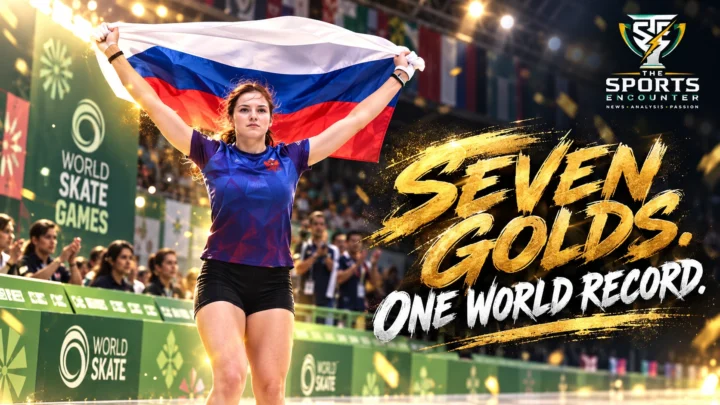
 AthleticsSeven Golds, One World Record: Russia Returns Under Its Flag and Raises the Bar in Paraguay
Woods, Federer, LeBron James and other athletes built substantial commercial portfolios.
In some cases, royalties and endorsements eventually became more valuable than the athlete’s playing income.
3. Global Markets Increased Competition for Elite Personalities
Soccer clubs, professional leagues, sponsors and international event organizers increasingly compete for athletes with worldwide recognition.
Saudi Arabia’s investment in Ronaldo illustrates one prominent example.
Major international sporting markets now influence the earnings ceiling beyond the established American and European professional leagues.
4. Equity, Licensing and Business Ownership Created New Income Channels
Modern athletes can earn money through business holdings, product licensing, equity arrangements and commercialization of their personal brands.
The value of those arrangements depends on their specific contractual terms and whether the athlete has actually received income.
That distinction is why earnings estimates should not be confused with speculative valuations of privately held interests.
Why Women’s Sports Are Still Missing From the 2026 Top 50
Despite the rapid growth of several women’s professional competitions, no woman appeared in Forbes’ 2026 list of the 50 highest-paid athletes.
It was the third consecutive year in which the ranking contained no women.
The exclusion reflects the size of the earnings gap at the highest financial level.
The threshold for entering the 2026 top 50 was approximately $54.6 million.
That is substantially above the reported annual earnings of even the leading women athletes.
The situation should not be interpreted as evidence that women’s professional sports are commercially stagnant.
Women’s Basketball Is Growing, but the Pay Gap Remains
The WNBA established new audience and attendance records during its 2026 season.
More than 90 million unique viewers watched across national network coverage, while attendance reached approximately 3.8 million.
TSE’s investigation of WNBA viewership and attendance growth examined how the league’s record season was changing its commercial position.
Audience growth, however, does not translate automatically into salaries comparable with the largest men’s sports contracts.
League revenues, collective bargaining arrangements, sponsorships, media contracts and the maturity of individual commercial markets influence what players receive.
The distinction is also evident in tennis.
Top women players can command substantial endorsements and tournament prizes, but the worldwide earnings ranking still shows a considerable gap between the most highly compensated men and women.
Serena Williams Shows the Importance of Lifetime Earnings
Serena Williams appeared in Sportico’s April 2026 ranking of the 50 highest-earning athletes of all time.
She was ranked 40th with approximately $680 million in inflation-adjusted lifetime earnings.
She was the only woman in that historical top 50.
Her placement reflects a remarkable career, but it also illustrates how concentrated the highest levels of sports income remain.
Women athletes have achieved substantial commercial success across tennis, basketball, gymnastics, soccer and other sports.
The fact that only one woman appeared in that particular lifetime earnings ranking demonstrates how much further commercial structures would need to develop before the distribution became substantially more balanced.
Annual Earnings, Career Earnings and Net Worth: Three Different Rankings
Many discussions of the richest athletes combine figures that measure different things.
That creates misleading comparisons.
| Measure | What It Describes | Example |
|---|---|---|
| Annual earnings | Income estimated during a defined reporting period | Ronaldo’s $300M in 2026 |
| Lifetime earnings | Income accumulated across a career and qualifying later commercial years | Jordan’s estimated $4.5B, inflation adjusted |
| Net worth | Estimated value of assets after liabilities | Separate wealth estimates for retired and active athletes |
| Contract value | Potential contractual payments over a stated period | A multiyear soccer or NBA contract |
| Transfer fee | Amount typically paid between clubs for player registration rights | Major European soccer transfers |
| Franchise valuation | Estimated value of a professional sports organization | Reported multibillion-dollar NBA team valuations |
These figures are not interchangeable.
An athlete may sign a contract worth hundreds of millions of dollars over several years without receiving that full amount immediately.
An athlete may also own a valuable business interest without selling it or receiving the entire estimated value as income.
Similarly, historical inflation-adjusted earnings are intended to make amounts from different periods more comparable, rather than identify the actual cash received in those years.
What Does the 1980-2026 Earnings Race Tell Us About Sport’s Future?
The historical progression reveals an extraordinary expansion in the financial value attached to elite sporting personalities.
Leonard demonstrated that an individual athlete could command enormous revenue through exceptional contests.
Jordan showed that licensing and endorsements could produce an enduring commercial empire.
Woods established the value of sustained international recognition.
Mayweather demonstrated the earnings power of one extraordinary pay-per-view event.
Federer and McGregor showed that off-field relationships and business transactions could influence the annual leadership.
Ronaldo’s latest record reflects the combined effects of global soccer visibility, a highly valuable playing contract and an extensive commercial portfolio.
The next major increase could arise through another blockbuster sporting event, an exceptionally lucrative contract or a major business transaction involving an athlete’s personal brand.
There is no reliable basis to identify which athlete will set the next earnings record or when it will occur.
The continuing growth of digital distribution, international sponsorship and sports investment may create additional opportunities, but earnings will still vary according to market conditions and individual arrangements.
The Biggest Lesson: Earning Power Has Outlasted Sporting Careers
Ronaldo is the world’s highest-paid athlete in Forbes’ latest annual ranking.
Mayweather retains the more valuable single-year benchmark when his $300 million from 2015 is adjusted for inflation.
Woods holds the record for the most first-place finishes.
Jordan remains the leader in inflation-adjusted lifetime earnings.
Each record describes a different dimension of sporting wealth.
That is what makes the history from 1980 through 2026 so revealing.
The biggest earning opportunities have shifted from individual competition purses toward global contracts, endorsements, media exposure, licensing and businesses that can continue generating income after retirement.
The numbers have increased enormously, but the more lasting transformation concerns how athletes earn money and how long that earning power can survive.
Jordan’s commercial success more than two decades after retiring provides the strongest example.
Ronaldo’s latest $300 million year demonstrates how high the annual ceiling has risen.
The next chapter will be determined not only by who wins on the field, in the ring or on the court, but also by who can translate sporting recognition into a durable commercial position.
Highest-Paid Athletes 1980-2026: Frequently Asked Questions
Who Is the Highest-Paid Athlete in the World in 2026?
Cristiano Ronaldo leads Forbes’ 2026 ranking with an estimated $300 million, including $235 million in playing-related income and $65 million in off-field earnings.
Who Was the Highest-Paid Athlete in 1980?
There is no directly comparable Forbes annual ranking for 1980 because the established series began in 1990. Sugar Ray Leonard was among the most prominent high-earning athletes of the period, with major boxing purses documented through contemporary reporting.
Who Was the Highest-Paid Athlete in 1990?
Mike Tyson led Forbes’ inaugural 1990 ranking with an estimated $28.6 million.
Who Has Topped the Forbes Highest-Paid Athletes Ranking Most Often?
Tiger Woods has led 11 times. Michael Jordan and Cristiano Ronaldo have each topped the ranking six times through 2026.
What Is the Highest Single-Year Athlete Earnings Total Ever Recorded by Forbes?
Floyd Mayweather’s $300 million in 2015 and Cristiano Ronaldo’s $300 million in 2026 share the largest nominal annual total recorded by Forbes.
Was Floyd Mayweather’s 2015 Earnings Record Worth More Than Ronaldo’s in 2026?
Yes. Forbes estimated that Mayweather’s $300 million in 2015 was equivalent to approximately $427 million in 2026 dollars after adjusting for inflation.
Who Is the Highest-Earning Athlete of All Time?
Michael Jordan leads Sportico’s April 2026 lifetime earnings ranking with an estimated $4.5 billion after adjusting historical earnings for inflation.
Why Is There No Forbes Highest-Paid Athlete Entry for 2001?
Forbes changed its reporting period around that time. Its 2002 list covered approximately June 2001 through June 2002, leaving no directly comparable standalone 2001 annual list.
How Much Did the World’s Top 10 Athletes Earn in 2026?
The 10 highest-paid athletes earned a combined estimated $1.4159 billion during Forbes’ May 2025 to May 2026 reporting window.
Why Are No Women Among Forbes’ 50 Highest-Paid Athletes in 2026?
The highest reported women’s earnings remained below the approximately $54.6 million threshold required to enter the 2026 top 50. The financial gap reflects differences in commercial markets, contracts, sponsorship income and competition compensation.