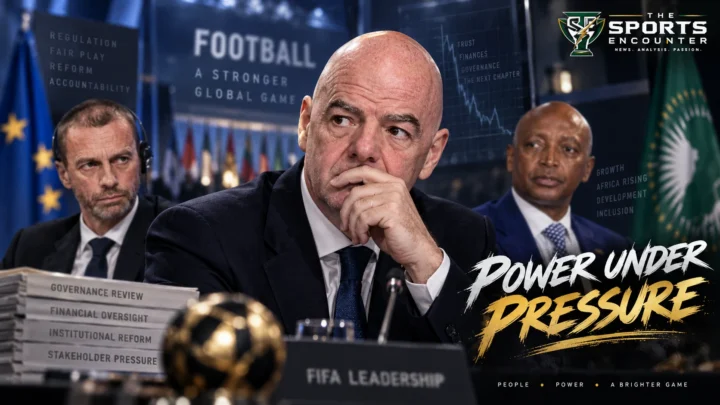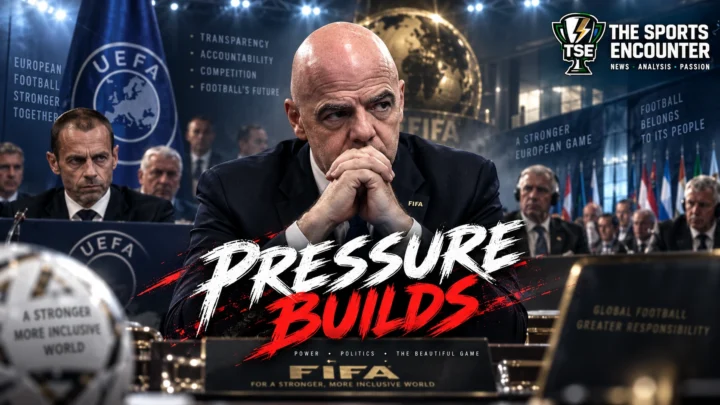
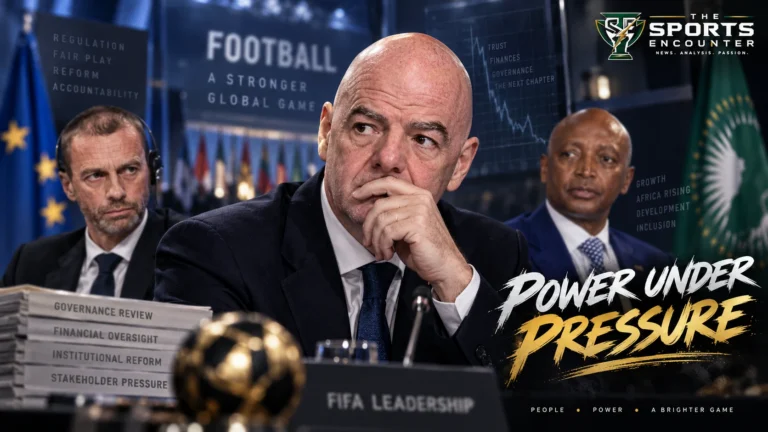
ZURICH, Switzerland, October 15, 2026: Gianni Infantino will chair a FIFA Council meeting on Thursday with several of his fiercest critics sitting across the table, a multibillion-dollar funding proposal under scrutiny, and the deadline for challengers to his presidency barely five weeks away. The 37-member Council is gathering for its first meeting since the collapse of Infantino’s controversial attempt to attract private investment into FIFA’s commercial operations, a proposal that turned disagreements about World Cup revenue into the gravest leadership challenge of his decade in office.
The meeting places four interconnected issues before world football’s senior decision-makers: the abandoned FIFA Forward Enterprise project, the use of FIFA’s substantial financial reserves, the independence of disciplinary procedures and the distribution of authority within the organization.
UEFA President Aleksander Čeferin and other confederation leaders have demanded fundamental changes to FIFA’s governance. A coalition of European associations has gone further, publicly calling for new leadership. Infantino, meanwhile, retains support from influential national associations and confederations, particularly in Africa, and has proposed significantly increasing development funding for FIFA’s 211 members.
The confrontation arrives ahead of the November 18 deadline for presidential nominations and the March 18, 2027 election in Rabat, Morocco.
Story at a glance
What Is Happening at the October 15 FIFA Council Meeting?
The FIFA Council consists of 37 members, including the FIFA president, eight vice presidents and 28 additional representatives elected through the confederation structures.
How Infantino’s World Cup Investment Plan Created the Crisis
The present confrontation began with a proposal to reorganize FIFA’s commercial operations through an entity called FIFA Forward Enterprise, or FFE.
UEFA Wants More Than an Apology: Its October 8 Reform Blueprint
The most substantial recent institutional development came on October 8, when UEFA’s national associations met in Berlin.
The $6 Billion Question: Why FIFA’s Reserves Are Now Central to the Fight
The financial dispute has become more consequential because of FIFA’s substantial reserves following the expanded 2026 World Cup.
FIFA and UEFA Offer Different Explanations of the Leadership Crisis
UEFA maintains that the failed commercial proposal revealed systemic weaknesses in FIFA’s governance and damaged confidence in the president.
The immediate question is whether the Council can establish credible checks on presidential authority. The longer-term question is whether the associations that opposed Infantino’s investment proposal can organize enough support to replace him.
There is also a financial issue that deserves closer examination. If FIFA can now offer billions in additional development funding from its own reserves, critics are asking why the organization previously considered granting private investors a permanent economic interest in its commercial activities.
That question does not automatically prove the earlier proposal was unnecessary or improper. It does, however, place the assumptions behind both financing strategies under renewed scrutiny.
The October 15 meeting had not produced publicly verified final decisions at this article’s publication cutoff. This report examines the confirmed developments, competing positions and issues that will determine what happens next.
What Is Happening at the October 15 FIFA Council Meeting?
The FIFA Council consists of 37 members, including the FIFA president, eight vice presidents and 28 additional representatives elected through the confederation structures.
It is the organization’s principal decision-making body between meetings of the FIFA Congress.
The Council’s composition makes Thursday’s meeting especially sensitive. Infantino will be chairing a body that includes officials who have challenged his leadership and demanded stronger institutional oversight.
According to the Associated Press report published October 14, the agenda includes the failed investment plan, the proposed use of FIFA’s reserves, disciplinary procedures and the organization’s governance standards.
| Issue | Confirmed Background | Principal Unresolved Question |
|---|---|---|
| FIFA Forward Enterprise | FIFA withdrew its proposed commercial investment structure after widespread opposition. | Will an independent review examine the project’s development and approval process? |
| Financial reserves | A new proposal would provide additional development funding to 211 member associations. | How much can be distributed, under what conditions, and with what financial oversight? |
| Disciplinary independence | Controversial World Cup disciplinary decisions have prompted demands for clearer procedures. | Will FIFA strengthen safeguards against actual or perceived executive and political influence? |
| Institutional governance | UEFA has published proposals to strengthen the Council and separate executive responsibilities. | Will FIFA adopt enforceable changes or rely on voluntary commitments? |
The meeting is not itself the scheduled FIFA presidential election.
Council members may discuss governance, consider proposals and shape future decisions. FIFA’s 211 member associations retain the central electoral role through the Congress.
Confusing those two processes would exaggerate what Thursday’s meeting can immediately accomplish.
How Infantino’s World Cup Investment Plan Created the Crisis
The present confrontation began with a proposal to reorganize FIFA’s commercial operations through an entity called FIFA Forward Enterprise, or FFE.
The project would have consolidated important commercial activities associated with FIFA tournaments, including broadcasting, sponsorship, licensing and other revenue-generating operations.
Private investors were expected to acquire a minority economic interest in the new structure.
The proposed transaction involved investors associated with Joshua Kushner, with reporting identifying a multibillion-dollar investment plan and a proposed minority stake of approximately 20 percent.
Infantino’s stated objective was to unlock commercial value and generate additional resources for football development.
But senior football officials questioned the process, the financial structure and the long-term consequences of granting private investors an interest in future tournament revenues.
Those objections escalated rapidly into opposition from major football institutions.
TSE examined the investment structure and its consequences in its investigation of why FIFA’s World Cup stake proposal collapsed.
The Central Dispute Was About Ownership, Control and Approval
FIFA argued that the proposed subsidiary would remain under the organization’s ownership and control.
Under FIFA’s description, commercial investment would not transfer the authority to regulate football, organize competitions or make sporting decisions to private investors.
Critics drew a distinction between formal governing authority and permanent economic rights.
Even if FIFA retained responsibility for football decisions, a private investor’s entitlement to a share of future commercial returns could affect the organization’s financial flexibility.
That concern deserves analysis on its own terms.
Football’s governing authority and the economic ownership of its revenue streams are not identical concepts.
A governing body might maintain control over its competitions while accepting long-term financial obligations to outside investors.
Whether such an arrangement would benefit football depends on its valuation, the projected revenue growth, contractual safeguards, duration and the alternatives available.
Those details became central to the dispute.
Why Confederations Objected to the Process
UEFA, the Asian Football Confederation and CONCACAF opposed the proposal and challenged the manner in which it had been developed.
The dispute involved more than disagreement over how much money the investment could generate.
Opponents argued that decisions with potentially lasting consequences for world football required meaningful consultation with elected representatives.
Some critics accused FIFA’s leadership of developing the proposal without sufficient transparency or institutional oversight.
Those are allegations about governance and process. They should not be presented as established findings of legal misconduct without an independent determination.
TSE previously examined how UEFA, the AFC and CONCACAF united against the investment proposal.
FIFA Withdrew the Proposal, but the Leadership Dispute Continued
The pressure intensified after the proposal became public in late July.
The opposition included threats to boycott FIFA competitions, criticism from senior officials and visible disagreement within FIFA’s leadership structure.
Infantino withdrew the project within days.
Abandoning the transaction removed the immediate commercial proposal from consideration.
It did not resolve the question of how the proposal had advanced so far without securing the confidence of important football stakeholders.
That distinction explains why the confrontation has continued into October.
UEFA Wants More Than an Apology: Its October 8 Reform Blueprint
The most substantial recent institutional development came on October 8, when UEFA’s national associations met in Berlin.
UEFA President Aleksander Čeferin announced that he would seek another term as president of European football’s governing body.
The meeting also produced a formal reform agenda for FIFA.
UEFA stated that its members, with Azerbaijan’s association excepted from the agreement on the reform direction, supported changes designed to distribute authority more clearly within FIFA.
Its position was explicit: institutional reform would not, by itself, restore confidence in the current leadership.
The official UEFA announcement of October 8 includes its institutional proposals and its call for leadership change.
Separate the President’s Role From Day-to-Day Management
One of UEFA’s central proposals concerns the responsibilities of the FIFA president.
UEFA argues that the president should provide strategic leadership, chair the Council and represent FIFA internationally without directly exercising management functions assigned to other officials.
The distinction is important.
In a large international organization, strategic oversight and operational management are separate responsibilities.
If those responsibilities become concentrated in one office, the people responsible for scrutinizing decisions may have less practical influence over them.
Clear separation of responsibilities can make it easier to establish who proposed, reviewed, authorized and implemented a major transaction.
Give the FIFA Council Greater Authority Before Commitments Are Made
UEFA also wants a reinforced FIFA Council capable of shaping major proposals before commitments are undertaken.
The demand reflects the principal criticism of the abandoned FFE project.
Opponents believe elected representatives should have been involved earlier in considering a commercial arrangement of such importance.
A stronger Council would not necessarily prevent controversial proposals.
It could, however, create a formal process for evaluating them before decisions become difficult to reverse.
That would represent a measurable governance change if the responsibilities were incorporated into binding regulations.
Make the FIFA Bureau More Accountable
UEFA’s proposals also call for the FIFA Bureau to exercise clearly defined executive powers.
The Bureau operates between full Council meetings and contains senior representatives from FIFA’s leadership structure.
Clarifying its responsibilities could reduce uncertainty over when important decisions require broader consultation.
The practical test would be whether those rules limit unilateral action and establish a documented decision-making process.
An Independent Review Must Be Able to Examine Evidence
Infantino previously indicated openness to an independent review of FIFA governance.
However, the credibility of such a review depends on how it is established.
An external review may be described as independent without necessarily possessing authority to inspect the records needed to reach meaningful conclusions.
A credible process would need a clearly defined scope, access to relevant documentation, safeguards against conflicts of interest and a process for communicating findings.
UEFA has specifically sought access to material associated with the investment proposal and its approval process.
TSE examined the earlier proposal in its September report on Infantino’s proposed independent governance review.
The October 15 meeting offers an opportunity to determine whether that proposal will become a substantive investigation or remain a commitment without an announced timetable.
The $6 Billion Question: Why FIFA’s Reserves Are Now Central to the Fight
The financial dispute has become more consequential because of FIFA’s substantial reserves following the expanded 2026 World Cup.
Contemporary reporting places FIFA’s available reserves in a range of approximately $5 billion to $6 billion, depending on the accounting period and projected commitments.
Those figures should not be treated as an independently audited closing balance for October 15.
They represent the financial resources cited in the current debate.
UEFA and CONCACAF leaders have argued that FIFA can provide additional development funding from its own resources without granting private investors a share of future tournament revenues.
That argument places the proposed investment transaction under renewed scrutiny.
Infantino’s New Funding Proposal
Reports published on October 14 describe a proposal under which each of FIFA’s 211 member associations would receive an additional $15 million during the 2027-2030 cycle.
That would supplement a proposed $10 million entitlement for the same cycle, taking the combined amount to $25 million per association.
Across 211 associations, the additional $15 million alone represents $3.165 billion.
The $25 million combined amount would represent $5.275 billion if made available equally to every association.
The wider reported funding proposal also includes allocations and program commitments beyond this simple per-association calculation.
Crucially, these amounts are proposals. They should not be described as already approved or distributed.
How the Proposed Funding Would Be Allocated
Reporting on the new program indicates that the proposed $25 million per association would be divided into three broad categories.
| Proposed Allocation | Amount | Purpose |
|---|---|---|
| Operational support | $10 million | Support for association activities and operating needs |
| Specific development projects | $10 million | Infrastructure and approved football development initiatives |
| Women’s and youth football | $5 million | Programs focused on women’s football and younger players |
| Combined proposed allocation | $25 million | Subject to the applicable approvals and funding conditions |
The reported structure provides a significant potential increase in resources for national associations.
But the purpose, approval requirements and monitoring arrangements for each category will matter as much as the headline amount.
Why Smaller Associations Could Benefit Substantially
For a financially powerful association with established commercial income, FIFA funding may represent one part of a larger budget.
For a smaller national association, additional millions of dollars could materially affect its ability to build facilities, train coaches, support youth development or strengthen administrative operations.
That is an important argument in favor of increased football development funding.
It explains why some associations may prioritize predictable financial support over the political demands of larger federations.
However, the potential benefit does not eliminate the need for oversight.
Large transfers create responsibilities involving budgeting, procurement, accountability and verification that resources reach the intended programs.
Does the New Funding Proposal Undermine the Case for FFE?
The comparison raises a legitimate question.
If FIFA can distribute substantial new funding from its existing reserves, the immediate need to sell an economic stake in future commercial revenues becomes less obvious.
But the two proposals are not financially identical.
Using reserves reduces resources already held by FIFA.
Seeking private investment could provide capital while also creating long-term financial rights and obligations.
Determining which approach is preferable requires an assessment of projected revenues, reserves, future obligations and the terms of the proposed investment.
Those figures have not been fully established through an independent public review of the abandoned arrangement.
TSE examined the competing financial and political interests in its analysis of FIFA’s reserves and Infantino’s search for support among global associations.
The key question for the Council is whether it can evaluate development funding on financial and sporting grounds while keeping electoral considerations separate.
FIFA and UEFA Offer Different Explanations of the Leadership Crisis
UEFA maintains that the failed commercial proposal revealed systemic weaknesses in FIFA’s governance and damaged confidence in the president.
Its institutional proposals seek stronger checks on executive authority and greater participation by elected representatives.
FIFA’s public position has been different.
It argues that Infantino was legitimately elected by the member associations and that political opposition must operate through the organization’s established rules.
In an August 8 statement, FIFA accused some opponents of attempting to undermine its president through allegations and misinformation.
Its official statement defending the FIFA presidency emphasizes the democratic mandate provided by the member associations and the importance of complying with FIFA’s statutes.
FIFA’s Argument: The Member Associations Decide
The strongest institutional point in FIFA’s position is straightforward.
The FIFA president is elected through a system in which national member associations possess voting rights.
Opposition from confederation leaders does not automatically remove that electoral mandate.
Critics who want new leadership must either use the relevant statutory procedures or support a candidate capable of winning the presidential election.
That requirement gives Infantino an important advantage as the incumbent.
UEFA’s Argument: An Electoral Mandate Does Not Remove Accountability
UEFA’s counterargument is that being elected does not exempt a president from institutional scrutiny.
It contends that the process surrounding a major proposed commercial transaction should be examined even if the president retains significant support.
These positions are not mutually exclusive in principle.
An elected president can hold a valid mandate while also being subject to transparent governance rules, financial scrutiny and independent review.
The dispute concerns whether the existing safeguards are sufficient and whether Infantino should continue leading the organization.
TSE previously documented the intensifying confrontation in its report on FIFA’s accusation of a UEFA smear campaign and the developing legal dispute.
The Balogun Case Makes Disciplinary Independence Part of the Agenda
FIFA’s governance controversy extends beyond commercial decisions.
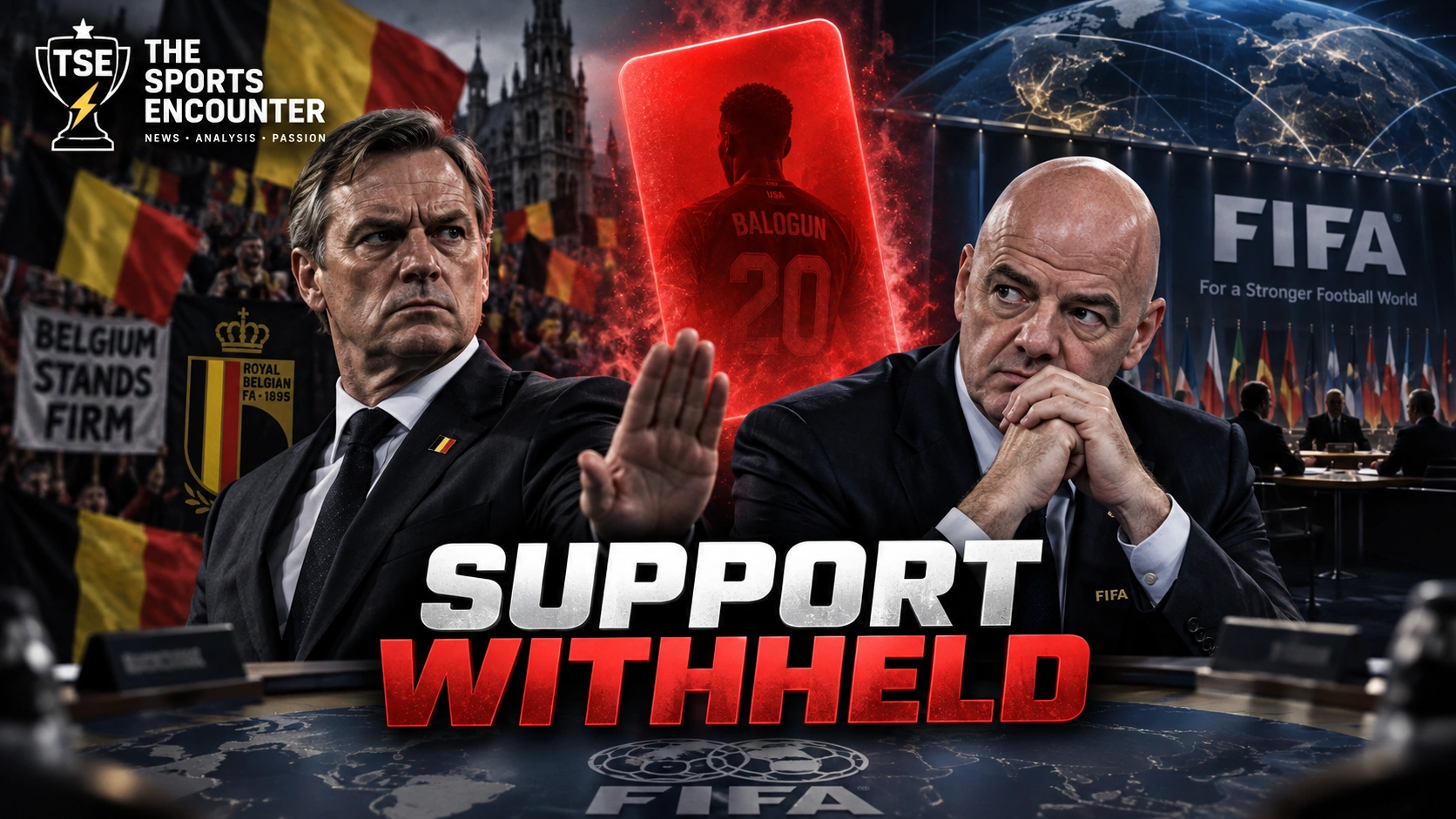
The handling of Folarin Balogun’s suspension during the 2026 World Cup has also prompted scrutiny.
Balogun received a red card during the United States’ round-of-32 victory over Bosnia and Herzegovina.
The dismissal ordinarily carried an automatic one-match suspension.
That suspension was subsequently lifted, allowing Balogun to play against Belgium.
The decision became controversial after U.S. President Donald Trump confirmed that he had contacted Infantino to request a review of the case.
Trump said he had not demanded a particular outcome.
Infantino stated that he had explained that the matter would be decided by FIFA’s independent judicial bodies.
The unusual reversal nevertheless raised questions about the consistency of disciplinary procedures and the independence of the decision-making process.
Why the Case Matters Beyond One Player
The issue is not whether one player deserved sympathy or a particular disciplinary outcome.
It concerns whether the same procedural standards apply to every national team and player.
If a suspension can be reconsidered, the grounds for reconsideration should be clear, consistent and available through established channels.
A system perceived as vulnerable to political or executive influence risks damaging confidence in the fairness of international competition.
TSE examined the international reaction in its report on Belgium’s Balogun dispute and its implications for Infantino’s re-election campaign.
Could FIFA Change Its Disciplinary Rules?
Reports ahead of Thursday’s meeting indicate that disciplinary procedures could be reviewed or clarified.
Any change would need to distinguish between the authority to correct an error and the power to suspend an otherwise applicable sanction.
It would also need to establish whether comparable cases are treated consistently.
The current debate does not establish that any proposed amendment has been adopted.
The Council’s discussions and subsequent official decisions will determine whether the procedures change.
March 2027 Election: Can Infantino’s Opponents Actually Defeat Him?
The presidential election is scheduled for March 18, 2027, in Rabat, Morocco.
Infantino is seeking another term.
His opponents face a deadline of November 18, 2026, for submitting valid candidacies.
A declaration of interest is not enough to guarantee a place on the ballot.
Under FIFA’s election rules, a presidential candidate must satisfy eligibility requirements and obtain formal support from at least five member associations.
The rules also require candidates to have played an active role in organized association football for at least two of the preceding five years.
The most difficult challenge for opponents is therefore converting dissatisfaction into an eligible candidacy with sufficient electoral support.
Ramon Vega Has Declared His Intention to Challenge
Former Switzerland international Ramon Vega has publicly declared his intention to challenge Infantino.
His declaration demonstrates that opposition is not confined to private discussions or unnamed potential candidates.
However, an expressed intention to run and a formally validated candidacy are different stages.
At the October 15 publication cutoff, the available reporting did not establish that Vega had secured the required five formal nominations.
TSE examined his challenge in its October 7 report on Vega entering the presidential contest.
Until formal nomination requirements are satisfied, Infantino’s opponents cannot assume that a competitive election is guaranteed.
Čeferin Will Seek Another UEFA Term
One development has already clarified part of the leadership picture.
Čeferin announced on October 8 that he would seek another term as UEFA president.
That election is scheduled for April 22, 2027, in Astana, Kazakhstan.
His decision means UEFA’s effort to change FIFA’s leadership will not simply involve Čeferin moving from the European presidency to challenge Infantino himself.
UEFA must identify or support someone else who can attract backing beyond Europe.
Why Support From Africa and Other Regions Matters
Infantino retains important backing from football leaders outside Europe.
The Confederation of African Football’s 54 member associations expressed support for his re-election at a meeting in Cape Verde on October 8.
That represents a substantial potential voting base.
However, expressions of support by associations or confederation leaders should not automatically be counted as final ballots months before the election.
Individual associations retain their electoral responsibilities.
Similarly, opposition from UEFA or other confederation leaders does not establish that every association within those regions will vote against Infantino.
That distinction is central to understanding the contest.
FIFA’s presidential election is determined by member-association votes, not by adding together the public positions of confederation presidents.
How Many Votes Would a Challenger Need?
FIFA has 211 member associations.
If all were eligible and cast valid votes in a two-candidate election, 106 votes would provide a simple majority.
The election regulations provide different procedures when three or more candidates remain in contention, including requirements for an initial two-thirds majority and successive ballots.
That makes the number of qualified candidates an important part of the election’s mechanics.
It also means the first practical test of the opposition will arrive before election day, when nominations close.
TSE previously examined the relevant political and electoral questions in its analysis of Infantino’s 2027 re-election campaign.
From July to October: How FIFA’s Crisis Reached Zurich
| Date | Development | Significance |
|---|---|---|
| July 2026 | FIFA’s proposed commercial investment structure becomes public. | Confederation leaders challenge the process and long-term implications. |
| Late July-August | Infantino withdraws the FIFA Forward Enterprise proposal. | The immediate deal ends, but leadership and governance questions continue. |
| August 8 | FIFA publicly defends the president’s democratic mandate. | FIFA challenges the methods and allegations of some opponents. |
| September 2026 | Discussions intensify over governance reviews and the use of financial reserves. | The disagreement expands beyond the abandoned transaction. |
| October 7 | Ramon Vega’s declared challenge brings attention to the 2027 election. | The opposition faces the task of obtaining formal nominations. |
| October 8 | UEFA national associations endorse a reform direction and call for new FIFA leadership. | A formal European reform agenda is established. |
| October 14 | Reports describe a substantial new FIFA development-funding proposal. | Financial resources become an immediate Council issue. |
| October 15 | FIFA Council scheduled to meet in Zurich. | Governance, funding and disciplinary questions reach the governing body. |
The chronology illustrates how the original disagreement has widened.
A commercial investment proposal became a dispute over the separation of powers, financial stewardship, institutional trust and the next presidential election.
Those subjects cannot all be settled through a single Council meeting.
They can, however, be addressed through specific commitments, procedures and decisions that can subsequently be evaluated.
What Would Meaningful FIFA Reform Look Like?
The strongest test of Thursday’s meeting is whether it produces measurable institutional changes.
A promise to improve governance is not equivalent to defining how future decisions will be made.
Several practical indicators would help distinguish substantive reform from a general statement of intent.
1. A Review With a Clearly Defined Mandate
An external investigation would need authority to examine relevant documents and communications relating to FFE.
Its leadership, scope, independence and publication arrangements should be identifiable.
Without those details, observers would have limited means of assessing its credibility.
2. Clear Financial Approval Procedures
Major commercial projects and substantial distributions from FIFA’s reserves require documented financial analysis.
A stronger process would identify who prepares proposals, who assesses them and which governing body possesses approval authority.
It would also establish procedures for disclosing potential conflicts of interest.
3. Public Accountability for Development Funding
Distributing more money is a measurable activity.
Demonstrating that the money improves football development requires additional evidence.
Useful indicators would include audited expenditure, completed infrastructure projects, coach education, youth participation and women’s football development.
Continue the FIFA World Cup 2026 Story
 FIFA World Cup 2026Belgium Turns Balogun Red-Card Row Into Direct Challenge to Infantino’s FIFA Re-Election
 FIFA World Cup 2026FIFA Accuses UEFA of “Smear Campaign” as Infantino Fight Enters US Courts
 FIFA World Cup 2026The Going Gets Tough for Infantino as FIFA’s $6B Reserves Fight Meets His African Power Base
Those outcomes should be assessed across associations with different resources and capacities.
4. Consistent Disciplinary Procedures
Clear disciplinary standards can reduce uncertainty over the authority to reconsider suspensions and other sanctions.
The governing principle should be consistent treatment under published procedures.
That requires a transparent distinction between independent judicial decisions and executive responsibilities.
5. An Election Conducted Under Established Rules
The presidential election must remain separate from the governance review and development-funding decisions.
Those subjects may affect how member associations evaluate candidates, but they should not alter the requirements for an eligible candidacy or a valid vote.
Maintaining that distinction will be important to the credibility of the March election.
The Real-World Stakes: National Associations, Clubs and Players
FIFA’s leadership dispute may appear remote from matches and domestic competitions.
Its consequences can nevertheless extend throughout the sport.
For National Football Associations
The proposed development-funding increase could materially affect budgets, infrastructure plans and long-term football programs.
That is especially important for smaller associations with limited independent commercial revenue.
However, proposed allocations are not the same as approved funding.
Associations still need clarity on eligibility, permitted expenditure, reporting requirements and payment schedules.
For Clubs and Competitions
FIFA’s commercial decisions can influence the financial structure of international tournaments and the relationship between global competitions and domestic football.
Any future attempt to attract private investment would need to clarify how economic rights interact with the wider interests of clubs, leagues and players.
The abandoned FFE proposal raised those questions without producing a completed transaction.
For Players and National Teams
Disciplinary independence has direct competitive implications.
Consistent suspension procedures are important because eligibility decisions can determine which players are available for major matches.
The Balogun controversy demonstrates why teams need predictable rules rather than uncertainty about when exceptional relief might be granted.
For Football Supporters
Supporters have a legitimate interest in understanding how the revenue generated by major competitions is managed.
The 2026 World Cup produced significant commercial returns, helping fuel the present discussion of financial reserves.
The central accountability question is whether those resources are managed transparently and used for clearly defined football purposes.
What Happens Next? Four Dates That Could Decide the Crisis
| Date | Event | Why It Matters |
|---|---|---|
| October 15, 2026 | FIFA Council meeting, Zurich | Governance, financial and disciplinary discussions |
| Before November 17, 2026 | Further meeting of UEFA’s 55 national associations | European strategy on FIFA reform and future leadership |
| November 18, 2026 | FIFA presidential nomination deadline | Determines which challengers submit valid candidacies |
| March 18, 2027 | FIFA presidential election, Rabat | Member associations decide the presidency |
A further question concerns the final approval process for the proposed development-funding program.
Reports indicate that additional Council consideration and subsequent Congress approval may be required before the new funding structure becomes effective.
Those stages should be confirmed through official FIFA decisions rather than assumed from the October 15 discussion.
The Sports Encounter Analysis: Infantino’s Biggest Advantage Is Also His Biggest Governance Challenge
Infantino’s strongest political advantage is the relationship FIFA has developed with its member associations through financial support.
For many national federations, development funding is central to their ability to operate and expand football programs.
The ability to offer additional resources therefore carries substantial institutional significance.
But that advantage creates a governance challenge.
If financial proposals become entangled with a presidential election, it becomes difficult to separate the merits of the programs from the political consequences of supporting them.
That does not establish that the new funding proposal was designed to purchase electoral support.
It does mean that transparent financial assessments and clear approval procedures are especially important.
The Opposition Has Won a Policy Battle, but Not an Election
UEFA and its allies successfully opposed the FIFA Forward Enterprise proposal.
That was a significant institutional outcome.
But preventing a commercial transaction and replacing a president are different challenges.
The first requires sufficient resistance to make a proposal politically or operationally unsustainable.
The second requires a valid challenger and enough member-association votes to win an election.
Infantino’s opponents have demonstrated the capacity to organize against a policy.
They have not yet demonstrated that they can assemble a winning presidential coalition.
Infantino Can Retain Support Without Resolving the Governance Questions
The reverse is also true.
Infantino could retain substantial electoral backing while questions about FIFA’s decision-making procedures remain unresolved.
An election victory would establish the member associations’ decision about who should lead the organization.
It would not, by itself, demonstrate that the abandoned FFE project’s governance arrangements were appropriate.
Likewise, a genuinely independent review could strengthen FIFA’s procedures without necessarily determining who should become president.
Keeping those questions distinct is essential to a fair assessment of the crisis.
The Sports Encounter Verdict: Zurich Must Answer Questions the World Cup Selloff Left Open
FIFA’s October 15 Council meeting is important because the original investment proposal has already been withdrawn.
The question is no longer whether that specific transaction will proceed.
It is whether FIFA can establish a credible explanation of how the proposal developed, why consultation failed, how the organization’s reserves should be managed and what safeguards will govern future decisions.
UEFA’s demands are substantial. It wants a stronger Council, clearer limits on executive authority, independent scrutiny and a change in leadership.
FIFA’s defense rests on the president’s electoral mandate, the organization’s statutory procedures and the claim that development funding and institutional stability remain its priorities.
The new multibillion-dollar funding proposal adds urgency to both arguments.
National associations have legitimate reasons to welcome additional investment in football. They also have legitimate reasons to require transparent scrutiny of the decisions that determine how those resources are distributed.
The immediate measure of success in Zurich will be whether the Council produces verifiable commitments and decisions.
The longer-term test will come on November 18, when the presidential candidate field becomes clearer, and on March 18, when FIFA’s members are scheduled to vote.
Infantino may retain enough support to survive the political challenge. His opponents may still find a candidate capable of defeating him. Neither outcome alone will answer the question that brought them to Zurich: who should be able to commit world football’s money and future, and who has the authority to stop them?
FIFA Council and Infantino Election: Frequently Asked Questions
When Is the FIFA Council Meeting?
The FIFA Council is scheduled to meet on Thursday, October 15, 2026, in Zurich, Switzerland.
Why Is Gianni Infantino Facing Opposition?
The opposition intensified after FIFA proposed creating a commercial subsidiary involving private investment in revenue-generating football operations. The proposal was withdrawn following widespread criticism, but concerns about governance and presidential authority continued.
What Was FIFA Forward Enterprise?
FIFA Forward Enterprise was a proposed structure that would have consolidated commercial activities connected to FIFA competitions and attracted private investment. FIFA said it would retain control, while critics questioned the long-term economic and governance implications.
What Does UEFA Want to Change?
UEFA wants clearer separation of responsibilities, a stronger FIFA Council, defined powers for the Bureau, more transparent decision-making and independent scrutiny. It has also called for new FIFA leadership.
How Much Money Could FIFA Give Its Member Associations?
A proposal reported in October 2026 would provide an additional $15 million per association for the 2027-2030 cycle, supplementing a proposed $10 million entitlement. The resulting $25 million per association remains subject to the applicable approval process.
Has FIFA Approved the New Funding Plan?
No final approval had been publicly verified at the publication cutoff for this article. The amounts should be treated as proposed, not distributed.
Who Is Challenging Infantino in the 2027 Election?
Former Switzerland international Ramon Vega has declared an intention to challenge Infantino. His qualification for the ballot depends on completing the required nomination and eligibility process.
How Many Associations Must Support a FIFA Presidential Candidate?
At least five FIFA member associations must provide the required formal support for a presidential candidacy.
When Is the FIFA Presidential Election?
The election is scheduled for March 18, 2027, in Rabat, Morocco.
Can the FIFA Council Remove Infantino at the October 15 Meeting?
The scheduled meeting is not the presidential election. The Council operates within FIFA’s governing statutes, while presidential election and dismissal procedures involve the FIFA Congress and applicable rules.