
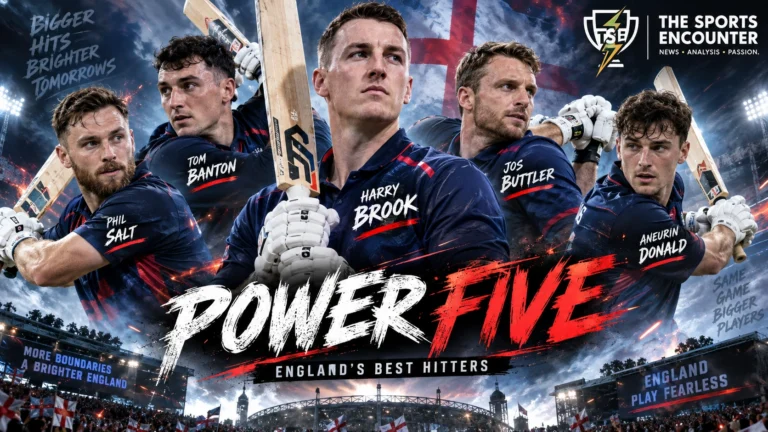
CARDIFF, Wales, September 18, 2026: England scored 254 for four in Southampton on Tuesday. Two nights later, they chased 146 in only 12.1 overs in Cardiff. The striking part was not simply the speed. It was how many different batters were capable of taking control.
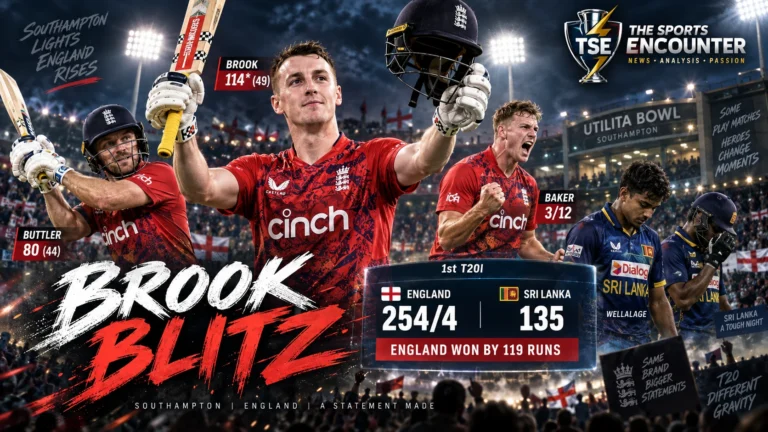
Harry Brook made an unbeaten 114 from 49 balls in the 119-run first-T20I victory over Sri Lanka. Jos Buttler made 80 from 44. Aneurin Donald began his international career with 12 from five. In Cardiff, Brook needed eight balls for 23, Buttler made 30 from 16, Donald struck 21 from 13, and Tom Banton finished the chase with an unbeaten 52 from 24 as England secured the series with a match to spare.
Phil Salt has missed this series with a right quad injury, but his absence only sharpens the larger point. England can lose one of the most destructive T20 openers in world cricket and still field a batting unit capable of making 250 or completing a chase at 12 runs per over.
Across the first two T20Is against Sri Lanka, Brook, Buttler, Banton and Donald have combined for 342 runs from 169 balls. That is a collective strike rate of 202.36. They have hit 19 sixes between them.
Story at a glance
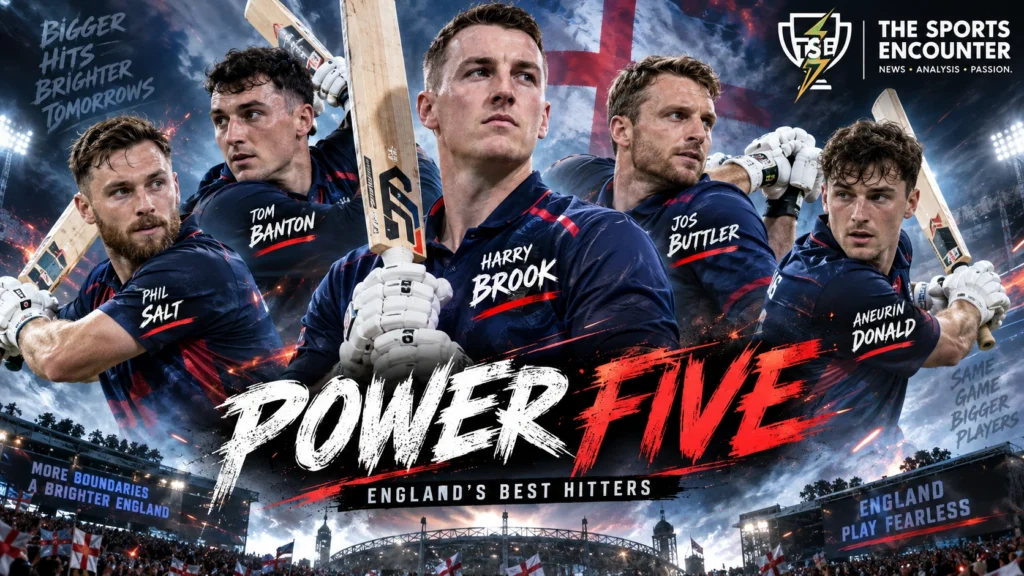
England’s Five Leading Power-Hitters: The 2026 Numbers
Statistics are current through England’s second T20I against Sri Lanka on September 17, 2026. Franchise figures refer to the relevant 2026 competitions discussed below.
1. Harry Brook: England’s Power Game Now Has a Captain
Harry Brook has reached the stage where a violent innings no longer feels surprising. That may be the strongest evidence of his development.
2. Phil Salt: Powerplay Pressure Before Bowlers Can Settle
Phil Salt is currently outside England’s XI because of a right quad injury, confirmed when the ECB announced its squads for the Sri Lanka series. His absence should not obscure his standing among England’s most dangerous short-format batters.
3. Jos Buttler: The Benchmark Everyone Else Is Chasing
Every younger England hitter on this list has grown up in a white-ball system that Buttler helped redefine.
4. Tom Banton: The Talent That Had to Learn Patience
Tom Banton’s international career is a reminder that early hype can arrive before a player fully understands his game.
Add Salt back to that group and England possess five batters who can damage an attack in different phases, on different lengths and through different areas of the ground.
England’s Five Leading Power-Hitters: The 2026 Numbers
| Player | Current / Career T20I Snapshot | Major 2026 Power-Hitting Evidence | Primary Threat |
|---|---|---|---|
| Harry Brook | 70 T20Is, 1,669 runs, SR 165.09, 83 sixes | 229 runs at SR 214.02 vs India; 255 at SR 180.85 in The Hundred; 114* off 49 vs Sri Lanka | Middle-over domination, spin hitting, sustained tempo |
| Phil Salt | 60 T20Is, 1,717 runs, SR 165.89, 83 sixes | 202 IPL runs at SR 168.33 with 11 sixes; 135 vs India; 195 in The Hundred | Powerplay destruction |
| Jos Buttler | More than 15,000 career T20 runs; England’s most prolific modern T20 power hitter | 526 IPL runs at SR 152.46 with 26 sixes; 334 Hundred runs at SR 173.06 with 25 sixes | 360-degree range, pace manipulation, finishing and opening |
| Tom Banton | 42 T20Is, 797 runs, SR 150.38, 36 sixes | 130 Hundred runs at SR 194.03; 239 Blast runs at SR 156.21; 52* off 24 vs Sri Lanka | Middle-order acceleration and inventive strokeplay |
| Aneurin Donald | 2 T20Is, 33 runs from 18 balls, SR 183.33 | 489 Blast runs at SR 230.66 with 37 sixes; 137 Hundred runs at SR 217.46 | Immediate powerplay pressure and extreme boundary frequency |
Statistics are current through England’s second T20I against Sri Lanka on September 17, 2026. Franchise figures refer to the relevant 2026 competitions discussed below.
1. Harry Brook: England’s Power Game Now Has a Captain
Harry Brook has reached the stage where a violent innings no longer feels surprising. That may be the strongest evidence of his development.
The 27-year-old followed his 114 not out in Southampton with 23 from eight balls in Cardiff. Against India earlier in the summer, he accumulated 229 T20I runs at a strike rate above 214. His unbeaten 79 from 35 in Bristol helped England complete their fastest successful T20I chase of 150 or more, with Phil Salt alongside him in an unbroken 146-run partnership against India.
What makes Harry Brook such a dangerous power-hitter?
Brook combines fast hands with unusually broad scoring access. Pace can disappear straight, through midwicket or over cover. Spin rarely forces him into a holding pattern because his footwork lets him alter his position before release and create new angles after the ball has left the hand.
His six-hitting therefore does more than increase the total. It removes the overs captains normally use to slow a T20 innings.
That was evident during The Hundred. Brook scored 255 runs from 141 balls at a strike rate of 180.85, hitting 17 sixes. In one Headingley chase, he blasted six sixes in an unbeaten 42 from only 17 deliveries as Sunrisers Leeds chased 182 in 88 balls.
From Burley to England captain
Brook was born in Keighley and raised in Burley-in-Wharfedale in a family immersed in club cricket. He played senior club cricket extraordinarily young, earned a scholarship to Sedbergh School and later captained England at Under-19 level.
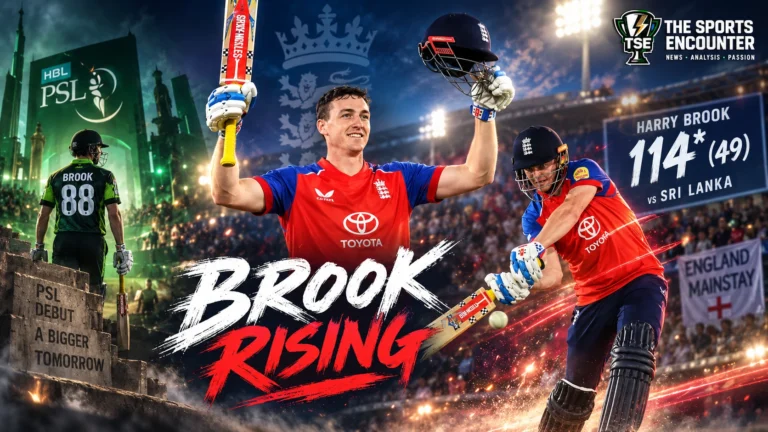
Yorkshire gave him his first-class debut while he was still at school. His early England career accelerated in 2022, when he made his T20I debut before a Pakistan Super League spell with Lahore Qalandars introduced a wider audience to his short-format power. His 102 not out from 49 balls in that PSL season became an early marker of what was coming.
The full connection between Pakistan, franchise cricket and his rise is explored in The Sports Encounter’s detailed account of Harry Brook’s development.
Brook is now England’s white-ball captain, a two-time T20I centurion and one of the few batters capable of maintaining extreme tempo without becoming dependent on one scoring zone.
Harry Brook’s future
The next stage is less about proving he belongs and more about how far he can take England. The 2027 ODI World Cup sits at the center of that challenge, while his T20 role increasingly looks settled at No. 3.
His power remains most valuable when England lose an early wicket. Brook does not need five overs to reconstruct an innings. He can absorb a brief examination and still have the scoring rate above 10 an over before the opposition has completed its preferred middle-over matchups.
2. Phil Salt: Powerplay Pressure Before Bowlers Can Settle
Phil Salt is currently outside England’s XI because of a right quad injury, confirmed when the ECB announced its squads for the Sri Lanka series. His absence should not obscure his standing among England’s most dangerous short-format batters.
Salt has 1,717 T20I runs from 60 matches at a strike rate of 165.89, with 83 sixes. Those numbers explain his primary value: England can be well ahead of the required run rate before the field has spread.
Why Salt is different from England’s other hitters
Salt’s game is built around the opening six overs. Width is punished immediately, short bowling rarely earns a quiet delivery, and his bat speed allows him to hit hard lengths square of the wicket without waiting for an obvious half-volley.
There is also a growing maturity beneath the aggression.
During The Hundred, Salt captained Welsh Fire to victory over Southern Brave with an unbeaten 47 from 37 balls on a difficult surface. It was far slower than his normal tempo, yet his controlled chase in Southampton showed why power-hitting should not be confused with indiscriminate swinging.
In the IPL earlier in 2026, Salt scored 202 runs from 120 balls, struck 11 sixes and operated at 168.33. Against India in July, he followed a 70 from 44 with an unbeaten 59 from 42 as England repeatedly won the powerplay battle.
Phil Salt’s unusual road to England
Salt was born in Bodelwyddan, North Wales, but spent roughly six years of his childhood in Barbados after his family moved there. That period exposed him to Caribbean cricket culture during formative years and helped shape a player whose natural instincts have always leaned toward tempo.
He later came through Sussex, moved to Lancashire and became a regular across global T20 leagues. His England T20I debut arrived in 2022, and his international career has since included four T20I hundreds.
Franchise cricket has reinforced his identity rather than creating it. His role remains simple in principle: make the new ball disappear before the bowling side can settle into its preferred defensive plans.
Phil Salt’s future
Salt turns 30 in 2026, leaving him comfortably inside the likely 2027 World Cup window. The immediate issue is fitness rather than selection quality.
Donald’s explosive arrival creates real competition, but it also gives England flexibility. A fit Salt remains one of the strongest candidates to open because very few international batters combine his volume of T20I runs with a strike rate above 165.
3. Jos Buttler: The Benchmark Everyone Else Is Chasing
Every younger England hitter on this list has grown up in a white-ball system that Buttler helped redefine.
His 30 from 16 in Cardiff on Thursday carried historic weight because he became the first batter to pass 15,000 career T20 runs. That milestone arrived only weeks after he became the format’s all-time leading run-scorer during The Hundred.
At 36, Buttler remains capable of producing some of the fastest innings in England’s side. He scored 80 from 44 in the first T20I against Sri Lanka, then attacked at 187.50 in Cardiff.
What makes Jos Buttler’s power so difficult to defend?
Buttler has spent more than a decade forcing bowlers to defend areas they once treated as safe. He can scoop genuine pace, access fine leg from outside off stump, hit straight without a large backswing and clear the leg-side boundary even when the bowler follows him.
That 360-degree range changes fields before he has played the shot.
His power is equally effective against spin because he can move deep into the crease, advance, sweep conventionally or reverse his hands. Captains rarely have one field that protects every option.
His 2026 numbers remain elite
Buttler scored 526 IPL runs in 2026 at a strike rate of 152.46, including 26 sixes. In The Hundred he was even more destructive, scoring 334 at 173.06 and hitting 25 sixes.
He also demonstrated his finishing range in ODI cricket, striking an unbeaten 41 from 13 balls as England piled up 387 at Lord’s in their series-deciding win over India.
From Somerset prodigy to World Cup winner
Born in Taunton, Buttler came through Somerset’s youth system and made his first-class debut in 2009. His unconventional stroke range quickly made him a limited-overs specialist of unusual promise.
England gave him his T20I debut in 2011 and ODI debut in 2012. Over the following decade he became central to the white-ball rebuild that followed England’s disastrous 2015 World Cup.
Buttler was part of the 2019 ODI World Cup-winning team and captained England to the 2022 T20 World Cup title. He stepped down from the white-ball captaincy in 2025, allowing Brook to take over, but relinquishing leadership appears to have preserved rather than reduced his value as a batter.
Jos Buttler’s future
The question is now longevity. The 2027 ODI World Cup remains within reach, and England can manage his workload more carefully now that he is no longer captain.
His role may continue evolving between opener, No. 3 and late-innings accelerator depending on Salt, Donald and the balance around Brook. Few players offer that degree of tactical flexibility.
4. Tom Banton: The Talent That Had to Learn Patience
Tom Banton’s international career is a reminder that early hype can arrive before a player fully understands his game.
His first England opportunity came in 2019 after a spectacular Somerset breakthrough. Banton was 20, already playing franchise cricket and being compared with England’s most inventive stroke-makers.
Then momentum stalled.
He moved in and out of the national team, struggled for consistency and later spoke openly about rediscovering his enjoyment of cricket. The player who returned to England consideration was older, clearer about his roles and more capable of changing tempo.
Banton’s recent power has been impossible to ignore
His unbeaten 52 from 24 balls in Cardiff contained four sixes and turned an already comfortable chase into a demolition. Banton reached fifty from 24 balls and finished at 216.66.
Earlier in 2026, he scored 130 runs in The Hundred at a strike rate of 194.03, with eight sixes from only 67 balls. His Vitality Blast season produced 239 runs at 156.21 with another 11 sixes.
Banton’s 42-match T20I career now contains 797 runs at a strike rate of 150.38 and 36 sixes.
What makes Banton special?
His height gives him natural leverage, particularly straight and over midwicket, but his most distinctive quality remains invention. Scoops, reverse options and changes of stance can turn acceptable bowling into boundary balls.
The important development is that he no longer appears compelled to demonstrate that range every few deliveries.
At 27, Banton has become a more selective attacker. He can bat at four, move deeper into the order, keep wicket if required and accelerate against either pace or spin.
From Somerset academy to a second England career
Banton joined the Somerset Academy in 2015, made his T20 debut in 2017 and exploded into national attention during the 2019 season. Franchise contracts followed rapidly, including opportunities in Australia, Pakistan and India.
His first international run never fully matched the hype. The comeback has carried more substance. Strong franchise performances, a major first-class revival and more mature role definition brought him back into England’s plans.
His current Somerset agreement runs through 2028 for white-ball cricket, giving him a clear domestic base while he pursues a more permanent England place.
Tom Banton’s future
England’s depth means Banton may never own one fixed position. That may actually suit him.
His ability to enter after seven or eight overs and immediately attack spin gives England another route to acceleration when Brook or Buttler has already fallen. Cardiff showed how quickly he can end a chase once the opposition’s best bowlers have been forced into defensive fields.
5. Aneurin Donald: The Late Bloomer With Extraordinary Boundary Numbers
Aneurin Donald’s England debut at 29 is one of the more unusual selection stories of the current white-ball era.
His talent was visible a decade ago. His route to the national side was anything except direct.
Donald was born in Swansea and came through Glamorgan, representing England at age-group level before making his first-class debut at 17. In 2016 he announced himself with one of the wildest innings in county history: 234 from 136 balls against Derbyshire, reaching his double hundred from 123 deliveries and equaling the then-record for the fastest first-class double century.
Form dipped afterwards. Injuries interrupted his progress. Moves from Glamorgan to Hampshire and later Derbyshire followed.
Then his short-format numbers became impossible to ignore.
Donald’s 2026 Blast season changed his career
Derbyshire’s own statistical review recorded Donald scoring 489 runs in the 2026 Vitality Blast at an average above 40 and a strike rate above 230. He hit 37 sixes in 12 matches. Over his final four home innings he made 84, 88, 65 and 91, striking 27 sixes in those four innings alone. The county described him as the likely heir to Wayne Madsen’s T20 legacy in its official review of Derbyshire’s 2026 Blast campaign.
The Hundred provided another test. Donald scored 137 runs from 63 balls at a strike rate of 217.46, the highest in the men’s competition among meaningful batting samples. His aggression remained visible late in the tournament when he struck 19 from nine balls for Trent Rockets against Southern Brave, part of a game covered in The Sports Encounter’s Hundred analysis.
Across the competition, Donald hit nine sixes from just 63 balls.
Donald has taken the same approach into international cricket
His first two England innings have produced 12 from five and 21 from 13. That is 33 runs from 18 balls at a strike rate of 183.33, including two sixes.
Those are tiny international samples, but they are completely consistent with his domestic method.
Donald does not wait for a formal invitation to attack. If the delivery enters his scoring arc, he tries to change the scoreboard immediately. That makes him particularly valuable in the powerplay, where one 15-run over can force the opposition captain to abandon the original bowling plan.
Aneurin Donald’s future
Salt’s quad injury created the immediate opening, but Donald has given selectors a reason to keep looking at him after Salt returns.
His age means England are evaluating a player in his physical and tactical prime rather than a long-term development prospect. The question is whether his domestic boundary rate survives extended exposure to international pace, high-quality wrist spin and teams with deeper scouting information.
The early evidence has been encouraging.
How Much Has Bazball Shaped These Five Batters?
Bazball began as a label for England’s Test transformation under Brendon McCullum and Ben Stokes in 2022. McCullum has never been particularly fond of the term, yet the core principles are easy to recognize: remove fear of failure, give attacking players permission to act on their strengths, and keep searching for ways to move the game forward.
That philosophy formally reached England’s limited-overs sides when the ECB appointed McCullum as white-ball head coach from January 2025. He stepped away from the Test role in July 2026 but remains in charge of England’s white-ball teams.
Brook is the clearest Bazball-era product
Brook’s natural style already existed before his Test debut, yet McCullum’s England gave him an environment where aggression did not need to be apologized for. His Test success reinforced the idea that attacking skill could be a primary method rather than an emergency option.
That confidence now follows him into white-ball captaincy.
Buttler and Salt did not need Bazball to teach them aggression
Buttler had already transformed England’s white-ball batting years before McCullum coached the limited-overs sides. Salt was an established high-tempo opener before entering McCullum’s setup.
The influence in their cases is environmental. England’s current structure asks aggressive players to make good decisions without stripping away the aggression that made them international players.
Banton may have benefited most from the change in selection philosophy
McCullum had previously worked with Banton at Kolkata Knight Riders. When Banton rebuilt his career through county and franchise cricket, England’s newer white-ball environment offered a clearer path back for a batter whose value cannot be measured through average alone.
His strike rate, versatility and willingness to attack difficult matchups now carry more selection weight than they might have in a more conservative era.
Donald represents the next stage
A decade ago, a 29-year-old county batter with two career moves, injury interruptions and no senior England caps might have remained outside the international conversation.
Donald forced the issue by producing a 230-plus Blast strike rate and then topping The Hundred strike-rate table. England responded to the evidence.
That is perhaps the most important Bazball-era inheritance. Selection increasingly rewards players who can change the state of a match rather than simply protect their wicket.
Why These Five Make England So Difficult to Contain
The biggest advantage is redundancy.
Salt is injured, so Donald opens. Buttler can attack from the other end. Brook can enter at three and immediately continue the pressure. Banton can arrive after a wicket and attack the same bowlers who were expecting relief.
England do not require one superstar to survive 18 overs.
That matters because modern T20 bowling attacks are built around matchups. Teams may have one left-arm spinner for Salt, one wrist-spinner for Brook, a specialist new-ball seamer for Buttler and a death bowler for Banton. England’s depth forces those resources to be used earlier and more often than planned.
The Hundred has also given all five regular exposure to compressed innings, matchup-driven bowling changes and high-pressure finishing. Readers can follow the tournament’s wider influence on England’s player pool through The Sports Encounter’s dedicated Hundred coverage.
There is still one structural weakness
Brook, Salt, Buttler, Banton and Donald are all right-handed.
That can allow opponents to settle into one set of angles if England lose their left-handed or all-round options around them. White-ball balance therefore still depends on players such as Ben Duckett, Will Jacks, Jacob Bethell when fit, and the all-rounders who extend the batting order.
The power-hitting group nevertheless gives McCullum and Brook something every T20 team wants: several batters capable of producing a match-defining 25 balls.
England’s White-Ball Future Is Being Built Around Relentless Pressure
England’s aggressive identity is no longer dependent on one generation.
Buttler represents the side that rebuilt after 2015 and won two World Cups. Salt belongs to the next wave of franchise-trained openers. Brook has become the captain around whom the next cycle is being constructed. Banton has returned after learning how to handle the instability that comes with early fame. Donald has reached international cricket through sheer domestic scoring pressure at 29.
Their stories are very different. Their value converges in one place.
Every one of them can force a bowling side to change its plan before the innings has reached its natural next phase.
That is why England currently look so formidable in T20 cricket. A wicket can bring another attacker. A quiet over can be followed by three sixes. An injury to Salt can uncover Donald. Brook can move from captain to destroyer in eight balls. Banton can arrive with the chase already under control and finish it before the opposition has time to reorganize.
England’s challenge now is to carry that depth through tournament pressure, stronger bowling attacks and the long road toward the 2027 World Cup.
The raw materials are already there.
Continue the Cricket Story
Frequently Asked Questions About England’s Power-Hitters
What is Harry Brook’s T20I strike rate?
Through September 17, 2026, Brook had scored 1,669 T20I runs from 1,011 balls, giving him a strike rate of approximately 165.09. He had also hit 83 sixes.
Is Harry Brook England’s white-ball captain?
Yes. Brook became England’s limited-overs captain in 2025 after Jos Buttler stepped down. He currently leads both the ODI and T20I sides.
Why is Phil Salt not playing against Sri Lanka?
Salt was ruled out of England’s September 2026 white-ball series against Sri Lanka because of a right quad injury. His absence opened an opportunity for Aneurin Donald in the T20I side.
Where was Phil Salt born, and did he grow up in Barbados?
Salt was born in Bodelwyddan, North Wales, on August 28, 1996. He spent several childhood years in Barbados after his family moved there, giving him early exposure to Caribbean cricket culture.
How many career T20 runs has Jos Buttler scored?
Buttler became the first batter to pass 15,000 career T20 runs during England’s second T20I against Sri Lanka in Cardiff on September 17, 2026. He had already become the format’s all-time leading run-scorer during The Hundred earlier in the summer.
Is Jos Buttler still England captain?
No. Buttler stepped down from England’s white-ball captaincy in 2025. Harry Brook succeeded him, while Buttler has remained a central member of England’s batting lineup.
What is Tom Banton’s T20I strike rate?
After his unbeaten 52 against Sri Lanka in Cardiff, Banton had 797 runs from 530 balls in T20 internationals, a career strike rate of approximately 150.38.
Which county does Tom Banton play for?
Banton plays for Somerset. He came through the county’s academy and has signed a white-ball contract that keeps him with Somerset through at least the end of the 2028 season.
Who is Aneurin Donald?
Aneurin Donald is a Swansea-born right-handed batter and wicketkeeper who came through Glamorgan, later represented Hampshire and Derbyshire, and made his England T20I debut against Sri Lanka in September 2026 at the age of 29.
What record did Aneurin Donald set with his 234?
Donald scored 234 from 136 balls for Glamorgan against Derbyshire in 2016. He reached 200 from only 123 deliveries, equaling the world record at the time for the fastest first-class double century.
What makes Aneurin Donald such an unusual England selection?
Donald reached senior international cricket at 29 after injuries, inconsistent red-ball form and moves between counties. His 2026 short-format numbers changed the conversation: 489 Blast runs at a strike rate above 230 and a Hundred strike rate above 217 forced him into England contention.