
THESSALONIKI, Greece, September 15, 2026: Opposition to Gianni Infantino is becoming easier to find across European soccer.
A candidate capable of replacing him remains considerably harder to find.
Greek Football Association president Makis Gagatsis publicly confirmed on Tuesday that his federation no longer supports Infantino’s candidacy for another term as FIFA president, adding another national association to the movement seeking change at the top of world soccer.
Former Germany national team director Oliver Bierhoff also backed the push for new leadership during events surrounding UEFA’s Executive Committee meeting in Thessaloniki, arguing that trust in FIFA’s direction has deteriorated after months of governance turmoil.
Story at a glance
Why Is UEFA Against Gianni Infantino?
UEFA’s break with Infantino developed around the failed FIFA Forward Enterprise proposal, but the dispute has since expanded into a much broader argument about governance.
What Was FIFA Forward Enterprise?
FIFA Forward Enterprise, widely shortened to FFE, was the proposed commercial vehicle at the center of the crisis.
Why Did the Greek FA Withdraw Support for Gianni Infantino?
Gagatsis linked Greece’s decision to two areas of concern: events surrounding the 2026 World Cup and the subsequent proposal involving FIFA’s commercial rights.
What Did Oliver Bierhoff Say About FIFA and Infantino?
Bierhoff said recent events had damaged confidence that FIFA was moving in the right direction.
When Is the Next FIFA Presidential Election?
The next FIFA presidential election will take place at the 77th FIFA Congress in Rabat, Morocco, on March 18, 2027.
Their interventions deepen the political problem surrounding Infantino after FIFA’s abandoned attempt to introduce outside investment into a commercial structure built around the World Cup and other competitions.
Yet they also expose the central weakness of the opposition.
The 2027 FIFA presidential election is approaching. Infantino intends to run. FIFA’s electoral system gives every eligible member association one vote. His European critics can withdraw support, issue statements and demand reform, but eventually they need somebody on the ballot who can persuade enough associations across Africa, Asia, the Americas, Oceania and Europe to vote for change.
That person has not yet emerged.
The result is an unusual political moment. UEFA’s argument against Infantino has become increasingly explicit, but the campaign to replace him remains structurally incomplete.
Gagatsis left little ambiguity about Greece’s position.
“The Greek FA has taken a clear position against a candidacy of Gianni Infantino.”
That declaration came less than three weeks after European national-association leaders said the trust required to continue exercising the FIFA presidency had been broken. In their official UEFA statement on the FIFA crisis, they called for new leadership and pledged to seek a credible alternative should Infantino stand again.
The Sports Encounter has followed this dispute from the moment it shifted from a disagreement over commercial rights into a battle over who should control world soccer. Our earlier report on UEFA’s unanimous rejection of the World Cup stake proposal showed how quickly European resistance hardened into an institutional challenge.
Two months later, the commercial plan is gone.
The fight over Infantino’s presidency remains.
FIFA Leadership Crisis: Key Facts
- Greek FA president Makis Gagatsis says Greece will not support Gianni Infantino’s candidacy.
- Former Germany national team director Oliver Bierhoff has publicly backed leadership change.
- UEFA has said FIFA needs new leadership after the collapse of FIFA Forward Enterprise.
- FIFA permanently withdrew the controversial investment proposal.
- UEFA subsequently suspended its threatened withdrawal from FIFA competitions.
- Infantino intends to seek another term as FIFA president.
- The FIFA presidential election will take place on March 18, 2027 in Rabat, Morocco.
- Presidential candidatures must be submitted at least four months before the Congress.
- The resulting nomination deadline is November 18, 2026.
- No clear opposition candidate has yet emerged.
- Each FIFA member association has one presidential vote.
Why Is UEFA Against Gianni Infantino?
UEFA’s break with Infantino developed around the failed FIFA Forward Enterprise proposal, but the dispute has since expanded into a much broader argument about governance.
The proposed structure would have placed commercial operations connected to major FIFA competitions into a new enterprise while allowing private capital to acquire a minority economic interest.
Opponents argued that the concept had advanced too far without sufficient consultation with confederations, national associations and other stakeholders whose teams, players and competitions generate much of FIFA’s value.
Europe’s response became unusually confrontational.
All 55 UEFA associations initially backed a withdrawal from FIFA competitions if the plan remained alive and adequate guarantees were not provided.
TSE documented that extraordinary moment in UEFA Votes 55-0 for FIFA Boycott Over World Cup Stake Plan.
The revolt quickly stopped being exclusively European.
CONCACAF also rejected the proposed structure, while resistance from other parts of global soccer made the project increasingly difficult for FIFA to sustain.
Infantino eventually withdrew it.
UEFA welcomed the withdrawal but concluded that removing the proposal could not by itself restore the confidence lost during the process.
The federation’s position is now explicitly about leadership, institutional controls and limits on presidential authority.
What Was FIFA Forward Enterprise?
FIFA Forward Enterprise, widely shortened to FFE, was the proposed commercial vehicle at the center of the crisis.
The concept was designed to consolidate important commercial operations connected with FIFA competitions and introduce outside investment into that business.
The investment proposal was presented as a way of unlocking additional capital and increasing resources available for soccer development around the world.
Critics focused on a different set of questions.
They wanted to know how the project had been developed, who had authorized it, which FIFA governing bodies had examined it, how investors had been selected and what influence private ownership could eventually exert over competitions whose value depends heavily on formats, calendars, broadcasting and participating teams.
Those questions became more damaging when opposition began appearing inside FIFA itself.
Former U.S. Soccer president Carlos Cordeiro resigned from his position as a senior Infantino adviser, while senior FIFA figures publicly distanced themselves from the project. TSE examined that turning point in our report on the revolt moving inside FIFA’s own leadership structure.
The project eventually disappeared.
The governance questions survived it.
Why Did the Greek FA Withdraw Support for Gianni Infantino?
Gagatsis linked Greece’s decision to two areas of concern: events surrounding the 2026 World Cup and the subsequent proposal involving FIFA’s commercial rights.
His statement matters because the Greek federation is not merely an outside commentator.
It holds a FIFA presidential vote.
Political declarations from former players, executives, supporters or governments can shape public pressure. A national association can help determine who becomes FIFA president.
Greece’s decision therefore moves one vote away from Infantino and toward the search for an alternative.
The wider significance comes from accumulation.
Other European associations have already questioned or withdrawn their support during the crisis. Ireland, for example, became part of the changing electoral map examined in TSE’s analysis of why losing European votes matters without necessarily defeating Infantino.
One national federation changing position does not decide an election.
A continuing sequence eventually can.
What Did Oliver Bierhoff Say About FIFA and Infantino?
Bierhoff said recent events had damaged confidence that FIFA was moving in the right direction.
His intervention carries a different type of significance from Gagatsis’ statement.
Bierhoff does not currently control the German federation’s FIFA vote. He spent 18 years as Germany’s national team director and remains an internationally recognizable figure with experience spanning elite football, administration and major tournaments.
His comments therefore add public and institutional credibility to the argument for change rather than another vote directly to the opposition column.
That distinction matters.
Soccer politics often combines formal power and informal influence. National associations cast ballots, but respected former players, executives, sponsors, leagues and public figures can shape the climate in which those ballots are cast.
UEFA’s challenge becomes stronger if concern about FIFA governance is understood as extending beyond confederation executives and into the wider football community.
When Is the Next FIFA Presidential Election?
The next FIFA presidential election will take place at the 77th FIFA Congress in Rabat, Morocco, on March 18, 2027.
FIFA confirmed both the election date and Infantino’s intention to seek another term in its official Congress update.
| FIFA Election Milestone | Date |
|---|---|
| Current date of latest political developments | September 15, 2026 |
| Candidate nomination deadline | November 18, 2026 |
| 77th FIFA Congress | March 18, 2027 |
| Host city | Rabat, Morocco |
FIFA’s election rules require presidential candidatures to reach the general secretariat at least four months before the Congress.
That puts considerable pressure on Infantino’s opponents.
They do not have until March to decide who should challenge him.
They have until November to build enough consensus around someone to create a viable candidacy.
Who Is Running Against Gianni Infantino in the 2027 FIFA Election?
At the moment, there is no confirmed challenger with an obvious path to victory.
That is the central political problem facing UEFA and other groups seeking change.
Danish football executive Jesper Møller has said he will continue working with European colleagues to identify somebody capable of commanding a majority, but public opposition to Infantino has so far developed faster than agreement over a replacement.
Potential names can attract speculation without producing a campaign.
A credible challenger would need more than European recognition.
FIFA contains 211 member associations spread across six confederations, and a successful presidential campaign requires relationships in regions where the political calculation surrounding Infantino looks very different from Europe’s.
TSE explored the possibility of a coordinated challenge when UEFA, the AFC and CONCACAF began weighing how far their opposition could go.
The same obstacle identified then remains unresolved.
Opposition is an attitude.
An election requires an alternative.
Can UEFA Remove Gianni Infantino as FIFA President?
No. UEFA cannot unilaterally remove the FIFA president.
FIFA is a separate global governing body whose president derives electoral authority from member associations rather than from continental confederations alone.
UEFA can influence the process by coordinating its 55 associations, building alliances with other confederations, supporting a rival candidate, pursuing governance reforms and applying political or legal pressure.
It cannot simply vote Infantino out through a UEFA Executive Committee decision.
This was one reason the governance confrontation became so complicated in August.
TSE’s analysis of federations and senior FIFA figures breaking ranks explained how an institutional revolt can weaken a president politically without automatically providing the votes required to replace him.
Does Gianni Infantino Still Have Enough Votes to Win Re-Election?
He may.
That is precisely why UEFA’s public momentum should not be confused with an inevitable electoral defeat.
FIFA’s one-association, one-vote structure gives Infantino a political base very different from the commercial hierarchy of global soccer.
England receives one presidential vote.
Germany receives one.
Brazil receives one.
So does every much smaller eligible association.
Infantino has spent much of his presidency building relationships with national federations through FIFA Forward development programs and direct engagement with countries whose soccer systems operate with far fewer commercial resources than Europe’s largest markets.
CAF and CONMEBOL have publicly defended his democratic mandate during the crisis, while support also remains in other parts of the world.
FIFA has argued that any attempt to challenge its president must occur through the organization’s statutes and electoral procedures. In an official statement defending that principle, FIFA said those seeking change should pursue it through established democratic processes rather than attempts to undermine the president outside them.
TSE examined the strength of that argument in FIFA Says Infantino Is Being Undermined as Leadership Crisis Turns Into a Battle Over Legitimacy.
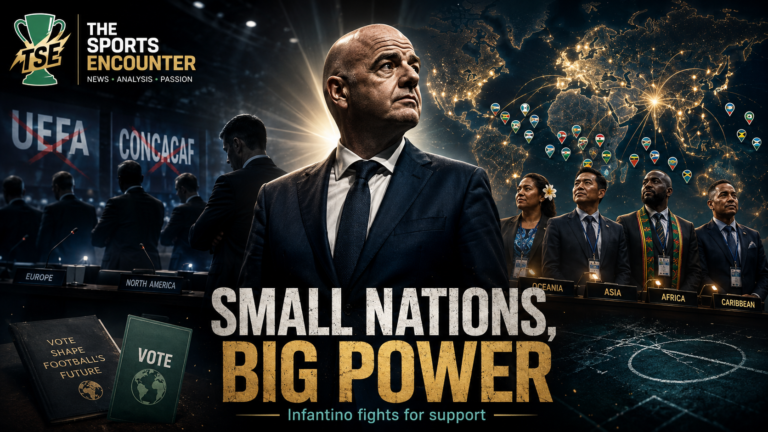
Why Do Smaller Football Nations Matter So Much in the FIFA Election?
Because FIFA’s electoral structure deliberately prevents commercial size from determining formal voting power.
A federation with a small domestic league and limited broadcasting revenue holds the same presidential vote as one representing a global soccer superpower.
That structure is fundamental to understanding Infantino’s political resilience.
Development funding can transform soccer infrastructure in smaller associations. FIFA money can finance pitches, technical centers, youth competitions, women’s programs, national-team travel and administrative systems that domestic revenues cannot support alone.
Infantino’s supporters argue that his presidency has shifted substantially more resources into those markets.
His critics accept the importance of development but argue that funding must remain an institutional entitlement governed by transparent rules rather than becoming politically associated with one president.
UEFA’s August statement addressed that point directly, arguing that development resources belong to world football and should never become instruments of personal influence.
The clash therefore goes beyond personality.
It concerns how FIFA’s enormous commercial revenues should be distributed, who controls the decisions and what safeguards separate institutional development from presidential politics.
How Did Donald Trump Become Part of the Infantino Leadership Crisis?
The FIFA dispute became even more politically sensitive when U.S. President Donald Trump publicly defended Infantino and warned against removing him.
Trump tied his support to the commercial success of the 2026 World Cup and praised Infantino’s leadership.
That intervention gave the FIFA president a powerful public ally at a moment when several football institutions were moving in the opposite direction.
The Sports Encounter examined the implications in Donald Trump Comes to Gianni Infantino’s Rescue as FIFA Crisis Turns Political.
The episode reinforced one of the contradictions surrounding the 2027 election.
Infantino’s institutional relationships have been damaged in important parts of the soccer world, yet his broader political and electoral network remains substantial.
Why Did UEFA Suspend Its FIFA Boycott?
UEFA suspended the threatened withdrawal after FIFA permanently abandoned the Forward Enterprise proposal and provided assurances that it would not return in another form.
That decision removed the immediate danger of European national teams refusing to participate in upcoming FIFA competitions.
It did not restore UEFA’s support for Infantino.
The distinction is important.
European associations achieved their immediate objective by stopping the investment plan. They then shifted attention toward governance reform and presidential leadership.
TSE documented that transition in our analysis of UEFA suspending the boycott while continuing the political challenge.
The conflict therefore changed form rather than disappearing.
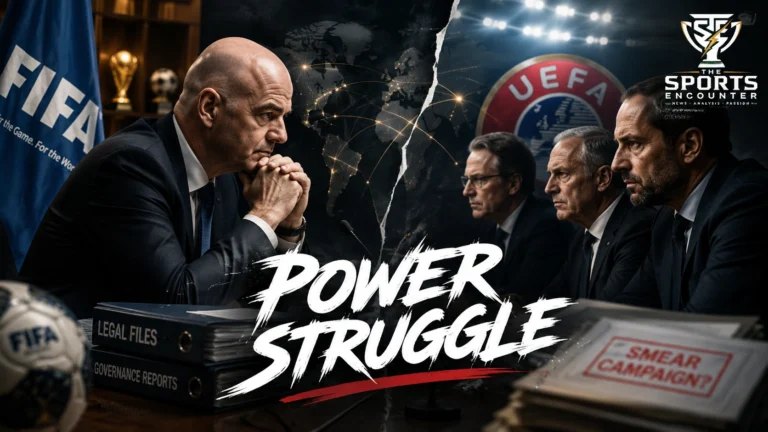
Why Is FIFA Accusing UEFA of Trying to Undermine Infantino?
Relations between the institutions have deteriorated far beyond the original commercial disagreement.
UEFA has pursued information connected with the abandoned project and explored legal avenues as part of its effort to establish how the proposal was developed.
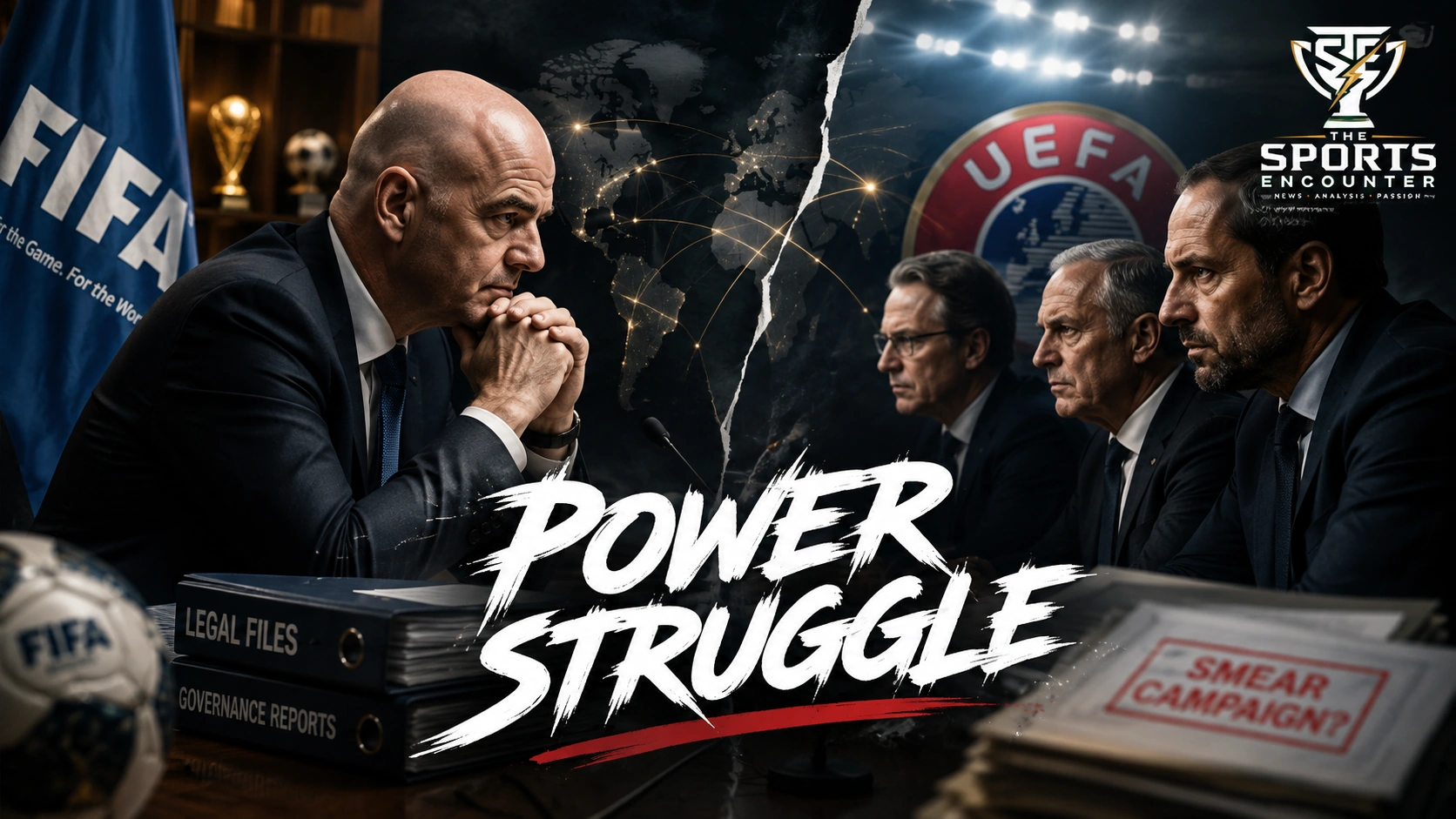
FIFA has characterized parts of that campaign as an attempt to damage the organization and its president rather than a neutral governance inquiry.
The confrontation was explored in detail in TSE’s report on FIFA accusing UEFA of a smear campaign.
That language demonstrates how far relations have fallen.
These are the two most powerful administrative centers in world soccer openly questioning each other’s motives while a presidential election approaches.
Could FIFA Reform Without Removing Gianni Infantino?
Yes, and this possibility may become increasingly important if opponents conclude that they cannot defeat Infantino electorally.
Governance reform does not necessarily require a change of president.
FIFA could strengthen consultation requirements, place additional controls around major commercial decisions, increase independent oversight, clarify the authority of the Council and committees, establish stronger safeguards for development funding and impose stricter approval processes for transactions affecting competition rights.
That route would change the political objective.
Instead of defeating Infantino, opponents would try to reduce the degree to which major institutional decisions can depend on presidential discretion.
Such a compromise would satisfy neither side completely.
UEFA has already said the loss of trust requires new leadership.
FIFA continues to defend Infantino’s democratic mandate.
But electoral arithmetic has a way of turning absolute positions into practical negotiations.
Why Greece’s Position Matters More Than Another Public Criticism
The FIFA crisis has generated months of statements from administrators, former players, unions, journalists and political figures.
Gagatsis’ intervention belongs in a different category.
He leads a national association.
When the 2027 election arrives, Greece can cast a ballot.
That is why UEFA’s task between now and November is less about generating headlines and more about turning statements into an electoral coalition.
Every federation that withdraws support changes the numbers slightly.
Every federation willing to nominate or endorse an alternative changes the political possibilities more substantially.
Europe can produce overwhelming opposition inside UEFA and still lose a FIFA presidential election if Infantino retains sufficient support elsewhere.
That tension has defined the crisis from the start, including in TSE’s broader examination of whether world soccer could actually turn against FIFA’s current leadership.
What Happens Next in the FIFA Presidential Race?
The next two months matter more than the five months between the nomination deadline and election day.
By November 18, Infantino’s opponents need a candidate, the required supporting associations and evidence that the campaign can extend beyond Europe.
A weak challenger could strengthen Infantino by allowing him to convert institutional criticism into a convincing electoral victory.
A strong challenger would force national federations to make a choice they have so far been able to avoid.
That candidate would also need a program addressing the issues exposed by the crisis:
- FIFA governance and presidential authority
- Distribution of development funding
- Commercial control of FIFA competitions
- Consultation with confederations and national associations
- Relations with clubs, leagues and players
- Transparency around major strategic decisions
- FIFA’s political neutrality and institutional independence
The debate cannot remain a referendum on Infantino alone.
Member associations will eventually want to know what the alternative would do differently.
The Anti-Infantino Coalition Now Has to Become an Election Campaign
UEFA’s opposition is no longer difficult to identify.
Its leaders have demanded reform, called for new leadership and secured the abandonment of a commercial proposal they considered unacceptable.
National associations are beginning to state their positions individually.
Greece has now done so publicly.
Bierhoff’s intervention shows the argument is attracting prominent voices beyond current federation presidents.
The difficult stage begins here.
Infantino does not remain FIFA president because criticism is absent. He remains president because FIFA’s member associations elected him, and replacing him requires another person to win the same electorate.
UEFA has demonstrated that it can organize resistance.
It has helped stop FIFA Forward Enterprise.
It has pushed governance into the center of international soccer’s political debate.
It has persuaded national associations to withdraw support.
Now it needs to demonstrate something different.
It needs to build a majority.
The November nomination deadline is approaching, and every week without a credible challenger makes the electoral question harder.
For continuing coverage of FIFA governance, the 2027 presidential election and global football politics, visit The Sports Encounter Soccer hub.
Continue the FIFA World Cup 2026 Story
Frequently Asked Questions About Gianni Infantino and the 2027 FIFA Election
Why is UEFA against Gianni Infantino?
UEFA says the abandoned FIFA Forward Enterprise proposal exposed serious problems involving consultation, presidential authority and institutional governance. European association leaders have said trust in Infantino’s leadership has been broken.
Does the Greek FA support Gianni Infantino?
No. Greek Football Association president Makis Gagatsis said on September 15 that the federation has taken a clear position against Infantino’s candidacy.
What did Oliver Bierhoff say about Gianni Infantino?
Bierhoff said recent events had damaged trust that FIFA would continue moving in the right direction and backed the push for change.
Is Gianni Infantino running for FIFA president again?
Yes. FIFA has confirmed that Infantino intends to seek another term in the 2027 presidential election.
When is the FIFA presidential election?
The election will take place at the 77th FIFA Congress in Rabat, Morocco, on March 18, 2027.
When is the deadline to challenge Gianni Infantino?
FIFA rules require presidential candidatures at least four months before the Congress, making November 18, 2026 the nomination deadline for the March 18, 2027 election.
Who is running against Gianni Infantino?
No clear opposition candidate has yet emerged. European officials are continuing discussions aimed at finding a challenger capable of attracting support beyond UEFA.
Can UEFA remove Gianni Infantino?
No. UEFA cannot remove the FIFA president by itself. FIFA’s member associations elect the president, and a challenger would need enough support across the global membership to defeat Infantino.
How many votes does UEFA control in the FIFA election?
UEFA contains 55 national associations, each of which has its own FIFA presidential vote. Associations ultimately vote individually rather than through one automatic UEFA bloc.
How many FIFA member associations are there?
FIFA has 211 member associations.
What was FIFA Forward Enterprise?
FIFA Forward Enterprise was a proposed commercial structure that would have involved private investment in a business connected with FIFA competitions and commercial rights. FIFA abandoned the project after widespread opposition.
Did UEFA end its boycott of FIFA competitions?
UEFA suspended its threatened withdrawal after FIFA permanently abandoned the investment proposal and provided assurances that it would not return in another form.
Does FIFA still support Gianni Infantino?
FIFA has defended Infantino’s democratic mandate and stated that any challenge to the presidency should occur through FIFA’s statutes and established electoral procedures.
Could Gianni Infantino still win the 2027 election?
Yes. Despite strong European opposition, Infantino retains support among associations in other regions, and FIFA’s one-association, one-vote system means European commercial influence does not automatically translate into an electoral majority.
Why do smaller countries matter in FIFA presidential elections?
Every eligible FIFA member association has one presidential vote regardless of population, commercial power or football history, making support among smaller federations strategically important.
UEFA
- UEFA’s Push to Replace Infantino Spreads, but the Hardest Part Starts Now
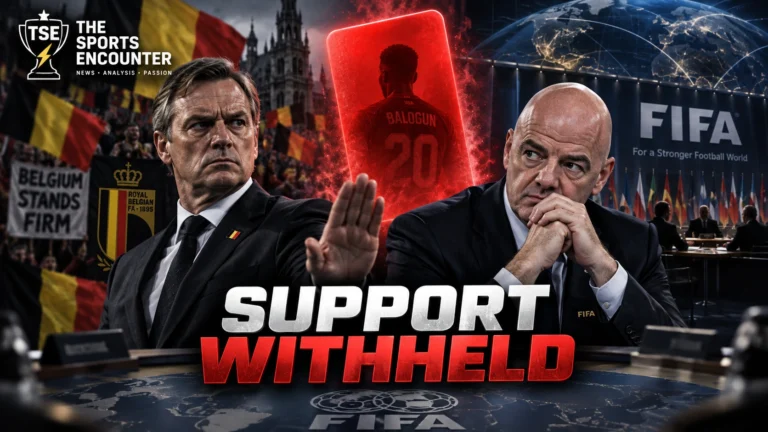
- Belgium Turns Balogun Red-Card Row Into Direct Challenge to Infantino’s FIFA Re-Election
- FIFA Accuses UEFA of “Smear Campaign” as Infantino Fight Enters US Courts
- EFL Hits Out at UEFA as Liverpool Champions League Clash Triggers Carabao Cup Fixture Chaos
- UEFA Set to Lift FIFA Boycott Threat as Italy Withdraws Support for Gianni Infantino