
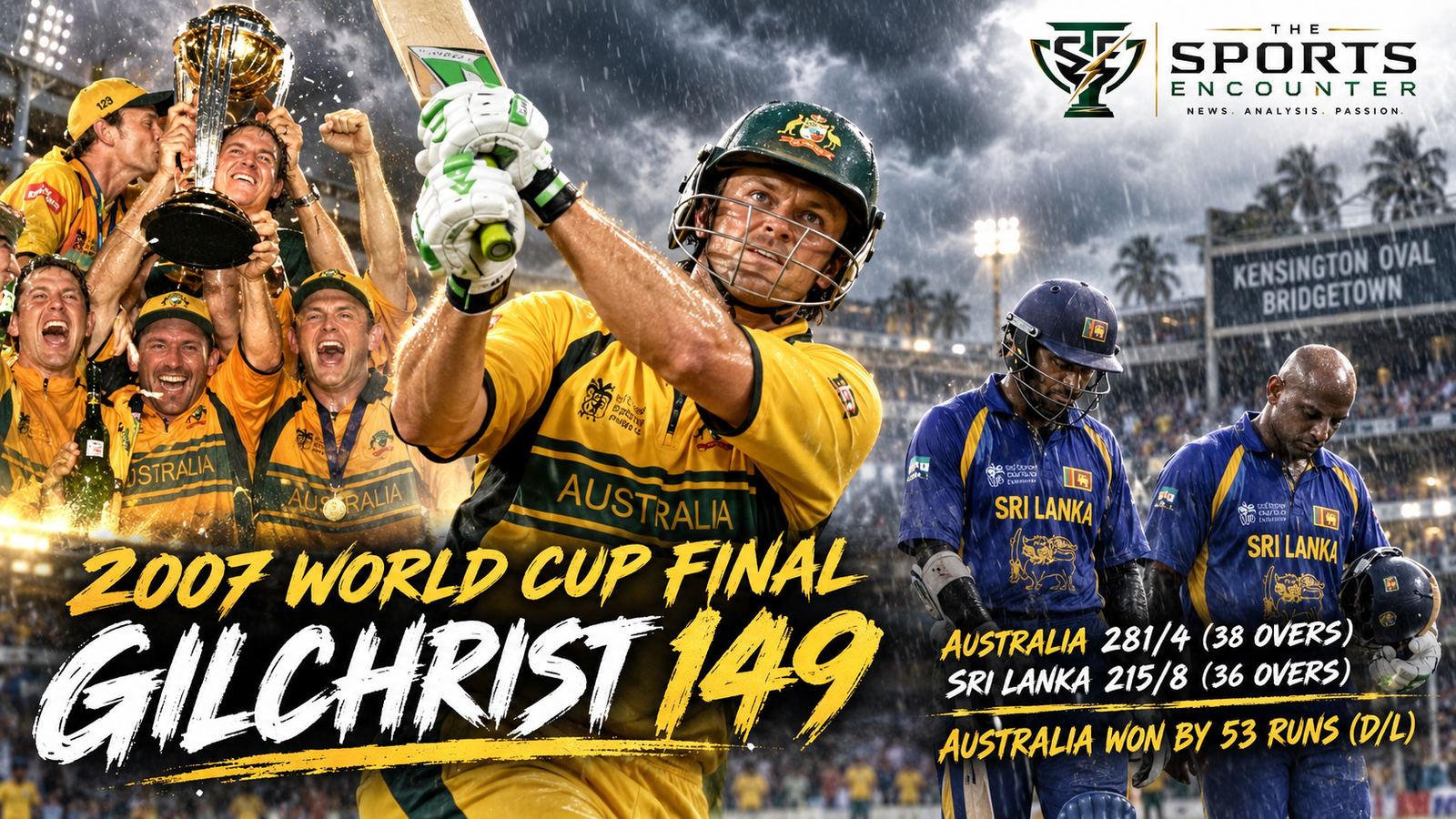
The World Cup final was already running against the clock when Adam Gilchrist decided that Australia had no time for caution.
Rain had reduced the contest to 38 overs per side. The final was meant to crown a champion, but the weather threatened to turn it into a shortened calculation. Gilchrist responded with one of the most destructive innings ever played in a World Cup final, smashing 149 from 104 balls as Australia reached 281 for four.
Sri Lanka fought back through Sanath Jayasuriya and Kumar Sangakkara, then watched the match slip away as Australia’s bowlers removed the middle order. A second rain interruption reduced Sri Lanka’s chase to 36 overs and revised the target to 269.
Australia eventually won by 53 runs under the Duckworth-Lewis method, completing a third consecutive World Cup title. The ending, however, became one of cricket’s strangest scenes. The players went off because of bad light, celebrated, returned to the field in near darkness and completed three unnecessary overs after confusion among the officials.
That mixture of extraordinary batting, tactical pressure, weather disruption and administrative confusion makes Australia versus Sri Lanka an essential entry in A Celebration of 5000 ODIs.
TL;DR
- Australia defeated Sri Lanka by 53 runs under the Duckworth-Lewis method.
- Adam Gilchrist made 149 from 104 balls, the highest score in a World Cup final at the time.
- Sanath Jayasuriya scored 63 and Kumar Sangakkara made 54 during Sri Lanka’s best partnership.
- Australia’s 281 for four came from only 38 overs after rain shortened the match.
- Australia won a third straight World Cup and extended its unbeaten tournament run to 29 matches.
- A bad-light and communication controversy overshadowed the final three overs.
Match Information
| Detail | Information |
|---|---|
| Match | Australia vs Sri Lanka, 2007 World Cup final |
| Venue | Kensington Oval, Bridgetown, Barbados |
| Date | April 28, 2007 |
| Australia | 281/4 in 38 overs |
| Sri Lanka | 215/8 in 36 overs |
| Result | Australia won by 53 runs, Duckworth-Lewis method |
| Player of the Match | Adam Gilchrist, 149 |
| Player of the Tournament | Glenn McGrath |
| Main turning point | Gilchrist’s assault after rain reduced the final |
| Why it matters | Australia secured a third consecutive World Cup title |
The match record and award details are confirmed by the historical scorecard and match report.
Adam Gilchrist Turns a Short Final Into His Stage
Australia had only 38 overs, but Gilchrist played as though the final had been reduced to a single extended powerplay.
He struck 13 fours and eight sixes, scoring at 143.26. Matthew Hayden provided support with 38, and the pair added 172 for the first wicket. That partnership removed Sri Lanka’s chance of immediately exploiting the shortened format.
Gilchrist attacked length, used the crease against the spinners and forced Sri Lanka’s fielders into defensive positions. His assault also allowed Ricky Ponting to enter with freedom. Ponting added 37 from 42 balls, while Andrew Symonds finished unbeaten on 23.
The innings carried a clear tactical message. In a rain-shortened final, preserving wickets for the last ten overs can become less valuable than maximizing the first 25. Australia recognized the conditions before Sri Lanka could settle into a bowling plan.
Gilchrist’s 149 remained the highest individual score in a World Cup final until later tournaments produced even larger innings. More importantly, it gave Australia a total that could withstand a strong Sri Lankan response.
Australia’s Complete Batting Scorecard
| Batter | Dismissal | Runs | Balls |
|---|---|---|---|
| Adam Gilchrist | c Chamara Silva b Dilhara Fernando | 149 | 104 |
| Matthew Hayden | c Mahela Jayawardene b Lasith Malinga | 38 | 55 |
| Ricky Ponting | Run out | 37 | 42 |
| Andrew Symonds | Not out | 23 | 21 |
| Shane Watson | b Lasith Malinga | 3 | 3 |
| Michael Clarke | Not out | 8 | 6 |
| Extras | lb 4, w 16, nb 3 | 23 | |
| Total | 4 wickets | 281 | 38 overs |
Sri Lanka Bowling
| Bowler | Overs | Maidens | Runs | Wickets |
|---|---|---|---|---|
| Chaminda Vaas | 8 | 0 | 54 | 0 |
| Lasith Malinga | 8 | 1 | 49 | 2 |
| Dilhara Fernando | 8 | 0 | 74 | 1 |
| Muttiah Muralitharan | 7 | 0 | 44 | 0 |
| Tillakaratne Dilshan | 2 | 0 | 23 | 0 |
| Sanath Jayasuriya | 5 | 0 | 33 | 0 |
Jayasuriya and Sangakkara Briefly Reopen the Final
Sri Lanka’s chase began badly when Upul Tharanga fell for six, but Jayasuriya refused to let Australia control the tempo.
His 63 from 67 balls included nine fours. Sangakkara added 54 from 52 deliveries, and their 116-run partnership moved Sri Lanka to 123 for two. At that stage, the chase remained alive, particularly because the revised target required attacking intent rather than slow accumulation.
Michael Clarke delivered Australia’s key breakthrough by dismissing Jayasuriya. Sangakkara soon followed, and Sri Lanka lost the platform that had made the chase realistic.
Mahela Jayawardene made 19, Chamara Silva scored 21 and Tillakaratne Dilshan added 14, but none could produce the sustained acceleration required after the rain interruption.
Australia’s Bowling Attack Wins the Middle Overs
Australia spread the wickets across the attack. Clarke took two for 33, while Brad Hogg, Glenn McGrath, Shane Watson, Nathan Bracken and Andrew Symonds each contributed.
The most important feature was control after the second-wicket stand. Australia did not need one spectacular spell. It needed to prevent partnerships from lasting long enough to challenge the revised target.
McGrath’s seven overs cost only 31 runs. Symonds conceded six from two overs and removed Lasith Malinga. Bracken dismissed Tharanga and Russel Arnold.
The attack also understood the value of wickets over economy once Sri Lanka’s required rate increased. By the time bad light interrupted play, Sri Lanka had fallen to 211 for eight.
Sri Lanka’s Complete Batting Scorecard
| Batter | Dismissal | Runs | Balls |
|---|---|---|---|
| Upul Tharanga | c Adam Gilchrist b Nathan Bracken | 6 | 8 |
| Sanath Jayasuriya | b Michael Clarke | 63 | 67 |
| Kumar Sangakkara | c Ricky Ponting b Brad Hogg | 54 | 52 |
| Mahela Jayawardene | lbw b Shane Watson | 19 | 19 |
| Chamara Silva | b Michael Clarke | 21 | 22 |
| Tillakaratne Dilshan | Run out | 14 | 13 |
| Russel Arnold | c Adam Gilchrist b Glenn McGrath | 1 | 2 |
| Chaminda Vaas | Not out | 11 | 21 |
| Lasith Malinga | st Adam Gilchrist b Andrew Symonds | 10 | 6 |
| Dilhara Fernando | Not out | 1 | 6 |
| Muttiah Muralitharan | Did not bat | – | – |
| Extras | b 0, lb 1, w 14 | 15 | |
| Total | 8 wickets | 215 | 36 overs |
Australia Bowling
| Bowler | Overs | Maidens | Runs | Wickets |
|---|---|---|---|---|
| Nathan Bracken | 6 | 1 | 34 | 1 |
| Shaun Tait | 6 | 0 | 42 | 0 |
| Glenn McGrath | 7 | 0 | 31 | 1 |
| Shane Watson | 7 | 0 | 49 | 1 |
| Brad Hogg | 3 | 0 | 19 | 1 |
| Michael Clarke | 5 | 0 | 33 | 2 |
| Andrew Symonds | 2 | 0 | 6 | 1 |
Fall of wickets: 7/1, 123/2, 145/3, 156/4, 188/5, 190/6, 194/7, 211/8.
The Final’s Most Controversial Turning Point
The rain had already changed the contest once. Then bad light created a second crisis.
Sri Lanka’s revised target was 269 from 36 overs. After 33 overs, the Duckworth-Lewis calculation had Australia 37 runs ahead of Sri Lanka’s par score. The umpires stopped play because visibility had deteriorated.
Australia began celebrating, believing the match had ended. The officials then said three overs remained and that the match would either continue or be completed the next day.
Jayawardene agreed to resume immediately. Ponting used spin because the light was too poor for safe fast bowling. Sri Lanka scored only nine runs during the final three overs, and Australia was eventually declared the winner by 53 runs.
Continue A Celebration of 5000 ODIs
 A Celebration of 5000 ODIsA Celebration of 5000 ODIs Match 21: Malinga Takes Four in Four, but South Africa Escape the Last Wicket
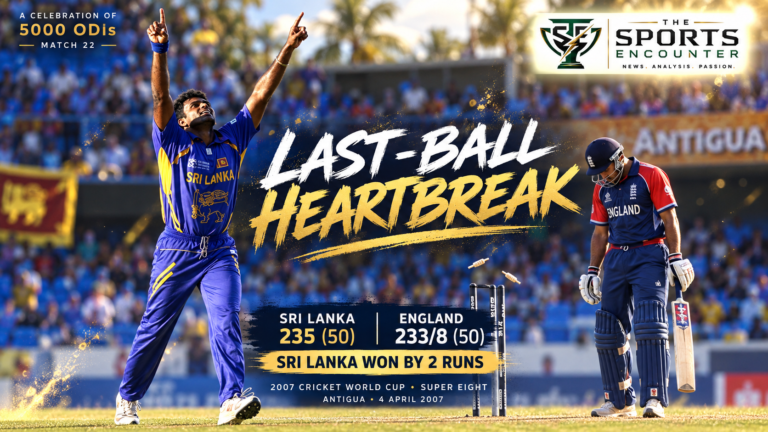 A Celebration of 5000 ODIsA Celebration of 5000 ODIs Match 22: Fernando’s Final Ball Breaks England’s Remarkable Recovery
 A Celebration of 5000 ODIsA Celebration of 5000 ODIs Match 20: Boucher Hits Six, but South Africa Miscalculate Their Way Out
The umpires later acknowledged a communication failure and accepted that Australia should have won by 37 runs when play was first suspended. The ICC’s official World Cup archive remains the appropriate historical reference point for the tournament’s records and legacy.
Why Match 24 Belongs in the 5,000 ODIs Collection
This final belongs in the collection because it captures several defining forces of one-day cricket in one afternoon.
Gilchrist produced a once-in-a-generation final innings. Sri Lanka showed enough quality to keep the match competitive through Jayasuriya and Sangakkara. Australia’s attack then turned pressure into control.
The result also completed a remarkable tournament story. Australia remained unbeaten, won its third successive World Cup and extended its World Cup winning streak to 29 matches. McGrath ended his international career as Player of the Tournament.
The match also demonstrated how tournament history can be shaped by details beyond batting and bowling. Rain altered the overs. The Duckworth-Lewis method altered the target. Confusion over playing conditions altered the ending.
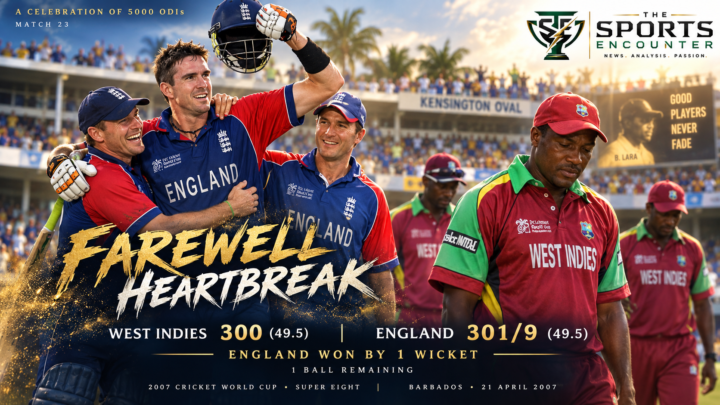
Readers can revisit the collection through Match 20, when Boucher’s six could not save South Africa, Match 21, Malinga’s four-wicket burst, Match 22, Sri Lanka’s final-ball victory over England and Match 23, England’s narrow chase against the West Indies.
Australia won the trophy with superior planning, greater depth and the defining innings of the final. Yet the lasting image is more complicated: Gilchrist lifting the match beyond Sri Lanka’s reach, Australian players celebrating in the darkness and officials later admitting that the finish had been mishandled.