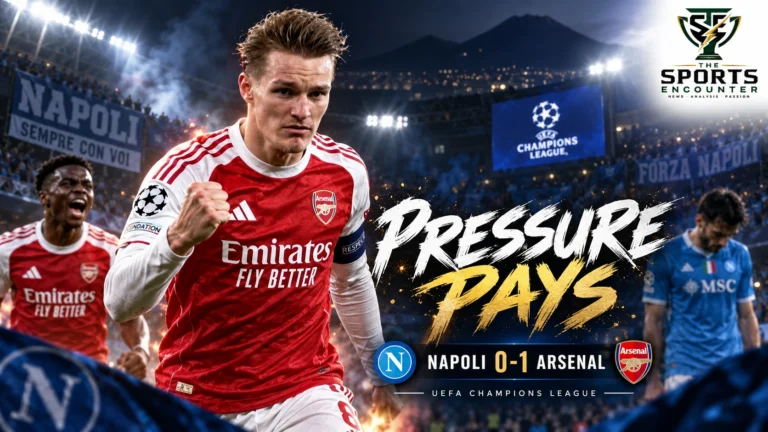
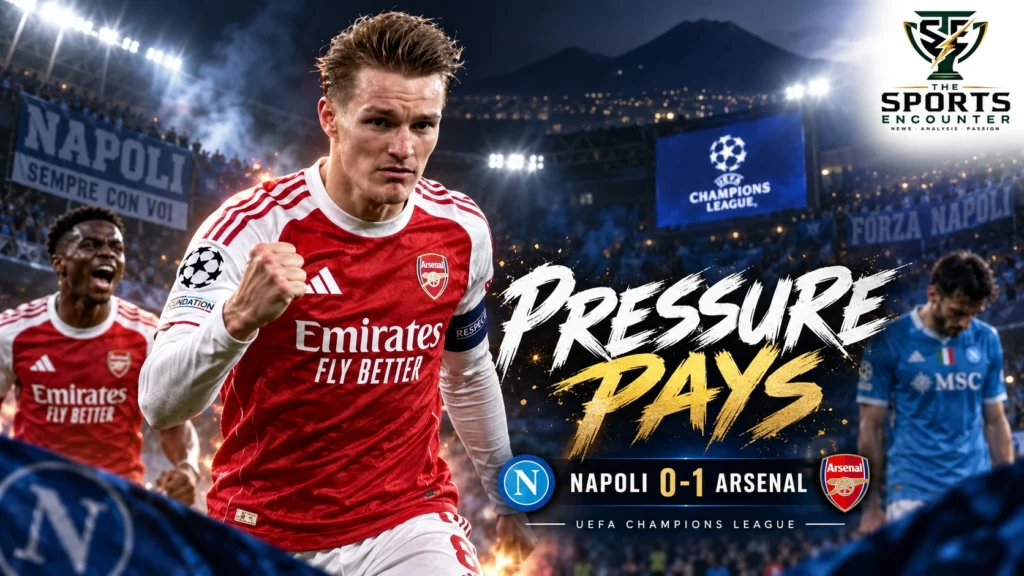
NAPLES, Italy, September 9, 2026: Arsenal needed 75 minutes to score in Naples, but the waiting should not be mistaken for struggle. By the time Martin Ødegaard finally broke Napoli’s resistance, the visitors had already spent most of the night making the same point over and over again.
Arsenal controlled the territory, controlled the shot count and controlled almost every attacking measure that mattered before Ødegaard scored the only goal in a 1-0 UEFA Champions League victory at the Stadio Diego Armando Maradona.
Napoli survived for long stretches despite being outshot 25-6 and conceding nine efforts on target. They finished with only 42% possession, did not win a single corner and rarely managed to keep Arsenal away from their penalty area for long enough to change the rhythm of the match.
The final score therefore tells only part of the story.
Story at a glance
Napoli Survived the First Wave, but Never Escaped It
The most revealing statistic was not Arsenal’s 58% possession.
Arsenal’s Problem Was Conversion, Not Creation
For most of the match, the danger for Arsenal was not that Napoli were taking over.
Ødegaard Found the Goal the Match Had Been Waiting For
Martin Ødegaard broke the deadlock in the 75th minute.
Napoli’s Defensive Discipline Deserves Credit
A 25-6 shot count can make the losing team look passive.
Arsenal’s Domestic Start Had Already Shown This Kind of Control
The performance in Naples did not arrive without warning.
Arsenal were not ruthless enough to turn dominance into a comfortable margin, but they were patient enough to avoid letting frustration turn into disorder. Ødegaard’s 75th-minute goal rewarded a performance built on control rather than chaos.
The result gives Mikel Arteta’s side three valuable points at the start of a demanding league-phase schedule. The Sports Encounter’s Champions League draw analysis had already identified Arsenal’s away route as one of the more difficult in the competition, with trips to Bayern Munich, Real Betis, Napoli and Slavia Prague.
Arsenal 1-0 Napoli: Match at a Glance
| Statistic | Napoli | Arsenal |
|---|---|---|
| Final score | 0 | 1 |
| Goal | — | Martin Ødegaard 75′ |
| Shots | 6 | 25 |
| Shots on target | 3 | 9 |
| Possession | 42% | 58% |
| Passes | 433 | 592 |
| Pass accuracy | 88% | 93% |
| Fouls | 12 | 11 |
| Yellow cards | 2 | 1 |
| Offsides | 1 | 1 |
| Corners | 0 | 6 |
Napoli Survived the First Wave, but Never Escaped It
The most revealing statistic was not Arsenal’s 58% possession.
It was the shot count.
Twenty-five attempts to six showed how often the visitors turned possession into an attacking conclusion and how rarely Napoli managed to do the same.
That distinction matters because possession alone can exaggerate control. Arsenal’s advantage was more substantial than that. They completed 592 passes at 93% accuracy, produced nine shots on target and won six corners. Napoli completed 433 passes, managed three efforts on target and did not take a single corner.
The hosts were therefore not simply seeing less of the ball. They were struggling to move the match far enough away from their own defensive third to create sustained attacking pressure.
UEFA had already framed the fixture as a difficult opening assignment for both sides. Napoli were beginning their fourth Champions League campaign in five seasons, while Arsenal entered as last season’s runners-up. The official UEFA Matchday 1 facts also noted that Arsenal had won three of the previous four competitive meetings between the clubs.
That historical edge did not make the opening easier, but it did fit what unfolded.
Arsenal’s Problem Was Conversion, Not Creation
For most of the match, the danger for Arsenal was not that Napoli were taking over.
It was that the visitors might waste a performance they were clearly controlling.
Nine shots on target from 25 attempts should usually produce more than one goal. When the score remains 0-0 after repeated entries into dangerous areas, pressure can begin turning inward.
Players start rushing.
Crosses arrive too early.
Shots come from poorer positions.
The match can become more frantic than it needs to be.
Arsenal avoided that trap.
That patience is part of what has changed in Arteta’s team since they finally converted years of near-misses into a Premier League title. The Sports Encounter’s preseason analysis asked whether Arsenal could turn one championship into a sustained era, and nights like this are part of the answer.
Champions do not always win because they overwhelm opponents early.
Sometimes they win because they refuse to stop applying the same pressure until the opening finally appears.
Ødegaard Found the Goal the Match Had Been Waiting For
Martin Ødegaard broke the deadlock in the 75th minute.
By then, Arsenal had already spent three-quarters of the match forcing Napoli deeper and deeper without finding the finish that would make the statistical superiority visible on the scoreboard.
Ødegaard’s goal changed that.
It was especially fitting because the Arsenal captain remains one of the players most responsible for turning Arteta’s possession structure into final-third threat. His positioning between midfield and attack gives Arsenal a player capable of recognizing when a patient sequence needs one faster decision.
UEFA lists Ødegaard as Arsenal’s No. 8 and one of the central figures in their 2026-27 Champions League campaign. His official UEFA player profile reflects the role he continues to carry for club and country.
His goal in Naples was not simply the winning moment.
It was the moment that prevented Arsenal’s control from becoming an exercise in regret.
Napoli’s Defensive Discipline Deserves Credit
A 25-6 shot count can make the losing team look passive.
Napoli were not passive.
They were under pressure for most of the night and still remained level until the 75th minute.
That required repeated defensive actions, good recovery positioning and enough discipline to stop Arsenal converting volume into an early breakthrough.
Napoli also arrived with important personnel concerns. UEFA’s Matchday 1 team news listed Scott McTominay and André-Frank Zambo Anguissa among the absentees, reducing the midfield options available to the Italian side before kickoff.
The hosts still kept the match alive deep into the second half.
The problem was that survival never developed into a serious attacking counterweight.
Six shots across 90 minutes and zero corners made that clear.
Napoli defended the game better than they attacked it.
Arsenal’s Domestic Start Had Already Shown This Kind of Control
The performance in Naples did not arrive without warning.
Arsenal opened their Premier League title defense with a commanding 3-0 victory over Coventry City, with Kai Havertz, Bukayo Saka and Ødegaard all scoring. The Sports Encounter’s match analysis highlighted how quickly the champions established the gap between themselves and the newly promoted side.
The next league game required something different.
Against Aston Villa, Arsenal did not overwhelm Unai Emery’s team but still controlled enough of the match for Bukayo Saka’s second-half goal to decide it. That 1-0 win at Villa Park showed a team becoming increasingly comfortable with narrow margins.
Naples followed the same broader pattern.
The score remained close.
The underlying performance did not.
Arsenal’s 93% Passing Accuracy Was More Than Cosmetic
Passing percentages can sometimes flatter teams that circulate the ball safely without progressing it.
That was not the case here.
Arsenal’s 93% accuracy came alongside 25 shots, nine attempts on target and six corners.
The ball retention was therefore serving a purpose.
Each completed sequence forced Napoli to defend again.
Repeated defensive work creates cumulative pressure. Even when a single attack is cleared, the next one arrives before the opposition has had time to reorganize properly or move its midfield higher.
That was the environment Arsenal created.
Napoli’s 88% passing accuracy looks respectable in isolation, but the 159-pass difference and the absence of corners show how much less territorial value those passes produced.
The visitors were not simply cleaner with the ball.
They used it to keep Napoli in defensive positions.
This Win Matters Because Arsenal’s League-Phase Road Gets Harder
Three points away from home carry extra value in the current Champions League format.
Every club plays eight different opponents, four at home and four away, before the league table determines direct qualification, playoff places and elimination.
Arsenal still have to travel to Bayern Munich, Slavia Prague and Real Betis.
At the Emirates, they will face Lille, Borussia Dortmund, Real Madrid and Sabah. UEFA’s official league-phase fixture list confirms the scale of what remains.
That is why opening with an away victory matters beyond Matchday 1.
Arsenal have already taken three points from one of the four road fixtures where the environment was likely to make control difficult.
The next European game, at home to Lille on October 13, now arrives without the pressure of needing to repair a poor start.
Napoli’s Schedule Leaves Little Room for a Slow European Beginning
Napoli also face a demanding road.
Their remaining league-phase fixtures include trips to Villarreal, Porto, Manchester City and Sabah, while Bodø/Glimt, Club Brugge and Viking still have to visit Naples.
The official UEFA schedule confirms that Manchester City away arrives in November, a fixture that could become significantly more important if Napoli fail to collect enough points before then.
The defeat does not place them in immediate trouble.
It does remove one of their home opportunities.
In a league phase where clubs do not face the same opponents, home points against elite teams can provide the margin that separates direct qualification from a playoff route.
Continue the UEFA Champions League 2026-27 Story
 UEFA Champions League 2026-27UEFA Champions League Returns: Man City vs. PSG Headlines Barcelona’s Istanbul Test Amid High Stakes
 UEFA Champions League 2026-27Champions League: Nico Paz Tears Manchester United Apart as Galatasaray Explode in a 4-Goal Comeback
 UEFA Champions League 2026-27Champions League: Foden’s Hat-Trick, Liverpool Comeback and PSG’s Barcelona Rout Steal the Show
Napoli were competitive enough to keep Arsenal within reach.
They were not dangerous enough to take anything from the match.
Matchday 1 Is Already Rewarding Different Forms of Control
Arsenal’s win adds another tactical variation to a Champions League opening round that has already produced several very different kinds of victories.
Sporting CP beat Galatasaray 3-1 despite having only 41% possession, showing that efficiency can matter more than circulation.
Liverpool defeated Atlético Madrid 2-1 despite the Spanish side seeing more of the ball, because the Reds doubled Atlético’s shot count.
PSG went in the opposite direction, combining territorial control with overwhelming volume in a 6-1 demolition of Slovan Bratislava.
Arsenal’s model sat somewhere between those extremes.
They had more of the ball, far more shots and almost all of the territorial pressure, but still had to wait until the 75th minute to turn dominance into a goal.
That is what made the performance interesting.
The Sports Encounter Verdict
Napoli can look at a 1-0 defeat and argue that they remained in the match until the end.
They did.
The underlying numbers show how difficult that survival really was.
Twenty-five shots conceded.
Nine on target.
Six corners against none.
Only six attempts of their own.
Arsenal should probably have won by more.
The fact that they did not may be the only real criticism of the night.
Everything else pointed in the same direction.
Arteta’s side were more accurate in possession, more dangerous in attack and more persistent when Napoli’s defensive resistance refused to break early.
Ødegaard’s goal finally gave the performance the result it deserved.
Last season’s Champions League runners-up have begun another European campaign with three points away from home.
The margin was one goal.
The gap in control was much larger.
Follow The Sports Encounter’s UEFA Champions League 2026-27 coverage for continuing Matchday 1 reports, tactical analysis and the road through the league phase.