Connect with us
Hamad Hussain | The Sports Encounter

Published

on

South Africa had done almost everything right before arriving in Karachi. They had won all five of their 1996 World Cup group matches, carried a 10-game ODI winning streak into the quarterfinal, and looked equipped to make a serious run at their first global cricket title.

West Indies arrived carrying very different baggage. Their defeat to Kenya had exposed a team struggling for stability, their opening combination remained unsettled, and South Africa’s disciplined, modern approach appeared a terrible matchup for a side still searching for itself.

Then South Africa left Allan Donald out.

Then Brian Lara walked in.

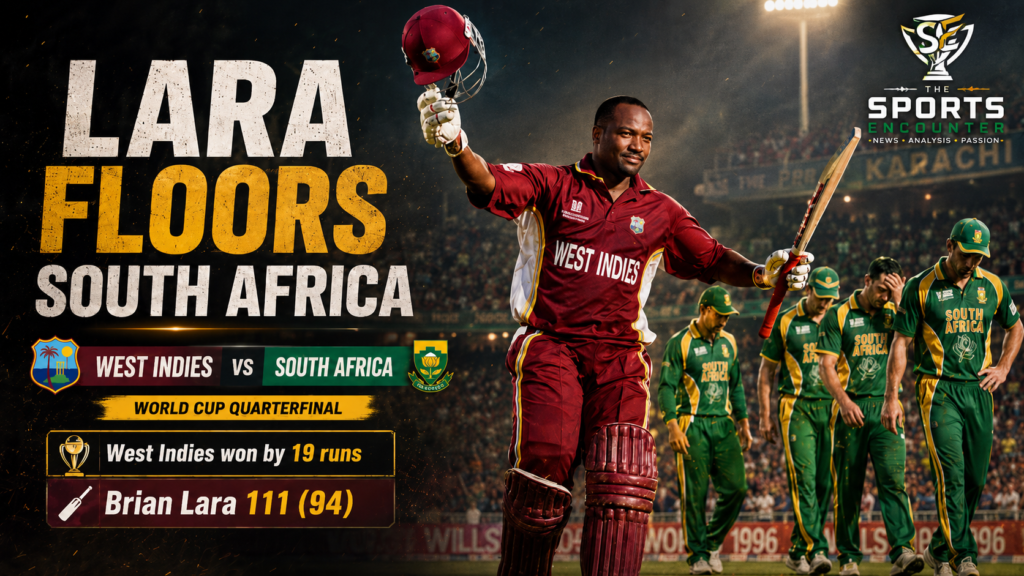
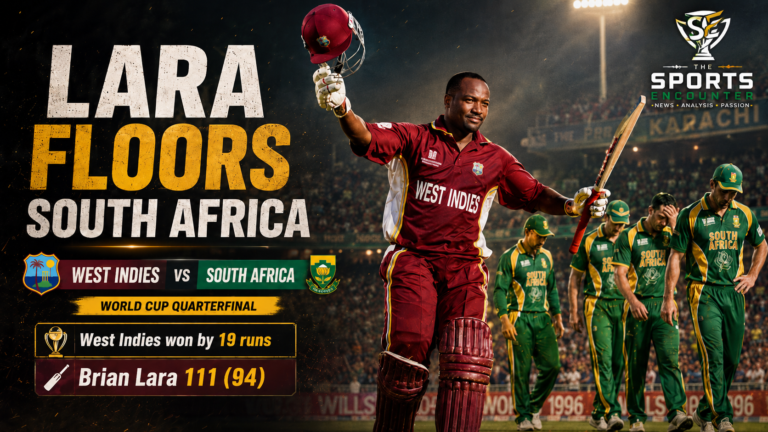
By the time the day ended, Lara had made 111 from 94 balls, West Indies had defended 264, and one of the tournament’s strongest teams was heading home after its first defeat of the World Cup.

That collision between form, selection, individual brilliance and knockout pressure is exactly why this quarterfinal belongs in A Celebration of 5000 ODIs, The Sports Encounter’s journey through 100 matches that explain why ODI cricket can punish certainty so quickly.

TL;DR

  • West Indies beat South Africa by 19 runs in the 1996 World Cup quarterfinal in Karachi.
  • Brian Lara scored 111 from 94 balls, including 16 fours, and was named Player of the Match.
  • Shivnarine Chanderpaul made 56 and shared a crucial 138-run second-wicket stand with Lara.
  • South Africa had won all five group matches but omitted fast bowler Allan Donald for an extra spinner.
  • Daryll Cullinan top-scored for South Africa with 69, while Andrew Hudson made 54 and Hansie Cronje 40.
  • Jimmy Adams took 3/53 before Roger Harper’s 4/47 ripped through the middle and lower order.

West Indies vs South Africa 1996 World Cup: Match Information

DetailInformation
MatchWest Indies vs South Africa, third quarterfinal
Tournament1996 Cricket World Cup
DateMarch 11, 1996
VenueNational Stadium, Karachi
TossWest Indies won the toss and batted
West Indies264/8 in 50 overs
South Africa245 all out in 49.3 overs
ResultWest Indies won by 19 runs
Player of the MatchBrian Lara, 111 from 94 balls
Top South Africa batterDaryll Cullinan, 69 from 78 balls
Best bowlerRoger Harper, 4/47
Major turning pointSouth Africa slid from 186/3 to 198/7
Tournament impactWest Indies advanced to the semifinals
Wider significanceSouth Africa suffered its first defeat of the tournament

The ICC’s official overview of the 1996 World Cup records a tournament eventually won by Sri Lanka, but South Africa’s quarterfinal exit remains one of its great knockout reversals.

Why Match 13 Belongs in A Celebration of 5000 ODIs

The 19-run margin only tells us where the contest finished.

Everything before it made the match special.

South Africa had swept through the group stage and appeared to possess the balance, fielding standards and tactical organization required for knockout cricket. West Indies had already suffered the humiliation of losing to Kenya and were still experimenting with their batting order.

The selection of Paul Adams ahead of Allan Donald became one of the match’s defining decisions. South Africa expected the Karachi surface to reward spin. Instead, Lara attacked Pat Symcox and Adams, while West Indies later extracted far more value from Jimmy Adams, Roger Harper and Keith Arthurton.

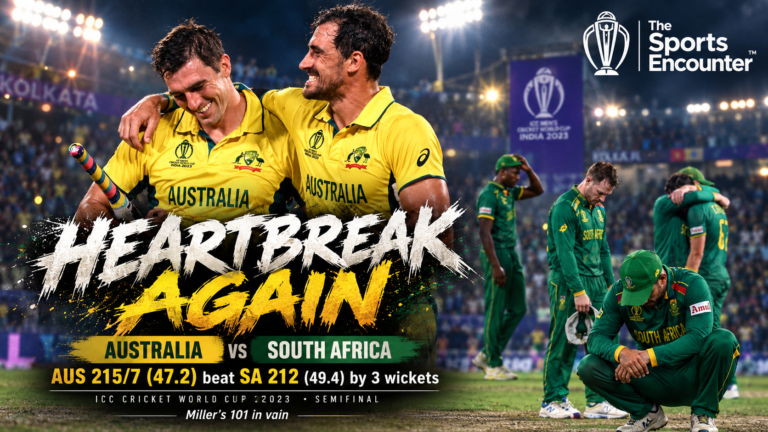
There is also a broader South African World Cup story here. Four years earlier, their campaign had ended in the infamous rain-rule semifinal against England, revisited in Match 11 of this series.

Karachi produced a different kind of heartbreak. This time, weather had nothing to do with it.

Brian Lara: 111 Runs That Changed the Quarterfinal

Lara Takes Apart South Africa’s Spin Gamble

Courtney Browne’s brisk 26 helped West Indies reach 42 before Lara joined Shivnarine Chanderpaul.

Lara initially took time to settle. Once his timing arrived, South Africa lost control.

The decisive acceleration came against Pat Symcox. Lara struck five boundaries in one over, attacking both sides of the wicket and turning what had been a calculated innings into a sustained assault.

He reached his first World Cup century from 83 balls and eventually fell for 111 from 94, having struck 16 fours.

South African captain Hansie Cronje later described Lara as the difference between winning and losing, while coach Bob Woolmer called the innings “simply brilliant.”

The ICC has repeatedly included Lara’s 1996 demolition of South Africa among his defining World Cup moments.

Shivnarine Chanderpaul: The Partner Lara Needed

Lara supplied the violence. Chanderpaul supplied the stability.

Promoted to open after West Indies changed their combination again, Chanderpaul made 56 from 93 balls and added 138 with Lara for the second wicket.

That partnership carried West Indies from 42/1 to 180/2.

Chanderpaul’s restraint mattered because it allowed Lara to dictate terms without the innings becoming reckless. West Indies later lost momentum, slipping from 210/3 to 230/7, which gave South Africa a route back into the contest.

Without the Lara-Chanderpaul partnership, 264 would never have existed.

Chanderpaul would feature prominently again three days later when West Indies suffered their own brutal knockout reversal against Australia, a match revisited in A Celebration of 5000 ODIs Match 12.

Daryll Cullinan Keeps South Africa in the Chase

South Africa lost Gary Kirsten for three when he hit his own wicket against Curtly Ambrose, but Andrew Hudson and Daryll Cullinan repaired the innings with a 97-run partnership.

Cullinan looked the most capable South African batter against West Indies’ varied attack.

His 69 from 78 balls included three fours and three sixes, while Hudson contributed 54.

At that point, the chase remained manageable.

The problem was that West Indies gradually forced South Africa to take greater risks against spin.

Jimmy Adams Breaks the Top Order

Jimmy Adams entered the match as a supporting bowling option.

He became one of its central figures.

His left-arm spin removed Hudson for 54, Cullinan for 69 and Cronje for 40. Those three wickets dismantled the part of South Africa’s batting order most capable of controlling the chase.

Cronje’s dismissal left South Africa at 186/4.

The target was still reachable.

Roger Harper made sure it stopped looking that way.

Roger Harper: 4/47 Turns Pressure Into Collapse

Harper attacked precisely when South Africa needed composure.

Jonty Rhodes fell for 13. Brian McMillan followed without adding another run to the total. Steve Palframan was gone at 198.

A chase that had reached 186/3 suddenly stood at 198/7.

Harper eventually finished with 4/47 from 10 overs, while Jimmy Adams claimed 3/53. Arthurton added another wicket, meaning West Indies’ slow bowlers accounted for eight of South Africa’s 10 dismissals.

That created the sharpest tactical irony of the match.

South Africa had dropped Donald partly to strengthen its spin resources.

West Indies won the game with spin.

Complete Match Scorecard

West Indies Innings: 264/8 in 50 Overs

BatterDismissalRunsBalls4s6sSR
Shivnarine Chanderpaulc Cullinan b McMillan56934060.22
Courtney Brownec Cullinan b Matthews261830144.44
Brian Larac Pollock b Symcox11194160118.09
Richie Richardsonc Kirsten b Symcox10270037.04
Roger Harperlbw b McMillan9151060.00
Roland Holderrun out (Adams)590055.56
Keith Arthurtonc Hudson b P Adams150020.00
Jimmy Adamsnot out13171076.47
Ian Bishopb P Adams17221177.27
Curtly Ambrosenot out01000.00
Courtney Walshdid not bat

Extras: 16
Total: 264/8 in 50 overs

Fall of wickets: 42/1, 180/2, 210/3, 214/4, 227/5, 230/6, 230/7, 254/8

South Africa Bowling

BowlerOversMaidensRunsWicketsEconomy
Shaun Pollock904605.11
Craig Matthews1004214.20
Hansie Cronje301705.67
Brian McMillan1013723.70
Pat Symcox1006426.40
Paul Adams804525.62

South Africa Innings: 245 All Out in 49.3 Overs

BatterDismissalRunsBalls4s6sSR
Andrew Hudsonc Walsh b J Adams54808067.50
Gary Kirstenhit wicket b Ambrose3140021.43
Daryll Cullinanc Bishop b J Adams69783388.46
Hansie Cronjec Arthurton b J Adams40472285.11
Jonty Rhodesc J Adams b Harper13240054.17
Brian McMillanlbw b Harper670085.71
Shaun Pollockc J Adams b Harper670085.71
Steve Palframanc and b Harper120050.00
Pat Symcoxc Harper b Arthurton242012120.00
Craig Matthewsnot out8120066.67
Paul Adamsb Walsh10140071.43

Extras: 11
Total: 245 all out in 49.3 overs

Fall of wickets: 21/1, 118/2, 140/3, 186/4, 196/5, 196/6, 198/7, 227/8, 228/9, 245/10

West Indies Bowling

BowlerOversMaidensRunsWicketsEconomy
Curtly Ambrose1002912.90
Courtney Walsh8.305116.00
Ian Bishop503106.20
Roger Harper1004744.70
Jimmy Adams1005335.30
Keith Arthurton602914.83

The Turning Points That Decided the Match

Lara Attacks Symcox

Five boundaries in one Symcox over changed the tempo of West Indies’ innings and placed South Africa’s spin-heavy selection under immediate pressure.

West Indies Stall After Lara

West Indies reached 210/3 but slipped to 230/7. South Africa had prevented the total from moving beyond control and entered the chase believing 265 was attainable.

Adams Removes South Africa’s Three Set Batters

Hudson, Cullinan and Cronje all fell to Jimmy Adams. Instead of one of them batting through the chase, all three were gone by 186.

Harper Turns 186/3 Into 198/7

The chase broke here. South Africa went from having wickets and established batting to exposing its lower order against a West Indian attack growing in confidence.

What the Result Said About Both Teams

West Indies played with greater adaptability.

They changed their opening combination, trusted Chanderpaul in a new role, allowed Lara to attack the matchup he wanted, and then recognized that spin rather than pace would decide the chase.

South Africa remained competitive for long stretches but paid for several lost moments. Their fielding standards slipped during Lara’s partnership, their spinners absorbed heavy punishment, and nobody converted the Hudson-Cullinan recovery into the innings required to finish a knockout chase.

The result also continued a painful World Cup pattern already visible in South Africa’s 1992 semifinal heartbreak.

For West Indies, the victory briefly revived memories of the side that had dominated the first two World Cups, a history explored through Clive Lloyd’s 1975 champions and the eventual end of their reign when India defended 183 in the 1983 final.

What Happened Next

West Indies advanced to face Australia in Mohali.

For much of that semifinal, another World Cup final appeared within reach. They reached 165/2 chasing 208 before Shane Warne and Australia produced one of ODI cricket’s great knockout recoveries.

That collapse is the subject of A Celebration of 5000 ODIs Match 12.

South Africa went home having lost only once in the tournament.

That one defeat was enough.

Final Takeaway: Knockout Cricket Found South Africa’s Weak Point

South Africa entered Karachi with the stronger tournament record. West Indies entered with Lara.

On March 11, 1996, that proved enough.

Lara’s century forced South Africa to chase a demanding total, Chanderpaul gave him the partnership the innings required, and Adams and Harper turned a competitive chase into a succession of desperate shots.

The quarterfinal also exposed the danger of preparing too precisely for what you expect a knockout match to become. South Africa backed additional spin. Lara attacked it. West Indies then used their own slower bowlers far more effectively.

A team that had won every World Cup match suddenly had nowhere left to go.

That is why Karachi belongs among the defining contests in the A Celebration of 5000 ODIs series and why readers can continue exploring historical and current cricket through The Sports Encounter Cricket Hub.

FAQs

Who won the West Indies vs South Africa 1996 World Cup quarterfinal?

West Indies won by 19 runs after scoring 264/8 and dismissing South Africa for 245 in 49.3 overs.

Who was Player of the Match?

Brian Lara was named Player of the Match after scoring 111 from 94 balls with 16 fours.

Why did South Africa leave Allan Donald out?

South Africa selected an additional spinner for the Karachi conditions, choosing Paul Adams as part of a spin-heavy strategy. The decision became one of the enduring selection debates from the 1996 World Cup.

How many runs did Brian Lara score?

Lara scored 111 from 94 deliveries at a strike rate of 118.09.

Who was South Africa’s highest scorer?

Daryll Cullinan top-scored with 69 from 78 balls.

Who took the most wickets for West Indies?

Roger Harper took 4/47 from 10 overs, while Jimmy Adams claimed 3/53.

What was the biggest turning point?

South Africa’s collapse from 186/3 to 198/7 transformed a competitive chase into a survival battle.

What happened to West Indies after beating South Africa?

West Indies reached the semifinal against Australia but lost by five runs after collapsing from 165/2 to 202 all out.

Hamad Hussain is the Dubai-based Founder and Senior Editor of The Sports Encounter, where he leads editorial direction, coverage standards, and the publication’s reader-first approach to sports journalism. His primary focus is cricket, with additional work across sports opinion, athlete performance, team selection, match analysis, tournament developments, and major international sporting stories. Hamad brings more than 22 years of leadership experience across corporate governance, operations, finance, HR, administration, and business development. That background shapes a structured, decision-focused approach to sports analysis, particularly when examining team strategy, selection calls, leadership, performance trends, and the wider consequences of results. Before taking on his current editorial leadership role, Hamad worked with The Sports Encounter as a Sports Analyst from 2010 to 2015. Today, his writing combines fan perspective with statistical context, historical comparison, and practical analysis of the decisions that shape teams, players, and competitions.

A Celebration of 5000 ODIs

A Celebration of 5000 ODIs Match 12: Warne Turns 165 for 2 Into West Indies Heartbreak

West Indies were cruising toward the 1996 World Cup final at 165/2. Shane Warne then dragged Australia back from almost certain defeat in Mohali.

Hamad Hussain | The Sports Encounter

Published

on

A Celebration of 5000 ODIs Match 12: Warne Turns 165 for 2 Into West Indies Heartbreak

West Indies were 165 for two, chasing 208, with Richie Richardson and Shivnarine Chanderpaul at the crease and enough overs remaining to make the finish look almost routine.

Australia had already escaped 15 for four earlier in the day. Asking them to manufacture another recovery felt unreasonable.

Then Chanderpaul fell.

Within 49 balls, West Indies lost eight wickets for 37 runs. Shane Warne attacked the middle and lower order, Damien Fleming finished the job, and Richardson stood unbeaten at the other end as a World Cup semifinal that appeared safely under Caribbean control disappeared by five runs.

Australia’s victory at Mohali on March 14, 1996 belongs in A Celebration of 5000 ODIs because it produced two reversals inside the same knockout match. Australia first recovered from a position that should have ended its innings. West Indies then surrendered a chase that should have taken them into the final.

TL;DR

  • Australia recovered from 15/4 to score 207/8 in 50 overs.
  • Stuart Law made 72 and Michael Bevan 69 in a 138-run fifth-wicket partnership.
  • West Indies reached 165/2 while chasing 208.
  • Shivnarine Chanderpaul top-scored with 80, while Brian Lara made 45.
  • Shane Warne took 4/36, including three wickets during the decisive late collapse.
  • West Indies lost their final eight wickets for 37 runs and were dismissed for 202.
  • Australia won by five runs and reached its third World Cup final.

Australia vs West Indies 1996: Match Information

DetailInformation
MatchAustralia vs West Indies, second semifinal
Tournament1996 Cricket World Cup
DateMarch 14, 1996
VenuePunjab Cricket Association Stadium, Mohali
TossAustralia won the toss and batted
Australia207/8 in 50 overs
West Indies202 all out in 49.3 overs
ResultAustralia won by five runs
Player of the MatchShane Warne, 4/36
Australia’s top scorerStuart Law, 72
West Indies’ top scorerShivnarine Chanderpaul, 80
Key partnershipLaw and Bevan, 138 for fifth wicket
Turning pointWest Indies collapsed after reaching 165/2
Tournament impactAustralia advanced to the World Cup final
Historical noteRichie Richardson played his final ODI

The ICC’s official history of the 1996 Cricket World Cup also identifies the Mohali collapse as one of the defining moments of the tournament.

Why Match 12 Belongs in A Celebration of 5000 ODIs

The five-run margin alone makes this a thriller. The route toward that margin makes it unforgettable.

Australia were 15 for four after just 9.1 overs. Mark Waugh and Ricky Ponting had made ducks. Mark Taylor scored one. Steve Waugh managed three.

West Indies then reached 165 for two while chasing 208.

Either position could have decided an ordinary ODI.

This semifinal survived both.

That is exactly the type of match this series was designed to preserve: pressure, improbability, individual brilliance, World Cup consequence and a scorecard that still makes little sense until the entire story is reconstructed.

The same theme runs through earlier installments such as Gary Gilmour rescuing Australia after they collapsed to 39 for six in 1975 and India defending 183 against West Indies in the 1983 final.

Mohali produced both types of tension in one afternoon.

Stuart Law Rebuilds Australia From 15 for Four

Curtly Ambrose and Ian Bishop made Australia look finished during the opening ten overs.

Ambrose trapped Mark Waugh lbw with the second ball and later removed Ponting. Bishop bowled Taylor and Steve Waugh. Four of Australia’s first five batters had contributed just four runs between them.

Stuart Law walked into a semifinal already slipping away.

His response was patient rather than desperate.

Law made 72 from 105 balls, hitting five fours and giving Australia enough stability to move beyond survival. Against Ambrose, Bishop and Courtney Walsh, trying to manufacture quick runs would probably have accelerated the collapse.

Law instead stayed long enough for Michael Bevan to join him.

Michael Bevan Gives Australia a Total to Defend

Bevan’s 69 from 110 balls carried all the qualities that made him one of the defining ODI batters of his generation.

He understood the situation immediately.

Australia did not need spectacle at 15 for four. They needed time, wickets in hand and a total capable of giving Warne and the bowlers something to work with.

Law and Bevan added 138 for the fifth wicket, taking Australia from 15/4 to 153/5. It was the partnership that restored the semifinal.

Ian Healy then provided the late acceleration with 31 from 28 balls as Australia reached 207/8.

It looked competitive.

For much of the West Indian chase, it did not look enough.

Shivnarine Chanderpaul Takes West Indies to the Door

Shivnarine Chanderpaul was only 21 years old.

He batted like the calmest man at Mohali.

After Courtney Browne fell for ten, Chanderpaul rebuilt with Brian Lara and refused to allow Australia’s bowlers to create sustained pressure. Lara made 45 from 45 balls and helped take the score to 93 before Steve Waugh bowled him.

Richie Richardson then joined Chanderpaul.

The pair carried West Indies to 165 for two.

Chanderpaul’s 80 came from 126 deliveries, including seven boundaries. His innings lacked the violence usually associated with West Indies batting of the period, but the situation required control.

He had almost provided enough.

Glenn McGrath removed him at 165.

The match changed immediately.

Shane Warne Turns a Chase Into Panic

Warne had already dismissed Browne with his first delivery of the innings.

His most important work came much later.

Once Chanderpaul departed, West Indies still had Richardson established and required only 43 more runs. Roger Harper fell to McGrath for two before Warne entered the center of the collapse.

Ottis Gibson was caught behind.

Jimmy Adams was trapped lbw.

Ian Bishop followed lbw three deliveries into his stay.

Warne finished with 4/36 from nine overs.

Numbers describe the spell. Timing explains its greatness.

He took wickets precisely when West Indies needed composure and Australia needed something disruptive. The required rate remained manageable throughout. Warne made wickets, rather than runs, the problem.

That is why he received the Player of the Match award.

Richie Richardson Watches the Final Collapse

Richardson’s unbeaten 49 deserves attention because he remained at the crease while everything collapsed around him.

After Chanderpaul departed, West Indies lost Harper, Gibson, Adams, Keith Arthurton and Bishop.

Still, Richardson remained.

Even at 194 for eight, the contest had not completely disappeared. West Indies needed 14 with two wickets remaining.

Curtly Ambrose helped take the score to 202 before Ian Healy ran him out.

One wicket remained. Six runs were required.

Damien Fleming bowled Courtney Walsh with the next delivery.

Richardson stood unbeaten on 49 in his final ODI as Australia celebrated a five-run victory.

Curtly Ambrose and Ian Bishop Nearly Win It in the First Ten Overs

West Indies should also be remembered for how convincingly they began the semifinal.

Ambrose took 2/26 from ten overs.

Bishop returned 2/35.

Their opening spells reduced Australia’s highly rated batting order to 15 for four, a position from which very few teams should recover in a World Cup knockout match.

Ambrose was particularly economical, conceding only 2.60 runs per over. Walsh also gave away just 33 from his ten overs.

The bowling created the winning position.

West Indies simply failed to finish from it.

Complete Match Scorecard

Australia Innings: 207/8 in 50 Overs

BatterDismissalRunsBalls4s6s
Mark Waughlbw b Ambrose0200
Mark Taylorb Bishop11100
Ricky Pontinglbw b Ambrose01500
Steve Waughb Bishop31800
Stuart Lawrun out7210550
Michael Bevanc Richardson b Harper6911041
Ian Healyrun out312820
Paul Reiffelrun out71100
Shane Warnenot out6600
Extras11 lb, 5 w, 2 nb18
Total8 wickets, 50 overs207

Did not bat: Damien Fleming, Glenn McGrath.

Fall of wickets: 0/1, 7/2, 8/3, 15/4, 153/5, 171/6, 186/7, 207/8.

West Indies Bowling

BowlerOversMaidensRunsWickets
Curtly Ambrose101262
Ian Bishop101352
Courtney Walsh101330
Ottis Gibson20130
Roger Harper90471
Jimmy Adams90420

West Indies Innings: 202 All Out in 49.3 Overs

BatterDismissalRunsBalls4s6s
Shivnarine Chanderpaulc Fleming b McGrath8012670
Courtney Brownec & b Warne101800
Brian Larab Steve Waugh454540
Richie Richardsonnot out498340
Roger Harperlbw b McGrath2500
Ottis Gibsonc Healy b Warne1200
Jimmy Adamslbw b Warne21100
Keith Arthurtonc Healy b Fleming0400
Ian Bishoplbw b Warne3300
Curtly Ambroserun out (Healy)2200
Courtney Walshb Fleming0100
Extras4 lb, 2 w, 2 nb8
TotalAll out, 49.3 overs202

Fall of wickets: 25/1, 93/2, 165/3, 173/4, 178/5, 183/6, 187/7, 194/8, 202/9, 202/10.

Australia Bowling

BowlerOversMaidensRunsWickets
Glenn McGrath102302
Damien Fleming8.30482
Shane Warne90364
Mark Waugh40160
Steve Waugh70301
Paul Reiffel50130
Michael Bevan41120
Stuart Law20130

The Match Changed Twice

The first turning point came before Australia had reached 20.

At 15 for four, West Indies had one foot in the final. Law and Bevan refused to allow that advantage to become decisive.

The second turning point arrived at 165 for two.

McGrath removed Chanderpaul and Australia suddenly found a route back into the contest. Warne then attacked that opening so effectively that West Indies lost their final eight wickets for just 37 runs.

It remains one of the sharpest late collapses in World Cup history.

The Sports Encounter has already revisited other Australian World Cup escapes, including the one-run victory over India in Chennai in 1987 and the seven-run 1987 final victory over England.

This one may have required even greater belief.

What the Result Meant

Australia reached its third men’s World Cup final after appearances in 1975 and 1987.

Sri Lanka ultimately defeated Mark Taylor’s team in Lahore, but Mohali helped confirm a trait that would define Australian World Cup cricket for the next two decades: they remained dangerous even when a match appeared lost.

West Indies faced the opposite emotion.

They had knocked South Africa out in the quarterfinal and were within 43 runs of returning to a World Cup final for the first time since 1983. Instead, the lower order disappeared around Richardson.

The result also ended Richardson’s international career.

Readers can continue the full historical journey through the A Celebration of 5000 ODIs main article or explore current and historical reporting through The Sports Encounter Cricket Hub.

For another example of a modest World Cup total becoming unexpectedly dangerous, revisit Eddo Brandes and Zimbabwe defending 134 against England in 1992.

Final Takeaway: 165 for Two Was Never the Finish

The score that explains this match is neither 207 nor 202.

It is 165 for two.

West Indies had eight wickets standing, an experienced captain at the crease, Chanderpaul set on 80 and fewer than 50 runs left to reach a World Cup final.

From there, Australia found ten minutes of belief and West Indies found panic.

Law and Bevan had already rescued Australia once. Warne made them do it again.

That double escape is why Mohali belongs among the 100 matches in A Celebration of 5000 ODIs, and why a five-run result from 1996 still feels impossible when you read the scorecard three decades later.

Continue Reading

A Celebration of 5000 ODIs

A Celebration of 5000 ODIs Match 11: 22 From One Ball Ends South Africa’s World Cup Dream

South Africa were closing on their first World Cup final when 12 minutes of Sydney rain turned a demanding chase into cricket’s most infamous impossible equation.

Hamad Hussain | The Sports Encounter

Published

on

A Celebration of 5000 ODIs Match 11: 22 From One Ball Ends South Africa’s World Cup Dream

South Africa needed 22 runs from 13 balls. Brian McMillan and Dave Richardson were still there. A place in the World Cup final remained difficult, but entirely possible.

Then Sydney’s rain arrived.

Twelve minutes later, the equation that had taken almost seven hours of cricket to create had become impossible. The giant SCG scoreboard flashed the numbers that would follow South African cricket for decades: 22 runs required from one ball.

There is an important detail behind that famous image. Archived match records show the scoreboard was actually wrong. Under the calculation eventually applied, South Africa’s true requirement was 21 from the final delivery. It hardly mattered. No legal delivery could produce either number. The semifinal had effectively ended in a calculation rather than a cricketing contest.

That extraordinary finish is why England’s 19-run victory on March 22, 1992, is Match 11 in The Sports Encounter’s A Celebration of 5000 ODIs series. The match gave us Graeme Hick’s finest World Cup innings, Jonty Rhodes attacking under knockout pressure, a genuinely competitive chase and, finally, a rain rule so inadequate that cricket was forced to rethink how interrupted matches should be decided.

TL;DR

  • England scored 252/6 from 45 overs, led by Graeme Hick’s 83 from 90 balls.
  • South Africa reached 231/6 after 42.5 overs and required 22 from the final 13 balls when rain interrupted play.
  • The Most Productive Overs method reduced the chase to an impossible final-ball equation.
  • Jonty Rhodes made an attacking 43 from 38 balls, while Andrew Hudson top-scored with 46.
  • Richard Illingworth and Gladstone Small took two wickets each for England.
  • Graeme Hick was Player of the Match as England advanced to the final against Pakistan.

England vs South Africa 1992 World Cup Semifinal: Match Information

DetailInformation
MatchEngland vs South Africa, 2nd Semifinal
Tournament1992 Cricket World Cup
DateMarch 22, 1992
VenueSydney Cricket Ground, Sydney
TossSouth Africa won the toss and fielded
England252/6 in 45 overs
South Africa232/6 in 43 overs
ResultEngland won by 19 runs under the revised target
Player of the MatchGraeme Hick, 83 from 90 balls
Top South Africa BatterAndrew Hudson, 46 from 52 balls
Turning PointRain with South Africa needing 22 from 13 balls
Tournament ImpactEngland reached the World Cup final
Historical ImpactThe finish exposed serious flaws in cricket’s rain-adjustment system

Why Match 11 Belongs in A Celebration of 5000 ODIs

A famous controversy alone would not be enough.

This semifinal deserves its place because a very good cricket match was unfolding before the mathematics swallowed it.

South Africa were playing their first World Cup after returning to international cricket following more than two decades of isolation. They had already reached the semifinals at their first attempt. England, meanwhile, were trying to reach their third World Cup final.

The chase remained alive almost to its natural conclusion.

That combination of historical context, individual performance, knockout pressure and an unprecedented finish satisfies exactly what our 100-match ODI collection was built to preserve. The series has already revisited extraordinary World Cup moments such as Kapil Dev rescuing India from 17 for five against Zimbabwe and India defending 183 against West Indies in the 1983 final.

This one belongs for another reason: cricket eventually learned from it.

Graeme Hick Builds England’s Innings Under Pressure

England lost Graham Gooch for two and Ian Botham for 21, leaving the innings at 39 for two.

Graeme Hick supplied the stability they needed.

His 83 from 90 balls contained nine fours and came at a strike rate above 92, excellent tempo for an ODI semifinal in 1992. He added 71 with Alec Stewart, then helped push England toward a total capable of surviving South Africa’s deep batting order.

Hick’s dismissal at 187 for five could have stalled the innings.

Instead, England found another gear.

Dermot Reeve Turns 220 Into 252

Dermot Reeve’s contribution lasted only 14 balls.

It changed the value of England’s total.

Reeve struck an unbeaten 25 with four boundaries, while Chris Lewis added 18 not out from 16 deliveries. Their late acceleration carried England to 252 for six after the innings had been restricted to 45 overs because South Africa failed to complete their scheduled overs within the allotted time.

Those final runs became even more significant once the chase tightened.

Andrew Hudson Keeps South Africa Moving

South Africa lost captain Kepler Wessels for 17, but Andrew Hudson refused to allow England complete control.

Hudson made 46 from 52 deliveries with six fours and kept the required rate manageable despite regular wickets around him. Peter Kirsten fell for 11 before Hudson departed at 90 for three.

Adrian Kuiper then made 36, but England kept removing batters before partnerships could become decisive.

Richard Illingworth was particularly important, dismissing Hudson and Kuiper while conceding 46 from his 10 overs.

Jonty Rhodes Attacks the Semifinal

Jonty Rhodes produced South Africa’s most aggressive innings.

His 43 from 38 balls pushed the chase forward when the required rate was becoming uncomfortable. England knew one substantial partnership could take the match away from them, and Rhodes was beginning to build exactly that threat.

Gladstone Small eventually removed him with the score on 206.

Yet South Africa were not finished.

McMillan and Richardson took the total to 231 for six. Thirteen legitimate deliveries remained.

They needed 22.

Then the weather intervened.

The 12 Minutes That Changed Cricket’s Rain Rules

The 1992 World Cup used the Most Productive Overs method for rain-affected matches. When overs disappeared from the chasing team’s innings, the target was adjusted by removing the least productive overs from the first innings.

That logic became absurd when rain arrived near the end of this chase.

South Africa had only 13 balls left. Losing two overs therefore removed almost all their remaining opportunities, while England’s target reduction amounted to only one run.

The television and SCG scoreboard famously changed from 22 required from 13 balls, to 22 from seven, and finally 22 from one. Archived ESPN records note that the mathematically correct requirement was actually 21 from one.

McMillan pushed Chris Lewis’ final delivery for a single.

Nobody celebrated the cricket.

England had earned their position and had arguably been the better side over the match, but even they had reached the final through an ending nobody could reasonably defend as a competitive solution. The incident became one of the strongest arguments for developing a more sophisticated method for rain-adjusted targets, eventually leading ODI cricket toward the Duckworth-Lewis system.

Man of the Match: Graeme Hick

Hick’s 83 remains the central performance of the semifinal.

England’s innings repeatedly threatened to lose momentum, and none of their other top-six batters reached 35. Without Hick, there would probably have been no 252 to defend and perhaps no controversy for history to remember.

He therefore deserved the Player of the Match award.

His innings tends to disappear behind the famous scoreboard image, which is unfortunate. The rain rule explains why the match became infamous. Hick explains why England had something worth defending in the first place.

Complete Match Scorecard

England Innings: 252/6 in 45 Overs

BatterDismissalRunsBalls4s6s
Graham Goochc Richardson b Donald2800
Ian Bothamb Pringle212330
Alec Stewartc Richardson b McMillan335440
Graeme Hickc Rhodes b Snell839090
Neil Fairbrotherb Pringle285010
Allan Lambc Richardson b Donald192210
Chris Lewisnot out181620
Dermot Reevenot out251440
Extrasb 1, lb 7, w 9, nb 623
Total6 wickets, 45 overs252

Did not bat: Phil DeFreitas, Gladstone Small, Richard Illingworth.

Fall of wickets: 20-1, 39-2, 110-3, 183-4, 187-5, 221-6.

South Africa Bowling

BowlerOversMaidensRunsWickets
Allan Donald100692
Meyrick Pringle92362
Richard Snell80521
Brian McMillan90471
Adrian Kuiper50260
Hansie Cronje40140

South Africa Innings: 232/6 in 43 Overs

BatterDismissalRunsBalls4s6s
Kepler Wesselsc Lewis b Botham172110
Andrew Hudsonlbw b Illingworth465260
Peter Kirstenb DeFreitas112600
Adrian Kuiperb Illingworth364450
Hansie Cronjec Hick b Small244610
Jonty Rhodesc Lewis b Small433830
Brian McMillannot out212100
Dave Richardsonnot out131010
Extraslb 17, w 421
Total6 wickets, 43 overs232

Did not bat: Richard Snell, Meyrick Pringle, Allan Donald.

Fall of wickets: 26-1, 61-2, 90-3, 131-4, 176-5, 206-6.

England Bowling

BowlerOversMaidensRunsWickets
Ian Botham100521
Chris Lewis50380
Phil DeFreitas81281
Richard Illingworth101462
Gladstone Small101512

England Were Better, but South Africa Deserved a Cricketing Finish

It is tempting to retell this semifinal entirely as an injustice.

That loses some of its complexity.

England had made 252 despite being limited to 45 overs. Hick had played the game’s strongest innings. Their bowlers had taken six wickets and repeatedly prevented South Africa from putting together the partnership that could have settled the chase earlier.

South Africa also contributed to their own difficulty by taking too long to bowl England’s innings, which led to the reduction from 50 overs to 45.

Yet none of that makes the final equation sensible.

A World Cup semifinal with 22 required from 13 balls deserved to be decided by players attempting those 13 balls.

That is ultimately why Match 11 survives.

Readers can revisit other matches where a single moment changed a World Cup through our reports on Australia’s seven-run 1987 final victory over England and Gary Gilmour’s extraordinary 1975 semifinal against England, while ongoing match reports and analysis are available through The Sports Encounter Cricket Hub.

Final Takeaway: The Match Cricket Had to Learn From

England advanced to face Pakistan and South Africa went home from their first World Cup carrying an image that would become part of cricket folklore.

The semifinal’s real legacy, however, reaches further than heartbreak.

Hick played a superb innings. Rhodes attacked the chase. England’s bowlers kept the game under pressure. South Africa remained alive with 13 balls remaining.

Then the rules failed the match.

Thirty-four years later, people still remember 22 from one without needing the teams, venue or date explained to them. Few scoreboards in ODI history have said so little while revealing so much about why cricket sometimes has to change.https://chatgpt.com/backend-api/sentinel/frame.html?sv=20260810913b

Continue Reading

A Celebration of 5000 ODIs

A Celebration of 5000 ODIs Match 10: Eddo Brandes Defends 134 and Leaves England Stunned

Eddo Brandes removed Graham Gooch with the first ball and dismantled England’s top order as Zimbabwe defended 134 to earn a famous World Cup victory.

Hamad Hussain | The Sports Encounter

Published

on

A Celebration of 5000 ODIs Match 10: Eddo Brandes Defends 134 and Leaves England Stunned

England needed 135. Zimbabwe needed a reason to believe before the chase could settle. Eddo Brandes supplied it with the first ball, trapping Graham Gooch lbw and turning a modest target into a test of nerve.

By the time Brandes had finished tearing through England’s top order, the tournament finalists were 43 for five. Zimbabwe’s 134, a total that appeared inadequate at the interval, suddenly carried the weight of a mountain.

England fought back, reached 95 for five and briefly looked ready to escape. Zimbabwe refused to loosen its grip. The last five wickets fell for 30 runs, completing a nine-run victory that remains one of the most startling defenses in World Cup history.

That combination of vulnerability, pressure and fearless fast bowling earns Zimbabwe versus England its place as Match 10 in A Celebration of 5000 ODIs.

TL;DR

  • Zimbabwe defended 134 to defeat England by nine runs at Albury.
  • Eddo Brandes took 4/21 and dismissed Graham Gooch with the first delivery.
  • England collapsed to 43 for five before Alec Stewart and Neil Fairbrother rebuilt.
  • Ali Shah, Iain Butchart and John Traicos maintained Zimbabwe’s control.
  • Brandes earned Player of the Match for one of Zimbabwe’s defining ODI spells.
  • The result gave Zimbabwe its only victory of the 1992 World Cup.

Match Information

DetailInformation
MatchZimbabwe vs England, 35th match, 1992 World Cup
DateMarch 18, 1992
VenueLavington Sports Oval, Albury
Zimbabwe134 all out in 46.1 overs
England125 all out in 49.1 overs
ResultZimbabwe won by nine runs
Player of the MatchEddo Brandes, 4/21
Zimbabwe’s top scorerDave Houghton, 29
England’s top scorerAlec Stewart, 29
Turning pointBrandes reduced England to 43 for five
Tournament contextZimbabwe’s only win; England had already qualified for the semifinals

Complete Match Scorecard

Zimbabwe Batting

BatterDismissalRunsBalls
Wayne Jamesc & b Illingworth1346
Andy Flowerb DeFreitas716
Andy Pycroftc Gooch b Botham313
Kevin Arnottlbw b Botham1133
Dave Houghtonc Fairbrother b Small2974
Andy Wallerb Tufnell816
Ali Shahc Lamb b Tufnell316
Iain Butchartc Fairbrother b Botham2436
Eddo Brandesst Stewart b Illingworth1424
John Traicosnot out06
Malcolm Jarvislbw b Illingworth66
Extras8 leg byes, 8 wides16
TotalAll out, 46.1 overs134

Fall of wickets: 12/1, 19/2, 30/3, 52/4, 65/5, 77/6, 96/7, 127/8, 127/9, 134/10

England Bowling

BowlerOversMaidensRunsWickets
Phil DeFreitas81141
Gladstone Small91201
Ian Botham102233
Richard Illingworth9.10333
Phil Tufnell102362

England Batting

BatterDismissalRunsBalls
Graham Goochlbw b Brandes01
Ian Bothamc Flower b Ali Shah1834
Allan Lambc James b Brandes1726
Robin Smithb Brandes213
Graeme Hickb Brandes06
Neil Fairbrotherc Flower b Butchart2077
Alec Stewartc Waller b Ali Shah2996
Phil DeFreitasc Flower b Butchart417
Richard Illingworthrun out1120
Gladstone Smallc Pycroft b Jarvis518
Phil Tufnellnot out00
Extras4 byes, 3 leg byes, 11 wides, 1 no-ball19
TotalAll out, 49.1 overs125

Fall of wickets: 0/1, 32/2, 42/3, 42/4, 43/5, 95/6, 101/7, 108/8, 124/9, 125/10

Zimbabwe Bowling

BowlerOversMaidensRunsWickets
Eddo Brandes104214
Malcolm Jarvis9.10321
Ali Shah103172
John Traicos104160
Iain Butchart101322

Eddo Brandes Turns 134 Into a Winning Total

Brandes attacked England before doubt could enter Zimbabwe’s fielding effort. Gooch fell first ball, a dismissal that removed England’s captain and changed the emotional temperature immediately.

Allan Lamb reached 17 before Brandes struck again. Robin Smith followed for two, then Graeme Hick fell for a six-ball duck. Brandes’ opening assault left England five wickets down with only 43 scored.

His final figures, four wickets for 21 runs from 10 overs with four maidens, captured the discipline behind the destruction. According to the ICC’s account of Zimbabwe’s classic World Cup performances, Brandes’ spell created the collapse from which England never fully recovered.

Brandes finished the 1992 tournament as Zimbabwe’s leading wicket-taker with 14, a record highlighted in the ICC’s retrospective interview with the fast bowler.

Dave Houghton and Iain Butchart Find Crucial Runs

Zimbabwe’s innings contained no major partnership or individual fifty. England’s bowlers kept taking wickets, with Ian Botham and Richard Illingworth claiming three apiece.

Dave Houghton’s 29 from 74 balls provided the closest thing to an anchor. His innings lacked fluency, but survival mattered while wickets disappeared around him.

The lower order then supplied the runs that ultimately separated the sides. Butchart made 24 from 36 balls and Brandes added 14. Their contributions helped Zimbabwe advance from 96 for seven to 127 for eight. In a nine-run match, those late runs carried enormous value.

Stewart and Fairbrother Rebuild Without Breaking the Pressure

Alec Stewart and Neil Fairbrother inherited a chase in crisis. Their 52-run sixth-wicket partnership repaired some of the damage, taking England from 43 for five to 95 for five.

Zimbabwe, however, controlled the pace of the stand. Stewart needed 96 balls for his 29, while Fairbrother scored 20 from 77. Neither batter found a reliable boundary option against accurate bowling and committed fielding.

Ali Shah ended the partnership by removing Stewart. Butchart dismissed Fairbrother and DeFreitas, exposing England’s tail with 34 runs still required. The chase had consumed too many deliveries without reducing the risk.

Zimbabwe’s Supporting Bowlers Complete the Upset

Brandes provided the headline, but Zimbabwe defended 134 through collective control.

Ali Shah returned two wickets for 17 runs with three maidens, including the vital dismissals of Botham and Stewart. Butchart claimed two for 32, while Malcolm Jarvis removed Gladstone Small as England approached the target.

John Traicos did not take a wicket, yet his 10 overs cost only 16 runs and included four maidens. His spell denied England the release it desperately needed. The pressure he created forced batters to take risks elsewhere.

The full ESPNcricinfo scorecard shows how thoroughly Zimbabwe controlled the chase: England batted into the final over but never developed meaningful momentum.

The Turning Points

MomentMatch impact
Gooch dismissed first ballRemoved England’s captain and gave Zimbabwe immediate belief
Brandes’ four-wicket burstReduced England to 43 for five
Stewart and Fairbrother containedTheir 52-run stand used 173 combined deliveries
Shah removed StewartEnded England’s main recovery partnership
Butchart’s double strikeExposed the lower order with the target still distant
Small dismissed at 124Left England nine short with one wicket remaining

Why This Match Belongs in the Celebration

Zimbabwe had lost its first seven matches of the tournament. England had already secured a semifinal place and would eventually reach the final. On form, reputation and batting depth, the contest appeared heavily tilted toward England.

That imbalance makes the result significant, but the quality of Zimbabwe’s defense makes it unforgettable. A team with almost no margin for error protected 134 through new-ball aggression, spin control, disciplined fields and sustained courage.

The match also complements other defining defenses in our Celebration of 5000 ODIs series, including India defending 183 against West Indies and Australia surviving India by one run in Chennai.

Readers can also revisit Kapil Dev’s rescue against Zimbabwe, Australia’s 1987 World Cup final victory, Australia ending Pakistan’s 1987 campaign and Inzamam-ul-Haq’s 1992 semifinal assault.

For more reporting, history and analysis, visit The Sports Encounter’s cricket coverage hub.

Final Takeaway

England entered the chase expecting control. One delivery was enough to disturb that certainty, and Brandes spent the rest of his spell ensuring it never returned.

Zimbabwe’s 134 should have been a losing score. Through Brandes’ opening burst, Traicos’ suffocating spell and the composure of every supporting bowler, it became a total England could see but never reach.

Continue Reading

FIFA World Cup 2026 Hub

Leandro Paredes and Argentina players during the fallout from the 2026 FIFA World Cup final as FIFA announces suspensions and disciplinary sanctions. Leandro Paredes and Argentina players during the fallout from the 2026 FIFA World Cup final as FIFA announces suspensions and disciplinary sanctions.
Breaking News1 week ago

FIFA Hits Argentina with Heavy World Cup Sanctions as Paredes Gets 10-Game Ban

FIFA has handed Argentina major disciplinary sanctions after the 2026 World Cup final brawl, including a 10-game suspension for Leandro...

Gianni Infantino at the center of a cinematic FIFA power struggle as UEFA, AFC and CONCACAF weigh a possible no-confidence move against the FIFA president. Gianni Infantino at the center of a cinematic FIFA power struggle as UEFA, AFC and CONCACAF weigh a possible no-confidence move against the FIFA president.
Breaking News1 week ago

Can FIFA Oust Gianni Infantino? Regional Powerhouses Now Weigh Historic No-Confidence Vote

Gianni Infantino is facing the most serious political challenge of his FIFA presidency as UEFA, the AFC and CONCACAF discuss...

AFC President Sheikh Salman and Qatar football officials depicted in a dramatic split-screen graphic as the Gianni Infantino crisis deepens divisions inside Asian football. AFC President Sheikh Salman and Qatar football officials depicted in a dramatic split-screen graphic as the Gianni Infantino crisis deepens divisions inside Asian football.
Editor's Choice1 week ago

AFC-Qatar Rift Deepens as Infantino Crisis Divides Asian Football

AFC President Sheikh Salman bin Ebrahim Al-Khalifa has hit back at Qatar after its football federation challenged the confederation’s stance...

Kevin Lamour and Gianni Infantino feature in a FIFA governance graphic highlighting Lamour’s departure after criticism of the abandoned World Cup investment plan. Kevin Lamour and Gianni Infantino feature in a FIFA governance graphic highlighting Lamour’s departure after criticism of the abandoned World Cup investment plan.
Breaking News2 weeks ago

Why FIFA COO Kevin Lamour Was Shown the Exit Way

FIFA COO Kevin Lamour has left the organization weeks after accusing staff of being deceived over the abandoned FIFA Forward...

Gianni Infantino pictured against an Ireland football backdrop as the FAI withdraws support for his FIFA re-election campaign. Gianni Infantino pictured against an Ireland football backdrop as the FAI withdraws support for his FIFA re-election campaign.
Breaking News2 weeks ago

Ireland Turns on Infantino as FIFA Election Revolt Spreads Beyond Europe’s Heavyweights

Ireland has withdrawn its support for Gianni Infantino’s re-election as FIFA president, adding another national association to a widening governance...

Donald Trump backs Gianni Infantino as UEFA, AFC and CONCACAF intensify pressure on the FIFA president ahead of the 2027 election. Donald Trump backs Gianni Infantino as UEFA, AFC and CONCACAF intensify pressure on the FIFA president ahead of the 2027 election.
Breaking News2 weeks ago

Donald Trump Comes to Gianni Infantino’s Rescue as FIFA Crisis Turns Political

Donald Trump has thrown his support behind Gianni Infantino as UEFA, AFC and CONCACAF deepen their challenge to the FIFA...

Gianni Infantino appears under intense scrutiny as UEFA, AFC and CONCACAF challenge his FIFA leadership over the abandoned World Cup commercial rights stake-sale plan. Gianni Infantino appears under intense scrutiny as UEFA, AFC and CONCACAF challenge his FIFA leadership over the abandoned World Cup commercial rights stake-sale plan.
Editor's Choice3 weeks ago

UEFA, AFC and CONCACAF Turn on Infantino as FIFA Crisis Becomes a Fight for His Presidency

UEFA, the AFC and CONCACAF have jointly accused FIFA President Gianni Infantino of breaking trust over the abandoned World Cup...

Gianni Infantino stands under intense scrutiny in a cinematic FIFA leadership crisis scene, surrounded by press cameras, officials, global football imagery, and the headline “Infantino Under Pressure.” Gianni Infantino stands under intense scrutiny in a cinematic FIFA leadership crisis scene, surrounded by press cameras, officials, global football imagery, and the headline “Infantino Under Pressure.”
Editor's Choice3 weeks ago

FIFA Says Infantino Is Being Undermined as Leadership Crisis Turns Into a Battle Over Legitimacy

FIFA has escalated its defense of Gianni Infantino, warning of a concerted effort to undermine its president as the fallout...

Lionel Messi raises both index fingers toward the sky in Argentina’s No. 10 jersey during a match, illustrating the uncertainty around when the 39-year-old legend will retire from international football. Lionel Messi raises both index fingers toward the sky in Argentina’s No. 10 jersey during a match, illustrating the uncertainty around when the 39-year-old legend will retire from international football.
Editor's Choice3 weeks ago

When Will Lionel Messi Retire? Argentina President Says Only Messi Has the Answer

Lionel Messi’s retirement remains an open question after his eight-goal 2026 World Cup. Argentina president Claudio Tapia says only Messi...

Cinematic FIFA governance graphic showing a somber football executive at a FIFA Congress podium, a glowing FA letter stamped “Support Withdrawn,” the headline “FA Turns Against Infantino,” international flags, a connected globe, and The Sports Encounter logo. Cinematic FIFA governance graphic showing a somber football executive at a FIFA Congress podium, a glowing FA letter stamped “Support Withdrawn,” the headline “FA Turns Against Infantino,” international flags, a connected globe, and The Sports Encounter logo.
Breaking News3 weeks ago

English FA Turns Its Back on Gianni Infantino, Withdraws Support for Re-Election

The English FA has formally withdrawn its support for Gianni Infantino’s bid for another term as FIFA president, adding major...

A suited FIFA official bows at a crisis meeting beneath a fractured world football graphic, surrounded by delegates, torn $4.2 billion deal papers and the headline “World Cup Not for Sale.” A suited FIFA official bows at a crisis meeting beneath a fractured world football graphic, surrounded by delegates, torn $4.2 billion deal papers and the headline “World Cup Not for Sale.”
Editor's Choice3 weeks ago

FIFA President Apologizes to Member Nations After FIFA World Cup Selloff Plan Fails to Inspire

FIFA has apologized to its member associations after abandoning a controversial plan to sell a 20% stake in a new...

Gianni Infantino stands under pressure as FIFA officials hold crisis talks in Morocco following the rejected World Cup commercial stake sale proposal. Gianni Infantino stands under pressure as FIFA officials hold crisis talks in Morocco following the rejected World Cup commercial stake sale proposal.
Breaking News3 weeks ago

Infantino in Survival Mode After World Cup Stake Sale Idea Results in Global Revolt

Gianni Infantino’s abandoned World Cup commercial rights proposal has triggered an internal FIFA revolt, lost European support, and drawn a...

Gianni Infantino stands isolated at a FIFA podium as Arsène Wenger, Mattias Grafstrom, Prince Ali and divided football officials surround him, with fractured blue-and-red VFX imagery, The Sports Encounter logo, and the headline “Allies Break Ranks.” Gianni Infantino stands isolated at a FIFA podium as Arsène Wenger, Mattias Grafstrom, Prince Ali and divided football officials surround him, with fractured blue-and-red VFX imagery, The Sports Encounter logo, and the headline “Allies Break Ranks.”
Editor's Choice3 weeks ago

Crisis Plagues FIFA as Wenger, Grafstrom and Federations Break Ranks

Gianni Infantino’s grip on FIFA is under growing pressure after senior officials, European federations and former allies distanced themselves from...

Gianni Infantino stands between representatives of smaller football nations and the rejected UEFA and CONCACAF blocs, with a glowing world map, voting imagery, and the headline “Small Nations, Big Power” beneath The Sports Encounter logo. Gianni Infantino stands between representatives of smaller football nations and the rejected UEFA and CONCACAF blocs, with a glowing world map, voting imagery, and the headline “Small Nations, Big Power” beneath The Sports Encounter logo.
Editor's Choice4 weeks ago

Infantino Looks to Smaller Nations After UEFA, CONCACAF Snub

Gianni Infantino’s FIFA future may depend on smaller and emerging nations after UEFA and CONCACAF lost confidence in his leadership....

Gianni Infantino appears under a fractured World Cup trophy as UEFA, AFC, and other football stakeholders reject FIFA’s failed private investment stake plan. Gianni Infantino appears under a fractured World Cup trophy as UEFA, AFC, and other football stakeholders reject FIFA’s failed private investment stake plan.
Editor's Choice4 weeks ago

FIFA’s World Cup Stake Plan Failed in Three Days. The Damage to Gianni Infantino May Last Much Longer

FIFA’s attempt to sell a 20% stake in a new World Cup commercial entity collapsed within days after a global...

Cinematic tribute to Cristiano Ronaldo’s World Cup career, showing his rise, record-breaking goals and six-tournament journey on one side, and his emotional final farewell with Portugal on the other, under the headline “Goals. Records. Farewell.” with The Sports Encounter logo. Cinematic tribute to Cristiano Ronaldo’s World Cup career, showing his rise, record-breaking goals and six-tournament journey on one side, and his emotional final farewell with Portugal on the other, under the headline “Goals. Records. Farewell.” with The Sports Encounter logo.
Editor's Choice4 weeks ago

Cristiano Ronaldo’s World Cup Career: Goals, Records and Final Farewell

Cristiano Ronaldo became the first man to score in six FIFA World Cups, but football’s greatest tournament never gave him...

Cinematic VFX featured image showing fictionalized World Cup legend silhouettes walking toward a glowing stadium tunnel, with farewell confetti, The Sports Encounter logo, and the headline “The Last Dance: World Cup Legends Say Goodbye.” Cinematic VFX featured image showing fictionalized World Cup legend silhouettes walking toward a glowing stadium tunnel, with farewell confetti, The Sports Encounter logo, and the headline “The Last Dance: World Cup Legends Say Goodbye.”
Editor's Choice4 weeks ago

The Golden Generation Saying Goodbye After the FIFA World Cup 2026

The 2026 World Cup did more than crown a champion. It marked the emotional farewell of a generation that shaped...

Cinematic tribute to Neymar Jr.’s World Cup journey, showing his Brazilian flair and rainbow-flick skill on one side and his pain, injuries and emotional heartbreak on the other, with the headline “Skill. Pain. Legacy.” and The Sports Encounter logo. Cinematic tribute to Neymar Jr.’s World Cup journey, showing his Brazilian flair and rainbow-flick skill on one side and his pain, injuries and emotional heartbreak on the other, with the headline “Skill. Pain. Legacy.” and The Sports Encounter logo.
Editor's Choice4 weeks ago

Neymar’s World Cup Career: Skill, Pain, and the Rainbow Flick Legacy

Neymar carried Brazil’s World Cup hopes across four tournaments, producing unforgettable goals while enduring injuries, criticism and elimination heartbreak. His...

Cinematic FIFA World Cup 2030 graphic showing the golden trophy at the center of a global football revolt, with protesting delegates, distressed executives, collapsing financial charts, torn investment documents, and the headline “World Cup 2030: Not for Sale?” alongside The Sports Encounter logo. Cinematic FIFA World Cup 2030 graphic showing the golden trophy at the center of a global football revolt, with protesting delegates, distressed executives, collapsing financial charts, torn investment documents, and the headline “World Cup 2030: Not for Sale?” alongside The Sports Encounter logo.
Editor's Choice4 weeks ago

Is the FIFA World Cup 2030 Not for Sale Anymore?

FIFA’s proposal to sell a minority stake in a $20 billion World Cup commercial company appears to have collapsed after...

A cinematic World Cup 2030 graphic compares a 48-team format with a proposed 64-team expansion, surrounded by national teams, global flags, the trophy, and contrasting calls to grow or protect the tournament. A cinematic World Cup 2030 graphic compares a 48-team format with a proposed 64-team expansion, surrounded by national teams, global flags, the trophy, and contrasting calls to grow or protect the tournament.
Editor's Choice4 weeks ago

FIFA Explores 64-Nation World Cup for 2030: Is Another Expansion Worth It?

FIFA is examining whether the 2030 World Cup should expand from 48 to 64 teams. The proposal could increase global...

ASEAN Championship 2026

English Premier League 2026

NHL 2026

The Hundred 2026

Wimbledon 2026

French Open 2026

Lanka Premier League 2026

Global Super League 2026

The World of LeBron James

NFL 2026-27

Boxing Gloves On

US Open 2026

Breaking News