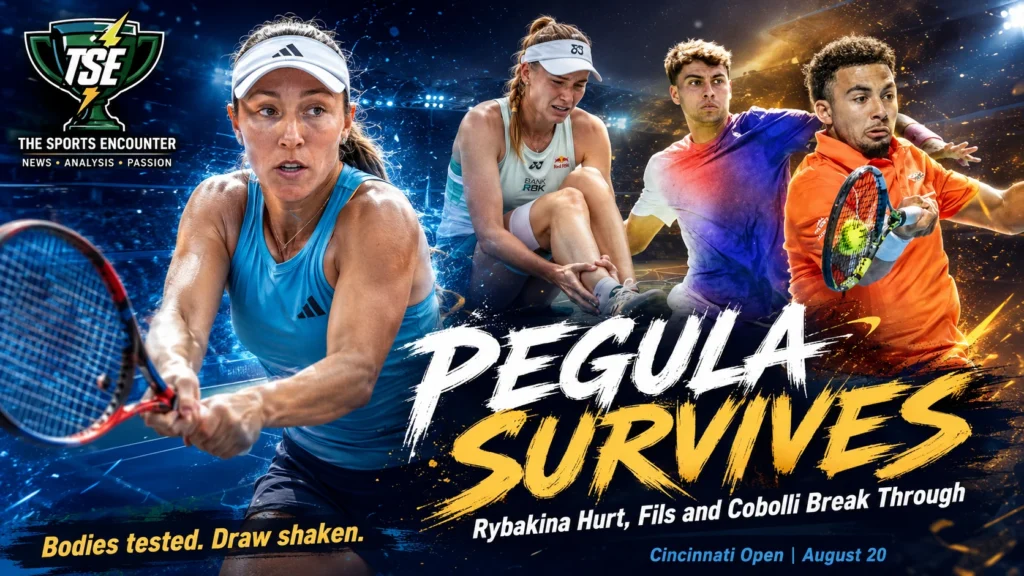
Cincinnati Open: Pegula Survives, Rybakina Injury Shakes the Draw as Fils and Cobolli Break Through
Jessica Pegula survived a three-set battle, Elena Rybakina retired with an ankle injury, and Arthur Fils and Flavio Cobolli reached major career milestones as the Cincinnati Open quarterfinals reshaped the road to the semifinals.
The Cincinnati Open quarterfinals on August 20 became as much a test of physical survival as tennis.
Jessica Pegula felt something on her serve, disappeared for a medical timeout, lost the second set and still found a way past Amanda Anisimova. Elena Rybakina could barely push off on serve before a left ankle injury ended her quarterfinal, along with her immediate chance of replacing Aryna Sabalenka as world No. 1.
On the men’s side, Flavio Cobolli looked physically drained for a set before rebuilding his energy and beating Tommy Paul, while Arthur Fils produced the cleanest performance of the day to reach his third ATP Masters 1000 semifinal of 2026.
Those four quarterfinals made August 20 one of the most revealing days of the Cincinnati Open 2026.
The previous session had already stripped the tournament of both No. 1 seeds, with Sara Bejlek stunning Aryna Sabalenka and Tommy Paul eliminating Alexander Zverev. Thursday showed what happened after the draw opened.
Opportunity was everywhere. So was physical stress.
Cincinnati Open August 20 Results at a Glance
| Event | Winner | Opponent | Score | Match Time |
|---|---|---|---|---|
| Women’s Quarterfinal | Jessica Pegula | Amanda Anisimova | 6-4, 2-6, 7-6(4) | 2h 15m |
| Women’s Quarterfinal | Iga Swiatek | Elena Rybakina | 4-1, retired | 31m |
| Men’s Quarterfinal | Flavio Cobolli | Tommy Paul | 2-6, 6-3, 6-4 | 1h 57m |
| Men’s Quarterfinal | Arthur Fils | Thiago Agustin Tirante | 6-3, 6-2 | 64m |
The four results are confirmed through the official ATP Tour Cincinnati coverage and WTA tournament reporting.
TL;DR: What Defined August 20 in Cincinnati?
- Jessica Pegula survived an injury scare and defeated Amanda Anisimova 6-4, 2-6, 7-6(4).
- Pegula improved to 6-0 against Anisimova and recorded her 100th hard-court WTA 1000 victory.
- Iga Swiatek advanced when Elena Rybakina retired with a left ankle injury while trailing 4-1.
- Rybakina’s retirement ended her chance of overtaking Aryna Sabalenka for the world No. 1 ranking before the US Open.
- Flavio Cobolli recovered from a poor opening set to beat Tommy Paul 2-6, 6-3, 6-4.
- Cobolli reached the first ATP Masters 1000 semifinal of his career.
- Arthur Fils defeated Thiago Agustin Tirante 6-3, 6-2 in just 64 minutes.
- Fils became the first Frenchman since Guy Forget in 1991 to reach three Masters 1000 semifinals in one season.
- Cobolli and Fils will meet for a place in the final, guaranteeing a first-time Masters 1000 finalist.
- Swiatek will face Pegula in a heavyweight women’s semifinal.
Jessica Pegula Survives the Match That Nearly Slipped Away
Jessica Pegula’s 6-4, 2-6, 7-6(4) victory over Amanda Anisimova contained almost every kind of pressure a player can encounter this close to a Grand Slam.
There was a physical concern.
There was a dramatic loss of momentum.
There was an opponent capable of hitting through the court when given even a small opening.
And there was a deciding tiebreak after more than two hours.
Pegula started well enough, taking the opening set 6-4, but the match changed quickly when she began feeling discomfort while serving during the second set.
She took an off-court medical timeout as Anisimova began imposing her power more effectively. The second set disappeared 6-2.
Pegula later explained through the official WTA match report that she decided to commit completely once the third set began.
“When I started the third, I was like I’m going to play full out.”
That decision changed the match again.
Pegula moved ahead 3-0 in the final set, but Anisimova refused to disappear. She recovered one break, then another, eventually leveling at 5-5.
At that stage, the contest became much more revealing than the score alone suggests.
The 27-Shot Rally That Changed the Tiebreak
One rally captured why Pegula continues to be such an uncomfortable opponent for Anisimova.
During the deciding tiebreak, the Americans traded control through a 27-shot exchange, the longest rally of the match.
Anisimova possesses greater obvious finishing power. Pegula’s strength is her ability to absorb that pace, redirect it and force the attacker to strike one more difficult ball.
Pegula won the rally.
She later won the final four points of the tiebreak.
That pattern helps explain one of the more surprising head-to-head records between elite American players: Pegula is now 6-0 against Anisimova.
Thursday also gave Pegula her 16th three-set victory of 2026.
Pegula Reaches 100 Hard-Court WTA 1000 Wins
The victory created another historical marker.
Pegula became only the second American woman since the WTA 1000 format was introduced in 2009 to reach 100 hard-court victories at this level.
The other is Serena Williams, who recorded 104.
That statistic provides useful context around Pegula’s career. She may not always generate the same attention as some of the sport’s more explosive personalities, but her consistency on elite hard courts has become historically significant.
Her Cincinnati run is also an important response to a more difficult Canadian swing, where she was among the major names eliminated during a volatile National Bank Open weekend that also removed Sabalenka.
This time, Pegula survived.
Elena Rybakina’s Ankle Changes More Than One Quarterfinal
The second women’s quarterfinal never developed into the match Cincinnati expected.
Iga Swiatek led Elena Rybakina 4-1 after 31 minutes when the Kazakh began struggling with her left ankle.
Rybakina appeared unable to push properly from the leg during her service motion. After receiving medical attention, she retired.
The most concerning detail arrived after the match.
Rybakina told WTA Communications that walking was painful and that an MRI would determine the extent of the problem.
“It’s painful to walk, and we will know more tomorrow when I do the MRI.”
Full details of the injury and Swiatek’s reaction were published by the WTA after the quarterfinal.
That makes Rybakina’s condition one of the most important fitness stories heading toward New York.
The Sports Encounter has already been tracking physical uncertainty across the Cincinnati field. Earlier in the tournament, Elina Svitolina withdrew with her own ankle problem while Brandon Nakashima produced the men’s headline result.
Several other leading players have also arrived at the final stage of the North American swing with disrupted preparation, an issue reflected in our broader analysis of Cincinnati’s early exits and physical failures.
Rybakina now joins that conversation at the worst possible point in the calendar.
Rybakina’s World No. 1 Chase Ends in Cincinnati
The ankle injury also had an immediate ranking consequence.
Aryna Sabalenka’s defeat to Sara Bejlek on August 19 had opened a path for Rybakina to become world No. 1.
Rybakina needed to reach the Cincinnati final to overtake Sabalenka.
Her quarterfinal retirement closes that path.
Sabalenka will therefore retain the No. 1 ranking heading into the US Open.
The outcome is particularly frustrating for Rybakina because her recent hard-court form had placed her close to a significant career milestone. She reached the National Bank Open semifinals in Toronto, where her comeback against Naomi Osaka helped set up a semifinal with Coco Gauff.
She then continued winning in Cincinnati.
The ranking chase ended because the body finally interrupted the run.
Iga Swiatek Advances, but Cincinnati Still Has Questions for Her
Swiatek moves into the semifinals having spent only 31 minutes on court against Rybakina.
That gives the defending champion considerably less physical wear from the quarterfinal, although the abbreviated match also denied her the elite-level test that a full contest against Rybakina would have provided.
Her form entering the semifinal remains strong.
Swiatek arrived in Cincinnati after winning the National Bank Open in Toronto and has continued building the hard-court rhythm that had been missing earlier in the year.
The Sports Encounter followed that recovery throughout Canada, including Swiatek’s controlled run into the Toronto semifinals.
She now faces Pegula.
Swiatek vs Pegula Has Genuine Semifinal Weight
Swiatek leads their career head-to-head 7-5, but Pegula has repeatedly shown that she can challenge the Pole on hard courts.
Four of Pegula’s victories in the matchup have come on the surface.
Her compact strokes, early timing and ability to redirect pace can prevent Swiatek from dominating court position as comfortably as she does against many opponents.
Swiatek, however, enters with far less physical expenditure from Thursday.
Pegula played 2 hours and 15 minutes, required treatment and endured a deciding tiebreak.
Swiatek played 31 minutes.
How Pegula’s body responds may matter as much as any tactical matchup.
Flavio Cobolli Turns Exhaustion Into His Biggest Masters Run
Flavio Cobolli looked like a player running out of fuel during the opening set against Tommy Paul.
Paul won it 6-2.
Cobolli had already survived a demanding three-set battle against Rafael Jodar the previous day, and his early movement and serving numbers reflected the accumulated effort.
He won only 46 percent of points behind his first serve in the opening set.
Then the match changed.
Cobolli improved that figure to 65 percent in the second set, won it 6-3 and eventually requested an unusual source of courtside energy: M&M’s.
The moment became an entertaining part of the broadcast, but the tennis behind it was serious.
In the deciding set, Cobolli won all 12 points when he landed his first serve.
He missed four break opportunities during the seventh game, remained composed, then created another chance at 4-4.
This time he converted.
Cobolli broke for 5-4 and served out the match.
The 2-6, 6-3, 6-4 victory took 1 hour and 57 minutes and sent the 24-year-old into the first ATP Masters 1000 semifinal of his career.
Cobolli’s Improvement Was Mental as Much as Technical
The first set offered Paul a clear route into the semifinal.
He was fresher, more stable and coming off one of the biggest victories of his season after saving match point to eliminate Zverev.
Cobolli gradually removed those advantages by improving the quality of his first serve and refusing to treat the opening set as evidence that his body had reached its limit.
That is important because his 2026 season has already pushed him into a new competitive tier.
He is now the second Italian man to reach a Cincinnati semifinal after Jannik Sinner, who reached this stage in 2024 and 2025.
Cobolli also improves to 2-0 against Paul, with both victories coming in Cincinnati.
Tommy Paul’s Zverev Victory Still Matters
Paul’s Cincinnati run ends one round after its defining moment.
That should not erase what happened against Zverev.
Paul entered the quarterfinal having saved a match point, survived rain interruptions and recovered from a set down to eliminate the men’s top seed.
That result was central to the dramatic August 19 Cincinnati round-of-16 session.
Against Cobolli, Paul controlled the first set but could not maintain the same separation once the Italian’s serve improved.
His tournament therefore ends with a frustrating quarterfinal defeat alongside valuable evidence that he can still beat one of the world’s best players immediately before the US Open.
Arthur Fils Produces the Performance of the Day
While Pegula survived, Rybakina stopped and Cobolli fought through fatigue, Arthur Fils simply took control.
The Frenchman defeated Thiago Agustin Tirante 6-3, 6-2 in 64 minutes.
It was the quickest match of the tournament to that point.
Fils never faced a break point.
He secured the decisive first-set break at 4-3, then increased the pressure in the second as his forehand repeatedly pushed Tirante away from the baseline.
Two more breaks followed.
The Argentine never found a realistic route back into the match.
Fils described the performance simply:
“I just played my best tennis and I am very happy with the performance.”
Fils Reaches a Masters Milestone France Has Waited 35 Years For
The historical significance goes beyond reaching the Cincinnati semifinals.
Fils has now reached three ATP Masters 1000 semifinals in 2026.
The last Frenchman to accomplish that in one season was Guy Forget in 1991.
Fils previously reached the semifinals in Miami and Madrid.
His 2026 record now stands at 30-10, with a Barcelona title also strengthening a season that began only after an eight-month injury layoff.
That recovery is important context.
Earlier in the North American swing, Fils had already shown flashes of his returning level. His growing presence was one of the young-player storylines tracked during the National Bank Open’s wave of upsets and emerging contenders.
Cincinnati looks considerably more convincing.
Fils is now seventh in the ATP Live Race to Turin and has placed himself firmly in contention for a first appearance at the ATP Finals.
Thiago Tirante Leaves Cincinnati With Far More Than a Quarterfinal Loss
Tirante’s tournament ends against Fils, but Cincinnati may still become one of the defining weeks of his season.
The Argentine arrived without the profile of a serious Masters title contender.
He leaves after reaching his first Masters 1000 quarterfinal and producing one of the tournament’s biggest shocks by defeating Novak Djokovic.
That Djokovic result became part of a wider early-tournament pattern examined in The Sports Encounter’s coverage of Djokovic’s Cincinnati return and US Open record chase.
Tirante also defeated Jan Choinski, Martin Landaluce and Jakub Mensik during his run.
His Cincinnati performance has lifted him to a projected career-high No. 41 in the ATP live rankings after beginning the season at No. 103.
Before 2026, Tirante had never won more than six tour-level matches in one season.
He has now won 26.
Fils ended the run decisively. The run itself deserves to survive the result.
Fils vs Cobolli Guarantees a New Masters Finalist
The first confirmed men’s semifinal is one Cincinnati could not have reasonably predicted at the beginning of the tournament.
Arthur Fils vs Flavio Cobolli.
Neither man has reached an ATP Masters 1000 final before.
One will do so in Cincinnati.
That guarantees the third first-time Masters finalist of the 2026 season, following Jiri Lehecka in Miami and Brandon Nakashima in Montreal.
The matchup also creates an intriguing contrast.
Fils arrives after spending only 64 minutes on court and never facing a break point.
Cobolli arrives after consecutive three-set battles against Jodar and Paul.
The Italian has demonstrated greater survival skills this week. The Frenchman currently looks fresher and more explosive.
That physical difference deserves as much attention as their baseline patterns when the semifinal begins.
The Hidden Story of August 20: Cincinnati Became a Fitness Test
The most revealing feature of Thursday’s four quarterfinals was the role the body played in almost every result.
Pegula experienced pain on serve and had to decide whether continuing was sensible.
Rybakina could not continue.
Cobolli entered his match depleted enough to seek an energy boost during play.
Fils, after losing eight months to injury, suddenly looked like the physically strongest player on court.
This is why Cincinnati carries unusual importance immediately before the US Open.
Ranking points and trophies matter. The tournament also exposes accumulated physical damage after Washington, Canada and weeks of summer hard-court tennis.
The Sports Encounter’s complete US Open 2026 preview identified preparation and fitness as central variables for several leading contenders. Cincinnati is now supplying much stronger evidence.
The timing is unforgiving.
Players can recover from a tactical defeat before New York.
An ankle, shoulder, back or abdominal problem follows them onto the next court.
What August 20 Changed Before the US Open
Jessica Pegula
The result strengthens her hard-court credentials, but her physical condition will be watched closely against Swiatek.
Iga Swiatek
She remains alive to defend her Cincinnati title and enters the semifinal with considerably less quarterfinal mileage than Pegula.
Elena Rybakina
Her ankle is now the biggest concern produced by Thursday’s action. The MRI matters more than the Cincinnati result.
Amanda Anisimova
Another loss to Pegula moves the head-to-head to 0-6, but her second-set level demonstrated how dangerous her first-strike tennis remains on hard courts.
Flavio Cobolli
He has reached a new Masters milestone while showing that his 2026 rise has the resilience required for difficult tournament weeks.
Arthur Fils
He may have produced the most encouraging US Open signal of the day. His movement, serve and forehand all looked sharp, and his physical recovery is increasingly translating into consistent elite results.
Tommy Paul
The Cincinnati title is gone, but the Zverev victory gives him a meaningful confidence marker before New York.
Thiago Agustin Tirante
His run ends with his ranking and reputation transformed. Cincinnati has moved him much closer to the group of players nobody will want to see early in a major draw.
What Comes Next at the Cincinnati Open?
Thursday determined only half of the singles semifinal fields.
The remaining quarterfinals continue Friday.
Women’s Quarterfinals
- Sara Bejlek vs Madison Keys
- Coco Gauff vs Marta Kostyuk
Men’s Quarterfinals
- Taylor Fritz vs Brandon Nakashima
- Lorenzo Musetti vs Frances Tiafoe
The Fritz-Nakashima matchup guarantees another American men’s semifinalist. Fritz entered Cincinnati carrying the confidence of his Washington championship, where he defeated Rafael Jodar to win the Mubadala DC Open title.
The tournament itself began with a fascinating mixture of returning stars, young players and veterans, something reflected in our early look at the Cincinnati Open wildcard field.
Much of that original hierarchy has disappeared.
The closing weekend now belongs to whoever has survived it.
TSE Verdict: August 20 Exposed the Cost of Reaching the End of the Summer Swing
The scoreboard says Pegula, Swiatek, Cobolli and Fils reached the Cincinnati Open semifinals.
The matches told us considerably more.
Pegula found another way through a match that became physically uncomfortable. Rybakina’s ranking chase ended with an injury serious enough to make walking painful. Cobolli turned visible fatigue into the biggest Masters result of his career. Fils produced 64 minutes of tennis that made his long injury absence feel increasingly distant.
The pattern matters because Cincinnati sits at the point where preparation and accumulation collide.
Players want matches before the US Open.
They also need enough of their bodies left to survive New York.
August 20 provided both sides of that equation.
Pegula survived.
Rybakina could not.
Cobolli recovered.
Fils looked ready for more.
That may be the most useful Cincinnati Open result of all.
Frequently Asked Questions
Who won at the Cincinnati Open on August 20, 2026?
Jessica Pegula, Iga Swiatek, Flavio Cobolli and Arthur Fils advanced from the four singles quarterfinals played on August 20.
What was the Jessica Pegula vs Amanda Anisimova score?
Pegula defeated Anisimova 6-4, 2-6, 7-6(4) in 2 hours and 15 minutes.
Is Jessica Pegula injured?
Pegula experienced discomfort while serving and took an off-court medical timeout against Anisimova. She continued playing and said the issue improved during the third set. Her condition will remain worth monitoring ahead of the semifinal.
Why did Elena Rybakina retire against Iga Swiatek?
Rybakina retired because of a left ankle injury while trailing Swiatek 4-1 in the first set. She later said walking was painful and planned to undergo an MRI.
Can Elena Rybakina still become world No. 1 after Cincinnati?
No. Rybakina needed to reach the Cincinnati final to overtake Aryna Sabalenka before the US Open. Her quarterfinal retirement ended that possibility, so Sabalenka will retain the No. 1 ranking heading into New York.
Who will Iga Swiatek play in the Cincinnati semifinal?
Swiatek will face Jessica Pegula for a place in the women’s singles final.
What is the Swiatek vs Pegula head-to-head record?
Swiatek leads Pegula 7-5 overall. Pegula has won four of their meetings on hard courts.
Who did Flavio Cobolli beat in the Cincinnati quarterfinal?
Cobolli recovered from losing the opening set to defeat Tommy Paul 2-6, 6-3, 6-4 and reach his first ATP Masters 1000 semifinal.
Who will Flavio Cobolli play next?
Cobolli will face Arthur Fils. Neither player has previously reached a Masters 1000 final, so Cincinnati is guaranteed another first-time finalist.
What was the Arthur Fils vs Thiago Tirante score?
Fils defeated Tirante 6-3, 6-2 in 64 minutes and did not face a break point.
What record did Arthur Fils set in Cincinnati?
Fils became the first Frenchman since Guy Forget in 1991 to reach three ATP Masters 1000 semifinals in a single season.
Which Cincinnati Open quarterfinals remain?
Sara Bejlek faces Madison Keys, Coco Gauff plays Marta Kostyuk, Taylor Fritz meets Brandon Nakashima and Lorenzo Musetti faces Frances Tiafoe in the remaining quarterfinals.

Breaking News
Brandon Nakashima Knocks Out Taylor Fritz in Cincinnati Thriller to Reach Semifinals
Brandon Nakashima survived an 11-9 opening tiebreak, absorbed Taylor Fritz’s second-set response and won the decider 6-3 to reach the Cincinnati Open semifinals and extend the best run of his career.
CINCINNATI, Ohio, August 22, 2026: Brandon Nakashima has turned the North American hard-court summer into the defining stretch of his career.
Two weeks after reaching his first ATP Masters 1000 final in Montreal, the 25-year-old American produced another major result on home soil, defeating sixth seed Taylor Fritz 7-6(11-9), 4-6, 6-3 in a tense Cincinnati Open quarterfinal.
The victory sends Nakashima into the semifinals at the Lindner Family Tennis Center and removes one of the highest-ranked players remaining in a men’s draw that has already lost Alexander Zverev, Novak Djokovic, Daniil Medvedev, Felix Auger-Aliassime and several other established contenders.
For Fritz, the defeat is particularly painful because he had successfully dragged the match into a deciding set after losing an extraordinary opening tiebreak. For Nakashima, it represents another sign that his recent surge has moved beyond a temporary hot streak.
He has now beaten Daniil Medvedev and Fritz during the same Cincinnati campaign after arriving in Ohio with confidence from his breakthrough run in Montreal.
The Sports Encounter has followed that rise throughout the summer, including Nakashima’s run to his first Masters 1000 final in Montreal, where his aggressive baseline tennis and improved willingness to finish points at the net began changing the ceiling of his game.
Taylor Fritz vs Brandon Nakashima: Cincinnati Quarterfinal Result
| Player | Set 1 | Set 2 | Set 3 |
|---|---|---|---|
| Taylor Fritz [6] | 6 (9) | 6 | 3 |
| Brandon Nakashima [27] | 7 (11) | 4 | 6 |
Winner: Brandon Nakashima
Final score: 7-6(11-9), 4-6, 6-3
Round: Men’s singles quarterfinal
Tournament: Cincinnati Open 2026
Surface: Outdoor hard court
Venue: Lindner Family Tennis Center
The official ATP Cincinnati tournament page lists the event as one of the season’s premier Masters 1000 tournaments, with the 2026 edition running through August 23.
A 20-Point Tiebreak Sets the Tone
The opening set immediately established what kind of match this would become.
Neither American was prepared to surrender control on serve, and the first set eventually moved into a tiebreak where the pressure continued to build long after the normal seven-point finish line had passed.
Fritz reached nine points.
Nakashima reached 11.
That 11-9 tiebreak gave Nakashima the opening set and placed Fritz in the uncomfortable position of having to chase a match against an opponent whose confidence has been growing almost every week.
Fast hard courts suit both players. Fritz possesses one of the most effective first-serve and forehand combinations in American tennis, while Nakashima has increasingly learned how to take the ball earlier and prevent opponents from settling into defensive patterns.
That made the first set less about extended control from the baseline and more about who could handle the small moments around serve, return depth and first-strike execution.
Nakashima handled the decisive points better.
Fritz Refuses to Let the Match Escape
Fritz entered Cincinnati with reasons to trust himself in difficult matches.
Earlier this month, he defeated Nakashima in three sets in the Washington semifinals before going on to win the Mubadala DC Open title.
The Sports Encounter documented that run in our report on Fritz’s Washington championship, where he repeatedly recovered from momentum shifts before defeating Rafael Jodar in the final.
That resilience appeared again in Cincinnati.
After losing such a punishing opening tiebreak, Fritz could easily have allowed frustration to carry into the second set.
Instead, he reset.
The sixth seed protected his service games more efficiently, maintained pressure on Nakashima’s second serve and eventually created enough separation to take the set 6-4.
The match had become exactly what the quarterfinal deserved: a one-set shootout between two Americans arriving in Cincinnati through very different paths.
Nakashima Has Learned How to Survive Deciding Sets
The third set provided another test of the quality that has increasingly defined Nakashima’s summer.
He does not disappear when matches become uncomfortable.
That was visible against Medvedev earlier in Cincinnati.
Nakashima lost the opening set in a tiebreak and then faced three consecutive match points in the second. He saved all three, won another tiebreak and overwhelmed the former US Open champion 6-1 in the deciding set.
Reuters described the result as one of the biggest wins of Nakashima’s season, while the victory extended a run that had already taken him to the Washington semifinals and his first Masters final in Montreal.
The Sports Encounter had already tracked Nakashima’s growing confidence during the Canadian swing, including his progression through a chaotic Montreal draw in our National Bank Open tournament coverage.
Against Fritz, the deciding set again demanded composure.
Nakashima found it.
He secured the separation he needed and protected it through the closing stages, completing the set 6-3 and earning another Masters 1000 semifinal.
Washington Belonged to Fritz. Cincinnati Belongs to Nakashima
The result also gives this emerging American rivalry a useful new chapter.
Only three weeks ago, Fritz beat Nakashima 6-3, 3-6, 6-3 in Washington.
The circumstances were similar.
Three sets.
Hard court.
A place in a major final at stake.
Fritz won that meeting and then lifted the trophy.
Cincinnati produced the reversal.
Nakashima won the first set, Fritz responded in the second, but this time the younger-ranked American controlled the deciding set.
That does not suddenly make Nakashima the stronger player overall. Fritz remains the more established Top 10-level performer, owns considerably more tour-level success and has already reached a US Open final.
What Cincinnati demonstrates is that the gap between them has narrowed.
Nakashima’s Summer Has Changed His Place in American Tennis
At the beginning of the summer, American men’s tennis conversations still tended to begin with Fritz, Ben Shelton, Tommy Paul and Frances Tiafoe.
Nakashima has forced his way into that group.
He reached the Queen’s Club semifinals after beating Alex de Minaur.
He made another semifinal in Washington.
He then produced the biggest tournament run of his career in Montreal, defeating Rafael Jodar in the semifinals to reach his first Masters 1000 final.
The Sports Encounter’s Montreal semifinal report highlighted how Nakashima had started taking the ball more aggressively from the baseline while also moving forward more confidently.
The official Cincinnati Open also noted before this tournament that Nakashima had begun working with former world No. 6 Wayne Ferreira in June.
That partnership appears to be accelerating several parts of his game.
Ferreira has encouraged Nakashima to move forward more often rather than relying almost exclusively on clean baseline patterns.
“Even if I lose some points here and there, just making the effort of coming forward and trying to finish points at the net I think is good for my game,” Nakashima told the official Cincinnati Open website earlier this week.
Medvedev, Borges and Fritz: This Was No Soft Route
Nakashima has earned this semifinal through a demanding part of the draw.
His third-round victory over Daniil Medvedev required him to save three match points.
He then defeated Nuno Borges 6-3, 6-7(5), 6-3 in the fourth round.
Fritz presented a different problem.
Medvedev tries to extend rallies and disrupt rhythm.
Fritz attacks much earlier and can make entire service games disappear quickly when his first delivery is working.
Nakashima has now solved both types of opponent during the same tournament.
That versatility is one reason his Cincinnati run feels more significant than a sequence built around favorable matchups.
Fritz’s Defeat Changes the American Hierarchy in Cincinnati
Cincinnati reached the quarterfinal stage with four American men still alive: Fritz, Nakashima, Tommy Paul and Frances Tiafoe.
The tournament’s official website noted that four American men had not reached the Cincinnati final eight together since 1995.
Paul was eliminated by Flavio Cobolli in another three-set quarterfinal, losing 2-6, 6-3, 6-4.
Fritz has now followed him out.
Tiafoe still has his quarterfinal against Lorenzo Musetti to play, while Nakashima has guaranteed that at least one American will appear in the semifinals.
That becomes particularly important during a summer when US men are again searching for someone capable of converting strong Masters performances into a genuine Grand Slam challenge.
The US Open Context Makes This Victory Bigger
The timing could hardly be better for Nakashima.
The US Open begins immediately after Cincinnati, and the men’s draw has changed dramatically in recent days.
World No. 1 Jannik Sinner has withdrawn because of a persistent right knee injury.
Carlos Alcaraz is returning from a long injury absence.
Novak Djokovic has endured fitness and heat problems.
Several other leading players have struggled for consistency during the North American swing.
The Sports Encounter’s complete US Open 2026 preview identified Fritz as America’s most established men’s contender entering the summer.
Nakashima is now creating a reason to expand that conversation.
He does not need to be called a US Open favorite for this run to matter.
Players who arrive in New York with confidence, clean serving mechanics and recent experience surviving long three-set battles can become exceptionally dangerous during the opening week.
Fritz Still Heads to New York With a Strong Summer Behind Him
The loss should not erase what Fritz has accomplished.
He won Washington.
He reached another Masters 1000 quarterfinal in Cincinnati.
His serve remains one of the most damaging weapons in the men’s field, and his experience gives him advantages Nakashima is still developing.
The question now becomes physical and emotional recovery.
Fritz dealt with chronic knee tendinitis earlier this season, an issue that kept him away from much of the clay swing and returned during Wimbledon.
The official Cincinnati Open highlighted those fitness concerns before the tournament.
With the US Open approaching, there is little value in treating this defeat as a crisis.
Fritz’s bigger objective begins in New York.
Nakashima’s Ranking Rise Is No Longer the Main Story
Nakashima entered Cincinnati at a career-high ranking around No. 22.
Those numbers will continue improving if he keeps reaching the closing rounds of Masters tournaments.
But the more important development is qualitative.
His game is starting to look more complete.
The serve has always been clean.
The backhand has always been reliable.
His court positioning has generally been disciplined.
The missing piece was often aggression at the right moments.
Nakashima could play high-quality tennis without consistently forcing opponents out of their comfort zone.
This summer has looked different.
He is taking larger cuts at second serves, stepping inside the baseline more willingly and finishing more points in the forecourt.
That makes his natural consistency far more dangerous.
The Montreal Final Was a Breakthrough. Cincinnati Is Confirmation.
One deep Masters run can happen through form, draw circumstances and momentum.
Doing it again immediately is harder.
Nakashima arrived in Cincinnati only days removed from the biggest tournament of his career.
There was every possibility of an emotional drop.
Instead, he has beaten Medvedev, survived Borges and now eliminated Fritz.
The Sports Encounter noted during Montreal’s quarterfinal stage that Nakashima was part of a younger group beginning to exploit opportunities created by an unstable ATP hierarchy.
Cincinnati suggests he may be doing more than exploiting openings.
He is starting to create them himself.
Who Will Brandon Nakashima Play Next?
Nakashima will face the winner of the remaining quarterfinal between Lorenzo Musetti and Frances Tiafoe.
Both would present very different challenges.
Musetti brings greater variety, changes pace more naturally and can disrupt Nakashima’s preferred baseline rhythm with angles, slice and movement into the forecourt.
Tiafoe would create another all-American matchup and a completely different kind of atmosphere.
The 2024 Cincinnati finalist has been one of the tournament’s most consistent performers this week and remains dangerous when his serve and forehand begin feeding off crowd energy.
The other semifinal is already set between Flavio Cobolli and Arthur Fils.
Cobolli recovered from a set down to defeat Tommy Paul 2-6, 6-3, 6-4, while Fils dominated Thiago Agustin Tirante 6-3, 6-2.
Cincinnati’s Men’s Draw Has Completely Escaped Its Original Script
Look at the tournament before the first ball was struck.
Alexander Zverev was the top seed.
Felix Auger-Aliassime was seeded second.
Daniil Medvedev, Alex de Minaur, Ben Shelton, Novak Djokovic and Taylor Fritz all appeared capable of reaching the weekend.
Now Cobolli, Fils and Nakashima are already in the semifinals, while Musetti or Tiafoe will complete the final four.
The wider upheaval reflects what has been happening throughout the North American swing.
The Sports Encounter explored the same instability during the National Bank Open quarterfinal stage, where established contenders disappeared and younger players received opportunities to redefine the tournament.
Cincinnati has followed the same theme.
TSE Analysis: Nakashima Won Because He No Longer Needs the Match to Stay Comfortable
That may be the biggest difference between the current Brandon Nakashima and earlier versions of him.
His tennis used to look best when the match stayed orderly.
Clean service games.
Predictable baseline patterns.
Controlled exchanges.
The last two weeks have been anything but orderly.
He saved three match points against Medvedev.
He survived a three-set battle with Borges.
Against Fritz, he endured a 20-point opening tiebreak, lost the second set and still recovered strongly enough to take the deciding set 6-3.
Those experiences matter because Masters 1000 and Grand Slam success eventually requires players to win matches when their preferred pattern disappears.
Nakashima is doing that now.
The First-Set Tiebreak May Have Been the Match
The scoreboard says the match lasted three sets.
The psychological center of it may have been the opening breaker.
Winning an 11-9 tiebreak against a server as dangerous as Fritz requires repeated emotional resets.
A set point can disappear with one serve.
A return opportunity may not come back.
Every mini-break feels temporary.
Nakashima survived that sequence and took the set.
Fritz deserves considerable credit for responding by winning the second, but the tiebreak ensured Nakashima never had to chase the match from behind.
When the third set began, both players effectively entered a fresh contest.
Nakashima handled it better.
What This Means for Brandon Nakashima
- He has reached another ATP Masters 1000 semifinal immediately after making the Montreal final.
- He has defeated Daniil Medvedev and Taylor Fritz during the same Cincinnati run.
- He has strengthened his position among the leading American hard-court players.
- He enters the final days before the US Open with arguably the strongest sustained form of his career.
- He is now two victories away from his first Masters 1000 title.
What This Means for Taylor Fritz
- His Cincinnati title hopes end in the quarterfinals.
- His North American summer still includes the Washington Open championship.
- Recovery becomes the priority before the US Open.
- His position as one of America’s leading Grand Slam hopes remains intact, although Nakashima’s rise adds another credible name to the conversation.
Final Verdict
Three weeks ago in Washington, Taylor Fritz had the final answer.
In Cincinnati, Brandon Nakashima found his own.
The 27th seed survived an extraordinary 11-9 opening tiebreak, watched Fritz force the match into a third set, then played the cleaner tennis when the quarterfinal finally reached its decisive phase.
7-6(11-9), 4-6, 6-3.
Another top player is gone from Cincinnati.
Nakashima is still standing.
After Washington, Montreal and now Cincinnati, his summer can no longer be described as a promising run of form.
It has become a genuine breakthrough.
One semifinal remains between him and another Masters 1000 final.
One week remains before the US Open.
Brandon Nakashima could hardly be arriving in New York with more momentum.
Frequently Asked Questions
Who won Taylor Fritz vs Brandon Nakashima at the Cincinnati Open?
Brandon Nakashima defeated Taylor Fritz 7-6(11-9), 4-6, 6-3 in the men’s singles quarterfinals.
What happened in the first-set tiebreak?
Nakashima won an extended tiebreak 11-9 to take the opening set 7-6.
Did Taylor Fritz win a set?
Yes. Fritz responded after losing the opening set and took the second 6-4 before Nakashima won the deciding set 6-3.
Who will Brandon Nakashima play in the Cincinnati semifinal?
Nakashima will face the winner of Lorenzo Musetti vs Frances Tiafoe.
Who is playing in the other Cincinnati men’s semifinal?
Flavio Cobolli will face Arthur Fils in the other semifinal.
Did Fritz and Nakashima play earlier in 2026?
Yes. Fritz defeated Nakashima in three sets in the Washington semifinals earlier in August before going on to win the title.
How far did Nakashima go in Montreal?
Nakashima reached his first ATP Masters 1000 final at the 2026 National Bank Open in Montreal.
Who has Nakashima beaten in Cincinnati?
His run has included a major victory over Daniil Medvedev, a three-set win over Nuno Borges and the quarterfinal victory over Taylor Fritz.
When is the Cincinnati Open men’s final?
The 2026 Cincinnati Open concludes on August 23.
Breaking News
Sara Bejlek Survives Madison Keys to Muscle Into Cincinnati Semifinals
Sara Bejlek survived a wild Madison Keys comeback, recovered from losing a 4-0 lead in the deciding set, and won a tense final-set tiebreak to reach the Cincinnati Open semifinals.
CINCINNATI, Ohio, August 21, 2026: Sara Bejlek has spent this week proving that she belongs on the same court as the biggest names in women’s tennis. Against Madison Keys, she had to prove something harder.
She had to prove she could survive herself.
The 20-year-old Czech recovered from the collapse of a 4-0 lead in the deciding set, absorbed a furious Madison Keys comeback, fell behind twice in the final tiebreak and still found enough nerve to win one of the most dramatic matches of the 2026 Cincinnati Open.
Bejlek defeated Keys 3-6, 6-4, 7-6(7-5) to reach the semifinals of a WTA 1000 event for the first time in her career.
The final score captures the length of the battle. It does not fully explain the chaos inside it.
Bejlek led 4-0 in the third set and appeared to have broken the resistance of the 2019 Cincinnati champion. Keys then won four straight games to make it 4-4. Bejlek steadied herself to move ahead 5-4 and later 6-5, but Keys refused to disappear and forced a deciding tiebreak.
There, Keys built leads of 4-2 and 5-4. Bejlek responded again. She won three of the final four points and closed the match 7-5 in the breaker, completing a victory that demanded much more than the fearless tennis that had already taken her past world No. 1 Aryna Sabalenka.
For continuing tournament coverage, match analysis and player stories, visit The Sports Encounter Tennis Hub.
Bejlek vs Keys: Cincinnati Open Quarterfinal Result
| Player | Set 1 | Set 2 | Set 3 |
|---|---|---|---|
| Sara Bejlek | 3 | 6 | 7 (7) |
| Madison Keys | 6 | 4 | 6 (5) |
Winner: Sara Bejlek
Final score: 3-6, 6-4, 7-6(7-5)
Round: Women’s singles quarterfinal
Tournament: Cincinnati Open 2026
Surface: Outdoor hard court
Venue: Lindner Family Tennis Center, Ohio
Keys Took Control Before Bejlek Changed the Match
Keys began the match looking like the player who had been here before.
The American carried the bigger reputation, home support and the experience of winning Cincinnati in 2019. Her first-strike tennis gave Bejlek less time to settle, and the opening set moved in Keys’ direction before she closed it 6-3.
That start mattered because Bejlek entered the quarterfinal carrying the emotional weight of the biggest victory of her career.
Only one round earlier, she had stunned Aryna Sabalenka 7-6(9-7), 6-4. The WTA described that victory as Bejlek’s first against a world No. 1 and her first Top 10 win. It also sent her into her first WTA 1000 quarterfinal. :contentReference[oaicite:0]{index=0}
The danger after an upset of that magnitude is obvious. Young players can spend so much emotional energy beating a superstar that the next match becomes harder than the previous one.
Bejlek avoided that trap.
She became more secure in the second set, extended rallies more effectively and prevented Keys from dictating every important exchange. The Czech took the set 6-4 and pushed the quarterfinal into a decider.
A 4-0 Lead Looked Like the Beginning of the End
The first four games of the third set suggested Bejlek was about to complete the job quickly.
She surged to a 4-0 lead.
Keys was suddenly chasing the score, the younger player had the rhythm and Bejlek appeared to have removed much of the uncertainty from a match that had been finely balanced for two sets.
Then the entire quarterfinal changed.
Keys began to shorten points more effectively, protected her serve and forced Bejlek to hit extra balls under growing scoreboard pressure.
One game became two.
Two became three.
Then Keys reached 4-4.
The four-game cushion was gone.
What had looked like Bejlek’s breakthrough moment was suddenly becoming a test of how she would respond to losing control of a match she could almost touch.
Keys’ Comeback Turned the Quarterfinal Into a Cincinnati Classic
Keys deserves enormous credit for what happened next.
Many players would have mentally accepted the result at 0-4 in the deciding set. Keys instead forced the match back into a contest point by point.
Her service games became cleaner. Her confidence returned. Bejlek began having to solve the same pressure repeatedly.
At 4-4, the momentum had moved almost entirely toward the American.
Bejlek responded with one of the most important holds of the match to lead 5-4.
Keys answered.
At 5-5, Bejlek was pushed through another difficult service game but survived again to reach 6-5.
That meant Keys had to serve to stay in the tournament.
She did.
The 20th seed held from 40-30 and forced the deciding set to 6-6.
By then, the quarterfinal had stopped feeling like a standard WTA 1000 match. The momentum had flipped too many times. Both players had been close to control without ever keeping it for long enough.
The Tiebreak Delivered One Final Swing
The deciding tiebreak matched everything that came before it.
Keys moved ahead 4-2.
At that point, Bejlek had already lost her 4-0 third-set lead and was now two points behind in the final breaker. The match appeared to be tilting toward the American again.
Bejlek pulled it back to 4-4.
Keys went ahead 5-4.
Bejlek answered once more.
At 5-5, the match had essentially become a two-point contest after nearly three sets of emotional turbulence.
Bejlek won the next point to earn match point at 6-5.
This time, she finished it.
The 7-5 tiebreak victory completed a match that demanded several recoveries within the same set.
Why This Win Says More About Bejlek Than the Sabalenka Upset
Beating Sabalenka announced Bejlek to a much wider tennis audience.
Beating Keys may tell us more about her.
The victory over Sabalenka was built on courage, clean execution and Bejlek’s ability to absorb elite pace. Reuters reported that she recovered from difficult positions in both sets before completing the biggest win of her career. :contentReference[oaicite:1]{index=1}
The Keys match asked a different question.
Could Bejlek keep thinking clearly after watching a huge lead disappear?
Could she avoid panic when the crowd sensed an American comeback?
Could she recover after falling behind in the tiebreak?
She answered yes every time.
That does not mean every decision was perfect. The third-set lead disappeared for a reason. Bejlek became vulnerable once Keys began attacking with greater freedom, and the Czech will know she cannot repeatedly surrender large advantages against elite opponents.
What matters is what happened afterward.
She did not mentally leave the match.
Bejlek’s Cincinnati Run Has Become One of the Tournament’s Biggest Stories
The quarterfinal victory extends a remarkable sequence for the Czech left-hander.
Bejlek opened her Cincinnati campaign by demolishing former world No. 1 Karolina Pliskova 6-0, 6-2. She then defeated former French Open champion Barbora Krejcikova 7-6(7-5), 6-4. :contentReference[oaicite:2]{index=2}
Ekaterina Alexandrova pushed her harder in the third round, taking the opening set before Bejlek recovered to win 4-6, 6-1, 6-2.
Then came Sabalenka.
The world No. 1 had arrived in Cincinnati as one of the central figures in the hard-court season, but Bejlek removed her in straight sets. Reuters described the result as the Czech player’s first Top 10 victory. :contentReference[oaicite:3]{index=3}
The Sports Encounter has followed the volatile North American hard-court season closely. Sabalenka had already suffered a significant setback in Toronto, where Ekaterina Alexandrova eliminated her during a weekend that also sent Jessica Pegula out of the tournament. Our National Bank Open report on Sabalenka and Pegula’s exits examined how rapidly the women’s hierarchy was shifting before Cincinnati.
Bejlek has now pushed that story much further.
From Toronto Defeat to Cincinnati Breakthrough
There is another detail that makes Bejlek’s run more impressive.
Earlier this month, Iga Swiatek beat her 6-0, 6-3 at the National Bank Open.
The Sports Encounter’s Toronto Day 4 report documented how Swiatek won the first nine games before Bejlek finally made the match competitive.
That result came only weeks ago.
Since then, Bejlek has gone from being overwhelmed by one elite opponent to beating several established players in the same WTA 1000 event.
The improvement is not linear, and one tournament should never be treated as proof that a player has permanently entered the elite. Still, Cincinnati has provided something tangible: Bejlek can now point to victories over major champions, experienced hard-court players and the world No. 1 within the same week.
Keys Leaves Cincinnati After One of Her Best Fights of the Tournament
Keys will leave disappointed, but this was not a passive defeat.
She entered the quarterfinal after beating Xiyu Wang 7-6(7-3), 6-4. That victory had taken the former Cincinnati champion into her first quarterfinal here since 2022. :contentReference[oaicite:4]{index=4}
Against Bejlek, Keys repeatedly created a route back into the match.
She won the first set.
She recovered from 0-4 in the third.
She held at 5-6 when defeat was one poor game away.
She led 4-2 in the deciding tiebreak.
Then she led 5-4.
There were enough opportunities to win this quarterfinal. Bejlek simply played the final pressure points better.
Bejlek Now Awaits Coco Gauff or Marta Kostyuk
Bejlek’s semifinal opponent will come from the remaining quarterfinal between Coco Gauff and Marta Kostyuk.
The official tournament bracket places the winner of that match against Bejlek, while the opposite semifinal has already been established between Jessica Pegula and Iga Swiatek.
Pegula reached the last four by surviving Amanda Anisimova 6-4, 2-6, 7-6(7-4). Swiatek advanced after Elena Rybakina retired while trailing 4-1 because of injury. :contentReference[oaicite:5]{index=5}
The contrast between the two semifinals is fascinating.
Swiatek and Pegula bring established WTA 1000 experience.
Bejlek arrives as the breakthrough player nobody expected to be here.
For additional context on the women’s hard-court picture, The Sports Encounter’s analysis of Swiatek’s Toronto semifinal run and our report on Gauff and Rybakina reaching the Toronto semifinals show how strongly several of the same contenders have carried their form into Cincinnati.
Bejlek’s Mental Recovery Was the Real Difference
The final set can be divided into three distinct phases.
| Phase | What Happened | Why It Mattered |
|---|---|---|
| Bejlek surge | Bejlek raced to 4-0 | She appeared to have complete control of the deciding set |
| Keys comeback | Keys won four straight games to reach 4-4 | Momentum and crowd energy shifted sharply |
| Pressure finish | Keys led 4-2 and 5-4 in the tiebreak | Bejlek had to recover again before winning 7-5 |
The biggest mistake would be to describe Bejlek’s victory as comfortable because she once led 4-0.
It was anything but comfortable.
Her advantage disappeared. Keys had the emotional lift. The tiebreak moved against her.
Bejlek kept finding enough control to win the next important point.
The US Open Has Another Name to Watch
Cincinnati is one of the final major checkpoints before the US Open, and Bejlek has transformed her profile at exactly the right time.
The Sports Encounter’s US Open 2026 preview outlined a women’s field already filled with established champions, dangerous hard-court players and rising contenders.
Bejlek now belongs in the conversation around players capable of creating problems in New York.
That does not make her a title favorite.
It does mean seeded players will have noticed what happened in Cincinnati.
She has beaten Pliskova, Krejcikova, Alexandrova, Sabalenka and Keys in succession.
That is not a soft path into a semifinal.
Cincinnati Has Rewarded Players Who Survive Chaos
The wider North American swing has been unusually unforgiving to established names.
Toronto had already produced repeated upsets and sudden momentum shifts, a pattern detailed in The Sports Encounter’s National Bank Open wrap-up on falling favorites and emerging stars.
Cincinnati has continued that theme.
Sabalenka is out.
Rybakina is out through injury.
Keys is out after coming within a handful of points of the semifinal.
Bejlek is still standing.
The official Cincinnati Open tournament page provides updated draws, scheduling and event information, with the women’s semifinals scheduled for Saturday and the final on Sunday. :contentReference[oaicite:6]{index=6}
TSE Analysis: Bejlek Did Not Win Because She Stayed Calm All Night
That would be too simple.
She lost control of the match.
She tightened.
Keys took advantage.
The 4-0 lead disappeared because the pressure changed how both players were striking the ball.
What separates this victory from a routine upset is that Bejlek recovered after the damage had already been done.
At 4-4, she could have folded.
At 4-2 down in the tiebreak, she could have rushed.
At 5-4 down, she could have started thinking about the lead she had wasted.
Instead, she kept playing the next point.
That is why this match matters.
The Sabalenka victory showed that Bejlek can beat the best player in the world.
The Keys victory showed that she can survive the emotional consequences of almost throwing a huge match away.
Those are two very different forms of confidence.
What Comes Next for Sara Bejlek?
The immediate answer is another semifinal, and potentially another huge name.
If Gauff advances, Bejlek will face one of the quickest defenders and strongest returners in women’s tennis.
If Kostyuk wins, the matchup becomes a different kind of test built around aggressive baseline exchanges and the ability to control court position.
Either opponent will force Bejlek to raise her level again.
There is also a broader challenge.
The emotional energy required to beat Sabalenka and then survive Keys is substantial. Bejlek has already played five matches in Cincinnati and has spent increasingly long stretches operating under intense pressure.
The semifinal will reveal whether the breakthrough still has another chapter.
Final Verdict
Sara Bejlek arrived in Cincinnati as a talented 20-year-old with a WTA title and growing potential.
She is leaving the quarterfinal stage as one of the central stories of the tournament.
Beating Sabalenka gave her the headline.
Surviving Keys gave the run substance.
A 4-0 lead disappeared. A former Cincinnati champion came roaring back. Keys moved ahead twice in the deciding tiebreak.
Bejlek still won.
3-6, 6-4, 7-6(7-5).
That score will send her into the record books as a Cincinnati semifinalist.
The way she reached it is what people who watched the match will remember.
Frequently Asked Questions
Who won Sara Bejlek vs Madison Keys at the Cincinnati Open?
Sara Bejlek defeated Madison Keys 3-6, 6-4, 7-6(7-5) in the women’s singles quarterfinals.
Did Bejlek lead 4-0 in the deciding set?
Yes. Bejlek raced to a 4-0 lead before Keys won four straight games to level the third set at 4-4.
What happened in the final tiebreak?
Keys led 4-2 and later 5-4, but Bejlek recovered, moved ahead 6-5 and converted the match point to win the breaker 7-5.
Who will Sara Bejlek play in the Cincinnati semifinal?
Bejlek will face the winner of the quarterfinal between Coco Gauff and Marta Kostyuk.
Who did Bejlek beat before Madison Keys?
Bejlek defeated world No. 1 Aryna Sabalenka 7-6(9-7), 6-4 in the round of 16.
Is this Bejlek’s first WTA 1000 semifinal?
Yes. Cincinnati marks Bejlek’s first appearance in a WTA 1000 semifinal.
How old is Sara Bejlek?
Bejlek is 20 years old and represents the Czech Republic.
When are the Cincinnati Open semifinals?
The tournament schedule lists the semifinals for Saturday, August 22, with the finals scheduled for Sunday, August 23.
Cincinnati Open
Cincinnati Open 2026: Bejlek Shocks Sabalenka, Paul Stuns Zverev as QFs Take Shape
The Cincinnati Open lost both top singles seeds on August 19 as Sara Bejlek stunned Aryna Sabalenka and Tommy Paul saved match point to beat Alexander Zverev. Swiatek, Rybakina, Gauff, Pegula, Fritz and Tiafoe also advanced as the quarterfinal fields took shape.
The Cincinnati Open needed one day to lose both of its top singles seeds.
By the end of the August 19 round-of-16 schedule, Aryna Sabalenka and Alexander Zverev were gone, Sara Bejlek had produced the biggest win of her young career, Tommy Paul had saved a match point to knock out the men’s No. 1 seed, and the American challenge had grown considerably stronger across both draws.
What began as a full day of fourth-round tennis at the Lindner Family Tennis Center gradually became a tournament reset.
Bejlek stunned Sabalenka 7-6(7), 6-4 to reach her first Cincinnati quarterfinal and record her first Top 10 win. Paul recovered from a set down and saved a match point before beating Zverev 4-6, 7-6(6), 6-4. Coco Gauff, Jessica Pegula, Madison Keys, Amanda Anisimova, Taylor Fritz and Frances Tiafoe all advanced as the home contingent survived one of the most important days of the tournament.
Iga Swiatek and Elena Rybakina also moved through comfortably, keeping alive one of the most significant women’s quarterfinals of the week and leaving the world No. 1 ranking in play.
The August 19 schedule was officially devoted entirely to the round of 16, with both the men’s and women’s draws playing for quarterfinal places. The tournament runs through August 23 and remains the final combined ATP and WTA 1000 stop before the US Open.
For continuing scores, player stories and tournament analysis, follow The Sports Encounter’s tennis coverage.
Cincinnati Open August 19 Results at a Glance
Women’s Round of 16
| Winner | Opponent | Score |
|---|---|---|
| Iga Swiatek | Diane Parry | 6-3, 6-3 |
| Jessica Pegula | Sorana Cirstea | 6-2, 4-6, 7-5 |
| Marta Kostyuk | Mirra Andreeva | 4-6, 6-0, 6-2 |
| Amanda Anisimova | Linda Noskova | 6-1, 6-4 |
| Elena Rybakina | Diana Shnaider | 6-4, 6-4 |
| Coco Gauff | Marie Bouzkova | 6-3, 6-2 |
| Madison Keys | Wang Xiyu | 7-6(3), 6-4 |
| Sara Bejlek | Aryna Sabalenka | 7-6(7), 6-4 |
Men’s Round of 16
| Winner | Opponent | Score |
|---|---|---|
| Flavio Cobolli | Rafael Jodar | 4-6, 7-6(3), 6-3 |
| Thiago Agustin Tirante | Jakub Mensik | 5-7, 6-4, 6-4 |
| Tommy Paul | Alexander Zverev | 4-6, 7-6(6), 6-4 |
| Arthur Fils | Alex de Minaur | 6-3, 6-4 |
| Brandon Nakashima | Nuno Borges | 6-3, 6-7(5), 6-3 |
| Taylor Fritz | Christopher O’Connell | 6-4, 6-3 |
| Frances Tiafoe | Felix Auger-Aliassime | 6-3, 6-4 |
| Lorenzo Musetti | Jaime Faria | 7-5, 6-2 |
Sara Bejlek Turns the Women’s Draw Upside Down
Sara Bejlek entered Wednesday’s match against Aryna Sabalenka without a Top 10 victory.
She left Center Court having defeated the world No. 1.
The 20-year-old Czech won 7-6(7), 6-4 in a performance that carried far more maturity than her ranking or experience suggested.
Sabalenka had opportunities in both sets.
Bejlek absorbed them.
The opening set demanded a tiebreak, where the younger player refused to retreat when the pressure increased. She then stayed composed in the second set and completed the biggest victory of her career without allowing the occasion to become bigger than the tennis itself.
The result has immediate consequences beyond one quarterfinal berth.
Sabalenka arrived in Cincinnati having occupied the No. 1 ranking for 96 consecutive weeks and 104 weeks overall. Her defeat now leaves Elena Rybakina with a potential route to the top ranking if the Kazakh wins the Cincinnati title.
That ranking story had been developing before Wednesday. The Cincinnati Open had already detailed the pressure surrounding Sabalenka’s No. 1 position, with Rybakina steadily closing the gap.
Bejlek has now turned that theoretical possibility into an immediate tournament storyline.
Her run is also another reminder of how quickly the North American hard-court swing can change a player’s trajectory. Only weeks earlier, Swiatek defeated Bejlek 6-0, 6-3 in Toronto. In Cincinnati, the Czech has produced the biggest win of her career.
Tommy Paul Saves Match Point and Sends Zverev Home
Tommy Paul’s victory over Alexander Zverev carried a different kind of drama.
The American spent much of the match chasing the top seed.
Zverev won the first set 6-4 and later reached match point in the second. Paul survived, forced a tiebreak and took it 8-6 before completing the comeback 6-4 in the third.
The match was interrupted by rain and momentum shifted repeatedly, but Paul’s ability to remain attached to the contest eventually became the difference.
Zverev served 14 aces, yet nine double faults repeatedly undermined that advantage. A costly foot fault also arrived during the deciding set as Paul’s pressure increased.
The victory sends Paul into his first Cincinnati quarterfinal and gives him one of the biggest wins of his season.
According to the ATP Tour’s official report, Paul became the first American man to record a Top 3 win in Cincinnati since John Isner defeated Novak Djokovic in the 2013 quarterfinals.
The result also reinforces a wider pattern that has defined the summer.
Zverev had already suffered an early exit in Canada during a National Bank Open that saw many leading men’s seeds disappear. The Sports Encounter documented that instability in our National Bank Open first-week wrap-up.
Cincinnati has now removed another major favorite.
Bejlek and Paul Make August 19 the Day of the Upset
The two headline results came from different positions in the draw, but they carried the same message.
Seedings are losing power quickly in Cincinnati.
Sabalenka was the leading woman in the tournament.
Zverev was the leading man.
Neither reached the quarterfinals.
Their exits created opportunities throughout both draws, particularly for players who have already found momentum on North American hard courts.
Paul now faces Flavio Cobolli.
Bejlek will meet Madison Keys.
Neither quarterfinal existed in the obvious pre-tournament script.
That unpredictability is exactly what makes the final Masters 1000 week before New York so valuable. Cincinnati does not simply prepare players for the US Open. It exposes who has actually adjusted to the surface, heat, schedule and pressure of late summer.
Iga Swiatek Keeps Winning and the Title Defense Gets More Serious
Iga Swiatek had one of the cleaner days among the leading women’s contenders.
The defending Cincinnati champion defeated Diane Parry 6-3, 6-3 and extended her hard-court winning streak to nine matches.
That streak began in Toronto, where Swiatek recovered from a difficult summer and eventually won the National Bank Open.
Her title there ended a year-long championship drought and gave her a 12th WTA 1000 trophy. The Sports Encounter followed that Canadian run throughout the tournament, including the day Sabalenka and Pegula fell while Swiatek survived.
Cincinnati has so far looked like continuation rather than reset.
Swiatek has appeared calmer, cleaner and increasingly comfortable on hard courts again.
The next test is considerably harder.
Elena Rybakina awaits in the quarterfinals.
Elena Rybakina Keeps the No. 1 Dream Alive
Rybakina defeated Diana Shnaider 6-4, 6-4 without needing the kind of recovery required elsewhere in the draw.
That result was already significant because it moved her into another WTA 1000 quarterfinal.
Sabalenka’s later defeat made it much bigger.
Rybakina can now potentially leave Cincinnati as world No. 1 if she wins the tournament.
Her quarterfinal against Swiatek therefore carries three layers at once.
It is a meeting between two of the strongest hard-court players in the women’s game.
It is a collision between the Toronto champion and the woman chasing the top ranking.
It is also the match most likely to define the lower half of the women’s title race.
Swiatek recently defeated Rybakina 6-2, 6-3 in the Toronto final to win her first title of 2026. Cincinnati now offers Rybakina an immediate chance to reverse that result.
Coco Gauff Looks Increasingly Comfortable in Familiar Territory
Coco Gauff handled Marie Bouzkova 6-3, 6-2 and moved into another Cincinnati quarterfinal with relatively little drama.
The setting matters for Gauff.
Cincinnati was the tournament that helped change her career in 2023. She won the title here and followed it by winning the US Open weeks later.
The official tournament has highlighted Cincinnati’s long history of launching players toward US Open success, with Gauff among the clearest recent examples.
Her current run carries a similar opportunity.
Gauff has moved through the draw while several major threats have disappeared, and her next opponent will be Marta Kostyuk.
The American has looked increasingly settled after surviving a more difficult opening earlier in the event.
Marta Kostyuk Turns One Lost Set Into a Statement
Marta Kostyuk’s victory over Mirra Andreeva may have been the most emphatic reversal of the women’s session.
Andreeva won the first set 6-4.
Kostyuk then won 12 of the next 14 games.
The Ukrainian took the second set 6-0 and the third 6-2, completely changing the physical and tactical balance of the match.
Andreeva entered Cincinnati as one of the leading young players in the sport and a major contender after a strong 2026 season.
Kostyuk refused to let the opening set define the match.
The result gives her a quarterfinal against Gauff and another opportunity to build on a North American swing that has repeatedly featured difficult, physical matches.
Jessica Pegula Survives the Match She Could Easily Have Lost
Jessica Pegula needed three sets to get past Sorana Cirstea 6-2, 4-6, 7-5.
The first set suggested a routine afternoon.
The next two did not.
Cirstea changed the rhythm of the contest, took the second set and pushed Pegula deep into the decider before the American finally separated herself at 5-5.
Winning ugly carries real value at this stage of a 1000-level tournament.
Pegula now moves into an all-American quarterfinal against Amanda Anisimova, guaranteeing at least one U.S. woman in the semifinals from that section.
The matchup also continues an American resurgence across the draw on a day when Gauff and Keys advanced as well.
Amanda Anisimova Removes the Wimbledon Champion
Amanda Anisimova produced one of the sharpest women’s performances of the day by defeating Linda Noskova 6-1, 6-4.
Noskova entered Cincinnati as the reigning Wimbledon champion and one of the players carrying the most obvious momentum from the grass season.
Anisimova gave her almost no time to settle.
The American dominated the opening set, then protected the advantage when the second became more competitive.
That victory strengthens Anisimova’s own US Open case.
She has the power to shorten points on hard courts and now has another deep WTA 1000 run immediately before New York.
Madison Keys Keeps Bejlek’s Next Test Very Real
Madison Keys defeated Wang Xiyu 7-6(3), 6-4 to secure her place in the quarterfinals.
The former Cincinnati champion needed patience in the opening set before taking control of the tiebreak and carrying that momentum into the second.
Keys now gets the player everyone will be watching.
Bejlek’s upset of Sabalenka creates enormous attention, but the next round will show whether the Czech can reproduce that emotional and physical level against another proven hard-court hitter.
Keys has seen every version of pressure Cincinnati can provide. Bejlek is experiencing this stage of the tournament for the first time.
Taylor Fritz Keeps the American Men’s Push Moving
Taylor Fritz defeated Christopher O’Connell 6-4, 6-3 and moved into the quarterfinals without allowing the match to become complicated.
Fritz entered Cincinnati carrying significant hard-court confidence after winning the Mubadala DC Open earlier this month.
The Sports Encounter covered that title when Fritz defeated Rafael Jodar in the Washington final.
His Cincinnati quarterfinal will be another all-American contest, this time against Brandon Nakashima.
That guarantees one American man a semifinal place from their section.
With Paul and Tiafoe also through, the home challenge suddenly looks far stronger than it did earlier in the tournament.
Frances Tiafoe Removes Felix Auger-Aliassime in Straight Sets
Frances Tiafoe produced one of the cleaner men’s upsets of the evening by beating second seed Felix Auger-Aliassime 6-3, 6-4.
The result denied Cincinnati a potential late-round meeting between two of the highest seeds and gave Tiafoe another important hard-court win in front of an American crowd.
Auger-Aliassime had looked convincing in the previous round, but Tiafoe prevented him from establishing the first-strike rhythm that normally makes the Canadian dangerous.
Tiafoe now meets Lorenzo Musetti.
That quarterfinal presents a sharp stylistic contrast between Tiafoe’s aggressive hard-court instincts and Musetti’s greater variety.
Brandon Nakashima Refuses to Leave Quietly
Brandon Nakashima needed three sets to defeat Nuno Borges 6-3, 6-7(5), 6-3.
The American had already survived one of the matches of the tournament in the previous round, saving three match points before eliminating Daniil Medvedev.
Wednesday demanded a different form of resilience.
Nakashima won the first set, lost the second in a tiebreak and then reset rather than allowing the missed opportunity to consume him.
He now faces Fritz for a semifinal place.
That quarterfinal also gives the American men’s game another guaranteed deep run at a Masters 1000 event immediately before the US Open.
Arthur Fils Looks Healthy Again
Arthur Fils defeated Alex de Minaur 6-3, 6-4 in one of his most convincing wins since returning from the lower-back stress fracture that cost him much of the previous year.
The Frenchman controlled the match against one of the tour’s best movers and reached his fifth Masters 1000 quarterfinal of the season.
That total puts him alongside Jo-Wilfried Tsonga for the most Masters 1000 quarterfinals reached by a Frenchman in a single season.
More important than the record is the way Fils is moving again.
His physical problems interrupted what had looked like a rapid rise. Cincinnati has offered evidence that his explosive first-strike tennis is returning without obvious restriction.
His quarterfinal opponent will be Thiago Agustin Tirante.
Tirante’s Giant-Killing Run Is Still Alive
Thiago Agustin Tirante recovered from a set down to defeat Jakub Mensik 5-7, 6-4, 6-4.
The Argentine has become one of Cincinnati’s least expected quarterfinalists.
His run already includes the tournament’s earlier shock victory over Novak Djokovic, who returned to Cincinnati hoping to sharpen his preparation for another US Open record chase.
The Sports Encounter had examined that objective before the event in our preview of Djokovic’s Cincinnati return and pursuit of a 25th Grand Slam title.
Tirante has now followed that result by beating Mensik and will face Fils with a semifinal place available.
At this point, calling him a one-match upset story no longer fits.
Flavio Cobolli Ends Rafael Jodar’s Latest Breakthrough Run
Rafael Jodar’s excellent North American summer finally met its limit against Flavio Cobolli.
Jodar won the opening set 6-4 and came within one set of another major quarterfinal.
Cobolli responded by winning the second-set tiebreak 7-3 and taking the decider 6-3.
The defeat ends another deep tournament for the 19-year-old Spaniard, whose rise has accelerated dramatically throughout 2026.
Only weeks earlier, Jodar reached the Washington final before losing to Fritz. He has also climbed rapidly through the ATP rankings and continued proving that his results are no longer isolated breakthroughs.
Cobolli’s reward is a quarterfinal against Paul.
Lorenzo Musetti Completes the Men’s Final Eight
Lorenzo Musetti defeated Jaime Faria 7-5, 6-2 and secured the final men’s quarterfinal position.
The Italian had to work through a competitive opening set before taking control.
His reward is Tiafoe, another match that should tell us plenty about how Musetti’s game translates to quicker North American hard courts under pressure.
The American Presence Is Becoming the Story of Cincinnati
Wednesday began with several U.S. contenders scattered through both draws.
It ended with an unmistakable home presence.
Among the women, Gauff, Pegula, Anisimova and Keys all reached the quarterfinals.
Among the men, Paul, Fritz, Nakashima and Tiafoe advanced.
Two quarterfinals are guaranteed all-American affairs:
- Amanda Anisimova vs Jessica Pegula
- Taylor Fritz vs Brandon Nakashima
That guarantees at least one American woman and one American man in the semifinals before the other U.S. contenders even play.
For a tournament positioned immediately before the US Open, that matters.
Confidence built in Cincinnati can travel quickly to New York.
The tournament’s own historical record supports that connection. Players including Gauff, Novak Djokovic, Rafael Nadal, Andy Roddick, Kim Clijsters and Serena Williams have all used Cincinnati success as part of major US Open runs.
Cincinnati Open 2026 Quarterfinal Lineup
Women’s Quarterfinals
| Quarterfinal | Matchup |
|---|---|
| QF1 | Amanda Anisimova vs Jessica Pegula |
| QF2 | Iga Swiatek vs Elena Rybakina |
| QF3 | Sara Bejlek vs Madison Keys |
| QF4 | Coco Gauff vs Marta Kostyuk |
Men’s Quarterfinals
| Quarterfinal | Matchup |
|---|---|
| QF1 | Tommy Paul vs Flavio Cobolli |
| QF2 | Thiago Agustin Tirante vs Arthur Fils |
| QF3 | Taylor Fritz vs Brandon Nakashima |
| QF4 | Lorenzo Musetti vs Frances Tiafoe |
What August 19 Changed Before the US Open
The obvious answer is the Cincinnati draw.
The larger answer is confidence.
Sabalenka now heads toward the final stages of US Open preparation with another unexpected defeat and her No. 1 ranking vulnerable.
Zverev leaves Ohio without the Masters 1000 title many expected him to challenge for.
Paul has added a Top 3 victory.
Bejlek has discovered that she can beat the best player in the world.
Swiatek has extended a winning streak.
Rybakina can see the No. 1 ranking.
Gauff, Pegula, Keys and Anisimova are all still alive on home soil.
Fritz, Nakashima, Tiafoe and Paul have given American men’s tennis multiple routes into the semifinals.
That is why Cincinnati matters so much at this point of the calendar.
Players are not merely chasing another trophy.
They are learning what their games look like two weeks before the final Grand Slam of the season.
Our broader North American hard-court coverage has followed that process from Washington through Canada, including the National Bank Open tournament guide and the subsequent wave of upsets that reshaped both tours.
Cincinnati is now supplying its own warning.
Very little about the hierarchy is secure.
TSE Verdict: Cincinnati Lost Its Top Seeds and Found a Better Tournament
August 19 was supposed to reduce two large draws into manageable quarterfinal fields.
Instead, it changed the personality of the tournament.
Bejlek removed the women’s No. 1 seed.
Paul removed the men’s No. 1 seed.
The American contingent grew stronger.
Swiatek and Rybakina moved closer to a quarterfinal carrying championship and ranking implications.
Fils showed that his body and game are finally moving in the same direction again.
Tirante proved his Djokovic upset was part of something larger.
Jodar lost, but another deep Masters run strengthened the evidence around his rapid rise.
By the time the final round-of-16 match ended, Cincinnati had become substantially harder to predict than it had been that morning.
That is exactly what the week before the US Open needed.
For official scores, schedules and tournament information, readers can follow the Cincinnati Open results center, the ATP Tour’s official Cincinnati results, and the WTA’s official Cincinnati draw.
-
Cricket3 weeks agoIs The Hundred Losing Its Oomph Among English Cricket Fans?
-
Editor's Choice2 weeks agoPremier League 2026–27 Curtain Raiser: Fixtures, Teams, Title Contenders, Transfers and Season Predictions
-
Editor's Choice3 weeks agoUS Open 2026 Curtain-Raiser: Players, Schedule, Title Contenders, New York Storylines and Everything Fans Need to Know