Connect with us
Ruben Santos | The Sports Encounter

Published

on

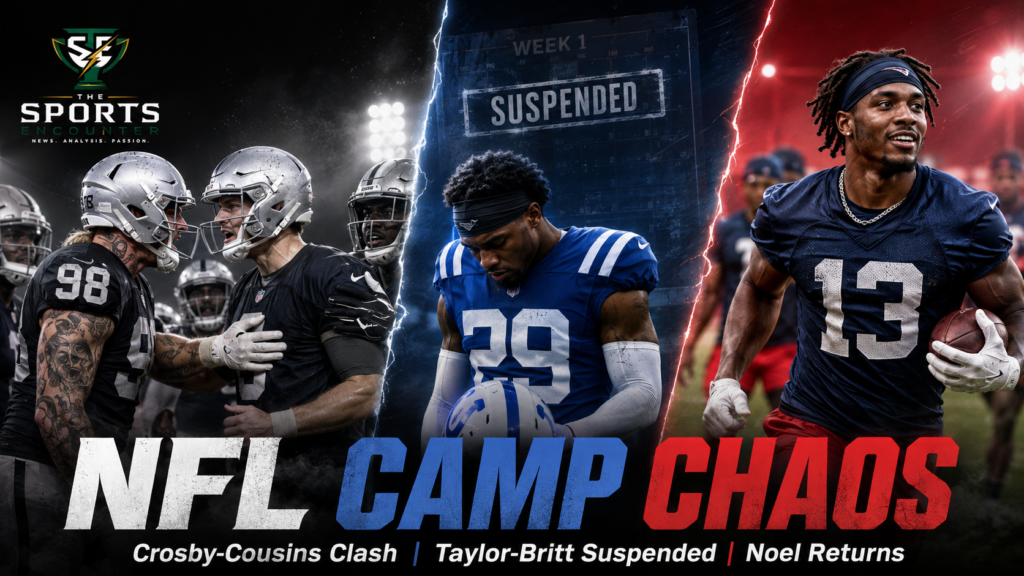
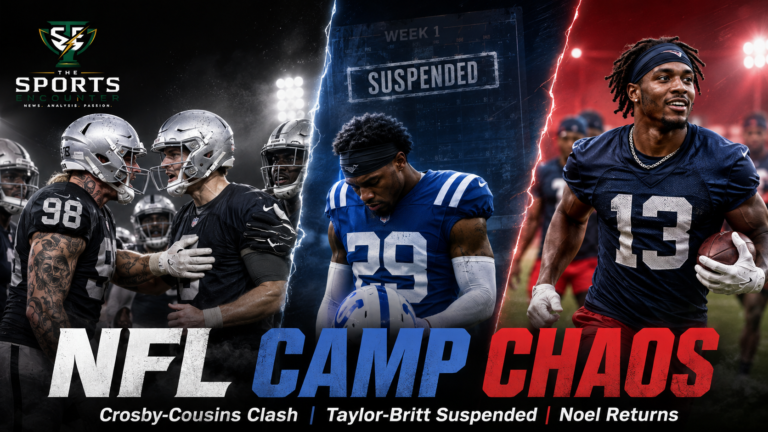
Three very different developments across the NFL on Friday captured what August football has become: Maxx Crosby and Kirk Cousins clashed during a fiery Raiders practice, Indianapolis Colts cornerback Cam Taylor-Britt received a one-game suspension, and Houston Texans wide receiver Jaylin Noel returned from the non-football injury list.

The NFL regular season is still more than a month away, but training camp has already reached the stage where consequences are becoming real.

In Las Vegas, competitive intensity boiled over when Maxx Crosby’s pressure on Kirk Cousins resulted in a heated confrontation between two of the Raiders’ most experienced players.

In Indianapolis, the consequences came from outside football. The NFL suspended Cam Taylor-Britt for the Colts’ season opener after determining that the veteran cornerback violated the league’s personal conduct policy.

Houston received considerably better news. Jaylin Noel returned to the field after recovering from a finger injury that had kept the second-year receiver and return specialist on the non-football injury list since the start of training camp.

None of the developments alone will determine an NFL season.

Together, they illustrate what teams are managing every day in August: player discipline, physical readiness, roster competition, leadership and the difficult balance between preparing aggressively and reaching Week 1 intact.

Follow The Sports Encounter’s NFL coverage for continuing training-camp reports, roster moves, injuries, suspensions and analysis from across the league.

Friday’s NFL Training Camp Developments at a Glance

TeamPlayerDevelopmentImmediate Impact
Las Vegas RaidersMaxx Crosby / Kirk CousinsHeated practice confrontation after contact on CousinsRaises questions about camp discipline and quarterback protection
Indianapolis ColtsCam Taylor-BrittSuspended one game under NFL personal conduct policyUnavailable for Week 1 against Baltimore
Houston TexansJaylin NoelActivated from non-football injury listReturns to receiving and return-game competition

TL;DR

  • Raiders quarterback Kirk Cousins and defensive end Maxx Crosby became involved in a heated exchange during Friday’s training-camp practice.
  • The confrontation followed repeated pressure and contact from Crosby during live 11-on-11 work.
  • Raiders coach Klint Kubiak said players must understand that throwing a punch in a game would result in an ejection.
  • Indianapolis cornerback Cam Taylor-Britt has been suspended for one game for violating the NFL’s personal conduct policy.
  • Taylor-Britt will miss the Colts’ September 13 season opener against the Baltimore Ravens.
  • The suspension relates to reckless-driving and license-related charges stemming from traffic stops in 2025.
  • Taylor-Britt remains eligible to practice and play during the preseason.
  • Houston activated Jaylin Noel from the non-football injury list after he recovered from a right pinkie injury.
  • Noel caught 26 passes for 292 yards and two touchdowns as a rookie in 2025.
  • He also provided significant value as a punt and kick returner.

Maxx Crosby and Kirk Cousins Turn Raiders Practice Into Something More Serious

The most dramatic development of the day came in Las Vegas.

Friday’s Raiders practice featured enough physicality that quarterback Kirk Cousins eventually decided he had seen enough.

During live 11-on-11 work, Maxx Crosby made contact with Cousins around the throwing arm for the second time during the session.

Cousins responded verbally before pushing Crosby and grabbing his jersey.

Teammates quickly moved between them.

The Raiders described the exchange as a scuffle in their official training-camp report, but the incident carried more significance than an ordinary summer disagreement because of who was involved. Crosby is the emotional center of the defense. Cousins enters camp as the veteran quarterback currently positioned at the top of the depth chart while rookie Fernando Mendoza develops behind him. :contentReference[oaicite:0]{index=0}

Crosby’s Greatest Strength Can Also Create a Training-Camp Problem

The Raiders do not want Maxx Crosby practicing casually.

His relentless approach is central to what makes him one of the NFL’s premier edge defenders.

The problem is that quarterbacks wear different rules during practice.

A defensive end can finish through a running back or offensive lineman. Finishing through the quarterback creates unnecessary risk, particularly during camp when the objective is preparation rather than survival.

Raiders coaches have already spent time emphasizing boundaries with Crosby around contact near the quarterback’s arm and head.

Crosby has acknowledged the issue himself. His approach has always been built around completing the play rather than slowing down once he reaches the backfield.

That mentality creates exactly the paradox Klint Kubiak must manage.

The Raiders need Crosby’s intensity.

They cannot afford for that intensity to endanger the quarterback preparing to start their season.

Kubiak’s Reaction Focused on What Happens When September Arrives

Kubiak did not present the confrontation as a crisis.

He described Crosby and Cousins as two leaders competing against one another.

His warning instead focused on the habits being built.

A shove at practice can be separated by teammates.

A punch during an NFL game can remove a player from the contest and potentially lead to additional discipline.

That distinction becomes particularly important for a Raiders team trying to create a new identity under its first-year head coach.

Training-camp toughness has value only when players maintain enough control to use it on Sundays.

The wider league is dealing with similar questions about balancing preparation against risk. The Sports Encounter has been following those pressures in its latest NFL training-camp injury roundup, where teams are already adjusting workloads to protect important players.

Friday’s Practice Had Already Produced Another Fight

The Cousins-Crosby confrontation was not the only moment when Raiders practice became heated.

Earlier, offensive lineman Caleb Rogers and defensive lineman Jonah Laulu became involved in another confrontation.

That exchange escalated far enough to stop the practice briefly.

The two incidents suggest the Raiders have reached the familiar point in camp when repetition, heat, physical contact and roster competition begin testing patience.

Coaches generally welcome competitive practices.

They do not welcome losing players to injuries or discipline because teammates cannot stop before the whistle.

Cousins Is Also Fighting for More Than Respect in Practice

Cousins’ response should also be understood within the quarterback competition.

He enters the season as the likely starter, but Las Vegas used the No. 1 overall pick on Fernando Mendoza.

That automatically creates pressure.

Cousins cannot treat training camp as a ceremonial preparation period. Every practice helps determine how quickly Mendoza becomes a realistic alternative.

The Raiders’ own camp coverage has described Cousins as the opening QB1 while emphasizing that the competition remains worth monitoring. :contentReference[oaicite:1]{index=1}

Crosby’s pressure therefore does more than test the offensive line.

It forces the quarterback room to operate at NFL speed.

That is useful until someone crosses the boundary between competitive simulation and unnecessary contact.

Crosby’s Return Adds Another Layer to the Situation

Crosby himself is working through an important summer.

He has returned to the practice field after knee surgery and remains one of the most important players on Las Vegas’ roster.

The Raiders need him healthy enough to provide the disruptive pass rush around which much of their defensive identity is built.

They also need him disciplined enough to reach the regular season without creating preventable problems.

That tension will likely remain part of camp.

Crosby has never built his reputation by practicing at half-speed.

Kubiak’s challenge is not removing that mentality. It is directing it.

Cam Taylor-Britt Suspension Gives Indianapolis a Different Kind of Problem

While Las Vegas dealt with discipline inside practice, Indianapolis received an official disciplinary ruling from the league.

The NFL suspended cornerback Cam Taylor-Britt for one game for violating its personal conduct policy.

The Colts confirmed the suspension Friday. Taylor-Britt will miss Indianapolis’ regular-season opener against the Baltimore Ravens on September 13. :contentReference[oaicite:2]{index=2}

He can continue practicing during training camp and can participate in preseason games.

Once the regular season begins, however, he cannot be around the team during the week leading into the opener.

Why Taylor-Britt Was Suspended

The suspension stems from legal issues connected to two traffic stops during 2025.

On January 6, 2026, Taylor-Britt pleaded guilty to reckless driving and driving without a valid driver’s license.

He subsequently spent five days in jail.

The NFL’s personal conduct policy allows the league to impose discipline independently of whatever criminal penalties a player receives.

In Taylor-Britt’s case, the league determined that the conduct warranted a one-game suspension.

The Timing Is Poor for a Player Starting Over in Indianapolis

Taylor-Britt joined the Colts in March on a one-year contract after spending the first four seasons of his NFL career with Cincinnati.

He does not arrive in Indianapolis as an automatic starter.

The Colts project Sauce Gardner and Charvarius Ward as the primary outside cornerbacks, leaving Taylor-Britt to compete for an important depth role.

Missing Week 1 therefore matters differently than it would for an established star guaranteed to reclaim his position immediately.

Depth-chart roles are won through trust.

A new coaching staff needs to know which reserve corner can enter a game without forcing the defense to change its coverage structure.

Taylor-Britt now loses his first opportunity to demonstrate that reliability during regular-season football.

Taylor-Britt Still Brings Significant Starting Experience

Indianapolis did not sign an inexperienced reserve.

Taylor-Britt appeared in 47 games during four seasons with Cincinnati and started 40 of them.

His strongest stretch came across 2023 and 2024, when he started 29 games and recorded all seven of his career interceptions.

He returned an interception for a touchdown in each of those seasons.

His career production also includes 203 tackles, four tackles for loss and two forced fumbles.

That experience explains why Indianapolis considered him useful depth despite having Gardner and Ward ahead of him.

Cornerback depth rarely feels important in August.

It becomes extremely important once injuries, matchups and multiple-receiver formations begin testing a secondary during the regular season.

Week 1 Against Baltimore Makes the Absence More Noticeable

The suspension removes Taylor-Britt from a Colts opener against Baltimore.

Indianapolis would obviously prefer to enter that matchup with every experienced defensive back available.

The Ravens can force defenses into difficult personnel decisions through formation changes, route combinations and athletic skill players.

The Colts still possess their projected starting corners.

Taylor-Britt’s absence instead reduces the margin behind them.

One injury or matchup problem could force Indianapolis deeper into its cornerback rotation than planned.

The Colts Suspension Fits a Wider August Theme

NFL roster decisions increasingly involve considerations beyond pure talent.

Availability matters.

Reliability matters.

Off-field decisions matter.

A talented player who cannot dress for a game creates a different type of roster risk from someone who simply loses a camp competition.

The Sports Encounter recently examined similar value questions in its feature on the most underrated NFL offseason signings of 2026. Depth additions become valuable precisely because teams rarely reach September with every original plan intact.

Houston Receives the Best News of the Three Teams

The Texans’ Friday update carried a far more positive tone.

Houston activated wide receiver Jaylin Noel from the non-football injury list, putting the second-year player back on the practice field after he injured his right pinkie while working out before camp.

Noel had been placed on the NFI list when Houston opened training camp in late July. NFL records confirmed that initial designation. :contentReference[oaicite:3]{index=3}

Head coach DeMeco Ryans welcomed Noel’s return and praised the work he had completed during the offseason.

The timing gives Noel an opportunity to participate in the most important evaluation phase before preseason games begin deciding roster roles.

Jaylin Noel’s Value Goes Well Beyond 26 Receptions

Noel’s rookie receiving statistics were modest but useful.

He caught 26 passes for 292 yards and two touchdowns across all 17 regular-season games, making three starts.

Houston selected him with the 79th overall pick in the third round of the 2025 NFL Draft after a productive career at Iowa State. The Texans’ official player profile confirms those receiving totals. :contentReference[oaicite:4]{index=4}

His value becomes clearer once special teams enter the calculation.

Noel handled both punt and kickoff returns as a rookie.

He returned 31 punts for 335 yards, averaging 10.8 yards per return, and 29 kickoffs for 799 yards at 27.6 yards per return.

Including his offensive production, he finished with 1,438 all-purpose yards.

That type of versatility changes roster mathematics.

Return Specialists Create Extra Value on Game Day

NFL teams have only a limited number of active roster spots available on Sundays.

A receiver who can contribute offensively and handle both major return roles effectively becomes easier to dress than a specialist who performs only one task.

Noel gives Houston that flexibility.

He can provide receiving depth.

He can return punts.

He can return kickoffs.

He can contribute to field position even during games when the offense does not target him heavily.

That is particularly useful for a Texans team trying to extract small advantages from an already competitive roster.

Noel Has a Chance to Expand His Offensive Role

The next step involves becoming more than a return specialist who occasionally contributes on offense.

Noel showed flashes during his rookie campaign.

He recorded five catches for 63 yards against San Francisco and four catches for 77 yards against Seattle, while also producing a 54-yard receiving performance against the Chargers late in the season.

Those individual games suggested he can provide more than underneath utility when given opportunities.

Houston now has the remainder of camp to determine how much larger that role should become.

The Texans Already Understand the Value of Quiet Roster Strength

Houston entered the offseason with a roster strong enough that many of its important additions did not generate the league’s biggest headlines.

The Sports Encounter highlighted that theme when examining Reed Blankenship’s addition to the Texans as one of the offseason’s potentially underrated moves.

Noel’s return works in the same area of team building.

It will not dominate national television for several days.

It makes the roster more complete.

Three Stories, One Training-Camp Reality

Crosby, Taylor-Britt and Noel occupy completely different situations.

The connection between them is availability.

PlayerQuestionWhat His Team Needs
Maxx CrosbyCan he maintain maximum intensity without creating unnecessary camp risk?Controlled aggression
Cam Taylor-BrittCan he rebuild trust and establish a role after his suspension?Reliability and depth
Jaylin NoelCan he turn a healthy return into a larger second-year role?Receiving growth and special-teams production

Every NFL team spends the spring assembling its ideal roster.

August starts dismantling the assumptions.

Injuries remove players.

Suspensions change depth charts.

Practice fights test discipline.

Young players return and reopen competitions coaches thought they understood.

The teams that navigate those changes best usually enter September with more answers than emergencies.

The Raiders Must Protect Competitive Edge Without Losing Control

The Cousins-Crosby incident will probably disappear quickly if Friday proves to be an isolated flashpoint.

Football teams fight during camp.

Tempers rise.

Veterans push one another.

The concern begins when the behavior repeats or threatens player health.

Kubiak’s job is therefore straightforward in principle and difficult in practice.

Keep Crosby playing like Crosby.

Keep Cousins upright.

Make sure neither goal compromises the other.

Recent NFL news has repeatedly demonstrated how one training-camp development can alter a team’s direction. The Sports Encounter’s coverage of Aaron Donald’s official Rams workout showed how dramatically a single personnel development can change expectations around a defense.

Indianapolis Must Absorb a Problem It Already Knows the Length Of

The positive side of Taylor-Britt’s suspension is clarity.

Indianapolis knows exactly how long he will be unavailable.

One game.

That allows the Colts to prepare the Week 1 secondary in advance rather than responding to a late injury.

The larger question belongs to Taylor-Britt.

He signed a one-year contract after leaving Cincinnati.

That type of agreement naturally creates a prove-it season.

Every missed opportunity therefore carries extra weight.

He has enough starting experience to become useful defensive depth.

He now needs the remainder of camp to ensure the suspension becomes a one-week complication rather than the defining story of his Indianapolis tenure.

Houston Can Start Asking a More Interesting Question About Noel

The Texans no longer need to ask when Jaylin Noel will return.

They can ask what he can become.

His rookie year proved he can survive an NFL season, contribute as a receiver and handle a heavy return workload.

The second season should determine whether his ceiling extends further.

A player who combines 400 to 500 receiving yards with high-level return production provides substantially more value than a player confined to special teams.

Noel now has enough camp remaining to compete for those additional snaps.

The NFL’s August News Cycle Is Accelerating

Friday’s developments also arrive during a particularly active stretch around the league.

Training camps are producing injuries and depth changes almost daily. The Sports Encounter has recently tracked Stefon Diggs’ move to Washington and Jalon Walker’s season-ending injury, as well as the latest injury concerns involving Josh Jacobs, Kenyon Sadiq and Elic Ayomanor.

Veteran careers are changing too.

Trystan Colon retired at 28 after six NFL seasons, while Aaron Donald’s workout has created genuine speculation about one of the most unlikely comeback stories of the year.

Even NFL front offices are changing around the football activity, with Detroit appointing Richard Haddad as its incoming president and CEO.

The regular season may still be weeks away.

The league has already started moving at regular-season speed.

What Happens Next for the Raiders?

Las Vegas must decide how aggressively to manage Crosby’s workload as preseason games approach.

The five-time Pro Bowl pass rusher does not need camp repetitions to prove that he can pressure quarterbacks.

He does need enough physical work to prepare his knee and body for a full season.

Cousins, meanwhile, needs repetitions with the first-team offense while Mendoza continues developing.

That makes their practice relationship important.

The Raiders benefit when Crosby forces Cousins to process pressure quickly.

They gain nothing if the same pressure turns into dangerous quarterback contact.

What Happens Next for Taylor-Britt?

Taylor-Britt remains eligible throughout the preseason.

That gives him several weeks to reinforce his value before serving the suspension.

The Colts can also use preseason snaps to determine which cornerback should take the additional Week 1 responsibilities created by his absence.

Once his suspension ends, Taylor-Britt will be eligible to return for Week 2.

The challenge will be ensuring his role remains meaningful when he does.

What Happens Next for Jaylin Noel?

Noel’s return restores competition to Houston’s receiver and special-teams rooms.

His immediate priority will be rebuilding timing after missing the opening portion of camp.

Finger injuries carry particular relevance for receivers because catching confidence matters almost as much as physical clearance.

Houston will therefore watch not merely whether Noel practices, but how naturally he catches, separates and handles return duties as his workload increases.

Final Verdict

August does not produce wins and losses in the standings.

It produces the conditions that influence them.

Las Vegas saw the dangerous side of competitive intensity when Maxx Crosby and Kirk Cousins crossed the line from football pressure into confrontation.

Indianapolis learned that Cam Taylor-Britt’s off-field conduct will cost the cornerback his first regular-season game with the franchise.

Houston finally received the type of camp news every team wants: an injured player returning rather than another one leaving.

The three developments carry different consequences.

Crosby’s situation requires control.

Taylor-Britt’s requires accountability.

Noel’s creates opportunity.

That is training camp in its most honest form.

Teams arrive with plans.

August begins changing them.

Frequently Asked Questions

Why did Maxx Crosby and Kirk Cousins fight at Raiders practice?

Cousins reacted after Crosby made contact around his throwing arm during live team work. The players exchanged words before Cousins shoved Crosby and grabbed his jersey, prompting teammates to separate them. The Raiders officially described the incident as a practice scuffle. :contentReference[oaicite:5]{index=5}

Did Maxx Crosby get suspended for the practice fight?

No suspension was announced. Raiders coach Klint Kubiak used the incident to remind players that fighting or throwing punches during games can result in ejection.

Is Kirk Cousins the Raiders’ starting quarterback?

Cousins entered training camp as the first-team quarterback, although No. 1 overall draft pick Fernando Mendoza remains part of the longer-term competition. :contentReference[oaicite:6]{index=6}

Why was Cam Taylor-Britt suspended?

The NFL suspended Taylor-Britt for one game for violating its personal conduct policy following reckless-driving and driver’s-license charges stemming from traffic stops in 2025.

Which game will Cam Taylor-Britt miss?

Taylor-Britt will miss the Indianapolis Colts’ season opener against the Baltimore Ravens on September 13. The Colts officially confirmed his one-game suspension. :contentReference[oaicite:7]{index=7}

Can Taylor-Britt play during the preseason?

Yes. He can practice and participate in preseason games before serving his suspension during Week 1.

Has Jaylin Noel returned to Texans practice?

Yes. Houston activated Noel from the non-football injury list after he recovered from a right pinkie injury suffered before training camp.

What were Jaylin Noel’s rookie receiving statistics?

Noel caught 26 passes for 292 yards and two touchdowns across 17 games during the 2025 season. :contentReference[oaicite:8]{index=8}

Where did Houston draft Jaylin Noel?

The Texans selected Noel in the third round with the 79th overall pick of the 2025 NFL Draft. :contentReference[oaicite:9]{index=9}

Why is Jaylin Noel important to Houston beyond receiving?

Noel contributes extensively on special teams as both a punt and kickoff returner, giving Houston additional game-day roster flexibility.

Sports Writer, North America. Ruben Santos covers North American sports for The Sports Encounter, including the NBA, NHL, MLS, MLB, and major international events across the United States, Canada, and Mexico. His work focuses on game stories, league developments, fan experience, tournament logistics, American sports culture, and the major storylines shaping the region. Coverage areas: NBA, NHL, MLS, MLB, North American sports, FIFA World Cup 2026, league analysis.

Breaking News

Gerónimo Rulli Returns to Manchester City After a Decade

Gerónimo Rulli is set to return to Manchester City a decade after his first spell, with James Trafford’s £40 million move to Leeds opening the door for the World Cup-winning goalkeeper.

Published

on

Gerónimo Rulli stands in a Manchester City goalkeeper kit against a dramatic Etihad Stadium backdrop, with the punchline “Rulli Returns: 10 Years Later” highlighting his reported comeback to City after James Trafford’s departure.

Manchester City have agreed a deal with Marseille to bring Gerónimo Rulli back to the Etihad a decade after his first spell ended without a senior appearance, with James Trafford’s £40 million move to Leeds United creating the opening for one of the summer’s most unusual transfer reunions.

Gerónimo Rulli was technically a Manchester City player once before.

He signed. He left almost immediately. He never played a competitive minute for the club.

Ten years later, the Argentine goalkeeper is preparing to return as a completely different footballer.

Manchester City have agreed a deal with Marseille for the 34-year-old, according to multiple reports, with Manchester Evening News placing the initial fee at approximately £1.4 million and the total package at around £1.7 million if add-ons are triggered.

Rulli is expected to sign a two-year contract and arrive as competition and experienced cover for Gianluigi Donnarumma.

The move became necessary after James Trafford completed a club-record transfer to Leeds United. British media have valued the deal at around £40 million plus bonuses, potentially taking the final package closer to £45 million.

That creates a striking piece of goalkeeper economics.

Manchester City are selling a 23-year-old England international for around £40 million and replacing his squad position with a 34-year-old World Cup winner for potentially less than £2 million.

The difference looks enormous.

The logic behind it is equally important.

Trafford needs regular football.

Rulli does not arrive needing to prove that he should be Manchester City’s long-term No. 1.

Donnarumma already occupies that position.

City are therefore replacing one goalkeeper with another while completely changing the profile of the role.

For wider transfer coverage, tactical analysis and Premier League news, readers can follow The Sports Encounter’s soccer coverage.

Gerónimo Rulli to Manchester City: Key Transfer Details

DetailLatest Information
PlayerGerónimo Rulli
Age34
Current clubMarseille
Buying clubManchester City
Reported initial feeApproximately £1.4 million
Potential total feeApproximately £1.7 million
Expected contractTwo years
Expected roleCompetition and cover for Gianluigi Donnarumma
Previous Manchester City spellSigned in 2016
Senior City appearances0
James Trafford transferLeeds United
Reported Trafford feeAround £40 million plus bonuses

TL;DR

  • Manchester City have reportedly agreed to sign Gerónimo Rulli from Marseille.
  • The initial fee is reported at around £1.4 million, potentially rising to approximately £1.7 million.
  • Rulli is expected to sign a two-year contract.
  • He is likely to serve as the experienced No. 2 behind Gianluigi Donnarumma.
  • James Trafford has left Manchester City for Leeds United on a five-year contract.
  • Trafford’s fee is reported at around £40 million plus bonuses.
  • Rulli previously signed for Manchester City in 2016 but never made a senior appearance.
  • He later played for Real Sociedad, Montpellier, Villarreal, Ajax and Marseille.
  • Rulli won the 2021 Europa League with Villarreal.
  • He was part of Argentina’s 2022 FIFA World Cup-winning squad.

The £40 Million Exit That Made Rulli’s Return Possible

Manchester City did not suddenly decide they needed another senior goalkeeper.

The position opened because Trafford wanted something City could not reasonably promise him.

Regular Premier League football.

Trafford returned to Manchester City in 2025 after developing into one of England’s most highly rated young goalkeepers.

He made 17 appearances across competitions during the 2025-26 campaign, but Donnarumma became the established first choice.

For a goalkeeper who turned 23 last October, another season dominated by cup appearances and occasional rotation carried an obvious cost.

Goalkeepers need matches.

A young midfielder can collect minutes through substitutions.

A forward can rotate across competitions.

The second-choice goalkeeper may spend weeks watching.

Leeds offer Trafford a completely different career proposition.

The Yorkshire club signed him on a five-year contract for an undisclosed club-record fee, with British media putting the figure at around £40 million plus bonuses.

Trafford therefore leaves Manchester as an expensive backup and arrives at Leeds with the expectation of becoming a central part of their project.

City and Leeds Are Buying Two Different Versions of Goalkeeping Value

The same player can have dramatically different value depending on what a club needs.

For Leeds, Trafford represents age, potential, England international pedigree and the possibility of owning their goalkeeper position for several seasons.

Manchester City already have an established No. 1.

That changes the calculation.

Spending another £30 million or £40 million on a young goalkeeper who expects to start would create an expensive problem rather than solve one.

Rulli represents the opposite proposition.

He has already built his career.

He has competed across major European leagues.

He has played international football.

He has experienced title races, knockout football, penalty shootouts and major tournaments.

At 34, he can enter a defined hierarchy without his development depending on weekly starts.

That makes the transfer less glamorous than signing another emerging star, but potentially much more efficient.

Manchester City Turn £40M Trafford Sale Into a Low-Cost Replacement

The financial contrast will inevitably become part of the story.

City could receive at least £40 million for Trafford while paying Marseille an initial £1.4 million for Rulli.

The reported Rulli package could rise to approximately £1.7 million.

That leaves a difference approaching £40 million before wages, accounting treatment, bonuses and other contractual details are considered.

Football finances are more complicated than subtracting one transfer fee from another, but the strategic benefit is obvious.

Manchester City maintain experienced goalkeeper depth while freeing substantial resources for other areas.

That matters in a summer when the club is entering a new Premier League era under Enzo Maresca.

The wider changes surrounding City and their rivals are detailed in The Sports Encounter’s complete Premier League 2026-27 season preview.

Rulli’s First Manchester City Chapter Barely Began

The full-circle element makes this transfer unusually interesting.

Manchester City originally signed Rulli in 2016.

He was 24.

He was considered a goalkeeper with significant long-term potential after establishing himself in Spain.

Yet his Manchester City career existed largely on paperwork.

He immediately returned to Real Sociedad on loan and subsequently joined the Spanish club permanently.

No Premier League debut followed.

No cup appearance.

No memorable Etihad moment.

Ten years later, City are returning to a player whose career developed almost entirely away from them.

The Player Returning in 2026 Is Nothing Like the Prospect City Signed in 2016

Manchester City originally invested in potential.

Now they are investing in experience.

Rulli has played in Spain, France and the Netherlands since his first City agreement.

His club career has included Real Sociedad, Montpellier, Villarreal, Ajax and Marseille.

Along the way, he has experienced European finals and international tournaments that the 24-year-old City originally signed could only imagine.

This is why describing Rulli merely as a cheap backup misses much of the story.

He is cheap in transfer-fee terms.

His football résumé is anything but lightweight.

Villarreal Gave Rulli the Night That Defined His Club Career

Rulli’s most famous club moment arrived in the 2021 UEFA Europa League final.

Villarreal faced Manchester United in Gdańsk.

The match finished 1-1 after extra time.

Then came one of the most remarkable penalty shootouts European football has seen.

Twenty consecutive outfield penalties were converted.

Eventually, the goalkeepers had to take penalties themselves.

Rulli stepped forward and scored.

David de Gea then took Manchester United’s 11th penalty.

Rulli saved it.

Villarreal won the shootout 11-10 and lifted their first major European trophy.

UEFA’s official Europa League final report records Rulli as both a penalty scorer and the goalkeeper who made the decisive save.

Why That Europa League Final Still Matters to Manchester City

A backup goalkeeper’s season can be quiet for months.

Then one injury, suspension or cup tie changes everything.

City may not expect Rulli to start 40 matches.

They do need confidence that he can enter high-pressure football without behaving like a player overwhelmed by the moment.

Gdańsk answered that question years ago.

Scoring a penalty in a European final and then saving the decisive one requires a level of nerve that cannot be recreated in training.

A World Cup Winner Arrives Behind Donnarumma

Rulli also returns to Manchester with a FIFA World Cup winner’s medal.

He was part of Lionel Scaloni’s Argentina squad at the 2022 World Cup in Qatar.

Emiliano Martínez was Argentina’s first-choice goalkeeper, but Rulli remained part of the group that eventually defeated France in the final.

That role carries useful relevance to Manchester City.

Rulli already understands what it means to prepare at the highest level while another goalkeeper holds the starting position.

He understands the difference between accepting a hierarchy and becoming passive within it.

The best No. 2 goalkeepers remain prepared even when they do not know when the next opportunity will arrive.

Rulli Also Knows Argentina’s Modern Winning Culture

His international experience places him inside one of football’s strongest recent national-team environments.

Argentina transformed from a team haunted by final defeats into Copa América and World Cup champions.

That journey required far more than the 11 players selected on matchday.

Squad culture matters during international tournaments.

Preparation matters.

Training standards matter.

Backup players have to push starters without destabilizing the group.

Rulli has lived inside that environment.

For a Manchester City squad operating under constant expectations, that experience has value.

Why Rulli Fits a Possession-Based Team

Shot stopping alone does not define goalkeeper recruitment at Manchester City.

The goalkeeper becomes part of possession.

He has to receive passes under pressure.

He must recognize when to play short and when to bypass pressure.

He needs the composure to invite opponents forward without panicking.

Rulli has spent much of his European career playing for teams that ask goalkeepers to participate in buildup.

That makes his technical profile important.

A backup who dramatically changes the team’s first phase of possession would force Maresca to alter tactical structures whenever Donnarumma rests.

Rulli potentially allows greater continuity.

Donnarumma Remains the Central Figure

Nothing about this agreement suggests Manchester City are planning a major goalkeeper battle immediately.

Donnarumma remains the established first choice.

That is precisely why the Rulli deal makes sense.

City need competition without creating an unnecessary succession debate.

Rulli can start domestic cup fixtures.

He can cover injuries.

He can provide Champions League and Premier League experience from the bench.

If form or circumstances create a genuine competition, City gain another option.

But the initial hierarchy appears straightforward.

Trafford Could Never Be a Comfortable Long-Term No. 2

This is where age becomes decisive.

A 23-year-old international goalkeeper should want to play.

If Trafford had quietly accepted multiple seasons behind Donnarumma, that might have created more concern about his ambitions than reassurance about City’s depth.

His departure therefore does not necessarily indicate failure.

It reflects career timing.

Leeds are offering the pathway he needs.

City receive a major fee.

Rulli fills the vacancy with a completely different set of priorities.

Manchester City’s Transfer Planning Is Becoming More Selective

The goalkeeper move also fits a wider summer in which City are reshaping their squad rather than simply adding expensive names.

The club has already faced major questions around the future of key players, including Rodri.

The Sports Encounter examined that uncertainty in our analysis of Real Madrid’s interest in Rodri and Manchester City’s attempt to keep him.

Those negotiations sit at the opposite financial end of the Rulli deal.

Yet the same principle applies.

Every player has to fit the wider structure.

City cannot allocate premium money to every squad position.

Finding an inexpensive goalkeeper who can maintain standards behind Donnarumma creates room for bigger decisions elsewhere.

City Still Have a Squad Built Around Elite Match-Winners

The club’s broader attacking identity continues to revolve around players capable of deciding matches individually.

Erling Haaland remains one of the defining figures of that group, and his career trajectory, records and Manchester City role are explored in The Sports Encounter’s complete Erling Haaland profile.

The squad already contains expensive elite talent.

That makes efficient depth recruitment even more valuable.

The Modern Premier League Transfer Market Is About More Than Spending

Big transfer windows often become scoreboards.

Which club spent the most?

Who signed the biggest name?

Who paid the largest fee?

The smarter question is whether every transaction solves the problem it was designed to solve.

Arsenal’s recent move for Bruno Guimarães represents one type of recruitment: paying a premium for a player expected to improve the starting XI immediately.

The Sports Encounter followed that story through the Brazilian midfielder’s reported £75 million move.

Rulli represents another.

Low-cost depth.

Experience.

Role clarity.

Minimal financial risk.

Chelsea’s Recruitment Model Offers Another Contrast

Chelsea have increasingly invested in youth, future control and long contract structures.

The Sports Encounter examined that strategy through the club’s long-term plan for Geovany Quenda.

Manchester City’s Rulli move operates from almost the opposite principle.

There is little need for resale value.

There is no long development runway.

The goal is usefulness now.

Could Rulli Be Available Immediately?

Manchester Evening News reports that the deal is expected to be completed before the Community Shield.

That would give Rulli very little time to integrate before competitive football begins.

Goalkeeper adaptation at Manchester City involves more than learning defenders’ names.

He will need to understand:

  • Build-up positioning
  • Passing triggers
  • Pressing escape patterns
  • Set-piece organization
  • Defensive-line communication
  • Maresca’s preferred risk levels in possession

Experience should accelerate that process, but it will still require work.

The Community Shield Could Bring an Immediate Twist

If registration and fitness allow it, Rulli could find himself involved in a competitive match almost immediately.

That would be a remarkable conclusion to a transfer story that began with him first signing for the club in 2016.

A decade without playing for Manchester City could potentially end within days of his return.

Manchester City Are Entering a Different Era

Rulli will also return to a Manchester City that differs substantially from the one he technically joined ten years ago.

The club has since become a dominant force in English football and a Champions League winner.

Its standards, expectations and global profile have grown enormously.

The managerial era has changed too, with Maresca now charged with taking City forward.

The Sports Encounter’s 2026-27 Premier League curtain-raiser identifies City’s transition from Pep Guardiola to Maresca as one of the defining narratives of the new season.

Rulli’s Return Connects Two Very Different Manchester City Eras

There is an appealing symmetry here.

Rulli first signed while City were becoming the team that would eventually dominate England.

He returns after that historic cycle has begun changing.

His own career has changed just as dramatically.

The prospect became a veteran.

The untested City signing became a European champion.

The young Argentine became a World Cup winner.

The goalkeeper who never played at the Etihad may now finally wear City colors in competitive football.

What Manchester City Gain From Rulli

Experience

Rulli has played hundreds of senior matches across European football and has operated in demanding environments.

Big-Match Composure

His Europa League final performance remains compelling evidence of his ability to handle pressure.

International Pedigree

Being part of Argentina’s World Cup-winning squad brings experience few backup goalkeepers can match.

Role Compatibility

At 34, Rulli can enter the squad without his career development depending on displacing Donnarumma immediately.

Financial Efficiency

A potential £1.7 million fee is minimal by modern Manchester City transfer standards.

What Leeds Gain From Trafford

The other side of the equation matters too.

Leeds are making a substantial investment because Trafford represents something Rulli no longer does.

Long-term upside.

Trafford could potentially occupy the goalkeeper position for five years or more.

He remains young enough to improve significantly.

His England ambitions provide motivation.

Regular Premier League starts could transform his career.

Manchester City were not positioned to offer him that route.

Why the Trafford Sale Should Not Be Judged Only by What He Does Next

If Trafford becomes one of England’s best goalkeepers at Leeds, people may eventually ask why City sold him.

That would ignore the circumstances.

A club cannot develop every elite player indefinitely while simultaneously refusing them minutes.

Sometimes selling a talented player is the correct decision precisely because the first-team pathway has closed.

City still benefit financially if Trafford succeeds.

Manchester Evening News reports that their agreement includes a 20 percent sell-on clause and matching rights on future bids.

City Have Protected Themselves Against Trafford’s Future Value

Those reported clauses make the outgoing deal especially interesting.

Manchester City receive a huge fee now.

If Trafford later moves for another major sum, City could benefit again.

If they ever want him back, matching rights could potentially become relevant.

That structure allows City to monetize the goalkeeper without completely disconnecting themselves from his future.

Could Rulli Become More Than a Backup?

Football rarely respects depth-chart assumptions forever.

Donnarumma enters the season as No. 1.

That does not guarantee he starts every game.

Form can change.

Injuries happen.

Cup competitions create opportunities.

Penalty shootouts can alter goalkeeper selection.

Rulli’s responsibility will be to ensure City do not experience a dramatic drop in confidence whenever the starter is unavailable.

If he performs exceptionally, Maresca gains a genuine selection option.

This Could Become One of the Summer’s Best Value Deals

A £1.7 million transfer does not normally dominate Premier League headlines.

Context changes the evaluation.

If Rulli gives City two dependable seasons, starts effectively when required and contributes during cup competitions, the transfer could produce enormous value relative to cost.

The price is especially striking when placed beside Trafford’s exit.

City are converting expensive unused potential into cash while replacing the vacant squad role with proven experience.

Rulli’s Return Also Says Something About Career Timing

Football careers rarely move in straight lines.

Ten years ago, Rulli needed Manchester City to represent the next step.

It never happened.

Instead, Real Sociedad, Villarreal, Ajax, Marseille and Argentina shaped the goalkeeper he became.

Now Manchester City want that finished product back.

That is what makes the transfer more compelling than the modest fee suggests.

City’s New Era Will Be Watched Closely

Manchester City’s post-Guardiola transition already creates pressure around every major squad decision.

Maresca inherits a team expected to challenge for the Premier League immediately.

There will be little patience for obvious weaknesses.

Rulli does not need to transform City.

He needs to ensure goalkeeper depth never becomes one of those weaknesses.

City’s wider evolution can also be viewed through players who helped define the previous era, including Haaland. The Sports Encounter explored his relationship with another global star in our feature on Erling Haaland and Jude Bellingham’s journey from Dortmund teammates to World Cup rivals.

Transfer Status: Agreement Reported, Official Announcement Still Pending

One distinction remains important.

Manchester City had not formally announced Rulli’s signing at the time this article was prepared.

The deal should therefore be described as agreed or approaching completion rather than officially completed.

A medical, paperwork and registration process still have to be finalized.

That wording matters during transfer windows, when even advanced deals should not be treated as complete before club confirmation.

The Fee Should Also Be Reported Carefully

The most detailed current reporting places the initial payment at approximately £1.4 million, potentially rising to around £1.7 million.

Other reports have mentioned slightly higher figures.

Until Manchester City or Marseille disclose the financial terms, the safest description is that Rulli is arriving in a low-cost deal expected to be worth around £1.7 million with add-ons.

Gerónimo Rulli Career Snapshot

StageClub or TeamSignificance
Early careerEstudiantesEstablished himself in Argentine football
European breakthroughReal SociedadBecame an established La Liga goalkeeper
2016Manchester CitySigned but never made a senior appearance
Later Spanish careerVillarrealWon the 2021 Europa League
NetherlandsAjaxAdded Eredivisie experience
FranceMarseilleReturned to regular top-level football
2022ArgentinaMember of the FIFA World Cup-winning squad
2026Manchester CityReportedly returning after ten years

The Bigger Manchester City Calculation

The best way to understand this transfer is to stop comparing Rulli directly with Trafford.

They are being asked to do different jobs.

Trafford’s value comes from what he might become.

Rulli’s value comes from what he already is.

Leeds want development.

Manchester City want certainty.

Trafford needs 35 or 40 starts.

Rulli needs to be ready if City ask him for five, ten or fifteen.

That is why a £40 million goalkeeper can leave and a £1.7 million goalkeeper can replace him without the squad necessarily becoming £38 million weaker.

Final Verdict: Ten Years Later, Rulli Finally Has a Manchester City Role

Gerónimo Rulli’s first Manchester City chapter never became a football story.

He signed in 2016.

He left.

He never played.

Everything important happened afterward.

He became a Europa League winner.

He saved the decisive penalty in a European final.

He played across Spain, France and the Netherlands.

He became a World Cup winner with Argentina.

He accumulated the experience Manchester City once hoped he might develop.

Now City are bringing him back.

The timing works because James Trafford has reached the opposite point in his career.

Trafford cannot afford to wait.

Rulli no longer needs to rush.

City turn a backup goalkeeper into a £40 million sale and potentially replace him for around £1.7 million.

Leeds gain a young first-choice goalkeeper.

Trafford gains the minutes his career needs.

Rulli gains another opportunity at one of European football’s biggest clubs.

Manchester City gain experience without consuming a major piece of their transfer budget.

For a deal involving such a small incoming fee, there are remarkably few losers.

And if Rulli finally walks onto the Etihad pitch in Manchester City colors, it will complete one of football’s stranger circles.

Ten years after signing for the club, Gerónimo Rulli may finally become a Manchester City goalkeeper in more than name.

Frequently Asked Questions

Is Gerónimo Rulli joining Manchester City?

Manchester City have reportedly agreed a deal with Marseille to sign Rulli. The transfer had not yet been formally announced by the club when this article was prepared.

How much will Manchester City pay for Gerónimo Rulli?

Manchester Evening News reports an initial fee of approximately £1.4 million, potentially rising to around £1.7 million with add-ons.

How long will Rulli’s Manchester City contract be?

Rulli is expected to sign a two-year contract.

Has Gerónimo Rulli played for Manchester City before?

Rulli signed for Manchester City in 2016 but never made a senior competitive appearance. He returned to Real Sociedad and later left City permanently.

Why are Manchester City signing Gerónimo Rulli?

City need another experienced goalkeeper after James Trafford’s move to Leeds United. Rulli is expected to provide competition and cover for Gianluigi Donnarumma.

How much did Leeds pay for James Trafford?

Leeds announced Trafford for an undisclosed club-record fee. British media have reported the transfer at around £40 million plus bonuses.

How many games did James Trafford play for Manchester City in 2025-26?

Trafford made 17 appearances across all competitions before leaving for Leeds.

Did Gerónimo Rulli win the World Cup?

Yes. Rulli was part of Argentina’s squad that won the 2022 FIFA World Cup in Qatar.

Did Gerónimo Rulli win the Europa League?

Yes. Rulli won the 2021 Europa League with Villarreal. He scored his penalty and then saved David de Gea’s attempt as Villarreal defeated Manchester United 11-10 in the final shootout.

Will Gerónimo Rulli replace Gianluigi Donnarumma?

There is currently no indication that Rulli is being signed as Manchester City’s immediate first-choice goalkeeper. Donnarumma is expected to remain No. 1.

Why did James Trafford leave Manchester City?

Trafford wanted the opportunity to play regularly. Donnarumma had established himself as Manchester City’s first choice, limiting Trafford’s pathway to consistent starts.

When could Gerónimo Rulli make his Manchester City debut?

Reports suggest City hope to complete the transfer before the Community Shield. His availability will depend on the medical, paperwork, registration and team selection.

Is the £1.7 million Rulli transfer fee officially confirmed?

No. The figure comes from media reporting. Manchester City and Marseille had not publicly confirmed the financial terms when this article was prepared.

Continue Reading

Editor's Choice

Anze Kopitar Becomes Immortal in Los Angeles as Kings Retire No. 11 and Build His Statue

The Los Angeles Kings will retire Anze Kopitar’s No. 11 and unveil a bronze statue outside Crypto.com Arena, cementing the legacy of their all-time leader in games, assists and points.

Marcos Wetherfield | The Sports Encounter

Published

on

Anze Kopitar in a black No. 11 hockey uniform stands beneath arena lights beside a retired jersey banner and bronze statue, honoring his 20-season Los Angeles Kings career, two Stanley Cups and permanent franchise legacy.

Anze Kopitar spent 20 seasons building his place in Los Angeles Kings history. On February 24, 2027, the franchise will make that legacy permanent by retiring his No. 11 jersey and unveiling a bronze statue outside Crypto.com Arena before the Kings face the Montreal Canadiens.

Some players leave a franchise with statistics.

Some leave championships.

A much smaller group becomes part of the architecture.

Anze Kopitar is about to join that group.

The Los Angeles Kings announced Friday that Kopitar’s No. 11 will be raised permanently to the rafters during the 2026-27 season, while a bronze statue honoring the longtime captain will be unveiled outside Crypto.com Arena on the same day.

The ceremonies are scheduled for February 24, 2027, before Los Angeles hosts the Montreal Canadiens.

For Kopitar, who retired after the 2025-26 season, the announcement completes one of the most remarkable one-franchise careers of the modern NHL era.

Twenty seasons.

Two Stanley Cups.

1,521 regular-season games.

452 goals.

864 assists.

1,316 points.

And all of it in a Los Angeles Kings uniform.

Readers can follow continuing league news, history, player analysis and legacy debates through The Sports Encounter’s NHL coverage.

The Los Angeles Kings officially confirmed Kopitar’s jersey retirement and statue unveiling on August 7. :contentReference[oaicite:1]{index=1}

Anze Kopitar Tribute: Key Details

DetailInformation
PlayerAnze Kopitar
Jersey numberNo. 11
Jersey retirement dateFebruary 24, 2027
Statue unveilingFebruary 24, 2027
VenueCrypto.com Arena, Los Angeles
Opponent that nightMontreal Canadiens
NHL seasons20
Career franchiseLos Angeles Kings only
Games played1,521
Goals452
Assists864
Points1,316
Stanley Cups2012, 2014
Selke Trophies2016, 2018
Lady Byng Trophies2016, 2023, 2025

TL;DR

  • The Los Angeles Kings will retire Anze Kopitar’s No. 11 on February 24, 2027.
  • The franchise will unveil a bronze statue of Kopitar outside Crypto.com Arena the same day.
  • The ceremonies will take place before the Kings host the Montreal Canadiens.
  • Kopitar retired after the 2025-26 season following 20 NHL seasons, all with Los Angeles.
  • He finished as the Kings’ career leader in games played, assists and points.
  • He ended his career with 452 goals, 864 assists and 1,316 points in 1,521 games.
  • Kopitar won Stanley Cups with Los Angeles in 2012 and 2014.
  • He won the Selke Trophy twice and the Lady Byng Trophy three times.
  • No. 11 will become the eighth number retired by the Kings.
  • Kopitar will become only the fourth Kings player honored with a statue outside Crypto.com Arena.

This Is More Than a Jersey Retirement

Hockey franchises retire numbers to preserve memory.

Statues do something different.

They place a player permanently into the physical identity of a building and a city.

Long after highlights disappear from nightly television and new generations replace the players who watched Kopitar compete, fans entering Crypto.com Arena will still walk past his image.

That is what makes the Kings’ decision especially significant.

Kopitar is receiving both honors together.

His number will exist above the ice.

His statue will exist outside the arena.

The franchise is effectively saying that its modern history cannot be told without him.

Kopitar Will Join a Tiny Group of Kings Immortals

No. 11 will become only the eighth retired number in Los Angeles Kings history.

Kopitar joins:

  • Rob Blake, No. 4
  • Marcel Dionne, No. 16
  • Dave Taylor, No. 18
  • Luc Robitaille, No. 20
  • Dustin Brown, No. 23
  • Rogie Vachon, No. 30
  • Wayne Gretzky, No. 99

That company alone explains the magnitude of the decision.

The list includes Hall of Famers, franchise scoring icons, championship captains and the greatest scorer the sport has ever seen.

For broader historical context, The Sports Encounter recently ranked the 10 greatest NHL players ever, with Gretzky leading an all-era list built around peak dominance, production, playoff impact and longevity.

The Statue Places Kopitar in an Even Smaller Circle

Kopitar will become the fourth Kings figure honored with a statue outside Crypto.com Arena.

The others are Dustin Brown, Luc Robitaille and Wayne Gretzky.

That distinction may carry even greater emotional weight than the retired number.

Numbers disappear into the rafters.

Statues become part of the city’s sporting landscape.

Every concert crowd, basketball fan, hockey supporter and tourist passing through the arena district can encounter them.

Kopitar’s statue therefore transforms his legacy from an internal Kings honor into a permanent Los Angeles landmark.

Twenty Seasons With One Team Is Almost an Anachronism

Kopitar’s career is extraordinary partly because careers like his are becoming increasingly rare.

Salary caps, free agency, rebuilds, trades and changing competitive windows make it difficult for a star to remain with one organization for two decades.

Kopitar did.

The Kings selected him 11th overall in the 2005 NHL Draft.

He arrived from Slovenia as one of the most intriguing prospects in European hockey and made his NHL debut during the 2006-07 season.

He never left.

Across 20 seasons, Kopitar lived through multiple versions of the Kings.

Rebuilding teams.

Contenders.

Champions.

Declining championship cores.

Another rebuild.

Another playoff cycle.

He remained the constant.

His Career Ended With 1,316 Points

The final statistical line is enormous even before the franchise context is added.

Kopitar retired with 1,316 points in 1,521 regular-season games.

Those points came from 452 goals and 864 assists.

The NHL confirmed that he finished as Los Angeles’ all-time scoring leader after passing Marcel Dionne late in his final season. :contentReference[oaicite:2]{index=2}

His 864 assists are also a franchise record.

So are his 1,521 games.

That combination matters.

Plenty of stars produce an extraordinary peak.

Kopitar combined high-end performance with two decades of availability and usefulness.

Passing Marcel Dionne Completed the Statistical Legacy

One of the final major milestones of Kopitar’s career arrived on March 14, 2026.

He passed Marcel Dionne to become the Kings’ all-time points leader.

Dionne had held the record at 1,307 points.

Kopitar ultimately finished nine points beyond that mark at 1,316. :contentReference[oaicite:3]{index=3}

The timing could hardly have been more fitting.

Kopitar had already announced that the 2025-26 season would be his last.

Instead of spending the final months merely collecting farewell ceremonies, he was still rewriting the franchise record book.

Two Stanley Cups Changed Everything

Kopitar’s legacy would be impressive without championships.

The two Stanley Cups turn it into something foundational.

Los Angeles won the first Stanley Cup in franchise history in 2012.

The Kings repeated the achievement in 2014.

Kopitar stood near the center of both runs.

Those teams changed how the Kings were perceived around the NHL.

Before 2012, Los Angeles had spent decades searching for the championship that repeatedly escaped it.

After 2014, the organization had become one of the defining teams of that era.

Kopitar’s place in both championships makes him inseparable from that transformation.

He Was Never Only an Offensive Star

The statistics tell one part of Kopitar’s value.

The Selke Trophies tell another.

He won the Frank J. Selke Trophy as the NHL’s best defensive forward in 2016 and again in 2018.

That award is central to understanding the player he became.

Kopitar could lead an offense while also handling difficult defensive assignments.

He played against elite opposing centers.

He killed penalties.

He took crucial faceoffs.

He controlled possession.

He became the type of center coaches trusted late in games whether Los Angeles needed a goal or needed to protect one.

That complete profile is why his legacy cannot be reduced to 1,316 points.

The Lady Byng Trophies Show Another Side of His Game

Kopitar won the Lady Byng Memorial Trophy three times, in 2016, 2023 and 2025.

The trophy recognizes high-level play combined with sportsmanship and disciplined conduct.

Winning both the Selke and Lady Byng in the same season in 2016 says something unusual about Kopitar’s game.

He could defend aggressively without becoming reckless.

He could play difficult minutes without spending excessive time in the penalty box.

That balance became one of the defining traits of his career.

He remained a Lady Byng finalist again in his final season, although Montreal’s Cole Caufield ultimately won the 2026 award. :contentReference[oaicite:4]{index=4}

Leadership Eventually Became Part of His Identity

Kopitar became Kings captain in 2016.

He then held the position for ten seasons.

The leadership style matched his playing style.

He rarely needed spectacle.

Consistency carried the message.

He played.

He defended.

He produced.

He prepared.

He remained available.

That type of leadership often looks less dramatic than a fiery speech, but over two decades it can shape an organization more deeply.

Luc Robitaille’s Tribute Explains Why the Statue Is Happening

Kings president Luc Robitaille described Kopitar as a player who defined what it meant to be a Los Angeles King for two decades.

Robitaille emphasized leadership, consistency, excellence and Kopitar’s influence on the Southern California community.

That framing matters because Robitaille understands the weight of both honors personally.

His own No. 20 is retired.

His statue already stands outside the arena.

He knows exactly what the organization is saying by giving Kopitar the same distinction.

Dustin Brown and Kopitar Defined the Championship Era Together

There is also powerful symbolism in Kopitar joining Dustin Brown outside Crypto.com Arena.

Brown captained the two Stanley Cup-winning teams.

Kopitar served as one of their most complete and important players.

They represented different kinds of leadership.

Brown brought physical force and emotional edge.

Kopitar brought control, intelligence and consistency.

Together, they became pillars of the most successful era in Kings history.

The statues will now preserve that connection permanently.

Wayne Gretzky Represents a Different Type of Kings Greatness

Gretzky’s presence outside the arena represents the era when Los Angeles became globally relevant in hockey.

His 1988 trade from Edmonton transformed the Kings and accelerated the sport’s growth in Southern California.

Kopitar’s significance is different.

Gretzky helped make Los Angeles matter.

Kopitar helped make Los Angeles a champion.

Those two legacies are not interchangeable.

They are complementary.

The Sports Encounter’s all-time NHL ranking placed Gretzky first because his statistical separation remains unmatched, but franchise mythology also depends on players who define what happens after the spotlight arrives.

Kopitar’s Slovenian Background Made His Rise Even More Unusual

Kopitar’s career also carries enormous significance outside Los Angeles.

He became the first Slovenian player to establish himself as an NHL star.

Slovenia is not one of hockey’s traditional global superpowers.

The country does not produce NHL players in the volume of Canada, the United States, Sweden, Finland, Russia or Czechia.

Kopitar therefore became both a franchise icon and an international symbol.

Young Slovenian players had proof that the path existed.

His success expanded what seemed possible for hockey players from smaller European nations.

The 2005 Draft Became One of the Most Important Nights in Kings History

Los Angeles selected Kopitar with the 11th overall pick in 2005.

Every franchise spends decades accumulating draft decisions.

Very few become transformational.

Kopitar’s selection did.

The Kings found a first-line center.

Then a franchise scoring leader.

Then a defensive award winner.

Then a Stanley Cup champion.

Then a captain.

Now they have a retired number and a statue.

That is the maximum possible return from a draft pick.

His Career Was Built on Consistency More Than Spectacle

Kopitar was rarely the loudest NHL superstar.

That may be part of why his career can be underappreciated outside Los Angeles.

He never built his identity around viral moments.

He built it around repeated excellence.

Season after season, the Kings knew what they were getting.

Strong possession.

Responsible defense.

Playmaking.

Faceoff value.

Penalty killing.

Leadership.

Top-line minutes.

In hockey, that reliability is enormously valuable.

His 2017-18 Season Showed How High His Offensive Ceiling Was

Kopitar’s career-high scoring season came in 2017-18.

He recorded 35 goals, 57 assists and 92 points.

That season demonstrated that his reputation as a defensive center never meant limited offensive ability.

He could drive elite production when the Kings’ attack required it.

That combination separated Kopitar from players who fit comfortably into only one category.

He was not simply a scorer.

He was not simply a shutdown center.

He was both.

The Modern Kings Identity Grew Around Him

Every successful franchise eventually develops an internal definition of what one of its players should look like.

For the modern Kings, Kopitar became part of that definition.

Smart.

Reliable.

Heavy enough to survive playoff hockey.

Skilled enough to create offense.

Responsible enough to protect a lead.

Professional enough to remain productive deep into a career.

Those characteristics became part of Los Angeles’ championship identity.

His Final Season Became a Farewell Without Becoming a Victory Lap

Kopitar announced before the 2025-26 season that it would be his last.

That allowed every arena and every Kings fan to understand what they were watching.

Yet the season never became purely ceremonial.

He still contributed.

He still chased franchise history.

He still helped Los Angeles reach the playoffs.

And he still finished as a finalist for the Lady Byng Trophy.

The Kings’ postseason ended against Colorado in April, closing his NHL career after 1,521 regular-season games and another four playoff appearances. The NHL confirmed his final totals at 452 goals, 864 assists and 1,316 points, plus 89 postseason points in 107 playoff games. :contentReference[oaicite:5]{index=5}

107 Playoff Games Matter to the Legacy

Regular-season production establishes longevity.

Playoff hockey determines how franchise legends are remembered.

Kopitar appeared in 107 postseason games.

He scored 27 goals and added 62 assists for 89 points. :contentReference[oaicite:6]{index=6}

Those numbers include two championship runs.

The context gives them greater weight.

Los Angeles did not simply qualify during Kopitar’s peak years.

The Kings survived four playoff rounds twice and lifted the Stanley Cup both times.

The 2012 Run Changed the Franchise Forever

The 2012 Kings remain one of the NHL’s unforgettable championship teams.

Los Angeles entered the playoffs as the eighth seed in the Western Conference.

Then the Kings tore through the postseason.

Kopitar’s ability to play in every situation became essential in a tournament where matchups grew harder every round.

Winning that championship erased decades of franchise frustration.

The second title in 2014 proved the first was not an accident.

The February Ceremony Will Connect Three Generations

The choice of Montreal as the opponent provides an interesting historical backdrop.

The Canadiens represent the NHL’s deepest championship tradition.

Los Angeles represents one of the league’s great expansion-era markets.

Kopitar’s career sits inside the story of how hockey’s geography changed.

A Slovenian star became a two-time champion in Southern California.

His statue will stand outside an arena thousands of miles from hockey’s traditional Canadian heartland.

That is a powerful picture of the modern NHL.

The Kings Are Building a Physical Hall of Memory Outside Their Arena

Sports arenas increasingly function as museums before fans even enter them.

Statues turn public plazas into historical spaces.

For the Kings, the collection outside Crypto.com Arena is becoming a map of franchise identity.

Gretzky.

Robitaille.

Brown.

Now Kopitar.

Each represents a different chapter.

Gretzky brought global attention.

Robitaille became one of the franchise’s great scorers and ambassadors.

Brown captained the championship era.

Kopitar became its longest-running constant.

How Does Kopitar Rank Among Kings Legends?

This is where the discussion becomes interesting.

Gretzky is the greatest hockey player ever.

Dionne produced enormous offensive numbers in Los Angeles.

Robitaille became one of the greatest left wings in league history.

Brown captained both Cup winners.

Yet Kopitar’s total Kings résumé may be the most complete.

He owns the franchise record for games.

He owns the points record.

He owns the assists record.

He won two Cups.

He won two Selkes.

He won three Lady Byng Trophies.

He captained the team for a decade.

And he never played anywhere else.

That combination gives him a legitimate argument as the defining Los Angeles King.

Could Kopitar Be the Greatest King Ever?

There is no objective answer because the criteria change the result.

If pure talent matters most, Gretzky wins easily.

If goals matter most, Dionne remains extraordinary.

If championship captaincy matters most, Brown has an unmatched claim.

If longevity, two-way excellence, franchise production, championships and one-team identity are combined, Kopitar becomes extremely difficult to beat.

The statue and jersey retirement tell us the Kings themselves recognize that scale.

Kopitar’s Career Fits the Type of Legacy Hockey Often Values Most

Hockey culture has always placed enormous value on complete players.

Scoring matters.

So does defense.

So does durability.

So does playoff performance.

So does leadership.

Kopitar scored highly in every category.

This is also why career comparisons need more than point totals, a principle we used in The Sports Encounter’s ranking of hockey’s greatest players.

A Different Kind of NHL Legacy From Patrick Kane

Kopitar’s farewell also arrives during a period when another star from his era is writing a very different final chapter.

Patrick Kane has returned to Chicago, reconnecting with the franchise where he won three Stanley Cups.

The Sports Encounter examined that reunion in Patrick Kane Comes Home as Jet Greaves Earns His NHL Future.

Kane left Chicago, played elsewhere and returned.

Kopitar never needed the return.

He never left.

Both careers show how many different forms franchise legacy can take.

Modern NHL Economics Make a Kopitar Career Harder to Reproduce

Today’s biggest stars operate inside increasingly complicated salary structures.

Record contracts reshape roster construction rapidly.

The Sports Encounter recently examined that changing market in our ranking of the highest-paid NHL players in history and our analysis of the record-setting Leo Carlsson offer-sheet saga.

Those economics make it increasingly difficult for a star to remain with one franchise for 20 seasons.

Kopitar’s career may therefore become even more distinctive with time.

The Kings Are Honoring the Person as Much as the Player

Kopitar’s statement after the announcement focused heavily on people.

Teammates.

Coaches.

Staff.

Fans.

His family.

That response matches the way Los Angeles has described him for years.

The player accomplished extraordinary things.

The organization also valued the way he represented it.

That combination is what usually produces statues.

What February 24 Will Feel Like

There will be highlights.

The Stanley Cup lifts.

The goals.

The assists.

The Selke moments.

The captaincy.

The record-breaking point.

Former teammates will return.

Fans will wear No. 11.

The statue will be revealed.

Then the jersey will rise.

And after all of that, the Kings will play hockey.

That final detail is fitting.

Kopitar’s career was never built around ceremony.

It was built around showing up and playing.

His Number Will Never Be Worn by Another King

That is what jersey retirement ultimately means.

No future Kings prospect will arrive and select No. 11.

No free-agent star will inherit it.

The number now belongs permanently to Kopitar’s era.

Future players will look up and see it.

Young fans will ask why it is there.

The answer will lead them back through two Stanley Cups, 1,316 points and 20 seasons.

The Statue Makes Sure the Story Starts Before Fans Enter the Building

The jersey explains history once fans are inside the arena.

The statue does it outside.

This is where the combination becomes so powerful.

Kopitar will occupy both spaces.

His career will become part of the building itself.

Final Verdict: No. 11 Has Become Part of Los Angeles

Anze Kopitar arrived in Los Angeles hoping to prove he belonged in the NHL.

Twenty-one years later, the franchise is preparing to place his likeness permanently outside its arena.

There may be no clearer measure of what happened in between.

He became the Kings’ all-time leader in games played.

He became their all-time leader in assists.

He became their all-time leader in points.

He scored 452 goals.

He won two Stanley Cups.

He won two Selke Trophies.

He won three Lady Byng Trophies.

He captained the franchise for ten seasons.

He played his entire 20-year NHL career in Los Angeles.

The records justify the jersey.

The championships justify the statue.

The loyalty explains why both honors feel inevitable.

On February 24, 2027, No. 11 will rise above the ice while a bronze Kopitar stands outside Crypto.com Arena.

One will preserve the number.

The other will preserve the man.

Together, they will make official what Kings fans have understood for years.

Anze Kopitar is part of Los Angeles hockey forever.

Frequently Asked Questions

When will the Los Angeles Kings retire Anze Kopitar’s No. 11?

The Kings will retire Kopitar’s No. 11 on February 24, 2027, before their game against the Montreal Canadiens. :contentReference[oaicite:7]{index=7}

Will Anze Kopitar get a statue?

Yes. The Kings will unveil a bronze statue honoring Kopitar outside Crypto.com Arena on the same day as his jersey retirement. :contentReference[oaicite:8]{index=8}

How many seasons did Anze Kopitar play in the NHL?

Kopitar played 20 NHL seasons, all with the Los Angeles Kings.

How many games did Anze Kopitar play?

He retired after appearing in 1,521 regular-season games.

How many career points did Anze Kopitar score?

Kopitar finished with 1,316 regular-season points, consisting of 452 goals and 864 assists. :contentReference[oaicite:9]{index=9}

Is Anze Kopitar the Kings’ all-time leading scorer?

Yes. Kopitar passed Marcel Dionne during the 2025-26 season and retired as Los Angeles’ all-time points leader with 1,316. :contentReference[oaicite:10]{index=10}

How many Stanley Cups did Anze Kopitar win?

Kopitar won two Stanley Cups with the Kings, in 2012 and 2014.

How many Selke Trophies did Kopitar win?

He won the Frank J. Selke Trophy twice, in 2016 and 2018.

How many Lady Byng Trophies did Kopitar win?

Kopitar won three Lady Byng Memorial Trophies, in 2016, 2023 and 2025.

How many Kings players have had their numbers retired?

Kopitar will become the eighth Kings player to receive a jersey retirement.

Which Kings players have statues outside Crypto.com Arena?

Kopitar will join Wayne Gretzky, Luc Robitaille and Dustin Brown as Kings players honored with statues outside the arena.

Did Anze Kopitar ever play for another NHL team?

No. Kopitar spent his entire 20-season NHL career with the Los Angeles Kings.

When did Anze Kopitar retire?

He retired after the conclusion of the Kings’ 2025-26 season. His NHL career ended in April 2026 after Los Angeles was eliminated from the playoffs. :contentReference[oaicite:11]{index=11}

Where does Anze Kopitar rank among Kings legends?

There is no official ranking, but his franchise records in games, assists and points, combined with two Stanley Cups, major defensive awards and 20 seasons with one organization, give him one of the strongest overall résumés in Kings history.

Continue Reading

Editor's Choice

When Will Lionel Messi Retire? Argentina President Says Only Messi Has the Answer

Lionel Messi’s retirement remains an open question after his eight-goal 2026 World Cup. Argentina president Claudio Tapia says only Messi will decide when his international career ends.

Jawad Hussain | The Sports Encounter

Published

on

Lionel Messi raises both index fingers toward the sky in Argentina’s No. 10 jersey during a match, illustrating the uncertainty around when the 39-year-old legend will retire from international football.

Lionel Messi has finished another FIFA World Cup, turned 39, broken more records and lost another final with Argentina. Yet there is still no retirement announcement. Argentine Football Association president Claudio Tapia says there should not be one until Messi himself decides the time has come.

For most footballers, the question would already sound answered.

Lionel Messi is 39 years old.

He has played in six World Cups.

He has already won the trophy that defined so much of his international career.

He has won two Copa América titles, the Finalissima, Olympic gold, a record collection of individual awards and virtually every major club honor available to him.

He has nothing left to prove.

And yet, less than three weeks after Argentina lost the 2026 FIFA World Cup final to Spain, football is once again asking a familiar question:

When will Lionel Messi retire?

Claudio “Chiqui” Tapia, president of the Argentine Football Association, has given the clearest answer available.

Nobody knows.

More importantly, nobody else gets to decide.

Tapia said Messi’s retirement is a purely personal decision and urged people to allow the Argentina captain time to relax and continue enjoying football before deciding what comes next.

That position reflects something Argentina learned during the last four years.

After Qatar 2022, many assumed Messi had reached the natural ending of his international story.

He had finally lifted the World Cup.

He was 35.

There seemed little reason to ask his body for another four-year cycle.

Messi never promised 2026.

He approached the future match by match.

Then he arrived in North America at 39 and produced eight goals and four assists, carried Argentina to another World Cup final and forced the retirement conversation to begin again from an entirely different position.

The question is no longer whether Messi is too old to contribute.

The 2026 World Cup answered that.

The question is whether he still wants to continue.

Readers can revisit Messi’s latest World Cup journey through The Sports Encounter’s complete FIFA World Cup 2026 hub, including our coverage of Spain’s extra-time victory over Argentina in the final.

Inter Miami have already removed one piece of uncertainty. Messi is under contract with the MLS club through the end of the 2028 season, according to Inter Miami’s official announcement.

Lionel Messi Retirement: What We Actually Know

QuestionCurrent Answer
Has Messi announced his retirement?No
Has he retired from Argentina?No
Has the AFA set a deadline?No
What does Claudio Tapia say?The decision belongs entirely to Messi
Messi’s age39
2026 World Cup output8 goals, 4 assists
Argentina’s 2026 finishWorld Cup runners-up
Inter Miami contractThrough the end of the 2028 MLS season
Possible next major Argentina tournament2028 Copa América
Age during 2030 World Cup43
Will he play in 2030?No indication at present

TL;DR

  • Lionel Messi has not announced when he will retire from club or international football.
  • AFA president Claudio Tapia says the decision belongs entirely to Messi.
  • Messi scored eight goals and recorded four assists at the 2026 World Cup.
  • Argentina reached the final before losing 1-0 to Spain after extra time.
  • Messi finished the tournament with 21 career World Cup goals.
  • He surpassed Miroslav Klose’s old record of 16 during the tournament before Kylian Mbappé finished on 22.
  • Messi remains contracted to Inter Miami through the end of the 2028 MLS season.
  • A possible 2028 Copa América now looks like a more realistic retirement checkpoint than the 2030 World Cup.
  • Messi would be 43 during the 2030 World Cup.
  • Roger Milla was 42 years and 39 days old when he became the oldest non-goalkeeper to appear at a World Cup.
  • Messi has already retired from Argentina once before, briefly stepping away after the 2016 Copa América final before returning.

Tapia Has Removed the Deadline

The most revealing part of Tapia’s comments is not praise for Messi.

Argentina officials have been praising him for years.

It is the absence of pressure.

The president of the AFA could have used the moment to talk about transition, succession planning or giving younger players space.

He did the opposite.

Tapia emphasized that Messi alone will determine when the journey ends.

He also pointed directly to the uncertainty that existed after 2022.

At that point, nobody knew whether Messi would play another World Cup.

Four years later, Argentina received one of the most productive World Cup campaigns of his career.

That experience has clearly changed how the federation views retirement predictions.

There is little value in forcing a timeline on a player who continues disproving the timelines created for him.

The 2026 World Cup Made Retirement Harder to Predict

If Messi had struggled badly in North America, the conversation would be simpler.

Age would provide an obvious explanation.

Argentina could frame the tournament as a dignified farewell.

The national team could begin the next cycle with an uncomplicated transition.

Instead, Messi scored eight goals.

FIFA’s official tournament record shows that he finished with 21 career World Cup goals after scoring against Algeria, Austria, Jordan, Cape Verde and Egypt during Argentina’s run.

He also supplied four assists.

His influence extended into the semifinal against England, where two late Messi-created goals helped Argentina overturn a deficit and reach the final.

The Sports Encounter broke down that extraordinary finish in Messi Engineers Argentina’s Late Escape as England Falter in Atlanta and later examined the tactical collapse from England’s perspective in our semifinal analysis.

Whatever retirement looks like, it cannot yet be explained through competitive irrelevance.

Messi remained decisive at 39.

Eight Goals at 39 Changes Everything

That number deserves more attention than a simple tournament stat.

Eight goals across a World Cup is elite production at any age.

Messi did it after turning 39 during the tournament.

He scored a hat-trick against Algeria.

He scored twice against Austria.

He added goals against Jordan, Cape Verde and Egypt.

By the knockout rounds, opponents knew Argentina’s attack still passed through him.

They still could not remove his influence consistently.

That matters to the retirement discussion because aging attackers normally become easier to manage once physical decline removes separation, recovery speed and repeated high-intensity movement.

Messi has already adapted around those losses.

He no longer needs to dominate every meter of the pitch.

He can disappear from stretches of a game, preserve energy and then decide a sequence through one pass, one dribble, one set piece or one finish.

That style creates the possibility of longevity that would have looked unrealistic for the younger Messi, whose game relied on relentless acceleration and repeated ball carries.

The Messi Argentina Need Today Is Different From the Messi of 2012

This is central to understanding why retirement cannot be assessed only through age.

Argentina are not asking Messi to play like he is 25.

They are asking him to solve specific moments.

His role has become more selective.

He receives the ball in areas where his vision matters.

Other players perform more of the running.

The midfield carries greater defensive responsibility.

Fullbacks and forwards create movement around him.

Messi chooses when to accelerate.

This is an important difference between physical decline and football decline.

His physical capacity has obviously changed.

His football intelligence has not.

The question becomes whether Argentina can continue designing a team that extracts the second without becoming excessively exposed by the first.

Argentina Have Already Proven They Can Carry the Physical Load Around Him

The 2026 squad offered evidence that the model still works.

Argentina reached another final.

Messi remained the creative reference point, but younger legs surrounded him.

The balance is why retirement cannot simply be discussed as an individual question.

It is also tactical.

If Argentina’s midfield and forward structure can keep providing enough defensive running, Messi’s unique creative contribution may remain worth accommodating.

If that balance changes, the calculation could change with it.

The Final Defeat Did Not Feel Like 2016

Messi has been here before.

Almost exactly ten years earlier, MetLife Stadium witnessed one of the lowest moments of his international career.

Argentina lost the 2016 Copa América Centenario final to Chile on penalties.

Messi missed his penalty in the shootout.

Afterward, emotionally exhausted by another final defeat, he announced that his international career was over.

He was only 29.

At the time, Argentina had lost the 2014 World Cup final and consecutive Copa América finals in 2015 and 2016.

The emotional pressure surrounding his national-team career had become enormous.

Messi eventually reversed the retirement decision and returned.

FIFA records his comeback in September 2016 against Uruguay.

That return ultimately changed Argentine football history.

Imagine If Messi Had Stayed Retired in 2016

The thought experiment demonstrates why retirement predictions around Messi require caution.

If his 2016 decision had remained permanent, Argentina would never have received the second half of his international story.

No Copa América 2021.

No Finalissima.

No Qatar 2022.

No second World Cup Golden Ball.

No 2024 Copa América title.

No 2026 World Cup final.

No 21 World Cup goals.

That is why the current AFA position makes sense.

Argentina once nearly lost Messi because emotional exhaustion convinced him the journey was over.

They have no reason to create that decision for him now.

Qatar 2022 Was Supposed to Be the Perfect Ending

There may never be a cleaner retirement moment than December 18, 2022.

Messi had just produced one of the great individual World Cup campaigns.

Argentina defeated France in perhaps the most dramatic final the tournament had seen.

Messi lifted the trophy.

The missing piece disappeared.

If football stories required neat endings, his international career would have stopped there.

Messi did not stop.

He continued through another Copa América cycle and another World Cup.

That tells us something about his motivation.

For years, outside observers assumed the World Cup was the finish line.

Messi appears to have viewed football itself as the reason to continue.

Tapia’s Message Is Really About Enjoyment

The AFA president repeatedly returned to the idea that Messi should continue enjoying football.

That may ultimately determine retirement more than statistics.

Messi no longer needs another trophy to validate his career.

He does not need another Ballon d’Or.

He does not need another goal record.

His decision can therefore become unusually personal.

Does he still enjoy training?

Does he still enjoy the travel?

Does his body recover well enough?

Does representing Argentina still give him energy rather than taking it away?

Does he want another tournament?

Those questions cannot be answered by the AFA, Inter Miami, sponsors, supporters or journalists.

Inter Miami Gives Us the Clearest Retirement Timeline

For all the uncertainty around Argentina, Messi’s club situation is far more concrete.

Inter Miami extended his contract through the end of the 2028 MLS season.

That agreement was announced in October 2025.

It means Messi has already committed contractually to professional football beyond his 41st birthday.

That does not guarantee he will complete every season of the agreement.

Contracts can change.

Players can retire while deals remain.

But it is the strongest available evidence that an immediate club retirement was not his plan when he signed.

Why the 2028 Contract Is So Important

The extension creates an obvious bridge between the 2026 World Cup and the next major international cycle.

If Messi remains healthy and continues playing regularly for Inter Miami through 2027 and into 2028, Argentina will naturally face another question.

Why would a still-active Lionel Messi automatically stop playing for the national team?

That does not mean he will continue.

Club football offers a different physical demand from international travel and tournament preparation.

But continued MLS football keeps the international door open.

Could Messi Play the 2028 Copa América?

This may be the most realistic next retirement checkpoint.

Messi would be 41 during the 2028 tournament.

He would also, based on his current contract, still be an active Inter Miami player.

That combination makes 2028 easier to imagine than 2030.

The host and full structure of the next Copa América have not yet been finalized publicly, although discussions about the tournament are already underway.

The AFA is clearly not closing the door.

Tapia’s latest remarks have been interpreted in Argentina as applying not only to retirement generally but also to Messi’s possible participation in the next Copa América cycle.

The important word remains possible.

No commitment has been made.

Why Copa América Could Be a More Natural Farewell Than the World Cup

Messi’s relationship with the Copa América is almost as important as his World Cup story.

For years, the tournament represented frustration.

Argentina lost finals.

Messi carried criticism.

His 2016 retirement followed a Copa América defeat.

Then the competition became the site of his international liberation.

Argentina won the 2021 title at the Maracanã.

That trophy changed the emotional atmosphere around the national team before Qatar.

Argentina then won again in 2024.

If Messi eventually chose 2028 as his final major international tournament, the symmetry would be remarkable.

The competition that once pushed him away from Argentina could become the one that allows him to leave on his own terms.

But Messi May Not Want a Farewell Tour

This is another narrative worth considering.

Retirement in modern sport often becomes a season-long ceremony.

Every stadium produces a tribute.

Every interview asks about the final game.

Every appearance becomes historical before it has even happened.

Messi has rarely seemed attracted to that kind of spectacle.

He may prefer to decide privately and announce the ending only when he is certain.

Tapia’s approach gives him that freedom.

What About the 2030 World Cup?

This is where possibility starts becoming fantasy, but not quite impossibility.

Messi would turn 43 during the 2030 World Cup.

The tournament will have special emotional meaning for South American football because Argentina, Uruguay and Paraguay will each stage centenary celebration matches before the competition continues primarily in Spain, Portugal and Morocco.

For Messi, the symbolism would be enormous.

Another World Cup.

A centenary edition.

A match connected to Argentina.

A chance to stretch one of football’s most extraordinary careers into a fourth decade of senior football.

None of that means it will happen.

Playing at 43 Would Require Messi to Break Another Age Barrier

Roger Milla appeared for Cameroon at the 1994 World Cup at 42 years and 39 days.

He remains the oldest non-goalkeeper to play in a World Cup.

Messi would be older than that during the 2030 tournament.

His participation would therefore require another piece of age history.

Even qualifying physically for a World Cup squad at 43 would be extraordinary.

Starting or playing decisive minutes would move into territory modern elite football has rarely seen.

Cristiano Ronaldo Has Changed the Longevity Conversation Too

Messi is not aging in isolation.

Cristiano Ronaldo played at the 2026 World Cup at 41.

The two players have spent almost two decades altering football’s understanding of what elite performance can look like.

Now they are altering assumptions about age.

The Sports Encounter recently examined Ronaldo’s complete tournament story in Cristiano Ronaldo’s World Cup Career: Goals, Records and Final Farewell.

Their careers remain different.

Their aging processes are different.

But Ronaldo playing into his 40s makes the concept of Messi continuing beyond 40 feel less absurd than it once would have.

Ronaldo Is Also a Warning Against Assuming Longevity Means 2030

Continuing professional football into your 40s and playing another World Cup are not the same achievement.

International tournaments demand different physical preparation.

National teams have limited squad spaces.

The competition level rises.

Managers must decide whether emotional and historical value still matches football value.

Messi will ultimately face those standards too.

His name cannot be the only reason for selection.

The 2026 tournament showed that it did not need to be.

Argentina Cannot Build Their Future Around a 43-Year-Old Messi

This is perhaps the most important distinction in the entire discussion.

Argentina can leave the door open for Messi.

They cannot postpone their own development while waiting for him to decide.

The next generation must develop regardless.

New creative responsibilities have to emerge.

New leaders have to form.

The national team must learn how to win matches when Messi is unavailable.

If he remains part of that structure, Argentina should treat him as an extraordinary additional weapon rather than the only architecture of the team.

Scaloni Already Started That Transition Years Ago

Lionel Scaloni’s greatest achievement may not simply be winning tournaments.

He built an Argentina team that allowed Messi to become more effective by requiring him to do less.

The younger generation absorbed defensive running.

The midfield developed technical security.

Multiple forwards became capable of scoring.

Leadership spread through the squad.

That process is why Argentina have a chance to manage Messi’s eventual exit without collapsing after it.

What Happens to Argentina When Messi Finally Leaves?

The emotional effect will be enormous.

The tactical effect may be even more complicated.

Argentina have spent nearly two decades possessing an automatic solution to the hardest problem in football.

When a match becomes stuck, give Messi the ball.

When a defense becomes compact, Messi sees the pass.

When a free kick appears, Messi can score it.

When pressure becomes overwhelming, Messi has already experienced something worse.

No replacement can reproduce that combination.

Argentina Should Not Search for the Next Messi

This is one of the traps national teams often fall into after losing a generational player.

There will not be another Lionel Messi.

The correct succession plan is collective.

More creativity from midfield.

More responsibility from wide players.

Greater tactical flexibility.

Shared leadership.

Different attacking structures.

Argentina’s post-Messi identity should not be a weaker imitation of the Messi era.

It should be something new.

The 2026 Final Already Offered a Glimpse of That Future Problem

Spain defeated Argentina 1-0 after extra time in the World Cup final.

Ferran Torres scored the decisive goal as Spain’s control eventually overwhelmed the defending champions.

The Sports Encounter’s full final report showed an Argentina side that remained competitive but increasingly struggled to escape Spain’s territorial pressure.

Messi could still create danger.

He could not solve every structural problem.

That is the reality Argentina must carry into the next cycle.

Messi’s 2026 World Cup Did Not Need Another Trophy to Matter

This tournament altered his legacy differently from Qatar.

2022 provided completion.

2026 provided longevity.

Messi showed that his international relevance was not dependent on nostalgia.

At 39, he remained one of the tournament’s dominant attacking players.

He scored eight times.

He created four assists.

Argentina reached the final.

The Sports Encounter’s 2026 World Cup Dream Team coverage reflected the scale of his tournament influence.

His World Cup Goal Record Became Another Retirement Argument

Messi entered the tournament with 13 World Cup goals.

He finished with 21.

That took him beyond Miroslav Klose’s long-standing record of 16.

Kylian Mbappé ultimately finished the tournament with 22 career World Cup goals, moving one ahead of Messi.

That creates an obvious temptation.

Could chasing Mbappé influence Messi’s decision?

Probably not in any decisive way.

At this stage of his career, one record is unlikely to justify another four-year World Cup cycle.

But it adds another layer to the mythology.

Messi vs Mbappé Is Now a Generational Handover

For years, football’s defining individual rivalry was Messi against Ronaldo.

The late stage of Messi’s international career now overlaps with Mbappé’s pursuit of World Cup history.

Messi leaves 2026 with 21 tournament goals.

Mbappé leaves with 22.

The record may eventually move far beyond both numbers if the French forward continues appearing at future tournaments.

That does not diminish Messi’s achievement.

It reinforces the generational transition taking place around him.

The Messi-Ronaldo Debate Has Also Reached Its Final Phase

Messi won the World Cup in 2022.

He returned to the final in 2026.

Ronaldo extended his own record-breaking career into a sixth tournament.

The Sports Encounter explored that era change in The Golden Generation Saying Goodbye After the FIFA World Cup 2026.

The title feels particularly appropriate now.

The generation is leaving.

It just has not left all at once.

Why Messi May Continue International Football Without Promising Another Major Tournament

There is another possibility that often gets overlooked.

Messi does not need to choose immediately between retirement and 2030.

He can continue playing selected matches.

He can assess his body.

He can reduce travel when necessary.

He can participate in friendlies or qualifiers selectively.

He can allow 2027 to determine whether 2028 remains realistic.

This is essentially the approach he used before 2026.

Game by game.

No grand declaration.

The AFA Can Afford to Give Him That Flexibility

Messi is not an ordinary veteran occupying a roster place.

His experience has sporting value.

Young Argentine players train alongside someone who has played virtually every type of match football can offer.

He understands finals.

He understands hostile crowds.

He understands losing.

He understands winning after losing.

That institutional knowledge has value even as his minutes eventually decline.

But Sentiment Cannot Become Selection Policy

This is the counterargument.

Argentina owe Messi respect.

They do not owe him unlimited minutes forever.

If his physical level drops substantially, Scaloni or whoever eventually coaches Argentina must make football decisions.

Tapia saying Messi controls his retirement does not mean Messi controls team selection.

Those are different responsibilities.

The healthiest arrangement would preserve both.

Messi decides when he wants to stop making himself available.

The coach decides how he fits into the team.

Would Messi Accept a Reduced Role?

This could eventually become the decisive question.

A player can remain physically capable of contributing without remaining capable of starting every major match.

Would Messi want to travel internationally as a substitute?

Would he accept selective minutes?

Would Argentina benefit from that arrangement?

No evidence currently tells us the answer.

But it may matter long before 2030 does.

Inter Miami Could Determine More Than Argentina

The clearest evidence about Messi’s future will probably come from weekly club football rather than international statements.

How many matches does he play?

How many minutes?

How often does he need rest?

Does he continue creating and scoring?

How does his body respond to travel?

Does he still enjoy the routine?

Inter Miami’s official 2026 statistics already show that Messi remains heavily involved in the team’s attack.

Those club performances will become the best guide to whether international football remains realistic.

Miami Also Gives Messi Control Over His Final Club Chapter

His move to MLS changed the rhythm of his career.

Barcelona existed inside relentless European expectation.

Paris Saint-Germain carried Champions League pressure.

Inter Miami offers competition, ambition and global attention but also greater control over lifestyle and workload.

That environment may extend his career.

His 2028 extension suggests both player and club believe there is still meaningful football ahead.

Could He Retire From Argentina Before Retiring From Club Football?

Yes.

That may actually be the most conventional outcome.

International football requires additional travel and short recovery windows.

Messi could theoretically continue at Inter Miami while stepping away from Argentina.

Many elite players have followed that route.

The question is whether representing Argentina remains too emotionally important for Messi to separate the two careers easily.

Could He Retire From Club Football and Still Play One Final Argentina Match?

That scenario is less likely but not impossible.

National associations sometimes organize ceremonial farewell appearances.

Messi’s eventual goodbye could become one of the largest sporting events Argentina has staged.

A final match in Buenos Aires would carry enormous emotional weight.

Whether Messi would actually want such a ceremony is another question.

The Farewell Venue Question Will Become Huge

Whenever retirement does come, Argentines will immediately ask where the final national-team match should be played.

Buenos Aires is the obvious answer.

But Messi’s international career has unfolded across the world.

He debuted in Hungary.

He experienced his greatest heartbreaks in Brazil, Chile and the United States.

He lifted the World Cup in Qatar.

He reached another final in New Jersey.

The final geography of his career could carry symbolic meaning.

Argentina’s Fans Have Already Experienced Losing Messi Once

The reaction to his 2016 retirement was extraordinary.

Supporters publicly called for him to return.

Argentina had spent years criticizing Messi for supposedly failing to reproduce his Barcelona form.

Then the prospect of actually losing him changed the emotional calculation.

That episode helped redefine his relationship with the country.

By 2022, that relationship had transformed completely.

Messi No Longer Needs Argentina’s Approval

This may be the biggest psychological difference between 2016 and 2026.

Ten years ago, Messi’s international legacy remained contested at home.

Now it does not.

He delivered the World Cup.

He delivered Copa América titles.

He returned to another World Cup final.

He owns the national team’s scoring and appearance records.

His relationship with Argentina has reached a point where retirement can be personal rather than defensive.

The 2026 Defeat Does Not Require Redemption

This matters enormously.

After 2014, Messi carried unfinished business.

After 2016, he carried unfinished business.

After 2026, there is disappointment but no existential failure.

Spain won the final.

Argentina did not surrender their legacy.

Messi does not need another tournament to correct what happened in New Jersey.

That freedom makes his decision harder to predict.

What Would Make Messi Retire?

No one outside his inner circle knows.

But several realistic triggers exist.

  • A significant decline in physical recovery.
  • Recurring injuries that prevent consistent training.
  • A feeling that international travel has become too demanding.
  • Reduced enjoyment of daily football.
  • A desire to spend more time with family.
  • A sense that Argentina’s next generation no longer needs him.
  • The conclusion of his Inter Miami contract.
  • A personally satisfying final tournament or farewell match.

None of those conditions has been publicly identified as the deciding factor yet.

What Probably Will Not Decide It

Public pressure.

Tapia has essentially removed that variable.

Argentina are not pushing Messi toward the exit.

They are not demanding another tournament either.

That may give him the rarest luxury available to a global sports icon.

Choice.

Three Realistic Messi Retirement Scenarios

Scenario 1: International Retirement Before 2028

Messi returns to Inter Miami, completes another MLS season and eventually decides that the World Cup final was his final major international chapter.

This remains entirely plausible.

At 39, even six months can change physical calculations dramatically.

Scenario 2: Copa América 2028 Becomes the Farewell

Messi remains healthy through his Inter Miami contract, stays connected to Argentina and reaches one final continental championship at 41.

Of the forward-looking scenarios, this currently feels the most realistic.

Scenario 3: Messi Keeps the 2030 Door Open

He never formally commits to another World Cup but continues playing long enough that the conversation refuses to disappear.

By 2029, Argentina evaluate his condition and role.

If he remains competitive at 42, the impossible conversation becomes a real selection discussion.

This is the least likely scenario, but Messi’s career has already made a habit of making improbable longevity look ordinary.

Probability Is Not the Same as Possibility

This distinction should guide all 2030 coverage.

Could Messi play at 43?

Technically, yes.

Is there evidence today that he plans to?

No.

Would it be unprecedented for an outfield player at the World Cup?

Yes.

That is why headlines declaring Messi “set for 2030” would be misleading.

The responsible framing is that 2030 remains theoretically possible only because Messi has not announced an ending.

The World Cup Generation Is Already Changing Around Him

Messi is not the only icon confronting the end.

The 2026 tournament featured a remarkable collection of veteran stars whose international careers are approaching or have reached their final stages.

The Sports Encounter explored that transition in our feature on the generation saying goodbye after the World Cup.

Football is moving toward a new era whether Messi retires tomorrow or two years from now.

Messi’s Legacy No Longer Depends on the Date

This is perhaps the most important point.

Whenever Messi retires, the date will not determine his place in football history.

The argument has already moved beyond accumulation.

Barcelona.

Argentina.

Eight Ballon d’Or awards.

World Cup 2022.

Two Copa América titles.

A second World Cup final in 2026.

Twenty-one World Cup goals.

More than two decades at elite level.

The ending can add emotion.

It cannot rewrite the scale of what came before.

What Retirement Would Mean for Global Football

Messi retiring will not feel like an ordinary player announcement.

Football has lived with him for more than two decades.

Entire generations have no memory of the sport before Messi and Ronaldo.

Broadcast economics changed around their rivalry.

Social media grew alongside their careers.

El Clásico became a global weekly event partly because both existed simultaneously.

MLS received unprecedented global attention after Messi moved to Miami.

Argentina’s international identity became inseparable from him.

His retirement will therefore represent the closing of an era rather than the departure of one player.

Inter Miami Will Feel the Impact Immediately

Messi’s influence in Miami extends beyond goals and assists.

His arrival changed the club’s profile, attendance, commercial reach and global relevance.

Inter Miami’s own contract-extension announcement described his presence as central to the club’s development and its move into Miami Freedom Park.

Whenever he leaves, the organization will face the same problem Argentina faces.

How do you build after the player who changed everything?

MLS Will Face Its Own Post-Messi Test

Messi’s American career has become part of the league’s growth story.

The 2026 World Cup also produced record-scale soccer audiences in the United States, which The Sports Encounter examined in our analysis of the World Cup final’s massive U.S. television audience.

MLS will eventually have to convert Messi-driven attention into long-term interest that survives after he stops playing.

That may become one of the defining business questions of the league’s next decade.

Would Messi Become a Coach?

Nothing in his current public plans suggests an immediate coaching career.

Great players do not automatically become coaches.

Messi’s football intelligence would obviously make the possibility fascinating, but his temperament and interests after retirement remain unknown.

Ownership, academy involvement, ambassadorial work or simply stepping away from professional football are all conceivable.

There is no reason to manufacture a post-playing role before Messi defines one himself.

Could He Remain Connected to Argentina?

This feels much easier to imagine.

Messi’s relationship with the national team is now permanent regardless of employment.

He could eventually become an ambassador, adviser or symbolic figure around the federation without holding a formal coaching role.

But again, that is future speculation.

The only current certainty is that he remains a player.

The Most Important Retirement Signal Will Come From Messi, Not Tapia

Tapia’s statement is important precisely because it refuses to become an announcement.

He is not predicting.

He is not pressuring.

He is not negotiating publicly.

He is telling everyone to wait.

That is probably the correct approach.

Final Verdict: Stop Trying to Write Messi’s Final Page for Him

Lionel Messi has already retired once.

Football learned from what happened next.

He returned.

He won the Copa América.

He won the World Cup.

He won another Copa América.

He reached another World Cup final.

He broke the World Cup goals record at 39 before Mbappé moved ahead.

He produced eight goals and four assists during a tournament many once assumed he would never play.

Now the sport wants another definitive answer.

Messi is not giving one.

Neither is Argentina.

Claudio Tapia’s position is therefore more meaningful than it initially sounds.

The AFA will not choose the ending.

Age will influence it.

Injuries may influence it.

Inter Miami may influence it.

The 2028 Copa América may influence it.

Perhaps even the distant possibility of 2030 will remain somewhere in the background.

But the final decision belongs to the player.

That seems appropriate.

For most of Lionel Messi’s international career, everyone else tried to define what he needed to accomplish.

Win a Copa América.

Win a World Cup.

Perform like Maradona.

Lead differently.

Score more.

Carry Argentina.

Then, eventually, know when to leave.

Messi has answered almost every demand football placed on him.

He has earned the right to ignore the last one until he is ready.

Frequently Asked Questions

When will Lionel Messi retire?

Messi has not announced a retirement date. Argentine Football Association president Claudio Tapia says the decision belongs entirely to Messi and that he should be allowed to continue enjoying football before deciding when to stop.

Has Lionel Messi retired from Argentina after the 2026 World Cup?

No. Messi has not announced his retirement from international football following Argentina’s defeat to Spain in the 2026 World Cup final.

How old is Lionel Messi?

Messi turned 39 on June 24, 2026.

How did Lionel Messi perform at the 2026 World Cup?

Messi scored eight goals and registered four assists as Argentina reached the final. FIFA lists his eight tournament goals as taking his career World Cup total to 21.

Who beat Argentina in the 2026 World Cup final?

Spain defeated Argentina 1-0 after extra time, with Ferran Torres scoring the decisive goal.

Is Lionel Messi still playing for Inter Miami?

Yes. Messi remains an Inter Miami player and is under contract through the end of the 2028 MLS season.

Could Lionel Messi play in the 2028 Copa América?

It is possible, but Messi has made no commitment. He would be 41 and, under his current contract, could still be playing for Inter Miami during that period.

Could Messi play in the 2030 World Cup?

There is no indication that Messi plans to play in 2030. He would be 43 during the tournament, making participation historically extraordinary for an outfield player.

How old would Messi be at the 2030 World Cup?

Messi would turn 43 during the tournament.

Who is the oldest outfield player to play at a World Cup?

Cameroon’s Roger Milla appeared at the 1994 World Cup at 42 years and 39 days old.

Did Lionel Messi ever retire from Argentina before?

Yes. Messi announced his international retirement after Argentina lost the 2016 Copa América Centenario final to Chile. He later reversed the decision and returned to the national team.

When did Messi return after his 2016 retirement?

He returned to international football in September 2016 and scored in Argentina’s 1-0 World Cup qualifying win over Uruguay.

How many World Cup goals does Lionel Messi have?

Messi finished the 2026 tournament with 21 career World Cup goals.

Who has more World Cup goals, Messi or Kylian Mbappé?

After the 2026 tournament, Mbappé had 22 career World Cup goals and Messi had 21.

How many World Cups has Messi played?

The 2026 tournament was Messi’s sixth FIFA World Cup.

What did Claudio Tapia say about Messi’s retirement?

Tapia said retirement is Messi’s personal decision and that Argentina should allow him to relax, continue enjoying football and choose the moment he believes is right.

Will Argentina pressure Messi to keep playing?

Tapia’s comments indicate the opposite. The AFA does not intend to publicly force either continuation or retirement and is leaving the decision to Messi.

What is the most realistic next major tournament for Messi?

If Messi remains with Argentina, the 2028 Copa América is a more immediate and realistic question than the 2030 World Cup because he is already contracted to play club football through 2028.

Continue Reading

FIFA World Cup 2026 Hub

Lionel Messi raises both index fingers toward the sky in Argentina’s No. 10 jersey during a match, illustrating the uncertainty around when the 39-year-old legend will retire from international football. Lionel Messi raises both index fingers toward the sky in Argentina’s No. 10 jersey during a match, illustrating the uncertainty around when the 39-year-old legend will retire from international football.
Editor's Choice56 minutes ago

When Will Lionel Messi Retire? Argentina President Says Only Messi Has the Answer

Lionel Messi’s retirement remains an open question after his eight-goal 2026 World Cup. Argentina president Claudio Tapia says only Messi...

Cinematic FIFA governance graphic showing a somber football executive at a FIFA Congress podium, a glowing FA letter stamped “Support Withdrawn,” the headline “FA Turns Against Infantino,” international flags, a connected globe, and The Sports Encounter logo. Cinematic FIFA governance graphic showing a somber football executive at a FIFA Congress podium, a glowing FA letter stamped “Support Withdrawn,” the headline “FA Turns Against Infantino,” international flags, a connected globe, and The Sports Encounter logo.
Breaking News2 days ago

English FA Turns Its Back on Gianni Infantino, Withdraws Support for Re-Election

The English FA has formally withdrawn its support for Gianni Infantino’s bid for another term as FIFA president, adding major...

A suited FIFA official bows at a crisis meeting beneath a fractured world football graphic, surrounded by delegates, torn $4.2 billion deal papers and the headline “World Cup Not for Sale.” A suited FIFA official bows at a crisis meeting beneath a fractured world football graphic, surrounded by delegates, torn $4.2 billion deal papers and the headline “World Cup Not for Sale.”
Editor's Choice2 days ago

FIFA President Apologizes to Member Nations After FIFA World Cup Selloff Plan Fails to Inspire

FIFA has apologized to its member associations after abandoning a controversial plan to sell a 20% stake in a new...

Gianni Infantino stands under pressure as FIFA officials hold crisis talks in Morocco following the rejected World Cup commercial stake sale proposal. Gianni Infantino stands under pressure as FIFA officials hold crisis talks in Morocco following the rejected World Cup commercial stake sale proposal.
Breaking News3 days ago

Infantino in Survival Mode After World Cup Stake Sale Idea Results in Global Revolt

Gianni Infantino’s abandoned World Cup commercial rights proposal has triggered an internal FIFA revolt, lost European support, and drawn a...

Gianni Infantino stands isolated at a FIFA podium as Arsène Wenger, Mattias Grafstrom, Prince Ali and divided football officials surround him, with fractured blue-and-red VFX imagery, The Sports Encounter logo, and the headline “Allies Break Ranks.” Gianni Infantino stands isolated at a FIFA podium as Arsène Wenger, Mattias Grafstrom, Prince Ali and divided football officials surround him, with fractured blue-and-red VFX imagery, The Sports Encounter logo, and the headline “Allies Break Ranks.”
Editor's Choice3 days ago

Crisis Plagues FIFA as Wenger, Grafstrom and Federations Break Ranks

Gianni Infantino’s grip on FIFA is under growing pressure after senior officials, European federations and former allies distanced themselves from...

Gianni Infantino stands between representatives of smaller football nations and the rejected UEFA and CONCACAF blocs, with a glowing world map, voting imagery, and the headline “Small Nations, Big Power” beneath The Sports Encounter logo. Gianni Infantino stands between representatives of smaller football nations and the rejected UEFA and CONCACAF blocs, with a glowing world map, voting imagery, and the headline “Small Nations, Big Power” beneath The Sports Encounter logo.
Editor's Choice5 days ago

Infantino Looks to Smaller Nations After UEFA, CONCACAF Snub

Gianni Infantino’s FIFA future may depend on smaller and emerging nations after UEFA and CONCACAF lost confidence in his leadership....

Gianni Infantino appears under a fractured World Cup trophy as UEFA, AFC, and other football stakeholders reject FIFA’s failed private investment stake plan. Gianni Infantino appears under a fractured World Cup trophy as UEFA, AFC, and other football stakeholders reject FIFA’s failed private investment stake plan.
Editor's Choice5 days ago

FIFA’s World Cup Stake Plan Failed in Three Days. The Damage to Gianni Infantino May Last Much Longer

FIFA’s attempt to sell a 20% stake in a new World Cup commercial entity collapsed within days after a global...

Cinematic tribute to Cristiano Ronaldo’s World Cup career, showing his rise, record-breaking goals and six-tournament journey on one side, and his emotional final farewell with Portugal on the other, under the headline “Goals. Records. Farewell.” with The Sports Encounter logo. Cinematic tribute to Cristiano Ronaldo’s World Cup career, showing his rise, record-breaking goals and six-tournament journey on one side, and his emotional final farewell with Portugal on the other, under the headline “Goals. Records. Farewell.” with The Sports Encounter logo.
Editor's Choice6 days ago

Cristiano Ronaldo’s World Cup Career: Goals, Records and Final Farewell

Cristiano Ronaldo became the first man to score in six FIFA World Cups, but football’s greatest tournament never gave him...

Cinematic VFX featured image showing fictionalized World Cup legend silhouettes walking toward a glowing stadium tunnel, with farewell confetti, The Sports Encounter logo, and the headline “The Last Dance: World Cup Legends Say Goodbye.” Cinematic VFX featured image showing fictionalized World Cup legend silhouettes walking toward a glowing stadium tunnel, with farewell confetti, The Sports Encounter logo, and the headline “The Last Dance: World Cup Legends Say Goodbye.”
Editor's Choice6 days ago

The Golden Generation Saying Goodbye After the FIFA World Cup 2026

The 2026 World Cup did more than crown a champion. It marked the emotional farewell of a generation that shaped...

Cinematic tribute to Neymar Jr.’s World Cup journey, showing his Brazilian flair and rainbow-flick skill on one side and his pain, injuries and emotional heartbreak on the other, with the headline “Skill. Pain. Legacy.” and The Sports Encounter logo. Cinematic tribute to Neymar Jr.’s World Cup journey, showing his Brazilian flair and rainbow-flick skill on one side and his pain, injuries and emotional heartbreak on the other, with the headline “Skill. Pain. Legacy.” and The Sports Encounter logo.
Editor's Choice1 week ago

Neymar’s World Cup Career: Skill, Pain, and the Rainbow Flick Legacy

Neymar carried Brazil’s World Cup hopes across four tournaments, producing unforgettable goals while enduring injuries, criticism and elimination heartbreak. His...

Cinematic FIFA World Cup 2030 graphic showing the golden trophy at the center of a global football revolt, with protesting delegates, distressed executives, collapsing financial charts, torn investment documents, and the headline “World Cup 2030: Not for Sale?” alongside The Sports Encounter logo. Cinematic FIFA World Cup 2030 graphic showing the golden trophy at the center of a global football revolt, with protesting delegates, distressed executives, collapsing financial charts, torn investment documents, and the headline “World Cup 2030: Not for Sale?” alongside The Sports Encounter logo.
Editor's Choice1 week ago

Is the FIFA World Cup 2030 Not for Sale Anymore?

FIFA’s proposal to sell a minority stake in a $20 billion World Cup commercial company appears to have collapsed after...

A cinematic World Cup 2030 graphic compares a 48-team format with a proposed 64-team expansion, surrounded by national teams, global flags, the trophy, and contrasting calls to grow or protect the tournament. A cinematic World Cup 2030 graphic compares a 48-team format with a proposed 64-team expansion, surrounded by national teams, global flags, the trophy, and contrasting calls to grow or protect the tournament.
Editor's Choice1 week ago

FIFA Explores 64-Nation World Cup for 2030: Is Another Expansion Worth It?

FIFA is examining whether the 2030 World Cup should expand from 48 to 64 teams. The proposal could increase global...

Gianni Infantino faces mounting internal opposition at FIFA as Carlos Cordeiro resigns and Kevin Lamour publicly challenges the proposed World Cup stake sale. Gianni Infantino faces mounting internal opposition at FIFA as Carlos Cordeiro resigns and Kevin Lamour publicly challenges the proposed World Cup stake sale.
Editor's Choice1 week ago

FIFA Revolt Moves Inside Infantino’s Office as Cordeiro Quits and Kevin Lamour Condemns World Cup Selloff

FIFA’s World Cup stake crisis has moved inside the organization. Carlos Cordeiro has resigned in protest, while chief operating officer...

Gianni Infantino faces mounting opposition to FIFA’s proposed World Cup stake sale as UEFA officials threaten a boycott and private investors circle the tournament’s commercial future. Gianni Infantino faces mounting opposition to FIFA’s proposed World Cup stake sale as UEFA officials threaten a boycott and private investors circle the tournament’s commercial future.
Editor's Choice1 week ago

Infantino’s World Cup Selloff Crisis Deepens as Adviser Quits and UEFA Backs FIFA Boycott

Gianni Infantino’s plan to bring private investors into a $20 billion FIFA commercial company has triggered a global soccer revolt....

Cinematic VFX-style featured image showing a cracked FIFA World Cup trophy chained at the center beneath a fractured globe as CONCACAF rejects FIFA’s World Cup stake sale proposal. A CONCACAF flag with a red “Rejected” stamp faces a FIFA flag in a storm-lit stadium, with the headline “CONCACAF Rejects FIFA Stake Plan” and the official The Sports Encounter logo in the top-left. Cinematic VFX-style featured image showing a cracked FIFA World Cup trophy chained at the center beneath a fractured globe as CONCACAF rejects FIFA’s World Cup stake sale proposal. A CONCACAF flag with a red “Rejected” stamp faces a FIFA flag in a storm-lit stadium, with the headline “CONCACAF Rejects FIFA Stake Plan” and the official The Sports Encounter logo in the top-left.
Editor's Choice1 week ago

CONCACAF Rejects FIFA’s World Cup Stake Plan as Infantino Faces a Global Governance Revolt

CONCACAF has unanimously rejected FIFA’s proposal to bring private investors into a new company controlling the commercial business of the...

Cinematic graphic showing a cracked World Cup trophy between UEFA and FIFA, symbolizing Europe’s boycott threat and the possibility of a rival international tournament. Cinematic graphic showing a cracked World Cup trophy between UEFA and FIFA, symbolizing Europe’s boycott threat and the possibility of a rival international tournament.
Breaking News1 week ago

Could UEFA Create Its Own World Cup? Kaveh Solhekol’s Warning Shows How Far the FIFA Crisis Could Go

UEFA’s threat to boycott FIFA competitions has opened a much bigger question for world soccer: if Europe walks away from...

European football representatives confront FIFA’s World Cup investment proposal across a fractured stadium pitch, with the headline “Europe Draws the Line.” European football representatives confront FIFA’s World Cup investment proposal across a fractured stadium pitch, with the headline “Europe Draws the Line.”
Breaking News1 week ago

UEFA Votes 55-0 for FIFA Boycott as Infantino’s World Cup Plan Sparks Open Revolt

UEFA’s 55 member associations have unanimously threatened to withdraw their national teams from FIFA competitions unless Gianni Infantino abandons plans...

Cinematic illustration of a global football trophy caught between passionate fans and private investors, symbolizing FIFA’s proposed $20 billion World Cup commercial stake sale. Cinematic illustration of a global football trophy caught between passionate fans and private investors, symbolizing FIFA’s proposed $20 billion World Cup commercial stake sale.
Editor's Choice1 week ago

Why FIFA Selling Stakes in the World Cup Isn’t a Good Idea

FIFA plans to raise up to $4.2 billion by selling minority stakes in a new commercial company valued at $20...

Cinematic FIFA vs UEFA confrontation with rival soccer executives facing off across a fractured pitch as global federation delegates gather around the World Cup trophy. Cinematic FIFA vs UEFA confrontation with rival soccer executives facing off across a fractured pitch as global federation delegates gather around the World Cup trophy.
Breaking News1 week ago

FIFA and UEFA at Loggerheads: Could the $20 Billion World Cup Plan Trigger a Global Soccer Revolt?

UEFA has opened a direct confrontation with FIFA over its proposed $20 billion World Cup company. The decisive battle will...

VFX cinematic featured image showing Cape Verde’s Sidny Lopes Cabral-inspired footballer celebrating a dramatic long-range goal against Argentina, with The Sports Encounter logo and the headline “Goal of a Nation.” VFX cinematic featured image showing Cape Verde’s Sidny Lopes Cabral-inspired footballer celebrating a dramatic long-range goal against Argentina, with The Sports Encounter logo and the headline “Goal of a Nation.”
Breaking News2 weeks ago

Sidny Lopes Cabral’s World Cup Wonder Goal Gave Cape Verde a Moment No One Can Take Away

Sidny Lopes Cabral’s stunning 25-yard strike against Argentina gave Cape Verde its defining World Cup 2026 moment. The 23-year-old left-back...

ASEAN Championship 2026

English Premier League 2026

NHL 2026

The Hundred 2026

Wimbledon 2026

French Open 2026

Lanka Premier League 2026

Global Super League 2026

The World of LeBron James

NFL 2026-27

Boxing Gloves On

US Open 2026

Breaking News