Connect with us
Jovana Zlatova | The Sports Encounter

Published

on

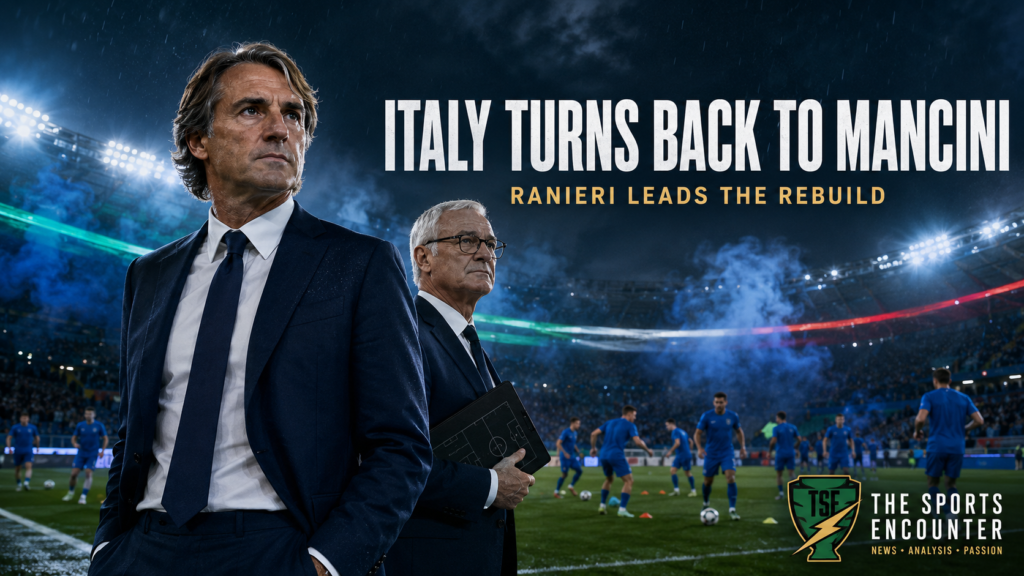
Italy have reunited with the coach who restored their pride at Euro 2020, while Claudio Ranieri takes control of the wider technical structure after a chaotic search exposed divisions inside the federation.

Roberto Mancini has returned as Italy head coach nearly three years after his unexpected departure, accepting one of the most difficult rebuilding assignments in international soccer.

Italian Football Federation President Giovanni Malagò confirmed Mancini’s appointment following Tuesday’s Federal Council meeting. Claudio Ranieri has joined the project as FIGC technical director and president of Club Italia, giving the former Leicester City manager oversight of technical operations and elite development across Italy’s national-team structure.

Mancini replaces Gennaro Gattuso, who left in April after Italy failed to qualify for the 2026 FIFA World Cup. The four-time world champions have now missed three consecutive editions of the tournament, extending an absence that began after their final group match at the 2014 World Cup.

The appointments provide Italy with two respected and highly experienced coaches. They also carry a clear tension. Mancini previously rebuilt the national team, won the European Championship and established a world-record unbeaten run. His first tenure still ended with Italy missing the 2022 World Cup and with his sudden resignation in August 2023.

Italy are therefore returning to a coach who represents both their greatest modern success and one of their most painful failures.

Mancini and Ranieri Appointments at a Glance

Key detail Information
Italy head coach Roberto Mancini
Technical director Claudio Ranieri
Additional Ranieri role President of Club Italia
Outgoing coach Gennaro Gattuso
Outgoing technical director Paolo Maldini
Mancini’s first Italy tenure 2018 to 2023
Matches during first tenure 58
Major achievement European Championship winner in 2021
Record unbeaten run 37 matches
Immediate challenge Restore Italy after missing three consecutive World Cups

Why Italy Returned to Roberto Mancini

Malagò described Mancini as the best person for the position, but the decision followed a coaching search that moved through several prominent candidates and generated another institutional crisis.

Pep Guardiola was reportedly Italy’s preferred option. The former Manchester City manager declined the opportunity, leaving the federation to explore alternatives.

Andrea Pirlo then became the leading candidate with the support of technical director Paolo Maldini and adviser Leonardo. His proposed appointment was blocked amid concerns surrounding his commercial relationship with a Russian betting company.

Maldini and Leonardo resigned shortly afterward, only 16 days after entering their federation roles. The full sequence intensified questions about authority, background checks and strategic control within the FIGC. The Sports Encounter previously examined how Maldini’s rapid departure exposed Italy’s deeper governance problems.

Mancini offered Malagò an experienced alternative who required little introduction to the national setup. He understands the federation, knows many of the available players and has already shown that he can restore confidence after a World Cup qualification failure.

His appointment also carries less coaching risk than the proposed move for Pirlo. The former Italy midfielder brought enormous symbolic value, but his managerial record remained relatively modest for a national team facing this level of pressure. Our earlier analysis of why Italy considered Pirlo after Guardiola’s refusal explored the attraction and uncertainty surrounding that plan.

Mancini Already Knows How to Revive a Wounded Italy

Mancini first became Italy coach in May 2018 after the country failed to reach the World Cup in Russia. The national team had lost confidence, supporters had become disconnected, and the squad appeared caught between generations.

He responded by changing both the mood and the style.

Italy moved away from the excessively cautious football that had shaped perceptions of the national team. Mancini encouraged pressing, short passing, positional movement and greater involvement from technical midfielders. The Azzurri began playing with freedom while retaining enough defensive intelligence to control difficult matches.

That transformation produced a 37-game unbeaten sequence consisting of 30 wins and seven draws. Italy scored 93 goals and conceded only 12 during the run, which became a men’s international record before Spain ended it in the 2021 UEFA Nations League semifinal.

The defining achievement came at the delayed Euro 2020 tournament. Italy defeated Turkey, Switzerland and Wales in the group stage before overcoming Austria, Belgium and Spain. Mancini’s side then beat England on penalties at Wembley to win the country’s first European Championship since 1968.

The victory temporarily restored Italy’s international authority. It also reconnected the current team with an older tradition of players who carried enormous national expectations, including the unforgettable figure explored in The Sports Encounter’s feature on Roberto Baggio and Italy’s emotional 1994 World Cup journey.

The Failure Mancini Cannot Escape

Italy’s European triumph makes Mancini’s return understandable. What happened afterward explains why the reunion cannot rely on nostalgia.

The Azzurri failed to qualify for the 2022 World Cup after losing to North Macedonia in a playoff semifinal. Italy dominated possession and produced a high volume of shots, yet lacked the efficiency and penalty-area authority needed to turn control into goals.

That failure exposed weaknesses concealed by the European Championship victory. Italy struggled to replace important players, several attackers failed to develop consistently, and the team lost the freshness that had defined its unbeaten run.

Mancini remained in charge and began another rebuilding process. His relationship with the federation later deteriorated, however, and he resigned in August 2023. He subsequently managed Saudi Arabia and returned to club football in Qatar.

Italy must now establish what has changed. If Mancini returns with the same ideas, the same personnel preferences and the same institutional frustrations, the federation may reproduce the conditions that ended his first tenure.

His second spell requires a sharper selection policy, a clearer attacking plan and closer coordination with Italy’s youth teams. The modern international game rewards countries that continually regenerate. Spain’s success with a new generation, illustrated by Lamine Yamal’s rise during the 2026 World Cup, shows the value of giving exceptional young players meaningful responsibility.

Ranieri Gives the Project More Than a Famous Name

Ranieri’s appointment may eventually prove as important as Mancini’s return.

The 74-year-old will serve as technical director and president of Club Italia, placing him above the day-to-day work of the senior national team. His responsibilities are expected to include technical coordination, elite development and greater alignment across Italy’s national sides.

Ranieri brings experience across several football cultures and competitive environments. His greatest achievement came in 2016, when he led Leicester City to one of the most unlikely Premier League titles in English soccer history.

That triumph was built on clear roles, tactical discipline, emotional intelligence and an ability to create trust within a squad that richer clubs had underestimated. Those qualities should help him evaluate Italy’s problems without becoming trapped by reputation or nostalgia.

His relationship with Mancini will still require clearly defined authority. Maldini’s departure showed how quickly a technical structure can collapse when the federation and its football leadership disagree over the head coach.

Ranieri must have genuine influence over development strategy and national-team coordination. Mancini, meanwhile, needs enough control to select and coach the senior side without feeling that changes are being imposed around him.

Malagò said he needed a technical director with whom he could share the decision on the coach. That statement suggests Ranieri entered the role with greater agreement over Mancini than Maldini had over Pirlo. The next test involves turning that personal alignment into a functioning governance model.

What Mancini Must Fix First

Find a dependable source of goals

Italy’s recurring attacking problems have outlived several coaches. The team can move the ball intelligently and control territory, but possession has too often ended without enough penalty-area presence.

Mancini must identify forwards who can complement one another rather than continually rotating players in search of an ideal solution. Wide attackers need clear responsibilities, while midfielders must contribute more runs and goals.

Build around the next generation

The squad needs renewal without discarding experienced players who can still contribute. Mancini gave young footballers opportunities during his first spell, and he must show the same courage again.

Selection should reward form, tactical suitability and development potential. Club reputation alone cannot determine who carries Italy into the next cycle.

Create a modern tactical identity

Italy cannot simply recreate the football of 2021. Opponents have evolved, player availability has changed, and international tournaments increasingly demand athletic range, pressing resistance and tactical flexibility.

Mancini needs a structure that can control weaker opponents without becoming vulnerable to transitions. He must also prepare Italy to manage momentum inside major matches. The dangers of losing control after taking the lead were evident in The Sports Encounter’s analysis of England’s tactical retreat against Argentina.

Italy’s Crisis Extends Beyond the Senior Team

No coach can repair Italian soccer alone.

Italy still produces intelligent players, accomplished coaches and tactically sophisticated clubs. Serie A remains internationally relevant. The national team, however, has struggled to turn those strengths into a stable supply of experienced Italian talent.

Young domestic players often face limited opportunities at leading clubs. Some spend crucial developmental years moving through loans or playing outside the highest level. Others arrive in the national squad without enough experience in Champions League matches, title races or high-pressure knockout football.

Ranieri’s technical role matters because those problems require coordination beyond international windows. Italy need stronger connections among youth national teams, club academies, coaching education and the senior side.

The 2026 World Cup provided another reminder that historic status offers no protection. Germany’s elimination, covered in our report on Paraguay’s World Cup upset over Germany, showed how quickly a traditional power can fall when execution and emotional control disappear.

Italy did not even reach that tournament. Supporters can revisit the competition’s major results, tactical stories and international trends through The Sports Encounter’s FIFA World Cup 2026 coverage.

Can Mancini and Ranieri Take Italy Forward?

The appointments solve the immediate vacancies, but they do not erase the disorder that preceded them.

Mancini knows how to restore belief, build relationships and give Italy a more ambitious playing identity. Ranieri brings calm judgment, immense experience and a reputation for improving teams through clarity rather than noise.

Their credentials give the new structure credibility. Their age and experience also mean Italy have chosen established authority instead of presenting the project as a radical generational reset.

That approach can work if Mancini remains open to tactical evolution and Ranieri creates a sustainable pathway beneath the senior team. It will fail if the federation expects two respected coaches to compensate for weak planning, limited development opportunities and unclear decision-making.

Mancini’s return is emotionally powerful because Italian supporters remember Wembley, the unbeaten run and a team that briefly made the country believe again. The harder memory involves North Macedonia, another missed World Cup and a resignation that arrived without a stable succession plan.

Italy are placing both versions of Mancini’s legacy back on the touchline.

Final Verdict

Roberto Mancini is a logical choice to lead Italy’s immediate recovery. He has already succeeded in this exact environment, understands the emotional demands of the position and owns a stronger international record than most available alternatives.

Claudio Ranieri gives the federation a respected technical leader capable of examining the wider structure. His appointment should provide Mancini with an experienced partner while creating greater continuity between the senior team and Italy’s development system.

The arrangement will be judged by more than early results. Italy need a recognizable style, productive young players, a more reliable attack and a development pathway that survives future coaching changes.

Mancini once helped Italy rise from the shock of missing a World Cup. His second attempt begins after the problem has grown much worse.

Official announcements, national-team information and technical updates are available through the official Italian Football Federation website.

For more international football news, coaching developments and tactical analysis, visit The Sports Encounter’s soccer coverage hub.

Sports Writer, Europe. Jovana Zlatova covers European sports for The Sports Encounter, with a focus on major events, match-day atmosphere, athlete stories, fan culture, and the human side of competition across the continent. Her coverage includes tennis, football, international tournaments, European sports culture, and feature-led reporting from the region. Coverage areas: European sports, tennis, football, major events, athlete stories, fan culture.

Breaking News

‘Clicky Ponting’ Cricket Scandal Explained: How a Finger Click Allegedly Created a Fake Wicket

An English amateur cricketer is accused of clicking his fingers to imitate an edge and deceive an umpire. We explain the incident, MCC Law 41 and the sanctions that may follow.

Jawad Hussain | The Sports Encounter

Published

on

Anonymous amateur cricketer in a white kit clicking his fingers near the bat to allegedly fake an edge, with the headline “The Click That Faked a Wicket” and The Sports Encounter logo.

A viral club cricket video appears to show a close-in fielder clicking his fingers as the ball passes the bat, allegedly creating a false edge sound that helped convince the umpire to give the batter out. The incident is now under formal investigation.

A strange dismissal in English amateur cricket has raised serious questions about deception, umpiring and the Spirit of Cricket.

The North Yorkshire and South Durham Cricket League has opened an investigation following a formal complaint about alleged incidents during a Division Two match between Saltburn Cricket Club’s second XI and Norton Cricket Club’s second XI on Saturday, July 25, 2026.

Video footage circulating online appears to show a Saltburn close-in fielder clicking his fingers at almost the exact moment the ball passes the batter’s outside edge. The wicketkeeper catches the delivery, the fielding side appeals and the umpire raises his finger.

The batter, reportedly Noman Shabir, immediately appears confused by the decision and gestures toward the nearby fielder. His reaction suggests he believed the sound heard by the umpire came from the finger click rather than contact between bat and ball.

Saltburn won the match by 159 runs. However, the result has been overshadowed by an allegation that goes far beyond an umpire making an ordinary mistake.

If the finger click was deliberate and intended to imitate the sound of an edge, it would represent an attempt to manufacture evidence for a dismissal.

That is why a brief movement of two fingers has created such a major controversy.

What Happened in the Alleged Finger-Click Incident?

In cricket, a batter can be dismissed caught when the ball touches the bat or a hand holding the bat before being legally caught by a fielder.

During caught-behind appeals, the umpire often relies heavily on sound. A faint edge may produce a small noise that can be difficult to distinguish from the bat hitting the ground, clothing moving or another sound near the wicket.

Professional matches offer technological assistance through tools such as UltraEdge. Most recreational cricket does not have that protection.

The viral video appears to show the following sequence:

  1. The bowler delivers the ball outside the batter’s off stump.
  2. The batter plays at the delivery.
  3. A close-in fielder appears to click his fingers as the ball passes the bat.
  4. The wicketkeeper catches the ball.
  5. Several fielders appeal for a catch.
  6. The umpire gives the batter out.
  7. The batter protests and points toward the fielder.

The allegation is that the finger click simulated the sound of bat hitting ball and influenced the umpire’s decision.

Online users have given the controversy several nicknames, including “Clickgate” and “Clicky Ponting,” a reference to former Australian captain and celebrated slip fielder Ricky Ponting.

The jokes have helped the footage travel around the world, but the underlying accusation is serious. It concerns a possible deliberate attempt to deceive a match official and unfairly remove an opponent from the game.

Readers interested in unusual moments that can influence a dismissal can also examine whether a bee disrupted Joe Root’s concentration immediately before his dismissal.

Finger-Click Controversy at a Glance

Detail Information
Competition North Yorkshire and South Durham Cricket League Division Two
Match Saltburn CC 2nd XI vs Norton CC 2nd XI
Date July 25, 2026
Allegation A fielder clicked his fingers to imitate the sound of an edge
Immediate outcome The batter was given out caught behind
Match result Saltburn won by 159 runs
League response Formal investigation opened
Applicable cricket law MCC Law 41 on unfair play
Possible consequences Warning, fine, suspension, points deduction or other disciplinary action
Current status The allegations remain under investigation

Why Would Clicking Fingers Fool an Umpire?

Caught-behind decisions are among the most difficult judgments in cricket, particularly without video or sound technology.

The umpire must watch several things within a fraction of a second:

  • The bowler’s front foot
  • The position of the ball
  • The batter’s movement
  • Possible contact with the bat
  • The wicketkeeper’s catch
  • The fielding side’s appeal

A very thin edge may not visibly change the ball’s direction. Sound can therefore become the strongest clue available to the umpire.

A finger click timed precisely as the ball passes the bat could create a convincing false signal. When that sound is followed by the wicketkeeper catching the ball and several fielders appealing together, the umpire may reasonably connect the noise with an edge.

This is what makes the alleged act especially troubling. It appears designed to exploit the normal limitations of an amateur umpire.

The official has only one chance to make the decision. The fielder, if the allegation is proven, would have deliberately introduced false information into that process.

Cricket regularly produces difficult decisions even when everyone acts honestly. A recent example came when an umpire’s-call decision helped confirm West Indies’ Test victory over Pakistan. That type of judgment is part of the game. Manufacturing an artificial sound would be fundamentally different.

What Does MCC Law 41 Say About Deliberate Deception?

The incident potentially falls under MCC Law 41, which governs unfair play in cricket.

Law 41.4 states that it is unfair for a fielder deliberately to attempt to distract the striker while the batter is preparing to receive or receiving a delivery.

Law 41.5 goes further. It prohibits a fielder from willfully attempting, through words or actions, to distract, deceive or obstruct either batter after the striker has received the ball.

The exact provision applied would depend on when the umpire believed the click occurred. However, deliberate deception is clearly covered by the law.

If an umpire detects such conduct during play, the available response can include:

  • Calling and signaling a dead ball
  • Preventing a dismissal from that delivery
  • Awarding five penalty runs to the batting team
  • Informing the fielding captain and both batters
  • Reporting the incident to the relevant cricket authority

Under Law 41.5, the batters may also be credited with any runs completed before the offense and may be allowed to decide which batter faces the next delivery.

The crucial issue is intent. An accidental click, clap or movement would not automatically amount to cheating. The umpire or disciplinary panel would need to determine whether the player acted willfully to create a false impression.

That is precisely what the league’s investigation must establish.

Modern cricket frequently debates whether new playing conditions improve or weaken competitive fairness. The Sports Encounter recently examined that wider issue in its analysis of the IPL Impact Player rule and its effect on genuine all-rounders.

Why Was It Against the Spirit of Cricket?

Cricket’s laws define what players may and may not do. The Spirit of Cricket establishes a wider expectation about how they should behave.

Players can appeal confidently when they genuinely believe a batter is out. They may celebrate, encourage the bowler and apply pressure within the rules.

Creating a false sound to manufacture an edge crosses a different line.

It potentially violates the Spirit of Cricket in several ways.

It Attempts to Deceive the Umpire

The umpire’s decision should be based on what happened during the delivery. Introducing a fake sound deliberately corrupts that decision-making process.

It Denies the Batter a Fair Contest

The batter is entitled to continue batting unless dismissed under the Laws of Cricket. A manufactured edge could end an innings without the ball ever touching the bat.

It Misuses the Appeal System

An appeal asks the umpire to rule on a genuine cricket event. If a player first creates false evidence and then appeals, the appeal becomes part of the deception.

It Exploits the Limitations of Recreational Cricket

Amateur matches rarely have television replays, stump microphones or ball-tracking systems. Fair play therefore depends heavily on honesty among players.

It Damages Trust

Cricket cannot function if every small sound near the bat becomes suspicious. Umpires must be able to trust that fielders are appealing based on what they genuinely saw or heard.

The allegation therefore concerns more than gaining one wicket. It threatens the trust that allows recreational matches to take place.

Cricket has confronted similar questions about legal skill and prohibited manipulation before. The Sports Encounter’s examination of Ian Botham’s career and the historical ball-tampering debate shows how deeply allegations of unfair play can affect reputations long after the match ends.

Readers can follow more controversies, match reports, player comparisons and tactical analysis through The Sports Encounter’s cricket news and analysis hub.

Why the Umpire Should Not Become the Main Target

The footage has led to criticism of the decision, but the umpire should not carry the main blame if deliberate deception is established.

An umpire working without technological assistance must judge a faint edge through sight and sound. A well-timed click could be extremely difficult to identify from the middle.

The official may have heard a noise, seen the ball enter the wicketkeeper’s gloves and observed a confident collective appeal. Those signals normally support a caught-behind decision.

Players also have a responsibility to avoid placing umpires in deliberately manufactured situations.

The investigation should therefore examine the alleged conduct that preceded the decision rather than treating an apparently deceived official as the central offender.

Even at the highest level, officiating controversies can overshadow the actions that produced the decision. The distinction between an official making a reasonable judgment and a participant knowingly creating a false impression must remain clear.

Could the Batter Be Reinstated After the Match?

Usually, an umpire may correct a decision promptly if convinced an error has occurred. Once play has moved on and the match has concluded, reinstating a batter is far more complicated.

The dismissal remains part of the official scorecard unless the competition authority uses its regulatory powers to amend the record or match outcome.

A disciplinary panel may punish misconduct without rewriting every event that followed it. Alternatively, league regulations may permit adjustments to points or results if the misconduct materially affected the competition.

No such decision has been announced in this case.

Saltburn’s 159-run victory also means the league would need to consider whether the disputed dismissal had a realistic effect on the final result. The disciplinary issue can remain serious even if officials conclude that Saltburn probably would have won anyway.

Cheating does not become acceptable because the winning margin was large.

What Punishment Could the Player Receive?

The league has not announced a charge, finding or punishment. Any player involved must therefore be treated as innocent unless the allegation is proven through the formal process.

If the investigation concludes that a fielder deliberately clicked his fingers to create a false edge, several sanctions may be available under recreational cricket disciplinary procedures.

Formal Warning or Reprimand

A disciplinary panel could record an official warning, particularly if it considered the incident isolated and at the lower end of misconduct.

Financial Penalty

Recreational cricket regulations can allow fines and administrative costs, depending on the rules adopted by the league and the classification of the offense.

Playing Suspension

A confirmed attempt to deceive an umpire could result in a ban for a specified number of matches or weeks. The length would depend on the seriousness of the conduct, whether it happened more than once and whether the player had any previous disciplinary record.

League Points Deduction

If the panel determines that the misconduct involved wider team participation or materially affected competition integrity, Saltburn could face a points deduction.

That would be particularly significant because the club was reported to be leading Division Two by 17 points when the controversy emerged.

Alteration of the Match Result

Competition authorities may have powers to adjust points or alter a result in serious cases. This would require a separate assessment of the applicable league rules and the effect of the alleged misconduct.

Expulsion in an Extreme Case

Some recreational cricket disciplinary frameworks allow a participant to be expelled from a league for sufficiently serious or repeated misconduct. This would ordinarily sit at the most severe end of possible sanctions.

The authorities may also consider aggravating factors, including whether the alleged action was planned, repeated, supported by teammates or previously used in other matches.

Recent cricket cases show that authorities usually distinguish between an isolated breach and wider leadership or cultural failure. That principle also appeared in The Sports Encounter’s coverage of the disciplinary questions surrounding Ben Stokes and England’s leadership.

Could Other Players Be Punished?

Potentially, but only if evidence establishes their involvement.

A wicketkeeper or another fielder should not automatically be punished merely for appealing. Cricket teams regularly appeal together when close-in fielders believe they have heard an edge.

The disciplinary question would concern what each player knew and intended.

Investigators may examine:

  • Whether teammates knew a fake sound would be created
  • Whether the tactic had been discussed before the match
  • Whether similar incidents occurred previously
  • Whether players continued appealing despite knowing there was no edge
  • Whether team officials or captains became aware of the conduct
  • Whether relevant footage or other evidence was removed or withheld

Claims about similar incidents have appeared in media coverage, but they remain allegations. Each incident would require separate evidence and proper review.

Responsibility may also extend beyond the individual if investigators find evidence of coordination. A captain or club official cannot be held accountable merely because the player belonged to the team. Authorities would need evidence showing knowledge, encouragement or a failure to act after becoming aware of the conduct.

What Has the League Said?

The North Yorkshire and South Durham Cricket League confirmed that it received a formal complaint and started a full investigation.

Its statement said:

“The league have received a formal complaint regarding alleged incidents in a division two game on Saturday 25 July 2026. A full investigation has been initiated and until such time as the formal processes are complete no further comment will be made.”

That restrained response is appropriate. Viral footage can generate immediate public judgment, but disciplinary authorities must review the complete video, hear from the umpires, speak to the players and allow those accused to respond.

The investigation may also need to determine whether the finger movement visible in the footage produced the sound heard, whether the timing was intentional and whether it influenced the umpire.

Questions involving player conduct, governing-body rules and public judgment require careful handling. A similar need for evidence and proportionate judgment appeared when The Sports Encounter examined how Ben Stokes’ conduct affected England’s leadership culture and public trust.

Why Amateur Cricket Depends So Heavily on Player Honesty

Professional cricket can review close decisions through multiple camera angles, stump microphones, ball-tracking systems and edge-detection technology.

Club cricket operates in a different environment.

An amateur umpire may work alone at one end without access to replay technology. Camera footage, if it exists, may be recorded for streaming or coaching rather than formal decision reviews. Players therefore carry a greater responsibility to preserve the integrity of the contest.

This does not mean players should withdraw every close appeal or correct every decision that benefits them. Honest disagreements will always exist.

The line is crossed when a participant intentionally manufactures the evidence that prompts the decision.

Recreational sport survives because competitors generally accept that winning has limits. Once deception becomes normalized, leagues must invest more heavily in monitoring, disciplinary systems and technology simply to reproduce the trust players should have protected themselves.

The wider importance of safeguarding standards and clearly defined conduct rules can also be seen in the regulations surrounding teenage cricketer Vaibhav Sooryavanshi and senior dressing rooms. Different situations involve different risks, but both demonstrate why sporting rules depend on participants respecting their purpose.

Final Verdict: A Small Action With a Serious Meaning

The alleged finger click lasted less than a second. Its possible significance stretches much further.

Cricket permits tactical deception in limited forms. A bowler can disguise a slower ball. A batter can use an unexpected shot. A captain may position a fielder to encourage a false stroke.

Those actions test an opponent’s cricketing judgment.

Creating a fake edge sound would serve a different purpose. It would attempt to convince an umpire that an event occurred when it did not.

If the allegation is proven, the conduct would constitute a clear challenge to fair play, respect for match officials and the integrity of recreational cricket. A suspension would be a realistic possibility, while stronger sanctions could follow if investigators find evidence of repetition, planning or wider team involvement.

For now, the distinction between allegation and fact remains essential.

The video has created serious questions. The North Yorkshire and South Durham Cricket League must now determine whether “Clicky Ponting” was an unfortunate visual coincidence, an isolated act of misconduct or evidence of a deliberate method used to manufacture wickets.

Frequently Asked Questions

What did the cricketer allegedly do?

A close-in fielder is accused of clicking his fingers as the ball passed the batter’s bat. The allegation is that the sound imitated a faint edge and contributed to the umpire giving the batter out caught behind.

Is clicking your fingers illegal in cricket?

Clicking your fingers is not automatically an offense. It may become unfair play if a fielder does it deliberately to distract or deceive a batter or umpire during a delivery.

Which cricket law could apply?

MCC Law 41 addresses unfair play, including deliberate attempts by fielders to distract, deceive or obstruct batters.

Could the dismissal be cancelled?

An umpire can correct a decision promptly during a match under certain circumstances. Changing a dismissal after the match has ended would depend on the league’s regulations and disciplinary powers.

What punishment could the player receive?

Possible sanctions may include a reprimand, fine, playing suspension or another disciplinary penalty. More serious consequences, including a points deduction, could be considered if investigators establish repeated conduct or wider team involvement.

Has the player been found guilty?

No. The league has opened an investigation, but no final finding or punishment had been announced at the time of writing.

Continue Reading

Editor's Choice

Glasgow 2026 Day 5 Wrap-Up: Records Fall, Jersey Ends a 36-Year Wait and Australia Tightens Its Grip

Australia extended its Glasgow 2026 lead on Day 5, while Emmanuel Eseme broke the men’s 100m Games record, Filip Nowacki ended Jersey’s 36-year wait for gold and Pakistan secured a historic women’s boxing medal.

Published

on

Glasgow 2026 Day 5 Wrap-Up: Records Fall, Jersey Ends a 36-Year Wait and Australia Tightens Its Grip

Australia strengthened its control of the Glasgow 2026 Commonwealth Games on a rain-soaked Day 5, but Filip Nowacki’s historic Jersey gold, Emmanuel Eseme’s record-breaking sprint and landmark boxing medals for Pakistan and Scotland gave the day a much wider meaning.

Day 5 of the Glasgow 2026 Commonwealth Games was expected to clarify the medal race. Instead, it revealed how many different versions of success can exist within the same sporting day.

Australia continued to overwhelm the competition through swimming, gymnastics and athletics. Canada collected gold through technical excellence, strength and the extraordinary consistency of Felix Dolci. England converted its bowls tradition into two titles, while Scotland found a home victory through one of the finest pressure shots of the Games.

Yet the moments that will probably last longest belonged to countries and territories with much smaller teams.

Filip Nowacki, an 18-year-old swimmer from Jersey, won the men’s 200m breaststroke to secure the island’s first Commonwealth Games gold medal in 36 years. Cameroon’s Emmanuel Eseme ran 9.83 seconds through heavy rain to become the fastest man in Commonwealth Games history. Zoe Hobbs gave New Zealand the women’s 100m crown in an Oceania record.

Pakistan’s Fatima Zahra and Scotland’s Caitlin Rainey guaranteed their countries’ first Commonwealth Games medals in women’s boxing. Nigeria produced its first swimming finalist in Games history. Wales celebrated its first Commonwealth artistic gymnastics title through Ruby Evans. Nauru placed a 17-year-old weightlifter on the podium.

The medal table still tells a story of Australian control. Day 5 itself told a richer one about athletes and nations changing what they believed was possible.

TL;DR: What Happened on Day 5 of Glasgow 2026?

  • Australia won nine gold medals across swimming, gymnastics and athletics, taking its reported overall total to 35 golds.
  • Emmanuel Eseme of Cameroon won the men’s 100m in a Commonwealth Games record of 9.83 seconds.
  • New Zealand’s Zoe Hobbs claimed the women’s 100m in an Oceania record of 10.93.
  • Jersey’s Filip Nowacki, 18, won the men’s 200m breaststroke in 2:07.32, ending the island’s 36-year wait for a Commonwealth title.
  • Lani Pallister dominated the women’s 800m freestyle in a Games record of 8:11.12.
  • Felix Dolci won the men’s vault and horizontal bar, finishing Glasgow’s gymnastics competition with six medals, including four golds.
  • Wales’ Ruby Evans became her country’s first Commonwealth Games artistic gymnastics champion.
  • Maude Charron won a third consecutive Commonwealth weightlifting title for Canada.
  • Scotland defeated England in a dramatic Para mixed pairs bowls tiebreak.
  • England won the women’s pairs and men’s singles bowls titles.
  • Pakistan’s Fatima Zahra and Scotland’s Caitlin Rainey secured historic first women’s boxing medals.
  • Uganda reached the women’s 3×3 basketball semifinals, while South Africa remained unbeaten in netball.
  • Australia remained far ahead in the medal standings, with Canada and England leading the pursuit.

Glasgow 2026 Day 5 at a Glance

Category Day 5 highlight Why it mattered
Athlete of the day Felix Dolci Won two golds and one bronze, finishing gymnastics with six medals
Performance of the day Emmanuel Eseme, 9.83 in the men’s 100m Commonwealth Games record in torrential rain
Breakthrough of the day Filip Nowacki Jersey’s first Games gold since 1990
Women’s sprint highlight Zoe Hobbs, 10.93 Personal best and Oceania record
Australian statement Nine Day 5 gold medals Extended an already commanding medal-table lead
Home-nation moment Scotland’s Para mixed pairs bowls gold Won through a final-ball tiebreak shot
Historic boxing result Fatima Zahra Pakistan’s first Commonwealth women’s boxing medal
Gymnastics breakthrough Ruby Evans Wales’ first Commonwealth artistic gymnastics gold
Weightlifting milestone Maude Charron Third consecutive Commonwealth title
Para sport highlight Stephen Clegg Won Scotland’s men’s S13 50m freestyle title
Emerging-nation breakthrough Abduljabar Adama Became Nigeria’s first Commonwealth swimming finalist

The Real Day 5 Story Was the Widening Medal Map

Australia’s supremacy is the easiest Day 5 story to identify. It is also only part of what happened.

The deeper development was the widening of the Glasgow medal map.

Jersey moved from celebrating a long-awaited silver to possessing a Commonwealth champion. Cameroon entered the medal table through the most prestigious race in athletics. Pakistan and Scotland reached new territory in women’s boxing. Nauru returned to the weightlifting podium through one of the youngest medalists of the day. Singapore won its first Glasgow 2026 medal through 16-year-old gymnast Amanda Yap.

Nigeria’s Abduljabar Adama won a swim-off to reach the men’s 50m butterfly final, becoming the first Nigerian swimmer to contest a Commonwealth Games final. That result will not appear as a medal, but its developmental importance could be greater than many bronze medals won by established powers.

This is where the Commonwealth Games still possesses a distinct sporting value.

World championships and the Olympics often measure success through global supremacy. The Commonwealth Games can provide an intermediate stage on which smaller programs gain belief, public recognition and funding. An athlete reaching one final can alter the expectations of an entire national federation.

The official Commonwealth Sport review of the widening Glasgow 2026 medal map identified Jersey, Pakistan, Nigeria, Singapore and Nauru as central examples of that wider breakthrough.

Australia dominated the quantity. Day 5’s smaller delegations supplied much of its meaning.

Emmanuel Eseme Produces the Race of the Games

The rain at Scotstoun Stadium could have slowed the men’s 100m final into a battle of survival.

Emmanuel Eseme turned it into history.

The 32-year-old Cameroonian entered the final after running a lifetime-best 9.89 in the semifinal. He improved again under heavier pressure, winning in 9.83 to break the Commonwealth Games record and claim Cameroon’s first medal of Glasgow 2026.

Australia’s Lachlan Kennedy took silver, while Nigeria’s Kayinsola Ajayi secured bronze.

Eseme’s performance deserves to be understood within the conditions. Sprinting relies on clean acceleration, confidence through the drive phase and the ability to apply force without tightening. Torrential rain can disrupt each part of that sequence. Athletes must also manage the psychological risk of slipping or losing control.

Eseme did not produce the best start in the field. His race developed through patience.

He allowed the early leaders to open a small advantage, stayed composed through the transition and closed powerfully over the second half. His post-race explanation was revealing: he expected others to lead through the opening 50 meters but trusted himself to catch them.

That is precisely what happened.

The result was Cameroon’s first Glasgow medal, a Games record and one of the strongest sprint performances ever witnessed at a Commonwealth Games.

Running 9.83 in ideal weather would have been exceptional. Achieving it on a drenched Glasgow track gave the performance a different level of authority.

The official Glasgow 2026 athletics report on the men’s and women’s 100m finals confirmed that Eseme lowered his personal best twice during the day.

Zoe Hobbs Finally Gets Her Championship Moment

New Zealand’s Zoe Hobbs arrived in Glasgow with years of international experience and a reputation as one of Oceania’s fastest women. A major senior title had remained out of reach.

That changed in 10.93 seconds.

Hobbs produced an excellent start in the women’s 100m final, established control early and maintained her technique when England’s Amy Hunt and Australia’s Torrie Lewis tried to close the gap.

Her 10.93 was a personal best and an Oceania record. Hunt took silver, while Lewis earned bronze with an Australian record.

Hobbs’ winning margin was only 0.05 seconds, but the race never felt out of her control once she found her upright running position. She resisted the tension that often appears in the closing meters of a championship final and continued driving through the line.

The emotional response after the finish suggested how much the result meant. Hobbs looked toward the scoreboard before allowing herself to celebrate. Years of marginal improvements had finally produced the medal she had chased.

Her victory also gave New Zealand a second major Day 5 swimming and athletics storyline, complementing Lewis Clareburt’s success in the pool.

Readers can follow more performances, records and tactical analysis through The Sports Encounter’s athletics coverage and results hub.

Australia Keeps Winning, but Its Day 5 Strength Went Beyond Swimming

Australia began Day 5 with a substantial medal-table lead after finishing Glasgow 2026 Day 4 with 26 gold medals and 59 medals overall.

By the end of Tuesday, the gap had grown again.

The Australian team reportedly collected nine gold medals during the day, moving to 35 golds and 80 medals overall. Swimming remained its primary engine, but gymnastics and athletics ensured the campaign did not depend entirely on Tollcross.

Jesse Moore won the men’s parallel bars. Breanna Scott took the women’s balance beam. Ky Robinson delivered gold in the men’s 10,000m. Eleanor Patterson reclaimed the women’s high jump title 12 years after winning it at Glasgow 2014.

Australia’s day showed something more significant than medal volume. Its athletes kept winning different types of contests.

Pallister controlled a long-distance swimming race from the front. Southam defeated an established champion in a sprint. Patterson survived a delayed, rain-disrupted high jump final lasting more than three hours. Robinson navigated a crowded and physical 10,000m.

That versatility is why Australia has separated itself.

England and Canada continue reaching podiums across many sports. Australia is converting more of those opportunities into gold.

Flynn Southam Signals a Changing of the Guard

The men’s 100m freestyle final offered one of Day 5’s most compelling internal Australian contests.

Kyle Chalmers entered as the defending Commonwealth champion and one of the defining swimmers of his generation. Flynn Southam arrived as the younger challenger who had already produced a 47.09 lead-off split in the 4x100m freestyle relay.

Southam won in 47.13.

Wales’ Matt Richards claimed silver, while Chalmers took bronze.

The victory was important because Southam did not inherit the title through Chalmers’ absence or a poor field. He defeated the established champion in direct competition.

Southam built the race through his speed and held his technique during the final 25 meters. Chalmers is renowned for late surges, so any swimmer facing him must balance early aggression with enough control to resist the closing attack.

Southam got that balance right.

The result did not diminish Chalmers’ career. It demonstrated that Australia’s freestyle succession plan is already producing championship-level outcomes.

Filip Nowacki Turns Jersey’s Long Wait Into Gold

No Day 5 victory altered a nation’s sporting history more directly than Filip Nowacki’s men’s 200m breaststroke title.

Jersey had waited 36 years for another Commonwealth Games gold medal. Colin Mallett’s shooting victory at Auckland 1990 remained the island’s most recent title.

Nowacki ended that wait at 18.

He entered Glasgow as the world and European junior champion and had already won silver in the 100m breaststroke, Jersey’s first Commonwealth medal since 1990. The 200m was considered his stronger event, but fulfilling that expectation required him to defeat a field containing established senior swimmers, including Australian Olympic champion Zac Stubblety-Cook.

Nowacki led with conviction and finished in 2:07.32. Canada’s Oliver Dawson took silver, while Stubblety-Cook earned bronze.

The winning time moved Nowacki into elite international territory and confirmed that his junior success can translate onto the senior stage. His progression also demonstrated the value of the Commonwealth pathway. He won three medals at the 2023 Commonwealth Youth Games before reaching the senior podium in Glasgow.

For Jersey, the result carries a scale that Australia’s latest swimming gold cannot match.

Large delegations can absorb sporting success into a wider medal campaign. Small territories experience it collectively. One title can become national history, a recruitment tool and an argument for further investment in sport.

Nowacki arrived in Glasgow as an emerging breaststroker. He leaves as one of Jersey’s most important Commonwealth athletes.

Lani Pallister Makes the 800m Look Almost Routine

Lani Pallister’s victory in the women’s 800m freestyle was far less surprising. The scale of her control still demanded attention.

Pallister won in a Commonwealth Games record of 8:11.12, finishing well ahead of New Zealand’s Erika Fairweather. Australia’s Molly Walker collected bronze.

The race was effectively decided before its closing stages. Pallister established a demanding rhythm, stretched the field and continued pressing when the gold medal was already secure.

That last detail matters.

Great distance swimmers do not measure themselves only against the people in neighboring lanes. They race the clock, their preparation and the technical standard they believe they can reach.

Pallister’s 800m title joined her earlier successes and reinforced her status as one of the central figures behind Australia’s pool dominance.

Australia later completed the swimming program with another record when its mixed 4x100m medley relay won in 3:40.46. South Africa claimed silver, while Duncan Scott produced a dramatic freestyle anchor to bring Scotland past England and Canada for bronze.

More swimming results and athlete analysis are available in The Sports Encounter’s international swimming coverage.

Forrester, Masse, Van Niekerk and Clareburt Defend Their Territory

The pool did not belong exclusively to Australia.

Canada’s Kylie Masse successfully defended the women’s 50m backstroke title. South Africa’s Lara van Niekerk retained the women’s 50m breaststroke crown. New Zealand’s Lewis Clareburt repeated as men’s 400m individual medley champion.

Australia’s Jenna Forrester won the women’s 200m individual medley, giving her a third individual gold of the Games.

Each victory involved a different type of championship pressure.

Masse carried the expectation associated with a long international career. Van Niekerk had to execute within one of swimming’s shortest and least forgiving events. Clareburt faced a 400m test requiring control across all four strokes. Forrester entered with momentum but also a growing workload.

Their victories prevented the session from becoming a simple Australian procession and gave Canada, South Africa and New Zealand important gold-medal movement.

Scotland’s Stephen Clegg added one of the home crowd’s strongest swimming moments by winning the men’s S13 50m freestyle. Australia’s Kiralee Hayes took the women’s S13 title.

Felix Dolci Leaves Glasgow With a One-Man Medal Campaign

Canada’s Felix Dolci produced the most complete individual performance of Day 5.

He won gold in the men’s vault and horizontal bar before collecting bronze in the parallel bars. Those results took his Glasgow tally to six medals, including four golds.

At the time his competition ended, Dolci’s personal medal return would have placed him among the leading nations on the medal table if he had been competing as a country.

His vault victory came with an average score of 13.766. He later scored 14.233 on horizontal bar, beating Cyprus’ Marios Georgiou, with Canadian teammate William Émard taking bronze.

Dolci’s success was built on durability as much as skill.

Multi-event gymnasts must repeatedly reset their concentration while managing physical fatigue, apparatus differences and the emotional consequences of previous routines. A mistake on one piece can follow an athlete into the next final.

Dolci kept producing.

His medal haul helped Canada move ahead of England on gold medals in the Day 5 standings and positioned him as one of the leading individual athletes of Glasgow 2026.

Ruby Evans Gives Wales Its First Artistic Gymnastics Gold

Ruby Evans’ women’s floor exercise title carried national significance.

Her 13.500 score defeated England’s Abigail Martin and Shantae-Eve Amankwaah, making Evans the first Welsh artistic gymnast to win Commonwealth Games gold.

The victory followed a difficult week in which Evans had endured inconsistent results and disappointment. Her floor routine offered the response athletes hope to produce after a competition has begun slipping away.

She combined difficulty with cleaner landings and enough expressive control to separate herself from the English challengers.

Wales entered Day 5 without a gold medal. Evans supplied one in an event built for visibility and emotion.

Australia’s Breanna Scott won the balance beam with 13.933, while 16-year-old Amanda Yap earned Singapore’s first medal of the Games with silver. Jesse Moore completed Australia’s apparatus success in the parallel bars.

The apparatus medals were distributed widely, even while Dolci remained the dominant individual force.

Maude Charron Completes a Commonwealth Three-Peat

Canadian weightlifter Maude Charron extended one of the Games’ most impressive active streaks.

Charron won the women’s 63kg competition, adding Glasgow 2026 to her Gold Coast 2018 and Birmingham 2022 titles. She set Games records in the snatch at 102kg and clean and jerk at 130kg.

England’s Sarah Davies Smale took silver. Nauru’s Femily-Crystie Notte, only 17, claimed bronze.

Charron’s third consecutive title represented longevity at the highest level. Weightlifting careers can be interrupted by injuries, bodyweight changes and shifting competition categories. Remaining the Commonwealth standard across eight years requires far more than maintaining raw strength.

Her technique stayed dependable when the weight increased, and her record lifts removed any doubt about the title.

Malaysia’s Erry Hidayat won the men’s 79kg division with a 331kg total, edging India’s Ajaya Babu by a single kilogram. England’s Chris Murray took bronze with 325kg after a frightening moment during the clean and jerk.

Murray appeared to faint after abandoning a 174kg attempt and required immediate attention. He recovered sufficiently to return minutes later and complete 177kg, securing bronze following an injury-ravaged two-year period.

Scotland’s Final Bowl Turns Pressure Into Gold

Scotland’s Para mixed pairs B2-B3 final against England delivered one of the best home moments of the day.

England won the opening set 7-2 through Ron Homer and Sally-Ann Lewis-Wall. Scotland responded to force a single-end tiebreak.

Robert Barr then delivered the decisive bowl.

With the title resting on one final shot, Barr found the line and weight required to give Scotland gold alongside Mary Stevenson and their directors. Stevenson won her first Commonwealth medal at 63.

The celebration inside the SEC reflected the pressure release. Bowls can appear measured and quiet from a distance, but its compressed indoor format creates sudden shifts. A match developed over two sets came down to one athlete controlling his hand and judgment for a few seconds.

England recovered to win both remaining bowls titles.

Amy Pharaoh and Sian Honnor defeated Malaysia’s Aleena Ahmad Nawawi and Syafiqa Abdul Rahman in the women’s pairs. Sam Tolchard beat Malaysia’s Izzat Shameer Dzulkeple in the men’s singles after taking the opening set 8-0.

Tolchard became emotional after winning, remembering his father, who died when the English bowler was 15. Northern Ireland collected bronze in both the women’s pairs and men’s singles.

The official Glasgow 2026 bowls review captured a session shaped by tight finishes, family memories and three different nations leaving with medals.

Fatima Zahra Changes Pakistan’s Women’s Boxing History

Fatima Zahra became the first Pakistani woman to guarantee a Commonwealth Games boxing medal.

She defeated New Zealand’s Jordan Wilson by unanimous decision in the women’s 60kg quarterfinal, securing at least bronze before her semifinal against Canada’s Marie-Bathoul Al-Ahmadieh.

Pakistan entered a women’s team in international boxing for the first time only in 2016. Ten years later, Zahra has placed the country on a Commonwealth podium.

Her victory is important for reasons extending beyond one tournament.

Women’s boxing programs need visible proof that international progress is possible. A first medal can help attract athletes, persuade federations to protect funding and challenge assumptions about which sports women from a particular country can pursue.

Zahra described the result as a first step and immediately turned her attention toward gold.

Scotland also secured its first Commonwealth women’s boxing medal when Caitlin Rainey stopped Papua New Guinea’s Flora Loga in the 65kg quarterfinal. She will face Northern Ireland’s Kaci Rock in the semifinals.

Lesotho guaranteed its first Commonwealth medal in 20 years after Pooana Khoahli defeated Mauritius’ Ziggy Agathe in the men’s 65kg division.

These quarterfinal results did not produce gold medals on Tuesday, but they created some of the day’s most consequential national milestones. The official Glasgow 2026 boxing report confirmed the historic achievements for Pakistan and Scotland.

Further results, profiles and fight analysis can be found through The Sports Encounter’s boxing news and analysis section.

Uganda Advances in 3×3 Basketball

Uganda’s women defeated Tonga 21-12 to qualify for the 3×3 basketball semifinals.

New Zealand, unbeaten through the competition, now stands between Uganda and the gold-medal game.

Jamila Nansikombi and her teammates have brought the same fearless energy that has characterized Uganda’s wider Games performance. The semifinal presents a more difficult tactical test because New Zealand has combined physicality with efficient outside shooting.

Uganda must protect possession and prevent the Kiwis from turning defensive rebounds into rapid two-point opportunities. In a game played to 21, a short scoring burst can decide the contest before a team has time to adjust.

Reaching the final four already represents progress. Defeating New Zealand would become one of the tournament’s defining team-sport upsets.

South Africa and Australia Prepare for a Netball Collision

South Africa maintained its perfect netball record by defeating Northern Ireland 78-30.

The Proteas were less convincing early but increased their intensity after halftime, outscoring Northern Ireland by 17 points in both the third and fourth quarters.

Australia followed with a 68-32 victory over Malawi, maintaining its own unbeaten start.

Those results created one of Day 6’s most important matchups. South Africa and Australia will meet before the Proteas finish the pool phase against England.

South Africa’s greatest positive has been lineup flexibility. Coach Jenny van Dyk has rotated players without losing control against the weaker teams. The unanswered question concerns whether those combinations can function against Australia’s defensive pressure and transition speed.

In Pool B, Wales earned its first victory by beating Trinidad and Tobago 74-30. Uganda pushed world No. 2 New Zealand before losing 58-50, further evidence of its growing status within international netball.

Glasgow 2026 Medal Table After Day 5

The available post-session standings showed Australia extending its lead significantly. Canada moved into second place on gold medals, while England remained ahead of Canada in overall medal volume.

Rank Nation Gold Silver Bronze Total
1 Australia 35 18 27 80
2 Canada 13 10 12 35
3 England 10 18 15 43

Medal standings are ordered by gold medals, followed by silver and bronze. Figures reflect the reported table after Day 5. Readers should consult the official Glasgow 2026 medal standings for subsequent results or corrections.

Australia’s advantage is now severe enough that the main overall question may no longer concern which nation will finish first.

The more competitive contest sits behind it.

Canada’s gymnastics, swimming, athletics and weightlifting golds have improved its conversion rate. England continues to collect more medals overall but has too many silvers and bronzes compared with Canada’s title count.

That distinction explains the rankings. Commonwealth standings prioritize gold medals rather than total podium finishes.

Glasgow 2026 Day 5 Scorecard

Category Leading athlete or nation Editorial assessment
Overall performance Australia Continued converting finals into gold across three major sports
Best individual campaign Felix Dolci Six gymnastics medals, including four golds
Best single performance Emmanuel Eseme Games-record 9.83 in extremely difficult conditions
Biggest national breakthrough Jersey First Commonwealth gold in 36 years
Most significant women’s milestone Fatima Zahra Pakistan’s first women’s Commonwealth boxing medal
Best home moment Scotland’s Para mixed pairs Won a tiebreak with the final bowl
Emerging talent Filip Nowacki Senior gold at 18 after Commonwealth Youth Games success
Strongest title defense Maude Charron Third successive weightlifting gold
Team-sport momentum South Africa netball Three wins before facing Australia and England
Day 6 team to watch Uganda women’s 3×3 One victory from the gold-medal game

What Most Glasgow 2026 Day 5 Coverage Missed

The obvious conclusion from Day 5 is that Australia keeps winning.

The more interesting conclusion concerns how Glasgow’s compact Games model is distributing importance.

With 10 sports, six integrated Para sports and four main venues, Glasgow 2026 does not possess the scale or variety of Birmingham 2022. Several popular Commonwealth sports were removed to make the event financially and operationally possible.

That reduction created legitimate criticism. It also concentrated attention.

Jersey’s swimming title did not disappear beneath dozens of simultaneous finals. Pakistan’s women’s boxing breakthrough became a central Games story. Para bowls received a loud, emotionally invested crowd. Nigeria’s first swimming finalist gained official recognition even without a medal.

A streamlined Commonwealth Games will ultimately be judged on sustainability, competitive quality and whether the omitted sports can return in future editions. Day 5 nevertheless demonstrated that a smaller program can still create broad international relevance when the competition remains accessible to developing nations and territories.

Australia may leave Glasgow with an overwhelming medal total.

Nowacki, Zahra, Adama, Evans, Notte and Eseme showed why the Games cannot be evaluated only by looking at the top of the table.

Final Verdict: Australia Owned the Numbers, but History Belonged to Everyone

Day 5 strengthened Australia’s control of Glasgow 2026.

Flynn Southam defeated Kyle Chalmers. Lani Pallister dismantled the 800m field. Jenna Forrester won another individual medley. The mixed medley relay broke the Games record. Jesse Moore, Breanna Scott, Ky Robinson and Eleanor Patterson extended the gold rush beyond the pool.

Canada produced the day’s leading individual athlete through Felix Dolci and another three-time champion in Maude Charron. England swept the two non-Para bowls titles. Scotland found home glory through Robert Barr’s final shot and Stephen Clegg’s Para swimming victory.

Those achievements shaped the medal race.

The day’s identity came from somewhere else.

It came from Jersey ending a 36-year wait through an 18-year-old swimmer. Cameroon won the men’s 100m with the fastest performance in Commonwealth Games history. Pakistan entered a new chapter in women’s boxing. Wales found its first artistic gymnastics champion. Nigeria reached a swimming final for the first time.

These were not side stories surrounding Australia’s dominance. They were the reason Day 5 mattered.

The medal table tells us which country is winning Glasgow 2026.

Day 5 reminded us that the Commonwealth Games becomes valuable when success reaches places that rarely occupy the center of the global sporting stage.

Readers can follow schedules, results and tournament announcements through the official Glasgow 2026 website and find wider institutional information through the official Commonwealth Sport platform.

Frequently Asked Questions

Who led the Glasgow 2026 medal table after Day 5?

Australia led the medal standings with a reported 35 gold medals and 80 medals overall. Canada occupied second place on gold medals, while England had won more total medals than Canada but fewer titles.

Who won the Glasgow 2026 men’s 100m final?

Cameroon’s Emmanuel Eseme won the men’s 100m in 9.83 seconds. His performance established a Commonwealth Games record and delivered Cameroon’s first medal of Glasgow 2026.

Why was Filip Nowacki’s swimming gold historic?

Filip Nowacki won Jersey’s first Commonwealth Games gold medal since Colin Mallett’s shooting victory at Auckland 1990. The 18-year-old took the men’s 200m breaststroke title in 2:07.32.

What record did Zoe Hobbs break?

New Zealand’s Zoe Hobbs won the women’s 100m in 10.93 seconds, setting a personal best and an Oceania record.

How did Fatima Zahra make history for Pakistan?

Fatima Zahra became the first Pakistani woman to secure a Commonwealth Games boxing medal after winning her women’s 60kg quarterfinal by unanimous decision.

How many medals did Felix Dolci win at Glasgow 2026?

Canadian gymnast Felix Dolci completed his competition with six medals, including four golds. He won the men’s vault and horizontal bar titles on Day 5 and added bronze on the parallel bars.

Continue Reading

Breaking News

FIFA and UEFA at Loggerheads: Could the $20 Billion World Cup Plan Trigger a Global Soccer Revolt?

UEFA has opened a direct confrontation with FIFA over its proposed $20 billion World Cup company. The decisive battle will involve the votes and loyalties of soccer’s 211 national associations.

Miley Rumer | The Sports Encounter

Published

on

Cinematic FIFA vs UEFA confrontation with rival soccer executives facing off across a fractured pitch as global federation delegates gather around the World Cup trophy.

UEFA has declared that the World Cup is “not FIFA’s to sell.” FIFA says private investment will democratize the game. Behind those competing claims, Gianni Infantino and Aleksander Čeferin are entering a battle for the allegiance of national associations across every continent.

TL;DR: Why the FIFA-UEFA Conflict Matters

  • FIFA plans to establish FIFA Forward Enterprise, a commercial subsidiary reportedly valued at approximately $20 billion.
  • Private investors could purchase non-controlling stakes of up to 20%, potentially raising about $4.2 billion.
  • UEFA says the proposal crosses an institutional red line and has urged national associations, leagues, clubs, players, supporters and governments to take the threat seriously.
  • No confederation outside Europe has formally joined UEFA’s opposition at the time of publication.
  • CONMEBOL could become the most influential swing bloc because of its competitive importance, cultural authority and recent strategic relationship with UEFA.
  • CAF, AFC, Concacaf and OFC associations may find FIFA’s promise of up to $20 million in optional development capital difficult to reject.
  • UEFA controls only 55 of FIFA’s 211 member-association votes, leaving it unable to defeat the proposal without substantial support from outside Europe.
  • The immediate dispute concerns private investment, but the deeper struggle involves FIFA’s authority, UEFA’s influence and the future control of international soccer.
  • A European World Cup boycott or breakaway competition remains an extreme and unsupported scenario. UEFA has announced no such plan.

FIFA’s World Cup Investment Plan at a Glance

Issue Current position Why it matters politically
Proposed company FIFA Forward Enterprise, or FFE Would place FIFA’s commercial and event operations inside a dedicated corporate entity
Reported valuation Approximately $20 billion Creates a financial value around the business operating FIFA competitions
Outside investment Minority, non-controlling stakes of up to 20% Introduces private shareholders into FIFA’s tournament economy
Potential capital raised Up to approximately $4.2 billion Gives FIFA substantial resources to distribute across world soccer
Expected lead investor Joshua Kushner’s Thrive Eternal Adds political and governance scrutiny to an already controversial proposal
FIFA’s argument Private capital can support sustainable and inclusive global development Appeals strongly to smaller and less wealthy national associations
UEFA’s argument Football’s soul and governance are not assets FIFA can sell Frames the proposal as an institutional threat rather than a routine investment
Possible association benefit Optional access to up to $20 million in one-off capital Could make it difficult for UEFA to recruit opposition outside Europe
Approval Expected to involve FIFA’s member associations and FIFA Council Turns the dispute into a contest for influence across FIFA’s 211-member electorate

The World Cup Ended, but the Fight for World Soccer Had Already Begun

Less than two weeks after Spain defeated Argentina in the 2026 FIFA World Cup final, the celebration surrounding the largest tournament in soccer history gave way to an institutional confrontation that could shape the sport for years.

FIFA announced plans to create FIFA Forward Enterprise, a new subsidiary that would oversee the commercial and event operations connected to the World Cup and its other competitions. The proposed company would reportedly be valued at approximately $20 billion, with outside investors permitted to purchase minority stakes of up to 20%.

UEFA’s response arrived quickly and carried little of the diplomatic restraint normally associated with disagreements between governing bodies.

European soccer’s leadership said FIFA had crossed a line that football institutions should never cross. Its statement argued that the game’s soul and governance could not become tradable assets and warned that FIFA had provided insufficient transparency about who might benefit financially.

The most important part of UEFA’s response was its intended audience. It did not speak only to European federations. UEFA directly addressed every national association, league, club, player, supporter, government and stakeholder concerned about the game’s future.

That language sounded like more than criticism. It resembled an invitation to organize.

FIFA has presented the proposal as a development initiative capable of channeling billions of dollars into facilities, coaching, grassroots competitions, national teams and women’s soccer. UEFA has recast it as a fight over whether any governing body possesses the moral authority to place an economic stake in the World Cup before private investors.

The confrontation has therefore moved beyond the accounting structure of one subsidiary. FIFA and UEFA are contesting who can legitimately speak for global soccer.

The dispute also follows a World Cup that produced enormous audiences, commercial opportunities and political controversy. The Sports Encounter’s examination of the record 2026 World Cup final viewership in the United States showed why FIFA’s tournament business has become so attractive to investors.

The emotions surrounding the World Cup remain public and communal. The commercial machinery surrounding those emotions is now valued in billions.

Why UEFA Treated FIFA’s Initiative as a Declaration of War

UEFA’s fury cannot be explained by private investment alone. European soccer already operates within a vast commercial system involving broadcasters, sponsors, investment funds, club owners, financial institutions and multinational corporations.

UEFA’s own competitions generate billions. The Champions League has repeatedly expanded its broadcasting inventory, sponsorship reach and match schedule. Europe cannot credibly argue that commercial money is inherently incompatible with soccer.

The difference lies in what FIFA wants to place inside the proposed company.

FIFA Forward Enterprise would reportedly oversee commercial and event operations associated with the World Cup and other FIFA competitions. Private shareholders would acquire an economic interest in the company managing the most valuable events under FIFA’s authority.

FIFA says those investors would remain passive. It would retain sole authority over sporting regulations, governance, competitions and the international match calendar. Outside capital would enter a FIFA subsidiary, not FIFA itself.

UEFA sees that distinction as too narrow.

A shareholder does not require direct control over team qualification, match rules or host selection to influence an organization’s commercial direction. Investors expect the value of their holdings to grow. That expectation can affect revenue targets, sponsorship strategies, event frequency, ticketing models and the commercial priorities surrounding future competitions.

UEFA’s wider concern is institutional. Allowing FIFA to complete the deal could strengthen Infantino’s influence over national associations for years. The billions raised through the transaction would give FIFA additional resources to distribute throughout Africa, Asia, the Caribbean, Oceania and other developing soccer regions.

Europe would retain its wealth, elite clubs and competitive importance. FIFA would strengthen the financial dependence of smaller associations on its development system.

From UEFA’s perspective, the proposal could therefore alter the balance of power between Zurich and Nyon. What FIFA describes as democratization may also consolidate the authority of FIFA’s leadership.

Infantino and Čeferin Are Fighting Over Two Different Visions of Soccer

The personal and institutional relationship between FIFA President Gianni Infantino and UEFA President Aleksander Čeferin has deteriorated through a series of disputes involving tournament expansion, the international calendar, player workload, governance, match operations and political influence.

The FFE proposal has brought those disagreements into one larger confrontation.

Infantino’s vision treats the World Cup as a powerful economic engine that can fund soccer in countries lacking Europe’s mature leagues, media markets and club infrastructure. FIFA argues that the game’s worldwide popularity should create meaningful opportunities throughout all 211 member associations.

Čeferin’s UEFA believes FIFA’s commercial expansion increasingly threatens the boundaries between governance and monetization. European officials fear that decisions affecting tournaments, players and the calendar will become harder to separate from FIFA’s revenue ambitions.

Both sides are defending institutional interests.

UEFA benefits from the most commercially successful club ecosystem in world soccer. Its leading teams attract international audiences, employ many of the world’s best players and generate recurring revenue that no other confederation can match.

FIFA’s power comes from its global electorate and the World Cup. Every national association receives a vote, placing small countries on the same formal electoral level as Germany, Brazil, England, Argentina or the United States.

Infantino’s development strategy speaks directly to that electorate. Čeferin’s strongest arguments involve governance, sporting autonomy, transparency and the cultural ownership of the game.

Their confrontation will be decided by which message national associations find more persuasive.

The political atmosphere surrounding Infantino was already tense before the proposal emerged. His recent defense of the tournament, political relationships and decision-making was examined in The Sports Encounter’s report on Infantino’s response to criticism of the 2026 World Cup.

UEFA Cannot Stop FIFA Alone

UEFA represents 55 national associations, making it one of the largest and most influential confederations within FIFA. Those associations include most of soccer’s wealthiest federations and many of its most successful national teams.

However, 55 votes cannot independently determine an outcome involving FIFA’s 211 members.

Confederation Approximate FIFA membership Likely position at this stage Political importance
UEFA 55 Institutionally opposed Leads resistance but lacks enough votes to defeat FIFA alone
CAF 54 No formal collective opposition announced Development funding gives FIFA a potentially strong position
AFC 46 No formal collective opposition announced Large, diverse bloc containing wealthy and developing associations
Concacaf 35 No formal collective opposition announced Recent World Cup partnership may reinforce ties with FIFA
OFC 11 No formal collective opposition announced Small associations may place exceptional value on FIFA funding
CONMEBOL 10 No formal collective opposition announced Small voting bloc with enormous sporting and symbolic importance

The precise voting process and timetable must still be confirmed. FIFA has said the proposal will be presented to its member associations and the FIFA Council, which it identifies as the final decision-makers.

Whatever procedural route is used, UEFA needs allies.

Its first objective will be maintaining a united European position. That should not be taken for granted. Some UEFA members may share the governing body’s philosophical concerns while remaining interested in FIFA’s financial offer. Smaller European associations can face many of the same infrastructure and development challenges found elsewhere.

UEFA must then secure meaningful support beyond Europe. It could lose even with unanimous European resistance if FIFA preserves its traditional alliances across other confederations.

This explains why UEFA addressed every national association in its statement. The language was designed to move the issue beyond a FIFA-UEFA quarrel and turn it into a global test of governance.

Could CONMEBOL Join UEFA Against FIFA?

CONMEBOL is the most obvious potential partner for UEFA, although no formal South American opposition to FIFA’s proposal had been announced when this article was prepared.

The South American confederation has only 10 FIFA members. Its influence is much greater than that number suggests.

Argentina, Brazil and Uruguay have won multiple World Cups. South America continues to produce a huge share of the players who shape European club soccer. Its national teams carry historical authority that a purely numerical assessment cannot capture.

UEFA and CONMEBOL have also built a closer working relationship through the revival of the Finalissima and cooperation between the two confederations. That relationship gives UEFA a natural channel through which it can discuss a coordinated position.

Several factors could push CONMEBOL toward UEFA.

  • Concern that private investment could change the commercial character of the World Cup
  • A desire to protect the influence of traditional soccer regions
  • Questions about investor rights, transparency and political relationships
  • Shared concerns about the international calendar and player workload
  • Existing institutional cooperation with UEFA

Other considerations could keep South America aligned with FIFA or at least prevent open confrontation.

CONMEBOL associations benefit from FIFA competitions and development programs. South American leaders may seek additional guarantees or financial concessions instead of joining a public rebellion. They may also hesitate to become dependent on a European strategy that ultimately protects UEFA’s own commercial position.

Infantino understands the symbolic importance of South America. Losing all 10 CONMEBOL votes would not automatically defeat the proposal, but a UEFA-CONMEBOL alliance would transform the narrative.

It would no longer look like wealthy Europe resisting development elsewhere. Two of soccer’s most historically powerful continents would be challenging FIFA together.

Such an alliance could encourage prominent associations in other confederations to demand more information, even if they stopped short of voting against the plan.

Why CAF May Be the Most Difficult Bloc for UEFA to Move

The Confederation of African Football represents 54 FIFA associations. Numerically, it is almost equal to UEFA and could become decisive in any broad vote.

UEFA may attempt to frame the dispute around football sovereignty, transparent governance and protection from private financial influence. Those principles could resonate with African administrators, players and supporters.

FIFA holds a powerful counterargument: money that can build actual soccer infrastructure.

Many African associations operate with limited domestic broadcasting revenue, unstable sponsorship markets and inadequate facilities. An optional program providing access to as much as $20 million could fund technical centers, women’s leagues, youth academies, coaching education and national-team programs.

For some federations, the proposal may feel less like an abstract privatization debate and more like a rare chance to transform their domestic game.

UEFA will struggle if its opposition appears designed to preserve European control over global soccer’s wealth. European clubs already benefit from African talent while many of the countries producing those players lack comparable infrastructure.

To win African support, UEFA would need to answer a practical question: what alternative development model can it offer?

Moral language may start the discussion. It will not automatically outweigh capital capable of building stadiums, training grounds and national academies.

Individual African associations could still demand better transparency. Governments, supporter groups and independent administrators may question the proposed investor structure. A small group could break ranks if legal protections and financial details remain unclear.

A unified CAF challenge to FIFA nevertheless appears difficult without a major change in the political environment.

AFC Contains Both FIFA’s Strongest Prospects and Its Most Complex Risks

The Asian Football Confederation is too diverse to be treated as a single political constituency.

It includes wealthy Gulf countries, major commercial markets such as Japan and South Korea, rapidly growing soccer economies, populous South Asian nations and smaller associations heavily reliant on development funding.

Several AFC members may welcome the commercial ambition behind FFE. Governments and investment institutions across Asia and the Middle East already use sports properties as part of wider economic, tourism and global-influence strategies.

FIFA’s promise to expand participation and fund infrastructure fits the ambitions of associations seeking a larger place within world soccer.

Others may share UEFA’s concerns about transparency and investor influence. Established federations with strong domestic resources have less immediate need for a one-off capital program and may examine the governance structure more critically.

Even then, public criticism remains politically difficult. An association may privately request stronger safeguards while avoiding direct alignment with UEFA.

The most realistic UEFA strategy in Asia may therefore involve encouraging abstentions, procedural delays or demands for disclosure. Persuading the AFC as an institution to lead a confrontation with FIFA would require far more than European outrage.

Concacaf Has Fresh Reasons to Remain Close to FIFA

Concacaf has just completed the largest World Cup ever staged, with the United States, Canada and Mexico sharing hosting responsibilities across 16 cities.

The tournament strengthened FIFA’s commercial position in North America and demonstrated the region’s importance to future soccer growth. It also produced enormous ticketing, tourism, sponsorship and broadcasting opportunities.

The Sports Encounter’s FIFA World Cup 2026 coverage hub documents the sporting and commercial scale of the competition.

Concacaf’s recent operational partnership with FIFA may make a confederation-wide break unlikely. FIFA can argue that FFE would extend the momentum created by the 2026 tournament and attract further investment into emerging soccer markets.

The bloc is not politically uniform.

The United States, Canada and Mexico possess resources and commercial opportunities unavailable to many Caribbean and Central American associations. Smaller members may value FIFA development funding far more than the region’s largest federations.

European lobbying could find a limited audience among associations concerned about governance or ticket affordability. Political leaders may also question whether a global sporting institution should permit private investors to profit from competitions built around national identity.

British Prime Minister Andy Burnham has already argued that the World Cup is not a product and does not belong to investors. Similar interventions from governments outside Europe would increase the political cost of the proposal.

At present, however, Concacaf appears more likely to seek guarantees within FIFA’s plan than to join a UEFA-led rebellion.

OFC’s Votes Could Matter More Than Its Commercial Size

Oceania has 11 FIFA member associations. The confederation commands only a small portion of global soccer revenue, but its votes carry the same formal weight as those of larger countries within the FIFA Congress.

That structure is central to Infantino’s development argument.

Associations across the Pacific face high travel costs, limited populations, small domestic markets and significant infrastructure challenges. FIFA assistance can sustain competitions and national programs that would otherwise struggle to operate.

An additional multimillion-dollar funding opportunity could make OFC one of FIFA’s strongest areas of support.

UEFA might argue that accepting the proposal could trade long-term institutional independence for immediate resources. Smaller associations may respond that soccer cannot develop through principles alone.

OFC illustrates the political genius and central controversy of FIFA’s proposal. The associations asked to judge the plan are also being offered direct access to its financial benefits.

The $20 Million Promise Is FIFA’s Strongest Political Weapon

FIFA says the capital raise could support an optional program allowing member associations to access up to $20 million in one-off funding. Eligible uses could include infrastructure, coaching, national teams, competitions, grassroots soccer and the women’s game.

That money gives Infantino more than a development policy. It gives him a persuasive case before the organizations that will evaluate the proposal.

UEFA will argue that voters should first receive complete information about the investors, shareholder rights, governance safeguards, valuation, financial returns and possible conflicts of interest.

FIFA can answer by asking associations what the funding could accomplish in their countries.

A federation without a national training center may see a route to building one. Another could establish its first sustainable women’s league. Smaller nations could improve coaching standards, pitches, medical facilities or youth competitions.

The political choice is therefore uneven. Wealthy federations can afford to prioritize long-term governance risks. Poorer associations must weigh those risks against immediate development needs.

UEFA’s campaign will gain traction only if it respects that reality. Lecturing smaller associations about the soul of soccer while Europe controls its richest leagues may produce the opposite result.

A more effective opposition would demand disclosure, independent valuation, spending audits, investor restrictions and enforceable protections against commercial interference. That approach could unite associations that want FIFA’s money but remain uncomfortable with its structure.

Could National Associations Break Away From Their Confederations?

Confederations do not always vote as unified blocs. Every national association has its own financial needs, political relationships and leadership priorities.

UEFA’s public position does not guarantee that all 55 European associations will oppose the proposal. Likewise, institutional silence from CAF, AFC, Concacaf, CONMEBOL or OFC does not mean every member supports FIFA.

Several types of association could become important:

  • Wealthy federations that do not depend heavily on FIFA funding
  • Associations with strong domestic governance requirements
  • Countries where governments or parliaments demand scrutiny
  • Federations worried about private control of sporting data and commercial rights
  • Smaller associations that support development funding but want stronger legal safeguards
  • National bodies whose leadership has an uneasy relationship with Infantino

A full rebellion may not be necessary to change the proposal. If enough associations express concern, FIFA could reduce the available stake, publish additional documents, introduce transfer restrictions or strengthen its control provisions.

The opposition’s first victory may therefore be delay rather than defeat.

Time would allow national associations, player unions, leagues, clubs, governments and supporter organizations to examine the plan. It would also give UEFA an opportunity to convert an emotional statement into a coordinated international campaign.

What a UEFA-Led Coalition Could Demand

A credible opposition campaign needs more than a declaration that football is not for sale. It needs specific institutional demands.

  1. Full investor disclosure: FIFA should identify every beneficial owner, intermediary and participating investment vehicle.
  2. Publication of shareholder rights: Member associations should see any board rights, vetoes, consent provisions and information privileges.
  3. An independent valuation: The $20 billion figure should be tested by advisers without a financial interest in completing the transaction.
  4. Restrictions on future transfers: Investors should not be allowed to sell shares to unidentified third parties without FIFA and member approval.
  5. Protection of the calendar: Commercial targets should have no role in determining additional competitions or matches.
  6. Fan-access guarantees: FFE should face enforceable rules around ticket affordability, allocations and official resale practices.
  7. Player-welfare safeguards: Tournament expansion should require independent medical and workload assessment.
  8. Audited development spending: Funding must reach soccer programs instead of disappearing through weak governance or political patronage.
  9. Conflict-of-interest rules: FIFA officials should not receive future employment, equity or financial benefits from the subsidiary without independent review.
  10. A review or exit mechanism: Member associations should retain a practical means of changing or terminating the structure if investor involvement harms the sport.

These demands could appeal beyond Europe because they do not require associations to reject development funding. They require FIFA to prove that the funding does not come with hidden institutional costs.

Player Workload Could Bring Clubs and Unions Into UEFA’s Camp

UEFA’s strongest potential allies may not be other confederations. Clubs, domestic leagues and player unions already fear that FIFA’s commercial ambitions will produce more fixtures.

The expanded 2026 World Cup featured 48 teams and 104 matches. FIFA can point to greater global representation and record demand. Critics can point to longer travel, increased workload, environmental pressure and a larger commercial inventory.

Private shareholders would benefit if FIFA competitions generated more broadcasting and sponsorship value. Even without formal control, investors would have an economic interest in expansion.

FIFA insists that all calendar and sporting decisions would remain exclusively under its authority. UEFA and player representatives may ask whether FIFA can make those decisions independently while also protecting the valuation of a partly investor-owned business.

The concerns are not theoretical. Even mandatory hydration breaks became part of the tournament’s commercial structure when broadcasters turned stoppages into advertising opportunities. The Sports Encounter explored the tension in its analysis of why World Cup hydration breaks divided players, fans and broadcasters.

UEFA has commercial conflicts of its own. Its expanded club competitions have added fixtures and media inventory. FIFA will use that record to challenge Europe’s moral authority.

Player unions can speak more convincingly. If they conclude that FFE creates further pressure for tournament growth, UEFA’s opposition could develop into a broader labor and governance campaign.

Supporters Could Turn an Administrative Fight Into a Political Crisis

The phrase “not FIFA’s to sell” resonates because supporters do not experience the World Cup as a corporate asset.

They experience it through national identity, family memories, public celebrations, disappointment and shared history. FIFA controls the commercial rights, but it did not independently create the emotional value supporting them.

UEFA has deliberately placed fans at the center of its argument. That strategy could prove effective if the dispute becomes connected to ticket prices, hospitality packages, broadcasting access or the use of supporter data.

The 2026 World Cup demonstrated the tension between enormous demand and affordability. Ticket values changed sharply during the tournament, while premium packages pushed access beyond the reach of many ordinary supporters. Our analysis of the World Cup ticket market and knockout-stage price changes showed how quickly commercial expectations can collide with actual fan demand.

Governments may become involved if supporter pressure grows. European political criticism has already begun. Similar interventions in South America, Africa or North America would make it harder for FIFA to present the dispute as UEFA protecting its own territory.

A global fan coalition would not possess a formal FIFA vote. It could still influence national associations through public pressure, sponsors and political oversight.

Could UEFA Challenge Infantino’s FIFA Presidency?

Infantino is expected to seek reelection, and the FFE dispute may become inseparable from the next FIFA presidential contest.

UEFA could support an alternative candidate, but defeating an incumbent FIFA president requires far more than European unity. A credible challenger would need relationships across Africa, Asia, the Americas and Oceania, along with a development program capable of competing with FIFA’s funding promises.

Opposing private investment would not provide a complete electoral platform. Smaller associations would want to know how the challenger intends to finance infrastructure, women’s soccer, youth programs and national competitions.

Infantino’s position remains strong if most associations view him as the leader who expanded World Cup participation and increased FIFA distributions.

The FFE controversy could weaken him if undisclosed terms, investor privileges or personal conflicts emerge. Reports that he might eventually hold a leadership role in the new enterprise would require particularly careful scrutiny if such a possibility became part of the formal proposal.

No allegation of personal wrongdoing should be inferred without evidence. FIFA still needs to address the potential perception that current officials could help create a valuable company and later benefit through appointments, compensation or influence.

UEFA may use the coming months to test whether dissatisfaction with Infantino extends beyond Europe. If the response remains limited, launching a challenger could expose UEFA’s political weakness. If concerns spread, the investment proposal could become the issue around which an opposition coalition forms.

Could Europe Boycott the World Cup?

A European boycott would be the most dramatic possible escalation. It is also highly speculative.

UEFA has not announced a boycott, threatened to withdraw its teams or proposed a breakaway international tournament. No responsible analysis should present those outcomes as established possibilities at this stage.

Europe supplies many of the World Cup’s leading national teams, commercial markets and star players. A tournament without UEFA members would suffer an enormous sporting and financial blow. European withdrawal would also harm players, supporters, broadcasters and sponsors while exposing national associations to potential disciplinary and legal consequences.

That makes a boycott extremely unlikely unless the dispute expands into a much deeper constitutional crisis.

More realistic forms of resistance include:

  • Voting against the proposal
  • Requesting a delay
  • Demanding publication of the complete transaction documents
  • Seeking independent legal and financial reviews
  • Coordinating with player unions and domestic leagues
  • Lobbying governments and sponsors
  • Challenging specific provisions through soccer’s legal structures
  • Backing an opponent to Infantino

The boycott scenario still matters as an illustration of the power UEFA holds. FIFA can defeat Europe in a member-association vote, but it cannot easily operate its most valuable tournament without European teams and audiences.

UEFA’s leverage comes from economic and competitive importance. FIFA’s leverage comes from global membership and development funding. Neither institution can fully dominate the other without damaging the game it governs.

Three Realistic Outcomes From the FIFA-UEFA Conflict

1. FIFA Wins Broad Approval

FIFA could secure enough support by emphasizing development funding, retaining formal sporting control and offering further governance assurances. UEFA would remain opposed but politically isolated beyond Europe.

This outcome would strengthen Infantino and demonstrate that FIFA’s global coalition can overcome resistance from its wealthiest confederation.

2. Opposition Forces FIFA to Rewrite the Plan

National associations may support the principle of new investment while demanding stricter controls. FIFA could reduce the stake, limit investor rights, publish more information and create independent monitoring.

This would allow both sides to claim partial success. FIFA would unlock capital, while UEFA could argue that its intervention protected soccer from an unchecked transaction.

3. A Wider Coalition Blocks or Delays the Proposal

If CONMEBOL aligns with UEFA and influential associations in other confederations demand further scrutiny, FIFA could struggle to move quickly.

A delay would push the dispute toward the next presidential election and deepen questions about Infantino’s authority. It could also encourage clubs, unions, governments and supporters to become more directly involved.

FIFA vs UEFA Power-Struggle Scorecard

Category FIFA advantage UEFA advantage Current edge
Member-association votes Strong relationships across the global electorate 55-member European bloc FIFA
Development funding Up to $20 million in optional capital per association No comparable alternative announced FIFA
Elite teams and players Controls the World Cup Represents many of soccer’s strongest nations and leagues UEFA
Public messaging Democratization and global participation Football does not belong to investors Even
Potential external allies CAF, AFC, Concacaf and OFC associations benefit from funding CONMEBOL, clubs, leagues, unions and governments could become partners FIFA
Governance argument Promises sole sporting control Questions financial influence and lack of transparency UEFA
Immediate political position Controls the proposal and approval timetable Has initiated public opposition FIFA

What Most Coverage of the FIFA-UEFA Fight Is Missing

The proposal is often described as a dispute over whether FIFA should sell part of the World Cup business.

The more consequential question involves the political structure of world soccer.

FIFA’s authority depends on its ability to represent every national association. UEFA’s influence comes from the economic, historical and competitive power concentrated in Europe. The FFE proposal touches both foundations.

If FIFA secures approval despite UEFA’s campaign, Infantino will have shown that European opposition cannot overcome his wider international coalition. FIFA would gain new capital and potentially deepen its importance to associations requiring development support.

If UEFA recruits CONMEBOL and dissenting associations elsewhere, the plan could become the first serious test of whether Infantino’s global alliance remains secure.

The decisive group may consist of associations that want the promised money but do not fully trust the structure. They do not need to adopt UEFA’s language or reject FIFA’s development goals. Their demands for documents, audits and enforceable safeguards could determine what survives.

The World Cup itself remains the source of everyone’s leverage. FIFA administers it. UEFA supplies many of its biggest teams and markets. Other confederations provide its global legitimacy. Players create its quality, while supporters create its meaning.

No single institution truly owns all of that value.

Final Verdict: UEFA Has Opened a Rebellion, but FIFA Still Holds the Votes

UEFA’s response to FIFA Forward Enterprise was stronger than a conventional objection. By calling on every association and stakeholder to react, it invited world soccer to challenge FIFA’s authority before private capital enters the World Cup’s commercial structure.

The rebellion is not yet global.

No other confederation has formally joined UEFA. FIFA’s promise of substantial development funding gives it a compelling advantage across associations that cannot reproduce Europe’s wealth. Infantino enters the confrontation with the proposal, the financial resources and the broader electoral network.

UEFA possesses different forms of power. European nations, clubs, players, broadcasters and supporters remain essential to the value FIFA wants investors to buy. If UEFA secures CONMEBOL’s support and brings leagues, unions and governments into the campaign, FIFA could face pressure that cannot be measured through votes alone.

The next stage will reveal whether UEFA’s fury becomes a coalition or remains a European protest.

National associations should demand the full investment terms before choosing either side. They need to know who owns the proposed shares, how investors will earn returns, what protections apply to the calendar and whether future FIFA officials could benefit from the company.

FIFA may be able to prove that FFE can fund global development without surrendering sporting authority. UEFA may be able to prove that economic influence can change soccer even when investors never receive formal control.

Until those details emerge, the strongest conclusion is also the simplest: FIFA has not sold a stake yet, UEFA has not built a global alliance yet, and the battle for world soccer’s 211 associations has only begun.

Readers can follow tournament announcements and institutional updates through the official FIFA platform and review European soccer’s position through the official UEFA institutional website.

For continuing reports on international soccer governance, competitions and global developments, visit The Sports Encounter’s soccer news and analysis hub.

Frequently Asked Questions

What is FIFA Forward Enterprise?

FIFA Forward Enterprise is a proposed subsidiary that would manage commercial and event operations connected to FIFA competitions. FIFA reportedly intends to offer private investors minority, non-controlling stakes of up to 20% while retaining authority over governance and sporting decisions.

Why is UEFA opposing FIFA’s $20 billion plan?

UEFA believes the proposal places the commercial future of the World Cup before private shareholders and crosses an institutional boundary. It has also raised concerns about transparency, investor influence and the principle that no governing body owns soccer’s cultural value.

Have other soccer confederations joined UEFA?

No other continental confederation had formally joined UEFA’s opposition at the time of publication. CONMEBOL appears to be the most plausible strategic partner, but any alliance remains unconfirmed.

Can UEFA stop FIFA from approving the plan?

UEFA cannot stop the proposal using its 55 member associations alone. It would need support from CONMEBOL and a meaningful number of associations within CAF, AFC, Concacaf or OFC.

Why could smaller national associations support FIFA?

FIFA says associations could receive optional access to as much as $20 million in one-off capital for infrastructure, grassroots programs, coaching, national teams, competitions and women’s soccer. That offer could have a transformative impact in countries with limited domestic resources.

Could European teams boycott the World Cup?

A boycott remains an extreme and speculative scenario. UEFA has not proposed withdrawing European teams. Voting opposition, legal scrutiny, demands for disclosure and political pressure are considerably more realistic responses.

Continue Reading

FIFA World Cup 2026 Hub

Cinematic FIFA vs UEFA confrontation with rival soccer executives facing off across a fractured pitch as global federation delegates gather around the World Cup trophy. Cinematic FIFA vs UEFA confrontation with rival soccer executives facing off across a fractured pitch as global federation delegates gather around the World Cup trophy.
Breaking News1 hour ago

FIFA and UEFA at Loggerheads: Could the $20 Billion World Cup Plan Trigger a Global Soccer Revolt?

UEFA has opened a direct confrontation with FIFA over its proposed $20 billion World Cup company. The decisive battle will...

VFX cinematic featured image showing Cape Verde’s Sidny Lopes Cabral-inspired footballer celebrating a dramatic long-range goal against Argentina, with The Sports Encounter logo and the headline “Goal of a Nation.” VFX cinematic featured image showing Cape Verde’s Sidny Lopes Cabral-inspired footballer celebrating a dramatic long-range goal against Argentina, with The Sports Encounter logo and the headline “Goal of a Nation.”
Breaking News1 day ago

Sidny Lopes Cabral’s World Cup Wonder Goal Gave Cape Verde a Moment No One Can Take Away

Sidny Lopes Cabral’s stunning 25-yard strike against Argentina gave Cape Verde its defining World Cup 2026 moment. The 23-year-old left-back...

Gianni Infantino angrily addresses reporters at a tense press conference as cameras flash, alongside The Sports Encounter logo and the headline “FIFA Fires Back.” Gianni Infantino angrily addresses reporters at a tense press conference as cameras flash, alongside The Sports Encounter logo and the headline “FIFA Fires Back.”
Editor's Choice1 day ago

Gianni Infantino Defends FIFA World Cup 2026 Decisions in an Open Letter

Gianni Infantino says critics allowed hate to obscure the joy of FIFA World Cup 2026. Fans, players, officials, and national...

FIFA World Cup 2026 Final Viewership Confirms Soccer’s Rise in the US FIFA World Cup 2026 Final Viewership Confirms Soccer’s Rise in the US
Editor's Choice6 days ago

FIFA World Cup 2026 Final Viewership Confirms Soccer’s Rise in the US

The FIFA World Cup 2026 final drew nearly 63 million U.S. viewers across Fox, Telemundo, and Peacock. The record audience,...

Back view of the 11 players selected in the fan-voted FIFA World Cup 2026 Dream Team walking toward the trophy under stadium lights. Back view of the 11 players selected in the fan-voted FIFA World Cup 2026 Dream Team walking toward the trophy under stadium lights.
Editor's Choice6 days ago

Who Made It to the Fan-Voted Dream Team of the FIFA World Cup 2026?

The fan-voted FIFA World Cup 2026 Dream Team features standout performers from Spain, France, Argentina, England, Norway, and Cape Verde,...

Lamine Yamal kisses the FIFA World Cup trophy as his Spain teammates celebrate behind him under gold confetti and bright stadium lights. Lamine Yamal kisses the FIFA World Cup trophy as his Spain teammates celebrate behind him under gold confetti and bright stadium lights.
Editor's Choice1 week ago

How Youngster Lamine Yamal Came of Age in the FIFA World Cup 2026

Lamine Yamal arrived at the FIFA World Cup 2026 as football’s most celebrated teenager. He left as a world champion...

Kylian Mbappé celebrates a FIFA World Cup 2026 goal in his signature crossed-arms pose as France teammates and fans react inside a packed stadium. Kylian Mbappé celebrates a FIFA World Cup 2026 goal in his signature crossed-arms pose as France teammates and fans react inside a packed stadium.
Editor's Choice1 week ago

Meet the Top 10 Goal Scorers of the FIFA World Cup 2026

Kylian Mbappé’s speed, movement, and ruthless finishing produced 10 goals and another Golden Boot, but the FIFA World Cup 2026...

Rodri lifts the FIFA World Cup 2026 trophy as Spain’s players celebrate on the winners’ podium beneath gold confetti and stadium lights. Rodri lifts the FIFA World Cup 2026 trophy as Spain’s players celebrate on the winners’ podium beneath gold confetti and stadium lights.
Editor's Choice1 week ago

Why FIFA Picked Rodri as the Best Player of the FIFA World Cup 2026

Rodri did not lead the FIFA World Cup 2026 scoring charts, but Spain’s captain controlled the spaces, passing lanes, defensive...

Breaking News1 week ago

From Johannesburg to New Jersey: Spain’s Two World Cup Heroes

Separated by sixteen years and two different generations, Andrés Iniesta and Ferran Torres delivered the goals that defined Spain's two...

Ferran Torres Ends Argentina’s Resistance as Spain Rule the World Again Ferran Torres Ends Argentina’s Resistance as Spain Rule the World Again
Breaking News1 week ago

Ferran Torres Ends Argentina’s Resistance as Spain Rule the World Again

Ferran Torres struck in extra time as Spain’s relentless control overwhelmed Argentina, ended Lionel Messi’s title defense, and delivered La...

Saka Hat-Trick Outshines Mbappé Record in World Cup Bronze Match Saka Hat-Trick Outshines Mbappé Record in World Cup Bronze Match
Breaking News1 week ago

Saka Hat-Trick Outshines Mbappé Record in World Cup Bronze Match

Bukayo Saka scored a hat-trick as England survived a fierce French comeback to win a record-breaking 6-4 World Cup third-place...

Wall mural of an iconic Argentina No. 10 footballer raising his arms as fans wave national flags beneath the slogan “Greatest Athlete of All Time,” with The Sports Encounter logo in the lower-left corner. Wall mural of an iconic Argentina No. 10 footballer raising his arms as fans wave national flags beneath the slogan “Greatest Athlete of All Time,” with The Sports Encounter logo in the lower-left corner.
Editor's Choice2 weeks ago

Is Lionel Messi the Greatest Athlete Ever? The Case, By the Numbers

Lionel Messi’s case reaches far beyond football. From a World Cup title and eight Ballon d’Or awards to 900 career...

Lionel Messi and Lamine Yamal during a 2007 UNICEF charity photoshoot. Photo Credit: Joan Monfort Lionel Messi and Lamine Yamal during a 2007 UNICEF charity photoshoot. Photo Credit: Joan Monfort
Editor's Choice2 weeks ago

From Messi to Yamal, 19 years ago

From Lionel Messi’s rise as Barcelona’s young prodigy to Lamine Yamal’s emergence as football’s next sensation, this story explores the...

Kylian Mbappé faces Harry Kane and Jude Bellingham in a dramatic France vs. England World Cup 2026 third-place playoff poster with national flags and the tagline “Pride on the Line.” Kylian Mbappé faces Harry Kane and Jude Bellingham in a dramatic France vs. England World Cup 2026 third-place playoff poster with national flags and the tagline “Pride on the Line.”
Editor's Choice2 weeks ago

France vs England: The 2026 World Cup Game Nobody Wanted, But Won’t Want to Miss

France and England meet in the 2026 World Cup third-place playoff in Miami after painful semifinal defeats. The bronze final...

Lionel Messi and Lamine Yamal headline the Argentina vs. Spain 2026 World Cup final preview, with MetLife Stadium, the trophy, ticket prices, travel demand, injury updates, and The Sports Encounter logo. Lionel Messi and Lamine Yamal headline the Argentina vs. Spain 2026 World Cup final preview, with MetLife Stadium, the trophy, ticket prices, travel demand, injury updates, and The Sports Encounter logo.
Editor's Choice2 weeks ago

Argentina vs. Spain World Cup 2026 Final: Messi, Yamal, Team News and Full Build-Up

Argentina and Spain meet in the 2026 FIFA World Cup final at MetLife Stadium, with Lionel Messi chasing a historic...

Thomas Tuchel and dejected England players react after a 2-1 World Cup 2026 semi-final defeat as Lionel Messi and Argentina celebrate in the background. Thomas Tuchel and dejected England players react after a 2-1 World Cup 2026 semi-final defeat as Lionel Messi and Argentina celebrate in the background.
Editor's Choice2 weeks ago

What Went Wrong for England in the World Cup 2026 Semi-Final Defeat to Argentina

England led Argentina through Anthony Gordon’s second-half goal but surrendered control as Enzo Fernández and Lautaro Martínez completed a dramatic...

Pelé’s blue No. 10 shirt from Brazil’s 1958 World Cup final is displayed at auction after selling for $4.9 million, with a young Pelé, the trophy celebration, and The Sports Encounter logo. Pelé’s blue No. 10 shirt from Brazil’s 1958 World Cup final is displayed at auction after selling for $4.9 million, with a young Pelé, the trophy celebration, and The Sports Encounter logo.
Breaking News2 weeks ago

Pelé’s 1958 World Cup Final Shirt Sells for $4.9 Million in Historic Sotheby’s Auction

Pelé’s blue No. 10 shirt from Brazil’s historic 1958 World Cup final victory over Sweden has sold for $4.9 million...

Messi Engineers Argentina’s Late Escape as England Falter in Atlanta Messi Engineers Argentina’s Late Escape as England Falter in Atlanta
Breaking News2 weeks ago

Messi Engineers Argentina’s Late Escape as England Falter in Atlanta

Lionel Messi created two late goals as Argentina punished England’s retreat, completed a dramatic 2-1 comeback in Atlanta, and reached...

VFX-style featured image showing ten FIFA World Cup 2026 footballers from behind with shirt names including Mbappe, Messi, Haaland, and Bellingham, standing in a dramatic stadium under The Sports Encounter logo. VFX-style featured image showing ten FIFA World Cup 2026 footballers from behind with shirt names including Mbappe, Messi, Haaland, and Bellingham, standing in a dramatic stadium under The Sports Encounter logo.
Editor's Choice2 weeks ago

Top 10 Players of the FIFA World Cup 2026

Mbappé leads the tournament in goal contributions, Messi keeps rewriting World Cup history, and Haaland transformed Norway. We rank the...

How VAR Became a WAR at the FIFA World Cup 2026 How VAR Became a WAR at the FIFA World Cup 2026
Editor's Choice2 weeks ago

How VAR Became a WAR at the FIFA World Cup 2026?

VAR was introduced to correct obvious mistakes. At World Cup 2026, sensors, expanded reviews, disputed red cards, and accusations of...

ASEAN Championship 2026

English Premier League 2026

NHL 2026

The Hundred 2026

Wimbledon 2026

French Open 2026

Lanka Premier League 2026

Global Super League 2026

The World of LeBron James

NFL 2026-27

Boxing Gloves On

US Open 2026

Breaking News