Bangladesh Punish Zimbabwe’s Dropped Catches to Level T20I Series
Bangladesh capitalized on Zimbabwe’s costly fielding errors before Rishad Hossain and Mahedi Hasan combined for seven wickets to level the T20I series in Bulawayo.
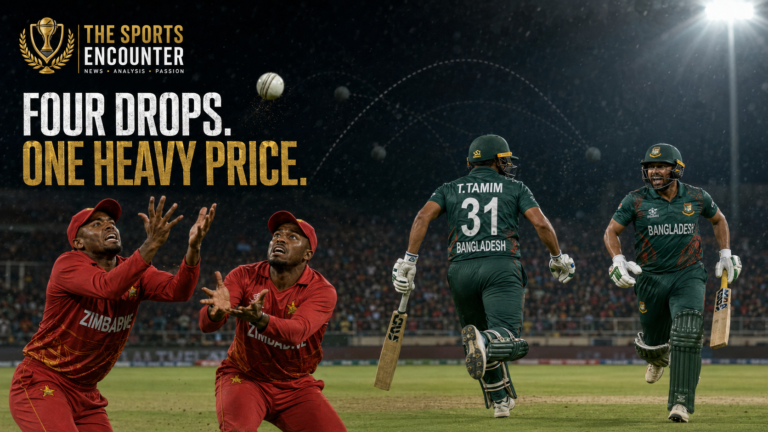
Zimbabwe gave Bangladesh four lives inside the powerplay. By the time the hosts regained control of their catching, the second T20I had already begun slipping beyond their reach.
Saif Hassan and Tanzid Hasan turned Zimbabwe’s generosity into an opening stand worth 120 runs, carrying Bangladesh toward 186 for 5 at Queens Sports Club. Rishad Hossain and Mahedi Hasan then shared seven wickets as Zimbabwe were bowled out for 152 in 19.4 overs.
The 34-run victory brought Bangladesh level at 1-1 and ensured that the final match on July 19 will decide the three-match series.
TL;DR
- Bangladesh beat Zimbabwe by 34 runs in the second T20I.
- The visitors scored 186 for 5 after Zimbabwe dropped four catches during the powerplay.
- Tanzid Hasan made 58, while Saif Hassan contributed 55 in a 120-run opening partnership.
- Brad Evans conceded 65 runs from four overs after dropping two catches.
- Rishad Hossain and Mahedi Hasan collected seven wickets between them.
- The series is level at 1-1, with the third T20I scheduled for July 19.
Zimbabwe vs Bangladesh Second T20I Scorecard
| Detail | Information |
|---|---|
| Match | Zimbabwe vs Bangladesh, 2nd T20I |
| Result | Bangladesh won by 34 runs |
| Venue | Queens Sports Club, Bulawayo |
| Date | July 17, 2026 |
| Bangladesh | 186/5 in 20 overs |
| Zimbabwe | 152 all out in 19.4 overs |
| Top Bangladesh Batters | Tanzid Hasan 58, Saif Hassan 55 |
| Best Bangladesh Bowlers | Rishad Hossain and Mahedi Hasan, seven combined wickets |
| Zimbabwe’s Top Score | Brad Evans, late counterattacking innings |
| Turning Point | Zimbabwe dropped four catches during the powerplay |
| Series Position | Level at 1-1 |
| Final T20I | July 19 at Queens Sports Club |
Four Dropped Catches Leave Zimbabwe Chasing the Game
Zimbabwe’s fielding had played an important role in their 32-run victory in the first T20I. Two days later, their catching fell apart when they needed early discipline most.
Saif Hassan survived three chances during the powerplay, while Tanzid Hasan also benefited from a missed opportunity. Brad Evans dropped two of those catches as Zimbabwe repeatedly failed to turn bowling pressure into wickets.
The mistakes became increasingly expensive because Bangladesh’s openers responded with confidence rather than caution. Saif attacked width and punished anything short, while Tanzid found a cleaner rhythm after his successful return to form in the third ODI against Zimbabwe.
Bangladesh reached 50 in 5.5 overs and finished the powerplay without losing a wicket. That start removed much of the pressure created by their defeat in the series opener.
Tanzid and Saif Build the Innings Bangladesh Needed
The visitors had spent much of the tour searching for a stable top-order partnership. Tanzid and Saif finally supplied one when the series was in danger.
Their 120-run stand gave Bangladesh both control and room to attack at the end. Saif scored 55 from 45 balls, hitting eight fours and one six. Tanzid made 58 from 44 deliveries, with six fours and two sixes.
Zimbabwe eventually removed both openers in quick succession, but the breakthrough arrived too late to repair the damage from the first 14 overs.
Mohammad Saifuddin then provided the finishing surge. His unbeaten 31 came from only 10 balls and included four sixes. Yasir Ali added 22 not out from 12 deliveries as Bangladesh scored 45 runs from their final three overs.
That acceleration lifted the total from competitive to imposing.
Brad Evans Endures a Punishing Afternoon
Few Zimbabwe players have contributed more during this home summer than Brad Evans. He scored an unbeaten 58 and took two wickets when Zimbabwe sealed the ODI series in Harare, while his lower-order runs and energetic bowling have repeatedly helped the hosts.
The second T20I showed how quickly the format can turn against an all-rounder.
Evans dropped two catches and then conceded 65 runs from his four overs. He claimed two wickets, but Bangladesh targeted his changes of pace and punished the deliveries that missed their intended length.
Saifuddin caused the heaviest damage during Evans’ final over, striking three consecutive sixes as Bangladesh finished with momentum.
Evans later fought back with the bat, producing the most aggressive phase of Zimbabwe’s chase. His late boundaries narrowed the final margin, but the required rate had already climbed beyond a realistic range.
Zimbabwe’s Chase Never Finds a Partnership
A target of 187 required a strong powerplay and at least one substantial partnership. Zimbabwe produced neither.
The hosts lost wickets at 15, 19 and 21, leaving the middle order to rebuild while the required scoring rate continued rising. Brian Bennett made 11, Tadiwanashe Marumani scored four, and Dion Myers also managed four.
Sikandar Raza attempted to change the tempo with 28 from 12 balls, but Rishad Hossain removed him before the Zimbabwe captain could turn his start into a match-shaping innings. Milton Shumba scored 19, while Clive Madande fell for one.
Zimbabwe briefly reached 65 for 3, yet another cluster of wickets left them 80 for 6. They never established the partnership needed to challenge Bangladesh’s total.
The batting lacked the resolve Zimbabwe had shown when they defended 141 in the first ODI against Bangladesh. Individual bursts kept the scoreboard moving, but no partnership gave the chase a stable foundation.
Rishad Hossain and Mahedi Hasan Take Control
Bangladesh’s spin pairing settled the contest through contrasting methods.
Mahedi attacked the stumps and struck during the powerplay, removing Marumani and Myers before they could settle. His early wickets prevented Zimbabwe from matching Bangladesh’s start.
Rishad entered when the hosts needed to accelerate. The leg-spinner removed Raza and Shumba, breaking the middle order’s two most promising attempts to revive the chase.
Together, Mahedi and Rishad took seven wickets. Their impact exposed Zimbabwe’s difficulty in balancing boundary-hitting with strike rotation against spin.
Bangladesh’s faster bowlers did not need to force the issue. Once the spinners had dismantled the middle order, Saifuddin closed out the innings as Zimbabwe were dismissed four balls short of their allotted 20 overs.
Readers can follow more regional coverage through The Sports Encounter’s cricket section and its wider collection of international cricket reports and analysis.
What Both Teams Must Fix Before the Final T20I
Bangladesh will take confidence from the response, especially after Zimbabwe had controlled much of the tour. The opening partnership answered a major batting concern, while the spinners showed how effectively they can defend a substantial total.
Some questions remain. Bangladesh lost five wickets after reaching 120 without loss, and stronger fielding could have changed the first half of the innings considerably. Depending on dropped chances is hardly a repeatable batting plan.
Zimbabwe face a more immediate problem. Four powerplay drops and 65 runs conceded by one bowler created a deficit their batting was never equipped to recover from. The hosts must also find greater substance through the middle order, where several players reached double figures without building a meaningful partnership.
Their strong results across the tour, including the seven-wicket ODI defeat that denied them a whitewash, have shown both their progress and their inconsistency.
The ICC’s official tour schedule confirms that the deciding T20I will take place at the same Bulawayo venue on July 19.
Bangladesh have restored parity and regained some confidence. Zimbabwe still have home advantage and the evidence of their opening-match victory. The catches may stick next time, but after this result, neither team enters the decider with room for another careless evening.

Breaking News
Asalanka, Eshan Malinga Take Galle Gallants to Thumping Win in LPL Opener
Charith Asalanka struck 65, Dasun Shanaka smashed an unbeaten 31 from nine balls, and Eshan Malinga claimed 4 for 26 as Galle Gallants defeated Jaffna Kings by 36 runs in the opening match of the 2026 Lanka Premier League.
Charith Asalanka gave Galle Gallants the innings they needed. Eshan Malinga then delivered the spell that Jaffna Kings could not survive.
Asalanka’s controlled 65, followed by a devastating late assault from captain Dasun Shanaka, powered Galle to 213 for 6 in the opening match of the 2026 Lanka Premier League. Malinga then claimed 4 for 26 as the Gallants dismissed Jaffna for 177 in 19.4 overs, completing a convincing 36-run victory at the Sinhalese Sports Club Ground in Colombo.
The result gave Galle an emphatic start to the new season and exposed a familiar problem for Jaffna. Their batting lineup had enough firepower to stay in the contest, but wickets fell too regularly for the chase to develop into a sustained threat.
Fans can follow the competition through The Sports Encounter’s Lanka Premier League hub, which brings together match reports, player form, tactical analysis, results, and tournament developments throughout the season.
Galle Gallants vs. Jaffna Kings: Match Summary
| Match detail | Information |
|---|---|
| Competition | Lanka Premier League 2026 |
| Match | Galle Gallants vs. Jaffna Kings |
| Venue | Sinhalese Sports Club Ground, Colombo |
| Galle Gallants | 213/6 in 20 overs |
| Jaffna Kings | 177 all out in 19.4 overs |
| Result | Galle Gallants won by 36 runs |
| Top scorer | Charith Asalanka, 65 off 38 |
| Best bowling | Eshan Malinga, 4/26 |
| Key finishing innings | Dasun Shanaka, 31 not out off 9 |
The tournament runs from July 17 to August 8, with five franchises competing across 24 matches, according to the official Lanka Premier League website.
Sam Harper Gives Galle a Flying Start
Jaffna won the toss and elected to field, but the decision quickly came under pressure.
Sam Harper attacked from the beginning, racing to 40 from only 19 balls. His innings included eight fours and one six, giving Galle momentum even as Lasith Croospulle departed for one.
Harper’s strike rate of 210.52 reflected the aggression of his approach. He punished loose width, found the gaps during the powerplay, and prevented Jaffna’s bowlers from settling into consistent lengths.
Galle reached 46 for 2 when Harper fell to Lizaad Williams in the fifth over. That dismissal gave Jaffna an opening, particularly after Mehidy Hasan Miraz struggled to accelerate during his 10 from 17 balls.
The innings could easily have drifted at that stage.
Asalanka refused to let that happen.
Asalanka Controls the Middle Overs
Asalanka’s 65 from 38 balls gave the Gallants both stability and scoring power.
He struck seven fours and three sixes, scoring at 171.05 without allowing the innings to become reckless. His judgment against spin proved especially important because Dunith Wellalage had established control, conceding only 10 runs from his three overs.
Rather than attack every delivery, Asalanka selected the right moments. He absorbed pressure when Galle lost wickets and accelerated once the bowlers moved away from their best lengths.
Sahan Arachchige supported him with 35 from 24 balls. Their partnership carried Galle from 82 for 3 in the 11th over to 156 before Asalanka departed in the 17th.
That stand established the platform. The final three overs transformed a competitive score into an intimidating one.
Asalanka’s balance between control and aggression echoed the qualities that often separate successful T20 innings from short bursts of entertainment. A similar pattern appeared when Sri Lanka were squeezed by Jason Holder and West Indies, where one decisive phase changed the direction of the match.
Shanaka and Nawaz Tear Apart the Death Bowling
Dasun Shanaka produced the most explosive innings of the night.
The Galle captain smashed an unbeaten 31 from nine balls, including two fours and three sixes. His strike rate of 344.44 captured the scale of Jaffna’s problems at the death.
Mohammad Nawaz added 21 from nine deliveries, hitting three sixes before falling from the final ball of the innings.
Galle scored 57 runs after Asalanka’s dismissal. Shanaka and Nawaz punished missed yorkers, length balls, and predictable slower deliveries as Jaffna’s bowling figures deteriorated rapidly.
David Wiese conceded 45 from three overs, while Dilshan Madushanka was taken for 40 in only two. Piyush Chawla claimed two wickets but gave away 43 runs from his four overs.
Wellalage’s 1 for 10 stood out in sharp contrast. Jaffna controlled one end for three overs but could not maintain that discipline across the rest of the attack.
The Gallants finished at 213 for 6, scoring at 10.65 runs per over. It was already the kind of total that demanded an almost flawless chase.
The pressure on modern fast bowlers to master short spells, powerplay plans, and death-over execution has become a defining feature of franchise cricket, a wider issue explored in The Sports Encounter’s analysis of modern fast-bowling workloads.
Jaffna Start Fast Before Eshan Malinga Changes the Match
Jaffna’s openers initially made the target look manageable.
Avishka Fernando scored 34 from 21 balls, while Kamil Mishara struck 28 from 14. Their opening partnership reached 63 in just over five overs, placing the chase ahead of the required pace.

Malinga changed everything.
He removed Avishka with the second ball of the sixth over and dismissed Ibrahim Zadran three deliveries later. The two wickets broke Jaffna’s rhythm and forced the middle order to rebuild while the required rate continued climbing.
Akif Javed then dismissed Mishara for 28, leaving Jaffna 68 for 3. Bhanuka Rajapaksa followed for only two after Asalanka introduced himself and claimed a wicket with his off-spin.
By the ninth over, Jaffna had slipped to 84 for 4. Their strong powerplay had been wasted within a few minutes.
Eshan Malinga’s rise gives Sri Lanka another pace option at a time when several of the country’s bowlers are being assessed across international and franchise cricket. His recent role in Sri Lanka’s T20I series defeat against West Indies showed the difficulty of converting promising spells into complete team performances.
Wellalage and Wickramasinghe Offer Brief Resistance
Dunith Wellalage played the best innings of Jaffna’s chase.
His 40 from 24 balls included four fours and two sixes, providing the first meaningful recovery after the middle-order collapse. He attacked the spinners effectively and briefly reduced the pressure created by the required run rate.
Chamindu Wickramasinghe then struck 24 from 10 balls as Jaffna attempted one final acceleration. His three sixes pushed the score beyond 150 and kept a narrow route back into the match open.
Neither batter stayed long enough.
Vijayakanth Viyaskanth dismissed Wellalage at 126, while Wickramasinghe was run out with Jaffna on 153. Piyush Chawla and Wiese also fell during the final push, leaving the lower order with too much to do.
Eshan Malinga Finishes the Job in Style
Malinga returned to complete the victory with the same control and aggression that had broken the chase earlier.
He dismissed Nuwanidu Fernando for four and finished the match with a dipping yorker that Traveen Mathew played far too early. The ball passed beneath the bat and crashed into off stump, giving Malinga his fourth wicket and ending Jaffna’s innings at 177.
His final figures of 4 for 26 from 3.4 overs included 15 dot balls. No other bowler in the match combined wicket-taking impact with that level of control.
Akif Javed supported him with 2 for 32, while Asalanka, Shanaka, and Viyaskanth claimed one wicket each.
Malinga’s performance carried extra significance because he entered as Galle’s impact player after the first innings. The substitution worked exactly as intended. Galle replaced a batter whose work had finished with a fast bowler capable of attacking Jaffna’s chase, and he became the decisive player of the second innings.
The role of pace in the tournament will remain a major storyline, especially with established names such as Shaheen Shah Afridi entering the competition under scrutiny. His situation is examined in our feature on Shaheen Afridi’s LPL debut and changing fast-bowling profile.
What the Result Means for Both Teams
Galle’s victory came from a complete T20 performance.
Harper dominated the powerplay, Asalanka controlled the middle overs, Shanaka destroyed the death bowling, and Malinga converted scoreboard pressure into wickets.
Jaffna showed flashes of quality. Wellalage was exceptional with the ball and later top-scored with 40. Mishara and Avishka also gave the chase an aggressive start.
The problem was continuity.
Their bowlers conceded too heavily outside Wellalage’s spell, while the batters lost five wickets between the sixth and tenth overs. A chase of 214 offered little room for that kind of collapse.
Fielding and execution under pressure will also matter as the tournament develops. Recent matches across international cricket have shown how quickly dropped chances can overturn control, including Bangladesh’s escape after Zimbabwe dropped six catches.
Galle leave Colombo with points, confidence, and evidence that their squad has multiple ways to win. Jaffna must tighten their death bowling and find greater stability through the middle order before the tournament begins moving quickly around them.
The LPL opener delivered runs, momentum swings, and a young fast bowler closing the night with a near-perfect yorker.
For the Galle Gallants, it was an opening statement worth remembering.
For broader coverage of international cricket, franchise leagues, match reports, and player analysis, visit The Sports Encounter’s Cricket hub.
Breaking News
Sir Garfield Sobers Dies at 89: Cricket Mourns the Greatest All-Rounder of All Time
Sir Garfield Sobers has died at 89, leaving cricket to mourn an all-rounder whose batting, bowling, fielding, and fearless imagination changed the game forever.
Cricket spent decades searching for the next Sir Garfield Sobers. It never truly found him.
The West Indies great died Friday, July 17, 2026, at the age of 89, only 11 days before his 90th birthday. His death closes the life of a cricketer whose range remains almost impossible to explain through ordinary comparisons.
Sobers could dominate a Test match as a world-class batter, change its direction with pace or spin, and decide it with his fielding. He played cricket with the freedom of a natural athlete, yet his career numbers carried the weight and consistency of a specialist.
Cricket West Indies confirmed his death with a simple tribute: “A great innings has come to an end. In our hearts, now and forever, Sir Garfield Sobers.”
No cause of death had been publicly announced at the time of publication.
TL;DR
- Sir Garfield Sobers died on July 17, 2026, at the age of 89.
- He scored 8,032 runs and took 235 wickets in 93 Tests for the West Indies.
- His unbeaten 365 against Pakistan remained the highest Test score for 36 years.
- Sobers could bowl fast-medium, orthodox spin, and wrist spin.
- He became the first batter to hit six sixes in one over in first-class cricket.
- His name lives on through the ICC’s Sir Garfield Sobers Trophy.
Sir Garfield Sobers: Career at a Glance
| Detail | Information |
|---|---|
| Full name | Garfield St Aubrun Sobers |
| Born | July 28, 1936, Bridgetown, Barbados |
| Died | July 17, 2026, aged 89 |
| International career | 1954 to 1974 |
| Test record | 93 matches, 8,032 runs, 235 wickets |
| Batting record | Average of 57.78, 26 centuries, 30 fifties |
| Highest Test score | 365 not out against Pakistan in 1958 |
| Best Test bowling | 6 for 73 |
| Fielding record | 109 Test catches |
| Captaincy | 39 Tests for West Indies |
| Major honors | Knighted in 1975, Barbados National Hero, ICC Hall of Fame |
The Cricketer Who Could Do Everything
Sobers’ statistics remain extraordinary. He scored 8,032 Test runs at an average of 57.78, including 26 centuries, while also taking 235 wickets and holding 109 catches.
Even those numbers struggle to capture his versatility.
He began international cricket primarily as a left-arm spinner. Over time, he developed into a bowler capable of delivering fast-medium seam, slow orthodox spin, and wrist spin. That variety would look unrealistic in a modern player profile, yet Sobers performed each role at Test level.
His batting belonged in a different category. Balance, power, timing, and improvisation allowed him to control attacks without appearing restricted by conventional technique. He could build an innings patiently or attack with a freedom that anticipated the aggressive batting of later generations.
Sobers also carried a workload that feels almost unimaginable in the age of specialization. The wider question of how earlier players handled such physical demands remains central to the modern debate over whether older fast bowlers were better equipped for Test cricket.
Among the great all-rounders discussed across eras, including Kapil Dev and his transformative impact on Indian cricket, Sobers remains the standard against which completeness is measured.
The Innings That Changed His Career
When Sobers walked out against Pakistan in Kingston in 1958, he had already played 28 Test innings without scoring a century.
His first hundred became 365 not out.
The innings broke Len Hutton’s record for the highest individual score in Test cricket and remained the world mark for 36 years. Brian Lara finally passed it with 375 against England in 1994.
Sobers was 21 when he produced the innings. Its importance went beyond the record because it confirmed that West Indies possessed another generational batter during a period when Caribbean cricket was developing a powerful collective identity.
He became the first player to reach 8,000 Test runs, but milestones never fully explained his value. Sobers could influence a match in too many ways for one number to define him.
That all-round tradition continues to shape West Indies cricket. Modern players such as Jason Holder operate in a different era, with shorter formats and more specialized roles, but Holder’s ability to alter games with bat and ball still carries echoes of the Caribbean ideal. His recent performance in West Indies’ T20I victory over Sri Lanka offered another reminder of how valuable a genuine all-rounder remains.
Six Balls That Became Cricket History
Ten years after his 365, Sobers created another landmark while captaining Nottinghamshire against Glamorgan in Swansea.
Facing Malcolm Nash in 1968, he hit six consecutive sixes in one over. It was the first recorded instance of a batter achieving the feat in first-class cricket.
The moment showed another side of Sobers. He could produce monumental Test innings, but he also possessed the destructive instincts associated with modern limited-overs batting. His natural power required no shortened boundary, oversized bat, or fielding restriction.
Sobers also understood match situations instinctively. He could change gears before analysts began dividing innings into phases and calculating matchup percentages.
That ability to read conditions remains decisive in every format. New Zealand spinner Jayden Lennox recently showed the modern value of adapting to a difficult surface when his five-wicket haul helped secure New Zealand’s 400th ODI victory against West Indies.
Lennox followed that performance with another four-wicket spell as New Zealand moved ahead in the series, a match covered in The Sports Encounter’s West Indies vs. New Zealand third ODI report.
Sobers, however, could provide that adaptability with almost every cricketing discipline.
A Caribbean Hero Beyond the Numbers
Born in Bridgetown, Barbados, Sobers reached Test cricket at 17 and represented the West Indies for 20 years. He captained the team in 39 Tests between 1965 and 1972, approaching leadership with the same attacking imagination that shaped his game.
His importance to Barbados and the wider Caribbean extended far beyond cricket.
Sobers emerged during an era when West Indies success carried deep cultural meaning across nations moving toward independence and developing a stronger regional identity. Caribbean supporters did not simply watch a talented cricket team. They saw players proving that the region could command respect on the world stage.
Barbados named Sobers a National Hero in 1998. He had already received a knighthood in 1975 for services to cricket and later entered the ICC Cricket Hall of Fame.
His influence also survives through the Sir Garfield Sobers Trophy, awarded annually to the ICC Men’s Cricketer of the Year. The title places every generation’s leading player beside the name that continues to represent cricketing completeness.
Readers can follow more historical features, international match reports, records, and player analysis through The Sports Encounter’s cricket coverage hub.
Broader analytical and long-form stories are also available through the site’s Editor’s Choice collection.
Cricket’s Greatest All-Round Question Has Lost Its First Answer
Every era produces its own definition of greatness.
Some value batting dominance. Others choose bowling records, match-winning performances, captaincy, athleticism, or longevity. Sobers made those categories difficult to separate because he occupied nearly all of them.
Modern cricket has produced outstanding all-rounders. Jacques Kallis built an unmatched statistical body of work. Imran Khan combined elite fast bowling with leadership. Kapil Dev changed Indian cricket. Ian Botham could seize a match through force of personality, while Ben Stokes has shaped some of the most dramatic contests of his generation.
Sobers remains different because his skill set had almost no visible boundary.
His death leaves cricket mourning a national hero, a West Indies captain, and one of the sport’s most gifted athletes. It also returns the game to a question it has asked for more than half a century.
Who was cricket’s greatest all-rounder?
For millions of players, historians, and supporters, the answer still begins with Sir Garfield Sobers.
Breaking News
Pelé’s 1958 World Cup Final Shirt Sells for $4.9 Million in Historic Sotheby’s Auction
Pelé’s blue No. 10 shirt from Brazil’s historic 1958 World Cup final victory over Sweden has sold for $4.9 million at Sotheby’s, setting a new record for memorabilia linked to the Brazilian legend.
Pelé’s blue No. 10 shirt from the 1958 FIFA World Cup final has sold for $4.9 million, setting a new record for memorabilia connected to the Brazilian football legend and becoming the second-most expensive football shirt ever sold at auction.
The match-worn jersey attracted 10 bids from more than five bidders before the Sotheby’s auction closed in New York on Thursday. Pelé wore the shirt as a 17-year-old while scoring twice in Brazil’s 5-2 victory over Sweden, a performance that delivered the country’s first World Cup title and introduced football’s first truly global superstar.
Only Diego Maradona’s shirt from Argentina’s famous 1986 World Cup quarterfinal against England has commanded a higher price. That jersey, worn during the “Hand of God” goal and the individual run later named the “Goal of the Century,” sold for $9.3 million in 2022.
Pelé’s shirt had carried a pre-auction estimate of more than $6 million, but the final $4.9 million price still placed it among football’s most valuable physical artifacts. It also represented an extraordinary increase from its previous auction sale in 2004, when it changed hands for £70,505, approximately $105,600 at the time.
Pelé Shirt Auction: Key Details
| Detail | Information |
|---|---|
| Item | Pelé’s match-worn No. 10 Brazil shirt |
| Match | Brazil vs. Sweden |
| Competition | 1958 FIFA World Cup final |
| Final score | Brazil 5-2 Sweden |
| Venue | Råsunda Stadium, Stockholm |
| Auction house | Sotheby’s |
| Sale price | $4.9 million |
| Number of bids | 10 |
| Number of bidders | More than five |
| Previous sale | £70,505 in 2004 |
| Football shirt auction ranking | Second-most expensive |
| Current record | Maradona’s 1986 World Cup shirt, $9.3 million |
Why This Pelé Shirt Carries So Much Historical Weight
The value of the shirt reaches far beyond its age, rarity or association with a famous player. Pelé wore it during the match that changed Brazilian football history.
Brazil entered the 1958 World Cup still carrying the emotional burden of losing the decisive match of the 1950 tournament at home to Uruguay. That defeat at the Maracanã became a lasting national wound. Eight years later, a gifted team led by teenagers, established internationals and a new attacking style traveled to Sweden looking for its first world championship.
The tournament became Pelé’s arrival on the international stage.
He did not play in Brazil’s opening two matches because of a knee injury. Once introduced, he scored the winning goal against Wales in the quarterfinal, a hat-trick against France in the semifinal and two more goals against Sweden in the final. He finished the tournament with six goals in four appearances.
At 17 years and 249 days, Pelé became the youngest player to appear in a World Cup final, the youngest player to score in one and the youngest to win the competition. Those records remain intact.
The shirt therefore represents the precise afternoon when Pelé moved from teenage prospect to world football royalty.
Brazil Wore Blue Because Sweden Claimed the Yellow Shirts
The blue color adds another layer to the shirt’s story.
Brazil’s now-famous yellow jersey could not be used in the final because Sweden, the designated home team, also played in yellow. Brazil therefore needed an alternative kit and wore blue shirts during the match.
The unfamiliar color reportedly caused concern among some Brazilian players, who viewed the late change as a possible bad omen. Pelé later recalled that the squad was reassured by the suggestion that blue represented Our Lady of Aparecida, Brazil’s patron saint.
What began as an improvised away kit became one of the most recognizable shirts in football history.
Unlike Brazil’s standard yellow, the blue jersey remains inseparable from one match, one scoreline and one extraordinary teenager.
How Pelé Scored Twice in the 1958 World Cup Final
Sweden initially threatened to ruin Brazil’s afternoon when Nils Liedholm opened the scoring after four minutes. Brazil responded through two goals from Vavá before halftime, taking control of the final.
Pelé produced the match’s defining moment in the 55th minute.
Receiving the ball inside the penalty area, he lifted it over a defender and volleyed into the net before it touched the ground. The technique, composure and imagination of the finish became an early demonstration of the qualities that would define his career.
Mario Zagallo made it 4-1 before Sweden pulled one back through Agne Simonsson. Pelé completed the 5-2 victory with a header in the final minute.
The teenage forward collapsed into tears after the final whistle as his teammates celebrated Brazil’s first world championship. The victory began a golden era in which the country won three of four World Cups between 1958 and 1970.
Readers following Brazil’s place in the modern tournament can also explore how Vinícius Júnior helped Brazil top its 2026 World Cup group before the team’s campaign ended in the knockout rounds.
The Shirt That Marked the Birth of a Global Superstar
Pelé was not merely the best young player at the 1958 tournament. His performances helped change the idea of what a global football star could look like.
Television coverage was expanding, international news photography carried images across borders and Brazil’s style of play gave audiences a new football language. Pelé became recognizable to people who knew little about Santos, Brazil’s domestic league or South American football.
The FIFA Museum describes him as football’s first global superstar, arguing that every major player who followed stepped into a world his fame helped create.
His career later included two more World Cup victories, in 1962 and 1970. Pelé remains the only player to win the men’s FIFA World Cup three times. He also shares the tournament record for 21 goal involvements and holds several age-related World Cup records.
That unmatched World Cup history explains why the shirt attracted collectors from across the world, even though the final price fell below its ambitious estimate.
The jersey is connected to Pelé before the endorsements, the international tours, the New York Cosmos years and the endless greatest-player debates. It captures the moment when the world first understood his ability.
How Pelé’s $4.9 Million Shirt Compares With Other Football Memorabilia
The auction confirmed the growing financial value of match-worn football artifacts.
Most expensive football shirts sold at auction
| Rank | Shirt | Sale price | Auction year |
|---|---|---|---|
| 1 | Diego Maradona, Argentina vs. England, 1986 World Cup | $9.3 million | 2022 |
| 2 | Pelé, Brazil vs. Sweden, 1958 World Cup final | $4.9 million | 2026 |
Maradona’s shirt remains ahead because it was worn during two of the sport’s most famous and contrasting goals. His first against England was scored with his hand. His second came after a remarkable run through the English defense.
The match also carried political and cultural tension four years after the Falklands War, increasing the shirt’s historical appeal beyond football. The Sports Encounter revisited that rivalry before the Argentina vs. England World Cup 2026 semifinal.
Pelé’s shirt tells a different story. It represents innocence, emergence and the beginning of Brazil’s World Cup identity. Maradona’s jersey embodies rebellion, controversy and individual defiance.
Collectors are paying for those stories as much as the fabric.
Why Match-Worn Shirts Are Reaching Multimillion-Dollar Prices
The sports memorabilia market has changed dramatically over the past two decades.
Collectors once focused heavily on autographs, trophies, medals and traditional trading cards. Match-worn jerseys now occupy a more powerful position because they offer a direct physical connection to a precise sporting moment.
The strongest items usually share several qualities:
- They were worn during a historically important match.
- The player produced a defining performance.
- The item has strong provenance and authentication.
- The moment remains globally recognizable.
- Few comparable pieces are available.
- The athlete’s legacy extends beyond one generation.
Pelé’s 1958 shirt meets each condition.
Its dramatic increase from the 2004 auction price also illustrates how football collectibles have moved into the same investment territory as fine art, rare watches and historic American sports memorabilia.
Recent high-profile sales have included a Kobe Bryant debut-season jersey for $7 million, Michael Jordan’s 1998 NBA Finals jersey for $10.1 million and Babe Ruth’s famous 1932 “called shot” jersey for approximately $24 million.
Football’s global audience gives its rarest items an enormous potential buyer pool. A Pelé shirt can attract Brazilian collectors, museums, football historians, sports investors and wealthy fans from almost any market.
The Auction Arrived During Another World Cup Summer
The timing of the sale helped intensify attention.
The auction closed during the final stages of the 2026 FIFA World Cup, when football history, national identity and comparisons between generations were already dominating global discussion.
Modern stars such as Lionel Messi, Kylian Mbappé, Erling Haaland, Jude Bellingham and Lamine Yamal have shaped the current tournament. Yet every World Cup also sends supporters back into the archive, where Pelé’s 1958 and 1970 performances remain central to any conversation about the competition’s greatest players.
The Sports Encounter explored that changing legacy debate in its comparison of Lionel Messi and Cristiano Ronaldo after the 2026 World Cup.
Pelé’s records provide the historical standard. He won earlier, won younger and won more World Cups than any other player.
The shirt sale translated that lasting status into a market price.
Did the Pelé Shirt Sell Below Expectations?
Sotheby’s had expected the jersey to exceed $6 million, meaning the $4.9 million result came in below the public estimate.
That does not make the auction unsuccessful.
Estimates are marketing tools as well as valuation ranges. The final price still established a record for Pelé memorabilia and placed the shirt behind only Maradona’s 1986 jersey among football shirts sold at auction.
The bidding details also showed genuine competition. More than five bidders submitted 10 bids, suggesting the market did not rely on one determined buyer.
The identity of the winning bidder was not immediately disclosed.
Pelé’s Legacy Remains Larger Than Any Auction Price
Pelé died in December 2022 at the age of 82, but his place in football history has continued to grow.
He scored 77 goals in 92 international appearances for Brazil and won World Cups in three separate eras of the national team. His 1958 triumph introduced the teenager. The 1962 victory confirmed Brazil’s dominance, although injury limited his tournament. In 1970, he became the creative leader of a team often ranked among the greatest ever assembled.
FIFA named Pelé one of the defining figures of the 20th century and continues to recognize him as the only three-time men’s World Cup winner.
His influence also survives in every discussion about football greatness. Messi, Maradona, Cristiano Ronaldo and other modern icons are routinely measured against achievements Pelé established before global club football became the commercial force it is today.
Fans can follow the current competition, its emerging stars and its historical records through The Sports Encounter’s FIFA World Cup 2026 coverage.
What the $4.9 Million Sale Really Bought
The successful bidder purchased a blue football shirt, but its meaning comes from everything surrounding it.
It carries the number worn by a 17-year-old who scored twice in a World Cup final.
It represents Brazil’s first world championship.
It marks the beginning of the country’s yellow-shirted football mythology, even though the jersey itself is blue.
It connects directly to the player who became football’s first global superstar and remains its only three-time World Cup winner.
The $4.9 million price reflects scarcity, celebrity and the growing sports collectibles market. The real value comes from the moment embedded in the fabric.
On June 29, 1958, Pelé wore that shirt and showed the world what the next era of football would look like. Nearly seven decades later, someone paid millions to hold a surviving piece of that afternoon.