Connect with us
Jawad Hussain | The Sports Encounter

Published

on

Iran were seconds away from turning a tense 1-1 draw with Egypt into one of the most emotional finishes of the FIFA World Cup 2026 group stage.

The ball went in. Iranian players ran toward the corner. Fans erupted. For a few seconds, it looked as if Iran had pulled off the kind of stoppage-time escape that turns a World Cup campaign into folklore.

Then came the flag.

Then came the delay.

Then came the outrage.

By the time the goal was disallowed for offside, social media had already chosen its villain. The referee was blamed. VAR was blamed. FIFA was accused of protecting bigger markets, bigger stars, and bigger storylines. Clips spread quickly, many of them paused at misleading angles. Screenshots circulated without the defensive line. Some fans insisted the Iranian attacker was behind an Egyptian defender. Others argued that because the goalkeeper was not the last man, the goal should have stood.

That last argument is exactly where the confusion begins.

The decision was not about whether one Egyptian player was ahead of the Iranian scorer. It was about whether two opponents, not one, were between the attacker and the goal line at the moment the ball was played.

That is the part many angry reactions missed.

Match Facts Box

MatchEgypt vs Iran
CompetitionFIFA World Cup 2026
StageGroup G
Final scoreEgypt 1-1 Iran
Main controversyIran’s late goal disallowed for offside
Key law involvedLaw 11: Offside
Egypt’s next matchAustralia in the Round of 32
Main takeawayThe disallowance was correct if the Iranian attacker was beyond the ball and the second-last Egyptian opponent

For more World Cup coverage, follow The Sports Encounter’s FIFA World Cup 2026 hub.

What the Offside Law Actually Says

Football fans often simplify offside into one phrase: “Was he behind the last defender?”

That shortcut is useful in normal situations, but it is not the full law.

Under Law 11, an attacker is in an offside position if any playable part of his head, body, or feet is:

  1. In the opponents’ half, and
  2. Nearer to the opponents’ goal line than both the ball and the second-last opponent.

The second part is the key.

The law does not say the attacker only needs to be behind one defender. It says he must not be nearer to goal than both the ball and the second-last opponent.

In plain English, an attacker usually needs either:

  • The ball ahead of him, or
  • Two opponents level with or ahead of him.

Most of the time, one of those two opponents is the goalkeeper. That is why fans casually talk about the “last defender.” In normal defensive shape, the goalkeeper is the last opponent and an outfield defender is the second-last opponent.

But when the goalkeeper comes off his line, gets caught ahead of play, falls behind the phase, or is no longer one of the two deepest opponents, the picture changes.

The law still requires two opponents.

They do not have to include the goalkeeper, but in most real-game situations, one of them does. If only one Egyptian player was between the Iranian attacker and the goal line when the ball was played, the attacker was offside.

That appears to be the core reason the goal was ruled out.

Why the “One Defender Was There” Argument Fails

A large part of the online anger came from fans pointing at one Egyptian player and saying Iran’s striker was not beyond the defender.

But offside is not judged against one opponent.

It is judged against the second-last opponent.

This matters because a goalkeeper can step out, dive, challenge, or get stranded outside the usual last-man position. When that happens, an outfield defender may become the last opponent, not the second-last. If the attacker is beyond the next Egyptian player in the defensive chain, then the attacker is in an offside position.

That is why the decision looked harsh to casual viewers but made sense under the law.

The camera angle also contributed to the anger. Broadcast replays can make the line look different depending on perspective, body lean, and the exact frame used. Offside is judged at the moment the ball is played or touched by a teammate, not when the attacker receives it, not when the crowd reacts, and not when the ball crosses the line.

That is why still images shared after the match were often misleading. A screenshot taken half a second too late can completely change how the incident looks.

Was the Goal Automatically Illegal?

No.

Being in an offside position by itself is not an offence. A player only gets penalized when he becomes involved in active play.

In this case, the Iranian attacker did exactly that. He attacked the ball, finished the move, and directly affected the outcome. Once he scored from that position, the offside position became an offside offence.

That distinction matters.

A player can stand in an offside position and not be punished if he does not interfere with play, interfere with an opponent, or gain an advantage. But when the player in that position scores, the law gives officials no serious room for interpretation.

If the offside line was correct, the goal had to be disallowed.

Why This Felt Bigger Than One Decision

The emotional reaction made sense even if the technical decision did.

Iran were chasing more than a goal. They were chasing survival, pride, and a possible route into the Round of 32. Egypt, meanwhile, were protecting a result that helped them move into the knockout stage, where they now face Australia.

That is why the moment exploded. It was not just a law debate. It was a World Cup campaign turning on a line, a frame, and a rule many fans only half understand.

Iran’s frustration was real. Their players had pushed Egypt into uncomfortable spaces, forced late pressure, and nearly turned a difficult group-stage finale into a defining national moment. To lose that ending to an offside call naturally felt brutal.

But brutal does not mean wrong.

This is where football’s emotional truth and legal truth separate.

Emotion says Iran were robbed of a cinematic winner. Law 11 says the attacker needed two opponents or the ball between him and the goal line. If he had only one opponent ahead of him, the goal could not stand.

For more on Egypt’s World Cup path, read The Sports Encounter’s analysis of Egypt vs Iran and the Round of 32 picture. You can also follow related tournament coverage through our World Cup 2026 match reports.

The Referee Did Not Rewrite the Law in the Iran-Egypt Match

The referee and VAR team did not create a new interpretation in the final minutes. They applied one of football’s oldest principles.
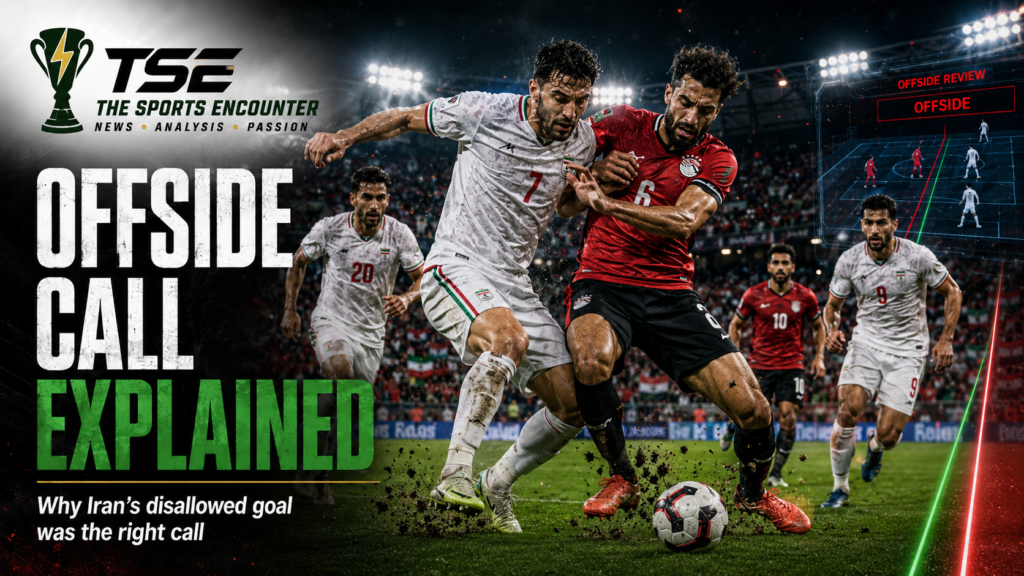
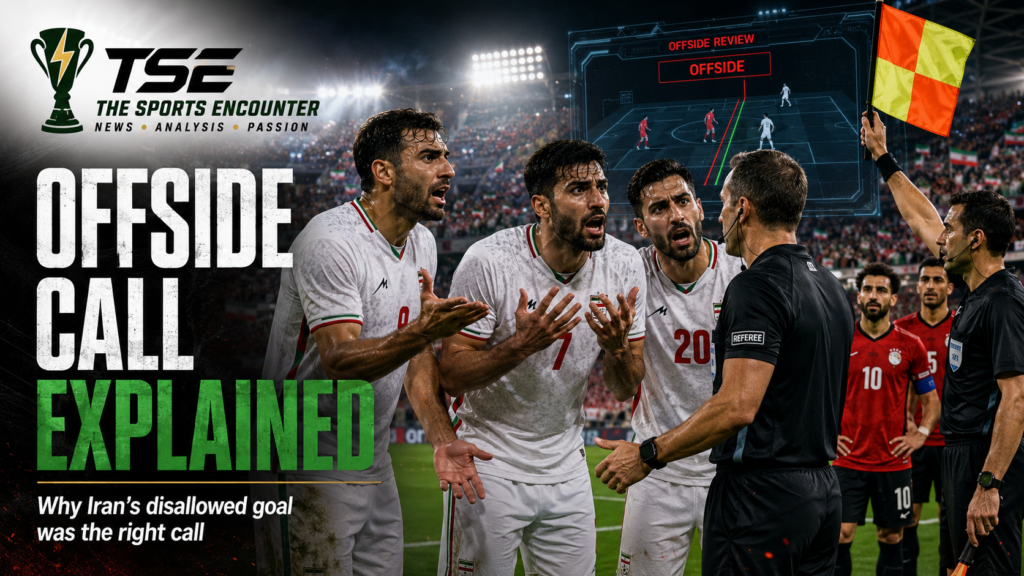
Iranian and Egyptian players battle aggressively for the ball during the Iran vs Egypt World Cup 2026 match, with an offside review graphic highlighting the disputed decision.

The misunderstanding comes from how offside is discussed by fans, commentators, and even former players. The phrase “last defender” has become popular shorthand, but it can confuse people in goalkeeper-displacement situations.

The correct reference is not the last defender.

The correct reference is the second-last opponent.

That means the goalkeeper is not automatically the offside line. The last outfield defender is not automatically enough either. What matters is the position of the attacker, the ball, and the second-last opponent when the teammate plays the ball.

Once that frame is understood, the Iran-Egypt controversy looks far less mysterious.

What Fans Should Take From the Incident

The bigger lesson is simple: offside is a two-opponent rule, not a one-defender rule.

That one detail explains why the decision caused so much anger and why it still appears to have been correct.

Iran can feel devastated. Their fans can feel crushed. The timing can feel cruel. None of that changes the law.

Football will always produce moments that feel unfair because the emotional rhythm of the match moves faster than the legal process. A late goal feels like destiny. A VAR review feels like interruption. A raised flag feels like theft.

But in this case, the controversy was powered more by misunderstanding than injustice.

Iran did not lose a goal because of a hidden agenda. They lost it because the law demands two opponents between the attacker and the goal line unless the ball is also ahead of him.

That is not a FIFA conspiracy.

That is Law 11.

FAQ

Why was Iran’s late goal against Egypt disallowed?

Iran’s late goal was disallowed because the attacker was judged to be in an offside position when the ball was played by a teammate. If he was nearer to the goal line than both the ball and the second-last Egyptian opponent, the decision was correct.

Does the goalkeeper have to be one of the two players for offside?

No. The law refers to the second-last opponent, not specifically the goalkeeper. However, in most situations, the goalkeeper is naturally one of the last two opponents. When the goalkeeper is out of position, fans often misread the offside line.

Why is one defender not enough to keep an attacker onside?

Because the offside law requires the attacker to be level with or behind the second-last opponent, not just one opponent. If only one defender is between the attacker and the goal line, the attacker can still be offside.

Is standing offside always an offence?

No. A player is only penalized for offside after becoming involved in active play. Scoring from that position clearly counts as involvement.

Did Iran have a right to feel frustrated?

Yes. The timing was painful and the decision shaped Iran’s World Cup fate. But frustration does not make the decision wrong if the offside line was applied correctly.

The Sports Encounter Credibility Line

The Sports Encounter’s World Cup 2026 coverage focuses on fixtures, team news, match analysis, fan stories, tournament trends, and the biggest talking points from football’s global stage.

Jawad Hussain is a Dubai-based journalist, editor, and content leader with 28 years of experience across international journalism, editorial management, digital media, corporate communications, and content operations. His career has included reporting, editing, newsroom leadership, large-scale team building, and the development of editorial systems across multiple industries and markets. At The Sports Encounter, Jawad contributes analysis, features, breaking news, and major-event coverage across cricket, soccer, basketball, tennis, and international sport. His work combines traditional newsroom judgment with digital publishing strategy, statistical context, historical perspective, and a strong focus on what matters most to readers. Over the course of his career, he has covered major international events, worked with global news organizations, led editorial teams, and built content operations from the ground up. His approach to sports journalism emphasizes accuracy, context, originality, and clear analysis that goes beyond the headline or final score.

Breaking News

India Knock Pakistan Out as 49-Goal FIH Hockey World Cup Day Delivers Drama

India’s 5-3 win over Pakistan became the headline result of an extraordinary August 19 at the FIH Hockey World Cup 2026. Across eight men’s and women’s matches, 49 goals were scored as the Netherlands crushed Japan, England overwhelmed Wales, and Australia and France survived with dramatic late equalizers.

Published

on

India players celebrate after beating Pakistan 5-3 during an eventful FIH Hockey World Cup 2026 matchday featuring men’s and women’s action.

August 19 began with Australia trying to save its Women’s Hockey World Cup campaign and ended with Belgium surviving a Malaysian challenge that came much closer to an upset than the final score suggested.

In between, the FIH Hockey World Cup produced one of its busiest and most revealing days yet.

Eight matches across the men’s and women’s tournaments delivered 49 goals. The Netherlands women scored nine of them. England’s men added eight. India and Pakistan revived one of international hockey’s fiercest rivalries with eight more between them. Chile came within 31 seconds of beating Australia, while France waited until the final 39 seconds to deny defending men’s champions Germany victory.

By the end of Wednesday, the picture had also become much clearer. Pool A and Pool B were settled in the women’s competition, while Pools B and D reached their conclusions on the men’s side. Under the 2026 format, the top two teams from each opening pool advance to the Second Stage and remain in championship contention, while the bottom two move into the Classification Stage.

The official FIH Hockey World Cup 2026 tournament center provides the full schedule, standings and match information as the competition moves forward.

For readers following hockey across its different international forms, The Sports Encounter’s hockey coverage hub tracks the sport’s major competitions, players and wider storylines.

FIH Hockey World Cup 2026: August 19 Results

CompetitionPoolMatchResultPlayer of the Match
WomenAChile vs Australia4-4Mariah Williams, Australia
WomenBArgentina vs ScotlandArgentina 2-0Victoria Miranda, Argentina
WomenBUnited States vs GermanyGermany 3-1Jette Fleschütz, Germany
WomenANetherlands vs JapanNetherlands 9-0Luna Fokke, Netherlands
MenDEngland vs WalesEngland 8-2Tom Sorsby, England
MenDPakistan vs IndiaIndia 5-3Abhishek, India
MenBFrance vs Germany1-1Michel Struthoff, Germany
MenBBelgium vs MalaysiaBelgium 5-3Tom Boon, Belgium

Those results were confirmed in the official FIH August 19 tournament review.

Women’s World Cup: Netherlands Turn Pool A Into a Warning

The Netherlands did considerably more than win Pool A.

They made another statement about the gap their best hockey can create.

Japan ran into the full force of the defending champions in Amstelveen and lost 9-0. The Dutch were already five goals clear by halftime before adding four more after the break.

Yibbi Jansen produced the day’s most destructive individual scoring performance.

She scored four.

Marijn Veen and Felice Albers contributed two goals each, while Frederique Matla completed the scoring.

Japan goalkeeper Akio Tanaka still made several excellent saves, which tells its own story about the volume and quality of Dutch pressure.

Yibbi Jansen Gives the Netherlands Another Route to Goal

Scoring four goals in a World Cup match would dominate almost any individual performance discussion.

What makes Jansen’s contribution more concerning for the Netherlands’ rivals is the attack around her.

The Dutch did not rely on a single scorer to manufacture nine goals. Veen and Albers both struck twice. Matla also scored. Japan had to defend threats coming from several areas while Jansen repeatedly punished them.

The result completed a perfect opening phase for the Netherlands and sent them into the Second Stage as Pool A winners.

Australia advanced alongside them in second place.

That second outcome only became secure after a match that nearly went badly wrong for the Hockeyroos.

Chile 4-4 Australia: Thirty-One Seconds Save the Hockeyroos

Australia’s tournament was moving toward a very different conversation when the clock entered its final minute.

Chile led 4-3.

Then Mariah Williams found the loose ball that kept Australia alive.

Her equalizer came with only 31 seconds remaining and completed one of the most dramatic matches of the tournament so far.

Courtney Schonell had initially put Australia ahead just 11 seconds before halftime. Laura Müller equalized early in the third quarter before Abigail Wilson converted a penalty stroke to restore the Hockeyroos’ advantage.

Australia then lost control of both its discipline and the match.

At one stage, the Hockeyroos were reduced to nine players. Chile removed its goalkeeper to create an even larger numerical advantage and Manuela Urroz converted that pressure into a 47th-minute equalizer.

Claire Colwill made it 3-2 to Australia from a penalty corner five minutes later.

Chile responded again.

Florencia Barrios scored her first senior international goal to make it 3-3 before Fernanda Villagran converted a penalty stroke in the 55th minute.

For the first time all afternoon, Chile led.

They were half a minute from a famous victory when Williams reacted fastest inside the circle and made it 4-4.

Why the Draw Mattered More Than the Score Suggests

Australia’s equalizer eventually proved sufficient to send the Hockeyroos through in second place after the Netherlands completed their rout of Japan.

Yet qualification should not disguise the warning.

Australia repeatedly lost leads, suffered costly disciplinary problems and allowed Chile to dictate the final-quarter pressure.

The Hockeyroos survived. The next stage may not be so forgiving.

Argentina 2-0 Scotland: Las Leonas Win Pool B Without Needing Their Best Hockey

Argentina’s 2-0 victory over Scotland carried a different tone.

There was little chaos and no nine-goal explosion.

Las Leonas simply found the moments they needed.

Scotland began positively, but María Granatto punished Argentina’s first significant opening by converting from a penalty corner in the 11th minute.

Argentina increasingly controlled the match during the second quarter without adding another goal.

Lara Casas finally created separation in the 41st minute, scrambling the ball home from close range.

The victory eventually secured first place in Pool B for Argentina.

That is important because World Cups are rarely won by playing at maximum intensity in every pool match. Championship teams learn how to win games that never fully open up.

Argentina did exactly that.

Germany 3-1 USA: Fleschütz Wins the Pool B Qualification Fight

Germany and the United States entered their meeting with considerably more at stake.

Second place in Pool B was effectively on the table.

Germany took it.

Jette Fleschütz opened the scoring from a penalty stroke in the 20th minute. Lisa Nolte doubled Germany’s advantage early in the second half.

The Americans refused to disappear.

Ashley Sessa produced an outstanding individual goal to reduce the deficit and briefly reopen the contest.

Germany’s response was immediate enough to prevent the match from changing direction.

Fleschütz converted another penalty stroke four minutes later to complete her brace and restore the two-goal advantage.

Germany won 3-1 and finished second behind Argentina.

Women’s Pool A and Pool B Winners

PoolWinnerSecondWhat Happened August 19
ANetherlandsAustraliaNetherlands beat Japan 9-0; Australia drew Chile 4-4
BArgentinaGermanyArgentina beat Scotland 2-0; Germany beat USA 3-1

Men’s World Cup: England Produce the Day’s First Avalanche

Before the Netherlands women scored nine, England’s men had already set the attacking standard.

Wales were beaten 8-2 in a Pool D match that England controlled almost from the opening whistle.

Sam Ward scored after two minutes.

Will Calnan then struck twice in seven minutes, pushing the lead to 3-0 before Wales had found any meaningful control.

Tom Sorsby added the fourth in the 22nd minute.

Zach Wallace made it 5-0 during the third quarter.

England were still not finished.

Three more goals arrived between the 48th and 54th minutes as Wales’ defense finally gave way under sustained pressure.

Goalkeeper Toby Reynolds-Cotterill prevented the score from becoming even more severe with a series of saves.

Gareth Furlong scored twice for Wales in the final three minutes, but those goals could only soften the margin.

England had already made its point.

An 8-2 victory gave them first place in Pool D and reinforced their status as one of the early men’s teams capable of creating goals in clusters.

India 5-3 Pakistan: The Rivalry Delivers, but India’s Start Decides It

The match carrying the greatest emotional weight on Wednesday was never difficult to identify.

India against Pakistan remains one of hockey’s defining rivalries, carrying decades of Olympic history, World Cup memories and regional sporting tension.

The 2026 meeting produced eight goals.

India won 5-3.

The decisive damage came early.

Harmanpreet Singh opened the scoring from a penalty corner. Abhishek doubled the advantage before Harmanpreet struck again to make it 3-0.

Pakistan suddenly faced a problem larger than simply chasing the game. They had to do so against an opponent with enough control to punish the spaces created by that chase.

Pakistan found one response.

Abhishek quickly answered with his second goal, restoring India’s three-goal cushion at 4-1.

Sufyan Khan then hammered home a drag flick for Pakistan to make it 4-2.

Any realistic comeback needed Pakistan to score next.

Instead, Hardik Singh converted a penalty stroke early in the second half and India were 5-2 ahead.

Hannan Shahid scored his second goal during the final quarter, but Pakistan could not complete the recovery.

India held on for a 5-3 victory and second place in Pool D behind England.

Abhishek Earns Player of the Match

Harmanpreet’s penalty-corner work gave India early authority, but Abhishek’s contribution changed the match’s shape.

His first goal stretched the lead. His second arrived after Pakistan had finally found a response.

That second strike mattered particularly because rivalry matches can change emotionally after one goal.

Pakistan had a route back at 3-1.

Abhishek closed it almost immediately.

FIH named him Player of the Match.

France 1-1 Germany: Thirty-Nine Seconds Change the Pool B Finish

Germany were 39 seconds from ending their opening stage with another victory.

France refused to accept it.

Justus Weigand had put the defending champions ahead in the 42nd minute after Thies Prinz’s effort found him positioned in front of goal.

Germany carried that 1-0 lead deep into the final quarter.

France then made the gamble teams increasingly use when a tournament result is slipping away.

The goalkeeper came off.

An extra outfield player went on.

Germany were also reduced to 10 players, creating the opening France needed.

Louis Haertelmeyer finally found it.

With 39 seconds left, his upright reverse-stick finish beat the German defense and rescued a 1-1 draw.

Germany still finished first in Pool B, but France had denied the defending champions a clean ending to the phase.

Belgium 5-3 Malaysia: Tom Boon Scores Four, but Malaysia Refuse to Fold

The final match of August 19 looked comfortable on paper.

World No. 1 Belgium beat Malaysia 5-3.

The match itself was considerably less comfortable.

Tom Boon scored four goals for Belgium, producing the men’s individual performance of the day. Thibeau Stockbroekx supplied Belgium’s other goal.

Malaysia kept creating enough pressure to stop the contest from becoming routine.

Aiman Rozemi scored while making his 200th appearance for Malaysia, giving his milestone night a World Cup goal against one of the tournament favorites.

More importantly, Malaysia had an opportunity to make the finish even more uncomfortable.

A penalty stroke in the closing minutes went unconverted.

Belgium survived and secured a 5-3 victory, confirming second place in Pool B behind Germany.

Tom Boon’s Four Goals Carry More Weight Than the Final Margin

Belgium needed Boon’s finishing because Malaysia kept asking questions.

That makes his four-goal performance more valuable than a similar total accumulated during a one-sided rout.

Belgium’s wider championship credentials will be tested later, but elite tournaments often turn on whether a leading scorer can convert difficult matches into victories.

Boon did that on Wednesday.

Readers interested in how individual scorers shape hockey’s biggest games can also explore The Sports Encounter’s coverage of Finland’s inaugural 3ICE World Cup title, another international hockey tournament where finishing quality became decisive.

Men’s Pool B and Pool D Winners

PoolWinnerSecondAugust 19 Decisive Results
BGermanyBelgiumGermany drew France 1-1; Belgium beat Malaysia 5-3
DEnglandIndiaEngland beat Wales 8-2; India beat Pakistan 5-3

The Numbers That Defined August 19

CategoryFigure
Matches played8
Women’s matches4
Men’s matches4
Total goals49
Women’s goals24
Men’s goals25
Biggest victoryNetherlands 9-0 Japan
Highest-scoring men’s matchEngland 8-2 Wales, 10 goals
Highest-scoring women’s matchesChile 4-4 Australia and Netherlands 9-0 Japan, 8 and 9 goals respectively
Leading individual scorersYibbi Jansen and Tom Boon, 4 goals each
Latest equalizerMariah Williams, Australia, 31 seconds remaining
Other late equalizerLouis Haertelmeyer, France, 39 seconds remaining

Jansen and Boon Owned the Scoreboard, but the Day Was About Pressure

Yibbi Jansen and Tom Boon will understandably dominate the individual headlines.

Both scored four times.

Their performances came in very different circumstances.

Jansen was the central scorer inside a Dutch attack that overwhelmed Japan from multiple directions. Boon supplied four of Belgium’s five goals in a match where Malaysia kept forcing the hosts to find another response.

Elsewhere, the day’s most important contributions were often smaller.

Mariah Williams needed one goal to change Australia’s tournament.

Louis Haertelmeyer needed one touch with 39 seconds remaining to change France’s evening.

Abhishek’s two goals helped India control the emotional momentum of the Pakistan rivalry.

Jette Fleschütz converted two penalty strokes in a match carrying direct qualification consequences.

That variety explains why Wednesday felt significant.

World Cups reveal teams through different types of pressure.

What August 19 Told Us About the Women’s World Cup

The Netherlands remain the clearest statement team from the pools decided on Wednesday.

Nine goals against Japan reinforced the depth of their attack and their ability to turn territorial superiority into scoreboard damage.

Argentina showed something different.

Las Leonas did not need a spectacular performance to beat Scotland. They remained patient, found two goals and won Pool B.

Germany handled a direct qualification contest against the United States with greater efficiency in the circles.

Australia advanced, but the Chile draw exposed problems that stronger Second Stage opponents will study carefully.

The Hockeyroos’ discipline and inability to protect repeated leads could become significant if left unresolved.

What August 19 Told Us About the Men’s World Cup

England may have made the loudest statement.

Eight goals against Wales showed how quickly their attack can turn control into separation.

Germany’s draw with France was less convincing, although the defending champions still won Pool B.

Belgium’s 5-3 victory also came with a warning. Malaysia stayed close enough to make the world No. 1 side work until late in the match.

India’s position is particularly interesting.

The 5-3 victory over Pakistan showed attacking quality and penalty-corner danger, but the three goals conceded also leave defensive questions before the level rises again.

The result itself, however, carries enormous value.

India entered one of world hockey’s most emotionally demanding fixtures and controlled enough of it to advance in second place.

TSE Matchday Awards

AwardSelectionReason
Women’s performance of the dayNetherlandsNine unanswered goals against Japan
Men’s performance of the dayEnglandEight goals and complete control against Wales
Women’s individual performanceYibbi JansenFour goals against Japan
Men’s individual performanceTom BoonFour of Belgium’s five goals against Malaysia
Most dramatic momentMariah WilliamsEqualized for Australia with 31 seconds remaining
Late escapeFranceHaertelmeyer equalized against Germany with 39 seconds left
Rivalry performanceAbhishekTwo goals and Player of the Match in India’s 5-3 win over Pakistan
Milestone momentAiman RozemiScored against Belgium on his 200th Malaysia appearance

Why the New World Cup Format Makes These Results More Important

The 2026 tournament does not move directly from conventional four-team pools into quarterfinals.

The top two teams from each opening pool move into a Second Stage, where the championship race continues. The bottom two enter the Classification Stage.

That changes the value of early positioning.

Winning a pool does not deliver an immediate knockout ticket, but it tells us which teams have entered the next phase with momentum and which have already exposed weaknesses.

The official FIH fixtures and results page will track the Second Stage and Classification Stage as the tournament develops.

August 19 Was the Day This World Cup Began to Separate Teams

The opening days of a World Cup tell us who has arrived.

Days like August 19 begin telling us who may stay around.

The Netherlands women look every bit like a team prepared to defend their title. Argentina have moved through their opening pool without requiring constant fireworks. Germany’s women survived a direct qualification test, while Australia escaped a result that could have transformed their tournament.

Among the men, England’s eight-goal performance will demand attention. Germany remain alive to another title defense. Belgium have Tom Boon scoring at frightening volume. India survived the pressure of Pakistan and moved forward.

There were also reminders that reputations offer little protection once the ball starts moving.

Chile pushed Australia to the final 31 seconds. France denied Germany with 39 seconds remaining. Malaysia stayed within striking distance of Belgium. Scotland made Argentina work.

For broader hockey analysis, readers can follow The Sports Encounter’s hockey news archive, revisit our Jonathan Toews career retrospective, or explore our analysis of hockey’s highest-paid players.

The sport’s club and international forms are very different, but the same competitive truth keeps appearing. The biggest games reward teams that manage pressure without losing their structure.

On August 19, some teams mastered that pressure.

Others survived it.

And a few discovered exactly how quickly a World Cup can begin slipping away.

Frequently Asked Questions

What were the FIH Hockey World Cup results on August 19, 2026?

In the women’s tournament, Chile drew 4-4 with Australia, Argentina beat Scotland 2-0, Germany beat the United States 3-1 and the Netherlands defeated Japan 9-0. In the men’s tournament, England beat Wales 8-2, India defeated Pakistan 5-3, France drew 1-1 with Germany and Belgium beat Malaysia 5-3.

Who scored four goals at the Hockey World Cup on August 19?

Yibbi Jansen scored four for the Netherlands women against Japan, while Tom Boon scored four for Belgium’s men against Malaysia.

What was the India vs Pakistan Hockey World Cup score?

India defeated Pakistan 5-3 in their men’s Pool D match. Abhishek scored twice and was named Player of the Match.

Who won England vs Wales?

England defeated Wales 8-2 to finish first in men’s Pool D.

What was the Netherlands vs Japan women’s score?

The Netherlands defeated Japan 9-0. Yibbi Jansen scored four goals, while Marijn Veen and Felice Albers scored twice each.

Did Australia qualify after drawing with Chile?

Yes. Australia’s 4-4 draw, combined with the Netherlands’ victory over Japan, left the Hockeyroos second in women’s Pool A and through to the Second Stage.

Who qualified from women’s Pool B?

Argentina finished first and Germany second, sending both teams into the Second Stage.

Who qualified from men’s Pool D?

England won Pool D and India finished second.

Who qualified from men’s Pool B?

Defending champions Germany finished first, with Belgium taking second place.

Where is the 2026 FIH Hockey World Cup being played?

The men’s and women’s competitions are being staged across Belgium and the Netherlands, with matches at the Belfius Hockey Arena and Wagener Hockey Stadium.

Final Verdict: Eight Matches Changed the Shape of Two World Cups

The raw number from August 19 is 49 goals.

The more useful number is eight.

Eight matches gave the tournament a much clearer hierarchy.

The Netherlands women and England men produced the largest victories. Jansen and Boon supplied the individual scoring explosions. Australia and France found equalizers in the final minute. Germany’s women won a direct qualification battle. India handled the pressure of Pakistan.

Yet none of those results finishes the argument about who will become world champion.

They make the next stage more interesting.

The teams moving forward now carry evidence with them. Some have shown overwhelming attacking power. Others have shown resilience. A few have revealed vulnerabilities their next opponents will already be studying.

That is what August 19 ultimately gave the FIH Hockey World Cup.

Less uncertainty about who survived the opening pools, and far more intrigue about what happens when the survivors begin facing each other.

Follow The Sports Encounter for continuing FIH Hockey World Cup 2026 results, match reports, analysis and major stories from the men’s and women’s tournaments.

Continue Reading

Breaking News

Harry Kane Wins Second European Golden Shoe as 36-Goal Season Strengthens Ballon d’Or Case

Harry Kane has claimed the European Golden Shoe for the second time after scoring 36 Bundesliga goals. His 61-goal season, domestic double, Champions League form and World Cup impact now strengthen a serious 2026 Ballon d’Or case.

Published

on

Harry Kane celebrates winning his second European Golden Shoe after scoring 36 Bundesliga goals for Bayern Munich in the 2025-26 season.

Harry Kane has spent most of his career answering questions with goals.

Could he score outside Tottenham? Could he dominate another league? Could he handle the expectations that come with leading Bayern Munich’s attack? Could he turn individual numbers into major trophies?

By August 2026, most of those questions have disappeared.

Kane received the European Golden Shoe for the second time in his career on Wednesday after scoring 36 Bundesliga goals during Bayern Munich’s extraordinary 2025-26 campaign. The England captain later described himself as “very proud” of the achievement and credited his teammates, coaches and family for helping him win the award.

“Very proud to win the European Golden Shoe for the second time in my career! An award that wouldn’t be possible without the support of my incredible teammates, coaches and family.”

The trophy confirms what the numbers had already made clear. Kane was Europe’s most productive domestic-league goalscorer last season.

Yet the more interesting conversation begins after the trophy presentation.

Kane scored 61 goals for Bayern across competitive matches, helped the German club win the Bundesliga and DFB-Pokal double, struck 14 times in the Champions League, scored a hat-trick in the German Cup final, then added six goals for England during a World Cup campaign that ended with a third-place finish.

At 33, he has assembled the kind of season that usually forces itself into the center of the Ballon d’Or discussion.

The question is how much football’s biggest individual vote will value it.

TL;DR

  • Harry Kane has received the 2025-26 European Golden Shoe after scoring 36 Bundesliga goals in 31 appearances.
  • He finished with 72 Golden Shoe points, ahead of Erling Haaland on 54 and Kylian Mbappé on 50.
  • Kane also won the European Golden Shoe in 2023-24, when he scored the same number of Bundesliga goals: 36.
  • He scored 61 competitive goals for Bayern Munich during 2025-26.
  • His season included 14 Champions League goals and a hat-trick in Bayern’s 3-0 DFB-Pokal final victory over VfB Stuttgart.
  • Bayern completed the Bundesliga and DFB-Pokal double.
  • Kane followed his club season with six goals as England finished third at the FIFA World Cup 2026.
  • His second Golden Shoe strengthens an already serious Ballon d’Or case, although team achievements and performances in the biggest international matches will also influence the debate.

Harry Kane’s 2025-26 Season at a Glance

CategoryHarry Kane
ClubBayern Munich
Bundesliga goals36
Bundesliga appearances31
European Golden Shoe points72
Champions League goals14
Competitive Bayern goals in 2025-2661
DFB-Pokal finalHat-trick vs VfB Stuttgart
Major club trophiesBundesliga, DFB-Pokal
World Cup 2026 goals6
England World Cup finishThird
European Golden Shoes2

Kane Wins the European Golden Shoe by a Huge Margin

The European Golden Shoe race never developed into the tight battle many expected.

According to the Bundesliga’s official Golden Shoe report, Kane accumulated 72 points from his 36 league goals.

Manchester City’s Erling Haaland finished on 54 points, while Real Madrid’s Kylian Mbappé collected 50.

PlayerClubGolden Shoe Points
Harry KaneBayern Munich72
Erling HaalandManchester City54
Kylian MbappéReal Madrid50

An 18-point advantage over Haaland gives the final standings an unusual degree of separation considering the quality of the players involved.

Kane averaged roughly 1.16 Bundesliga goals per appearance. More importantly, his goals formed part of a Bayern attack capable of sustaining pressure across an entire season.

Haaland remains one of the defining scorers of his generation, something The Sports Encounter examined in our detailed look at Erling Haaland’s career, records and evolution. Kane still managed to create considerable distance between himself and the Norwegian in Europe’s domestic scoring race.

The comparison became even more fascinating during the World Cup, when Kane and Haaland found themselves on opposite sides of England’s quarterfinal against Norway.

Europe’s two dominant central strikers had spent the club season chasing goals. By July, they were chasing national history.

36 Goals Again, Three Seasons Apart

There is a strange symmetry to Kane’s two European Golden Shoes.

He scored 36 Bundesliga goals during his first Bayern season in 2023-24.

Two years later, he reached exactly 36 again.

The surrounding circumstances changed dramatically.

His first Golden Shoe in Germany arrived during a season in which Bayern failed to win the Bundesliga. The second came with major silverware attached.

That distinction matters when evaluating Kane’s wider legacy.

Goals have rarely been difficult to find on his résumé. Team trophies were the missing part of the conversation for much of his career.

That gap has narrowed considerably.

61 Bayern Goals Change the Scale of the Discussion

The Bundesliga total gives Kane the Golden Shoe. His wider Bayern numbers explain why his season deserves a deeper examination.

Bayern Munich’s official season review credits Kane with 61 goals across competitive club matches in 2025-26.

That included 36 Bundesliga goals and 14 in 13 Champions League appearances.

Bayern also reported that Kane had reached 146 goals in 147 competitive appearances for the club by August, alongside 33 assists.

Those numbers reveal why describing Kane purely as a penalty-box striker has become increasingly inadequate.

He still finishes attacks at an elite rate. Yet Vincent Kompany has also used his passing range, movement into deeper areas and ability to connect Bayern’s runners around him.

Kane can operate close to the center-backs for one sequence, retreat toward midfield during the next and then arrive inside the penalty area before the defense resets.

That movement gives players around him room to attack.

It also creates an awkward problem for defenders. Following Kane into midfield leaves space behind. Giving him freedom to receive allows one of football’s best passers among center forwards to turn and find runners.

The DFB-Pokal Final May Be the Best Snapshot of Kane’s Season

Statistics across 50 or 60 matches can sometimes blur into one giant number.

The DFB-Pokal final provides something more tangible.

Bayern faced VfB Stuttgart at Berlin’s Olympiastadion with the opportunity to complete the domestic double.

Kane scored three times.

Bayern won 3-0.

His hat-trick pushed his club tally to 61 goals and turned a major final into a personal showcase.

That performance carries particular weight in any Ballon d’Or conversation because individual awards are rarely decided through spreadsheets alone. Voters remember decisive nights, finals, knockout games and performances that become shorthand for an entire season.

Berlin gave Kane one of those nights.

The World Cup Added Another Layer to Kane’s Season

Kane’s season did not end when Bayern’s club campaign finished.

England traveled to North America expecting to challenge for the World Cup, with Kane again carrying the responsibility that comes with captaining a country whose tournament history follows every generation.

He scored six times.

The Sports Encounter’s final breakdown of the leading scorers at the FIFA World Cup 2026 placed Kane sixth in a remarkable scoring race eventually won by Kylian Mbappé.

His goals helped England move through the group stage and early knockout rounds before Argentina stopped Thomas Tuchel’s team in the semifinals.

The buildup to that game had placed enormous attention on Kane, Messi and Bellingham, as explored in our preview of Argentina vs England with a World Cup final at stake.

England fell short.

Our tactical review of why England lost the semifinal to Argentina showed how the team’s attacking burden had become concentrated around Kane and Jude Bellingham during critical stages of the tournament.

Kane then remained on the bench as England beat France 6-4 in the bronze-medal game, with Bukayo Saka producing the defining performance. That remarkable finish is covered in our full report on England’s victory over France in the World Cup third-place playoff.

England returned home with its best men’s World Cup finish since 1966.

Kane returned to Munich with another six tournament goals added to an already extraordinary year.

Why the Ballon d’Or Conversation Is Complicated

Sixty-one Bayern goals. A domestic double. Fourteen Champions League goals. Six World Cup goals. A second European Golden Shoe.

Placed together, the résumé looks overwhelming.

The Ballon d’Or has never functioned as a simple goals leaderboard, however.

UEFA’s published explanation of how Ballon d’Or voting is assessed identifies three broad considerations: individual performances and decisive impact, team achievements, and class and fair play.

That framework creates both strengths and complications for Kane.

Individual performance: elite

Very few players can challenge his statistical case.

Thirty-six league goals gave him Europe’s scoring crown. Sixty-one Bayern goals expanded the argument beyond domestic football. His Champions League production showed he could maintain that level against elite continental opposition.

The Sports Encounter ranked Kane among the standout performers during the World Cup knockout stages, giving his individual season another major-tournament dimension.

Team achievement: strong, with one obvious limitation

The Bundesliga and DFB-Pokal double gives Kane the major team success that critics once used against him.

Bayern still missed the Champions League title.

England reached the World Cup semifinals and eventually finished third. Spain won the tournament.

Those details matter because Ballon d’Or races often become especially sensitive to the biggest trophies available in a given year.

Decisive moments: a much stronger case than his old reputation suggests

The DFB-Pokal final hat-trick is difficult to ignore.

So are his league goals, Champions League production and World Cup scoring contribution.

Kane’s performance profile now contains far more trophy-connected moments than it did during the Tottenham years.

Harry Kane’s Ballon d’Or Case: TSE Scorecard

CategoryAssessmentWhy It Matters
Domestic scoring10/1036 goals and European Golden Shoe winner
Overall club scoring10/1061 competitive Bayern goals
Champions League production9/1014 goals in 13 appearances
Domestic trophies10/10Bundesliga and DFB-Pokal double
Major final impact10/10Hat-trick in the DFB-Pokal final
World Cup performance8/10Six goals as England finished third
Champions League team result7/10Bayern fell short of the title
World Cup team result8/10England reached the semifinals and won bronze
Longevity and consistency10/10Second Golden Shoe and sustained elite production into his 30s
Overall Ballon d’Or case92/100One of the strongest complete-season résumés in world football

Haaland and Mbappé Keep the Striker Debate Alive

Kane’s numbers become even more impressive when placed beside the forwards defining his era.

Haaland has changed expectations around goalscoring volume. Mbappé used the World Cup to strengthen his own claim to football’s highest individual honors.

Kane sits between them stylistically.

He lacks Haaland’s extraordinary acceleration and physical directness. Mbappé offers a different kind of one-on-one threat from wider areas.

Kane compensates through a combination of finishing, passing, spatial awareness, aerial strength, penalties, long-range shooting and the ability to function as both scorer and attacking reference point.

That versatility explains why comparisons based purely on goals can miss part of his influence.

It also explains why Kane remained in the wider World Cup conversation even when supporters selected other forwards ahead of him in The Sports Encounter’s fan-voted World Cup 2026 Dream Team.

Munich Has Changed Harry Kane’s Career Story

The move from Tottenham to Bayern always carried risk.

Kane left the Premier League while chasing Alan Shearer’s scoring record. He entered a club where winning the Bundesliga was treated almost as a minimum requirement rather than a career-defining achievement.

The first season complicated the narrative when Bayern went trophyless despite Kane scoring 36 league goals.

Three years later, his decision looks very different.

He has won major trophies, broken Bayern records, collected two European Golden Shoes and established himself as the central striker of one of Europe’s biggest clubs.

He has also resisted the idea that an aging elite forward inevitably has to begin looking toward a lower-pressure league.

That subject recently resurfaced when Saudi clubs were linked with major Premier League and European forwards. The Sports Encounter examined Kane’s name in that wider market while reporting on Al-Hilal’s pursuit of Ollie Watkins and the changing striker market.

Kane’s latest comments point toward ambition rather than retreat.

He described 2025-26 as the best season of his career during Wednesday’s Golden Shoe ceremony and spoke enthusiastically about continuing to improve.

Only Messi and Ronaldo Have Won More Golden Shoes

The historical company is becoming difficult to dismiss.

According to Bayern, Kane is now the third player to win the European Golden Shoe twice while representing the club, following Gerd Müller and Robert Lewandowski.

Across the wider history of the award, only Lionel Messi and Cristiano Ronaldo have collected it more often than Kane’s current total.

That does not place Kane alongside them in an overall career debate. Their bodies of work extend far beyond one award.

It does place his peak goalscoring seasons inside a remarkably exclusive historical group.

Football has spent nearly two decades using Messi and Ronaldo as the statistical reference point for attacking greatness. Kane’s second Golden Shoe provides another reason to consider how the next generation of elite scorers should be measured once those two names leave the center of the conversation.

The Most Interesting Part of Kane’s Season May Be His Age

Kane turned 33 in July.

For an earlier generation of strikers, that age often marked the beginning of a visible decline.

Modern conditioning, recovery, tactical intelligence and sports science have changed the curve.

Kane’s game helps, too.

His effectiveness has never depended entirely on explosive pace. Reading defenders, manipulating space, passing accurately and finishing efficiently can age more gracefully than repeated high-speed isolation attacks.

That makes his 2025-26 season significant beyond the trophies.

A striker in his early 30s has just produced the most prolific club campaign of his career.

So, Does Harry Kane Deserve the 2026 Ballon d’Or?

He deserves to be treated as a serious contender.

That conclusion can be reached without pretending the race is settled.

The Ballon d’Or asks voters to combine individual excellence with team achievement, decisive performances and the emotional weight attached to football’s biggest competitions.

Kane checks almost every box.

He won the Bundesliga. Bayern lifted the DFB-Pokal. He scored a hat-trick in the cup final. His 61 club goals established an extraordinary statistical foundation. Fourteen Champions League goals demonstrated elite European production. Another six World Cup goals helped England reach the final four.

His weaker points are relative rather than disastrous.

Bayern did not win the Champions League. England did not reach the World Cup final. Other contenders can therefore build arguments around trophies or tournament moments Kane does not possess.

That is where the vote becomes fascinating.

If the award prioritizes the most consistently devastating individual season, Kane has a compelling argument.

If the electorate gives overwhelming weight to the Champions League or World Cup winner, another candidate may gain the advantage.

Final Verdict: The Golden Shoe Confirms Something Bigger

The trophy Kane lifted in Munich rewards 36 Bundesliga goals.

His season deserves a wider interpretation.

At 33, Harry Kane has produced 61 goals for Bayern Munich, won a domestic double, scored a cup-final hat-trick, finished as Europe’s leading league scorer and followed it with six goals at the World Cup.

He has also won the European Golden Shoe twice in three seasons in Germany.

For years, Kane’s career was discussed through whatever happened to be missing. The absence of a major team trophy usually dominated the conversation, regardless of how many goals he scored.

That old framing has run out of road.

Kane now has trophies. He has records. He has repeat scoring titles. He has major-final goals. He has elite European production and another strong World Cup behind him.

The next judgment belongs to Ballon d’Or voters.

Whatever they decide, the second European Golden Shoe has already settled one important argument.

Harry Kane’s move to Bayern Munich did far more than preserve his goalscoring career. It pushed him into one of the most productive periods any European striker has produced in the modern game.

Frequently Asked Questions

How many European Golden Shoes has Harry Kane won?

Harry Kane has won the European Golden Shoe twice. He first won it after scoring 36 Bundesliga goals for Bayern Munich in 2023-24 and won it again after scoring 36 league goals in 2025-26.

How many Bundesliga goals did Harry Kane score in 2025-26?

Kane scored 36 goals in 31 Bundesliga appearances during the 2025-26 season.

How many goals did Harry Kane score for Bayern Munich in 2025-26?

Bayern Munich credits Kane with 61 goals across competitive club matches during the 2025-26 campaign.

How many Champions League goals did Harry Kane score?

Kane scored 14 goals in 13 Champions League appearances during Bayern Munich’s 2025-26 campaign.

How many goals did Harry Kane score at the 2026 World Cup?

Kane scored six goals for England at the FIFA World Cup 2026. England reached the semifinals before eventually finishing third.

Did Harry Kane win trophies with Bayern in 2025-26?

Yes. Bayern won the Bundesliga and DFB-Pokal, completing a domestic double. Kane scored a hat-trick in the 3-0 German Cup final victory over VfB Stuttgart.

Is Harry Kane a contender for the 2026 Ballon d’Or?

His 61-goal club season, European Golden Shoe, Bundesliga and DFB-Pokal titles, Champions League scoring record and six World Cup goals give him one of the strongest individual cases. The final vote will also reflect the achievements and decisive performances of other leading candidates.

Continue Reading

A Celebration of 5000 ODIs

A Celebration of 5000 ODIs Match 8: Australia Break Pakistan’s World Cup Dream in Lahore

Steve Waugh transformed the final over before Craig McDermott dismantled Pakistan’s chase, sending Australia into the 1987 World Cup final by the narrowest of margins.

Hamad Hussain | The Sports Encounter

Published

on

A Celebration of 5000 ODIs Match 8: Australia Break Pakistan’s World Cup Dream in Lahore

Eighteen runs separated Pakistan from a home World Cup final. Australia had collected exactly 18 from the last over of its innings.

That symmetry still defines the 1987 semifinal in Lahore. Pakistan recovered from 38 for three through Javed Miandad and Imran Khan, giving a packed Gaddafi Stadium reason to believe. Yet the runs Steve Waugh extracted at the end of Australia’s innings became a burden Pakistan could never shed.

Craig McDermott then took five wickets, including four during the closing stages, as Australia dismissed Pakistan for 249 to win by 18 runs.

That combination of late-innings calculation, a courageous recovery and ruthless fast bowling earns the semifinal its place as Match 8 in A Celebration of 5000 ODIs, The Sports Encounter’s journey through the matches that shaped one-day international cricket.

TL;DR

  • Australia defeated Pakistan by 18 runs in the 1987 World Cup semifinal.
  • Steve Waugh’s unbeaten 32 helped Australia score 18 from the final over and reach 267 for eight.
  • Pakistan fell to 38 for three before Javed Miandad and Imran Khan added 112.
  • Craig McDermott claimed five for 44 and won the Player of the Match award.
  • Pakistan conceded 34 extras, a costly loss of control in a tight knockout match.
  • Australia advanced to the final and secured its first World Cup title by beating England.

Match Information

DetailInformation
MatchAustralia vs Pakistan, 1987 World Cup semifinal
DateNovember 4, 1987
VenueGaddafi Stadium, Lahore
TossAustralia won the toss and batted
Australia267/8 in 50 overs
Pakistan249 all out in 49 overs
ResultAustralia won by 18 runs
Player of the MatchCraig McDermott, 5/44
Turning PointAustralia scored 18 runs from the final over
Tournament ImpactAustralia advanced to the World Cup final

Complete Match Scorecard

Australia Batting

BatterDismissalRunsBalls4s6s
Geoff MarshRun out315720
David BoonSt Javed Miandad b Saleem Malik659140
Dean Jonesb Tauseef Ahmed384530
Allan BorderRun out182220
Mike Velettab Imran Khan485020
Steve WaughNot out322841
Simon O’DonnellRun out0200
Greg Dyerb Imran Khan0100
Craig McDermottb Imran Khan1300
Tim MayNot out0200
Bruce ReidDid not bat
Extras34 (b 1, lb 19, nb 1, w 13)
Total267/8 in 50 overs

Fall of wickets: 73, 155, 155, 215, 236, 236, 241, 249.

Pakistan Bowling

BowlerOversMaidensRunsWickets
Imran Khan101363
Saleem Jaffar60570
Wasim Akram100540
Abdul Qadir100390
Tauseef Ahmed101391
Saleem Malik40221

Pakistan Batting

BatterDismissalRunsBalls4s6s
Ramiz RajaRun out1100
Mansoor Akhtarb McDermott91900
Saleem Malikc McDermott b Waugh253130
Javed Miandadb Reid7010340
Imran Khanc Dyer b Border588440
Wasim Akramb McDermott201302
Ijaz Ahmedc Jones b Reid8710
Saleem Yousufc Dyer b McDermott211520
Abdul QadirNot out201620
Saleem Jaffarc Dyer b McDermott0200
Tauseef Ahmedc Dyer b McDermott1300
Extras16 (lb 6, w 10)
Total249 all out in 49 overs

Fall of wickets: 2, 37, 38, 150, 177, 192, 212, 236, 247, 249.

Australia Bowling

BowlerOversMaidensRunsWickets
Craig McDermott100445
Bruce Reid102412
Steve Waugh91511
Simon O’Donnell101450
Tim May60360
Allan Border40261

David Boon Gives Australia Its Platform

David Boon’s 65 provided the control Australia needed after choosing to bat. His partnership with Geoff Marsh settled the innings, while Dean Jones maintained the tempo with 38.

Pakistan fought back when Jones and Boon departed at 155. Mike Veletta responded with 48 from 50 balls, keeping Australia above a run-a-ball trajectory without taking reckless risks.

Imran Khan led Pakistan’s attack superbly, conceding only 36 runs and taking three wickets. However, the support bowling lacked the same discipline. Pakistan conceded 34 extras, including 13 wides and 19 leg byes. In a match decided by 18 runs, those concessions were damaging.

Steve Waugh Turns One Over Into the Winning Margin

Australia slipped from 215 for three to 249 for eight as Imran attacked the lower order. Pakistan appeared to have limited the damage, but Waugh changed the shape of the contest in the final six deliveries.

His unbeaten 32 from 28 balls drove Australia to 267. The last over, delivered by Saleem Jaffar, cost 18 runs. Waugh’s calm, clean striking gave Australia a total that demanded an exceptional chase under semifinal pressure.

It echoed the composure Australia had shown in its one-run victory over India in Chennai. Once again, a handful of late runs proved decisive.

Javed Miandad and Imran Khan Rescue Pakistan

Pakistan’s chase began disastrously. Ramiz Raja was run out before McDermott removed Mansoor Akhtar. Waugh then dismissed Saleem Malik, leaving the hosts 38 for three.

Miandad and Imran refused to let the occasion collapse around them. Their 112-run partnership restored order through controlled rotation, selective aggression and a clear understanding of the required rate.

Imran made 58 before Allan Border dismissed him at 150. Miandad continued to 70, but Bruce Reid bowled him with Pakistan still needing 56 runs. Wasim Akram, Saleem Yousuf and Abdul Qadir attacked bravely, though Australia retained just enough control.

Craig McDermott Owns the Semifinal

McDermott delivered the performance that separated the teams. After removing Mansoor early, he returned to stop Pakistan’s lower-order charge.

Wasim Akram had struck two sixes in a rapid 20 when McDermott bowled him. Saleem Yousuf followed after making 21 from 15 balls. McDermott then dismissed Saleem Jaffar and Tauseef Ahmed to complete figures of five for 44.

The spell earned him the Player of the Match award and carried Australia into the final. Pace mattered, but so did his ability to attack the stumps when Pakistan’s batters had no time to settle.

Why This Semifinal Belongs in the 5,000 ODIs Collection

The match captured the unforgiving mathematics of knockout cricket. Australia’s final-over acceleration, Pakistan’s 34 extras and McDermott’s closing spell all contributed directly to an 18-run result.

Pakistan had enjoyed a powerful home campaign, winning five of its six group matches. The semifinal offered Imran’s team the chance to reach a World Cup final on home soil. Instead, Australia absorbed the atmosphere and survived Pakistan’s strongest partnership.

The victory also prepared the way for Australia’s seven-run win over England in the 1987 final, which secured the country’s first men’s World Cup title.

Readers can explore more landmark matches through The Sports Encounter’s Celebration of 5000 ODIs collection, including India’s 1983 final triumph and Kapil Dev’s rescue against Zimbabwe.

Pakistan found courage after losing three early wickets, but Australia owned the smaller moments. Waugh won the final over, McDermott won the closing passage, and those two interventions ended a nation’s dream within sight of the final.

Continue Reading

FIFA World Cup 2026 Hub

AFC President Sheikh Salman and Qatar football officials depicted in a dramatic split-screen graphic as the Gianni Infantino crisis deepens divisions inside Asian football. AFC President Sheikh Salman and Qatar football officials depicted in a dramatic split-screen graphic as the Gianni Infantino crisis deepens divisions inside Asian football.
Editor's Choice1 day ago

AFC-Qatar Rift Deepens as Infantino Crisis Divides Asian Football

AFC President Sheikh Salman bin Ebrahim Al-Khalifa has hit back at Qatar after its football federation challenged the confederation’s stance...

Kevin Lamour and Gianni Infantino feature in a FIFA governance graphic highlighting Lamour’s departure after criticism of the abandoned World Cup investment plan. Kevin Lamour and Gianni Infantino feature in a FIFA governance graphic highlighting Lamour’s departure after criticism of the abandoned World Cup investment plan.
Breaking News2 days ago

Why FIFA COO Kevin Lamour Was Shown the Exit Way

FIFA COO Kevin Lamour has left the organization weeks after accusing staff of being deceived over the abandoned FIFA Forward...

Gianni Infantino pictured against an Ireland football backdrop as the FAI withdraws support for his FIFA re-election campaign. Gianni Infantino pictured against an Ireland football backdrop as the FAI withdraws support for his FIFA re-election campaign.
Breaking News6 days ago

Ireland Turns on Infantino as FIFA Election Revolt Spreads Beyond Europe’s Heavyweights

Ireland has withdrawn its support for Gianni Infantino’s re-election as FIFA president, adding another national association to a widening governance...

Donald Trump backs Gianni Infantino as UEFA, AFC and CONCACAF intensify pressure on the FIFA president ahead of the 2027 election. Donald Trump backs Gianni Infantino as UEFA, AFC and CONCACAF intensify pressure on the FIFA president ahead of the 2027 election.
Breaking News1 week ago

Donald Trump Comes to Gianni Infantino’s Rescue as FIFA Crisis Turns Political

Donald Trump has thrown his support behind Gianni Infantino as UEFA, AFC and CONCACAF deepen their challenge to the FIFA...

Gianni Infantino appears under intense scrutiny as UEFA, AFC and CONCACAF challenge his FIFA leadership over the abandoned World Cup commercial rights stake-sale plan. Gianni Infantino appears under intense scrutiny as UEFA, AFC and CONCACAF challenge his FIFA leadership over the abandoned World Cup commercial rights stake-sale plan.
Editor's Choice1 week ago

UEFA, AFC and CONCACAF Turn on Infantino as FIFA Crisis Becomes a Fight for His Presidency

UEFA, the AFC and CONCACAF have jointly accused FIFA President Gianni Infantino of breaking trust over the abandoned World Cup...

Gianni Infantino stands under intense scrutiny in a cinematic FIFA leadership crisis scene, surrounded by press cameras, officials, global football imagery, and the headline “Infantino Under Pressure.” Gianni Infantino stands under intense scrutiny in a cinematic FIFA leadership crisis scene, surrounded by press cameras, officials, global football imagery, and the headline “Infantino Under Pressure.”
Editor's Choice2 weeks ago

FIFA Says Infantino Is Being Undermined as Leadership Crisis Turns Into a Battle Over Legitimacy

FIFA has escalated its defense of Gianni Infantino, warning of a concerted effort to undermine its president as the fallout...

Lionel Messi raises both index fingers toward the sky in Argentina’s No. 10 jersey during a match, illustrating the uncertainty around when the 39-year-old legend will retire from international football. Lionel Messi raises both index fingers toward the sky in Argentina’s No. 10 jersey during a match, illustrating the uncertainty around when the 39-year-old legend will retire from international football.
Editor's Choice2 weeks ago

When Will Lionel Messi Retire? Argentina President Says Only Messi Has the Answer

Lionel Messi’s retirement remains an open question after his eight-goal 2026 World Cup. Argentina president Claudio Tapia says only Messi...

Cinematic FIFA governance graphic showing a somber football executive at a FIFA Congress podium, a glowing FA letter stamped “Support Withdrawn,” the headline “FA Turns Against Infantino,” international flags, a connected globe, and The Sports Encounter logo. Cinematic FIFA governance graphic showing a somber football executive at a FIFA Congress podium, a glowing FA letter stamped “Support Withdrawn,” the headline “FA Turns Against Infantino,” international flags, a connected globe, and The Sports Encounter logo.
Breaking News2 weeks ago

English FA Turns Its Back on Gianni Infantino, Withdraws Support for Re-Election

The English FA has formally withdrawn its support for Gianni Infantino’s bid for another term as FIFA president, adding major...

A suited FIFA official bows at a crisis meeting beneath a fractured world football graphic, surrounded by delegates, torn $4.2 billion deal papers and the headline “World Cup Not for Sale.” A suited FIFA official bows at a crisis meeting beneath a fractured world football graphic, surrounded by delegates, torn $4.2 billion deal papers and the headline “World Cup Not for Sale.”
Editor's Choice2 weeks ago

FIFA President Apologizes to Member Nations After FIFA World Cup Selloff Plan Fails to Inspire

FIFA has apologized to its member associations after abandoning a controversial plan to sell a 20% stake in a new...

Gianni Infantino stands under pressure as FIFA officials hold crisis talks in Morocco following the rejected World Cup commercial stake sale proposal. Gianni Infantino stands under pressure as FIFA officials hold crisis talks in Morocco following the rejected World Cup commercial stake sale proposal.
Breaking News2 weeks ago

Infantino in Survival Mode After World Cup Stake Sale Idea Results in Global Revolt

Gianni Infantino’s abandoned World Cup commercial rights proposal has triggered an internal FIFA revolt, lost European support, and drawn a...

Gianni Infantino stands isolated at a FIFA podium as Arsène Wenger, Mattias Grafstrom, Prince Ali and divided football officials surround him, with fractured blue-and-red VFX imagery, The Sports Encounter logo, and the headline “Allies Break Ranks.” Gianni Infantino stands isolated at a FIFA podium as Arsène Wenger, Mattias Grafstrom, Prince Ali and divided football officials surround him, with fractured blue-and-red VFX imagery, The Sports Encounter logo, and the headline “Allies Break Ranks.”
Editor's Choice2 weeks ago

Crisis Plagues FIFA as Wenger, Grafstrom and Federations Break Ranks

Gianni Infantino’s grip on FIFA is under growing pressure after senior officials, European federations and former allies distanced themselves from...

Gianni Infantino stands between representatives of smaller football nations and the rejected UEFA and CONCACAF blocs, with a glowing world map, voting imagery, and the headline “Small Nations, Big Power” beneath The Sports Encounter logo. Gianni Infantino stands between representatives of smaller football nations and the rejected UEFA and CONCACAF blocs, with a glowing world map, voting imagery, and the headline “Small Nations, Big Power” beneath The Sports Encounter logo.
Editor's Choice2 weeks ago

Infantino Looks to Smaller Nations After UEFA, CONCACAF Snub

Gianni Infantino’s FIFA future may depend on smaller and emerging nations after UEFA and CONCACAF lost confidence in his leadership....

Gianni Infantino appears under a fractured World Cup trophy as UEFA, AFC, and other football stakeholders reject FIFA’s failed private investment stake plan. Gianni Infantino appears under a fractured World Cup trophy as UEFA, AFC, and other football stakeholders reject FIFA’s failed private investment stake plan.
Editor's Choice2 weeks ago

FIFA’s World Cup Stake Plan Failed in Three Days. The Damage to Gianni Infantino May Last Much Longer

FIFA’s attempt to sell a 20% stake in a new World Cup commercial entity collapsed within days after a global...

Cinematic tribute to Cristiano Ronaldo’s World Cup career, showing his rise, record-breaking goals and six-tournament journey on one side, and his emotional final farewell with Portugal on the other, under the headline “Goals. Records. Farewell.” with The Sports Encounter logo. Cinematic tribute to Cristiano Ronaldo’s World Cup career, showing his rise, record-breaking goals and six-tournament journey on one side, and his emotional final farewell with Portugal on the other, under the headline “Goals. Records. Farewell.” with The Sports Encounter logo.
Editor's Choice2 weeks ago

Cristiano Ronaldo’s World Cup Career: Goals, Records and Final Farewell

Cristiano Ronaldo became the first man to score in six FIFA World Cups, but football’s greatest tournament never gave him...

Cinematic VFX featured image showing fictionalized World Cup legend silhouettes walking toward a glowing stadium tunnel, with farewell confetti, The Sports Encounter logo, and the headline “The Last Dance: World Cup Legends Say Goodbye.” Cinematic VFX featured image showing fictionalized World Cup legend silhouettes walking toward a glowing stadium tunnel, with farewell confetti, The Sports Encounter logo, and the headline “The Last Dance: World Cup Legends Say Goodbye.”
Editor's Choice3 weeks ago

The Golden Generation Saying Goodbye After the FIFA World Cup 2026

The 2026 World Cup did more than crown a champion. It marked the emotional farewell of a generation that shaped...

Cinematic tribute to Neymar Jr.’s World Cup journey, showing his Brazilian flair and rainbow-flick skill on one side and his pain, injuries and emotional heartbreak on the other, with the headline “Skill. Pain. Legacy.” and The Sports Encounter logo. Cinematic tribute to Neymar Jr.’s World Cup journey, showing his Brazilian flair and rainbow-flick skill on one side and his pain, injuries and emotional heartbreak on the other, with the headline “Skill. Pain. Legacy.” and The Sports Encounter logo.
Editor's Choice3 weeks ago

Neymar’s World Cup Career: Skill, Pain, and the Rainbow Flick Legacy

Neymar carried Brazil’s World Cup hopes across four tournaments, producing unforgettable goals while enduring injuries, criticism and elimination heartbreak. His...

Cinematic FIFA World Cup 2030 graphic showing the golden trophy at the center of a global football revolt, with protesting delegates, distressed executives, collapsing financial charts, torn investment documents, and the headline “World Cup 2030: Not for Sale?” alongside The Sports Encounter logo. Cinematic FIFA World Cup 2030 graphic showing the golden trophy at the center of a global football revolt, with protesting delegates, distressed executives, collapsing financial charts, torn investment documents, and the headline “World Cup 2030: Not for Sale?” alongside The Sports Encounter logo.
Editor's Choice3 weeks ago

Is the FIFA World Cup 2030 Not for Sale Anymore?

FIFA’s proposal to sell a minority stake in a $20 billion World Cup commercial company appears to have collapsed after...

A cinematic World Cup 2030 graphic compares a 48-team format with a proposed 64-team expansion, surrounded by national teams, global flags, the trophy, and contrasting calls to grow or protect the tournament. A cinematic World Cup 2030 graphic compares a 48-team format with a proposed 64-team expansion, surrounded by national teams, global flags, the trophy, and contrasting calls to grow or protect the tournament.
Editor's Choice3 weeks ago

FIFA Explores 64-Nation World Cup for 2030: Is Another Expansion Worth It?

FIFA is examining whether the 2030 World Cup should expand from 48 to 64 teams. The proposal could increase global...

Gianni Infantino faces mounting internal opposition at FIFA as Carlos Cordeiro resigns and Kevin Lamour publicly challenges the proposed World Cup stake sale. Gianni Infantino faces mounting internal opposition at FIFA as Carlos Cordeiro resigns and Kevin Lamour publicly challenges the proposed World Cup stake sale.
Editor's Choice3 weeks ago

FIFA Revolt Moves Inside Infantino’s Office as Cordeiro Quits and Kevin Lamour Condemns World Cup Selloff

FIFA’s World Cup stake crisis has moved inside the organization. Carlos Cordeiro has resigned in protest, while chief operating officer...

Gianni Infantino faces mounting opposition to FIFA’s proposed World Cup stake sale as UEFA officials threaten a boycott and private investors circle the tournament’s commercial future. Gianni Infantino faces mounting opposition to FIFA’s proposed World Cup stake sale as UEFA officials threaten a boycott and private investors circle the tournament’s commercial future.
Editor's Choice3 weeks ago

Infantino’s World Cup Selloff Crisis Deepens as Adviser Quits and UEFA Backs FIFA Boycott

Gianni Infantino’s plan to bring private investors into a $20 billion FIFA commercial company has triggered a global soccer revolt....

ASEAN Championship 2026

English Premier League 2026

NHL 2026

The Hundred 2026

Wimbledon 2026

French Open 2026

Lanka Premier League 2026

Global Super League 2026

The World of LeBron James

NFL 2026-27

Boxing Gloves On

US Open 2026

Breaking News