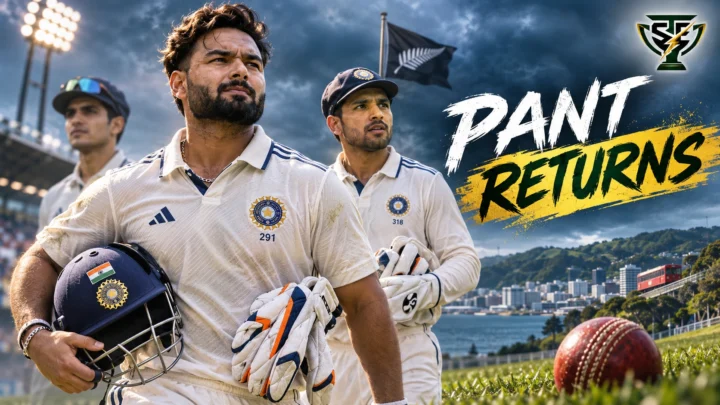
CHRISTCHURCH, New Zealand, November 29, 2026: Dhruv Jurel scored a defiant 88 to rescue India from 117/7, but New Zealand tightened its grip on the New Zealand vs India series decider by establishing a 243-run lead at stumps on Day 3 of the second Test at Hagley Oval on Sunday.
Kyle Jamieson finished with 4/69 as India reached 246 in reply to New Zealand’s 356. Devon Conway then scored 51 before Rachin Ravindra’s unbeaten 46 helped the hosts reach 133/3. Jasprit Bumrah claimed two wickets, but India also lost first-innings bowling hero Akash Deep to concussion, with Prasidh Krishna replacing him.
Key Takeaways
- Dhruv Jurel scored a defiant 88 to rescue India from 117/7, but New Zealand tightened its grip on the New Zealand vs India series decider by establishing a 243-run lead at stumps on Day 3 of the second Test at Hagley Oval on Sunday.
- Kyle Jamieson finished with 4/69 as India reached 246 in reply to New Zealand’s 356.
- Akash Deep scored 29 from 52 deliveries and shared a 46-run eighth-wicket partnership with Jurel.
- Akash Deep had taken 5/99 in New Zealand’s first innings, making his withdrawal a substantial setback.
New Zealand vs India: Jurel Turns a Collapse Into a Contest
India began the morning at 116/6, trailing by 240 runs and needing another 41 to eliminate the possibility of a follow-on. Matt Henry increased the pressure by dismissing Anshul Kamboj without scoring, leaving Jurel with only three partners remaining.
The wicketkeeper-batter had faced 45 deliveries for seven runs overnight. He subsequently added 81 runs from his remaining 125 balls, adjusting his approach as the lower order provided support. His 14 boundaries accounted for 56 of his 88 runs.
Jurel’s response was particularly important after the slow scoring and succession of wickets described in TSE’s Day 2 report. With India already seven wickets down, he had to balance scoring opportunities against the risk of exposing the tail to New Zealand’s seamers.
How the Lower Order Changed the New Zealand vs India Contest
Akash Deep scored 29 from 52 deliveries and shared a 46-run eighth-wicket partnership with Jurel. The pair took India beyond the follow-on threshold before Nathan Smith had Akash caught behind at 163/8.
Debutant Gurnoor Brar then faced 46 deliveries for ten runs. His 64-run partnership with Jurel carried India to 227/9, with Jamieson eventually bowling the young seamer shortly after New Zealand took the second new ball.
India reached lunch at 206/8, having added 90 runs for two wickets in the morning. Jamieson ended the innings when Jurel edged behind, leaving Bumrah unbeaten on four.
The final three partnerships produced 129 runs, compared with 117 before the seventh wicket fell. In other words, 52.44% of India’s first-innings total arrived with only three wickets remaining. That is the clearest statistical measure of how dramatically the lower order altered the New Zealand vs India match situation.
| Wicket | Batters | Runs |
|---|---|---|
| 8th | Jurel and Akash Deep | 46 |
| 9th | Jurel and Gurnoor Brar | 64 |
| 10th | Jurel and Jasprit Bumrah | 19 |
| Total | Final three wickets | 129 |
Jurel’s innings also gives fresh relevance to the selection debate that accompanied Rishabh Pant’s return to fitness. India fielded both wicketkeeper-batters in Christchurch, and Jurel supplied the resistance its top order could not.
Jamieson Leads a Balanced New Zealand Seam Attack
Jamieson dismissed Devdutt Padikkal and Shubman Gill on Saturday before removing Brar and Jurel on Sunday. Henry, Smith and Jacob Duffy took two wickets each, completing a collective performance in which all four specialist seamers contributed.
Henry’s removal of Kamboj was especially valuable because it exposed the tail early. His effectiveness against India continues a productive tour that included six wickets in the fourth ODI, although the longer format demanded a different approach.
The full match scorecard records 19 maiden overs from the four seamers across 83.1 overs. Their sustained control ensured India never established a partnership worth 70 runs in the New Zealand vs India first innings.
| Bowler | Overs | Maidens | Runs | Wickets |
|---|---|---|---|---|
| Matt Henry | 23 | 5 | 58 | 2 |
| Kyle Jamieson | 25.1 | 7 | 69 | 4 |
| Nathan Smith | 18 | 3 | 54 | 2 |
| Jacob Duffy | 17 | 4 | 57 | 2 |
| Rachin Ravindra | 3 | 1 | 2 | 0 |
Akash Deep Concussion Forces India to Change Its Attack
Akash Deep had taken 5/99 in New Zealand’s first innings, making his withdrawal a substantial setback. The Indian Express reported that he suffered blows to the helmet while batting against Jamieson.
Prasidh Krishna entered as the concussion replacement and delivered ten wicketless overs for 29 runs. His inclusion follows the selection and fitness considerations outlined in India’s original Test squad announcement.
India needed wickets rather than simply economical bowling in the second innings. Krishna’s arrival preserved its seam-bowling resources, but replacing the most successful bowler of the opening innings changed the tactical balance of the New Zealand vs India contest.
New Zealand vs India: Conway and Ravindra Extend the Lead
Bumrah finally gained a reward for his accuracy when he bowled Tom Latham for eight at 22/1. He then dismissed Henry Nicholls with a return catch, reducing the hosts to 63/2.
Continue the Cricket Story



Conway reached his half-century from 89 deliveries before Washington Sundar had him caught by Yashasvi Jaiswal for 51. The opener’s contribution was another important development after his concussion setback earlier in the tour.
Ravindra and Daryl Mitchell subsequently added an unbroken 40 runs. Mitchell scored five from 38 deliveries, allowing Ravindra to accumulate runs at the other end. Ravindra’s 46 came from 84 balls and included five boundaries, a marked improvement on his first-innings duck.
The final ten overs brought 23 runs without a wicket. India restricted the scoring rate, but New Zealand retained seven wickets with which to accelerate on Monday. The hosts’ approach leaves the New Zealand vs India Test poised for a declaration decision rather than an immediate scramble for runs.
| Batter | Runs | Balls |
|---|---|---|
| Tom Latham | 8 | 15 |
| Devon Conway | 51 | 97 |
| Henry Nicholls | 22 | 42 |
| Rachin Ravindra | 46* | 84 |
| Daryl Mitchell | 5* | 38 |
| Total (46 overs) | 133/3 |
New Zealand vs India: Day 4 Declaration Equation
New Zealand’s current lead comprises its 110-run first-innings advantage and 133 second-innings runs. Every additional run increases the eventual target by one. The following scenarios assume no further adjustment to the scores beyond the stated additions.
| Additional NZ runs | Overall lead | India target |
|---|---|---|
| 0 | 243 | 244 |
| 56 | 299 | 300 |
| 81 | 324 | 325 |
| 106 | 349 | 350 |
At three runs per over, adding 81 would take 27 overs; at four, it would take just over 20 overs. That difference matters because the Day 3 Reuters report identifies the series and World Test Championship stakes, while match commentary indicates possible rain on the final day. Latham must weigh the security of a larger target against the time his bowlers need to dismiss India.
Following the Wellington draw, the implications identified in TSE’s Christchurch preview remain pertinent. A victory would secure the series for either team, whereas another draw would leave it level.
India’s immediate task in the New Zealand vs India Test is to remove Ravindra and Mitchell before the hosts can accelerate. Jurel has kept the visitors within reach of the contest, but they still need a much stronger collective batting performance to turn that resistance into a result.
New Zealand vs India
- New Zealand vs India: Jurel’s Defiant 88 Cannot Prevent Black Caps From Building 243-Run Lead
- New Zealand vs India 4th ODI: Henry’s Six-Wicket Haul Scripts a Ruthless 244-Run Rout
- Conway’s Concussion Leaves New Zealand Short of Batters as Seifert Faces India Test at Eden Park
- Seifert’s 93, Phillips’ Final Flourish Seal New Zealand’s Comeback But India Escape With 3-2 T20I Series Win
- Phillips and Duffy Turn a Two-Run Midpoint Gap Into an 87-Run Thrashing for India in the 4th T20I