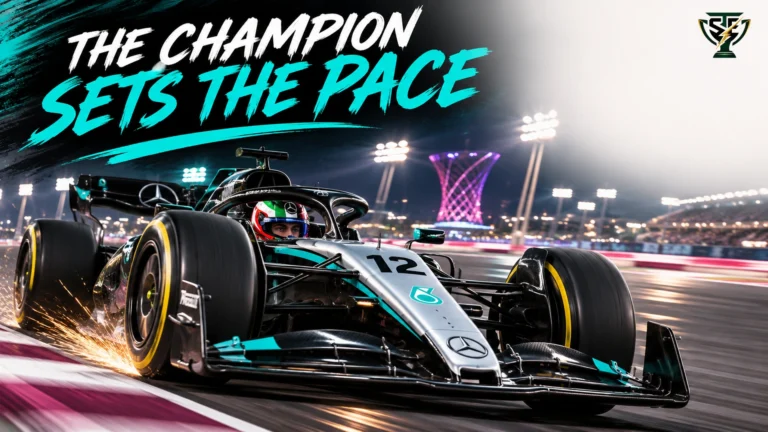
LUSAIL, Qatar, November 27, 2026: Kimi Antonelli produced the fastest lap in both practice sessions at the Qatar Grand Prix without needing the softest available tire compound. The newly crowned Formula 1 world champion led teammate George Russell in successive Mercedes one-twos, but a restriction on tire mileage means that the team’s apparent speed advantage will face a different test over Sunday’s 57-lap race.
Antonelli set a 1:23.217 in the opening session and lowered his benchmark to 1:23.077 in the evening. As Reuters reported, Russell finished 0.507 seconds behind in the first session and 0.127 behind in the second. McLaren’s Lando Norris emerged as the closest challenger from another team by the end of the day.
Key Takeaways
- Kimi Antonelli produced the fastest lap in both practice sessions at the Qatar Grand Prix without needing the softest available tire compound.
- In opening practice, the medium-tire lap from Kimi Antonelli was faster than Russell’s effort on softs.
- Russell reduced his deficit by 0.380 seconds between sessions, while Norris cut his gap to the leader from 0.850 to 0.445.
- Hadjar’s third place in opening practice offered encouragement to Red Bull, although he slipped to sixth in the evening behind Max Verstappen.
Mercedes has already secured both championships, as our analysis of the season-ending Gulf races explained. Qatar nevertheless offers an important opportunity to examine how effectively the champion team can manage its tires at a circuit where even exceptional durability cannot eliminate the need for two stops.
Kimi Antonelli establishes an advantage without a completed soft-tire run in FP2
In opening practice, the medium-tire lap from Kimi Antonelli was faster than Russell’s effort on softs. Red Bull’s Isack Hadjar placed third, 0.661 seconds behind the Italian, with Norris fourth and Oscar Piastri fifth.
Conditions became more representative of qualifying in the evening, but two red flags complicated the comparison. According to Formula 1’s second practice report, Russell was pursuing an improvement on soft tires when gravel on the circuit interrupted his attempt. Mercedes ended the session without either driver completing a representative soft-tire lap.
| Driver | FP1 position | FP2 position | FP2 time |
|---|---|---|---|
| Antonelli | 1 | 1 | 1:23.077 |
| George Russell | 2 | 2 | 1:23.204 |
| Lando Norris | 4 | 3 | 1:23.522 |
| Oscar Piastri | 5 | 4 | 1:23.549 |
Russell reduced his deficit by 0.380 seconds between sessions, while Norris cut his gap to the leader from 0.850 to 0.445. That convergence is worth noting, but differences in tire compounds, fuel loads and interrupted runs prevent a clean measurement of how much each car actually improved.
Why Kimi Antonelli faces a different challenge on race day
Lusail’s succession of fast corners subjects tires to sustained lateral loads. Pirelli’s weekend guidance explains that reinforced tire construction and lower aerodynamic loads from the 2026 cars have allowed the mileage ceiling to rise from 25 laps last year to 27 this season.
Two fresh sets could cover only 54 of the scheduled 57 laps. Three sets are therefore necessary over the full distance. Mileage already accumulated in earlier sessions also counts toward the limit, reducing the available race life of used tires.
For example, a theoretical sequence of 19, 19 and 19 laps would distribute the distance evenly. A 10, 24 and 23 sequence would bring the first stop forward and require longer subsequent stints. Both fit the mileage limit on fresh sets, but the second exposes a driver to more traffic risk after an early stop.
For Kimi Antonelli, the ability to maintain competitive times on the medium compound could prove useful if Mercedes can preserve sufficient fresh rubber and find clear track space after its stops. Friday’s single-lap results do not establish the team’s long-run advantage.
Continue the Motorsport Story



The remaining battles extend beyond Mercedes
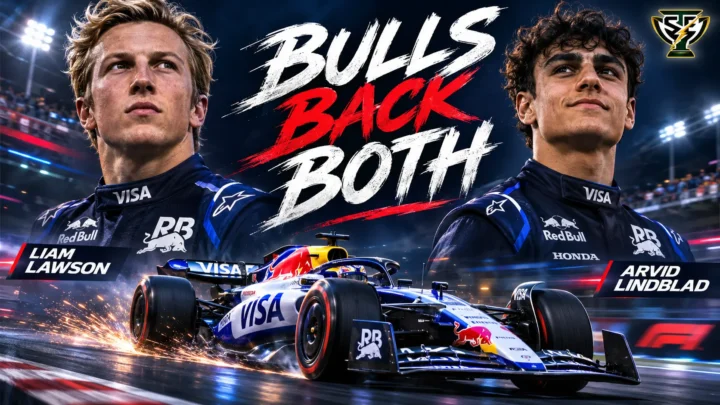
Hadjar’s third place in opening practice offered encouragement to Red Bull, although he slipped to sixth in the evening behind Max Verstappen. Both drivers are confirmed for next season, as detailed in our report on Red Bull’s driver lineup. Their relative performance on a high-speed circuit remains a useful development benchmark.
Further back, Valtteri Bottas finished 21st in second practice. Cadillac’s difficulties provide a contrasting example of the challenges facing teams under the new regulations, particularly after its decision to retain Bottas for 2027.
Lusail also staged a MotoGP round earlier this month following uncertainty over the event’s status, outlined in our MotoGP preview. Formula 1’s return brings a separate set of technical demands, with qualifying position and tire availability likely to shape the weekend’s remaining action.
Readers following TSE’s motorsport coverage should watch whether the advantage established by Kimi Antonelli survives the switch to fresh soft tires in qualifying. If Mercedes secures the front row, the next question will be whether it can protect that track position through two pit-stop cycles without sacrificing its race pace.