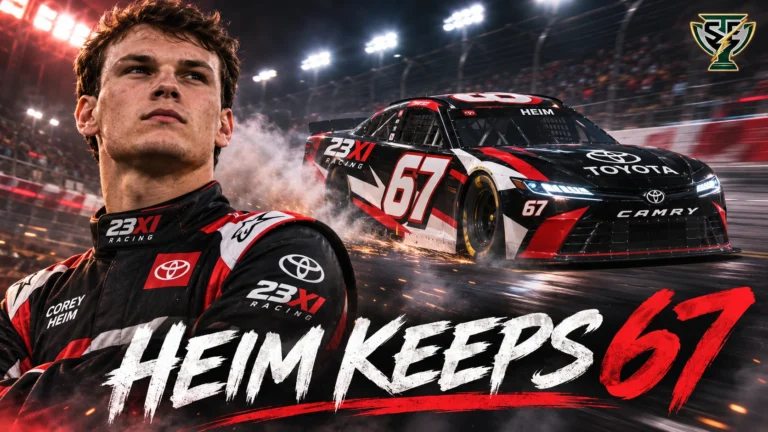
HUNTERSVILLE, North Carolina, November 18, 2026: Corey Heim will retain the No. 67 Toyota when he becomes a full-time NASCAR Cup Series driver for 23XI Racing in 2027, overturning the team’s original plan to put him in the No. 35. The decision follows an exceptional part-time campaign in which the 2025 NASCAR Craftsman Truck Series champion won twice, including the prestigious Brickyard 400 at Indianapolis Motor Speedway.
The Corey Heim No. 67 announcement completes an important piece of 23XI Racing’s driver transition. Heim was already confirmed for a full-time promotion, but his success changed the thinking around which car number should accompany him into the next stage of his career. For the organization co-owned by Michael Jordan and Denny Hamlin, preserving the No. 67 also means retaining a number associated with two of its most important victories of the season.
Key Takeaways
- Corey Heim will retain the No. 67 Toyota when he becomes a full-time NASCAR Cup Series driver for 23XI Racing in 2027, overturning the team’s original plan to put him in the No. 35.
- The Corey Heim No. 67 announcement completes an important piece of 23XI Racing’s driver transition.
- When 23XI Racing confirmed Heim’s promotion in May, the plan was straightforward.
- He won the inaugural Cup Series race at Naval Base Coronado in San Diego on June 21 before adding the Brickyard 400 at Indianapolis on July 26.
Why Corey Heim No. 67 Became 23XI Racing’s Choice
When 23XI Racing confirmed Heim’s promotion in May, the plan was straightforward. He would replace Riley Herbst in the No. 35 Toyota, a car the team had introduced as part of its expansion to three full-time entries.
Story at a glance

Why Corey Heim No. 67 Became 23XI Racing’s Choice
When 23XI Racing confirmed Heim’s promotion in May, the plan was straightforward. He would replace Riley Herbst in the No. 35 Toyota, a car the team had introduced as part of its expansion to three full-time entries.
How Heim’s Two Wins Changed His Position Within NASCAR
Heim arrived in the Cup Series with substantial credentials. He won the 2025 NASCAR Craftsman Truck Series championship after a season that included 12 victories, establishing himself as one of the most successful young drivers in the competition.
Why Keeping No. 67 Matters Beyond Driver Preference
Car numbers are part of the competitive and commercial identity of NASCAR teams. Supporters associate successful numbers with particular drivers, victories and memorable moments.
What the Switch Means for 23XI Racing’s Lineup
Heim’s promotion forms part of 23XI Racing’s longer-term development, rather than a sudden decision driven by one strong season.
Can Heim Challenge for the Cup Series Championship Immediately?
Heim’s victories make him an unusually promising incoming full-time driver. They do not automatically make him a championship favorite.
Heim, meanwhile, would complete his developmental campaign in the No. 67, which had already become familiar to supporters through his occasional Cup appearances.
That arrangement changed after Heim achieved considerably more than an ordinary part-time development driver could reasonably be expected to deliver.
He won the inaugural Cup Series race at Naval Base Coronado in San Diego on June 21 before adding the Brickyard 400 at Indianapolis on July 26. Both victories came in the No. 67 Toyota.
The results gave 23XI Racing a compelling reason to reconsider its original number allocation. Keeping the No. 67 preserves the identity under which Heim established himself as a Cup Series winner, rather than asking him to abandon it immediately before his first full-time campaign.
The official NASCAR announcement confirms the decision and its significance for the team’s upcoming lineup.
Corey Heim No. 67: The Results Behind the Decision
Heim’s limited Cup Series schedule makes his performance particularly striking. Across 13 starts during the 2026 season, he registered two victories, three top-five finishes and four top-10 results.
That means he finished inside the top 10 in approximately 30.8% of his starts and recorded a victory in approximately 15.4% of them.
Those figures are unusually impressive for a driver still making the transition from NASCAR’s lower national divisions. However, they should be interpreted carefully. A part-time schedule does not expose a driver to the same weekly demands as a full championship campaign.
| 2026 Cup Series performance | Corey Heim |
|---|---|
| Starts | 13 |
| Victories | 2 |
| Top-five finishes | 3 |
| Top-10 finishes | 4 |
| Win rate | 15.4% |
| Top-10 rate | 30.8% |
| First victory | Naval Base Coronado, San Diego |
| Second victory | Brickyard 400, Indianapolis |
| 2027 full-time car | No. 67 Toyota Camry |
Calculation: Percentages use Heim’s 13 Cup Series starts in 2026 as the denominator. They describe his completed part-time campaign, not a forecast for 2027.
His two victories also stand out because they came at very different venues. San Diego demanded performance on a temporary street circuit, while Indianapolis tested his ability to compete in one of stock-car racing’s most prestigious events.
Success in both environments supports the view that Heim’s ability extends beyond one particular track configuration. It does not establish that he will immediately contend for the championship across a full season, but it strengthens the evidence behind 23XI Racing’s decision to promote him.
How Heim’s Two Wins Changed His Position Within NASCAR
Heim arrived in the Cup Series with substantial credentials. He won the 2025 NASCAR Craftsman Truck Series championship after a season that included 12 victories, establishing himself as one of the most successful young drivers in the competition.
He was already part of Toyota’s development structure and had spent time working with 23XI Racing before receiving his full-time opportunity.
The distinction between his Truck Series accomplishments and his Cup victories is important.
Dominating a lower division demonstrates racecraft, consistency and an ability to manage championship pressure. Winning at NASCAR’s highest level provides additional evidence that those skills can transfer against more established opposition.
Heim’s 2026 results supplied that second form of evidence earlier than many teams would expect from a developing driver.
His transition has also been deliberate. The team’s original promotion announcement described a program designed to give him time to refine his racing skills before taking on the demands of weekly Cup competition.
Heim was not simply promoted because a seat became available. His development experience and competitive results gave the organization a substantial performance record on which to base the decision.
Why Keeping No. 67 Matters Beyond Driver Preference
Car numbers are part of the competitive and commercial identity of NASCAR teams. Supporters associate successful numbers with particular drivers, victories and memorable moments.
For Heim, the No. 67 already has a history worth preserving.
The number appeared for 23XI Racing at the 2023 Daytona 500 with Travis Pastrana, while Kamui Kobayashi also drove it in the team’s earlier Cup appearances.
Heim subsequently turned it into a winning entry.
That history helps explain why maintaining the number is more meaningful than a cosmetic adjustment. His first two Cup victories will remain associated with the same number that now accompanies him into full-time competition.
From a team-building perspective, continuity could also be useful. Fans already recognize Heim in the No. 67, allowing 23XI Racing and its partners to build on an established identity rather than introduce another one.
However, the number itself provides no competitive advantage. Heim’s performance will depend on the quality of his car, crew, preparation and race execution.
The decision has symbolic and commercial value, while the sporting challenge remains unchanged.
What the Switch Means for 23XI Racing’s Lineup
Heim’s promotion forms part of 23XI Racing’s longer-term development, rather than a sudden decision driven by one strong season.
The team began Cup Series competition in 2021 with Bubba Wallace driving the No. 23 Toyota. Tyler Reddick subsequently joined the organization in the No. 45, and its expansion brought a third full-time entry into the operation.
Riley Herbst helped establish that additional program in the No. 35. Heim will now occupy the full-time seat while retaining the No. 67 designation from his development schedule.
The driver lineup offers an interesting combination of experience and emerging talent.
| Driver | Car | Role in 23XI Racing’s plans |
|---|---|---|
| Bubba Wallace | No. 23 Toyota | Established Cup Series driver |
| Tyler Reddick | No. 45 Toyota | Established race winner and championship contender |
| Corey Heim | No. 67 Toyota | Incoming full-time driver with two Cup victories |
Heim’s arrival provides the organization with another driver capable of winning races, but supporting three competitive cars also places demands on engineering resources, personnel and race preparation.
The meaningful test is whether 23XI Racing can maintain the competitiveness of its established entries while developing Heim into a consistent weekly performer.
That balance will influence whether the team merely increases its number of competitive cars or becomes a stronger championship organization.
Can Heim Challenge for the Cup Series Championship Immediately?
Heim’s victories make him an unusually promising incoming full-time driver. They do not automatically make him a championship favorite.
A complete NASCAR Cup Series season requires sustained performance across different circuits, track surfaces, racing conditions and competitive situations.
Drivers must regularly manage tire wear, race traffic, pit-road execution, restarts and adjustments made during lengthy events. They must also recover from weekends when the car is less competitive.
Heim has demonstrated that he can capitalize on opportunities to win. The next question is whether he can consistently produce strong results when circumstances are less favorable.
Three areas will be particularly important.
Qualifying and track position: Starting near the front can help reduce exposure to traffic and limit the risks associated with recovering positions during a race. Heim must establish whether his qualifying pace is competitive across the full schedule.
Consistency: His 2026 results demonstrate considerable potential, but a championship campaign requires strong finishes across many more races. Reducing costly mistakes will matter as much as producing occasional exceptional performances.
Continue the Motorsport Story



Team execution: Pit stops, car adjustments and tactical decisions can determine whether a driver converts a competitive afternoon into a top-five finish or loses substantial ground.
There is also a psychological difference between racing as an ambitious part-time prospect and competing every weekend as an established Cup driver.
Expectations will be higher. Rivals will have more opportunities to study his racing tendencies, and the demands on his preparation will become continuous rather than intermittent.
His championship prospects should therefore be judged through sustained results, not simply extrapolated from an impressive 13-race sample.
Why 23XI Racing’s Development Strategy Deserves Attention
Heim’s progression offers a useful example of how a racing organization can prepare a young driver without requiring an immediate full-time promotion.
His experience began with reserve and developmental responsibilities before expanding through additional Cup starts. The program allowed 23XI Racing to evaluate him against higher-level opposition while he continued developing his skills.
The strategy is not unique to NASCAR. Other motorsport championships regularly face decisions about when to promote young drivers and whether further preparation offers more value than immediate exposure.
The Sports Encounter recently examined a related dilemma in its coverage of Racing Bulls retaining Liam Lawson and Arvid Lindblad, a decision that placed established performance ahead of another immediate junior-driver promotion.
Although Formula 1 and NASCAR have different development systems, both cases illustrate how teams balance proven results, future potential and the risks associated with changing their lineups.
Heim’s progression suggests that 23XI Racing’s staged approach has produced the desired outcome: a young driver who enters full-time competition already possessing Cup Series victories.
The next step is proving that the development program has prepared him for the full demands of the championship.
What Happens Next for Corey Heim and 23XI Racing?
Confirmation of the No. 67 removes an important uncertainty surrounding Heim’s first full-time season.
The team’s next priorities include completing its preparations, finalizing operational arrangements and ensuring the new full-time entry has the support needed to compete consistently.
Heim will also have to adjust from a selective schedule to the responsibilities of competing across the entire Cup Series calendar.
His two victories have already established that he belongs in the conversation about NASCAR’s most promising young competitors. They have also made his transition more compelling than an ordinary driver promotion.
For 23XI Racing, the Corey Heim No. 67 decision preserves the identity behind those breakthrough results while allowing the organization to build around a driver it has developed over several seasons.
The real measure of success will not be whether the number remains familiar. It will be whether Heim can turn his remarkable part-time achievements into sustained results, more victories and eventually a serious NASCAR Cup Series championship challenge.