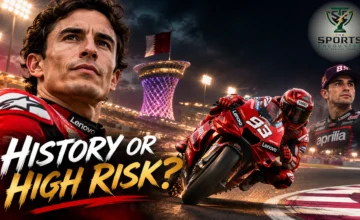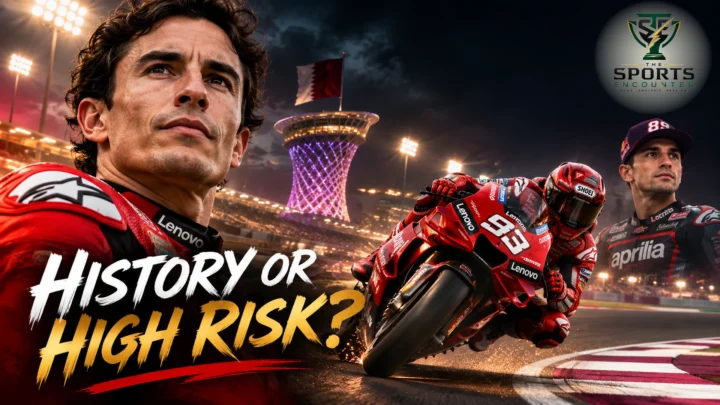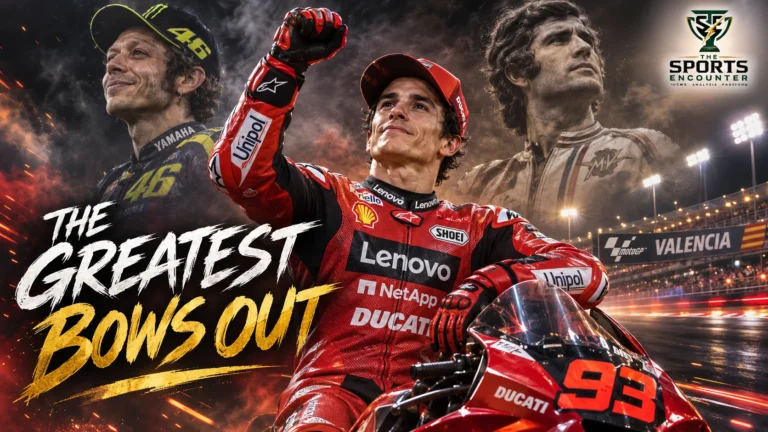
VALENCIA, Spain, November 27, 2026: Marc Márquez needed eight world championships to equal a record that had stood for 51 years. He needed only five more days to announce that he would leave motorcycle racing without attempting to break it. The reigning MotoGP champion will retire after Sunday’s Valencia Grand Prix, ending his career at the same circuit where he first secured the premier-class title in 2013.
The 33-year-old Spaniard stands joint first with Giacomo Agostini on eight premier-class championships, one ahead of Valentino Rossi. His ten world titles across all Grand Prix classes put him third on that separate historical list, behind Agostini and Ángel Nieto. But if greatness is measured by the ability to dominate, adapt and return from adversity, there is a compelling argument that Marc Márquez deserves first place outright.
Key Takeaways
- Marc Márquez needed eight world championships to equal a record that had stood for 51 years.
- The 33-year-old Spaniard stands joint first with Giacomo Agostini on eight premier-class championships, one ahead of Valentino Rossi.
- The retirement, reported by Reuters, comes despite a Ducati contract that was due to run through 2028.
- Motorcycle racing’s premier-class championship began in 1949.
The retirement, reported by Reuters, comes despite a Ducati contract that was due to run through 2028. The decision makes his eighth championship more than another milestone: it is the final title of a career whose most remarkable achievements came after its apparent peak.
Where Marc Márquez ranks among the most successful MotoGP champions
Motorcycle racing’s premier-class championship began in 1949. The 500cc category became MotoGP in 2002, but the historical championship records treat them as successive versions of the same top-level competition. The table below therefore includes the great 500cc champions rather than restricting the comparison to riders who raced under the modern MotoGP name.
| Rank | Rider | Country | Premier-class titles | Title years |
|---|---|---|---|---|
| =1 | Marc Márquez | Spain | 8 | 2013, 2014, 2016–2019, 2025, 2026 |
| =1 | Giacomo Agostini | Italy | 8 | 1966–1972, 1975 |
| 3 | Valentino Rossi | Italy | 7 | 2001–2005, 2008, 2009 |
| 4 | Mick Doohan | Australia | 5 | 1994–1998 |
| =5 | Mike Hailwood | Great Britain | 4 | 1962–1965 |
| =5 | John Surtees | Great Britain | 4 | 1956, 1958–1960 |
| =5 | Geoff Duke | Great Britain | 4 | 1951, 1953–1955 |
| =5 | Eddie Lawson | United States | 4 | 1984, 1986, 1988, 1989 |
| =9 | Kenny Roberts | United States | 3 | 1978–1980 |
| =9 | Wayne Rainey | United States | 3 | 1990–1992 |
| =9 | Jorge Lorenzo | Spain | 3 | 2010, 2012, 2015 |
Source: MotoGP’s historical comparison of its champions, updated for the 2026 title. Equal title counts share the same rank.
Agostini’s 15 world championships remain the overall benchmark, with seven of them coming in the 350cc category. Nieto won 13 championships in the smaller-displacement classes without winning the premier-class crown. The 2010 125cc and 2012 Moto2 championships bring the career total for Marc Márquez to ten. These are different measures of accomplishment, and confusing them would obscure what the Spaniard has actually achieved.
Three careers within one career
Marc Márquez and the destruction of the rookie learning curve
In 2013, Honda promoted its 20-year-old Moto2 champion into a field containing Rossi, Jorge Lorenzo and Dani Pedrosa. The rookie beat them to the championship, becoming the youngest premier-class world champion. Kenny Roberts in 1978 had been the last rider to win the top-level title in his debut championship season.
His second campaign began with ten consecutive Grand Prix victories. By 2019, Marc Márquez had collected six titles in seven premier-class seasons. That year’s consistency was particularly revealing: he finished first or second in every Grand Prix he completed. The only exception to that sequence of results was his retirement from the race in Austin after a crash.
The period demonstrated that the Spaniard could win through both overwhelming speed and sustained championship management. Lorenzo’s 2015 title also matters to the comparison. It showed that even during his strongest years, Márquez was not competing without opposition capable of beating him across a season.
The years that could have ended everything
A fractured right humerus at Jerez in 2020 interrupted that dominance. Multiple operations and interrupted campaigns followed. Honda’s former championship winner was now trying to recover his physical capacity to race while the competitive balance of MotoGP shifted toward European manufacturers.
Marc Márquez left Honda after 2023 and joined Gresini on Ducati machinery. In 2024, his Aragon victory ended a wait of more than 1,000 days between Grand Prix wins. The move to the factory Ducati team in 2025 subsequently produced his seventh premier-class championship, six years after his sixth.
A comeback after injury is difficult to compare across generations because medical treatment, protective equipment and circuits have changed. In sporting terms, however, the six-year interval between championships is revealing: the rider who returned had to beat a different generation on a different motorcycle. His earlier record alone could not accomplish that.
Marc Márquez and the 102-point escape
His final championship required yet another recovery. After Mugello, he trailed Aprilia’s Marco Bezzecchi by 102 points. Shoulder and foot problems had disrupted his season, and the title defense appeared to be slipping away. Our Qatar Grand Prix preview documented his subsequent rise to the lead before the final three rounds.
According to MotoGP’s championship statistics, the 102-point recovery established a new record for the largest deficit overturned to win the premier-class title. The sprint-era scoring format offers more points per weekend than earlier systems, so the raw deficit should not be treated as a direct measure of difficulty against older comebacks.
There was another distinction. Six championships had come with Honda and two with Ducati. Only Rossi had previously won at least two premier-class titles with each of two manufacturers. Winning again in 2026 established that the switch to Ducati had produced sustained success rather than one exceptional season.
TSE’s five greatest premier-class champions
Our editorial ranking for The Sports Encounter weighs championship success, sustained dominance, adaptability and recovery from adversity. It is deliberately different from the title-count table. No mathematical formula can reliably adjust for the quality of opposition, safety standards and equipment across nearly eight decades of racing.
1. Marc Márquez: The strongest all-round championship case
The Spaniard combines a record-equalling title count with rookie success, repeated championships for two manufacturers and a second period of dominance after years of injury. His first and final premier-class titles came 13 years and 12 days apart. That span is especially impressive because it includes a substantial period when he was unable to contend for championships.
Continue the Motorsport Story
2. Giacomo Agostini: The benchmark for dominance
Agostini won seven successive 500cc titles before securing an eighth with Yamaha in 1975. His 68 wins from 130 premier-class starts represent a victory rate of approximately 52.3 percent. He also won seven 350cc championships. Against Marc Márquez, the Italian’s strongest argument is the extraordinary frequency with which he won. The Spaniard’s counterargument is the depth of his comeback and the competitive circumstances of the modern championship.
3. Valentino Rossi: Longevity and reinvention
Rossi remains the benchmark for sustained race-winning longevity, with 89 premier-class victories and 199 podiums. His decision to leave Honda for Yamaha before the 2004 season, followed by an immediate championship, was a defining demonstration of adaptability. He also built a legacy beyond competition through his rider academy and team. Marc Márquez has surpassed him in titles, but that does not erase Rossi’s distinct contributions to the sport.
4. Mick Doohan: The great precedent for recovery
Doohan suffered a devastating leg injury at Assen in 1992 before returning to win five consecutive championships with Honda. In 1997, he won 12 of 15 races. His recovery is a particularly relevant historical comparison, because he too had to rebuild a career threatened by injury. The Australian won fewer titles than the three men above him, but his peak dominance belongs in their company.
5. Mike Hailwood: Exceptional versatility
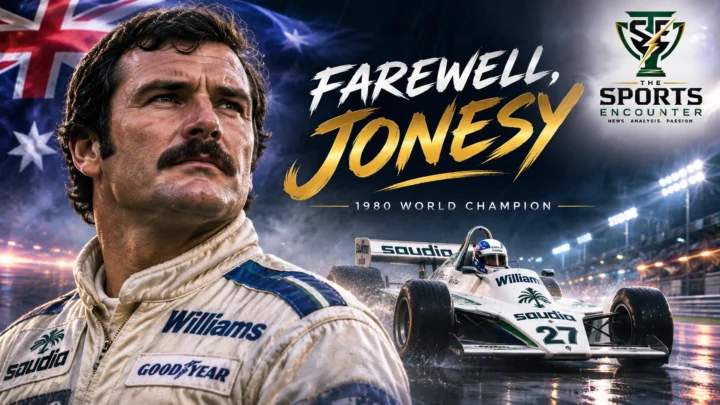
Hailwood’s four premier-class championships formed part of nine world titles across multiple categories. His versatility illustrates a quality that modern single-class career paths make harder to demonstrate. John Surtees, also a four-time premier-class champion, remains another compelling candidate for this position because he subsequently won the Formula 1 world championship. The relationship between a champion and the machinery that enables success is also explored in TSE’s retrospective on Alan Jones and Williams.
What the retirement means for MotoGP
Valencia will close an era rather than decide the championship. The departure of the reigning champion creates a competitive opening for Ducati’s rivals, but the manufacturer’s recent successes suggest that the balance of power will not automatically shift with one rider’s exit. Aprilia’s Bezzecchi and Jorge Martín have already demonstrated their ability to challenge for the title.
The final weekend also arrives during a complicated period for international racing, as our analysis of Formula 1’s Gulf season finales illustrated through the implications of MotoGP’s Qatar event. Readers can follow the next championship cycle through TSE’s motorsport coverage.
Agostini still has the strongest claim to outright statistical supremacy across all classes. Rossi’s record of premier-class Grand Prix victories remains a separate benchmark. But Marc Márquez leaves with a combination neither rival can match precisely: a championship as a rookie, eight titles in the modern premier class, six years between title-winning campaigns and successive crowns after changing manufacturers. For TSE, that combination makes him the greatest premier-class champion, even though he will share the championship record rather than own it alone.