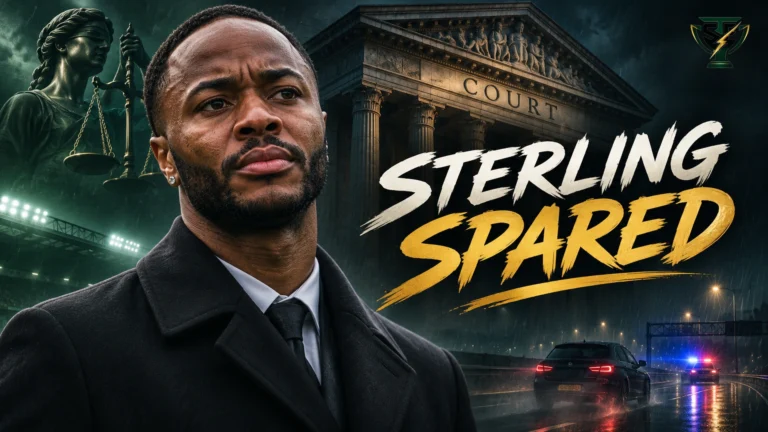
BASINGSTOKE, England, November 25, 2026: Raheem Sterling received a 12-month prison sentence, suspended for 18 months, after admitting dangerous driving, unlawful possession of nitrous oxide and failing to provide a blood specimen. The former England winger must complete 100 hours of unpaid work and is disqualified from driving for two years. His conviction also places medical and driving-test requirements between him and the restoration of his license.
The most revealing detail of Wednesday’s ruling is the legal significance of the 12-month sentence. A change to England and Wales’ sentencing law made suspension the required outcome in qualifying cases unless a statutory exception applied. The court found none in Sterling’s case. Understanding how his sentence reached that threshold is essential to assessing whether the former Manchester City forward received exceptional treatment.
Key Takeaways
- Raheem Sterling received a 12-month prison sentence, suspended for 18 months, after admitting dangerous driving, unlawful possession of nitrous oxide and failing to provide a blood specimen.
- Section 1 of the Sentencing Act 2026 introduced a presumption of suspension for qualifying custodial terms of 12 months or less.
- The offenses arose from the May 28 crash involving a Lamborghini Urus.
- Raheem Sterling earned 82 England caps and won four Premier League titles with Manchester City.
Why Raheem Sterling Was Spared Immediate Imprisonment
District Judge Kirsty Allman’s published sentencing remarks establish a distinction between the seriousness of the offenses and the manner in which the punishment must be served. The judge classified the dangerous driving in the highest culpability and harm categories under the applicable guidelines. She considered a noncustodial sentence inadequate.
After assessing the offenses collectively and weighing mitigation, Allman determined that 18 months’ imprisonment would have been appropriate following a trial. Sterling’s early guilty pleas earned a one-third reduction, bringing the lead sentence to 12 months. A separate two-month term for the specimen offense runs concurrently.
How the Law Applied to Raheem Sterling
Section 1 of the Sentencing Act 2026 introduced a presumption of suspension for qualifying custodial terms of 12 months or less. The provision applies to eligible adult offenders convicted after its commencement. The court must consider statutory exceptions before applying it.
The arithmetic matters. The guilty plea reduced the lead term by six months and brought it exactly to the statutory threshold. Had the final sentence exceeded 12 months, this particular statutory presumption would not have applied, although that alone would not establish that immediate imprisonment was inevitable.
| Measure | Court’s decision |
|---|---|
| Dangerous driving | 12 months in prison, suspended for 18 months |
| Failure to provide blood specimen | Two months, concurrent |
| Nitrous oxide possession | No additional penalty |
| Unpaid work | 100 hours |
| Driving disqualification | 24 months; extended driving test and medical fitness requirements apply |
| Costs and victim surcharge | £272 combined |
Why the Court Considered the Public Danger So Serious
The offenses arose from the May 28 crash involving a Lamborghini Urus. Motorists reported erratic driving on the M25 and M3, with some forced to take evasive action. Allman found that Raheem Sterling had deliberately driven while impaired by nitrous oxide and after going without sleep.
Although the judge identified damage to Sterling’s own vehicle, the absence of a worse outcome offers little reassurance about the original risk. Road safety depends on every motorist retaining sufficient control to respond to the mistakes of others. When surrounding drivers must compensate for one individual’s impairment, the danger extends beyond that person’s vehicle.
As Reuters reported, the judge also recognized Sterling’s charitable contributions and subsequent engagement with addiction services. The published ruling records voluntary residential treatment in June and a favorable probation risk assessment. Those considerations helped determine the sentence without excusing his conduct.
From an England Role Model to a Test of Personal Accountability
Raheem Sterling earned 82 England caps and won four Premier League titles with Manchester City. His three goals at Euro 2020 included the winner against Croatia and the opening goal against Germany in the round of 16. England’s progress to the final established him as one of the defining players of that tournament.
The national team’s subsequent evolution provides a measure of how quickly the professional landscape changes. TSE’s coverage of Harry Kane’s England appearance record and the Bellingham brothers’ selection illustrates the competing demands of sustaining an international career and introducing new talent.
Continue the Soccer Story



Sterling’s work beyond soccer also influenced the judgment. His 2021 MBE recognized services to racial equality in sport. His foundation and youth academy were considered in mitigation. For young players entering professional soccer, such as Tottenham’s emerging academy graduate Luca Williams-Barnett, the transition to senior sport deserves support that extends beyond training and contract negotiations.
Revisiting TSE’s Warning About Off-Field Responsibility
In August, The Sports Encounter connected the initial charges against Raheem Sterling with a separate incident involving England cricketer Brydon Carse to examine the responsibilities of elite athletes. Their legal circumstances were different. As our earlier Carse report established, the cricketer was de-arrested without charge in that incident.
Wednesday’s judgment gives that discussion a more concrete basis. Professional soccer should consider whether confidential support remains accessible when players lose regular selection, change clubs or leave established dressing rooms. Such support cannot transfer responsibility for an individual’s unlawful decisions to an employer.
For Raheem Sterling, the next 18 months carry a legal obligation to comply with the suspended sentence. Any future playing opportunity is a separate question. His reputation as a sporting role model will depend on how he responds to the obligations the court has imposed.