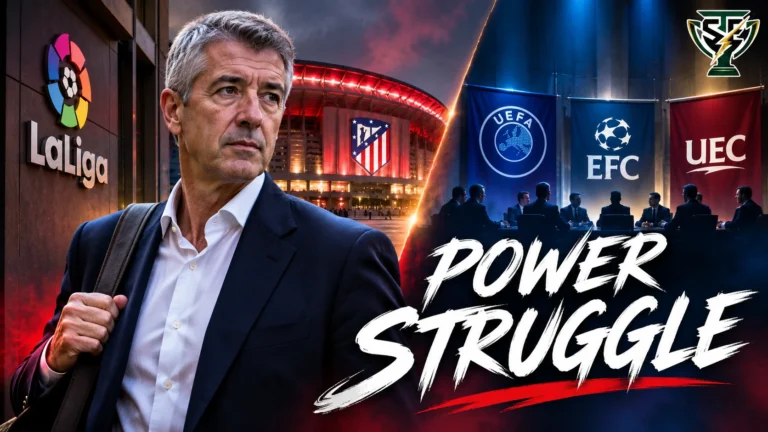
MADRID, Spain, November 24, 2026: Atlético Madrid chief executive Miguel Ángel Gil Marín has resigned as LaLiga’s first vice president, stepping away from one of Spanish football’s most influential administrative positions as a dispute over European club representation threatens to divide domestic leagues, UEFA and competing club associations.
Gil Marín, who had held the position since 2020, announced his departure during LaLiga’s general assembly in Madrid. Atlético attributed the decision to his expanding responsibilities on the executive committees of UEFA and European Football Clubs (EFC), saying that the overlapping positions had become increasingly difficult to manage and could create conflicts of interest.
Key Takeaways
- Gil Marín, who had held the position since 2020, announced his departure during LaLiga’s general assembly in Madrid.
- Spanish media have also reported that LaLiga provided more than €1 million in financial support to UEC.
- Gil Marín’s departure from LaLiga’s Delegate Committee was confirmed during the league’s general assembly.
- UEC’s complaint invokes Articles 101 and 102 of the Treaty on the Functioning of the European Union.
His resignation comes at a particularly sensitive moment. LaLiga president Javier Tebas has supported a competition complaint brought by the Union of European Clubs (UEC), an organization challenging the privileged position held by EFC in UEFA’s decision-making structure. Gil Marín sits on the executive committee of EFC, placing him inside an organization whose institutional arrangements are being challenged by a group supported by the league he helped govern.
Story at a glance
Why Did Miguel Ángel Gil Marín Resign From LaLiga?
Gil Marín’s departure from LaLiga’s Delegate Committee was confirmed during the league’s general assembly.
The European Football Dispute Behind the Resignation
The central disagreement concerns the relationship between UEFA, European Football Clubs and the Union of European Clubs.
Why the European Commission Complaint Matters
UEC’s complaint invokes Articles 101 and 102 of the Treaty on the Functioning of the European Union.
Why LaLiga’s Reported Financial Support for UEC Is So Significant
One of the most sensitive questions concerns reports that LaLiga has financially supported UEC.
Javier Tebas Faces a Difficult Balance Between Domestic and European Interests
LaLiga president Javier Tebas has supported UEC’s challenge to the established European club-representation model.
Spanish media have also reported that LaLiga provided more than €1 million in financial support to UEC. The precise financial arrangements and their implications remain subject to clarification.
The resignation therefore raises a question extending well beyond Atlético Madrid: who should have the authority to speak for Europe’s football clubs when decisions are made about competition formats, broadcasting revenue, scheduling and the distribution of money?
Why Did Miguel Ángel Gil Marín Resign From LaLiga?
Gil Marín’s departure from LaLiga’s Delegate Committee was confirmed during the league’s general assembly.
Atlético Madrid explained that its chief executive holds important positions within UEFA and EFC, creating an increasingly demanding combination of administrative responsibilities.
According to the club, Gil Marín also wanted to prevent potential conflicts of interest arising from his participation in the different governing bodies.
The distinction between those two explanations matters. Difficulty managing several senior positions is an administrative concern. A potential conflict of interest involves the possibility that obligations to different organizations could become incompatible.
Both issues are relevant to Gil Marín’s situation, but the second has attracted greater attention because LaLiga and EFC are positioned on different sides of an emerging European football governance dispute.
The Reuters report on Gil Marín’s resignation confirmed Atlético’s explanation and detailed the competing institutional interests involved.
Importantly, Gil Marín has not resigned as Atlético Madrid’s chief executive. His departure concerns his LaLiga leadership position.
The European Football Dispute Behind the Resignation
The central disagreement concerns the relationship between UEFA, European Football Clubs and the Union of European Clubs.
EFC, previously known as the European Club Association, is an established representative organization with more than 900 member clubs.
UEC was founded in 2023 to provide an alternative voice, particularly for clubs concerned about unequal access to European football’s decision-making institutions.
UEC currently represents 138 clubs, according to figures reported in connection with the dispute.
Its challenge concerns a memorandum of understanding signed between UEFA and EFC in 2024.
That agreement recognizes EFC as the representative of European club interests and provides it with positions within UEFA’s governance structure.
UEC argues that granting one organization exclusive recognition can restrict competition between representative bodies and marginalize clubs outside the established association.
It has taken that argument to the European Commission through a competition complaint.
What Is the Difference Between EFC and UEC?
| Issue | European Football Clubs | Union of European Clubs |
|---|---|---|
| Abbreviation | EFC | UEC |
| Background | Formerly the European Club Association | Founded in 2023 |
| Reported membership | More than 900 clubs | 138 clubs |
| UEFA relationship | Recognized under a formal cooperation agreement | Challenges aspects of that recognition |
| Governance position | Holds representation within UEFA decision-making bodies | Seeks greater access and more inclusive representation |
| Current dispute | Defends an established institutional arrangement | Has filed a competition complaint concerning that arrangement |
The membership figures demonstrate that EFC is substantially larger, but size alone does not settle the question of representation.
A representative body may have hundreds of members while still facing legitimate questions about whether its governance structure gives sufficient influence to smaller organizations.
Equally, the existence of a smaller rival association does not automatically establish that the larger organization is acting unlawfully.
The central issue is whether UEFA’s arrangements allow meaningful representation and comply with applicable European competition law.
Why the European Commission Complaint Matters
UEC’s complaint invokes Articles 101 and 102 of the Treaty on the Functioning of the European Union.
Article 101 addresses agreements between undertakings that may restrict competition. Article 102 concerns the abuse of a dominant position.
UEC argues that the UEFA-EFC arrangement creates an unfair structure by granting one organization privileged access to decisions affecting clubs throughout Europe.
The complaint specifically raises concerns about revenue allocation, match scheduling and competition structures.
Those are commercially important decisions because they influence the financial resources and sporting opportunities available to clubs.
A change in European competition formats can affect the number of matches a club plays, its broadcasting exposure, travel requirements and potential prize money.
Revenue distribution determines how much money reaches participating teams and how financial resources are shared across the broader football system.
UEC’s argument is that organizations representing smaller clubs should have meaningful opportunities to influence those decisions.
However, filing a complaint does not establish that UEFA or EFC has violated European law.
The European Commission would need to assess the allegations and determine whether further proceedings are justified.
No final infringement decision has been established by the reporting available at publication.
The Spanish news agency EFE’s coverage of the resignation confirms the connection between the European competition complaint, Tebas’ position and Gil Marín’s departure.
Why LaLiga’s Reported Financial Support for UEC Is So Significant
One of the most sensitive questions concerns reports that LaLiga has financially supported UEC.
Spanish media have placed the amount above €1 million, although the exact contractual terms, duration and financial classification have not been fully established through publicly available documentation.
Spanish football federation president Rafael Louzán subsequently described the arrangement as a loan rather than a grant, according to reporting by AS.
That distinction is important.
A loan ordinarily creates a repayment obligation, while a grant or subsidy generally does not carry the same expectation of repayment.
Without the underlying agreement, repayment conditions and accounting disclosures, it would be premature to characterize the entire amount as a nonrepayable subsidy.
Nevertheless, the broader governance question remains relevant regardless of how the transaction is classified.
LaLiga is a domestic league representing clubs with potentially different positions on European football’s institutional arrangements.
If the league provides financial assistance to one European representative organization while some of its members participate in a rival organization, questions naturally arise about authorization, transparency and the use of shared institutional resources.
Those questions do not prove misconduct. They identify the information necessary to assess whether the arrangement was properly approved and communicated.
Four Questions LaLiga’s Financial Disclosures Need to Answer
| Question | Why the Answer Matters |
|---|---|
| Was the reported payment a loan, grant or another financial arrangement? | Establishes its accounting and contractual nature |
| Who approved the transaction? | Clarifies the governance process and authorization |
| What conditions apply to the funds? | Shows whether repayment, restrictions or other obligations exist |
| How were member clubs informed? | Determines the transparency of the decision-making process |
Answers to these questions would allow clubs and observers to evaluate the transaction on documented facts rather than competing interpretations.
Javier Tebas Faces a Difficult Balance Between Domestic and European Interests
LaLiga president Javier Tebas has supported UEC’s challenge to the established European club-representation model.
His position reflects a wider debate about the relationship between domestic leagues and continental competitions.
National leagues depend on competitive domestic championships to maintain broadcasting value, sponsorship interest and long-term financial stability.
European competitions offer additional revenue and international exposure, but their expansion can create scheduling pressure and increase the commercial advantages enjoyed by clubs that qualify regularly.
These competing interests help explain why a domestic league president might support an organization advocating broader representation.
However, the challenge becomes more complicated when a senior official from that same domestic league holds influential positions within the European organization being challenged.
Gil Marín’s departure removes one visible source of overlapping responsibility, but it does not resolve the disagreement between LaLiga and EFC.
Nor does it determine whether the reported financial arrangement with UEC was appropriate.
Those questions require separate institutional decisions.
Why This Is Not Necessarily a Personal Break Between Tebas and Gil Marín
Gil Marín has been one of Tebas’ longstanding allies within Spanish football administration.
He became LaLiga’s first vice president in 2020 and was subsequently reelected.
Spanish reporting indicates that the two executives have maintained a constructive relationship despite the disagreement involving European club representation.
That makes it important to distinguish an institutional conflict from a personal dispute.
A senior executive can support an organization in many areas while disagreeing with a particular policy or finding that overlapping roles have become incompatible.
Gil Marín’s resignation is evidence that the institutional tension has become significant enough to affect LaLiga’s leadership structure. It is not, by itself, evidence that relations between Atlético Madrid and the league have collapsed.
What Does LaLiga’s Delegate Committee Actually Do?
The Delegate Committee is a central administrative and governing body within LaLiga.
It provides a structure through which elected club representatives participate in important league matters between broader assemblies.
Its composition includes six representatives from the top division and six from the second division, alongside two elected vice presidents.
Javier Tebas serves as president.
Gil Marín’s resignation therefore removes an experienced executive from a body responsible for significant institutional responsibilities.
The immediate administrative consequence is the need to address the vacancy in accordance with LaLiga’s governance procedures.
His departure does not automatically change Atlético Madrid’s participation in LaLiga or the club’s sporting position.
The distinction is particularly important because Atlético remain an active contender in Spanish and European competition.
The Sports Encounter’s latest analysis of LaLiga’s title and European qualification races examined Atlético’s position alongside Barcelona, Real Madrid and other clubs competing for continental places.
Those sporting competitions continue independently of the executive resignation, although the wider governance debate concerns the financial and competitive framework in which clubs operate.
Why Smaller Clubs Have a Direct Stake in the Dispute
For clubs outside Europe’s wealthiest group, representation is not merely a constitutional issue.
It can affect the financial conditions under which they compete.
European football’s commercial structure rewards participation in continental competitions, particularly the Champions League.
Clubs that qualify regularly can build stronger international brands, attract sponsorships and use European revenue to reinforce their squads.
Those advantages can make it harder for less wealthy competitors to close the gap.
UEC’s complaint reflects concern that smaller clubs may have insufficient influence over decisions affecting this competitive balance.
However, the practical effects of any alternative representation model would depend on its rules.
Simply creating additional seats or recognizing another organization would not guarantee more equitable revenue distribution.
The meaningful test would be whether clubs outside the established elite gain a stronger voice in decisions affecting access, scheduling and financial allocations.
The Representation Gap Is More Complicated Than Club Membership Numbers
EFC’s membership of more than 900 clubs demonstrates substantial reach.
UEC’s 138 members represent a smaller constituency.
But effective representation depends on more than membership totals.
Relevant questions include how executive positions are allocated, whether smaller clubs can influence policy, how representatives are elected and whether important decisions require broad approval.
A large association could provide inclusive representation through transparent procedures. A smaller organization could also struggle to represent its members fairly if its internal governance were concentrated among a few influential clubs.
For that reason, the European Commission dispute should ultimately be assessed through the legal structure of the UEFA-EFC agreement and its practical effects rather than assumptions about either organization’s motives.
The Historical Background: European Football’s Long Struggle Over Control
The current dispute belongs to a longer history of disagreements about the balance of power between clubs, leagues and football governing bodies.
European club organizations have sought greater influence over commercial revenue, competition formats and fixture scheduling for decades.
UEFA, meanwhile, remains responsible for organizing continental competitions and maintaining the regulatory structure through which European football operates.
Domestic leagues have their own commercial and sporting priorities, which do not always align with the interests of clubs competing regularly in Europe.
The proposed European Super League made those disagreements particularly visible.
Its original model provoked widespread opposition over concerns about sporting merit, qualification access and the concentration of commercial power.
Subsequent legal proceedings also intensified scrutiny of how football governing bodies exercise regulatory and commercial authority.
That history provides important context for the UEC complaint, although the present case concerns a different legal question: whether UEFA’s recognition of one representative organization unlawfully restricts competition.
It should not be treated as a continuation of the Super League proceedings or as evidence that the same legal conclusions necessarily apply.
Why Football Governance Disputes Have Become More Consequential
Modern football organizations control decisions with substantial financial implications.
Competition formats determine the number of commercially valuable fixtures. Broadcasting agreements influence the revenue available to leagues and clubs. Qualification systems affect which teams can participate in lucrative international tournaments.
Governance arrangements therefore shape the economic environment of the sport.
The significance of institutional accountability has also been evident in other disputes involving international governing bodies.
TSE’s investigation into the FIFA-UEFA legal dispute involving Gianni Infantino examined a separate controversy over institutional authority, legal scrutiny and the commercial direction of international football.
The cases are legally distinct, but both demonstrate why decisions made away from the pitch can carry consequences for the wider football economy.
Continue the La Liga Story
 La LigaRequena Rescues Levante From Relegation Trouble as Elche Pay for Wasting Their Late Lead
 La LigaChina Opens Dialogue with Real Madrid Over Mbappé’s Mao Remarks, but LaLiga’s €10M Broadcast Risk Remains
 La LigaLa Liga Weekend: Barcelona’s Lead, Madrid’s Chase and a Seville Derby With European Stakes
What the Resignation Means for Atlético Madrid
Gil Marín remains Atlético Madrid’s chief executive, and there is no confirmed change to his responsibilities at the club resulting from this resignation.
He also retains his positions within UEFA and EFC.
Consequently, Atlético has not lost its principal executive leader.
What has changed is the club’s direct representation through Gil Marín in one of LaLiga’s most influential administrative positions.
The distinction matters because Atlético operates simultaneously within several football structures.
It competes in LaLiga, participates in UEFA competitions when qualified and has interests in the commercial arrangements governing European football.
Those interests can overlap, but they are not always identical.
For example, a club regularly competing in Europe may benefit from certain continental commercial arrangements while also depending on the health and competitiveness of its domestic league.
Gil Marín’s decision illustrates how difficult it can become for one executive to represent those interests through multiple governing bodies.
Atlético’s European ambitions remain an important part of its sporting strategy.
TSE’s Champions League analysis featuring Atlético’s meeting with Bayern Munich provides further context on the club’s continental campaign and the competitive importance of UEFA tournaments.
Could This Dispute Affect European Competition Revenue and Scheduling?
The immediate resignation does not change the Champions League format, prize-money arrangements or LaLiga’s fixture calendar.
However, the underlying complaint concerns organizations involved in decisions about those matters.
Any eventual change to UEFA’s relationship with club representatives could influence how competing interests are considered in future negotiations.
That influence would depend on the nature of the change.
| Possible Development | Potential Implication | Current Status |
|---|---|---|
| UEFA-EFC agreement remains unchanged | Existing representation continues | No confirmed change |
| European Commission opens further proceedings | Greater scrutiny of exclusivity and governance arrangements | Not established by the available reporting |
| UEFA expands consultation with other associations | Additional representative voices may enter discussions | Possible, not announced |
| LaLiga publishes detailed UEC funding terms | Clubs gain clearer information about the financial arrangement | Full terms not verified |
| LaLiga fills its vice-presidential vacancy | Administrative representation is restored | Replacement not confirmed |
These are possible institutional developments rather than predictions.
At present, there is no established basis for claiming that Gil Marín’s resignation will directly alter European prize money or domestic league schedules.
Why LaLiga’s Commercial Interests Make Governance Transparency Essential
LaLiga’s international business depends on commercial relationships that extend far beyond Spain.
Broadcasting rights, sponsorship agreements and overseas distribution are important sources of revenue and international visibility.
When disputes arise involving those relationships, league officials must balance the interests of individual clubs with the commercial position of the competition as a whole.
Recent developments have illustrated how quickly external events can affect Spanish football’s business interests.
The Sports Encounter’s examination of LaLiga’s broadcasting dispute in China explored the commercial consequences of disrupted international distribution and the efforts to restore relationships with major broadcasting partners.
That controversy is unrelated to Gil Marín’s resignation, but it provides a useful example of why LaLiga’s institutional decisions carry financial consequences for its members.
The same principle applies to European club representation.
When a domestic league supports a particular governance model, its members have a legitimate interest in understanding the rationale, costs and expected benefits.
Transparent decision-making can reduce uncertainty even when clubs disagree about the underlying policy.
What Happens Next in the LaLiga and UEFA Governance Dispute?
Several developments will determine whether Gil Marín’s resignation remains an isolated administrative change or becomes part of a broader institutional realignment.
| Issue | What to Watch | Why It Matters |
|---|---|---|
| LaLiga leadership | Announcement of Gil Marín’s successor | Clarifies the league’s new administrative representation |
| UEC funding | Disclosure of financial terms, approval and repayment conditions | Allows assessment of transparency and governance |
| European Commission complaint | Any formal procedural decision or request for information | Establishes whether the legal challenge progresses |
| UEFA-EFC agreement | Official response or proposed governance changes | Indicates whether the representation structure may be reconsidered |
| LaLiga member clubs | Statements or decisions concerning the UEC arrangement | Shows the extent of institutional agreement or disagreement |
| Atlético Madrid | Further clarification of Gil Marín’s continuing roles | Confirms the boundaries of his remaining responsibilities |
The most consequential immediate development would be a documented explanation of LaLiga’s reported financial arrangement with UEC.
That would help establish whether the disagreement concerns the principle of supporting an alternative representative body, the process through which the support was approved or the terms of the transaction itself.
The European Commission’s handling of the competition complaint will be equally important for the longer-term governance debate.
Gil Marín’s Departure Reveals a Question European Football Cannot Ignore
Miguel Ángel Gil Marín’s resignation removes one prominent executive from LaLiga’s leadership, but it does not settle the dispute that has placed European football’s representative organizations under scrutiny.
The deeper issue concerns how authority is distributed between governing bodies, domestic leagues and club associations.
UEFA needs effective channels for consulting clubs. Domestic leagues have legitimate interests in protecting their competitions. Larger clubs possess considerable commercial influence, while smaller clubs need meaningful opportunities to participate in decisions affecting their future.
Those interests are not automatically incompatible, but the current dispute demonstrates how difficult it becomes when institutional roles overlap and financial relationships are not fully understood.
Gil Marín’s decision addresses his own position within that structure.
The wider test now belongs to LaLiga, UEFA, EFC and UEC: whether they can establish transparent arrangements that allow clubs with different financial resources and sporting ambitions to participate meaningfully in European football’s governance.
Until the legal complaint and financial questions are resolved, the resignation will remain a visible consequence of a much larger argument over who gets a voice when European football makes its most important decisions.
LaLiga
- Atlético CEO’s LaLiga Exit Exposes a Bigger Battle Over Who Controls European Club Football
- China Opens Dialogue with Real Madrid Over Mbappé’s Mao Remarks, but LaLiga’s €10M Broadcast Risk Remains
- Real Sociedad 0-0 Celta: Seventeen Shots, Eleven Corners and Still No Goal at Anoeta
- Barcelona Dominate Athletic as Osasuna Turn Celta Clash on Its Head
- João Cancelo Is Back at Barcelona Again, but This Time He Is Here to Stay