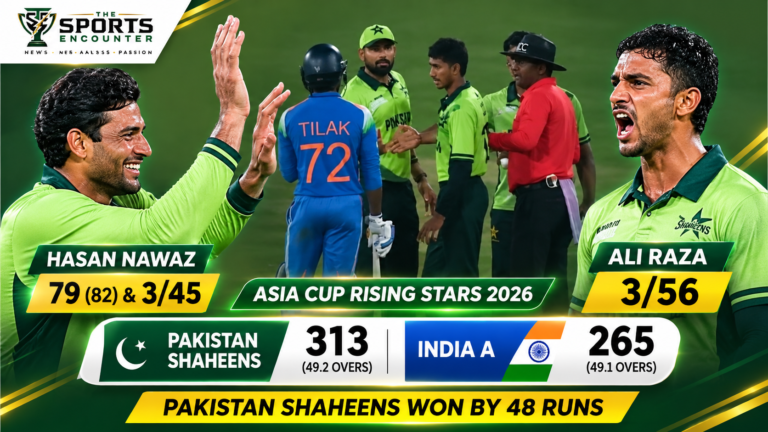
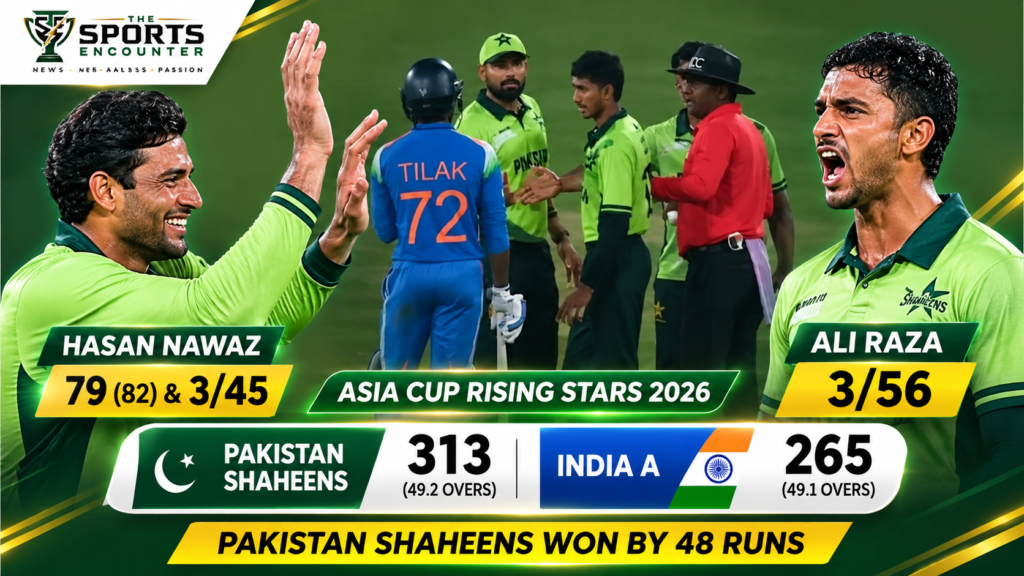
DOHA, Qatar, November 22, 2026: Pakistan Shaheens defeated India A by 48 runs in a fiercely contested ACC Men’s Asia Cup Rising Stars encounter at West End Park International Cricket Stadium, with Hasan Nawaz delivering a match-winning all-round performance and captain Abdul Samad producing a decisive tactical intervention. India appeared capable of chasing 314 while Abhishek Sharma was attacking Pakistan’s bowling, but his dismissal for 70 triggered a middle-order collapse that the visitors never fully overcame. Hasan scored 79 and claimed 3/45, while Ali Raza took 3/56 as Pakistan dismissed India for 265 in 49.1 overs.
The Pakistan A vs India A contest also featured heated exchanges between players, particularly Indian fast bowler Harshit Rana and Pakistan’s opening batters. Abhishek’s explosive 70 from 42 deliveries initially threatened Pakistan’s total of 313, but Samad’s decision to introduce Hasan Nawaz changed the direction of the innings. India captain Tilak Varma scored 100 from 149 balls, and Shahbaz Ahmed contributed 56 from 49, yet their efforts could not overcome the damage caused by the earlier collapse. Pakistan’s second consecutive tournament victory strengthened their position in Group B and reinforced their credentials as defending champions.
Key Takeaways
- The Pakistan A vs India A contest also featured heated exchanges between players, particularly Indian fast bowler Harshit Rana and Pakistan’s opening batters.
- Pakistan entered the contest after defeating the United Arab Emirates by 61 runs in their opening Group B match.
- India captain Tilak Varma scored 100 from 149 deliveries.
- Pakistan entered the competition as defending champions after winning the 2025 Rising Stars tournament against Bangladesh A in a Super Over.
Pakistan A vs India A: Scorecard, Result and Key Performances
| Match detail | Information |
|---|---|
| Tournament | ACC Men’s Asia Cup Rising Stars 2026 |
| Fixture | India A vs Pakistan Shaheens, Group B |
| Date | November 22, 2026 |
| Venue | West End Park International Cricket Stadium, Doha |
| Toss | Pakistan won and elected to bat |
| Pakistan Shaheens | 313 all out, 49.2 overs |
| India A | 265 all out, 49.1 overs |
| Result | Pakistan won by 48 runs |
| Player of the Match | Hasan Nawaz |
| Leading Pakistan batter | Hasan Nawaz, 79 |
| Leading India batter | Tilak Varma, 100 |
| Best Pakistan bowling | Hasan Nawaz, 3/45 |
| Other leading bowler | Ali Raza, 3/56 |
| Most aggressive India innings | Abhishek Sharma, 70 off 42 |
Pakistan entered the contest after defeating the United Arab Emirates by 61 runs in their opening Group B match.
Story at a glance
Pakistan A vs India A: Scorecard, Result and Key Performances
Pakistan entered the contest after defeating the United Arab Emirates by 61 runs in their opening Group B match.
Hasan Nawaz’s 79 Gives Pakistan the Foundation for 313
Hasan Nawaz was Pakistan’s outstanding batter.
Shamyl Hussain and Maaz Sadaqat Put India’s New-Ball Bowlers Under Pressure
Pakistan made an aggressive start through Shamyl Hussain and Maaz Sadaqat.
Farhan Yousaf’s 56 and Imran Randhawa’s Late Hitting Lift Pakistan Beyond 300
Farhan Yousaf supplied the acceleration Pakistan needed during the closing overs.
Harshit Rana’s Heated Exchanges Add Another Dimension to the Rivalry
The contest featured several confrontational moments during Pakistan’s innings.
India had made an equally impressive start, crushing Nepal by 306 runs.
Both sides therefore arrived with confidence, but Pakistan demonstrated greater consistency across their batting and bowling departments.
The result also gave the Shaheens another important victory over India A at a tournament where they are attempting to retain their continental title.
Hasan Nawaz’s 79 Gives Pakistan the Foundation for 313
Hasan Nawaz was Pakistan’s outstanding batter.
He scored 79 from 82 deliveries, including five fours and four sixes.
His innings began at a difficult stage after Pakistan lost Rohail Nazir for a duck with the score on 67.
Although the opening pair had provided a rapid start, India had taken two wickets within eight deliveries and were threatening to regain control.
Hasan responded by building a 54-run partnership with Maaz Sadaqat.
The pair advanced Pakistan to 121/3 before Maaz departed for 59.
Hasan then established a productive partnership with captain Abdul Samad.
Their fourth-wicket stand added 65 runs, taking Pakistan to 186/4.
Samad contributed 28 from 35 balls before being run out.
The partnership helped Pakistan recover from the early breakthroughs while maintaining a scoring rate capable of producing a competitive total.
Hasan reached his half-century in 44 deliveries and continued batting through the middle overs.
He eventually fell to Suryansh Shedge for 79, caught by Ayush Badoni.
Pakistan were 230/5.
The dismissal prevented Hasan from converting his innings into a century, but the platform he had created allowed the lower order to push the total beyond 300.
Hasan Nawaz’s Match-Winning All-Round Figures
| Statistic | Performance |
|---|---|
| Batting | 79 from 82 balls |
| Fours | 5 |
| Sixes | 4 |
| Batting strike rate | 96.34 |
| Bowling | 10 overs |
| Runs conceded | 45 |
| Wickets | 3 |
| Economy rate | 4.50 |
| Batting partnership with Maaz | 54 |
| Batting partnership with Samad | 65 |
| Key bowling victim | Abhishek Sharma |
| Official award | Player of the Match |
Hasan’s contribution extended far beyond the runs he scored.
His bowling during India’s chase would eventually become the single most important factor in Pakistan’s victory.
Shamyl Hussain and Maaz Sadaqat Put India’s New-Ball Bowlers Under Pressure
Pakistan made an aggressive start through Shamyl Hussain and Maaz Sadaqat.
Shamyl scored 33 from just 23 deliveries, striking four fours and two sixes.
His positive approach immediately challenged India’s seam attack.
Maaz played the more substantial innings, scoring 59 from 63 deliveries, including six fours and one six.
The opening pair added 66 runs in 7.5 overs.
That early scoring rate gave Pakistan a useful advantage.
However, India recovered through Ayush Badoni, who dismissed Shamyl, and Harshit Rana, who trapped Rohail Nazir lbw.
Pakistan were 67/2.
Maaz then adjusted his approach, rebuilding alongside Hasan before falling to Shedge.
His half-century ensured that Pakistan did not lose the momentum created by the opening partnership.
The innings also demonstrated that Pakistan possessed more than one reliable scoring option.
When the openers departed, Hasan took responsibility.
When Hasan eventually fell, Farhan Yousaf continued the recovery.
Farhan Yousaf’s 56 and Imran Randhawa’s Late Hitting Lift Pakistan Beyond 300
Farhan Yousaf supplied the acceleration Pakistan needed during the closing overs.
He scored 56 from 48 deliveries, striking four fours and two sixes.
His innings was especially valuable after Pakistan lost Hasan with the score on 230.
Farhan initially combined with Mohammad Imran Randhawa, who contributed 23 from only 14 balls.
Randhawa’s innings included two sixes and helped Pakistan maintain momentum.
Although wickets continued falling, Farhan remained aggressive.
He eventually departed for 56, caught behind off Prince Yadav.
Pakistan were all out for 313 in 49.2 overs.
The total reflected contributions from several positions.
Hasan scored 79, Maaz made 59 and Farhan contributed 56.
Shamyl added 33, Samad scored 28 and Randhawa supplied a valuable 23.
Pakistan’s ability to spread the scoring responsibility across the lineup became an important advantage over India, whose chase eventually depended heavily on three batters.
Harshit Rana’s Heated Exchanges Add Another Dimension to the Rivalry
The contest featured several confrontational moments during Pakistan’s innings.
Harshit Rana exchanged words with Shamyl Hussain and Maaz Sadaqat while attempting to disrupt their opening partnership.
His animated reactions and aggressive send-offs attracted considerable attention.
The confrontation was particularly noticeable because Pakistan’s openers were scoring freely.
Shamyl attacked the bowling from the beginning, forcing India to reconsider their approach.
Rana responded with verbal aggression and animated celebrations, including during the period when Pakistan lost two early wickets.
The exchanges contributed to the intensity expected whenever Pakistan and India meet, even at the A-team level.
However, a responsible assessment must distinguish visible confrontation from allegations about specific language.
The available match reporting establishes that heated exchanges occurred. It does not independently establish every word spoken or confirm a disciplinary finding.
Rana’s bowling also deserves examination separately from his behavior.
He took two wickets but conceded 77 runs from ten overs.
His wickets came through the dismissal of Rohail Nazir and Ahmed Daniyal.
The 7.70 economy rate illustrates how difficult India found it to contain Pakistan’s batting.
Aggression may create pressure, but the scoreboard ultimately provides the clearest measure of bowling effectiveness.
Abhishek Sharma’s Explosive 70 Threatens Pakistan’s Victory
India’s chase began with considerable attacking intent from Abhishek Sharma.
He scored 70 from only 42 deliveries, striking six sixes.
His strike rate of 166.67 made him the most dangerous batter in India’s lineup.
The target of 314 required a scoring rate of 6.28 runs per over.
Abhishek’s aggressive approach helped India stay competitive despite early wickets.
Vaibhav Sooryavanshi fell for 11 when Mohammad Imran Randhawa had him caught by Samad.
Ayush Badoni then fell for a duck, bowled by Ali Raza.
India were 26/2 after 4.3 overs.
Abhishek responded by attacking Pakistan’s bowling rather than retreating into a defensive approach.
He reached his half-century from 31 balls and continued targeting loose deliveries.
India advanced to 93/2.
At that stage, Abhishek’s scoring rate was keeping the chase alive despite Tilak Varma’s cautious start.
Pakistan needed to remove the attacking left-hander before he developed his innings into a potentially match-winning century.
Samad’s response became the defining tactical decision of the encounter.
Abdul Samad’s Masterstroke: Introducing Hasan Nawaz Against Abhishek Sharma
Pakistan captain Abdul Samad demonstrated important tactical judgment when he brought Hasan Nawaz into the bowling attack.
Abhishek was already established and scoring rapidly.
Pakistan’s specialist bowlers had removed two early batters but had not prevented him from attacking.
Hasan offered a different challenge through his off-spin.
The decision produced an immediate and decisive result.
Abhishek attempted to attack Hasan but was caught by Samad for 70.
India were 93/3 after 15.5 overs.
The wicket removed the batter who had been setting the pace of the chase.
Hasan’s introduction also forced India to reassess its batting approach.
Tilak Varma remained at the crease, but he had not matched Abhishek’s scoring rate.
With the aggressive opener gone, India needed another batter to establish momentum.
Instead, Pakistan continued taking wickets.
Pakistan A vs India A: How Hasan’s Spell Changed the Chase
| India score | Wicket | Bowler |
|---|---|---|
| 25/1 | Vaibhav Sooryavanshi, 11 | Mohammad Imran Randhawa |
| 26/2 | Ayush Badoni, 0 | Ali Raza |
| 93/3 | Abhishek Sharma, 70 | Hasan Nawaz |
| 102/4 | Kumar Kushagra, 2 | Sufyan Moqim |
| 115/5 | Rinku Singh, 6 | Hasan Nawaz |
| 129/6 | Suryansh Shedge, 3 | Hasan Nawaz |
After Abhishek departed, India lost another three wickets for only 36 runs.
The collapse exposed India’s middle order and shifted the responsibility toward Tilak and Shahbaz Ahmed.
Hasan eventually finished with 3/45 from ten overs.
His three wickets were Abhishek, Rinku Singh and Suryansh Shedge.
The performance validated Samad’s decision to use an additional bowling option at a crucial stage.
Ali Raza’s 3/56 Confirms His Importance to Pakistan’s Bowling Attack
Ali Raza delivered another outstanding spell for Pakistan Shaheens.
The young fast bowler finished with 3/56 from ten overs.
His first wicket came early when he bowled Ayush Badoni for a duck.
India were 26/2.
Although Abhishek subsequently attacked, Ali’s early contribution prevented India from establishing a secure opening platform.
His greatest influence came later in the innings.
Shahbaz Ahmed and Tilak Varma had rebuilt India’s chase through a substantial seventh-wicket partnership.
Their stand added 112 runs, taking India from 129/6 to 241/7.
With both batters established, Pakistan needed another breakthrough.
Ali provided it.
He dismissed Shahbaz for 56, with Hasan taking the catch.
The wicket removed India’s most aggressive remaining batter and left the lower order facing a difficult equation.
Ali then bowled Vipraj Nigam for a first-ball duck.
India lost two wickets without adding a run.
That burst effectively settled the contest.
Ali’s performance also carried significance beyond this match.
He had taken three wickets against the UAE in Pakistan’s tournament opener.
His six wickets across the first two matches highlighted his ability to influence games against different batting combinations.
The challenge now is to sustain that effectiveness through the knockout stage.
Tilak Varma’s 100: Valuable Resistance, but Was the Approach Too Cautious?
India captain Tilak Varma scored 100 from 149 deliveries.
His innings included seven fours and one six.
He remained at the crease for almost the entire chase, but his strike rate of 67.11 created an important tactical question.
Could India afford such a cautious innings while chasing 314?
The required scoring rate at the beginning was 6.28 runs per over.
Tilak’s personal scoring rate was approximately 4.03 runs per over.
The difference became especially important during his partnership with Abhishek.
Abhishek scored 57 runs in their 67-run stand.
Tilak contributed only eight.
That imbalance placed substantial responsibility on Abhishek to keep the required rate under control.
When Hasan dismissed him, India lost its most aggressive batter.
Tilak remained, but the scoring burden now had to be shared by a middle order that was struggling against Pakistan’s attack.
Kumar Kushagra scored two.
Rinku Singh made six.
Suryansh Shedge contributed three.
India were 129/6.
Tilak’s innings therefore developed into a difficult attempt to balance survival and scoring.
His hundred demonstrated concentration and resistance, but the rate of accumulation was insufficient to sustain a serious chase without substantial assistance.
Tilak Varma’s Century in Context
| Measure | Figure |
|---|---|
| Runs | 100 |
| Balls faced | 149 |
| Strike rate | 67.11 |
| Fours | 7 |
| Sixes | 1 |
| Initial required scoring rate | 6.28 per over |
| Runs from his third-wicket partner, Abhishek | 57 |
| His contribution to that stand | 8 |
| Result | India lost by 48 runs |
Calling the innings deliberately selfish would require evidence of the batter’s intentions.
The scorecard supports a more useful conclusion.
Tilak’s innings lacked the scoring urgency required for a chase of this size, particularly while Abhishek was attacking so successfully.
However, India’s wider batting failures also contributed heavily.
Five specialist or middle-order batters failed to reach double figures.
A captain cannot finish such a chase alone, but he must also manage the required scoring rate while attempting to preserve wickets.
Tilak’s performance exposed the difficulty of that balance.
Did Tilak’s Slow Scoring Make India’s Task Harder?
The figures suggest it did.
A batter scoring 100 from 149 deliveries occupies almost half of a 50-over innings.
That level of occupation can be valuable when chasing a modest target or recovering from severe early damage.
However, India required 314.
The batting side needed sustained scoring contributions through the innings.
Abhishek delivered that aggression.
Shahbaz provided another attacking contribution later.
Tilak’s comparatively slow accumulation meant the other batters had to compensate.
The collapse to 129/6 made that task increasingly difficult.
His century should therefore be evaluated as determined resistance that was not sufficiently productive in the circumstances, rather than as proof of an intention to prioritize a personal milestone.
Shahbaz Ahmed’s 56 Gives India One Last Opportunity
Shahbaz Ahmed produced India’s most important supporting innings.
He scored 56 from 49 deliveries, striking one four and four sixes.
His strike rate of 114.29 provided the urgency that India’s chase had been missing.
Shahbaz joined Tilak at 129/6.
The pair added 112 runs for the seventh wicket.
Their partnership carried India to 241/6 and temporarily revived hopes of a late recovery.
Shahbaz’s hitting was especially important because the required scoring rate had climbed substantially.
He attacked scoring opportunities while Tilak continued anchoring the innings.
However, Ali Raza removed Shahbaz for 56, with Hasan completing the catch.
India were 241/7.
Vipraj Nigam fell immediately afterward without scoring.
Harshit Rana then departed for a duck.
India slipped to 244/9.
The lower order could not provide the same level of support that Shahbaz had offered.
Tilak eventually reached his century, but Ahmed Daniyal removed him for 100, with Rohail Nazir taking the catch.
India were all out for 265.
Pakistan had completed the 48-run victory.
Continue the Cricket Story



Pakistan’s Bowling Depth Makes the Difference
Pakistan’s attack demonstrated greater balance and flexibility than India’s batting lineup.
Hasan and Ali shared six wickets.
Imran Randhawa removed Sooryavanshi and Rana.
Sufyan Moqim dismissed Kushagra.
Daniyal completed the innings by removing Tilak.
The result reflected Pakistan’s ability to find breakthroughs from several bowlers.
That depth gave captain Samad different tactical options.
He could use pace to attack early.
He could introduce spin through Hasan when Abhishek was threatening.
He could return to Ali when Shahbaz and Tilak began rebuilding.
Those decisions helped prevent India from establishing sustained control.
Pakistan also maintained pressure between wickets.
India scored only 36 runs while losing three wickets after Abhishek’s dismissal.
The resulting collapse placed the chase under considerable strain.
Five Turning Points That Decided the Match
1. Pakistan’s Openers Add 66
Shamyl and Maaz attacked India’s new-ball bowlers and gave Pakistan a rapid start.
The partnership reduced pressure on the middle order.
2. Hasan and Samad Add 65
After Pakistan lost three wickets, Hasan and Samad stabilized the innings.
Their stand helped create the platform for a total above 300.
3. Abhishek Falls for 70
Samad’s decision to bring Hasan into the attack removed India’s most dangerous batter.
The dismissal shifted the match’s momentum.
4. India Collapse to 129/6
Kushagra, Rinku and Shedge departed cheaply.
The collapse left Tilak and Shahbaz responsible for an increasingly difficult chase.
5. Ali Removes Shahbaz and Nigam
The dismissal of Shahbaz ended India’s final substantial partnership.
Ali’s next wicket effectively eliminated any realistic chance of an extraordinary recovery.
Pakistan Shaheens Strengthen Their Asia Cup Rising Stars Title Defense
Pakistan entered the competition as defending champions after winning the 2025 Rising Stars tournament against Bangladesh A in a Super Over.
They had also won the 2023 Emerging Teams Asia Cup in the 50-over format.
The squad for the 2026 tournament combines emerging talent with players who have already experienced senior international cricket.
Hasan’s all-round performance demonstrates the value of that experience.
Maaz and Farhan provided essential batting support.
Ali continued developing as an important fast-bowling prospect.
Samad showed that he can adjust his bowling resources to match the opposition’s strengths.
The victory gave Pakistan two wins from two Group B matches.
India, meanwhile, suffered their first defeat after an emphatic opening victory over Nepal.
Pakistan’s remaining group fixture is against Nepal, while India face the UAE.
Both sides still have an opportunity to advance, but Pakistan now possess the stronger immediate position.
The result also provides useful evidence for Pakistan’s selectors.
Hasan has shown he can influence matches through batting and bowling.
Ali has demonstrated wicket-taking ability against different opponents.
The younger batters have contributed meaningful runs under pressure.
Those are encouraging signs for a team attempting to defend its continental championship.
Pakistan Win the Cricket Contest Behind the Verbal Exchanges
The match contained the emotion, confrontation and competitive edge that often accompany Pakistan-India cricket.
Rana’s confrontations with Pakistan’s opening batters added intensity.
Abhishek’s six sixes temporarily put Pakistan under pressure.
Hasan’s introduction changed the chase.
Ali’s wickets ended India’s final substantial recovery.
The difference between the teams ultimately came from execution.
Pakistan received three half-centuries and several useful lower-order contributions.
India relied heavily on Abhishek, Tilak and Shahbaz.
Pakistan found wickets whenever India threatened to establish momentum.
India’s bowlers failed to prevent Pakistan from reaching 313 despite taking all ten wickets.
The contest also showed why successful ODI teams need more than one approach.
Pakistan combined early aggression with middle-order rebuilding and late acceleration.
Its bowlers combined attacking pace with spin and controlled pressure.
India demonstrated considerable individual talent, but its batting lineup could not produce the partnerships and scoring continuity needed for the chase.
Pakistan A vs India A ended with the Shaheens winning by 48 runs, but the performance carried greater significance than the margin alone. Hasan Nawaz produced a match-winning all-round display, Ali Raza delivered another three-wicket spell, and Abdul Samad’s tactical judgment helped Pakistan overcome the most dangerous phase of India’s chase.
For the defending champions, the result provided another important step toward the knockout stage. For India, it exposed questions about batting tempo, middle-order stability and the ability to maintain momentum after losing an aggressive top-order player.
Hasan Nawaz
- Pakistan A Beat India A by 48 Runs as Hasan Nawaz Delivers All-Round Masterclass in Heated Asia Cup Clash
- Arafat Minhas Announces Arrival on the International Stage as Pakistan Destroy England in Tri-Nation Series
- Hasan Nawaz Fights Alone as India Punish Pakistan’s Chaos to Win Asian Games Cricket Gold
- Rahkeem Cornwall Wrecks TKR Powerplay as Falcons Win CPL 2026 Thriller by 8 Runs
- CPL 2026: Shadab Khan, Moeen Ali Power Falcons Past Patriots in Style