
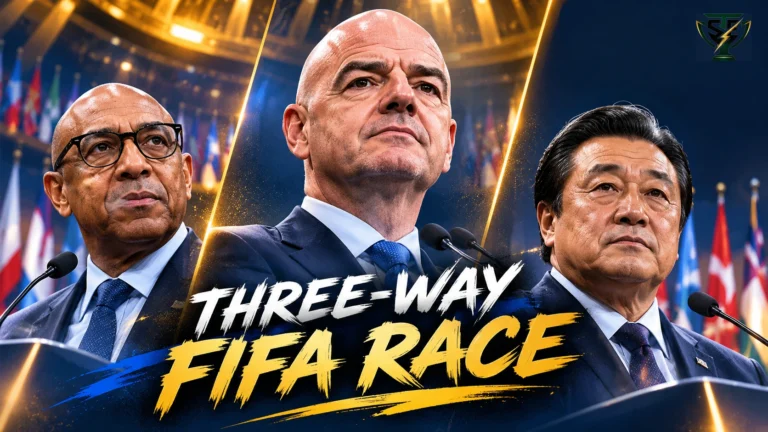
ZURICH, Switzerland, November 19, 2026: Gianni Infantino will face two challengers in his bid to extend his leadership of world soccer after FIFA officially named France’s Philippe Diallo and Japan’s Kohzo Tashima alongside the incumbent president. The three nominations establish the field for the March 18 vote in Rabat, Morocco, subject to the required eligibility checks, and create the first contested presidential race of Infantino’s tenure.
The FIFA presidential election now presents a question that goes beyond whether the Swiss-Italian administrator remains popular. Diallo has organized European opposition around demands for governance reform, while Tashima offers an Asian alternative despite his confederation’s leadership having endorsed Infantino. With 211 national associations entitled to vote, the result will depend on whether either challenger can build support beyond his established relationships and whether opposition votes eventually converge behind one candidate.
Key Takeaways
- Gianni Infantino will face two challengers in his bid to extend his leadership of world soccer after FIFA officially named France’s Philippe Diallo and Japan’s Kohzo Tashima alongside the incumbent president.
- FIFA announced Thursday that its general secretariat had received three candidacies following the call for an election issued by the FIFA Council on April 29.
- Member associations are scheduled to receive the list of formally admitted candidates no later than February 18, one month before the election at the 77th FIFA Congress.
- Infantino first became FIFA president in February 2016 following the governance crisis that ended Sepp Blatter’s leadership.
FIFA Presidential Election Confirms Three Candidates, but Not Yet Three Approved Names
FIFA announced Thursday that its general secretariat had received three candidacies following the call for an election issued by the FIFA Council on April 29.
Story at a glance
FIFA Presidential Election Confirms Three Candidates, but Not Yet Three Approved Names
FIFA announced Thursday that its general secretariat had received three candidacies following the call for an election issued by the FIFA Council on April 29.
Why Ramon Vega’s Absence Changes the Election
One of the most consequential details in FIFA’s announcement concerns a name missing from the list.
Infantino Remains the Candidate With the Broadest Established Network
Infantino first became FIFA president in February 2016 following the governance crisis that ended Sepp Blatter’s leadership.
Diallo Has European Backing, but Europe Cannot Elect Him Alone
Diallo’s candidacy represents the clearest organized attempt to replace Infantino.
Tashima Creates an Asian Challenge to Asia’s Own Leadership Position
Tashima’s entry is unusual because the Asian Football Confederation’s leadership has previously endorsed Infantino.
The nominations were submitted before Wednesday’s deadline and will now be examined under FIFA’s electoral and governance procedures.
The distinction between submitting a nomination and receiving final clearance matters. The federation has confirmed the names put forward, but the necessary eligibility and integrity assessments must still be completed.
Member associations are scheduled to receive the list of formally admitted candidates no later than February 18, one month before the election at the 77th FIFA Congress.
The official FIFA announcement identifies the three nominees in alphabetical order by surname.
FIFA Presidential Election Candidates and Their Political Positions
| Candidate | Football background | Political position | Main challenge |
|---|---|---|---|
| Gianni Infantino | FIFA president since 2016 | Incumbent with established global federation relationships | Defending his governance record after disputes over commercial rights |
| Philippe Diallo | President of the French Football Federation | Supported by European national associations represented on UEFA’s executive bodies | Building support outside Europe |
| Kohzo Tashima | Honorary president of the Japan Football Association and FIFA Council member | Independent challenger with extensive Asian football experience | Winning votes in a region whose confederation leadership backs Infantino |
The table describes the candidates’ present political positions, not confirmed voting commitments. Endorsements from football organizations and actual ballots cast by national associations are different things.
Why Ramon Vega’s Absence Changes the Election
One of the most consequential details in FIFA’s announcement concerns a name missing from the list.
Former Switzerland international and Tottenham Hotspur defender Ramon Vega had publicly expressed his intention to challenge Infantino.
He featured in earlier discussions about potential candidates and had been associated with demands for a different approach to FIFA leadership.
However, Vega was not among the three nominees announced after the submission deadline.
FIFA’s announcement does not establish why he was absent, and it would be premature to claim that he failed a particular requirement or withdrew for a specific reason without confirmation.
His absence nevertheless reduces the number of competing alternatives to the incumbent.
That matters because the composition of the field directly affects the first ballot, the possibility of an elimination round and the political choices available to associations seeking a change of leadership.
The Sports Encounter’s earlier analysis of UEFA’s support for Diallo examined a wider group of potential challengers before the nomination deadline.
FIFA’s latest announcement narrows those possibilities to a defined three-person contest, pending approval.
Infantino Remains the Candidate With the Broadest Established Network
Infantino first became FIFA president in February 2016 following the governance crisis that ended Sepp Blatter’s leadership.
He was subsequently re-elected in 2019 and 2023 without an opponent.
Over the following decade, he pursued a program involving expanded international competitions, greater development funding and stronger direct relationships with national federations.
His administration oversaw the expansion of the men’s World Cup to 48 teams, the introduction of a 32-team Club World Cup and changes to FIFA’s international competition structure.
Supporters view the expansion as a means of providing more countries with meaningful participation and access to resources. Critics question the resulting demands on players, the concentration of decision-making power and the transparency of major commercial decisions.
The strongest political advantage for Infantino is not simply his incumbency. It is his established relationship with national associations outside Europe’s traditional centers of influence.
Every FIFA member association has one vote, whether it represents a major soccer nation or a small country with limited professional infrastructure.
Development programs and access to international competitions can therefore carry substantial importance for federations evaluating presidential candidates.
The Sports Encounter previously examined these relationships in its report on the Asian Football Confederation’s endorsement of Infantino.
That endorsement came after tensions over FIFA’s proposed commercial arrangements, demonstrating that opposition to one policy does not necessarily translate into opposition to the president himself.
Diallo Has European Backing, but Europe Cannot Elect Him Alone
Diallo’s candidacy represents the clearest organized attempt to replace Infantino.
On November 16, UEFA announced that national associations represented on its Executive Committee and the FIFA Council had unanimously invited the French Football Federation president to stand and pledged their support.
The official UEFA statement confirms that decision.
That is a meaningful political endorsement. It should not, however, be misrepresented as proof that all 55 European associations have already committed their individual ballots.
Diallo has significant administrative experience. Before leading French soccer, he worked with professional club organizations, served in domestic league governance and participated in FIFA’s dispute-resolution structures.
He became president of the French Football Federation in 2023 and has since been involved in European soccer administration.
His political case emphasizes governance, institutional accountability and the importance of federation participation in decisions affecting the sport’s commercial future.
But even if every UEFA association eventually supported him, Europe alone could not deliver a majority of FIFA’s 211 votes.
That arithmetic is the fundamental challenge.
Diallo must convince associations in Africa, Asia, North and Central America, South America and Oceania that his proposed changes would deliver tangible benefits beyond Europe’s existing priorities.
Tashima Creates an Asian Challenge to Asia’s Own Leadership Position
Tashima’s entry is unusual because the Asian Football Confederation’s leadership has previously endorsed Infantino.
The former Japan Football Association president nevertheless submitted his candidacy after securing the necessary backing from national associations.
He brings experience from domestic administration and FIFA’s governing structures.
That background may help him present himself as an alternative who understands both the interests of national federations and the practical responsibilities of international governance.
However, Tashima cannot assume that an Asian candidacy will attract a unified Asian vote.
The confederation’s stated position and the decisions of its individual member associations may diverge, but the extent of any divergence has not been established.
The Sports Encounter explored this tension in its analysis of Tashima’s nomination and the divisions within Asian soccer.
The question now is whether he can translate his administrative experience into a coalition capable of challenging an incumbent with longstanding relationships across the same region.
The Voting Mathematics Make the First Ballot Especially Important
FIFA has 211 member associations, each entitled to one vote.
With more than two candidates contesting the presidency, the applicable rules require a two-thirds majority of the members present and eligible to vote in the first ballot.
If all 211 associations are present and eligible, that would mean at least 141 votes are needed for an immediate victory.
If no candidate reaches the necessary threshold, the election proceeds under the relevant rules for subsequent ballots, including elimination of the lowest-ranked candidate.
Once two candidates remain, a simple majority of valid votes determines the winner.
These thresholds depend on attendance, eligibility and valid ballots. The illustrative numbers below assume full participation and 211 valid votes.
| Election stage | Requirement | Illustrative winning threshold |
|---|---|---|
| First ballot with three candidates | Two-thirds of associations present and eligible | 141 of 211 |
| Subsequent ballot with two candidates | More than half of valid votes | 106 of 211 |
| Nomination stage | Support from at least five member associations | 5 endorsements to submit a candidacy |
TSE calculation: The thresholds of 141 and 106 are derived from the stated voting rules under an assumption of 211 eligible participating associations and 211 valid votes. These are illustrative calculations, not forecasts.
FIFA’s official legal documents library provides access to the Statutes and Governance Regulations governing presidential elections.
How the FIFA Presidential Election Could Be Decided on a Second Ballot
Consider an illustrative first-round result in which Infantino receives 100 votes, Diallo 65 and Tashima 46.
No candidate reaches the 141-vote threshold.
If the rules lead to Tashima’s elimination, the remaining contest becomes a direct choice between Infantino and Diallo.
In that situation, Diallo would need to gain at least 41 additional votes from the original distribution to reach 106, assuming all 211 votes remain valid and the original supporters stay with their preferred candidates.
That would require almost all of Tashima’s original supporters to move to Diallo.
But the transfer cannot be assumed. Some might prefer Infantino, and others could change their position for reasons unrelated to their initial choice.
The example demonstrates why a candidate’s first-round tally does not establish the outcome of a later ballot.
| Candidate | Illustrative first ballot | Result |
|---|---|---|
| Gianni Infantino | 100 | Below two-thirds threshold |
| Philippe Diallo | 65 | Advances if lowest candidate is eliminated |
| Kohzo Tashima | 46 | Lowest in this hypothetical scenario |
| Total | 211 | No first-ballot winner |
This is a mathematical illustration only. It does not represent polling data, confirmed endorsements or a prediction of how associations will vote.
The important conclusion is that two challengers do not automatically strengthen or weaken the opposition.
The effect depends on how many associations each attracts, whether either can force a subsequent ballot and what those associations decide if their first-choice candidate is eliminated.
The Failed World Cup Investment Proposal Remains the Central Governance Dispute
The political confrontation did not begin with the nomination deadline.
During 2026, Infantino faced criticism over a proposal involving FIFA’s commercial rights and a potential multibillion-dollar investment arrangement.
Opponents questioned the transparency of the process, the role of national associations and the potential consequences for the management of commercial revenues.
The proposal was ultimately withdrawn, but the dispute damaged relationships between FIFA’s leadership and several confederation officials.
TSE investigated the underlying issues in its analysis of the abandoned World Cup commercial proposal and the documents subsequently disclosed.
The controversy provides Diallo with a recognizable reform argument.
Yet the presidential campaign must address more than one abandoned proposal.
Associations will also consider future development funding, the economics of expanded tournaments, institutional representation and the relationship between FIFA and the confederations.
An opposition candidate who concentrates only on the original controversy may struggle to persuade federations that place greater importance on future resources and competitive opportunities.
Infantino’s Governance Record Contains Both Achievements and Unresolved Questions
Infantino’s presidency cannot be assessed solely through the disputes of the past year.
FIFA has expanded its competitions, increased the geographical reach of major tournaments and pursued reforms in areas including transfers and technology.
Supporters point to those changes as evidence that international soccer has become more inclusive and commercially powerful.
Critics question whether competition growth has been balanced against the interests of players, clubs and domestic leagues.
They also challenge the concentration of power around the presidency and the degree of consultation preceding significant decisions.
Infantino’s proposal for an independent governance review formed part of the response to mounting criticism.
The Sports Encounter examined that initiative in its report on the proposed external scrutiny of FIFA’s governance.
The election provides member associations with an opportunity to judge whether those commitments are sufficient or whether a change of leadership is necessary.
Neither conclusion can be inferred simply from the existence of challengers.
What Must Diallo and Tashima Prove Before Rabat?
The two challengers face related but distinct political tests.
Diallo needs to demonstrate that European concerns about FIFA governance also matter to federations elsewhere and that his proposed changes would preserve meaningful support for soccer development.
Tashima needs to build a coalition despite the Asian Football Confederation leadership’s declared support for Infantino.
Both must also explain how they would manage the relationship between national associations, confederations, major competitions and commercial partners.
Those responsibilities extend far beyond selecting World Cup hosts or presiding over the sport’s most prestigious events.
The president leads FIFA’s political direction while operating within a wider governance structure involving the Council, Congress and administration.
For smaller federations, reliable development assistance and access to competitions may be as important as questions of institutional reform.
For associations with large professional leagues, workload, scheduling and commercial decision-making may receive greater emphasis.
A successful challenger must communicate a program credible to both groups.
The Dates That Will Determine the Race
| Date | Development | Status |
|---|---|---|
| April 29, 2026 | FIFA Council issues election call | Completed |
| November 18, 2026 | Nomination deadline | Completed |
| November 19, 2026 | FIFA announces three submitted candidacies | Completed |
| By February 18, 2027 | Member associations notified of admitted candidates | Pending |
| March 18, 2027 | 77th FIFA Congress and presidential election in Rabat | Scheduled |
The next formal milestone is confirmation of candidate eligibility.
Between now and then, the most consequential political developments will concern support from associations outside the challengers’ immediate regional networks and whether the candidates articulate distinct, practical governing programs.
Why the Race Could Be Decided Before the Final Vote
The FIFA presidential election has become a genuine contest in the sense that Infantino now has two formally nominated challengers, subject to eligibility approval. That does not establish that his re-election is seriously threatened.
His advantages remain substantial: incumbency, established relationships across FIFA’s membership and a record of directing expanded competitions and development programs.
Diallo brings organized European opposition and a reform platform. Tashima offers another candidacy with experience inside Asian and international soccer administration.
Neither challenger can rely on his existing political base alone.
The decisive question may be whether their supporters can agree on a common alternative if the election moves beyond the first ballot.
That would require political choices by individual associations, not simply an agreement between candidates.
FIFA’s announcement has settled who submitted nominations. It has not settled who can command a majority.
In Rabat, the presidency will be decided by votes, but the outcome may depend on the alliances formed long before any ballot is cast.
