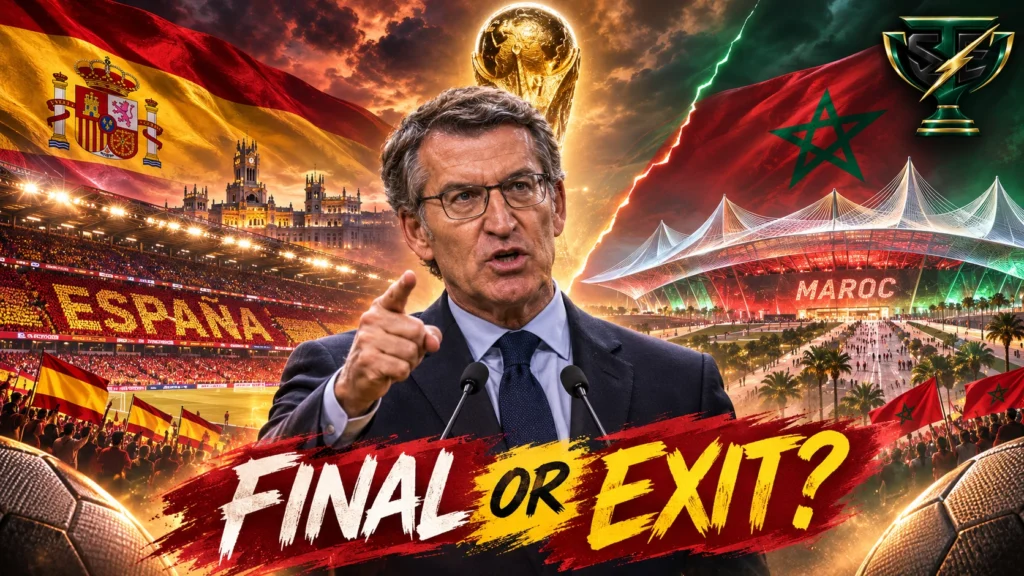
MADRID, Spain, November 6, 2026: Spain’s opposition leader Alberto Núñez Feijóo has threatened to pull the country out of organizing the 2030 FIFA World Cup if Morocco is awarded the final, turning a dispute over football’s biggest match into a political confrontation just weeks before Spain’s November 29 general election. The conservative People’s Party leader said Spain should refuse to continue as a co-host unless the championship match is staged on Spanish soil, challenging the foundations of a tournament that FIFA awarded jointly to Spain, Morocco and Portugal in December 2024.
The ultimatum comes while FIFA is inspecting prospective host cities and has yet to decide whether the final will take place at Real Madrid’s Santiago Bernabéu, Barcelona’s Camp Nou or Morocco’s proposed 115,000-seat Grand Stade Hassan II near Casablanca. Spanish Prime Minister Pedro Sánchez and national team coach Luis de la Fuente have also backed Spain’s claim, while Moroccan football federation president Fouzi Lekjaa has publicly predicted a Casablanca final. Yet the Spanish football federation has previously opposed any withdrawal, citing binding hosting commitments. The dispute now raises a question that goes well beyond stadium prestige: could political pressure disrupt a World Cup designed to unite three continents for football’s centenary?
Has Spain Threatened to Withdraw From the 2030 FIFA World Cup?
Yes, but the threat comes from opposition leader Alberto Núñez Feijóo, not from an official decision by the Spanish government or the Royal Spanish Football Federation (RFEF).
Speaking on Spanish television program El Chiringuito on Thursday, November 5, Feijóo insisted that Spain should host the tournament’s final.
Story at a glance
Has Spain Threatened to Withdraw From the 2030 FIFA World Cup?
Yes, but the threat comes from opposition leader Alberto Núñez Feijóo, not from an official decision by the Spanish government or the Royal Spanish Football Federation (RFEF).
Why Does Alberto Núñez Feijóo Want the World Cup Final in Spain?
Feijóo’s argument combines sporting history, national prestige and political leverage.
Who Will Decide the Venue for the 2030 World Cup Final?
FIFA retains responsibility for deciding the final venue through its tournament organization and stadium selection procedures.
Spain vs Morocco: Which Stadiums Are Competing for the 2030 World Cup Final?
Three venues emerged as potential final hosts in FIFA’s original 2030 bid assessment.
What Did the Original 2030 World Cup Bid Promise?
Morocco, Portugal and Spain presented a joint hosting proposal that distributed stadiums across all three countries.
He argued that the country’s football history, infrastructure and capacity to organize major international events made it the appropriate choice.
When asked whether he would support withdrawing Spain from the 2030 World Cup organization if Morocco received the final and he became prime minister, Feijóo answered yes.
His position was reinforced by a subsequent social media statement emphasizing national pride and Spain’s standing in world football.
The timing gives the remarks additional importance. Spain is preparing for an early general election on November 29, with Feijóo seeking to replace Prime Minister Pedro Sánchez.
However, campaign statements and formal hosting decisions are different matters.
Spain remains one of the three principal organizers. FIFA has not announced a change to that arrangement, and no withdrawal process has been confirmed.
| Issue | Current Status | What Remains Unresolved |
|---|---|---|
| Spain’s hosting status | Official FIFA co-host | Whether future political pressure could affect participation |
| Morocco’s hosting status | Official FIFA co-host | Which major matches its stadiums will receive |
| Portugal’s hosting status | Official FIFA co-host | Final distribution of matches |
| 2030 World Cup final | Venue not selected | Which stadium FIFA will choose |
| Feijóo’s proposal | Conditional withdrawal position | Whether it could become government policy |
| Spanish federation | Previously opposed withdrawal | How it would respond to any future government initiative |
| FIFA venue assessments | Inspection process underway | Final venue approval and match allocation |
| Spanish general election | Scheduled for November 29, 2026 | Next government’s composition and policies |
The distinction is essential. A prominent politician has threatened a future withdrawal, but the country has not withdrawn from the tournament.
Why Does Alberto Núñez Feijóo Want the World Cup Final in Spain?
Feijóo’s argument combines sporting history, national prestige and political leverage.
Spain has an established record of organizing major football competitions. It hosted the 1982 men’s World Cup, while Spanish clubs regularly stage high-profile European matches in some of the world’s best-known stadiums.
The country also enters the 2030 planning period with the status of reigning men’s and women’s world champions, a point repeatedly emphasized by Spanish officials in their public case for hosting the final.
Feijóo believes those achievements strengthen Spain’s claim to the biggest match of the centenary tournament.
His intervention goes further than the preference expressed by other Spanish football figures because it attaches a potential withdrawal to FIFA’s eventual decision.
That makes the statement politically consequential, even though its practical implementation remains uncertain.
Spain’s national team coach Luis de la Fuente has also publicly endorsed holding the final in Spain.
The Sports Encounter has closely followed De la Fuente’s long-term relationship with Spain’s national team and the 2030 World Cup, including the importance of continuity as the country prepares to co-host the tournament.
But supporting a Spanish final is different from endorsing withdrawal if another country is chosen.
Who Will Decide the Venue for the 2030 World Cup Final?
FIFA retains responsibility for deciding the final venue through its tournament organization and stadium selection procedures.
The competition was awarded jointly to Spain, Morocco and Portugal following a bidding process supported by the relevant continental confederations.
The successful joint bid did not guarantee that any particular country would stage the final.
FIFA has repeatedly said that the venue remains undecided.
Its evaluation process considers stadium infrastructure, operational capacity, accessibility, accommodation, transport, broadcasting requirements and other hosting obligations.
Those considerations are especially important for a World Cup final, which brings significant international media, security, logistical and spectator demands.
The official FIFA World Cup 2030 organization portal provides the tournament’s hosting framework and supporting bid documents.
FIFA’s ongoing inspections will contribute to venue assessments, but a visit does not guarantee approval for a specific match.
Spain vs Morocco: Which Stadiums Are Competing for the 2030 World Cup Final?
Three venues emerged as potential final hosts in FIFA’s original 2030 bid assessment.
Spain put forward the Santiago Bernabéu in Madrid and Camp Nou in Barcelona.
Morocco proposed the Grand Stade Hassan II in the Benslimane area near Casablanca, a stadium designed to accommodate approximately 115,000 spectators.
Each venue offers a different argument.
Santiago Bernabéu: Spain’s Established International Showcase
Real Madrid’s renovated Santiago Bernabéu provides a compelling case built around existing infrastructure, global recognition and experience hosting important football events.
Madrid also offers major transport connections, extensive accommodation capacity and a developed international events sector.
However, FIFA’s final assessment must extend beyond reputation to the specific requirements of staging the World Cup’s championship match.
Camp Nou: Barcelona’s High-Capacity Alternative
Barcelona’s Camp Nou offers another prominent Spanish option, with its redevelopment designed to significantly increase capacity and modernize spectator facilities.
Its suitability for the final will depend on the completed stadium’s facilities, operational readiness and FIFA’s assessment at the relevant stage.
A proposed or projected capacity should not be mistaken for a certified capacity available for tournament use.
Grand Stade Hassan II: Morocco’s 115,000-Seat Statement
Morocco’s strongest argument concerns the scale of the Grand Stade Hassan II project.
The venue is planned to hold approximately 115,000 spectators, potentially making it one of the world’s largest football stadiums.
That scale is attractive for a World Cup final, but capacity alone cannot determine the host.
Construction progress, transport access, accommodation, crowd management, broadcasting infrastructure and operational readiness will also matter.
| Stadium | Location | Host Nation | Principal Advantage | Important Consideration |
|---|---|---|---|---|
| Santiago Bernabéu | Madrid | Spain | Established stadium and international event experience | FIFA-specific final requirements |
| Camp Nou | Barcelona | Spain | Large-capacity redevelopment and global recognition | Redevelopment and certified readiness |
| Grand Stade Hassan II | Benslimane, near Casablanca | Morocco | Approximately 115,000 planned seats | Construction completion and operational testing |
TSE comparison: Spain’s bid offers two original final candidates with established football identities, while Morocco’s leading contender is a purpose-built stadium of exceptional planned capacity.
The comparison does not establish which venue FIFA should select. It demonstrates why stadium size and proven operational experience are both relevant, but neither is sufficient on its own.
What Did the Original 2030 World Cup Bid Promise?
Morocco, Portugal and Spain presented a joint hosting proposal that distributed stadiums across all three countries.
The 2024 bid listed 20 proposed venues in 17 host cities.
Spain accounted for 11 stadiums, Morocco six and Portugal three.
That original allocation provides useful context for the present disagreement.
Spain was assigned the largest share of stadiums, but a larger number of venues was never a guarantee of hosting the final.
| Country | Proposed Stadiums | Share of Original 20-Stadium Bid | Hosting Role |
|---|---|---|---|
| Spain | 11 | 55% | Principal co-host |
| Morocco | 6 | 30% | Principal co-host |
| Portugal | 3 | 15% | Principal co-host |
| Total | 20 | 100% | Three principal hosts |
TSE statistical finding: Spain supplied 55% of the proposed stadiums in the original bid, nearly twice Morocco’s 30% share. That helps explain why Spanish officials regard their country’s organizational contribution as substantial.
However, the figures describe stadium distribution rather than an agreed allocation of World Cup matches, revenue or final-hosting rights.
The original stadium list is also subject to subsequent changes and FIFA’s final validation.
The Spanish football federation’s official stadium announcement records the original 11 Spanish selections and the considerations behind them.
Could Spain Really Withdraw From Hosting the 2030 World Cup?
A political leader can advocate withdrawal, but the practical process would be considerably more complicated than announcing a change of policy.
Spain is part of a formally awarded joint tournament involving multiple national football associations, governments, cities and commercial partners.
Hosting arrangements involve substantial commitments covering stadiums, infrastructure, security, transport, accommodation and tournament operations.
A future Spanish government seeking to reverse participation would therefore face questions about existing agreements and the responsibilities held by the RFEF and other organizations.
The exact legal consequences cannot be established from Feijóo’s public statement alone.
Claims that Spain could simply withdraw without financial or contractual consequences would require evidence from the relevant agreements.
Likewise, predictions of specific penalties or compensation payments would be speculative without access to the governing contractual provisions.
RFEF president Rafael Louzán previously emphasized that Spain had signed agreements with FIFA and its organizing partners.
He also rejected the idea of abandoning the tournament merely because the final might be played outside Spain.
That creates an important distinction between political rhetoric and the position previously expressed by the country’s football governing body.
What Would Happen if Spain Tried to Leave the 2030 World Cup?
No official contingency plan for a Spanish withdrawal has been announced.
Nevertheless, the scale of the original bid allows several practical consequences to be identified.
Spain accounted for more than half the stadiums in the initial joint proposal. Removing those venues would require a major reassessment of the remaining infrastructure and match distribution.
Portugal and Morocco would face additional organizational questions if expected Spanish venues became unavailable.
FIFA would also need to consider contractual, financial, scheduling and operational implications before deciding how any changed arrangement could proceed.
| Scenario | Immediate Question | Potential Consequence |
|---|---|---|
| Spain remains a co-host; Spain gets the final | Which Spanish venue is selected? | Existing joint-hosting structure continues |
| Spain remains a co-host; Morocco gets the final | How are the remaining matches distributed? | Spain could still stage numerous important games |
| A future government proposes withdrawal | What do the signed hosting agreements permit? | Legal and organizational negotiations may follow |
| Spain formally seeks to leave | How would FIFA address the proposed change? | Venue and competition planning could require revision |
| Existing Spanish venues become unavailable | Can replacement venues meet requirements? | Infrastructure, transport and scheduling complications |
None of these scenarios should be presented as an established FIFA decision.
The essential point is that Spain’s importance to the original bid gives the withdrawal threat considerable political weight, but also makes actual withdrawal potentially disruptive for Spain itself.
Morocco’s World Cup Final Ambition Has Already Created Diplomatic Tension
The November controversy did not begin with Feijóo.
In September, Fouzi Lekjaa, president of the Royal Moroccan Football Federation, publicly predicted that Casablanca would host the 2030 final.
His comments generated criticism because FIFA had not made that decision.
Moroccan Prime Minister Aziz Akhannouch subsequently indicated that the matter had not been formally discussed with Spain and Portugal in the way Lekjaa’s remarks might have suggested.
Spain’s football federation president Rafael Louzán also rejected any suggestion that Morocco had already secured the final.
Both countries nevertheless continue to press their claims.
From Morocco’s perspective, staging the final would be a major symbolic achievement for African football.
Morocco became the first African nation to reach a men’s World Cup semifinal in 2022. Hosting the final eight years later would represent another significant milestone.
The Sports Encounter has followed Morocco’s growing football ambitions, including its dramatic penalty-shootout victory during the 2026 World Cup knockout rounds.
Those sporting achievements help explain Morocco’s ambition, but they do not establish a contractual right to stage the 2030 championship match.
The 2030 World Cup Was Designed to Unite Six Countries Across Three Continents
The centenary tournament has an unusual geographical structure.
Spain, Portugal and Morocco will serve as the three principal hosts.
Argentina, Paraguay and Uruguay will each stage one centenary celebration match to commemorate the inaugural World Cup held in Uruguay in 1930.
The three South American fixtures reflect the tournament’s historical origins.
The remaining competition is organized around the principal European and African co-hosts.
FIFA’s published framework assigns 101 matches to the main hosting arrangement, with three additional centenary matches in South America.
| Country | Continent | Official Hosting Role |
|---|---|---|
| Spain | Europe | Principal tournament co-host |
| Portugal | Europe | Principal tournament co-host |
| Morocco | Africa | Principal tournament co-host |
| Argentina | South America | One centenary celebration match |
| Paraguay | South America | One centenary celebration match |
| Uruguay | South America | One centenary celebration match, honoring the 1930 host |
The geographical scale is an important part of FIFA’s original vision.
It also creates organizational complexity, making cooperation among the host countries important long before the first match is played.
For comparison, The Sports Encounter has examined the wider governance implications of international tournament changes in its analysis of FIFA’s proposed 64-team expansion for the 2030 World Cup.
That separate proposal raises questions about competition structure and scheduling, whereas the present dispute concerns the location of the final within the existing hosting framework.
What Is Portugal’s Position in the Spain-Morocco World Cup Final Dispute?
Portugal is the third principal co-host, but most of the public debate over the final has concentrated on Spain and Morocco.
The Portuguese federation participated in the joint bid, which originally included three Portuguese stadiums.
Portugal’s role remains important because the tournament depends on coordinated planning across all three host countries.
Any future proposal to alter Spain’s participation would have implications for Portugal, even if Portugal were not the country selected for the final.
Portugal’s footballing status is also substantial in its own right.
The country has developed a consistent international record and remains among the stronger European national teams.
TSE recently examined Portugal’s rise to fifth in the FIFA world rankings, an illustration of the country’s competitive standing as preparations continue for future major tournaments.
That sporting reputation does not automatically determine hosting decisions, but Portugal should not disappear from discussions about a tournament it is helping organize.
Why the Spanish General Election Makes the World Cup Dispute More Sensitive
Spain’s November 29 general election has introduced a political timetable into what would otherwise be a technical and sporting venue-selection process.
Feijóo leads the conservative People’s Party and is attempting to replace Socialist Prime Minister Pedro Sánchez.
Sánchez has also advocated holding the World Cup final in Spain.
The disagreement therefore concerns more than whether Spain should seek the final. It concerns how far a future government might be prepared to go if FIFA chooses Morocco.
Feijóo’s conditional threat represents a harder position than a preference for a Spanish venue.
However, electoral campaigning does not itself alter international hosting agreements.
Whether the issue becomes an actual government policy will depend on the election outcome, subsequent decisions and negotiations involving the relevant football authorities.
Spain’s sporting leadership has also emphasized long-term preparation for 2030.
The Sports Encounter previously covered Spain extending Luis de la Fuente’s contract through 2032, reinforcing the country’s ambition to maintain continuity across the next World Cup cycle.
FIFA’s Governance Challenges Add Another Layer to the Controversy
The final-venue dispute comes during a period when FIFA’s governance and commercial decisions have attracted increased scrutiny.
Disagreements involving international football investment, national associations and competition planning have raised broader questions about how FIFA makes decisions that affect multiple stakeholders.
These disputes are separate from the 2030 final selection, and there is no verified evidence that they determine which stadium will receive the match.
Continue the Soccer Story
 FA CupFA Cup: Bristol Rovers Stun Cambridge 2-0 as Leicester Survive Oxford City’s Fightback in Six-Goal Thriller
 Saudi Pro LeagueSaudi Pro League Postpones Matchweek 13: Ronaldo’s 1,000-Goal Chase Paused as Asian Cup Delay Forces Calendar Overhaul
 Serie AKike Pérez Fires Veanezia Off Serie A Bottom as Udinese’s Zanetti Era Begins With 2-1 Defeat
Still, the wider governance environment provides useful context for why a transparent venue-selection process matters.
The Sports Encounter has examined several relevant developments, including FIFA’s release of documents concerning its abandoned World Cup commercial proposal.
Earlier coverage explored Gianni Infantino’s apology during a FIFA Council dispute and the wider disagreements between FIFA and UEFA representatives.
Those events underline the importance of institutional confidence without proving wrongdoing in the 2030 World Cup venue-selection process.
Publicly documented selection criteria and consistent explanations would help distinguish technical judgments from competing political claims.
What Happens Next in the 2030 World Cup Stadium Selection?
FIFA has begun visiting prospective tournament host cities in Spain, Morocco and Portugal.
The visits are scheduled across November and December 2026.
They are intended to assess the suitability of candidate locations and stadium infrastructure.
That process comes before the final confirmation of the complete venue list and distribution of matches.
The next meaningful developments to watch are therefore official FIFA inspection updates, decisions affecting the approved stadium list and any formal announcement concerning the final.
Spain’s election later this month could also influence the political debate, but it will not automatically decide the stadium allocation.
Could FIFA Still Award the 2030 World Cup Final to Morocco?
Yes. Morocco remains a candidate for the final, and FIFA has not awarded the match to Spain.
The Grand Stade Hassan II is central to Morocco’s bid.
Its planned capacity gives it an advantage in terms of potential spectator numbers, while Madrid and Barcelona offer established football infrastructure and internationally recognized stadiums.
The final decision must consider whether the proposed venue satisfies FIFA’s requirements by the relevant deadline.
That means neither country’s political statements can be treated as proof of an outcome.
The strongest current conclusion is that all three original final candidates remain part of the historical bid discussion, while FIFA’s subsequent selection process will determine which are formally eligible and ultimately chosen.
2030 World Cup Final Hosting Dispute: Frequently Asked Questions
Has Spain withdrawn from hosting the 2030 FIFA World Cup?
No. Spain remains an official co-host alongside Morocco and Portugal. Opposition leader Alberto Núñez Feijóo has threatened withdrawal under a future condition, but no formal withdrawal has been announced.
Why is Feijóo threatening to withdraw Spain?
He believes Spain should stage the 2030 World Cup final and says the country should reconsider organizing the tournament if FIFA awards the match to Morocco.
Who will host the 2030 FIFA World Cup?
Spain, Portugal and Morocco are the three principal hosts. Argentina, Paraguay and Uruguay will each stage one centenary celebration match.
Has FIFA decided where the 2030 World Cup final will be played?
No. As of November 6, 2026, FIFA has not announced the final’s venue.
Which Spanish stadiums are candidates for the final?
Real Madrid’s Santiago Bernabéu in Madrid and Barcelona’s Camp Nou were identified as candidates in the original bid assessment.
Which stadium could host the final in Morocco?
Morocco is promoting the Grand Stade Hassan II near Casablanca, with a planned capacity of approximately 115,000 spectators.
Could Morocco become the first African country to stage a men’s World Cup final?
Yes. If FIFA selects Morocco for the 2030 final, it would become the first African country to host the men’s World Cup championship match.
Does Spain have more proposed stadiums than Morocco?
Yes. The original 2024 bid included 11 stadiums in Spain, six in Morocco and three in Portugal. These were proposed venues, subject to subsequent changes and FIFA validation.
When will FIFA announce the final venue?
FIFA has not confirmed a specific announcement date. Its stadium and host-city assessment process is continuing.
When is Spain’s next general election?
Spain’s early general election is scheduled for November 29, 2026.
TSE Verdict: Spain’s World Cup Threat Creates a Risk Greater Than the Final Itself
The competition between Spain and Morocco to host the 2030 World Cup final is understandable.
Spain has the stadiums, history and organizational experience to make a strong case.
Morocco has invested in an ambitious stadium project and sees the final as an opportunity to establish another landmark for African football.
Both countries have legitimate sporting ambitions, and FIFA must decide which venue best meets its requirements.
The problem arises when a hosting dispute becomes an ultimatum against the tournament’s wider structure.
Spain supplied 11 of the 20 stadiums in the original joint bid. Its participation is therefore central to the competition’s organization.
Walking away would potentially create difficult questions about infrastructure, contracts, scheduling and responsibilities already accepted by several institutions.
Feijóo’s remarks may strengthen his political message ahead of the election, but their practical consequences remain uncertain.
FIFA has made no final-venue decision, and Spain has not begun a confirmed withdrawal process.
The next meaningful test will concern whether the three principal hosts continue to cooperate while the stadium selection progresses.
The 2030 World Cup was conceived as a centenary celebration spanning Europe, Africa and South America.
Its organizers now face the challenge of demonstrating that the shared ambition behind that agreement can survive disagreement over the single match every host would most like to stage.