Key Takeaways
- Major League Baseball confirmed that eight players received qualifying offers before the November 2 deadline.
- Among the eight recipients, Randy Arozarena and Seiya Suzuki are two particularly interesting candidates to pursue multiyear contracts.
- Three pitchers received qualifying offers: Baltimore starter Trevor Rogers, Yankees closer David Bednar and San Diego reliever Adrian Morejon.
- MLB’s current collective bargaining agreement is scheduled to expire on December 1, 2026.
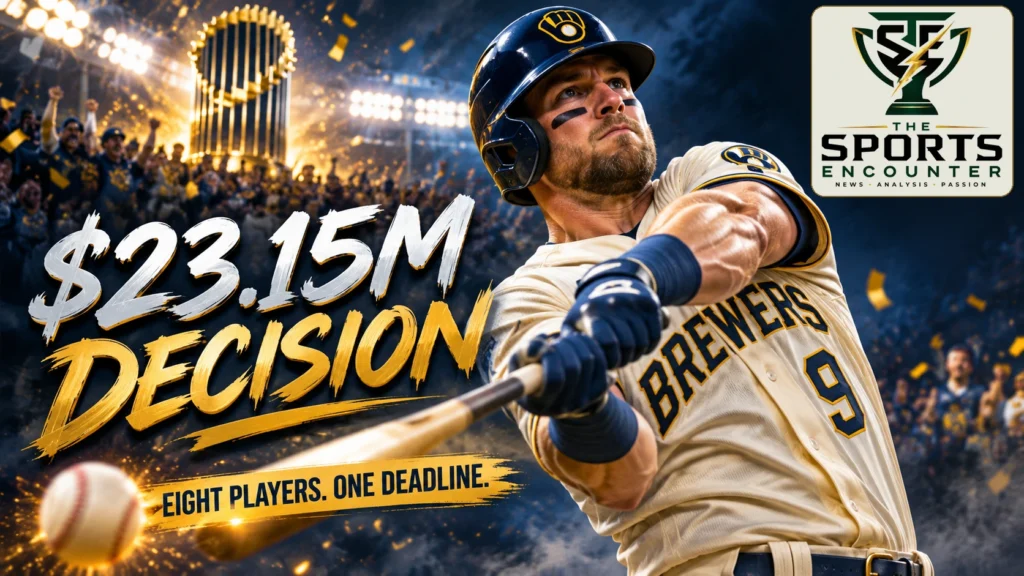
MILWAUKEE, United States, November 3, 2026: Eight Major League Baseball players have received one-year qualifying offers worth $23.15 million each for the 2027 season, putting a combined $185.2 million in potential contracts on the table as the offseason begins. Milwaukee Brewers first baseman and outfielder Jake Bauers, fresh from winning the National League Championship Series MVP award and helping his club capture its first World Series title, is among the eight players who must decide whether to accept their offers by 4 p.m. Eastern Time on November 17. The other recipients include Seattle’s Randy Arozarena, Chicago’s Seiya Suzuki, New York Yankees closer David Bednar, Baltimore starter Trevor Rogers, Pittsburgh second baseman Brandon Lowe, Minnesota catcher Ryan Jeffers and San Diego reliever Adrian Morejon.
The most intriguing decision belongs to Bauers, who earned $2.7 million in 2026 before producing the strongest season of his career. Accepting Milwaukee’s offer would increase his salary by $20.45 million for one year, while declining would allow him to pursue a potentially more lucrative multiyear agreement. The Brewers would then have an opportunity to receive draft-pick compensation if he signs elsewhere. That same calculation faces seven other players, each with different earning histories, career trajectories and market values. With MLB’s collective bargaining agreement approaching its December 1 expiration, the decisions could influence not only free agency but also the way teams approach roster building before a potentially uncertain winter.
Which Eight MLB Players Received $23.15 Million Qualifying Offers?
Major League Baseball confirmed that eight players received qualifying offers before the November 2 deadline. Four represent American League clubs, while four represent National League teams.
Story at a glance
Which Eight MLB Players Received $23.15 Million Qualifying Offers?
Major League Baseball confirmed that eight players received qualifying offers before the November 2 deadline. Four represent American League clubs, while four represent National League teams.
Jake Bauers’ $23.15 Million Decision Comes After Milwaukee’s Historic World Series
Bauers has arguably the most compelling personal story among the eight recipients.
How Much Draft Compensation Could the Brewers Receive if Bauers Leaves?
Milwaukee is classified as a revenue-sharing recipient under the qualifying-offer rules.
Randy Arozarena and Seiya Suzuki Could Test the Multiyear Free-Agent Market
Among the eight recipients, Randy Arozarena and Seiya Suzuki are two particularly interesting candidates to pursue multiyear contracts.
Brandon Lowe’s 35 Home Runs Give Pittsburgh Another Difficult Decision
Brandon Lowe delivered one of the strongest offensive seasons among the eight recipients.
The offers are identical in value and duration. Each player can accept a guaranteed $23.15 million salary for 2027 or reject the offer and continue negotiating in free agency.
However, equal contract offers do not mean equal decisions. A player seeking his first major payday may view the guaranteed money differently from an established star who believes a longer contract is available.
Complete 2026 MLB Qualifying-Offer List
| Player | 2026 Team | Position | 2026 fWAR | Qualifying Offer |
|---|---|---|---|---|
| Randy Arozarena | Seattle Mariners | Outfielder | 5.5 | $23.15 million |
| Brandon Lowe | Pittsburgh Pirates | Second baseman | 4.9 | $23.15 million |
| Seiya Suzuki | Chicago Cubs | Outfielder | 4.5 | $23.15 million |
| Trevor Rogers | Baltimore Orioles | Starting pitcher | 4.0 | $23.15 million |
| Jake Bauers | Milwaukee Brewers | First baseman/outfielder | 3.7 | $23.15 million |
| Adrian Morejon | San Diego Padres | Relief pitcher | 2.8 | $23.15 million |
| Ryan Jeffers | Minnesota Twins | Catcher | 2.6 | $23.15 million |
| David Bednar | New York Yankees | Relief pitcher | 1.9 | $23.15 million |
Source: MLB’s official 2026 qualifying-offer announcement. The wins above replacement figures use the FanGraphs version of the statistic, commonly abbreviated fWAR.
The eight players produced a combined 29.9 fWAR in 2026. This is a sum of individual performance estimates, not a projection of what they will produce in 2027 or evidence that each player has an identical market value.
MLB’s official breakdown of all eight qualifying-offer recipients provides their performance records and eligibility details.
Jake Bauers’ $23.15 Million Decision Comes After Milwaukee’s Historic World Series
Bauers has arguably the most compelling personal story among the eight recipients.
The 31-year-old helped Milwaukee secure the first World Series championship in franchise history after producing career-best regular-season numbers and delivering an outstanding National League Championship Series.
He batted .266 with a .389 on-base percentage and .484 slugging percentage across 144 games. His 26 home runs and 86 RBIs helped establish him as an important contributor to Milwaukee’s offense.
His performances during the National League Championship Series earned him MVP honors as the Brewers advanced to the World Series.
That postseason success culminated in the championship victory over Tampa Bay, a moment examined in The Sports Encounter’s report on Milwaukee’s first World Series championship.
The championship transformed the immediate context of Bauers’ free agency. He is no longer simply an experienced player coming off a productive contract year. He is a postseason award winner whose contribution is closely associated with the most successful season in Brewers history.
But teams negotiating contracts must decide how much of that performance is sustainable.
What Does Accepting the Offer Mean for Bauers’ Salary?
Bauers earned $2.7 million in 2026. The qualifying offer would increase that figure to $23.15 million in 2027 if accepted.
The difference is substantial enough to change the financial calculation surrounding a possible multiyear contract.
| Financial Measure | Amount | Significance |
|---|---|---|
| 2026 salary | $2.7 million | Reported previous-season earnings |
| 2027 qualifying offer | $23.15 million | Guaranteed one-year salary if accepted |
| Potential annual increase | $20.45 million | Difference between the two salaries |
| Salary multiple | 8.57 times | Qualifying offer divided by 2026 salary |
| Percentage increase | Approximately 757.4% | Increase relative to 2026 salary |
| 2026 home runs | 26 | Career-best offensive season |
| 2026 RBIs | 86 | Regular-season run production |
| 2026 fWAR | 3.7 | MLB’s published FanGraphs estimate |
The salary increase is calculated using the reported $2.7 million figure, which may not include every bonus or other element of a player’s total compensation.
The larger question is whether Bauers believes the market will offer a contract with more total guaranteed money over multiple seasons.
A three-year agreement worth $45 million, for example, would provide a lower annual average than the qualifying offer but a greater overall guarantee. That is a hypothetical illustration, not a reported offer or an estimate of Bauers’ market price.
His decision must balance immediate earning potential, long-term security, injury risk and the possibility of returning to free agency after another season.
Why Milwaukee Can Afford to Offer Bauers a Contract It May Not Expect Him to Accept
The qualifying-offer system provides clubs with two potential outcomes.
If Bauers accepts, Milwaukee retains him for 2027 at the fixed salary.
If he declines and signs a qualifying contract with another club, the Brewers may receive a compensatory selection in the following MLB Draft.
For a team that has regularly replenished its roster through trades and player development, that compensation could be valuable.
The Brewers’ willingness to make the offer also demonstrates the importance they place on Bauers’ contribution. An organization cannot issue a qualifying offer without accepting the possibility that the player will take it.
Milwaukee’s broader offseason picture includes catcher William Contreras. The club exercised his $15.5 million option for 2027 after he earned World Series MVP honors.
The two decisions show Milwaukee attempting to preserve key elements of a championship roster while keeping future roster construction in view.
That approach has particular significance after the excitement surrounding the Brewers-Rays World Series matchup, when Milwaukee entered the Fall Classic pursuing a title that had eluded the franchise since its creation.
How Much Draft Compensation Could the Brewers Receive if Bauers Leaves?
Milwaukee is classified as a revenue-sharing recipient under the qualifying-offer rules.
That status matters because the value of a departing player’s new contract influences the position of the Brewers’ compensatory draft pick.
If Bauers rejects the qualifying offer and signs elsewhere for at least $50 million, Milwaukee could receive a selection between the first round and Competitive Balance Round A.
If his new contract is worth less than $50 million, the compensatory selection would fall after Competitive Balance Round B.
The precise outcome depends on the applicable rules and the contract he eventually signs.
MLB Qualifying-Offer Draft Compensation Explained
| Former Club Classification | Condition | Potential Compensation |
|---|---|---|
| Competitive Balance Tax payer | Qualified free agent signs elsewhere | Selection after the fourth round |
| Revenue-sharing recipient | New contract worth at least $50 million | Selection between first round and Competitive Balance Round A |
| Revenue-sharing recipient | New contract below $50 million | Selection after Competitive Balance Round B |
| Other qualifying club | Qualified free agent signs elsewhere | Selection after Competitive Balance Round B |
The important distinction is that compensation is conditional. Rejecting the qualifying offer does not immediately give the former club a draft pick.
The player must sign with another organization under circumstances covered by the qualifying-offer system.
The signing team may also lose one or more draft selections, with the penalty determined by its financial classification.
That additional cost can affect negotiations because a prospective employer must consider both the contract offered to the player and the draft resources surrendered to complete the signing.
MLB’s official qualifying-offer rules explain the compensation and signing penalties in detail.
Randy Arozarena and Seiya Suzuki Could Test the Multiyear Free-Agent Market
Among the eight recipients, Randy Arozarena and Seiya Suzuki are two particularly interesting candidates to pursue multiyear contracts.
Arozarena, 31, finished 2026 with 26 home runs, 79 RBIs and 26 stolen bases.
His combination of power, speed and experience gives him several potential routes to value for interested clubs.
MLB credited him with 5.5 fWAR, the highest figure among the eight qualifying-offer recipients.
He has also produced six consecutive seasons with at least 20 home runs and 20 stolen bases, demonstrating a sustained combination of offensive skills.
For Seattle, offering $23.15 million ensures that the Mariners can retain him for one season if he accepts or pursue compensation if he leaves under the qualifying-offer rules.
Suzuki, meanwhile, has been a consistently above-average hitter during his five-year stay with the Chicago Cubs.
He produced 113 home runs across those five seasons and recorded a 128 OPS+, meaning his adjusted offensive production was 28% above the league average under that measure.
His defensive performance also improved in 2026, according to MLB’s published advanced metrics.
Those improvements could strengthen his appeal to clubs seeking a proven outfielder.
However, neither player has publicly accepted or rejected the qualifying offer as of the November 3 reporting window.
Market interest, contract length and the cost of draft compensation will influence how their decisions develop.
Brandon Lowe’s 35 Home Runs Give Pittsburgh Another Difficult Decision
Brandon Lowe delivered one of the strongest offensive seasons among the eight recipients.
The second baseman hit 35 home runs and recorded 96 RBIs for Pittsburgh in 2026.
He appeared in 150 games, scored 94 runs and finished with an .824 OPS.
His 4.9 fWAR ranked second among the qualifying-offer group.
The Pirates acquired Lowe before the season, and his performance provided an immediate return on that decision.
But the qualifying offer now creates a different calculation.
Pittsburgh can retain a proven power-hitting infielder for one year if he accepts. Alternatively, the club may receive draft compensation if he signs elsewhere after declining the offer.
His experience and offensive production could attract interest from clubs needing infield power.
At the same time, potential suitors must weigh his expected future production, defensive value and the cost of acquiring a player attached to draft compensation.
The financial calculations are occurring during a complicated baseball offseason. The Sports Encounter’s examination of MLB salary-cap negotiations and possible labor disruption explains why the wider financial environment could influence clubs’ willingness to commit to long contracts.
Trevor Rogers, David Bednar and Adrian Morejon Put Pitching Value Under the Spotlight
Three pitchers received qualifying offers: Baltimore starter Trevor Rogers, Yankees closer David Bednar and San Diego reliever Adrian Morejon.
They represent different roles, making their decisions difficult to compare through conventional statistics alone.
Trevor Rogers Has a Strong Case for Long-Term Security
Rogers experienced a less consistent 2026 season than his outstanding 2025 campaign.
After recording a 1.81 ERA in 2025, he finished 2026 with a 4.03 ERA across 169 2/3 innings.
However, the full-season figure conceals a considerable difference between his difficult stretch early in the year and his performance across other starts.
MLB’s review identified a seven-start period in which Rogers allowed 33 earned runs in 29 2/3 innings.
Outside those outings, he allowed 43 earned runs over 140 innings, equivalent to a 2.76 ERA.
That distinction could influence how prospective teams evaluate him.
Clubs must determine whether the difficult period reflects a lasting problem or a temporary decline within an otherwise productive season.
David Bednar’s 35 Saves Strengthen His Position
Bednar saved 35 games in 39 opportunities for the Yankees while recording a 2.47 ERA.
His performance reinforced his status as an established late-inning reliever.
For New York, the qualifying offer preserves the possibility of retaining an important bullpen contributor without immediately committing to a multiyear contract.
If Bednar rejects the offer, the Yankees may explore replacement options or attempt to negotiate a separate agreement.
The decision fits into a broader period of Yankees roster planning under general manager Brian Cashman, whose continued leadership was examined in our report on Cashman’s contract and the Yankees’ organizational direction.
Adrian Morejon Represents a Less Common Qualifying-Offer Choice
Morejon is particularly notable because he is a setup reliever rather than a traditional closer.
MLB observed that the small group of relievers previously offered qualifying deals had generally been closers.
Over the past three seasons, Morejon has produced a 2.58 ERA with 248 strikeouts across 223 1/3 innings.
That performance explains why San Diego has placed substantial value on him despite his role differing from that of a conventional ninth-inning specialist.
His case may also test how interested teams value elite relief performance when saves are not the player’s principal statistical contribution.
Ryan Jeffers Must Decide Whether $23.15 Million Is Worth More Than Contract Security
Minnesota catcher Ryan Jeffers faces another interesting decision because the guaranteed one-year salary would represent a major payday at a demanding defensive position.
Jeffers played 92 games in 2026, batting .256 with 14 home runs and 56 RBIs.
His .814 OPS demonstrates his offensive contribution when available.
MLB also noted that Jeffers has ranked among the leading offensive catchers since 2023 by adjusted production.
The Twins retained Jeffers through the trade deadline despite interest in his services, preserving the option to make a qualifying offer after the season.
Now the organization must await his decision.
The guaranteed salary could be attractive because catchers face considerable physical demands, and a single season of high earnings offers security without requiring a lengthy negotiation.
On the other hand, a multiyear deal could provide greater total guarantees and protection against changes in future performance.
There is no confirmed indication that Jeffers has decided which route to take.
Why $185.2 Million in Qualifying Offers Does Not Mean MLB Teams Have Spent That Money
The combined face value of the eight qualifying offers is $185.2 million.
That figure is calculated by multiplying the $23.15 million one-year offer by eight recipients.
It is a useful measure of how much salary the eight clubs are collectively prepared to guarantee if every player accepts.
But it should not be reported as completed spending.
None of the qualifying offers becomes an accepted 2027 contract until the individual player elects to take it.
If a player declines, his former club is not automatically required to pay him the qualifying-offer salary.
How MLB’s Qualifying-Offer Value Has Changed
| Offseason | Offer Value Per Player | Offers Issued | Accepted |
|---|---|---|---|
| 2023-24 | $20.325 million | 7 | 0 |
| 2024-25 | $21.05 million | 13 | 1 |
| 2025-26 | $22.025 million | 13 | 4 |
| 2026-27 | $23.15 million | 8 | Pending November 17 deadline |
The value has increased by $1.125 million from the previous offseason, approximately 5.1%.
The eight offers issued in 2026 also represent five fewer than the 13 issued following the 2025 season, a reduction of approximately 38.5%.
Only 18 of the 157 qualifying offers issued before the current offseason were accepted, an historical acceptance rate of approximately 11.5%.
That does not mean exactly one of this year’s eight recipients will accept. The historical rate describes past decisions, not the probability that any particular player will choose a specific option.
There was also a notable change last offseason, when four of 13 players accepted their offers, the highest number of acceptances in a single year since the system began.
The eight current recipients have different financial circumstances and market expectations, making a simple historical projection unreliable.
Why Didn’t Jazz Chisholm, Ian Happ and Other Free Agents Receive Offers?
Several recognizable free agents did not receive qualifying offers.
These include Yankees second baseman Jazz Chisholm Jr., Cubs outfielder Ian Happ and pitcher Matthew Boyd.
A club may decide not to make an offer because it believes the player could accept the guaranteed salary, because its roster priorities have changed or because the expected draft compensation does not justify the financial risk.
That decision is not necessarily a judgment that a player lacks quality.
It may simply indicate that the club is unwilling to guarantee $23.15 million for one season.
Other players were ineligible under the rules.
A player who has already received a qualifying offer during his career cannot receive another.
Players who did not spend the entire season within the same organization are also ineligible, which affects some notable free agents acquired in midseason trades.
For example, Tarik Skubal’s move during the season left him ineligible to receive a qualifying offer from his new club.
These eligibility restrictions make the eight-player list different from a ranking of the eight best available free agents.
Could the December 1 Collective Bargaining Deadline Change Free-Agent Decisions?
MLB’s current collective bargaining agreement is scheduled to expire on December 1, 2026.
Negotiations concerning future financial rules, including possible changes to payroll structures, have created uncertainty across the sport.
The current qualifying offers remain governed by the existing agreement, meaning players face the November 17 decision deadline under the established rules.
However, uncertainty about negotiations may influence the willingness of players and clubs to complete agreements before December.
A player who values immediate certainty may view the guaranteed qualifying offer differently from one confident of attracting several multiyear bids.
A club might similarly hesitate before offering a long-term contract if it expects the financial framework of the sport to change.
These are possible negotiating considerations, not evidence that a lockout is certain or that contracts will necessarily be delayed.
Baseball’s financial uncertainty also extends beyond player salaries. Our examination of the global sports media-rights market provides broader context for the commercial pressures and opportunities facing major professional leagues.
The record qualifying-offer value is another reminder of how substantial elite professional sports compensation has become, a trend also explored in The Sports Encounter’s historical analysis of the world’s highest-paid athletes.
Neither comparison changes MLB’s specific contract rules, but both help place the $23.15 million salary figure within the wider economics of professional sport.
What Happens Between November 3 and November 17?
All eight players can continue discussing potential contracts with interested clubs while considering their qualifying offers.
The deadline is November 17 at 4 p.m. Eastern Time.
Acceptance means the player returns to his previous team on the one-year contract for 2027.
Rejection means he remains a free agent and can seek a separate agreement.
The qualifying-offer compensation rules may then affect the draft-pick obligations of a new signing club.
Continue the MLB Story
 MLBMariners Hand Jason Kanzler First Managerial Job at 36, Betting on Player Development to Reverse a 14-Win Collapse
 MLBMilwaukee Brewers Win First World Series as Misiorowski, Pratt and Contreras End 57-Year Wait
 MLBPitching Problems Exposed: Rays Lose Edwin Uceta Into 2027 as Red Sox Trade Eduardo Rivera to Cardinals
| Date | Offseason Milestone | Importance |
|---|---|---|
| November 2, 2026 | Qualifying offers issued | Eight players receive $23.15 million offers |
| November 3-16 | Decision and negotiation period | Players can evaluate one-year security against other opportunities |
| November 17, 4 p.m. ET | Acceptance deadline | Qualifying-offer decisions become due |
| After November 17 | Free agency continues | Players who decline may pursue contracts elsewhere |
| December 1, 2026 | Scheduled CBA expiration | Potential implications for the broader offseason |
| 2027 MLB Draft | Potential compensation selections | Eligible former clubs may receive picks for qualifying departures |
The key outcome is that the qualifying-offer decision does not necessarily conclude a player’s negotiations with his existing team.
A player can reject the qualifying offer and still agree to a different contract with the same club.
This distinction matters for Milwaukee and Bauers. Rejecting the one-year offer would not automatically mean he is leaving the Brewers.
Milwaukee’s Next Challenge Is Keeping a Championship Team Competitive
Winning the World Series creates an immediate expectation that the Brewers should remain contenders.
However, maintaining a championship roster involves difficult decisions about aging players, financial commitments and the need to replenish talent.
Bauers’ case captures that tension.
His 2026 production and postseason success justify serious consideration from Milwaukee. But a $23.15 million one-year commitment also represents a substantial financial decision.
Milwaukee has previously demonstrated a willingness to trade established players approaching free agency, including Corbin Burnes, Devin Williams and Freddy Peralta.
Other players, such as Willy Adames, remained through their contract years before departing.
The Brewers’ approach therefore cannot be reduced to an assumption that they will always keep or always trade valuable veterans.
Each decision depends on the player’s projected contribution, contract situation, alternative options and organizational strategy.
The franchise’s championship journey has also strengthened the connection between the team and its supporters. Our coverage of Bob Uecker’s family and Milwaukee’s championship run explored the emotional significance of that achievement.
The demand surrounding the Fall Classic was also evident in the extraordinary prices reported for World Series tickets.
That excitement now gives way to a different challenge: constructing a roster capable of defending the title.
Milwaukee’s American League opponent, Tampa Bay, reached the World Series after defeating Cleveland, a journey examined in our report on the Rays’ American League Championship Series victory.
For both World Series participants, the offseason brings decisions that may determine whether their success can be sustained.
Which Players Are Most Likely to Accept Their MLB Qualifying Offers?
There is no reliable basis for assigning exact acceptance probabilities to each player without access to verified contract negotiations and individual preferences.
Nevertheless, their circumstances suggest different considerations.
Bauers and Jeffers may place considerable value on the guaranteed one-year salary relative to their previous earnings.
Arozarena and Suzuki could explore multiyear deals based on their established offensive records.
Lowe’s power production offers a strong case for market interest, while Bednar, Rogers and Morejon must weigh the opportunities and risks associated with pitching contracts.
The major unknown is the value of the offers available from other clubs.
Draft compensation can also influence the market because acquiring a player who rejected a qualifying offer may require surrendering draft resources.
That can become particularly important when a player is evaluating offers from teams with different financial classifications.
For clubs outside the qualifying-offer conversation, offseason roster changes are already underway. The Sports Encounter also covered the Los Angeles Angels’ managerial change after their difficult season, another example of organizations facing significant decisions before 2027.
The Bigger Question: Eight Offers, Eight Careers, and a Changing Baseball Market
Eight players have received the same $23.15 million offer, but their decisions will reflect different priorities.
For Bauers, the offer represents an extraordinary increase from his previous salary and an opportunity to remain with the World Series champions.
For Arozarena, Suzuki and Lowe, the appeal of a multiyear agreement may prove more important than maximizing one year’s salary.
For the pitchers, the balance between guaranteed earnings and longer-term security becomes especially relevant.
And for the clubs, the qualifying-offer system provides a way to protect draft resources if an important player departs.
The November 17 deadline will clarify which players value the guaranteed one-year contract and which believe the market can provide a better alternative.
Until then, the $185.2 million headline remains a measure of potential commitments, not completed contracts.
Milwaukee’s decision is particularly compelling because Bauers’ future now sits at the intersection of a historic championship, a remarkable individual season and the financial realities of building another contender.
The Brewers have celebrated their first World Series title. Their next major test is deciding how much of the team that won it they can afford to keep together.
MLB Qualifying Offers 2026: Frequently Asked Questions
How much is the MLB qualifying offer for 2027?
The qualifying offer is worth $23.15 million for one year. The amount is calculated using the average salary of MLB’s 125 highest-paid players.
Which eight players received qualifying offers in 2026?
Randy Arozarena, Brandon Lowe, Seiya Suzuki, Trevor Rogers, Jake Bauers, Adrian Morejon, Ryan Jeffers and David Bednar received qualifying offers.
When is the deadline to accept an MLB qualifying offer?
Players have until November 17, 2026, at 4 p.m. Eastern Time to accept their offers.
What happens if Jake Bauers accepts Milwaukee’s qualifying offer?
Bauers would return to the Brewers for the 2027 season on a one-year contract worth $23.15 million.
What happens if Jake Bauers rejects the offer?
He remains a free agent. If he signs with another club under the applicable rules, Milwaukee may receive draft-pick compensation. Rejecting the offer does not prevent him from negotiating another contract with the Brewers.
How many qualifying offers were issued in 2026?
Eight players received offers, five fewer than the 13 players offered qualifying contracts following the 2025 season.
How many players have accepted MLB qualifying offers historically?
Eighteen players accepted qualifying offers among the 157 issued from 2012 through 2025. Decisions on the eight offers issued in 2026 remain pending as of November 3.
Can a player receive an MLB qualifying offer twice?
No. A player who has previously received a qualifying offer is ineligible to receive another under the current rules.
Does a team receive draft compensation every time a player rejects an offer?
No. The player must sign with another club under conditions that qualify the former team for draft compensation. The position of the compensatory selection depends on the club’s financial classification and, in some cases, the new contract value.
Does the $185.2 million total mean all eight players have signed contracts?
No. The figure is the combined face value of eight potential one-year contracts. The individual players must accept their offers before those agreements become binding for 2027.