Key Takeaways
- Kobe entered Matchday 4 as one of the East Region’s two teams with perfect records, alongside Kashima Antlers.
- The top eight teams in the East Region advance, but their positions determine the Round of 16 pairings.
- Kobe’s victory was only one of several important East Region results on Tuesday.
- The Round of 16 will be contested through home-and-away ties in March 2027.
KOBE, Japan, November 3, 2026: Vissel Kobe were eight minutes away from surrendering their perfect AFC Champions League Elite record when captain Tetsushi Yamakawa completed a remarkable escape. The Japanese club defeated Thailand’s Ratchaburi FC 3-2 at Noevir Stadium Kobe on Tuesday after conceding an 82nd-minute goal that left them trailing 2-1. Erik equalized almost immediately before Yamakawa headed home the 88th-minute winner, preserving Michael Skibbe’s team’s fourth consecutive victory and lifting Kobe to 12 points at the halfway stage of the East Region league phase.
The comeback was even more revealing because both late goals were scored by substitutes. Yamakawa entered at halftime, Erik joined the contest in the 62nd minute, and Yuya Osako, introduced in the 69th, assisted the winner. Ratchaburi had threatened a major upset through Phongsakorn Sangkasopha and Ekanit Panya after Kento Hamasaki’s first-half opener. Kobe’s response demonstrated the value of their experienced bench, but conceding twice against opponents who had collected only one point from their previous three fixtures also raised questions about their defensive control ahead of a potentially demanding knockout campaign.
Vissel Kobe 3-2 Ratchaburi: AFC Champions League Elite Match Summary
Kobe entered Matchday 4 as one of the East Region’s two teams with perfect records, alongside Kashima Antlers.
Story at a glance

Vissel Kobe 3-2 Ratchaburi: AFC Champions League Elite Match Summary
Kobe entered Matchday 4 as one of the East Region’s two teams with perfect records, alongside Kashima Antlers.
How Did Vissel Kobe Come Back From 2-1 Down in Six Minutes?
Three late goals transformed the second half.
Vissel Kobe vs. Ratchaburi: Every Goal and Decisive Substitution
The most important feature of the sequence is the relationship between Kobe’s substitutions and the final two goals.
Michael Skibbe’s Bench Was the Difference
Kobe’s substitutions deserve as much attention as the winning header.
The Overlooked Contribution: Yuya Osako’s Header Made the Winner Possible
Yamakawa will receive the credit for the decisive goal, but Osako’s contribution deserves recognition.
Ratchaburi arrived at the opposite end of the competitive picture, seeking their first victory after collecting just one point from three matches.
The difference in form suggested an advantage for the hosts, but Ratchaburi came remarkably close to overturning expectations.
| Match Detail | Verified Information |
|---|---|
| Competition | AFC Champions League Elite 2026/27 |
| Region | East |
| Stage | League stage, Matchday 4 |
| Date | November 3, 2026 |
| Venue | Noevir Stadium Kobe, Japan |
| Final score | Vissel Kobe 3-2 Ratchaburi FC |
| Halftime score | Vissel Kobe 1-0 Ratchaburi FC |
| Kobe scorers | Kento Hamasaki 34′, Erik 83′, Tetsushi Yamakawa 88′ |
| Ratchaburi scorers | Phongsakorn Sangkasopha 64′, Ekanit Panya 82′ |
| Kobe head coach | Michael Skibbe |
| Kobe’s league-stage record | Four wins from four matches |
| Kobe’s points | 12 |
| Ratchaburi’s points | 1 |
The AFC’s official match report confirms the victory and its immediate consequence for the East Region standings.
For Kobe, the three points were invaluable. For Skibbe, the nature of the victory provided another problem to examine.
How Did Vissel Kobe Come Back From 2-1 Down in Six Minutes?
Three late goals transformed the second half.
Ratchaburi equalized after 64 minutes and then stunned Kobe when Ekanit Panya scored in the 82nd.
But the visitors’ lead lasted barely a minute.
Erik scored in the 83rd, before Yamakawa completed the turnaround five minutes later.
Kento Hamasaki Puts Kobe Ahead in the 34th Minute
Kobe made the first breakthrough through Kento Hamasaki.
The midfielder scored from close range after Yuta Goke supplied the decisive pass, putting the Japanese side ahead midway through the opening half.
The goal gave Kobe a platform to control the match against opponents who had struggled to collect points during the opening rounds.
However, the hosts could not convert their advantage into a second goal before halftime.
That failure left Ratchaburi within one successful attack of returning to level terms.
Phongsakorn Sangkasopha Makes It 1-1
Ratchaburi’s equalizer arrived in the 64th minute.
Daniel Ting supplied the pass for Phongsakorn Sangkasopha, who finished from inside the penalty area.
It was a deserved reward for the visitors’ improved attacking ambition after halftime.
Ratchaburi had already threatened when Thossawat Limwanasathian struck the crossbar in the 59th minute.
That opportunity illustrated how the visitors were beginning to find space and create chances against the previously unbeaten Japanese side.
The equalizer changed the competitive pressure. Kobe had led for half an hour but now needed another goal to preserve their perfect record.
Ekanit Panya Stuns Kobe in the 82nd Minute
With eight minutes of normal time remaining, Ekanit Panya delivered what appeared to be the decisive blow.
The Thai international found space outside the penalty area and struck into the upper corner, completing a move assisted by Tana.
The goal moved Ratchaburi ahead 2-1 and briefly placed them on course for their first victory of the continental campaign.
The timing was especially important.
Kobe had limited time to respond, while Ratchaburi suddenly had a tangible result to protect.
Yet the visitors were unable to manage the next few moments.
Erik Equalizes Before Ratchaburi Can Settle
Erik, introduced in the 62nd minute, restored parity in the 83rd.
Yuya Kuwasaki supplied the assist, and the Brazilian substitute finished from inside the area.
The equalizer arrived so quickly that Ratchaburi had little opportunity to reorganize after taking the lead.
It also demonstrated the impact of Skibbe’s attacking substitutions.
Erik had entered the game before Ratchaburi’s first equalizer. Rather than disappearing from the contest after Kobe fell behind, he provided the immediate response his team desperately needed.
Tetsushi Yamakawa Wins It With an 88th-Minute Header
The winner came from a corner.
Osako redirected the ball with a header, and Yamakawa met it in the middle of the penalty area, sending his effort into the upper-right corner.
The captain had entered at halftime in place of Caetano.
His late contribution turned a potentially damaging defeat into another three points.
The goal also revealed how useful experienced substitutes can become when a tightly contested match reaches its final minutes.
Yamakawa had been on the field for almost the entire second half, while Osako had entered in the 69th minute as Kobe searched for greater attacking influence.
Vissel Kobe vs. Ratchaburi: Every Goal and Decisive Substitution
| Minute | Incident | Score or Consequence |
|---|---|---|
| 34′ | Kento Hamasaki scores, Yuta Goke assist | Kobe lead 1-0 |
| 46′ | Tetsushi Yamakawa replaces Caetano | Future match winner enters |
| 46′ | Yosuke Ideguchi replaces Kota Watanabe | Kobe adjust midfield |
| 59′ | Thossawat Limwanasathian hits the crossbar | Ratchaburi threaten an equalizer |
| 62′ | Erik replaces Yuta Goke | Future equalizer scorer enters |
| 64′ | Phongsakorn Sangkasopha scores, Daniel Ting assist | 1-1 |
| 69′ | Yuya Osako and Yoshinori Muto enter | Kobe strengthen attacking options |
| 82′ | Ekanit Panya scores, Tana assist | Ratchaburi lead 2-1 |
| 83′ | Erik scores, Yuya Kuwasaki assist | 2-2 |
| 88′ | Yamakawa heads in, Osako assist | Kobe win 3-2 |
The most important feature of the sequence is the relationship between Kobe’s substitutions and the final two goals.
Erik and Yamakawa came off the bench to score, while Osako, another substitute, created the winner.
Those contributions were directly measurable in the result.
Skibbe’s changes did not prevent Ratchaburi from taking the lead, but they gave Kobe enough attacking quality to recover when the situation became desperate.
Michael Skibbe’s Bench Was the Difference
Kobe’s substitutions deserve as much attention as the winning header.
Yamakawa was introduced at halftime, while Erik entered after 62 minutes.
Osako and Muto followed in the 69th minute.
Those decisions gave Kobe additional experience and attacking options during a period when Ratchaburi had become increasingly dangerous.
The tactical significance lies in the variety of contributions.
Erik supplied the finishing touch needed to erase Ratchaburi’s lead.
Osako contributed the aerial pass that created the final opportunity.
Yamakawa used his positioning to convert it.
Neither goal required Kobe to rely entirely on the players who had started the match.
The value of bench contributions was already visible during Kobe’s opening continental fixture.
In September, substitute Yoshinori Muto scored the winner against Port FC after Ren Komatsu’s earlier goal had been canceled out.
The Sports Encounter’s report on Kobe’s opening victory in Thailand examined how the Japanese club recovered through attacking changes.
The latest result reinforces that pattern.
The Overlooked Contribution: Yuya Osako’s Header Made the Winner Possible
Yamakawa will receive the credit for the decisive goal, but Osako’s contribution deserves recognition.
The veteran forward was introduced in the 69th minute and later supplied the headed pass from which Yamakawa scored.
Without that intervention, the captain’s chance would not have developed in the same way.
Osako’s role also shows why creative contributions are not limited to conventional passes along the ground.
His awareness during a set-piece situation created a high-value attacking opportunity.
It was another reminder that experienced players can influence matches through positioning, aerial judgment and decision-making even when they do not score.
For Kobe, that experience could become increasingly important when facing opponents with stronger defensive records in the knockout phase.
What Do the Statistics Reveal About Kobe’s 3-2 Victory?
The available match statistics show that Kobe created the greater attacking volume.
However, Ratchaburi were sufficiently effective to turn their opportunities into two second-half goals.
| Statistic | Vissel Kobe | Ratchaburi |
|---|---|---|
| Goals | 3 | 2 |
| Possession | 55% | 45% |
| Total shots | 21 | 12 |
| Shots on target | 7 | 5 |
| Shots on target percentage | 33.3% | 41.7% |
| Goals per shot on target | 42.9% | 40.0% |
| Touches in opposition penalty area | 33 | 15 |
The match statistics show: Kobe attempted 75% more shots than Ratchaburi, calculated from 21 attempts compared with 12.
But the advantage in shots on target was much smaller: seven against five.
That helps explain why the visitors remained dangerous despite spending less time in possession.
Kobe also registered more than twice as many touches in the opposition penalty area.
The numbers suggest that Kobe established a stronger attacking presence across the match, while Ratchaburi still found opportunities to exploit spaces at the other end.
These figures come from published match-event statistics. Shot counts can vary slightly between providers because of classification differences, particularly for blocked efforts.
Why Kobe’s Perfect Record Is More Complicated Than It Looks
Four wins from four games represent an excellent start.
Yet Kobe’s previous match against Daejeon Hana Citizen also required a late winner.
On October 27, Ren Komatsu scored with a header in the closing stages to secure a 1-0 victory away to the South Korean club.
That match followed two earlier victories, including Kobe’s opening result against Port FC.
Skibbe subsequently acknowledged that his team had been fortunate against Daejeon.
The pattern is revealing.
Kobe possess the resilience to win difficult games, but a series of narrow results should not automatically be interpreted as evidence of overwhelming tactical superiority.
Strong opponents may eventually exploit the periods in which Kobe lose control.
That possibility should be considered alongside the positive evidence that the team can recover after setbacks.
From Daejeon to Ratchaburi: Two Late Headers, Six Valuable Points
| Comparison | vs. Daejeon | vs. Ratchaburi |
|---|---|---|
| Date | October 27, 2026 | November 3, 2026 |
| Venue | Daejeon World Cup Stadium | Noevir Stadium Kobe |
| Result | Won 1-0 | Won 3-2 |
| Decisive scorer | Ren Komatsu | Tetsushi Yamakawa |
| Winning goal | Late header | 88th-minute header |
| Goals conceded | 0 | 2 |
| Points collected | 3 | 3 |
| Key lesson | Patience in a difficult away match | Bench impact and recovery from a late deficit |
The two victories demonstrate different qualities.
Against Daejeon, Kobe had to remain patient until a late attacking opportunity emerged.
Against Ratchaburi, they needed a rapid response after losing a lead.
Both results required decisive contributions in the closing stages.
The timing should encourage Skibbe, but the defensive problems against Ratchaburi remain relevant.
Ratchaburi’s Defeat Hurts More Because the Victory Was Within Reach
Ratchaburi’s opening three matches had produced one point.
The club entered the Kobe fixture needing a significant improvement.
The performance was more competitive than that record suggested.
Phongsakorn Sangkasopha scored the equalizer, Ekanit Panya produced an excellent finish, and the visitors created opportunities that threatened Kobe’s unbeaten record.
However, the inability to protect their 82nd-minute lead left Ratchaburi with another defeat.
The frustration was compounded by their earlier continental results.
On Matchday 1, Ratchaburi lost 6-4 to Shanghai Port despite an extraordinary hat-trick from Njiva Rakotoharimalala.
That contest was analyzed in TSE’s complete AFC Champions League Elite opening-round review.
The two matches illustrate a recurring problem.
Ratchaburi have demonstrated an ability to score against strong opposition but have also conceded heavily in some of their most important matches.
That makes defensive stability an urgent priority as the league phase approaches its conclusion.
What Does Kobe’s Fourth Straight Win Mean for the East Region Standings?
Kobe have collected 12 points from their opening four matches.
That places them at the top of the East Region standings at the halfway stage, pending the completion of the remaining Matchday 4 fixtures.
The expanded AFC Champions League Elite features 16 clubs in each regional league.
Every team plays eight league-stage matches against different opponents from its region.
The first eight clubs advance to the Round of 16.
Kobe’s results have created a substantial advantage, but mathematical qualification should not be declared until the remaining fixtures and standings make that conclusion certain.
The Sports Encounter’s guide to the expanded 2026/27 AFC Champions League Elite explains the competition’s regional structure and qualification format.
Can Vissel Kobe Still Finish With a Perfect League-Stage Record?
Yes.
Kobe have won their first four games and have four remaining.
A perfect eight-match campaign would give them 24 points.
However, maintaining that record will require improvement against opponents capable of exploiting the defensive gaps evident against Ratchaburi.
| Remaining Four-Match Record | Additional Points | Final Total |
|---|---|---|
| Four wins | 12 | 24 |
| Three wins, one draw | 10 | 22 |
| Three wins, one defeat | 9 | 21 |
| Two wins, two draws | 8 | 20 |
| Two wins, two defeats | 6 | 18 |
| Four draws | 4 | 16 |
| Four defeats | 0 | 12 |
The scenarios show the points available through different outcomes.
They do not establish a guaranteed finishing position because the final standings depend on results involving other clubs.
Kobe could continue collecting points and still find their league-stage position influenced by the performances of Kashima Antlers, Kashiwa Reysol, Jeonbuk and other contenders.
Why Finishing Higher Matters in the AFC Champions League Elite
The top eight teams in the East Region advance, but their positions determine the Round of 16 pairings.
Under the competition’s published structure, first plays eighth, second plays seventh, third plays sixth, and fourth plays fifth.
The higher-ranked side is scheduled, in principle, to host the second leg of its Round of 16 tie.
Consequently, Kobe have reasons to pursue a leading position even after qualification becomes secure.
A high finish may provide a more favorable route to the quarterfinals, although finishing above another club does not guarantee an easier opponent.
The official AFC Champions League Elite competition hub provides updates on the format, results and knockout progression.
Kashiwa, Jeonbuk and Shanghai Port Reshape the East Region Race
Kobe’s victory was only one of several important East Region results on Tuesday.
Kashiwa Reysol defeated Daejeon Hana Citizen 2-0, with second-half goals from Keita Endo and Shota Fujio.
Jeonbuk Hyundai Motors also won 2-0, defeating previously unbeaten Johor Darul Ta’zim through goals from Bruno Mota and Italo.
Shanghai Port recovered from the previous week’s defeat to Cong An Ha Noi by winning 4-2 away to Newcastle Jets.
Port FC earned their first points of the competition with a dramatic 7-4 victory against 10-man Beijing FC.
Bordin Phala completed a hat-trick during a match that produced seven first-half goals.
Cong An Ha Noi and Kyoto Sanga finished goalless in Vietnam.
| Match | Result | Main Consequence |
|---|---|---|
| Vissel Kobe vs. Ratchaburi | 3-2 | Kobe reach 12 points |
| Kashiwa Reysol vs. Daejeon | 2-0 | Kashiwa move to seven points |
| Jeonbuk vs. Johor Darul Ta’zim | 2-0 | Jeonbuk and JDT both have seven points |
| Newcastle Jets vs. Shanghai Port | 2-4 | Shanghai move to seven points |
| Port FC vs. Beijing FC | 7-4 | Port secure their first win |
| Cong An Ha Noi vs. Kyoto Sanga | 0-0 | Kyoto move to seven points; Cong An Ha Noi to four |
The AFC’s official Matchday 4 reporting confirms these results and their implications.
The results demonstrate how quickly competition positions can change.
Kashiwa, Jeonbuk and Shanghai have all strengthened their prospects, while teams near the qualifying boundary face increasing pressure.
Japan’s Clubs Are Setting the Standard, but the Race Remains Open
Japanese clubs have delivered several important performances across the opening four rounds.
Kobe have won every match.
Kashima Antlers began the competition with a remarkable 7-1 victory over Newcastle Jets and followed it with further wins.
Kashiwa have recovered after losing to Jeonbuk on the opening matchday.
The strength of Japan’s representation is evident, but the tournament has also produced challenges from South Korean, Chinese, Thai and Malaysian clubs.
Our AFC Champions League Elite Matchday 3 review examined how the wider competition was developing, including the different pressures facing clubs in the East and West.
The balance between the regions will become particularly important once the competition moves beyond its regional knockout stage.
What Happens After the AFC Champions League Elite Round of 16?
The Round of 16 will be contested through home-and-away ties in March 2027.
The surviving clubs will then move to the centralized finals phase in Saudi Arabia.
The quarterfinals, semifinals and final are scheduled for April and May 2027.
That progression creates an additional challenge for teams accustomed to home-and-away league-stage football.
Once the quarterfinals begin, squad management, travel, recovery and single-match execution become even more significant.
Recent West Region performances offer an indication of the quality that may await East Region contenders later in the competition.
Continue the AFC Champions League Elite Story
 AFC Champions League EliteWatkins Strikes Twice as Al-Hilal End Shabab Al-Ahli’s Perfect Start, but the Real Prize Is a Better Asian Knockout Route
 AFC Champions League EliteAl Ain Humiliate Al Ittihad 4-1 in Jeddah to Take Control of AFC Champions League Elite
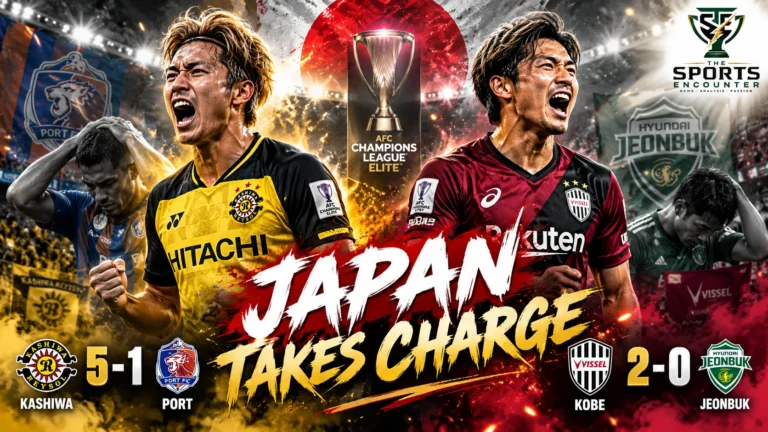 AFC Champions League EliteFive Goals in 28 Minutes Rescue Kashiwa as Kobe Punish Jeonbuk to Keep Japan’s Asian Charge Perfect
Al-Ain have won four consecutive matches, including a 4-1 victory over Al-Ittihad.
TSE’s analysis of Al-Ain’s commanding start detailed how the Emirati side reached 12 points with an impressive goal difference.
Defending champions Al-Ahli have also demonstrated their resilience during the opening rounds.
Our report on Feras Al-Brikan’s opening-night equalizer examined how the holders avoided an early defeat against Pakhtakor.
They subsequently recovered to defeat Al-Wasl, as covered in TSE’s Matchday 2 analysis.
Those results underline the range of contenders Kobe may eventually need to overcome if they continue progressing.
Is Kobe’s Perfect Record Enough to Make Them Asian Champions League Favorites?
Four consecutive victories establish Kobe as one of the strongest early performers.
However, the evidence is insufficient to declare them overwhelming favorites.
The late victories against Daejeon and Ratchaburi demonstrate determination, but they also reveal periods when Kobe failed to establish control.
Stronger opponents may be less forgiving.
Kobe’s greatest strength could prove to be their squad depth.
Skibbe has already demonstrated that he can introduce players capable of changing matches from the bench.
That may prove valuable during the knockout stage, when injuries, fatigue and tactical adjustments can influence outcomes.
However, relying repeatedly on late goals is not a sustainable substitute for creating advantages earlier.
The next four league-stage matches will provide a stronger indication of whether Kobe can combine their resilience with more consistent performances.
Why Domestic Form Also Matters in Asia’s Expanded Competition
Continental success depends partly on how clubs manage the demands of their domestic schedules.
The enlarged competition requires more travel, additional opponents and careful squad management.
Those demands affect leading clubs across both regions.
Saudi club Al-Hilal, for example, entered the competition while managing a demanding domestic campaign.
Its six-goal victory over Al-Taawoun demonstrated the depth of attacking options available to a leading continental contender.
Yet even powerful squads can experience setbacks, as shown by NEOM’s 2-0 victory over Al-Hilal.
The underlying lesson also applies to Kobe.
Squad depth matters, but success requires maintaining tactical discipline and physical consistency across different competitions.
What Happens Next for Vissel Kobe and Ratchaburi?
Kobe return to their domestic commitments before resuming the continental league stage later in November.
The next Asian match will provide an opportunity to extend their winning streak and move closer to securing a favorable knockout position.
Skibbe must address the defensive lapses that allowed Ratchaburi to score twice while preserving the attacking flexibility demonstrated by his substitutes.
Ratchaburi have a different challenge.
With one point from four matches, their qualification position is increasingly difficult.
They must improve results across the remaining fixtures while monitoring other clubs competing for eighth place.
Their performance in Kobe offered evidence that they can threaten strong opponents.
The immediate problem is converting competitive passages into points.
Vissel Kobe vs. Ratchaburi: Frequently Asked Questions
Who won Vissel Kobe vs. Ratchaburi on November 3, 2026?
Vissel Kobe defeated Ratchaburi FC 3-2 at Noevir Stadium Kobe in the AFC Champions League Elite.
Who scored Vissel Kobe’s winning goal?
Captain Tetsushi Yamakawa scored the 88th-minute winner with a header.
Who assisted Yamakawa’s winning goal?
Yuya Osako provided the headed assist after a corner.
Who scored Kobe’s other goals?
Kento Hamasaki opened the scoring in the 34th minute, and Erik equalized in the 83rd.
Who scored for Ratchaburi?
Phongsakorn Sangkasopha scored in the 64th minute, and Ekanit Panya put Ratchaburi ahead in the 82nd.
How many points do Vissel Kobe have after four matches?
Kobe have 12 points from four consecutive victories.
Have Kobe qualified for the Round of 16?
They have established a strong position, but qualification should not be declared mathematically secure without confirming the remaining standings scenarios.
How many teams qualify from the East Region?
The first eight clubs from the 16-team East Region advance to the Round of 16.
When are the AFC Champions League Elite knockout rounds?
The Round of 16 takes place in March 2027, followed by the centralized final stage in Saudi Arabia during April and May.
Can Vissel Kobe finish with 24 points?
Yes. Winning their remaining four matches would give Kobe eight victories and the maximum available 24 points.
Yamakawa Saved the Perfect Record, but Kobe Have Work to Do
The decisive image from Tuesday’s contest will be Yamakawa rising to meet Osako’s header and sending Kobe’s supporters into celebration.
Yet the most important lesson lies in the sequence that made the winner necessary.
Kobe led, conceded an equalizer and then fell behind with eight minutes remaining.
They responded through two substitutes and secured a fourth successive victory.
That resilience deserves recognition.
But Skibbe will understand that stronger opponents may not offer the same opportunity to recover from defensive mistakes.
For now, Kobe occupy the leading position in the East Region, hold the maximum 12 points and remain on course for the knockout stage.
The next challenge is to turn a collection of dramatic victories into the sustained control required to win a continental championship.