Key Takeaways
- The November 2 rankings reveal a competitive group immediately behind India and New Zealand.
- The October 31 ODI tri-series final against Sri Lanka supplied Pakistan’s defining result.
- Pakistan and South Africa have different priorities as they prepare for the ICC Men’s Cricket World Cup 2027.
- The 2027 World Cup will be played in South Africa, Zimbabwe and Namibia from October 2 to November 21.
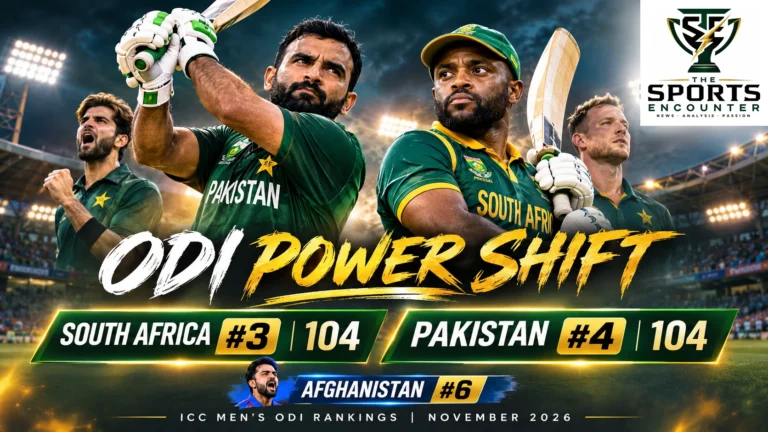
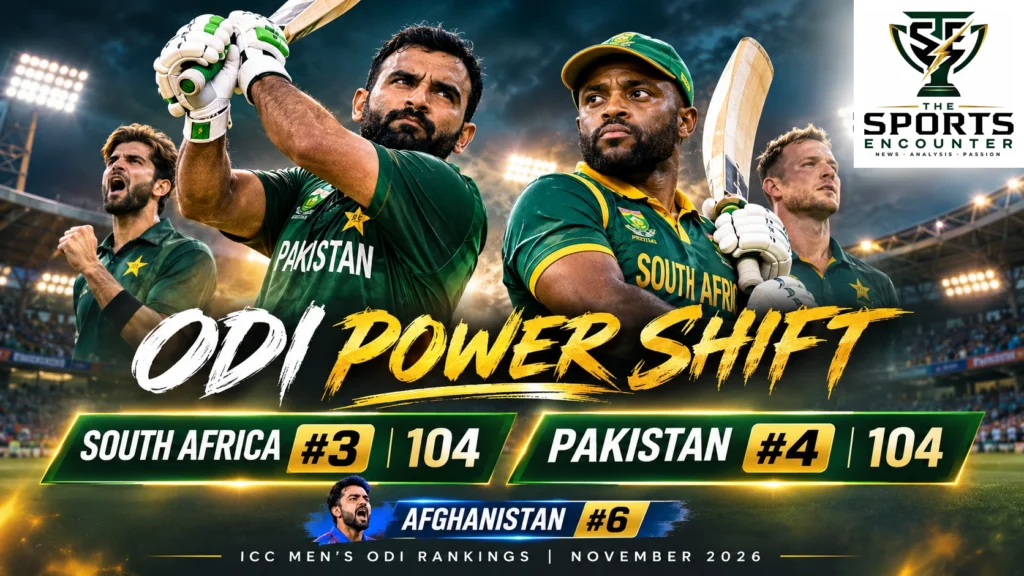
LAHORE, Pakistan, November 3, 2026: Pakistan have climbed to fourth in the ICC Men’s ODI Team Rankings following their dramatic tri-series victory over Sri Lanka, drawing level with third-placed South Africa on 104 displayed rating points and moving ahead of five-time World Cup champions Australia. Shaheen Shah Afridi’s team gained valuable ground after winning four of five matches in the Lahore tournament, including a record-equalling successful chase of 326 in the October 31 final. The latest rankings, released on November 2, also place India first, New Zealand second and Afghanistan at a historic sixth, but the most consequential movement for the approaching 2027 Cricket World Cup involves Pakistan’s recovery and South Africa’s emergence as a consistently strong ODI contender.
Pakistan were fifth with 100 rating points in the ICC’s October 15 rankings snapshot and have since improved to fourth with 104. South Africa, meanwhile, have moved from fourth with 102 points following May’s annual rankings update to third with 104, supported by strong ODI performances against Australia and an established middle order. Both nations have progressed through different strengths. Pakistan have demonstrated remarkable batting recoveries, emerging talent and match-winning bowling, while South Africa possess greater recent middle-order stability. Afghanistan’s rise to sixth adds another dimension to the 2027 World Cup, where the Afghans will face Pakistan in Group A, while South Africa compete in Group B as tournament co-hosts.
Latest ICC ODI Rankings: Pakistan Fourth, South Africa Third
The November 2 rankings reveal a competitive group immediately behind India and New Zealand.
Story at a glance
Latest ICC ODI Rankings: Pakistan Fourth, South Africa Third
The November 2 rankings reveal a competitive group immediately behind India and New Zealand.
Pakistan’s ODI Recovery: From Fifth to Fourth in Less Than Three Weeks
Pakistan’s latest movement is particularly significant because it follows a difficult period for the national side’s 50-over batting.
Fakhar Zaman’s 127 Turns Pakistan’s Lahore Triumph Into a Rankings Breakthrough
The October 31 ODI tri-series final against Sri Lanka supplied Pakistan’s defining result.
Pakistan’s Middle Order Has Improved by 75.5%, but South Africa Still Lead
The most revealing comparison between Pakistan and South Africa lies beyond their official team rankings.
South Africa’s ODI Progression Is Built on Middle-Order Stability and Big-Match Batting
South Africa’s rise to third in the rankings deserves attention beyond the prominence of Pakistan’s recent triumph.
Read next Prince and Verreynne Reprimanded Over 15-Second DRS Dispute in Cape Town Test: Why ICC Punishment?
South Africa occupy third place with 104 rating points, followed by Pakistan on the same rounded rating. Australia have dropped behind Pakistan into fifth, with 102 points.
Afghanistan are sixth on 94, ahead of Sri Lanka, who also have a displayed rating of 94.
England remain eighth on 93.
These positions demonstrate why the rankings should be interpreted through more than the displayed whole-number ratings.
| Rank | Team | Matches | Ranking points | Displayed rating |
|---|---|---|---|---|
| 1 | India | 36 | 4,122 | 115 |
| 2 | New Zealand | 35 | 3,809 | 109 |
| 3 | South Africa | 34 | 3,547 | 104 |
| 4 | Pakistan | 37 | 3,838 | 104 |
| 5 | Australia | 35 | 3,568 | 102 |
| 6 | Afghanistan | 31 | 2,926 | 94 |
| 7 | Sri Lanka | 44 | 4,144 | 94 |
| 8 | England | 38 | 3,530 | 93 |
| 9 | Bangladesh | 41 | 3,304 | 81 |
| 10 | West Indies | 37 | 2,924 | 79 |
Source: ICC Men’s ODI Team Rankings snapshot, November 2, 2026. Matches and ranking points belong to the ICC’s rankings calculation, not simply a team’s most recent bilateral series. Whole-number ratings are rounded.
The official ICC rankings portal provides the governing body’s latest rankings and historical comparison tools.
Why South Africa Are Third When Pakistan Also Have 104 Rating Points
South Africa and Pakistan appear level when their ratings are rounded to whole numbers.
However, the underlying figures reveal a narrow difference.
South Africa have accumulated 3,547 ranking points from 34 weighted matches.
Pakistan have 3,838 from 37.
Dividing the published ranking points by the corresponding match counts gives approximately 104.324 for South Africa and 103.730 for Pakistan.
That explains why South Africa remain third even though both teams display 104 rating points.
The difference between the calculated averages is approximately 0.594 rating points.
The Sports Encounter statistical insight: Pakistan have almost closed the gap to South Africa, but the rounded ratings conceal a measurable advantage for the Proteas. The next ICC rankings update could change the order, depending on each team’s subsequent results and the ranking calculations applied.
These calculations use the published match counts and ranking-point totals. They should not be confused with a team’s batting average or points earned in a tournament table.
Pakistan’s ODI Recovery: From Fifth to Fourth in Less Than Three Weeks
Pakistan’s latest movement is particularly significant because it follows a difficult period for the national side’s 50-over batting.
On October 15, Pakistan occupied fifth place in the ODI rankings with 100 rating points.
Australia were fourth with 102.
By November 2, Pakistan had overtaken Australia and improved to 104, moving within reach of South Africa.
The Lahore tri-series supplied the immediate momentum.
Pakistan won three of their four league matches before defeating Sri Lanka in the final, a sequence that revealed both the team’s match-winning potential and its persistent weaknesses.
| Team | May 2026 ICC update | October 15 snapshot | November 2 snapshot | Main development |
|---|---|---|---|---|
| Pakistan | 5th, 98 | 5th, 100 | 4th, 104 | Recent tournament success drives rating recovery |
| South Africa | 4th, 102 | 3rd, 104 | 3rd, 104 | Maintains position among leading ODI teams |
| Australia | 3rd, 109 | 4th, 102 | 5th, 102 | Other teams move ahead as competitive order shifts |
| Afghanistan | 7th, 93 | 8th, 92 | 6th, 94 | Historic ascent following successful ODI campaigns |
The three columns represent dated rankings snapshots, not uninterrupted match-by-match rating histories. Pakistan’s November rating increased by one point specifically following the tri-series final, while the broader change from October 15 reflects the subsequent tournament period.
Pakistan’s rise is encouraging, but it is not evidence that every long-standing problem has been solved.
Fakhar Zaman’s 127 Turns Pakistan’s Lahore Triumph Into a Rankings Breakthrough
The October 31 ODI tri-series final against Sri Lanka supplied Pakistan’s defining result.
Chasing 326 at Gaddafi Stadium, Pakistan slipped to 14/2 after losing both Maaz Sadaqat and Babar Azam.
For a team already under scrutiny because of repeated top-order failures, the beginning was deeply concerning.
Fakhar Zaman changed the contest.
The left-handed opener scored 127 from 99 deliveries, including 11 fours and six sixes, and shared a 149-run third-wicket partnership with Saad Baig.
Saad made 74, giving Pakistan the stability required to recover from the early damage.
Later, Arafat Minhas struck 61 from just 31 balls and added 94 for the sixth wicket with Hasan Nawaz.
Pakistan completed a three-wicket victory with nine balls remaining.
The chase equalled the highest successful target chase in a men’s ODI final.
The complete match account, including the decisive partnerships, is available in The Sports Encounter’s report on Pakistan’s historic 326 chase.
The Pakistan Cricket Board’s official final report confirms the result, individual performances and record-equalling chase.
Why the Final Matters Beyond One Additional Rating Point
Pakistan’s victory improved their ICC rating by one point without immediately moving them above South Africa.
But the match provided something potentially more valuable than the numerical increase.
Several generations of Pakistani players made important contributions.
Fakhar supplied experience and attacking quality.
Saad demonstrated composure after the early collapse.
Hasan Nawaz helped manage the decisive phase, while Arafat accelerated the scoring when the required rate threatened to become unmanageable.
The performances suggest Pakistan’s ODI depth is improving.
However, the top-order failure that made those recoveries necessary remains an important concern before the 2027 World Cup.
Pakistan’s Middle Order Has Improved by 75.5%, but South Africa Still Lead
The most revealing comparison between Pakistan and South Africa lies beyond their official team rankings.
During the October 20 Pakistan-England ODI in Rawalpindi, a television broadcast graphic compared batting averages at positions five, six and seven across ten leading ODI nations.
The figures showed that Pakistan had recorded the strongest improvement between the two reporting periods.
Its combined average at those positions climbed from 19.08 in January 2020-July 2022 to 33.49 from August 2022 through October 2026.
That represents an increase of 14.41 runs per dismissal, or approximately 75.5%.
South Africa, by contrast, recorded a marginal decline, but retained the highest recent average of the ten teams studied.
| Team | 2020-July 2022 average | August 2022-October 2026 average | Change |
|---|---|---|---|
| South Africa | 37.24 | 36.80 | -1.2% |
| India | 44.16 | 33.57 | -24.0% |
| Pakistan | 19.08 | 33.49 | +75.5% |
| New Zealand | 50.41 | 31.95 | -36.6% |
| Sri Lanka | 27.38 | 30.78 | +12.4% |
| Australia | 35.27 | 28.98 | -17.8% |
| Afghanistan | 29.85 | 27.85 | -6.7% |
Source: October 20, 2026 television broadcast graphic, previously analyzed by The Sports Encounter. These are batting-position averages, not ICC rankings ratings, and the periods contain different numbers of innings.
The original comparison, including all ten teams, statistical calculations and player analysis, is available in our investigation into the changing balance of ODI middle-order batting.
Pakistan Have Improved Faster, South Africa Have Remained Stronger
The distinction is important.
Pakistan’s 75.5% improvement is outstanding, particularly because the earlier average was the lowest among the teams studied.
South Africa’s average has barely changed, but its recent figure of 36.80 remains higher than Pakistan’s 33.49.
The difference is 3.31 runs per dismissal.
That suggests Pakistan have made substantial progress toward closing a long-standing weakness, while South Africa continue to demonstrate greater productivity across those middle-order positions.
Neither measurement guarantees success in individual matches.
Strike rates, wickets remaining, match conditions and the bowling opposition also influence whether a middle-order contribution changes the result.
Nevertheless, the comparison provides a useful explanation of how the two teams have reached nearly identical ODI ratings through different patterns of performance.
South Africa’s ODI Progression Is Built on Middle-Order Stability and Big-Match Batting
South Africa’s rise to third in the rankings deserves attention beyond the prominence of Pakistan’s recent triumph.
The Proteas moved from fourth with 102 rating points after the May annual update to third with 104 in the latest standings.
More importantly, they have produced significant ODI performances against strong opposition.
One particularly valuable result came against Australia in Johannesburg on September 27.
South Africa were reduced to 93/3 before David Miller scored a career-best 142 from 93 deliveries.
Captain Temba Bavuma contributed 103 as the hosts recovered to reach 365/9.
Australia threatened the chase before South Africa completed a 32-run victory and secured another bilateral ODI series against their rivals.
The match was examined in our report on Miller’s century and South Africa’s sixth successive ODI series victory over Australia.
Why David Miller’s 142 Provides a Valuable World Cup Lesson
The significance of Miller’s innings was not simply the number of runs.
South Africa had lost three wickets relatively early, creating pressure on the remaining batting unit.
Miller responded by building a substantial innings rather than relying only on late boundary hitting.
Bavuma’s contribution provided the platform for South Africa to establish a formidable total.
The partnership between an experienced middle-order finisher and the captain demonstrated the value of balancing recovery with acceleration.
It was precisely the kind of performance that becomes important in a World Cup, where a side may encounter early movement, unfamiliar conditions or a top-order collapse.
For South Africa, the challenge is reproducing that stability throughout a demanding tournament rather than depending on one extraordinary innings.
Pakistan’s Rankings Rise Also Exposes an Uncomfortable Question About Babar Azam
Pakistan’s success in Lahore did not remove questions surrounding Babar Azam’s consistency.
The former captain struggled to convert starts throughout the tri-series.
He was dismissed without scoring in the final, leaving the rest of the batting unit to repair the innings.
Four days earlier, Sri Lanka had dismissed Pakistan for just 110 in a match the visitors won by eight wickets.
That performance was examined in our report on Pakistan’s batting collapse and the consequences for their World Cup preparations.
Pakistan eventually won the final against the same opponents, demonstrating remarkable resilience.
Yet the two results show how dramatically the team’s batting effectiveness can change between matches.
Fakhar, Arafat, Salman Ali Agha and Shadab Khan have provided significant contributions.
However, relying repeatedly on recoveries after early collapses is a demanding strategy against the strongest bowling attacks.
Shadab Khan’s Miracle Against England Was Another Warning
Pakistan’s one-wicket victory over England on October 25 was among the most extraordinary ODI results of the year.
Chasing 242, Pakistan slipped to 154/9.
Shadab Khan and Haris Rauf then produced an unbeaten 89-run tenth-wicket partnership to complete the chase.
Shadab finished on 113 not out.
The innings secured Pakistan’s place in the tri-series final and highlighted the team’s remarkable capacity to recover.
The complete account is available in our report on Shadab’s historic century and Pakistan’s last-wicket victory.
However, the same result exposed a serious weakness.
A team cannot expect to win regularly after losing nine wickets for 154.
Pakistan’s improved ranking reflects their overall success, but their batting must become more dependable if they are to challenge the leading teams consistently.
What Must Pakistan and South Africa Improve Before the 2027 World Cup?
Pakistan and South Africa have different priorities as they prepare for the ICC Men’s Cricket World Cup 2027.
Pakistan must convert its improved middle-order depth into greater batting consistency across all 50 overs.
South Africa must maintain the productivity of its established batting unit while balancing the demands of a home World Cup.
Both teams also need reliable bowling combinations and tactical flexibility.
| Area | Pakistan | South Africa |
|---|---|---|
| Current ODI ranking | 4th | 3rd |
| Displayed rating | 104 | 104 |
| Recent major ODI success | 2026 home tri-series title | 2026 series victory over Australia |
| Middle-order trend | Strong improvement | Greater measured stability |
| Important batting contributors | Fakhar, Salman Agha, Shadab, emerging younger players | Bavuma, Miller and established middle-order options |
| Main batting concern | Early collapses and inconsistent top-order conversion | Maintaining performance under tournament pressure |
| World Cup advantage | Momentum and improving batting depth | Home conditions and established ODI experience |
| World Cup challenge | Group featuring India, Australia and Afghanistan | Group featuring New Zealand, England and Sri Lanka |
This is an editorial comparison based on verified recent results and batting data, not a probability model.
Pakistan’s progress is measurable, but South Africa’s current ranking advantage remains real.
Afghanistan’s Historic Sixth Place Adds Pressure to Pakistan’s World Cup Group
Afghanistan’s rise to sixth in the ICC ODI rankings is a major achievement for a nation that played its first ODI in 2009.
The team overtook Sri Lanka after an impressive series of results, including a 4-0 away victory over Ireland and an unbeaten tri-series campaign against Bangladesh and Zimbabwe.
Afghanistan have won 96 of their 191 ODIs.
The rise also places them ahead of former world champions Sri Lanka, England and the West Indies.
For Pakistan, the development is particularly relevant because Afghanistan will be one of their Group A opponents in the 2027 World Cup.
Pakistan cannot afford to treat the Afghans as secondary opposition.
Afghanistan already defeated Pakistan during the 2023 World Cup and have continued developing their batting and bowling depth.
Our report on Afghanistan’s unbeaten tri-series triumph explains how several players contributed to their latest success.
Earlier in the year, Rashid Khan’s all-round performance against Ireland helped Afghanistan secure a crucial victory in their World Cup qualification campaign.
The historic ranking is therefore supported by meaningful competitive results, although Afghanistan still need to show that they can produce similar performances against the strongest World Cup opponents.
Why Pakistan, South Africa and Afghanistan’s Rankings Matter for the 2027 World Cup
The 2027 World Cup will be played in South Africa, Zimbabwe and Namibia from October 2 to November 21.
Pakistan have been placed in Group A alongside India, Australia, Afghanistan, Zimbabwe and a qualifier.
South Africa are in Group B alongside New Zealand, Sri Lanka, England, Bangladesh and a qualifier.
The top three teams from each group, along with the better fourth-placed side, advance to the Super 7 stage.
Those details are confirmed in the ICC’s official 2027 World Cup schedule and format announcement.
Pakistan Face a Group Where Rankings Alone Cannot Provide Security
India, Australia and Afghanistan present different challenges.
India occupy first place in the ODI rankings and enter as one of the tournament’s leading contenders.
Australia remain an experienced World Cup side despite slipping to fifth in the latest rankings.
Afghanistan have reached their highest-ever ODI position and possess a proven record of upsetting stronger opponents.
Pakistan’s ranking improvement provides encouragement, but it does not guarantee a place in the Super 7.
Each group-stage result will matter.
South Africa Have Home Advantage, but a Difficult Group
South Africa’s position is also complicated.
New Zealand are second in the ODI rankings, while England and Sri Lanka remain dangerous opponents despite recent changes in their respective positions.
Playing at home could offer familiar conditions and substantial crowd support.
However, it may also increase expectations.
The Proteas will need to manage tournament pressure while maintaining their batting balance and bowling discipline.
A successful bilateral series against Australia is encouraging evidence, but World Cup matches create different demands.
Which Team Is Better Positioned to Challenge India and New Zealand?
South Africa currently possess the stronger statistical position.
They are ranked third, have a marginally higher underlying ODI rating than Pakistan and lead the recent middle-order batting comparison.
Pakistan, however, have demonstrated considerable recent momentum and a remarkable improvement in batting depth.
Their tri-series success also showed that younger players can contribute in difficult situations.
The two teams therefore offer contrasting cases.
South Africa have the stronger evidence of sustained batting productivity.
Pakistan have made the more dramatic improvement from a weaker starting point.
Neither has resolved every concern.
For Pakistan, top-order consistency remains essential.
For South Africa, the challenge is converting an established ODI structure into performances under World Cup pressure.
Those competing strengths make the narrow rankings gap more interesting than the displayed ratings alone suggest.
Could Pakistan Overtake South Africa Before the World Cup?
Yes, but a particular number of wins cannot be presented as a guaranteed route to third place.
The ICC’s team rankings use a weighted calculation that reflects match results and the strength of opposition.
Pakistan’s underlying rating is currently lower than South Africa’s despite both displaying 104.
Future rankings will depend on each team’s results, the opponents involved and the ICC’s applicable calculation.
Pakistan must therefore sustain its improvement rather than assume one more victory will automatically secure third place.
The team should also recognize that Australia remain close behind.
With a displayed rating of 102, the Australians are still within reach of the two teams above them.
One strong series or a difficult run of results could alter the relative positions.
Why the Rise of Pakistan and South Africa Reinforces ODI Cricket’s Value
The latest standings arrive during a wider debate about the future of 50-over cricket.
Pakistan’s home tri-series offered several compelling contests, including Shadab’s final-wicket partnership, Sri Lanka’s emphatic victory over the hosts and the extraordinary final chase.
Those results demonstrated the value of a format that allows matches to change direction repeatedly.
South Africa’s recovery against Australia in Johannesburg provided another example.
The Proteas transformed a difficult early position into a substantial total before defending it against aggressive opposition.
These contests challenge the idea that ODI cricket lacks the excitement of shorter formats.
Our analysis of whether tri-nation tournaments can revive ODI cricket examines how meaningful competition formats can generate greater interest.
The broader historical context is available in A Celebration of 5000 ODIs, The Sports Encounter’s ongoing examination of the results and performances that have shaped the format.
Continue the Cricket Story
 CricketAfghanistan Stun Australia to Win Hong Kong Sixes 2026 as Pakistan Claim Plate and South Africa Lift Bowl
 CricketHong Kong Sixes 2026 Day 2: Australia and Afghanistan Reach Cup Final, Pakistan Demolish Hosts as India Exit
 CricketSouth Africa Recall De Zorzi and Hamza for Bangladesh Tests, but Bedingham’s Omission Raises a Big Question
Frequently Asked Questions About the November 2026 ODI Rankings
What is Pakistan’s latest ICC ODI ranking?
Pakistan are fourth in the ICC Men’s ODI Team Rankings dated November 2, 2026, with a displayed rating of 104.
What is South Africa’s ODI ranking?
South Africa are third with a displayed rating of 104, marginally ahead of Pakistan on the underlying ranking calculation.
Why are South Africa ahead of Pakistan when both have 104 points?
The ratings are rounded. South Africa’s published ranking points divided by weighted matches produce approximately 104.324, compared with Pakistan’s 103.730.
How much have Pakistan’s ODI rankings improved?
Pakistan improved from fifth with 100 rating points on October 15 to fourth with 104 on November 2.
Who won the Pakistan ODI tri-series?
Pakistan defeated Sri Lanka by three wickets in the October 31 final at Gaddafi Stadium, Lahore, successfully chasing a target of 326.
Which team has the strongest recent ODI middle-order batting average?
South Africa recorded 36.80 at positions five through seven in the August 2022-October 2026 comparison, while Pakistan improved to 33.49.
What is Afghanistan’s highest-ever ODI ranking?
Afghanistan reached sixth place in the November 2 rankings, overtaking Sri Lanka.
Are Pakistan and South Africa in the same 2027 World Cup group?
No. Pakistan are in Group A with India, Australia, Afghanistan and Zimbabwe, while South Africa are in Group B with New Zealand, England, Sri Lanka and Bangladesh. Each group also includes a qualifier.
Can Pakistan overtake South Africa in the ODI rankings?
Yes. Their underlying ratings are close, but the next change depends on future results and the ICC’s ranking calculations rather than a fixed number of victories.
The Sports Encounter Verdict: Pakistan Have Closed the Gap, but South Africa Still Set the Standard
The November 2026 ICC ODI rankings reveal two encouraging developments for international cricket.
Pakistan have recovered from fifth to fourth in less than three weeks, gaining rating points through a tournament that showcased emerging talent, remarkable partnerships and the ability to win under pressure.
South Africa remain third, their recent performances reflecting a more established middle-order structure and the capacity to defeat strong opposition.
The narrow difference between their underlying ratings makes the comparison particularly compelling.
Pakistan’s progress is substantial, but South Africa retain the stronger current position.
Afghanistan’s rise to sixth adds further competition, particularly for Pakistan in the approaching World Cup group stage.
The challenge for Pakistan is to turn extraordinary recoveries into consistent performances that do not require repeated rescue missions.
For South Africa, the priority is maintaining batting stability while converting home conditions into a successful World Cup campaign.
Neither team can afford to rely solely on its ranking.
But both have compelling reasons for optimism.
As the 2027 Cricket World Cup approaches, Pakistan’s upward movement and South Africa’s sustained strength may become two of the most important stories in 50-over cricket.