Key Takeaways
- South African opener Marques Ackerman was given out caught during the hosts’ second innings of the deciding Test.
- However, umpires Richard Illingworth and Richard Kettleborough determined that the request had not been made within the required 15 seconds.
- The disciplinary announcement followed one of South Africa’s most remarkable recent Test series victories.
- The timing of Ackerman’s dismissal matters because South Africa were fighting back from a 100-run first-innings deficit.
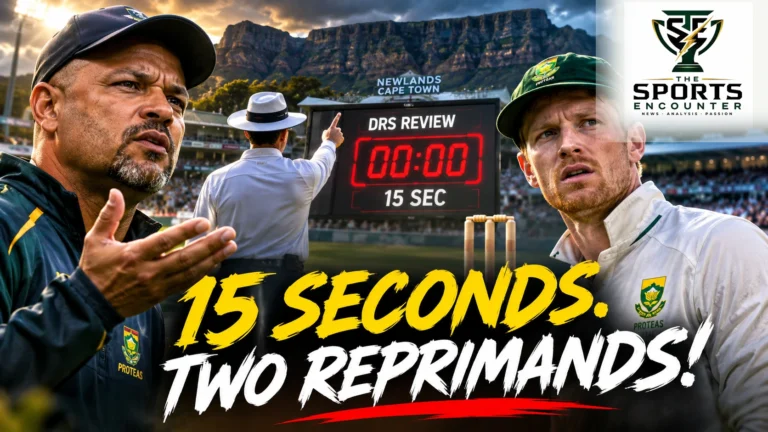
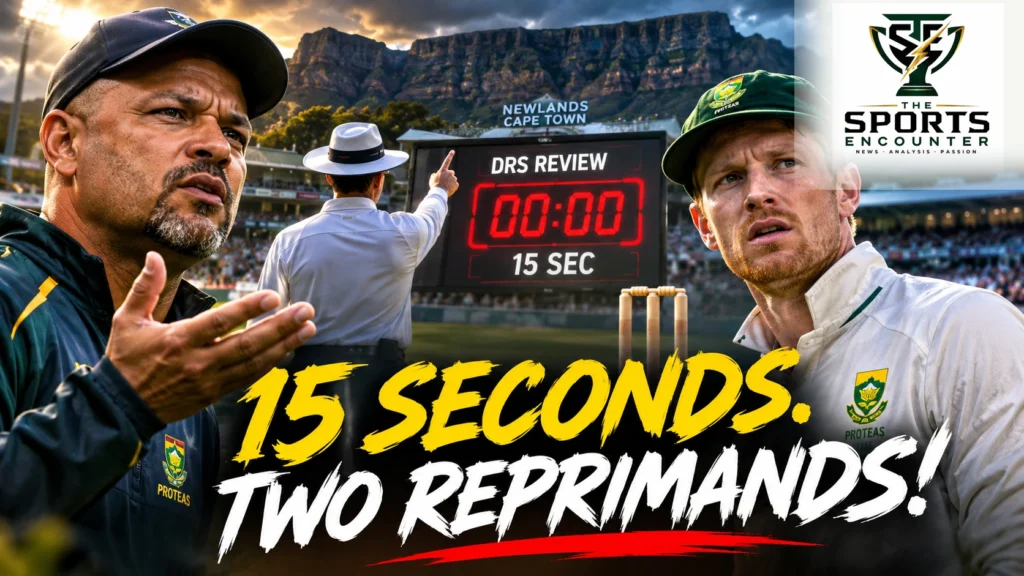
CAPE TOWN, South Africa, November 3, 2026: South Africa batting coach Ashwell Prince and wicketkeeper-batter Kyle Verreynne have received official reprimands and one demerit point each from the International Cricket Council after protesting the rejection of Marques Ackerman’s Decision Review System (DRS) request during the third Test against Australia at Newlands. The ICC announced the sanctions on Monday, November 2, confirming that both men breached Article 2.8 of its Code of Conduct on the third day of the match. Their conduct followed the umpires’ ruling that Ackerman had exceeded the permitted 15 seconds to challenge a caught dismissal.
Prince repeatedly challenged the timing decision, while Verreynne, who was not selected in South Africa’s playing XI, asked Ackerman to remain inside the boundary line, delaying his departure. Both admitted their Level 1 offenses and accepted the sanctions proposed by match referee Javagal Srinath, eliminating the need for formal hearings. Neither was suspended. The disciplinary action came after South Africa had recovered from an opening-Test defeat to win the three-match series 2-1, completing a remarkable 176-run victory at Cape Town and returning to the summit of the ICC Men’s Test Team Rankings.
Why Did the ICC Reprimand Ashwell Prince and Kyle Verreynne?
The disciplinary action arose from one incident but involved two separate contributions to the dispute.
Story at a glance
Why Did the ICC Reprimand Ashwell Prince and Kyle Verreynne?
The disciplinary action arose from one incident but involved two separate contributions to the dispute.
Ackerman’s DRS Incident: How the 15-Second Dispute Unfolded
The available ICC disciplinary release establishes the sequence but does not provide a synchronized, independently audited frame-by-frame countdown proving precisely when Ackerman made his initial signal.
What Does Cricket’s 15-Second DRS Rule Actually Say?
Under the ICC’s player-review procedure for Test cricket, a player must request a review within a defined period after the ball becomes dead.
DRS Timing: What the Rules Allow and What They Do Not
The ICC’s published Test player-review protocol explains the review request procedure and the 15-second requirement.
What Is Article 2.8 of the ICC Code of Conduct?
Article 2.8 concerns dissent at an umpire’s decision during an international match.
Read next South Africa’s Australian Comeback Puts WTC Final Within Reach, But Anything’s Possible Yet
South African opener Marques Ackerman was given out caught during the hosts’ second innings of the deciding Test.
He attempted to challenge the decision through DRS.
However, umpires Richard Illingworth and Richard Kettleborough determined that the request had not been made within the required 15 seconds.
They refused to permit the review.
Prince protested that the batter still had time to request it.
Verreynne, who was serving in a non-playing capacity rather than appearing in the XI, told Ackerman to remain inside the boundary as he departed.
According to the ICC, that instruction delayed the batter’s exit.
The governing body found both men responsible for showing dissent toward an umpiring decision.
What Did Prince Do?
Prince’s offense involved repeatedly challenging the umpires verbally over the availability of a review.
The ICC did not sanction him simply for disagreeing with the interpretation of the rule.
It sanctioned his conduct during the disagreement.
The distinction matters because coaches are entitled to have opinions about controversial decisions, but they remain subject to behavioral standards during international matches.
What Did Verreynne Do?
Verreynne was not part of the playing XI.
Nevertheless, he was involved in the incident when he encouraged Ackerman to remain inside the field boundary.
The resulting delay formed part of the conduct examined by match officials.
His absence from the playing XI did not place him outside the ICC’s disciplinary framework.
The Code of Conduct covers players and player support personnel, subject to its applicable definitions and provisions.
Ackerman’s DRS Incident: How the 15-Second Dispute Unfolded
| Sequence | What Happened | Why It Mattered |
|---|---|---|
| 1. On-field decision | Marques Ackerman was given out caught | Created an opportunity to request a player review |
| 2. Review attempted | Ackerman sought to challenge the dismissal | His request was subject to the DRS time limit |
| 3. Umpires’ ruling | The request was deemed too late | No player review was permitted |
| 4. Prince’s response | He repeatedly protested the timing decision | Contributed to the dissent charge |
| 5. Verreynne’s response | He asked Ackerman to remain inside the boundary | Delayed the batter leaving the field |
| 6. ICC investigation | Officials charged both under Article 2.8 | Initiated the disciplinary process |
| 7. Final outcome | Both accepted official reprimands and demerit points | No formal hearing was necessary |
The available ICC disciplinary release establishes the sequence but does not provide a synchronized, independently audited frame-by-frame countdown proving precisely when Ackerman made his initial signal.
That limitation is crucial.
The umpires determined that the request was late, and the disciplinary proceedings addressed the subsequent conduct of Prince and Verreynne.
The reprimands should therefore not be presented as an independent technical review of whether Ackerman originally signaled within 15 seconds.
What Does Cricket’s 15-Second DRS Rule Actually Say?
Under the ICC’s player-review procedure for Test cricket, a player must request a review within a defined period after the ball becomes dead.
The standard time allowance is 15 seconds.
The request is normally communicated using the familiar T-shaped signal.
The bowler’s-end umpire is expected to provide a prompt after approximately 10 seconds if a review has not yet been requested.
If the on-field umpires believe the request was made outside the permitted window, they can decline it.
The applicable protocol also contains provisions for certain caught-decision situations where an umpire review must first resolve whether the catch was fair.
Those provisions should not be confused with an unrestricted right to request a review at any time.
Why Does the ICC Impose a Time Limit?
The countdown serves several purposes.
It prevents extended delays after decisions, keeps the match moving and restricts opportunities for players to obtain additional outside information before deciding whether to challenge an umpire.
The rule also creates a consistent procedural expectation for both teams.
However, a short deadline increases the importance of clear communication.
A batter must decide quickly whether a challenge is worthwhile, often while recovering from the immediate disappointment of being dismissed.
That creates a legitimate debate about whether 15 seconds is the optimal period.
It does not establish that the rule was incorrectly applied in Cape Town.
DRS Timing: What the Rules Allow and What They Do Not
| Situation | General Rule | Practical Consequence |
|---|---|---|
| Review requested within the permitted period | Can proceed, subject to remaining requirements | Decision may be reviewed |
| Request judged outside the permitted period | Umpires can decline the player review | Original decision remains |
| Umpires give a 10-second prompt | Part of the normal timing procedure | Warns that time is nearly exhausted |
| Fair-catch umpire review affects the sequence | Specific exception may apply | Review timing follows the applicable protocol |
| Coach disagrees with the decision | Disagreement alone does not automatically reverse it | Conduct must remain within the Code |
| Non-playing participant intervenes improperly | Disciplinary rules may still apply | Being outside the XI is not automatic immunity |
The ICC’s published Test player-review protocol explains the review request procedure and the 15-second requirement.
For readers, the most important distinction is between challenging a dismissal through DRS and challenging an umpire’s decision about whether a review request is procedurally valid.
They are different questions.
What Is Article 2.8 of the ICC Code of Conduct?
Article 2.8 concerns dissent at an umpire’s decision during an international match.
The provision is part of the ICC Code of Conduct for Players and Player Support Personnel.
It allows disciplinary action when a participant’s behavior goes beyond acceptable disagreement or frustration.
The offenses attributed to Prince and Verreynne were classified as Level 1 breaches.
Both admitted the charges.
That meant the case could be resolved without a formal disciplinary hearing.
Were Prince and Verreynne Fined or Suspended?
The ICC announced official reprimands and one demerit point each.
It did not announce a monetary fine or suspension for either individual.
Level 1 offenses can carry penalties ranging from a reprimand to a fine of up to 50% of the applicable match fee, together with one or two demerit points.
The precise sanction depends on the case.
| Disciplinary Measure | Ashwell Prince | Kyle Verreynne |
|---|---|---|
| Offense | Article 2.8, dissent | Article 2.8, dissent |
| Breach level | Level 1 | Level 1 |
| Official reprimand | Yes | Yes |
| Demerit points added | 1 | 1 |
| Previous offenses in preceding 24 months | None reported by ICC | None reported by ICC |
| Fine announced | No | No |
| Immediate suspension | No | No |
| Admission of offense | Yes | Yes |
| Formal hearing required | No | No |
How Many Demerit Points Trigger an ICC Suspension?
The ICC uses a rolling 24-month disciplinary period.
When a player or relevant support person accumulates four or more demerit points during that period, the points are converted into suspension points under the applicable Code.
Two suspension points correspond to a suspension from one Test or two ODIs or two T20Is, whichever comes first under the applicable provisions.
The published ICC explanation also states that demerit points remain on the disciplinary record for 24 months before being expunged.
What Does One Demerit Point Mean for Prince and Verreynne?
Each now has one demerit point arising from the Cape Town incident.
That is below the four-point threshold.
Neither faces an immediate suspension from this ruling.
However, any further offenses within the relevant 24-month period could increase the accumulated total.
Importantly, another offense does not automatically carry exactly one point. The sanction depends on its nature and classification.
| Total Demerit Points Within 24 Months | General Position | Important Qualification |
|---|---|---|
| 1 | Below suspension threshold | Current position of Prince and Verreynne |
| 2 | Below threshold | Further misconduct remains punishable |
| 3 | Below threshold | Another sanction could trigger conversion |
| 4 or more | Points converted into suspension points | Duration governed by the applicable disciplinary provisions |
| 24-month period expires | Relevant points are expunged | Subject to the Code’s record-keeping rules |
There is an important distinction between an official reprimand and a playing suspension.
A reprimand is itself a disciplinary penalty.
A suspension is a more serious consequence that arises under the applicable rules and circumstances.
Describing Prince or Verreynne as having been banned would therefore be factually wrong.
Who Charged Prince and Verreynne, and Who Approved the Sanctions?
The charges were brought by the match’s four umpires.
Richard Illingworth and Richard Kettleborough served as the on-field officials.
Chris Gaffaney was the third umpire, while Lubabalo Gcuma was the fourth umpire.
Match referee Javagal Srinath of the Emirates ICC Elite Panel proposed the sanctions.
Both South African representatives accepted the findings and penalties.
The admissions removed the need for formal hearings.
This procedure is important because disciplinary cases do not necessarily require a lengthy hearing when the participants accept responsibility and the proposed sanction.
Why South Africa’s 2-1 Test Series Triumph Gives the Incident Added Significance
The disciplinary announcement followed one of South Africa’s most remarkable recent Test series victories.
Australia had won the first Test in Durban by 214 runs.
South Africa recovered through an innings-and-31-run victory in Gqeberha.
The series then moved to Cape Town, where the hosts completed a 176-run triumph after overturning a 100-run first-innings deficit.
The Sports Encounter’s complete Cape Town final-Test report reconstructs Simon Harmer’s ten-wicket match haul, South Africa’s second-innings recovery and Australia’s dramatic final collapse.
The reprimands did not reverse the match result or alter the confirmed series victory.
They were disciplinary consequences arising from the conduct of two South African team representatives during the contest.
How South Africa Recovered After Losing the First Test
Australia’s opening victory in Durban was built around Matt Renshaw’s outstanding batting and an effective bowling performance.
TSE’s Durban Test report explains how Renshaw helped Australia escape a difficult position and secure a 214-run victory.
South Africa answered in Gqeberha.
Captain Temba Bavuma scored 179 after his team had fallen to 110/6, supported by crucial lower-order contributions from Marco Jansen and Harmer.
Our detailed analysis of Bavuma’s rescue innings shows how South Africa transformed a likely first-innings disaster into a commanding position.
The hosts subsequently completed an innings victory.
TSE’s second-Test result and full analysis documents the partnerships, bowling performances and series consequences.
Why the Cape Town Test Produced More Than One Umpiring Controversy
The Ackerman incident was not the only disputed decision to attract attention during the series decider.
Australian batter Marnus Labuschagne was dismissed lbw by Kagiso Rabada after offering no shot to a delivery that moved back toward the stumps.
His review failed because the relevant ball-tracking projection supported retaining the original decision under the applicable DRS procedure.
TSE’s explanation of Labuschagne’s no-shot lbw dismissal examines the legal differences between a batter attempting a genuine stroke and one who shoulders arms.
However, the two incidents raise different questions.
Labuschagne’s involved the substantive requirements for an lbw dismissal.
Ackerman’s involved the deadline for requesting a review of a caught decision.
The ICC sanctions against Prince and Verreynne then concerned conduct toward the umpires.
Combining these issues into a single allegation that the technology failed would be misleading.
Decision Review System Versus Code of Conduct: Three Different Questions
| Question | Relevant Standard | What the Cape Town Evidence Establishes |
|---|---|---|
| Was Ackerman out caught? | Cricket laws and available evidence of the dismissal | On-field dismissal stood without player review |
| Was the review request in time? | ICC DRS timing procedure | Umpires ruled it was late |
| Did Prince and Verreynne act improperly? | Article 2.8 of the ICC Code of Conduct | Both admitted Level 1 offenses |
| Could the sanctions alter the match? | Separate disciplinary process | No match-result reversal was announced |
The distinctions are central to understanding the case.
Even if observers disagree with the original timing decision, the participants remain responsible for complying with applicable standards of conduct.
Conversely, accepting a dissent charge is not the same as acknowledging that every detail of an umpiring decision was technically correct.
South Africa’s New World No. 1 Position Adds a Leadership Test
The Cape Town victory returned South Africa to the top of the ICC Men’s Test Team Rankings.
It also strengthened their position in the 2025-27 World Test Championship standings.
That success makes the disciplinary incident an important leadership issue, even though the penalties themselves are relatively modest.
Teams competing at the highest level must manage difficult decisions without escalating disputes or causing avoidable delays.
For coaching personnel, the challenge is particularly important.
Coaches influence team behavior, especially when players feel aggrieved.
Prince’s role therefore creates a legitimate question about how senior staff should communicate concerns while preserving professional boundaries.
The same principle applies to non-playing squad members.
Verreynne’s presence outside the XI did not remove the need for appropriate conduct.
Could the Reprimands Affect South Africa’s Next Test Series?
The sanctions do not automatically prevent either man from being involved in future international matches.
Both received official reprimands, not bans.
However, their demerit points remain relevant during the ICC’s rolling disciplinary period.
Further misconduct could therefore create additional consequences.
The immediate cricketing challenge for South Africa is to maintain the standards that produced the series victory.
For Australia, the defeat has already triggered a separate selection review.
Head coach Andrew McDonald has acknowledged questions surrounding the position of Marnus Labuschagne ahead of the December home series against New Zealand.
TSE’s analysis of Australia’s selection dilemma examines the consequences of the defeat without confusing those issues with South Africa’s disciplinary case.
Why Cricket’s Review Procedures Deserve Scrutiny Beyond This Incident
Ackerman’s rejected request invites an important policy discussion about the relationship between speed and accuracy.
The 15-second rule provides consistency and limits unnecessary delays.
But it also requires an immediate decision from a batter who may not have had a clear view of whether the ball touched the bat, glove or ground.
That tension is especially apparent during caught dismissals.
Could a Longer Review Window Improve the System?
A longer period might give players additional time to make informed decisions.
However, it could also increase delays or create more opportunities to seek outside guidance.
Neither outcome should be assumed without evidence.
An evidence-based review would examine how frequently legitimate review requests are declined for lateness, whether existing prompts are consistently administered and how any change affects match duration.
It would also consider whether the current process is communicated clearly enough to spectators watching the broadcast.
The case does not demonstrate that the entire DRS framework is defective.
It does provide a practical example of why procedural transparency matters.
Continue the Cricket Story
 CricketSouth Africa Recall De Zorzi and Hamza for Bangladesh Tests, but Bedingham’s Omission Raises a Big Question
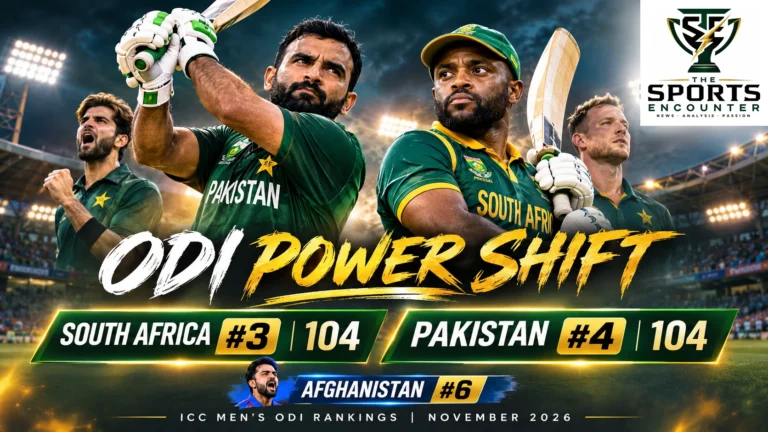 CricketPakistan Close on South Africa in ODI Rankings After Lahore Triumph, but World Cup Test Lies Ahead
 CricketAustralia Face a Marnus Labuschagne Reckoning as McDonald Orders Selection Review Before NZ Tests
Why the Newlands Crowd and Test Cricket’s Reputation Also Matter
Cricket’s public confidence depends not only on good umpiring but also on understandable rules and appropriate reactions when disagreements occur.
The South Africa-Australia series had already generated debate about attendance and the presentation of Test cricket.
TSE’s investigation into Durban’s disappointing crowds examined why a high-profile series involving the World Test Championship holders attracted unexpectedly modest attendance.
Those concerns continued in Cape Town.
Our analysis of the Newlands attendance problem asked how cricket administrators can make Test matches more accessible and compelling to spectators.
There is no evidence that the Prince-Verreynne incident caused those crowd problems.
The connection is broader: clear decision-making and good conduct form part of how cricket maintains trust among supporters.
South Africa’s Cape Town Comeback: The Match Context Behind the Incident
The timing of Ackerman’s dismissal matters because South Africa were fighting back from a 100-run first-innings deficit.
Australia had scored 429 in reply to South Africa’s 329.
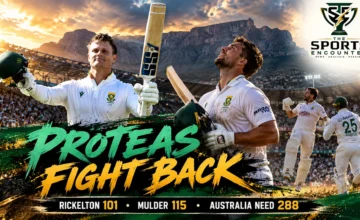
Rickelton and Wiaan Mulder then produced centuries as the hosts built their second-innings total to 387.
The recovery left Australia needing 288 to win the Test and series.
TSE’s fourth-day report from Newlands explains how the second-innings partnerships transformed the match before the final day’s bowling collapse.
South Africa eventually dismissed Australia for 111.
Simon Harmer took six wickets in the final innings and ten across the match.
The hosts won by 176 runs.
That result remains intact, irrespective of the separate ICC disciplinary action.
ICC Reprimands Prince and Verreynne: Frequently Asked Questions
Why Were Ashwell Prince and Kyle Verreynne Reprimanded?
They were sanctioned for showing dissent after the umpires refused Marques Ackerman’s late DRS request during the Cape Town Test.
What Did Prince Do?
The ICC found that he repeatedly protested the umpires’ timing decision.
What Did Verreynne Do?
He asked Ackerman to remain within the boundary, delaying the batter’s departure after dismissal.
Was Verreynne Playing in the Test?
No. He was not selected in the playing XI.
How Long Does a Batter Have to Request DRS?
The standard ICC player-review window is 15 seconds, subject to the relevant protocol and specified exceptions.
Did Either Man Receive a Fine?
The ICC announced official reprimands and one demerit point each. No monetary fine was announced.
Were They Suspended?
No. Neither received an immediate suspension.
What ICC Rule Did They Breach?
Article 2.8 of the Code of Conduct for Players and Player Support Personnel.
Who Was the Match Referee?
Javagal Srinath, a member of the ICC Elite Panel of Match Referees.
When Can Demerit Points Lead to a Suspension?
Four or more demerit points accumulated within a 24-month period trigger conversion into suspension points under the applicable ICC provisions.
Did the Sanctions Change the Test Result?
No. South Africa’s 176-run victory and 2-1 series win remain unchanged.
Did the ICC Rule That Ackerman’s Review Was Incorrectly Rejected?
No. The published disciplinary announcement does not establish that the umpires misapplied the 15-second review rule.
Fifteen Seconds Sparked the Protest, but the ICC’s Decision Was About Conduct
South Africa completed the series against Australia with an extraordinary sporting achievement.
After losing heavily in Durban, the hosts fought back in Gqeberha and Cape Town to win 2-1 and reclaim the world’s top Test ranking.
The reprimands issued to Prince and Verreynne do not diminish the verified result.
But they illustrate how quickly a disputed review can become a disciplinary matter.
Ackerman sought to challenge his dismissal.
The umpires ruled that the request was too late.
Prince protested, and Verreynne intervened in the batter’s departure.
The ICC treated their behavior as dissent, and both accepted responsibility.
The immediate consequences are limited to official reprimands and one demerit point each.
The broader lesson concerns the separation of three issues: whether a dismissal is correct, whether a review is procedurally valid and whether participants respond appropriately to the umpire’s ruling.
Each requires its own evidence.
The current rules provide a defined review window and penalties for misconduct.
Whether that review window should eventually change is a separate policy question.
For now, the result is clear.
South Africa remain the series winners, and Prince and Verreynne carry disciplinary points that could become important if they commit further breaches within the relevant period.
Official sources: The ICC’s November 2 disciplinary announcement confirms the incident, penalties and admissions; the ICC’s published Test DRS procedure explains the 15-second review requirement; and the ICC Code of Conduct resource provides the disciplinary framework.