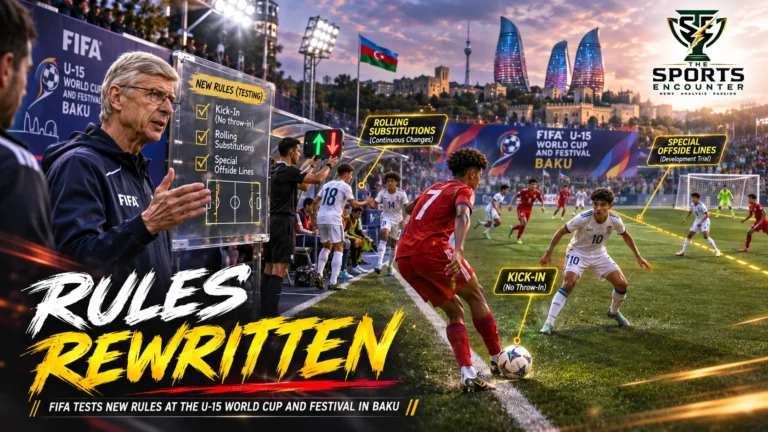
Key Takeaways
- Matches were played with eight players per team, lasted 40 minutes and took place on smaller pitches with full-size goals.
- Instead of applying the usual halfway-line restriction, FIFA marked special offside lines 14 meters from each goal line.
- One particularly unusual decision illustrates how different this tournament was from a conventional World Cup.
- FIFA has already outlined plans to expand the U-15 festival concept beyond the inaugural boys’ competition.
BAKU, Azerbaijan, November 3, 2026: FIFA has completed one of the most ambitious youth soccer experiments in its history, testing unlimited rolling substitutions, kick-ins instead of throw-ins and offside lines just 14 meters from each goal during the inaugural FIFA U-15 World Cup & Festival in Baku. The October 24-30 competition brought together 189 national teams, produced 4,505 goals across 932 matches and gave thousands of young players an unfamiliar version of the sport. Under the guidance of Arsène Wenger, FIFA’s Chief of Global Football Development, the tournament prioritized playing time, technical development and international experience over the traditional structure of an elite knockout competition.
The experiment ended with Spain defeating Czechia 3-0 to become the inaugural Tier A champion, while five other nations collected titles in separate competitive tiers. The event averaged 4.83 goals per match and gave 187 of the 189 participating teams at least one victory. Those figures suggest that the festival succeeded in creating widespread opportunities for meaningful competition, although they do not establish that the modified rules directly increased scoring. The larger question now concerns what FIFA learned from the experiment, whether smaller fields and alternative restarts genuinely improve player development, and whether any of the ideas could eventually influence soccer beyond the U-15 level.
What New Rules Did FIFA Test at the U-15 World Cup in Baku?
FIFA’s experimental format altered several familiar features of association football.
Story at a glance
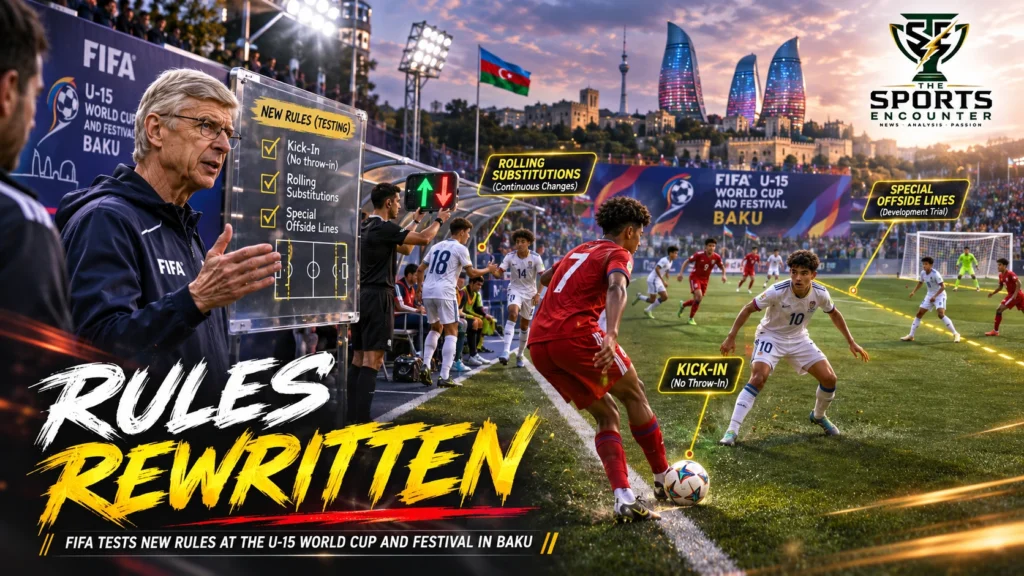
What New Rules Did FIFA Test at the U-15 World Cup in Baku?
FIFA’s experimental format altered several familiar features of association football.
How Did FIFA’s 14-Meter Offside Rule Actually Work?
The offside adjustment was arguably the tournament’s most tactically significant experiment.
Why Did FIFA Replace Throw-Ins With Kick-Ins?
The replacement of throw-ins with kick-ins was another visible change.
Unlimited Substitutions: Why Wenger Wanted More Children Playing
The experimental substitution system supported the tournament’s central objective of maximizing participation.
Did the Experimental Rules Make the U-15 World Cup More Attacking?
The tournament was undeniably high-scoring.
Read next Crisis Plagues FIFA as Wenger, Grafstrom and Federations Break Ranks
Matches were played with eight players per team, lasted 40 minutes and took place on smaller pitches with full-size goals. Players could be substituted repeatedly, and the traditional throw-in disappeared from the tournament.
Perhaps the most intriguing change concerned offside.
Instead of applying the usual halfway-line restriction, FIFA marked special offside lines 14 meters from each goal line.
That meant attackers could operate across a much larger part of the pitch without entering the modified offside zone.
| Rule or feature | Standard senior soccer | FIFA U-15 Baku experiment | Development purpose |
|---|---|---|---|
| Players on field | 11 per team | 8 per team | More opportunities for individual involvement |
| Match duration | Two 45-minute halves | Two 20-minute halves | More matches against different opponents |
| Pitch | Usually around 105m × 68m internationally | Approximately 68m × 47m | More frequent interactions in reduced space |
| Goal dimensions | 7.32m × 2.44m | Full-size goals retained | Maintain realistic finishing targets |
| Sideline restart | Throw-in | Kick-in | Encourage ball-based restarts |
| Substitutions | Competition-limited substitutions | Unlimited rolling substitutions | Distribute playing opportunities and manage workload |
| Offside | Relevant in the opponents’ half | Applied beyond lines 14m from each goal line | Permit greater attacking movement |
The modified rules were confirmed in FIFA’s official explanation of the experimental tournament format, published before the competition.
These were competition-specific playing conditions. They did not automatically change the Laws of the Game used in professional leagues, international senior matches or the FIFA World Cup.
How Did FIFA’s 14-Meter Offside Rule Actually Work?
The offside adjustment was arguably the tournament’s most tactically significant experiment.
In conventional soccer, a player may be penalized for an offside offense in the opponents’ half when the relevant positioning and involvement conditions are satisfied.
In Baku, the offside restriction was moved substantially closer to the goal.
Two specially marked lines, each 14 meters from its respective goal line, created the zones where the modified offside rule applied.
Why Could This Change Attacking Movement?
Consider a forward positioned 20 meters from the opposition goal.
Under the modified Baku arrangement, that forward would be outside the special 14-meter offside zone.
Under conventional senior rules, the same player might be in an offside position depending on the ball, defenders and the halfway line.
That change could allow attackers to occupy more advanced positions before the offside restriction becomes relevant.
Defenders would consequently have to reconsider where to hold their line and how to protect the space behind them.
The potential tactical consequences include longer forward passing options, more opportunities for attacking runs and different defensive spacing.
However, these are plausible effects of the rule structure. They should not be presented as measured tournament outcomes without positional tracking or comparable match data.
Does the Rule Remove Offside Entirely?
No.
Offside remained part of the competition. The location where it became applicable changed.
Once an attacker entered the specially marked zone near the opposition goal, the tournament’s offside provisions still applied.
This distinction is particularly important because claims that FIFA completely abolished offside during the Baku event would be inaccurate.
The experiment instead explored how moving the restriction closer to goal might influence player positioning and attacking decisions.
Why Did FIFA Replace Throw-Ins With Kick-Ins?
The replacement of throw-ins with kick-ins was another visible change.
When the ball crossed the touchline, a player could restart play by kicking it from the appropriate position rather than throwing it with both hands.
The idea fitted FIFA’s broader emphasis on developing soccer-specific technical skills.
A kick-in creates another opportunity to use the feet for passing, delivery and decision-making.
It could also change how defending teams organize against sideline restarts.
For example, a player near the touchline may be able to deliver the ball toward teammates through a different passing trajectory than a conventional throw-in.
The precise tactical effect depends on the competition’s restart procedures, defensive organization and player choices.
There is a reasonable coaching debate here.
Supporters may argue that foot-based restarts increase technical involvement and reduce the interruption associated with a traditional throw.
Critics may argue that throw-ins are already an established technical element of soccer, with their own tactical demands and skills.
Neither interpretation can be settled solely by observing that the tournament produced a high number of goals.
Unlimited Substitutions: Why Wenger Wanted More Children Playing
The experimental substitution system supported the tournament’s central objective of maximizing participation.
Teams could make unlimited rolling substitutions, allowing coaches to rotate players without being restricted to the substitution limits familiar in senior competitions.
This offered several practical benefits.
Coaches could distribute playing time, respond to fatigue and give substitutes opportunities to experience competitive situations against opponents from different football cultures.
The format also reduced the need to treat every substitution as an irreversible tactical decision.
For young players, that is important because development does not always follow a predictable pattern.
A player who struggles in one match may benefit from further opportunities against a different opponent.
Another may need additional time to adapt to a playing style encountered for the first time.
Wenger’s central argument was that children develop when they are given meaningful opportunities to play, compete and learn.
In his official tournament assessment, Wenger emphasized exposure to different opponents and the benefits of an inclusive international environment.
That philosophy also explains why FIFA built the competition around an unusually large number of short games.
Did the Experimental Rules Make the U-15 World Cup More Attacking?
The tournament was undeniably high-scoring.
FIFA’s completed statistics recorded 4,505 goals in 932 matches, an average of 4.83 goals per game.
The highest-scoring individual match produced 21 goals.
Those numbers provide a clear starting point for evaluating the competition.
| Measure | Official tournament figure | What it tells us |
|---|---|---|
| Teams participating | 189 | Exceptionally broad international representation |
| Matches completed | 932 | Large number of competitive opportunities |
| Total goals | 4,505 | Substantial overall attacking output |
| Average goals per game | 4.83 | Nearly five goals per 40-minute match |
| Highest-scoring match | 21 goals | Some fixtures featured extreme scoring |
| Teams winning at least once | 187 of 189 | Most participants experienced a victory |
| Countries making first global youth appearance | 78 | Opportunities extended to new participants |
The Sports Encounter statistical analysis: Dividing 4,505 goals by 932 matches produces 4.8337 goals per match, rounded to 4.83.
Because the games lasted 40 minutes, this equates to approximately 10.87 goals per 90 minutes as a mathematical rate conversion.
That figure should not be interpreted as a prediction of how many goals the same players would score in a 90-minute match.
It simply standardizes the observed scoring rate by playing time.
Smaller teams, reduced pitch dimensions, different goal-to-pitch proportions, varied opponent strengths and developmental priorities could all have contributed to the scoring pattern.
Without a controlled comparison, it is impossible to assign the increase to any individual rule.
FIFA’s official tournament statistics provide the verified underlying figures.
Spain Won the World Cup, but Why Were There Six Champions?
The competition’s unusual structure created another question that conventional match reports can easily leave unanswered.
Why did the inaugural FIFA U-15 World Cup have six championship winners?
The answer lies in its development-focused format.
FIFA divided the tournament into an initial qualification phase and a subsequent tournament phase.
Teams competed against opponents from varied footballing backgrounds before being placed into one of six performance tiers.
Each tier then produced its own champion.
The Tier A winner received the overall inaugural FIFA U-15 World Cup & Festival title.
Spain claimed that honor by defeating Czechia 3-0 on October 30.
Zambia, Belarus, Tajikistan, Central African Republic and New Zealand won the remaining tiers.
| Competition tier | Winner | Runner-up | Final result |
|---|---|---|---|
| Tier A | Spain | Czechia | 3-0 |
| Tier B | Zambia | Portugal | 5-2 |
| Tier C | Belarus | Tunisia | 3-0 |
| Tier D | Tajikistan | Canada | 4-2 |
| Tier E | Central African Republic | Bangladesh | 4-1 |
| Tier F | New Zealand | Ethiopia | 2-1 |
Spain won all ten matches during its campaign, establishing an unbeaten championship record.
Its victory continued a remarkable sequence of Spanish international success following the senior men’s World Cup title earlier in 2026.
That senior triumph and its historical context were explored in The Sports Encounter’s 2026 World Cup coverage and tournament calendar.
Yet the other five tier victories were meaningful in a different way.
They gave teams from multiple confederations opportunities to win matches and compete for honors against opponents of more comparable competitive strength.
That structure was central to FIFA’s philosophy.
Why FIFA Did Not Publish One Final Ranking of All 189 Teams
One particularly unusual decision illustrates how different this tournament was from a conventional World Cup.
FIFA did not publish an official overall final ranking of all 189 teams.
The governing body explained that a single ranking would not adequately represent the purpose of the competition or the different levels of opposition faced by teams across the six tiers.
This is an important distinction.
Spain’s Tier A championship was the tournament’s highest honor, but the performances of teams in the remaining tiers were not intended to be reduced to a simple list of places from first to last.
Unlike a conventional knockout competition, teams continued participating after the initial phase rather than being eliminated and sent home.
That allowed young players to accumulate further competitive experience even when their results were weaker.
It also produced a format in which success could mean improvement, meaningful competition and participation rather than only progression toward a single final.
For comparison, our explanation of the senior FIFA World Cup’s 48-team qualification structure shows how conventional tournaments use group positions to determine entry into knockout rounds.
The U-15 festival followed a different principle by keeping all teams involved until the concluding matchday.
Why the Tournament Gave Smaller Soccer Nations More Opportunities
The presence of 189 participating teams was among the event’s most significant achievements.
FIFA reported that 78 member associations were making their first appearance at a FIFA World Cup at any age level.
That expanded international opportunities for countries that rarely qualify for major global tournaments.
The impact extended beyond the field.
Players were housed in shared accommodation, exposed to different cultures and given opportunities to participate in educational activities.
FIFA also reported that approximately 700 participants were leaving their home countries for the first time.
Those experiences are difficult to capture through a scoreboard.
However, they are central to the tournament’s objective of making international youth development less dependent on the competitive strength and resources of established football nations.
Wenger has consistently argued that identifying talent requires creating opportunities for young players to test themselves against international opposition.
His wider involvement in development policy was previously examined in our report on Wenger’s role in global football development discussions.
What Did the Six Confederations Achieve in Baku?
The tournament’s results reveal the breadth of participation across FIFA’s six continental confederations.
African teams recorded the highest number of victories, followed by European and Asian teams.
Those raw totals must be interpreted carefully because the confederations entered different numbers of teams.
| Confederation | Participating teams | Total victories | Wins per participating team |
|---|---|---|---|
| CAF (Africa) | 52 | 234 | 4.50 |
| UEFA (Europe) | 37 | 213 | 5.76 |
| AFC (Asia) | 45 | 183 | 4.07 |
| Concacaf | 34 | 111 | 3.26 |
| CONMEBOL (South America) | 10 | 57 | 5.70 |
| OFC (Oceania) | 11 | 20 | 1.82 |
The Sports Encounter calculation: Wins per participating team equals each confederation’s total victories divided by its number of participating teams.
For example, Europe’s 213 victories divided by 37 teams produce approximately 5.76 wins per participating team.
South America’s 57 victories from ten teams produce 5.70.
This is a descriptive comparison, not an official confederation ranking.
Match difficulty, opponent distribution, tier placement and the exact number of matches played can all affect the figures.
Nevertheless, they demonstrate why raw victory totals alone can mislead when evaluating a tournament with uneven participation across confederations.
Could FIFA Introduce Kick-Ins or New Offside Lines Into Professional Soccer?
The Baku experiment has prompted speculation about whether similar rules might eventually influence the wider game.
There is a significant distinction between testing modified conditions in a youth development competition and implementing new Laws of the Game for professional soccer.
The International Football Association Board, commonly known as IFAB, governs changes to the global Laws of the Game.
FIFA’s decision to use modified rules in Baku does not mean that kick-ins or the 14-meter offside restriction have been approved for the Premier League, Champions League or senior World Cup.
Any broader proposal would require an appropriate regulatory and evaluation process.
The questions would include:
- Would kick-ins increase useful attacking play or simply encourage more long deliveries into crowded penalty areas?
- Would a shorter offside zone improve attacking movement while retaining a fair balance between offense and defense?
- Could rolling substitutions improve player welfare without disrupting the competitive rhythm of senior matches?
- Would results from eight-a-side youth football translate meaningfully to 11-a-side professional soccer?
These are genuine evaluation questions. The Baku tournament provides useful observations, but its format is too different from elite senior soccer to establish answers automatically.
The broader issue of how FIFA’s decisions affect competitive fairness has been explored in our reporting on the 2026 World Cup rules controversy involving the United States and Belgium.
That story concerned a different regulatory issue, but it demonstrates why changes to competition rules can have consequences well beyond an individual match.
What Fans Have Right and Wrong About FIFA’s Baku Experiment
Some fans have welcomed the idea of giving young players more touches, shorter games and greater opportunities to learn against different opponents.
Others have questioned whether changing familiar rules risks producing a version of soccer that looks too different from the senior game.
Those concerns deserve consideration, but neither side should confuse the competition’s developmental purpose with an immediate plan to rewrite professional soccer.
FIFA designed the Baku event around player experience.
The offside adjustment, substitution system and smaller teams were intended to produce more meaningful involvement for young footballers.
Whether individual rule changes should be adopted elsewhere depends on evidence about player development, tactical learning, injury risk, match quality and competitive balance.
There is also an important distinction between increased scoring and improved development.
A high-scoring match may create more attacking actions, but goals alone cannot establish whether players improved their passing decisions, positioning or tactical understanding.
The most useful evaluation would compare measurable developmental outcomes against an appropriate conventional youth tournament or a controlled alternative format.
How Does the Baku Experiment Compare With FIFA’s Expanded World Cup Philosophy?
FIFA’s recent competition reforms share an interest in expanding access, although they operate through different structures.
The men’s 2026 World Cup expanded to 48 teams and introduced a Round of 32.
That allowed additional teams, including eight third-place finishers, to continue into the knockout phase.
The unusual qualification mechanism was explained in our preview of the World Cup’s Lucky 8 teams.
The subsequent results, examined in our review of those third-place qualifiers, showed that additional opportunities do not necessarily translate into equal competitive success.
The U-15 festival took inclusion further by ensuring that every team remained involved through the final day.
That created more matches for developing players, but without requiring the event to follow a conventional elimination model.
The distinction matters for evaluating whether FIFA achieved what it set out to accomplish.
The senior World Cup primarily determines a world champion through elite international competition.
The U-15 festival also crowned a champion, but placed greater emphasis on development and widespread participation.
What Happens Next for FIFA’s U-15 World Cup?
FIFA has already outlined plans to expand the U-15 festival concept beyond the inaugural boys’ competition.
A girls’ edition is planned for 2027, with annual boys’ and girls’ competitions intended from 2028 onward.
The next major test will be whether FIFA can preserve the developmental benefits while improving logistical efficiency and using the lessons from Baku to refine the tournament format.
The competition’s scale was extraordinary.
Organizers needed 20 pitches, coordinated hundreds of matches and accommodated thousands of participants in a concentrated period.
Those operational demands create another layer of evaluation beyond the playing rules.
FIFA must consider whether its proposed long-term tournament model provides meaningful playing time while remaining practical for national associations with different financial, travel and coaching resources.
Questions about wider access to football development funding have also featured in The Sports Encounter’s reporting on FIFA’s proposed development support for member associations.
Funding and tournament design are separate issues, but both affect whether smaller nations can provide their young players with regular international opportunities.
Continue the Soccer Story
 Premier LeagueBarcelona vs Aston Villa: Can Emery Exploit Flick’s High Line in Champions League Showdown?
 SoccerTenerife Star Jesús de Miguel in Intensive Care After Terrifying Collision Forces Andorra Match to Be Abandoned at 2-2
 FIFA World Cup 2026FIFA Opens Files on Scrapped $20B World Cup Deal, but UEFA’s Fight With Infantino Is Far From Over
Frequently Asked Questions
What new rules did FIFA use at the U-15 World Cup in Baku?
FIFA used eight-a-side matches, two 20-minute halves, unlimited rolling substitutions, kick-ins instead of throw-ins and modified offside lines positioned 14 meters from each goal line.
Did FIFA abolish the offside rule?
No. Offside remained in effect, but its application was restricted to specially marked zones closer to the goals.
Why were throw-ins replaced by kick-ins?
The change formed part of FIFA’s effort to increase foot-based technical interactions and create a development-focused playing environment.
How many teams participated in the tournament?
A total of 189 national teams participated in the inaugural competition.
How many goals were scored?
FIFA recorded 4,505 goals in 932 matches, an average of 4.83 per game.
Who won the 2026 FIFA U-15 World Cup?
Spain won the overall Tier A championship by defeating Czechia 3-0 in the final on October 30, 2026.
Why were there six champions?
FIFA organized the tournament into six competitive tiers, each producing its own winner. Tier A determined the overall World Cup champion.
Will FIFA introduce kick-ins into professional soccer?
No general change has been established by this tournament. The kick-in experiment was part of the competition-specific U-15 playing conditions, and wider changes would require the appropriate rulemaking process.
Is there a girls’ U-15 World Cup?
FIFA plans to introduce a girls’ edition in 2027 and hold annual boys’ and girls’ competitions from 2028 onward.
The Sports Encounter Verdict: The Real Innovation Was Giving Every Young Player More Football
The most memorable features of FIFA’s Baku experiment were its unusual rules.
Kick-ins, rolling substitutions and radically different offside markings attracted attention because they challenged assumptions about how soccer should be played.
But the tournament’s strongest achievement may have been its structure.
Almost every participating nation recorded a victory. Teams continued playing until the final day. Players encountered opponents from different confederations, and many experienced international competition for the first time.
Spain earned the overall title through an unbeaten campaign, while five other nations won their respective competitive tiers.
The 4,505 goals demonstrated the tournament’s attacking character, although they do not prove that any particular rule should be transferred to professional soccer.
FIFA now has an opportunity to examine which elements genuinely improve youth development, which need adjustment and which belong specifically in small-sided competition.
For Wenger, the central objective remains straightforward: give talented young players meaningful opportunities to compete, learn and develop.
That ambition may ultimately prove more important than whether elite professional soccer ever adopts a 14-meter offside line.
For further analysis of international tournaments, rule changes and the development of the global game, follow The Sports Encounter’s soccer coverage.