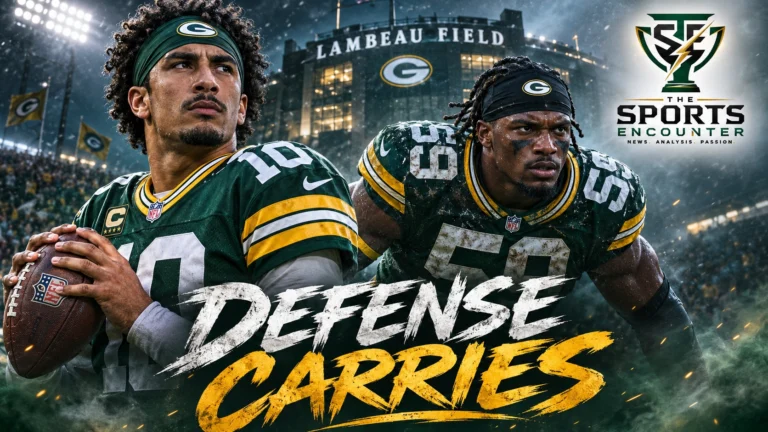
GREEN BAY, United States, November 1, 2026: The Green Bay Packers have won four of their last five NFL games and climbed to 5-3, but their resurgence is revealing an uncomfortable imbalance. Jonathan Gannon’s defense has surrendered just 73 points across that five-game stretch, the franchise’s best defensive scoring sequence since 2021, while the offense remains last in the NFL in rushing production. Thursday’s 27-19 victory over the Carolina Panthers at Lambeau Field provided the clearest illustration yet: Jordan Love threw three touchdowns, Green Bay’s defense recorded six sacks, and the Packers survived three turnovers despite rushing for only 66 yards against the league’s lowest-ranked run defense.
Linebacker Ty’Ron Hopper delivered an interception, a sack and three passes defended, joining Charles Woodson as the first Packers player since 2009 to produce that statistical combination in one game. Christian Watson returned from a hospital evaluation and played through a broken rib to finish with 113 receiving yards, while Josh Jacobs scored two touchdowns despite gaining just 39 yards on 21 rushing attempts. The victory strengthened Green Bay’s playoff position, but it also exposed a problem that could become increasingly damaging in the crowded NFC North: the Packers are winning because their defense repeatedly rescues an offense that cannot reliably control games on the ground.
TL;DR: Five Things the Packers’ 5-3 Record Is Hiding
- Defensive resurgence: Green Bay has allowed 73 points across its last five games, an average of 14.6 per contest.
- Run-game crisis: The Packers gained only 66 rushing yards from 26 attempts against Carolina, averaging 2.54 yards per carry.
- Jordan Love’s production: The quarterback completed 30 of 41 passes for 288 yards and three touchdowns.
- Ty’Ron Hopper’s breakthrough: The linebacker contributed an interception, a sack, three passes defended and eight tackles.
- Playoff question: Green Bay is 5-3, but a demanding NFC North schedule and the inability to protect leads through rushing remain significant concerns.
The Sports Encounter covered the complete game in our Packers-Panthers Week 8 match report. This analysis examines what the result reveals about Green Bay’s longer-term competitiveness.
Story at a glance
TL;DR: Five Things the Packers’ 5-3 Record Is Hiding
The Sports Encounter covered the complete game in our Packers-Panthers Week 8 match report. This analysis examines what the result reveals about Green Bay’s longer-term competitiveness.
Green Bay’s Defensive Revival Is Real, but the Offensive Imbalance Is Also Real
Five-game samples are not sufficient to guarantee future performance, but they can reveal important trends.
Packers 27-19 Panthers: How the Defense Prevented a Late Collapse
The Packers appeared comfortably positioned when they established a 27-10 lead during the third quarter.
Ty’Ron Hopper Is Becoming Green Bay’s Most Important Defensive Discovery
Injuries can expose a roster’s weaknesses.
Jonathan Gannon’s Defense Is Thriving Without Several Important Players
Defensive coordinator Jonathan Gannon has had to operate without a fully healthy roster.
Green Bay’s Defensive Revival Is Real, but the Offensive Imbalance Is Also Real
Five-game samples are not sufficient to guarantee future performance, but they can reveal important trends.
Green Bay’s latest sequence offers compelling evidence that its defense has become the most reliable part of the team.
The Packers have conceded only 73 points across their last five games.
That works out to 14.6 points per game, an outstanding figure in a league designed to encourage offense.
It is also Green Bay’s lowest points conceded across a five-game span since 2021.
That season, the Packers earned the NFC’s No. 1 playoff seed.
The historical comparison is encouraging, but it should not be interpreted as evidence that this team is destined to repeat the achievement.
The present Packers face a different division, different opponents and significant personnel changes.
Most importantly, their offensive balance is considerably weaker than the kind of complementary football generally associated with sustainable championship contention.
| Packers Performance Indicator | Verified Figure | Competitive Significance |
|---|---|---|
| Season record after Week 8 | 5-3 | Above .500 in a competitive NFC North |
| Last five games | 4 wins, 1 loss | Strong recent form |
| Points allowed in five games | 73 | Best five-game defensive scoring stretch since 2021 |
| Average points conceded | 14.6 per game | Strong defensive output |
| Season takeaways | 15 | Already exceeded all of 2025 |
| 2025 season takeaways | 14 | Benchmark surpassed after eight games |
| Rushing offense | Last in NFL | Persistent offensive weakness |
| Week 8 rushing output | 66 yards on 26 attempts | Only 2.54 yards per attempt |
TSE statistical insight: Green Bay has already generated more takeaways in eight games this season than it managed throughout 2025. That indicates a meaningful improvement in turnover production, although the defense still needs to sustain this performance against stronger offenses.
Packers 27-19 Panthers: How the Defense Prevented a Late Collapse
The Packers appeared comfortably positioned when they established a 27-10 lead during the third quarter.
Love was finding receivers, the defense was creating pressure and Carolina was struggling to protect quarterback Bryce Young.
But the closing stages exposed the cost of Green Bay’s inability to run effectively.
The Packers failed to score in the fourth quarter.
Love threw an interception, the offense produced consecutive unsuccessful possessions and Carolina gradually reduced the deficit.
Young found Jalen Coker for a 26-yard touchdown on fourth down with 5:37 remaining.
The Panthers failed on the subsequent two-point conversion, leaving Green Bay ahead 27-19.
Carolina still had opportunities to equalize.
The Packers’ defense prevented that from happening.
Two Fourth-Down Stops Prove Decisive
Green Bay produced two particularly important fourth-down stops during the second half.
The first came when rookie defensive tackle Chris McClellan and safety Evan Williams helped prevent Chuba Hubbard from converting fourth-and-two near midfield.
That stop gave Green Bay the opportunity to extend its lead.
The Packers converted the ensuing possession into a Josh Jacobs receiving touchdown, moving ahead 27-10.
Later, with Carolina trailing by eight points, Young faced fourth-and-five near midfield.
Green Bay forced the quarterback from his preferred passing position, and his attempt over the middle fell incomplete.
The Panthers’ final possession ended without a realistic opportunity to change the result.
It was an important demonstration of defensive resilience.
The offense had failed to produce the yardage necessary to finish the contest comfortably.
The defense therefore had to protect the lead without additional scoring support.
Six Sacks and Consistent Pressure on Bryce Young
Green Bay recorded six sacks against Young.
Six different defenders contributed a sack, demonstrating the variety of the Packers’ pass rush.
Young completed 23 of 41 passes for 209 yards, one touchdown and one interception.
He was repeatedly forced to respond to pressure before his preferred passing routes could fully develop.
The Panthers finished with only 258 total net yards.
Their offense also struggled on third down, converting five of 18 opportunities.
The combination of pressure, disruption and timely defensive stops allowed Green Bay to overcome offensive turnovers that might otherwise have proved decisive.
The official Packers-Panthers game center provides the verified box score and team statistics.
Ty’Ron Hopper Is Becoming Green Bay’s Most Important Defensive Discovery
Injuries can expose a roster’s weaknesses.
They can also reveal players capable of accepting responsibilities that previously belonged to established starters.
Ty’Ron Hopper has become one of the most important examples of that development for Green Bay.
The third-year linebacker has assumed greater responsibility because of injuries to Edgerrin Cooper and Zaire Franklin.
Against Carolina, he delivered the best performance of his emerging NFL career.
Hopper’s Interception Changes the First Half
Hopper intercepted Young in the second quarter after deflecting the quarterback’s pass back toward himself.
The turnover created a scoring opportunity for Green Bay.
Love subsequently connected with Matthew Golden for a touchdown, helping establish a 20-10 halftime advantage.
The play mattered because it demonstrated more than instinctive reaction.
Hopper recognized the throwing opportunity, disrupted the passing lane and completed the interception.
Linebackers capable of affecting both the passer and passing lanes provide substantial tactical flexibility.
They make it more difficult for quarterbacks to predict whether pressure will come through the middle or whether a defender will drop into coverage.
A Statistical Performance Not Seen Since Charles Woodson
Hopper finished with eight total tackles, a sack, three passes defended and an interception.
He became the first Packers defender since Charles Woodson in 2009 to record at least three passes defended, one sack and one interception in the same game.
The comparison does not mean Hopper has already reached Woodson’s overall level.
It places one performance in a meaningful historical context.
Woodson was a transformative defensive player whose ability to influence different areas of the field helped define an era.
Hopper demonstrated similar versatility in one game, combining coverage responsibilities with pressure and tackling.
That versatility is particularly valuable to a defense dealing with major injuries.
Jonathan Gannon’s Defense Is Thriving Without Several Important Players
Defensive coordinator Jonathan Gannon has had to operate without a fully healthy roster.
Cooper suffered an Achilles injury on October 4, ending his season.
Franklin has missed consecutive games because of a shin injury.
All-Pro edge rusher Micah Parsons remains unavailable while recovering from the torn anterior cruciate ligament he sustained during the 2025 season.
Those absences could reasonably have forced Green Bay into a more cautious defensive approach.
Instead, Gannon has maintained an aggressive identity.
Why Green Bay’s Pressure Comes From Several Positions
The Packers do not rely exclusively on one defensive star to create sacks.
Against Carolina, six different players recorded sacks.
That distribution creates a challenge for offensive lines.
If an opponent concentrates its protection adjustments on one edge rusher, pressure may arrive from another area.
If the offensive line prepares primarily for interior pressure, Green Bay can attack around the tackles.
The result is a defense that can maintain aggression even when individual players are missing.
The Cooper Injury Remains Significant
Cooper had been playing at a high level before sustaining his Achilles injury.
His absence reduced Green Bay’s speed and playmaking depth at linebacker.
Hopper’s development has helped compensate, but the two players do not necessarily perform identical tactical roles.
The coaching staff must continue managing the distribution of coverage, tackling and pressure assignments.
TSE examined the original injury and its implications in our detailed report on Edgerrin Cooper’s Achilles injury.
What Would Micah Parsons’ Return Change?
Parsons has not yet returned to regular-season action.
The Packers hope he can resume practicing soon, potentially creating an opportunity to return later in November.
That remains a recovery objective rather than a confirmed return date.
His eventual availability could provide another elite pass-rushing option.
It might also affect how opponents distribute blocking assignments.
However, the defense’s current success should not be attributed to a player who has not participated.
Green Bay’s available defenders have earned recognition for their performance without him.
Jordan Love Is Producing, but the Quarterback Cannot Solve Everything
Jordan Love was highly effective through the air against Carolina.
He completed 30 of 41 attempts for 288 yards and three touchdowns, finishing with a 106.6 passer rating.
Those figures reflect a quarterback capable of directing an efficient passing attack.
He connected with Tucker Kraft, Matthew Golden and Josh Jacobs for touchdowns.
The Packers moved the ball effectively through the air for much of the evening.
But the game changed when Green Bay attempted to protect its lead.
The rushing attack could not consistently provide the necessary yardage.
Love was forced to continue carrying a substantial share of the offense’s responsibility.
| Green Bay Offensive Performer | Week 8 Production | Significance |
|---|---|---|
| Jordan Love | 30/41, 288 yards, 3 TD, 1 INT | Provided the main offensive production |
| Christian Watson | 8 receptions, 113 yards | Leading receiver despite injury scare |
| Matthew Golden | 7 receptions, 79 yards, 1 TD | Important third-down scoring contribution |
| Tucker Kraft | 6 receptions, 53 yards, 1 TD | Reliable receiving target |
| Josh Jacobs | 39 rushing yards, 2 total TD | Effective near goal line, limited rushing production |
| Team rushing offense | 26 attempts, 66 yards | Only 2.54 yards per carry |
Why Green Bay’s Running Game Is a Serious Playoff Concern
The ability to run the football is not automatically essential to every victory.
Modern NFL offenses can win through efficient passing, explosive plays and strong quarterback decision-making.
But a consistently ineffective running game creates predictable problems.
It makes short-yardage situations more difficult.
It reduces a team’s ability to control the clock while protecting a lead.
It can also allow opponents to concentrate more defenders on passing responsibilities.
Those weaknesses become particularly important during close playoff games.
Green Bay does not necessarily need to become one of the league’s leading rushing teams.
It does need a ground attack capable of producing reliable yardage when opponents know a run is likely.
Josh Jacobs Scores Twice but Gains Just 39 Rushing Yards
Jacobs’ performance illustrates the difference between scoring production and overall rushing effectiveness.
He scored on a one-yard run and later caught a four-yard touchdown pass from Love.
Those contributions were important.
But Jacobs gained only 39 rushing yards on 21 attempts.
That represents an average of approximately 1.86 yards per carry.
It is not the kind of efficiency Green Bay needs from its leading running back.
Why Jacobs’ Return Has Not Fixed the Running Game
Jacobs spent the opening six games on the NFL Commissioner’s Exempt List before returning to the active roster.
His absence created obvious challenges involving game conditioning, timing and coordination with the offensive line.
But the Packers’ rushing problems existed before his return.
That matters because it would be inaccurate to assign responsibility exclusively to him.
The running game depends on blocking assignments, the offensive line’s ability to create movement, the running back’s decisions and the broader offensive structure.
TSE examined those concerns when Jacobs returned to practice ahead of Green Bay’s divisional matchup with Detroit.
His return has provided a proven option near the goal line.
It has not yet delivered the overall improvement in rushing efficiency the Packers require.
Sixty-Six Yards Against the NFL’s Worst Run Defense
The opponent makes Thursday’s result especially concerning.
Carolina entered the game ranked last in the league against the run.
The Panthers had surrendered 258 rushing yards against Tampa Bay the previous week.
Green Bay nevertheless managed only 66 rushing yards.
The contrast demonstrates how deeply the problem is embedded in the Packers’ offense.
This was not simply a difficult night against an elite run defense.
It was another poor rushing performance against an opponent that had struggled badly in the same area.
The Packers’ official analysis of their rushing problems confirms both the 66-yard performance and the team’s continuing concerns about closing games.
Christian Watson’s Broken Rib Adds Another Test of Green Bay’s Offensive Depth
Christian Watson delivered one of the most remarkable performances of the game.
He caught eight passes for 113 yards after leaving the contest for a medical evaluation.
Watson suffered a chest injury during a 53-yard reception and was taken to a hospital for a CT scan.
He later returned after testing did not identify the internal injury initially feared.
Subsequent reporting confirmed that he played through a broken rib.
His performance was impressive, but the injury requires careful monitoring.
A broken rib can affect breathing comfort, movement and the ability to absorb contact.
No assumption should be made about his availability for Green Bay’s next game until the club provides updated information.
Why Watson’s Availability Matters So Much
Watson has already established career highs in receptions and receiving yards this season.
His speed and ability to produce explosive gains make him an important part of Love’s passing attack.
That value increases when the running game cannot reliably create yardage.
If Watson is limited or unavailable, Green Bay may become even more dependent on shorter passing routes and other receiving options.
The Packers have already dealt with changes elsewhere in the offense, including tight-end and offensive-line availability.
TSE previously examined Tucker Kraft’s injury recovery and Green Bay’s offensive preparations.
The Offensive Line Is Part of the Problem, but Not the Only Explanation
The Packers entered Thursday’s game without center Sean Rhyan and guard Travis Glover.
Those absences required changes to the interior offensive line.
Despite the disruption, Green Bay did not allow Carolina to sack Love.
That was an encouraging pass-protection performance.
But pass protection and run blocking are not identical skills.
An offensive line may be effective at maintaining a pocket while struggling to create rushing lanes.
Run blocking requires coordinated movement, leverage and the ability to control defenders at the point of attack.
When those assignments are repeatedly unsuccessful, even an experienced running back can struggle to generate consistent yardage.
The Packers must improve that coordination rather than assume the return of one player will solve the problem.
The wider importance of investing in offensive-line quality was explored in TSE’s examination of Tennessee’s $100 million commitment to guard Peter Skoronski.
Three Turnovers, Only Three Points Allowed: Green Bay’s Most Revealing Statistic
The Packers committed three turnovers against Carolina.
In many NFL games, that total is enough to transform the result.
But the Panthers generated only three points from those opportunities.
That statistic may be more revealing than the six sacks.
It demonstrates how effectively the defense responded after the offense or special teams created unfavorable situations.
Defensive units do not control when their teammates turn the ball over.
They do control how they respond to the field position and scoring threat that follows.
Green Bay repeatedly prevented those mistakes from becoming touchdowns.
| Defensive Measure | Green Bay vs Carolina | Why It Matters |
|---|---|---|
| Sacks recorded | 6 | Repeated disruption of Bryce Young |
| Panthers’ third-down conversions | 5 of 18 | Only 27.8% success |
| Panthers’ total net offense | 258 yards | Limited sustained production |
| Points allowed after Packers turnovers | 3 | Prevented offensive mistakes becoming multiple scores |
| Ty’Ron Hopper | 1 INT, 1 sack, 3 passes defended | Major contribution despite linebacker injuries |
| Fourth-down stops in second half | 2 | Helped prevent Carolina’s comeback |
TSE statistical insight: Green Bay’s defense forced Carolina to fail on 13 of its 18 third-down opportunities, a defensive success rate of approximately 72.2%.
That figure helps explain why the Packers survived despite making three mistakes that surrendered possession.
Can the Packers Reach the Playoffs Without a Reliable Rushing Attack?
Yes, but the margin for error becomes smaller.
Green Bay’s 5-3 record provides a competitive foundation.
The defense is capable of making important plays, and Love has demonstrated the ability to produce multiple touchdown drives.
But the NFC North remains highly competitive.
Every team in the division was at least two games above .500 entering the latest weekend.
That means a strong record alone may not guarantee a favorable playoff position.
Divisional results and later conference tiebreakers could become important.
Why the Detroit Defeat Still Matters
Green Bay lost 20-17 to Detroit on October 25 when Jake Bates converted a short field goal as time expired.
The defeat underlined how narrow the difference between success and failure can be in divisional football.
TSE covered the result in our Week 7 analysis of Detroit’s victory over Green Bay and the changing NFC North race.
Winning against Carolina provided an immediate response.
But defeating divisional opponents and maintaining consistent performance against playoff contenders will remain essential.
The Historical Danger of Relying Too Heavily on Defense
Strong defensive teams can certainly win championships.
But an offense that struggles to generate basic rushing yardage may create additional pressure on its defense.
If Green Bay cannot shorten games while ahead, Gannon’s unit may face extra possessions late in contests.
Repeatedly defending narrow leads also increases the importance of avoiding penalties, explosive plays and missed tackles.
That is a demanding formula over a full season.
The broader role of defensive depth and the challenge of replacing injured starters were explored in TSE’s Week 4 report on Green Bay’s injury-hit victory over Tampa Bay.
What Must Matt LaFleur Fix Before Green Bay Visits New England?
The Packers’ next game is scheduled for November 8 against the New England Patriots.
Green Bay will play three of its next four games away from Lambeau Field.
That makes the coming stretch particularly important.
Winning on the road requires discipline, effective communication and the ability to respond when the home team builds momentum.
The Packers must address several priorities.
| Priority | Current Problem | Required Improvement |
|---|---|---|
| Run blocking | Insufficient rushing lanes | Better coordination and leverage |
| Late-game offense | No fourth-quarter points against Carolina | Sustain drives while leading |
| Ball security | Three turnovers against Carolina | Reduce unnecessary possessions lost |
| Special teams | Opening kickoff fumble and missed extra point | Improve reliability in routine situations |
| Defensive depth | Cooper and Franklin unavailable | Maintain productive rotations |
| Receiver health | Watson dealing with broken rib | Monitor availability and workload |
| Pass rush | Parsons still recovering | Sustain production without assuming his return |
LaFleur cannot expect the offense to become balanced simply because Jacobs has returned.
The coaches must determine whether the current blocking approach is creating sufficient opportunities and whether different personnel groupings can improve short-yardage effectiveness.
The broader difficulty of managing roster availability was also central to TSE’s Week 6 investigation of injuries and personnel changes across the league.
Could Green Bay’s Defensive Depth Become Its Biggest Competitive Advantage?
The most encouraging finding from Thursday is that the Packers are not dependent on a single defensive player to produce results.
Hopper has developed into a valuable contributor.
Dani Dennis-Sutton has provided pressure from the edge.
McClellan has made important plays against the run.
The secondary has contributed to limiting explosive passing opportunities.
That distribution creates resilience.
When one player is injured, another may be capable of accepting additional responsibilities.
The advantage becomes particularly important late in a season, when fatigue and injuries influence roster availability.
But depth alone cannot guarantee sustained success.
The Packers still need their leading players healthy and effective, and the offensive unit must contribute more consistently.
The broader relationship between physical demands, defensive longevity and championship performance remains a central part of football history, as discussed in TSE’s coverage of the 2026 Pro Football Hall of Fame class.
Five Questions That Will Determine the Packers’ Season
1. Can Green Bay Establish a Functional Running Game?
The Packers do not need to lead the NFL in rushing.
They need enough production to make their offense less predictable and protect leads more effectively.
2. Will Ty’Ron Hopper Maintain His Breakthrough Form?
One outstanding performance does not automatically establish long-term excellence.
But Hopper’s coverage, pressure and tackling against Carolina provide encouraging evidence of his development.
3. When Will Micah Parsons Be Ready?
The Packers hope Parsons can return later in November, but his recovery timetable remains subject to medical clearance.
His presence could add another important dimension to the pass rush.
4. How Much Will Christian Watson’s Injury Affect the Passing Attack?
Watson’s eight catches for 113 yards demonstrated his importance.
Green Bay needs updated medical information before assessing his availability against New England.
5. Can the Defense Continue Protecting the Offense From Its Mistakes?
Green Bay’s three turnovers against Carolina produced only three opposing points.
That is encouraging, but repeatedly depending on such performances is risky.
The offense must reduce the number of difficult situations it creates for the defense.
Continue the NFL Story
 NFLLove’s Touchdowns Save Packers From Three Turnovers as Panthers’ Late Rally Falls Short at Lambeau
 NFLNFL’s Top 5 Plays of October 2026: A 98-Yard Pick-Six, London’s One-Second Miracle, and the Defensive Plays That Stole Games
 NFLNFL Week 8: Payne’s Season in Doubt, Patriots Lose Brown, and Henderson, James Hits IR as Charbonnet Returns
Frequently Asked Questions
What Is the Green Bay Packers’ Record After Week 8?
Green Bay is 5-3 after defeating Carolina 27-19 on October 29, 2026.
Why Is Green Bay’s Defense Receiving So Much Attention?
The Packers have allowed just 73 points across their last five games, their best five-game defensive scoring stretch since 2021.
How Many Rushing Yards Did the Packers Gain Against Carolina?
Green Bay gained 66 rushing yards from 26 attempts, averaging approximately 2.54 yards per carry.
How Did Jordan Love Perform?
Love completed 30 of 41 passes for 288 yards, three touchdowns and one interception.
Who Was Green Bay’s Best Defensive Player?
Ty’Ron Hopper delivered one of the most influential performances, recording an interception, a sack, three passes defended and eight tackles.
How Many Sacks Did Green Bay Record?
Six different Packers defenders recorded sacks against Carolina.
Did Christian Watson Return After Going to the Hospital?
Yes. Watson returned after medical testing and finished with eight receptions for 113 yards. Subsequent reporting confirmed he played through a broken rib.
What Happened to Edgerrin Cooper?
Cooper suffered a season-ending Achilles injury in October.
When Will Micah Parsons Return?
The Packers hope he can return later in November, but no confirmed return date should be assumed.
Who Do the Packers Play Next?
Green Bay is scheduled to visit the New England Patriots on November 8, 2026.
The Sports Encounter Verdict: The Packers Have Built a Defense Worth Believing In, but Their Offense Must Catch Up
Green Bay’s 5-3 record is not accidental.
The defense has produced the kind of consistent performance that makes winning possible even when other areas of the team are struggling.
It has generated pressure, forced turnovers and prevented opponents from taking full advantage of mistakes.
Hopper’s breakout performance against Carolina is particularly encouraging because it demonstrates the quality of the available defensive depth.
Love has also provided evidence that Green Bay can move the ball effectively through the air.
His three touchdown passes helped establish the lead that ultimately proved sufficient.
But the larger problem remains unresolved.
Green Bay gained only 66 rushing yards against the league’s worst run defense.
Jacobs scored twice but averaged fewer than two yards per carry.
The offense failed to score in the fourth quarter, forcing its defense to preserve an eight-point lead through repeated stops.
That is not an ideal formula for a team hoping to challenge the strongest opponents in the NFC.
The Packers should celebrate their defensive improvement.
They should also recognize that the defense cannot reasonably be expected to rescue every offensive mistake over the rest of the season.
Gannon has built an aggressive, adaptable unit capable of performing through injuries.
LaFleur must now find a way to make the running game productive enough to support it.
If he succeeds, Green Bay could become a substantially more balanced playoff contender.
If he does not, the Packers risk reaching the most important weeks of the season with a defense capable of winning championships and an offense unable to protect the leads it creates.
The central question is no longer whether Green Bay’s defense is good enough. It is how long the offense can afford to remain this one-dimensional.
For more football analysis, team developments and roster coverage, visit The Sports Encounter’s NFL section.
Official game coverage: The Green Bay Packers’ five takeaways from the Carolina victory provide additional context on the defensive contributions and offensive concerns.