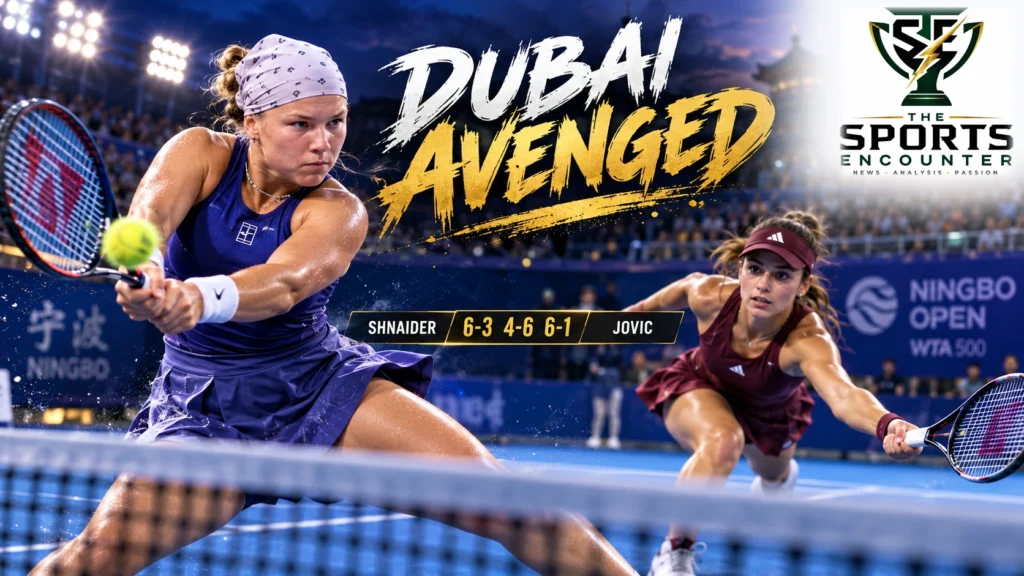
NINGBO, China, October 23, 2026: Diana Shnaider found the perfect answer to a painful February defeat, recovering from a second-set setback to beat American teenager Iva Jovic 6-3, 4-6, 6-1 in a compelling BNB Ningbo Open quarterfinal on Friday. The sixth-seeded Russian needed two hours and 11 minutes to overcome the fourth seed, reversing the outcome of their Dubai encounter and reaching her fourth WTA semifinal of 2026. World No. 1 Elena Rybakina now stands between Shnaider and her first final of the season.
Eight months earlier, Jovic had humiliated Shnaider in a 6-0 deciding set in Dubai. Ningbo delivered a striking reversal. Shnaider recovered from losing the second set, broke twice in the decider and captured five consecutive games to finish with a 6-1 flourish. Her mixture of heavy groundstrokes, delicate slices and intelligently placed lobs repeatedly disrupted Jovic’s attacking rhythm, while her greater composure during the final set turned a finely balanced contest into a convincing finish.
Diana Shnaider vs Iva Jovic: Ningbo Open 2026 Quarterfinal Result
The contest brought together two of the WTA Tour’s strongest emerging competitors.
Shnaider, 22, entered the quarterfinal ranked world No. 13 and seeded sixth. Jovic, 18, was ranked No. 12 and seeded fourth.
Story at a glance
Diana Shnaider vs Iva Jovic: Ningbo Open 2026 Quarterfinal Result
The contest brought together two of the WTA Tour’s strongest emerging competitors.
How Shnaider Recovered From 0-2 to Win the Opening Set 6-3
Jovic started more confidently, winning the opening two games and immediately placing Shnaider under pressure.
Jovic Fights Back: The One Service Game That Changed the Second Set
Jovic’s response deserves considerable credit.
Five Straight Games: How Shnaider Took Control of the Decider
The opening two games of the third set were shared, leaving the players level at 1-1.
Dubai vs Ningbo: How the Deciding Set Changed Everything
The result becomes more revealing when compared with the players’ first meeting.
Only one ranking position separated them, and their previous encounter suggested that the match could become another demanding examination of both players’ attacking consistency.
Jovic had won their first meeting at the Dubai Duty Free Tennis Championships on February 17. Shnaider arrived in Ningbo determined to correct that result while extending a particularly successful record at the Chinese tournament.
She had reached the Ningbo final in 2023, advanced to the semifinals in 2025 and entered Friday’s quarterfinal with nine career victories at the event.
The win over Jovic improved that record to 10-3.
| Set | Shnaider Games | Jovic Games | Shnaider Breaks | Jovic Breaks | Shnaider’s Share of Games |
|---|---|---|---|---|---|
| First | 6 | 3 | 3 | 1 | 66.7% |
| Second | 4 | 6 | 0 | 1 | 40.0% |
| Third | 6 | 1 | 2 | 0 | 85.7% |
| Match Total | 16 | 10 | 5 | 2 | 61.5% |
Match details: BNB Ningbo Open 2026, WTA 500, women’s singles quarterfinal, outdoor hard court. Final score: Shnaider defeated Jovic 6-3, 4-6, 6-1. Duration: two hours and 11 minutes.
The set-by-set numbers reveal how differently the match developed. Shnaider dominated the first and third sets through repeated service breaks, while Jovic protected her serve throughout the second and converted its only break opportunity.
How Shnaider Recovered From 0-2 to Win the Opening Set 6-3
Jovic started more confidently, winning the opening two games and immediately placing Shnaider under pressure.
The American threatened to extend that advantage, but Shnaider began to change the rhythm of the exchanges.
Rather than attempting to overpower Jovic from every position, she varied her pace, occasionally drawing her opponent forward with shorter balls before attacking the spaces left behind.
That adjustment became important as Jovic continued looking for opportunities to dictate rallies.
Shnaider broke back in the third game, then remained close enough to pressure the American’s subsequent service games.
With the score at 3-3, the Russian found another breakthrough.
She broke for 4-3, consolidated the advantage and attacked Jovic’s serve again in the ninth game.
The final service break completed a 6-3 opening set.
Shnaider had won six of the seven games contested after her early 0-2 deficit.
Her willingness to use angles and change the height of the ball was particularly effective when Jovic approached the net.
During the final game, Shnaider passed the American with a well-directed backhand and later used a lob to exploit her forward positioning.
Those shots illustrated an important difference between the two players on the day.
Jovic was capable of matching Shnaider’s pace from the baseline. Shnaider, however, increasingly demonstrated that she could win points through changes of direction, trajectory and positioning.
Jovic Fights Back: The One Service Game That Changed the Second Set
Jovic’s response deserves considerable credit.
The teenager became more effective behind her first serve and reduced the opportunities available to Shnaider on return.
She lost only four points behind her first delivery throughout the second set and did not face a break point.
That improvement changed the tactical balance.
Shnaider could no longer build the same sustained pressure on Jovic’s service games that had helped her control the opener.
The decisive moment arrived at 3-3.
Shnaider briefly lost her serving rhythm, committing three unforced errors and a double fault during the game.
Jovic seized the opportunity and broke for 4-3.
It proved the only service break of the set.
With a narrow lead to protect, Jovic maintained her aggressive approach and continued serving effectively.
She eventually claimed the set 6-4, completing the turnaround with an exceptional 23-shot rally on set point.
The exchange required both players to cover the court repeatedly before Jovic drew Shnaider toward the net with a drop shot and completed the point with a crosscourt forehand.
It was a fitting conclusion to the American’s strongest phase of the match.
The second set also provided a useful reminder of Jovic’s progress during 2026.
She has already challenged and defeated established players, while her performances at major tournaments have demonstrated an increasing ability to survive demanding baseline exchanges.
At the US Open, however, Coco Gauff defeated her 6-1, 6-4 after Jovic produced a more competitive second set. The Sports Encounter’s analysis of Gauff’s victory over Jovic examined how the American teenager’s improvement still left her vulnerable against opponents who controlled important points more consistently.
That challenge resurfaced in Ningbo, although Jovic did enough in the second set to force another deciding-set examination.
Five Straight Games: How Shnaider Took Control of the Decider
The opening two games of the third set were shared, leaving the players level at 1-1.
What followed provided the clearest evidence of Shnaider’s tactical superiority.
She held serve and then broke Jovic in the fourth game to move ahead 3-1.
The break came after an attacking approach from Jovic left her exposed to another carefully executed lob.
Shnaider recognized that the teenager was attempting to shorten points by coming forward, and repeatedly tested her movement through shorter slices and changes of pace.
In one extended exchange, Shnaider used successive short balls to draw Jovic into an uncomfortable position before completing the rally with a backhand winner.
The Russian continued applying pressure and secured another break in the sixth game.
At 5-1, she served for a place in the semifinals.
Shnaider completed the victory on her third match point, striking her fourth ace of the afternoon.
Her serving was particularly impressive during the final set. She won 79% of points behind her first serve and did not face a single break point.
That combination of reliable serving and calculated attacking variety prevented Jovic from creating the type of recovery she had produced in Dubai.
| Match Situation | Development | Why It Mattered |
|---|---|---|
| First set, 0-2 | Jovic wins opening two games | Places immediate pressure on Shnaider |
| First set, 3-3 | Shnaider breaks for 4-3 | Takes the initiative after recovering from early deficit |
| First set, 5-3 | Shnaider breaks again | Completes 6-3 opening set |
| Second set, 3-3 | Jovic breaks Shnaider | Creates the only break of the set |
| Second set, set point | Jovic wins a 23-shot rally | Levels the match at one set apiece |
| Third set, 2-1 | Shnaider breaks for 3-1 | Establishes control of the deciding set |
| Third set, 4-1 | Shnaider breaks for 5-1 | Removes Jovic’s remaining service-game margin |
| Third set, 5-1 | Shnaider finishes with an ace on her third match point | Secures 6-1 deciding set and semifinal place |
Shnaider explained the importance of recovering emotionally after losing the second set.
In her on-court interview, she said, “I tried to regroup after the second set and fight for the third set.”
Her response was reflected in the scoreline and the absence of break-point opportunities for Jovic during the decider.
The WTA’s official match report confirms the pivotal exchanges, Shnaider’s tactical variation and the decisive third-set serving statistics.
Dubai vs Ningbo: How the Deciding Set Changed Everything
The result becomes more revealing when compared with the players’ first meeting.
On February 17, Jovic defeated Shnaider 6-4, 1-6, 6-0 in the second round of the Dubai Duty Free Tennis Championships.
That contest followed an unusual pattern.
Shnaider lost the opening set, dominated the second and then failed to win a single game in the decider.
Jovic controlled the closing phase so completely that the final set ended 6-0.
In Ningbo, the deciding-set pattern reversed.
Shnaider again entered the third set after a disappointing preceding set, but this time she maintained her service games while breaking Jovic twice.
| Comparison | Dubai, February 17 | Ningbo, October 23 |
|---|---|---|
| Tournament | Dubai Duty Free Tennis Championships | BNB Ningbo Open |
| Category | WTA 1000 | WTA 500 |
| Round | Second round | Quarterfinal |
| Winner | Iva Jovic | Diana Shnaider |
| First Set | Jovic 6-4 | Shnaider 6-3 |
| Second Set | Shnaider 6-1 | Jovic 6-4 |
| Deciding Set | Jovic 6-0 | Shnaider 6-1 |
| Match Duration | 1h 46m | 2h 11m |
| Head-to-Head After Match | Jovic leads 1-0 | Tied 1-1 |
The official WTA record of their Dubai meeting establishes how dramatically the first encounter ended.
TSE statistical discovery: Shnaider won 12 of the 16 games played across the first and third sets in Ningbo, a 75% share. In the second set, she managed only four of 10 games, or 40%.
Across the entire match, Shnaider won 16 games to Jovic’s 10, giving her 61.5% of the 26 completed games.
These calculations use the official set scores. They measure games won, rather than points won or the probability of victory.
The most significant change was Shnaider’s ability to regain control after losing momentum.
Dubai had exposed a severe deciding-set weakness against Jovic. Ningbo offered evidence of a more complete response under comparable match pressure.
Whether the result signals a lasting advantage for either player remains uncertain. The head-to-head is now level, and both matches involved substantial shifts in momentum.
Shnaider’s Road to the Ningbo Semifinals: Three Very Different Tests
Shnaider’s quarterfinal victory completed a demanding route through the draw.
She began by overcoming Yulia Putintseva 7-5, 7-6(4), saving five set points across the two sets.
The next match brought another challenging contest against Alexandra Eala.
Shnaider defeated the Filipina 7-5, 6-4 in one hour and 55 minutes, converting important opportunities late in both sets.
TSE’s report on Eala’s defeat to Shnaider examined how the Russian controlled decisive moments despite facing sustained resistance.
Eala had arrived with confidence after beating Diane Parry 6-3, 6-1 in her opening match, a performance detailed in our coverage of Eala’s seven-game surge against Parry.
Against Jovic, Shnaider encountered a different challenge. She had to recover after conceding a set and then raise her level again in the deciding set.
| Player | Round | Opponent | Result | Key Context |
|---|---|---|---|---|
| Diana Shnaider | First round | Yulia Putintseva | Won 7-5, 7-6(4) | Saved five set points |
| Diana Shnaider | Round of 16 | Alexandra Eala | Won 7-5, 6-4 | Won both competitive sets |
| Diana Shnaider | Quarterfinal | Iva Jovic | Won 6-3, 4-6, 6-1 | Recovered from second-set loss |
| Iva Jovic | First round | First-round bye | Advanced | Seeded fourth |
| Iva Jovic | Round of 16 | Jasmine Paolini | Won 6-4, 6-3 | Beat an established top-level opponent |
| Iva Jovic | Quarterfinal | Diana Shnaider | Lost 3-6, 6-4, 1-6 | Unable to maintain second-set momentum |
The contrasting routes help explain the nature of the quarterfinal.
Shnaider had already survived two tightly contested matches and demonstrated her ability to win important points under pressure.
Jovic entered after a straight-sets victory over Paolini, suggesting she was capable of challenging another highly ranked opponent.
Neither player arrived without evidence of competitive form.
What separated them was their ability to execute during the final stretch.
What Does the Defeat Mean for Iva Jovic’s Breakthrough Season?
Jovic’s defeat should be viewed within a season of substantial development.
The 18-year-old has increasingly challenged established players and reached important stages of major tournaments.
Her US Open run provided evidence of her ability to compete at Grand Slam level, although Gauff eventually ended that campaign in straight sets.
During the China Open, Jovic reached the Round of 16 before Iga Swiatek defeated her 6-1, 6-3.
TSE’s analysis of the Beijing results examined how Swiatek used aggressive returning and controlled rallies to restrict Jovic’s attacking opportunities.
The American encountered another setback at Wuhan, where Maja Chwalinska defeated her 6-4, 6-1.
That defeat featured 31 unforced errors from Jovic, compared with 15 from Chwalinska.
Her Wuhan performance and Shnaider’s victory over Karolina Muchova were both examined in our report on the Wuhan Open’s reshaped quarterfinal field.
Jovic’s Ningbo quarterfinal revealed both progress and an unresolved challenge.
Her second-set serving performance was strong enough to deny Shnaider a break-point opportunity. She also demonstrated the athleticism and shotmaking needed to win demanding rallies.
But maintaining that standard across a third set remains a challenge against players capable of changing tactics rather than simply exchanging powerful shots.
The encouraging element is that Jovic has repeatedly reached positions where those weaknesses can be tested against high-quality opposition.
Friday’s defeat provides another opportunity to identify the adjustments needed for future tournaments.
Shnaider Reaches Her Fourth Semifinal of 2026 With a Bigger Goal Still Ahead
The victory took Shnaider into her fourth semifinal of the season, following previous appearances in Adelaide, Roland Garros and Washington, D.C.
Her French Open performance remains the most important breakthrough of the year.
She reached her first Grand Slam semifinal after defeating world No. 1 Aryna Sabalenka in the quarterfinals, recovering from a set and a double-break deficit.
Shnaider has also beaten three top-10 opponents this season, having recorded just one such victory before 2026.
That progress has continued across different surfaces and competitive environments.
In Toronto, Shnaider defeated Jessica Pegula 6-3, 6-3, one of the most impressive results of her North American hard-court campaign.
Our report on Toronto’s major upsets placed Shnaider’s victory over Pegula alongside Ekaterina Alexandrova’s defeat of Sabalenka.
Shnaider subsequently lost 6-2, 6-1 to Swiatek in the Toronto quarterfinals, a result examined in TSE’s analysis of Swiatek’s commanding performance.
Those contrasting matches demonstrate why Shnaider’s progression remains compelling.
She has shown the attacking quality needed to defeat leading opponents, but translating that ability into sustained tournament success against the very best players remains her next challenge.
Her last WTA singles title came in Monterrey in 2025.
Ningbo now offers a chance to end that drought, although reaching the final requires overcoming the world’s top-ranked player.
Elena Rybakina Awaits: Can Shnaider Carry Her Ningbo Form Into the Semifinal?
Shnaider’s next opponent presents the most demanding possible test within the remaining draw.
Top seed and defending champion Elena Rybakina advanced to the semifinals after beating Polish qualifier Katarzyna Kawa 6-1, 3-6, 6-1 on Friday.
Rybakina had previously progressed when Polina Kudermetova retired while trailing 5-0 in the opening set.
That retirement followed the world No. 1’s injury-disrupted Asian swing, examined in The Sports Encounter’s detailed report on Rybakina’s Ningbo return.
Friday’s victory over Kawa provided a more complete test.
Rybakina struck eight aces and won 81% of her first-serve points, demonstrating that her serve remains a major attacking weapon.
Continue the Tennis Story
 TennisRybakina Survives Kawa’s Ningbo Fightback as Shnaider Awaits in a Semifinal With a Familiar Scoreline
 TennisAlex Eala Ends Three-Match Skid With Ruthless Ningbo Win Over Diane Parry, Setting Up Shnaider Showdown
 TennisRybakina Needs Just Five Games to Reach Ningbo Quarterfinals, but Kawa Could Be Her Toughest Test Yet
She also created 17 break-point opportunities and converted six, placing consistent pressure on Kawa’s service games.
Shnaider will need to find ways of disrupting that rhythm.
The pair have met twice before in 2026, with Rybakina winning both encounters in straight sets.
The first came on clay in Stuttgart, and the second on hard courts in Cincinnati.
| Measure | Diana Shnaider | Elena Rybakina |
|---|---|---|
| Country | Russia | Kazakhstan |
| World Ranking | No. 13 | No. 1 |
| Ningbo Seed | No. 6 | No. 1 |
| Quarterfinal Opponent | Iva Jovic | Katarzyna Kawa |
| Quarterfinal Result | 6-3, 4-6, 6-1 | 6-1, 3-6, 6-1 |
| Quarterfinal Duration | 2h 11m | 1h 45m |
| First-Serve Points Won in Quarterfinal Decider | 79% | Not separately established here |
| Prior Head-to-Head | 0 wins | 2 wins |
| Previous Ningbo Best | Finalist, 2023 | Champion, 2025 |
| Semifinal Date | Saturday, October 24, 2026 | |
The comparison highlights two important factors.
Rybakina arrives with a superior head-to-head record and the experience of winning the tournament. Shnaider has played more completed matches in Ningbo this week and has repeatedly demonstrated her ability to survive difficult moments.
Neither factor guarantees the outcome.
Rybakina’s serve can shorten rallies and restrict opponents’ opportunities to attack. Shnaider’s task will be to extend enough exchanges to introduce the variations that unsettled Jovic.
Short slices and changes of direction may help challenge Rybakina’s movement, but the Russian will also need to defend her own service games more consistently than she did during the second set against Jovic.
The WTA’s official semifinal preview confirms Rybakina’s 2-0 advantage in their head-to-head and the competitive stakes of Saturday’s match.
Rybakina’s arrival at world No. 1 followed a remarkable Grand Slam season, including her US Open campaign. TSE previously examined her victory over Zheng Qinwen and the ranking milestone that helped establish her position at the top of women’s tennis.
What Does the Ningbo Result Mean for the WTA Finals Race?
The late-season qualification picture adds another layer of importance to the Ningbo tournament.
The eight-player singles field for the 2026 WTA Finals has already been settled, but alternate positions remain relevant.
Before the quarterfinal developments, Jovic occupied 11th place in the WTA Race, while Shnaider stood 13th.
Marta Kostyuk held 10th place and Maja Chwalinska occupied 12th.
Shnaider’s progress offers an opportunity to improve her position through additional tournament points.
However, the result should not be described as securing a Finals alternate place.
That depends on the final Race standings and the applicable participation arrangements.
The more immediate opportunity is a place in Sunday’s Ningbo final.
Shnaider has consistently reached the later rounds of important tournaments in 2026, but the final step toward another singles title remains unfinished.
Her performance against Rybakina will provide a meaningful measure of how much she has progressed since their earlier encounters.
What Happens Next at the Ningbo Open?
The singles semifinals are scheduled for Saturday, October 24, with the championship match following on Sunday.
Shnaider will meet Rybakina in one semifinal.
The other features Canada’s Leylah Fernandez against Czech player Marie Bouzkova.
Fernandez reached the last four after recovering from a set down to beat Ekaterina Alexandrova 4-6, 6-2, 6-1.
Bouzkova defeated compatriot Sara Bejlek 6-3, 6-4.
For Shnaider, the immediate objective is clear.
She has corrected the outcome of her previous meeting with Jovic, strengthened her impressive Ningbo record and demonstrated the tactical variety needed to compete in demanding matches.
Now she must challenge a world No. 1 who has already defeated her twice.
The Jovic victory suggests that Shnaider is becoming increasingly comfortable adjusting her game when opponents change their approach.
Saturday will test whether that adaptability is sufficient against one of the strongest servers and most accomplished attacking players on the WTA Tour.
Diana Shnaider vs Iva Jovic: Frequently Asked Questions
Who won Diana Shnaider vs Iva Jovic at the Ningbo Open?
Diana Shnaider defeated Iva Jovic 6-3, 4-6, 6-1 in the quarterfinals of the 2026 Ningbo Open on Friday, October 23.
How long did Shnaider vs Jovic last?
The quarterfinal lasted two hours and 11 minutes.
How did Shnaider win the deciding set?
Shnaider won the third set 6-1, breaking Jovic twice and capturing five consecutive games after the score reached 1-1. She faced no break points in the final set.
Who won the previous meeting between Shnaider and Jovic?
Iva Jovic defeated Shnaider 6-4, 1-6, 6-0 in the second round of the Dubai Duty Free Tennis Championships on February 17, 2026.
What is the Shnaider vs Jovic head-to-head record?
Their head-to-head record is tied 1-1 after Shnaider’s victory in Ningbo. Both meetings took place during 2026.
How many semifinals has Shnaider reached in 2026?
Ningbo is Shnaider’s fourth semifinal of 2026, following Adelaide, Roland Garros and Washington, D.C.
Who will Diana Shnaider play in the Ningbo semifinals?
Shnaider will face world No. 1 Elena Rybakina, who defeated Katarzyna Kawa 6-1, 3-6, 6-1 in the quarterfinals.
When is the Shnaider vs Rybakina semifinal?
The semifinal is scheduled for Saturday, October 24, 2026, at the BNB Ningbo Open in China. Rybakina leads their previous head-to-head meetings 2-0.
Final result: Diana Shnaider defeated Iva Jovic 6-3, 4-6, 6-1 in two hours and 11 minutes to reach the BNB Ningbo Open 2026 semifinals. She will face Elena Rybakina on October 24.