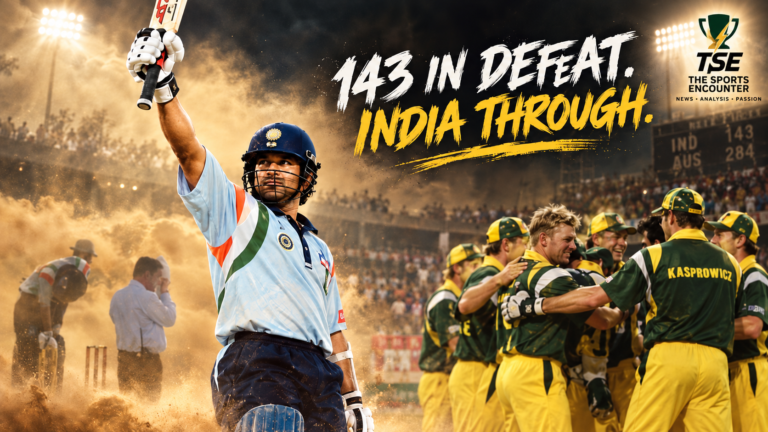
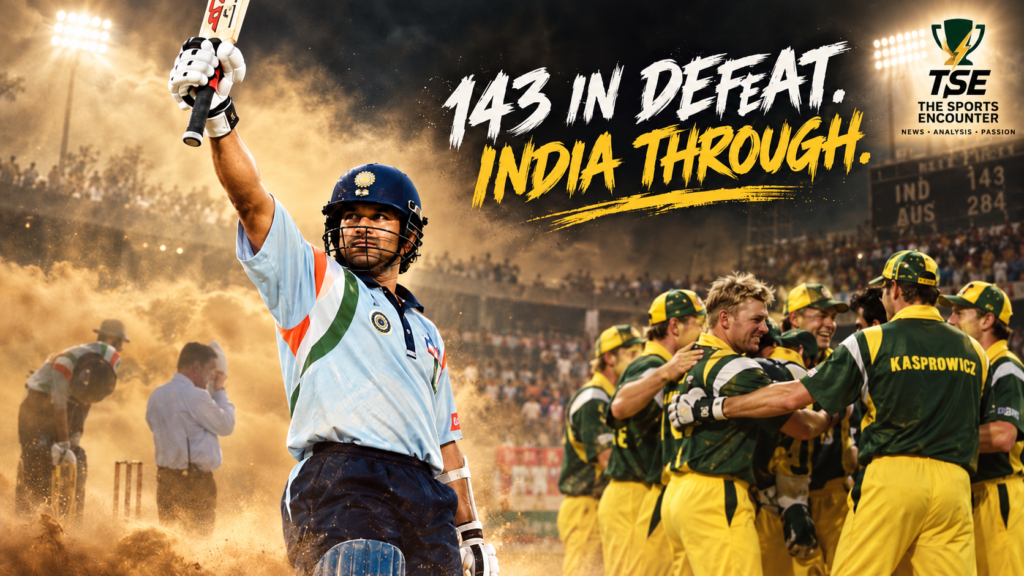
SHARJAH, United Arab Emirates, April 22, 1998: Australia beat India by 26 runs in the final league match of the Coca-Cola Cup, yet Sachin Tendulkar was named Player of the Match and India were the side celebrating when the lights faded over Sharjah. Australia had made 284/7, India finished 250/5 from a rain-reduced 46 overs, and the scorecard recorded a defeat. The tournament table told a different story.
A violent sandstorm had interrupted India’s chase and changed the equation. The revised victory target became 276 from 46 overs, but India needed only 237 to finish ahead of New Zealand on net run rate and reach the final. Tendulkar made 143 from 131 balls, carried India past that qualification line, then continued attacking because merely surviving was never his intention. ICC remembers the innings as the performance that sent India into the final despite defeat, one of the defining knocks of his ODI career. icc
That contradiction is exactly why India vs Australia at Sharjah is Match 48 in A Celebration of 5000 ODIs.
India lost the cricket match.
Story at a glance
Why Match 48 Belongs in A Celebration of 5000 ODIs
Most great ODI innings are remembered because they won the match.
Michael Bevan Turns 87/3 Into 284
Australia’s innings belongs to Michael Bevan almost as much as the chase belongs to Tendulkar.
India’s Bowlers Had Moments, but Australia Never Lost Control for Long
Venkatesh Prasad returned India’s best figures:
Damien Fleming Removes Ganguly and Australia Begin Squeezing India
India’s original target was 285.
Mohammad Azharuddin and Ajay Jadeja Fall as India Slide to 138/4
Mohammad Azharuddin made 14.
Tendulkar still achieved the result that mattered most.
India vs Australia 1998 Coca-Cola Cup: Match at a Glance
| Detail | Information |
|---|---|
| Competition | Coca-Cola Cup 1998 |
| Match | Australia vs India, 6th Match |
| Date | April 22, 1998 |
| Venue | Sharjah Cricket Stadium |
| Toss | Australia won and batted |
| Australia | 284/7 in 50 overs |
| India | 250/5 in 46 overs |
| Revised target | 276 from 46 overs |
| Qualification target | India needed 237 to finish ahead of New Zealand on net run rate |
| Result | Australia won by 26 runs under the revised target |
| Player of the Match | Sachin Tendulkar |
| Australia top scorer | Michael Bevan, 101* |
| India top scorer | Sachin Tendulkar, 143 |
| Key interruption | Sandstorm during India’s chase |
| Tournament consequence | India qualified for the final ahead of New Zealand |
Why Match 48 Belongs in A Celebration of 5000 ODIs
Most great ODI innings are remembered because they won the match.
This one became immortal because it did something stranger.
It converted defeat into progress.
Australia were already through to the final and had won all four of their league matches. India and New Zealand had one victory each.
India therefore faced two calculations when the sandstorm cleared.
First, they could still try to win.
Second, they absolutely had to reach the qualification threshold.
Before the interruption, India had been chasing 285.
After four overs were removed, they needed 276 from 46 overs to win.
More importantly, they needed 237 from 46 overs to move ahead of New Zealand on net run rate.
Tendulkar attacked as though the smaller target did not exist.
That is the difference between this innings and an ordinary qualification rescue.
Once India were safely through, he kept trying to beat Australia.
Michael Bevan Turns 87/3 Into 284
Australia’s innings belongs to Michael Bevan almost as much as the chase belongs to Tendulkar.
Australia had lost Adam Gilchrist for 11.
Ricky Ponting counterattacked for 31.
Damien Martyn went for one.
At 87/3, India had an opening.
Bevan closed it.
Michael Bevan’s 101* Gives Australia a Target Built for Pressure
Bevan made:
101 not out
103 balls
9 fours
Strike rate: 98.06
The innings was a particularly revealing example of why he became regarded as one of ODI cricket’s great finishers.
He did not enter with 10 overs remaining.
He arrived in the 15th over with Australia under pressure.
His responsibility was initially reconstruction.
Then acceleration.
He accomplished both.
ICC’s retrospective on Bevan specifically identifies this unbeaten 101 as an innings in which he rescued Australia from 87/3 and carried them to 284/7 despite Tendulkar’s later 143. icc
Mark Waugh’s 81 Gives Bevan the Platform He Needs
Mark Waugh scored:
81 from 99 balls
7 fours
2 sixes
He and Bevan added 90 for the fourth wicket.
That stand transformed the Australian innings.
India had removed Ponting and Martyn in consecutive phases.
Another wicket could have exposed Steve Waugh and the lower middle order far earlier than Australia wanted.
Instead, Mark Waugh stayed long enough for Bevan to establish himself.
When Waugh departed at 177/4, the innings was ready for its second acceleration.
Darren Lehmann Helps Bevan Push Australia Beyond 250
Steve Waugh made 10 before being run out.
Darren Lehmann then contributed 26 from 27 balls.
His partnership with Bevan added another 53.
Australia reached 250/6 before Lehmann was dismissed.
Bevan remained.
He reached his century and guided Australia to 284, a total large enough to force India into a chase that was simultaneously about victory and survival.
India’s Bowlers Had Moments, but Australia Never Lost Control for Long
Venkatesh Prasad returned India’s best figures:
8 overs, 41 runs, 2 wickets
He dismissed Lehmann and Tom Moody.
Anil Kumble conceded only 41 from his 10 overs and removed Martyn.
Harvinder Singh took Gilchrist.
Harbhajan Singh dismissed Ponting.
Tendulkar himself contributed with the ball, removing Mark Waugh and conceding only 27 from five overs.
The issue was not a complete absence of wickets.
It was timing.
India took Australia from 87/3 to 177/4 only after a 90-run partnership.
Then from 197/5 to 250/6 only after Bevan and Lehmann rebuilt again.
Australia repeatedly found another partnership before India could create sustained pressure.
Complete Australia Scorecard
Australia Batting: 284/7 in 50 Overs
| Batter | Dismissal | R | B | 4s | 6s | SR |
|---|---|---|---|---|---|---|
| Adam Gilchrist | c Nayan Mongia b Harvinder Singh | 11 | 13 | 1 | 0 | 84.62 |
| Mark Waugh | c Sourav Ganguly b Sachin Tendulkar | 81 | 99 | 7 | 2 | 81.82 |
| Ricky Ponting | st Nayan Mongia b Harbhajan Singh | 31 | 26 | 4 | 1 | 119.23 |
| Damien Martyn | b Anil Kumble | 1 | 3 | 0 | 0 | 33.33 |
| Michael Bevan | not out | 101 | 103 | 9 | 0 | 98.06 |
| Steve Waugh | run out | 10 | 16 | 1 | 0 | 62.50 |
| Darren Lehmann | b Venkatesh Prasad | 26 | 27 | 2 | 0 | 96.30 |
| Tom Moody | c Mohammad Azharuddin b Venkatesh Prasad | 5 | 10 | 0 | 0 | 50.00 |
| Shane Warne | not out | 7 | 4 | 1 | 0 | 175.00 |
Did not bat: Michael Kasprowicz, Damien Fleming
Extras: 11
Total: 284/7 in 50 overs
Run rate: 5.68
Fall of wickets: 17/1 Gilchrist, 84/2 Ponting, 87/3 Martyn, 177/4 Mark Waugh, 197/5 Steve Waugh, 250/6 Lehmann, 271/7 Moody.
India Bowling
| Bowler | O | M | R | W | Econ |
|---|---|---|---|---|---|
| Venkatesh Prasad | 8 | 0 | 41 | 2 | 5.13 |
| Harvinder Singh | 7 | 0 | 44 | 1 | 6.29 |
| Anil Kumble | 10 | 0 | 41 | 1 | 4.10 |
| Harbhajan Singh | 8 | 0 | 63 | 1 | 7.88 |
| Sourav Ganguly | 2 | 0 | 15 | 0 | 7.50 |
| Hrishikesh Kanitkar | 6 | 0 | 33 | 0 | 5.50 |
| VVS Laxman | 4 | 0 | 16 | 0 | 4.00 |
| Sachin Tendulkar | 5 | 0 | 27 | 1 | 5.40 |
Damien Fleming Removes Ganguly and Australia Begin Squeezing India
India’s original target was 285.
Sourav Ganguly made 17 from 32 before Damien Fleming trapped him lbw.
India were 38/1.
Tendulkar was already scoring with greater freedom.
Nayan Mongia was promoted and helped build the next partnership.
India reached 107 before Mongia fell for 35.
The chase remained possible.
Then the middle order began disappearing.
Mohammad Azharuddin and Ajay Jadeja Fall as India Slide to 138/4
Mohammad Azharuddin made 14.
Tom Moody bowled him.
Ajay Jadeja followed for one.
India:
138/4.
Australia had 284 behind them.
Tendulkar had four wickets gone around him.
India’s position was already difficult when the weather became part of the match.
Then the Desert Arrives
At around 143/4, a sandstorm swept across Sharjah and forced play to stop.
The interruption lasted long enough to remove four overs from India’s innings.
The target was recalculated.
India would now have only 46 overs.
The winning target became 276.
The qualification requirement became 237.
The mathematics had changed.
The pressure had not.
ICC’s historical review describes the innings as the famous “Desert Storm,” with Tendulkar’s 143 taking India into the final even though the team lost the match. icc
Tendulkar Returns After the Sandstorm With Two Targets in His Head
This is where the innings became something larger.
India could have focused on 237.
Reach the final.
Accept the defeat.
Reset for Australia two days later.
Tendulkar continued chasing 276.
He understood that qualification came first, but his batting did not become conservative once that target moved closer.
Shane Warne was attacked.
Michael Kasprowicz was attacked.
Steve Waugh was attacked.
Anything in Tendulkar’s scoring zone disappeared.
Player of the Match Sachin Tendulkar Produces 143 in a Defeat
Tendulkar’s final numbers:
143 runs
131 balls
9 fours
5 sixes
Strike rate: 109.16
The numbers carry extra weight in the context of 1998.
India’s next-highest score was Mongia’s 35.
Nobody else reached 25.
Tendulkar contributed 57.2% of India’s 250 runs from the bat.
He also scored at a substantially higher rate than every other Indian batter who faced a meaningful number of deliveries.
The innings became one of eight selected by ICC when reviewing the greatest ODI performances of Tendulkar’s career. icc
VVS Laxman’s 23* Was Small on the Scorecard and Huge in Context
One performance is routinely lost when Desert Storm is remembered.
VVS Laxman.
He made only:
23 not out from 34 balls
One boundary.
Yet his contribution mattered because of where India were when he arrived.
At 138/4, Tendulkar could not afford another partner disappearing immediately.
Laxman gave him stability.
Their partnership reached 104 runs for the fifth wicket.
Laxman’s job was not to match Tendulkar.
He needed to rotate strike, survive the stronger bowlers and keep the best batter in the match.
He did exactly that.
Without the partnership, reaching 237 becomes far more difficult.
Tendulkar Passes 237 but Refuses to Stop There
India’s real tournament objective had now been achieved.
They had moved beyond New Zealand on net run rate.
The final was theirs.
The rational choice might have been to preserve the margin and simply complete the innings.
Tendulkar continued attacking Australia.
He was trying to turn qualification into victory.
India reached 242 before Fleming finally removed him for 143.
The chase was effectively over.
The final place was secure.
That sequence is why the defeat became celebratory.
Damien Fleming Finally Ends the Innings That Australia Could Not Control
Fleming finished with:
10 overs
46 runs
2 wickets
He dismissed Ganguly early.
Then, after Tendulkar had transformed the evening, he finally removed him.
Tom Moody also took two wickets.
Steve Waugh dismissed Jadeja.
Shane Warne went wicketless but conceded only 39 from nine overs.
Australia’s bowling was good enough to win the match.
It was not good enough to prevent India from winning the qualification race.
Complete India Scorecard
India Batting: 250/5 in 46 Overs
| Batter | Dismissal | R | B | 4s | 6s | SR |
|---|---|---|---|---|---|---|
| Sourav Ganguly | lbw b Damien Fleming | 17 | 32 | 2 | 0 | 53.13 |
| Sachin Tendulkar | c Adam Gilchrist b Damien Fleming | 143 | 131 | 9 | 5 | 109.16 |
| Nayan Mongia | c Mark Waugh b Tom Moody | 35 | 46 | 4 | 1 | 76.09 |
| Mohammad Azharuddin | b Tom Moody | 14 | 20 | 0 | 0 | 70.00 |
| Ajay Jadeja | c Adam Gilchrist b Steve Waugh | 1 | 5 | 0 | 0 | 20.00 |
| VVS Laxman | not out | 23 | 34 | 1 | 0 | 67.65 |
| Hrishikesh Kanitkar | not out | 5 | 14 | 0 | 0 | 35.71 |
Did not bat: Anil Kumble, Harvinder Singh, Venkatesh Prasad, Harbhajan Singh
Extras: 12
Total: 250/5 in 46 overs
Run rate: 5.43
Australia Bowling
| Bowler | O | M | R | W | Econ |
|---|---|---|---|---|---|
| Damien Fleming | 10 | 0 | 46 | 2 | 4.60 |
| Michael Kasprowicz | 9 | 0 | 55 | 0 | 6.11 |
| Shane Warne | 9 | 0 | 39 | 0 | 4.33 |
| Tom Moody | 9 | 0 | 40 | 2 | 4.44 |
| Steve Waugh | 9 | 0 | 65 | 1 | 7.22 |
Result: Australia won by 26 runs under the revised target.
Player of the Match: Sachin Tendulkar.
Seven Turning Points That Made Desert Storm Possible
1. Australia Recover From 87/3
India had their opportunity.
Bevan and Mark Waugh took it away.
Their 90-run partnership prevented India from exposing Australia’s lower order early.
2. Bevan Bats Through for 101*
His innings took Australia from a vulnerable middle-over position to 284/7.
Without that century, India’s qualification problem may never become dramatic enough to create Desert Storm.
3. India Lose Four Wickets Before 140
Ganguly, Mongia, Azharuddin and Jadeja were gone.
Tendulkar no longer had an established batter beside him.
4. The Sandstorm Changes the Mathematics
Four overs disappeared.
The winning target became 276.
The qualification threshold became 237.
The match now contained two separate finish lines.
5. Laxman Stays With Tendulkar
His 23* looks modest.
The 104-run partnership does not.
Laxman prevented Australia from reaching India’s lower order while Tendulkar attacked.
6. Tendulkar Takes India Beyond 237
At that moment, the principal tournament objective was complete.
New Zealand’s net run rate had been passed.
India were in the final.
7. Tendulkar Keeps Chasing the Match
He could have shut down.
Instead, he continued toward 276.
That decision turned an outstanding qualification innings into a performance remembered almost three decades later.
Why Australia Won the Match but Lost Control of the Story
Australia’s performance was excellent.
They made 284.
Bevan scored a century.
Mark Waugh made 81.
Fleming and Moody took four wickets between them.
Their bowlers stopped India 26 runs short of the revised victory target.
Ordinarily, that is the entire story.
The tournament format changed what victory meant.
Australia were already in the final.
India’s battle was with New Zealand as much as with Steve Waugh’s team.
Once Tendulkar crossed the qualification line, Australia’s win ceased to have the same consequence.
That is why one of cricket’s most famous matches is remembered almost entirely through the losing side.
Michael Bevan’s Century Deserved More Attention Than History Gave It
The mythology of Tendulkar’s 143 can make Australia’s innings disappear.
Bevan’s century deserves better.
He entered at 87/3.
He batted through the remaining 35 overs.
He scored almost a run a ball.
He adjusted from rebuilding to finishing without giving India the wicket they needed.
ICC later selected the 101* among the defining innings of Bevan’s ODI career. icc
Australia do not reach 284 without him.
Without 284, there is no qualification crisis.
Without the crisis, there is no Desert Storm in the form cricket remembers today.
Shane Warne vs Tendulkar Added Another Chapter to 1998
Tendulkar’s assault also arrived during one of cricket’s defining individual rivalries.
Earlier in 1998, India had beaten Australia 2-1 in the Border-Gavaskar Trophy.
Tendulkar scored 446 Test runs at 111.50 in that series as he repeatedly attacked Warne.
The Sharjah matches continued the pattern.
ICC’s retrospective on Tendulkar’s rise describes 1998 as a year in which he repeatedly put Australia under pressure, first in the Test series and then through the two famous Sharjah centuries. icc
Warne bowled nine overs for 39 in this match and did not dismiss him.
Two days later, they would meet again.
Why 1998 Was Tendulkar’s Great ODI Year
Desert Storm was not an isolated peak.
Tendulkar scored 1,894 ODI runs in 1998, a remarkable calendar-year output that remains central to discussions of his batting prime.
ICC notes that he averaged 65.31 that year while scoring at a strike rate above 100, numbers that were especially extraordinary for the era. icc
The Sharjah sequence became its clearest expression.
143 on April 22.
134 on April 24.
Same opponent.
Same ground.
Different result.
The two innings belong together.
That is why the next episode in this series returns immediately to Sharjah.
What Happened Next?
India and Australia met again in the Coca-Cola Cup final on April 24.
Tendulkar turned 25 that day.
He scored 134.
Australia made 272/9.
India chased it in 48.3 overs and won by six wickets.
ICC describes the back-to-back centuries as part of cricket folklore and notes that the first carried India into the final while the second delivered the tournament. icc
That final is Match 49 in A Celebration of 5000 ODIs.
Match 48 is the setup.
Match 49 is the completion.
Why Desert Storm Still Feels Different From Other Great Losing Innings
Many brilliant innings have come in defeat.
Most eventually become footnotes to the winning team’s story.
Tendulkar’s 143 did the opposite.
It took ownership of the match.
The reason is not nostalgia alone.
The innings achieved a measurable tournament objective.
India had to cross 237.
They crossed it.
New Zealand were eliminated.
India reached the final.
Tendulkar was named Player of the Match despite Australia winning.
Two days later, India won the trophy.
The result column therefore tells only part of what happened on April 22.
Australia won.
India advanced.
Tendulkar changed the tournament.
How Match 48 Connects to Earlier A Celebration of 5000 ODIs Classics
India and Australia had already produced extraordinary ODI tension before Sharjah.
In the 1987 World Cup, Australia beat India by one run in Chennai after a chase reached its final delivery. That match is revisited in Match 6: Australia Beat India by One Run After Chennai Chase Turns Into Final-Over Agony.
Australia’s ability to survive seemingly lost matches also appears in Match 12: Warne Turns 165/2 Into West Indies Heartbreak.
A year after Sharjah, Steve Waugh produced another defining Australian pressure innings against South Africa in Match 14: Waugh Survives Gibbs and Keeps Australia Alive at Headingley.
Pakistan then stopped Australia in another tense 1999 World Cup chase in Match 17: Inzamam and Wasim Deny Australia in a Headingley Thriller.
Decades later, Australia and New Zealand produced 771 runs in Match 41, another example of a massive total refusing to settle a match.
Sharjah belongs comfortably in that company.
Continue A Celebration of 5000 ODIs
 A Celebration of 5000 ODIsA Celebration of 5000 ODIs Match 47: Ganguly Carries 315 Into Reach Before Kanitkar Finds Four in the Dhaka Darkness
 A Celebration of 5000 ODIsA Celebration of 5000 ODIs Match 46: Miandad Turns Four From One Ball Into the Six That Changed India-Pakistan Cricket
 A Celebration of 5000 ODIsA Celebration of 5000 ODIs Match 43: Miller Rescues South Africa From 24/4 Before Australia Survive Another Semifinal Thriller
Frequently Asked Questions
Who Won the 1998 Desert Storm Match?
Australia beat India by 26 runs under the revised target.
Why Is the Match Called the Desert Storm Match?
A sandstorm interrupted India’s chase in Sharjah and reduced the innings from 50 overs to 46. Tendulkar’s extraordinary attack after play resumed became known as the Desert Storm innings.
How Many Runs Did Sachin Tendulkar Score?
Tendulkar made 143 from 131 balls, hitting nine fours and five sixes.
Why Did India Qualify Even Though Australia Won?
India needed to reach 237 in the reduced 46-over chase to finish ahead of New Zealand on net run rate. Tendulkar carried India beyond that threshold.
What Was India’s Revised Winning Target?
After the sandstorm, India needed 276 from 46 overs to win.
Who Was Player of the Match?
Sachin Tendulkar was named Player of the Match despite India losing by 26 runs.
Who Scored a Century for Australia?
Michael Bevan made an unbeaten 101 from 103 deliveries.
What Did Mark Waugh Score?
Mark Waugh made 81 from 99 balls.
Who Supported Tendulkar During the Crucial Part of the Chase?
VVS Laxman scored 23 not out and shared a 104-run fifth-wicket partnership with Tendulkar.
What Happened in the Final?
India faced Australia again two days later. Tendulkar scored 134 as India won the final and the Coca-Cola Cup.
A Celebration of 5000 ODIs
- A Celebration of 5000 ODIs Match 48: Tendulkar Loses the Match but Wins India a Final in the Desert Storm
- A Celebration of 5000 ODIs Match 47: Ganguly Carries 315 Into Reach Before Kanitkar Finds Four in the Dhaka Darkness
- A Celebration of 5000 ODIs Match 46: Miandad Turns Four From One Ball Into the Six That Changed India-Pakistan Cricket
- A Celebration of 5000 ODIs Match 45: Fakhar Makes 402 Look Reachable Before Rain Seals Pakistan’s World Cup Lifeline
- A Celebration of 5000 ODIs Match 43: Miller Rescues South Africa From 24/4 Before Australia Survive Another Semifinal Thriller