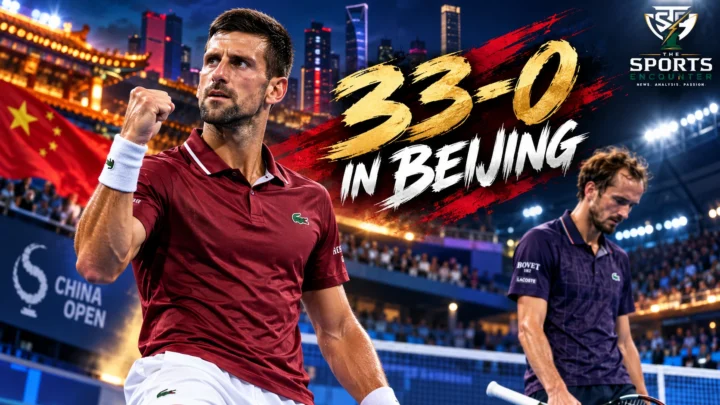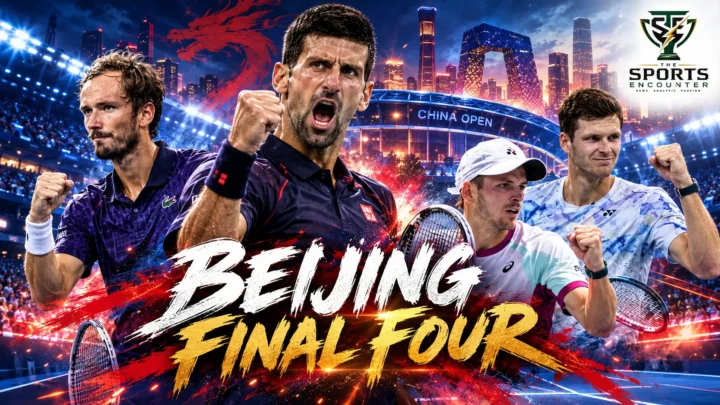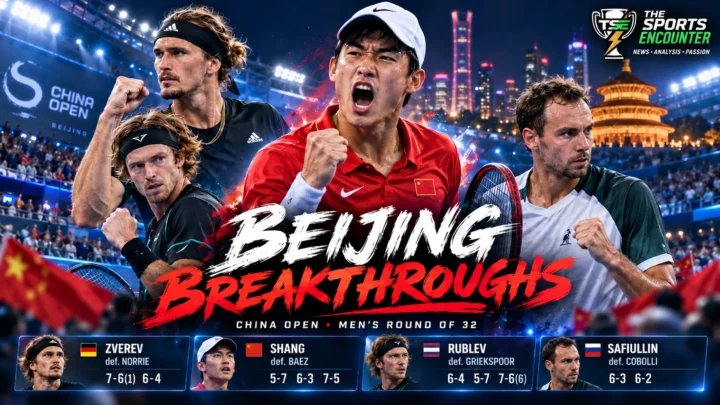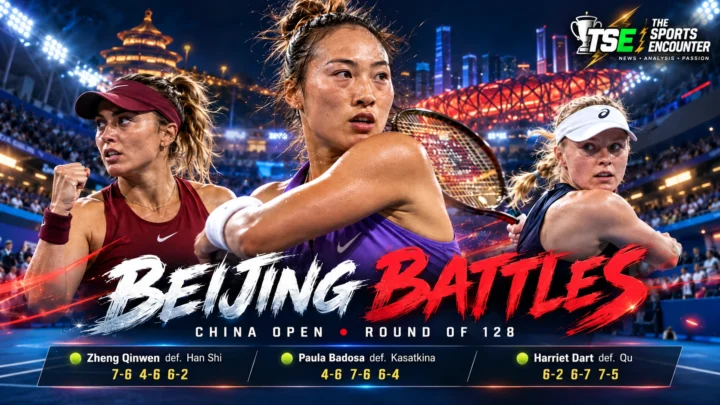
Beijing, China – October 6, 2026: Novak Djokovic returned to Beijing after 11 years away with an undefeated record, six trophies and enough physical questions to make another China Open title feel far less inevitable than his history suggested.
He leaves with all three numbers changed.
Djokovic claimed his seventh China Open championship on Tuesday after Alex de Minaur retired with an injury early in the second set of the men’s singles final. Djokovic had won the opening set 7-6(3), while De Minaur held serve to lead 1-0 in the second before he could no longer continue.
The ending was unfortunate and incomplete. It should not be described as a walkover because the match had already begun.
Story at a glance

Djokovic vs De Minaur: China Open Final at a Glance
Reuters reported that De Minaur took a medical timeout after the opening set and returned with heavy strapping around his left thigh. The Australian managed to hold serve in the opening game of the second set before deciding he could not continue.
The Final Ended Early, but the First Set Told Us Something
No serious assessment of this final should pretend Djokovic comprehensively defeated a healthy De Minaur across two completed sets.
Djokovic Won the Tiebreak Without an Ace
There is a useful contrast buried inside the serving statistics.
De Minaur’s Injury Denied the Final Its Real Test
The disappointment is obvious.
Djokovic’s Route to a Seventh Beijing Title Was Anything but Routine
Djokovic returned to the China Open this year for the first time since 2015.
What it produced, however, was another extraordinary collection of numbers attached to a career that has spent nearly two decades making statistical milestones feel routine.
Djokovic is now 34-0 at the China Open.
He has won the tournament seven times in seven appearances.
The Beijing championship is the 102nd tour-level singles title of his career.
And perhaps most significantly for the surface on which he has built so much of his career, Djokovic now owns 73 men’s tour-level hard-court titles, extending his Open Era record beyond Roger Federer’s 71 and Andre Agassi’s 46.
The official ATP records entered the 2026 season with Djokovic already leading the hard-court title list, while ATP’s Open Era record book listed him on 72 before this Beijing victory.
One more title has made the gap larger.
TL;DR
- Novak Djokovic won his seventh China Open title after Alex de Minaur retired from the final.
- Djokovic won the first set 7-6(3); De Minaur led 1-0 in the second set when he retired.
- De Minaur required treatment after the first set and returned with his left thigh heavily strapped before stopping.
- Djokovic moves to a perfect 34-0 career record in Beijing.
- The trophy is the 102nd tour-level singles title of Djokovic’s career.
- It is his record-extending 73rd hard-court title, ahead of Roger Federer with 71 and Andre Agassi with 46.
- Djokovic has now won at least one tour-level title in 21 consecutive seasons from 2006 through 2026.
- The title is particularly significant after a difficult 2026 season in which physical problems had repeatedly raised questions about how much elite tennis his body could still sustain.
Djokovic vs De Minaur: China Open Final at a Glance
| Match Detail | Information |
|---|---|
| Tournament | China Open 2026 |
| Category | ATP 500 |
| Venue | National Tennis Center, Beijing |
| Final | Novak Djokovic vs Alex de Minaur |
| Score at Retirement | Djokovic led 7-6(3), 0-1 |
| Winner | Novak Djokovic |
| Reason Match Ended | Alex de Minaur retired with injury |
| Djokovic China Open Titles | 7 |
| Djokovic Beijing Record | 34-0 |
| Djokovic Career Titles | 102 |
| Djokovic Hard-Court Titles | 73 |
Reuters reported that De Minaur took a medical timeout after the opening set and returned with heavy strapping around his left thigh. The Australian managed to hold serve in the opening game of the second set before deciding he could not continue.
The ATP’s official China Open tournament page confirms Beijing as a hard-court ATP 500 event played at the National Tennis Center.
The Final Ended Early, but the First Set Told Us Something
No serious assessment of this final should pretend Djokovic comprehensively defeated a healthy De Minaur across two completed sets.
He did not.
The match ended too early for that conclusion.
The first set was competitive enough to make De Minaur’s retirement particularly frustrating. Neither player broke serve. De Minaur produced more aces, landed more first serves and remained level through 12 games before Djokovic separated himself in the tiebreak.
The available match statistics show how unusual the set was.
| Statistic | Novak Djokovic | Alex de Minaur |
|---|---|---|
| Aces | 0 | 4 |
| Double Faults | 0 | 2 |
| First Serve % | 53% | 68% |
| First-Serve Points Won | 90% | 74% |
| Second-Serve Points Won | 72% | 64% |
| Break Points Converted | 0/2 | 0/1 |
| Tiebreaks Won | 1 | 0 |
| Receiving Points Won | 16 | 7 |
| Total Points Won | 47 | 41 |
| Service Points Won | 31 | 34 |
De Minaur’s four aces and 68% first-serve rate gave him more obvious service production.
Djokovic answered by making the points he did begin with a first serve extremely difficult to touch. He won 90% of those points and 72% behind his second delivery.
The return numbers reveal an even more important difference.
Djokovic won 16 receiving points to De Minaur’s seven.
He did not convert either of his two break opportunities, but he created twice as many receiving points and repeatedly made De Minaur work harder to protect serve.
That pressure did not produce a break.
It eventually produced the tiebreak margin.
Djokovic Won the Tiebreak Without an Ace
There is a useful contrast buried inside the serving statistics.
De Minaur hit four aces.
Djokovic hit none.
Yet Djokovic won the set.
That distinction fits the larger story of his Beijing run.
Djokovic has not spent this tournament overwhelming opponents with free points. He has repeatedly survived difficult passages, protected the most important service points and changed matches through return pressure, patience and timing.
That was already visible when he recovered from a set down to defeat Alexander Zverev 4-6, 6-4, 6-4 in the quarterfinals.
Zverev served at an extraordinary level for long stretches of that match. Djokovic waited until the final return game of both the second and third sets to break.
De Minaur gave him a different problem.
The Australian moved quickly, shortened Djokovic’s time to construct points and protected his serve without giving away a break.
Djokovic still took the set when the margin became smallest.
De Minaur’s Injury Denied the Final Its Real Test
The disappointment is obvious.
De Minaur had earned his place in the final after producing one of the tournament’s strongest quarterfinal recoveries, coming back from a 1-6 opening set to defeat Andrey Rublev 1-6, 6-2, 6-3.
His semifinal against Hubert Hurkacz also ended prematurely when the Pole retired with an adductor problem.
That meant De Minaur entered the championship match without having completed his semifinal, then became the player forced to retire from the final himself.
The result creates an unusual footnote around Djokovic’s seventh championship.
It does not diminish the legitimacy of the title, but it does change what can reasonably be claimed about the final itself.
Djokovic won the first set.
He did not get the opportunity to demonstrate that he would have won a completed two-set or three-set match against a healthy De Minaur.
The historical importance therefore comes less from the unfinished final and more from everything required to reach it.
Djokovic’s Route to a Seventh Beijing Title Was Anything but Routine
Djokovic returned to the China Open this year for the first time since 2015.
The Sports Encounter examined the reasons behind that return in our analysis of why Djokovic came back to Beijing after an 11-year absence.
He began the tournament with a 29-0 career record at the event.
Five more victories have taken that number to 34-0.
| Round | Opponent | Result |
|---|---|---|
| Round of 32 | Nuno Borges | 6-3, 7-6(2) |
| Round of 16 | Yunchaokete Bu | 4-6, 7-6(2), 6-2 |
| Quarterfinal | Alexander Zverev | 4-6, 6-4, 6-4 |
| Semifinal | Daniil Medvedev | Djokovic led 7-5, 5-3 when Medvedev was defaulted |
| Final | Alex de Minaur | Djokovic led 7-6(3), 0-1 when De Minaur retired |
Bu took the opening set and pushed Djokovic close to three hours.
Zverev also won the first set.
Daniil Medvedev created enormous return pressure in the semifinal before being defaulted while Djokovic was serving for the match at 7-5, 5-3.
De Minaur then forced a tiebreak before injury ended the final.
This was not the effortless Beijing domination Djokovic produced during parts of his prime.
It may be more revealing because it was not.
From 29-0 to 34-0 After an 11-Year Absence
The strangest part of Djokovic’s China Open record is the gap in the middle.
He won Beijing in 2009, 2010, 2012, 2013, 2014 and 2015.
Then he disappeared from the tournament for more than a decade.
When Djokovic announced his return, he was not returning as the player who left.
He was 39.
His body had become a larger part of every tournament discussion.
His 2026 season had already contained several reminders that elite tennis and elite physical recovery are no longer the same challenge for him.
The Sports Encounter asked that question directly after his physical difficulties during the Cincinnati defeat to Thiago Tirante.
It became more serious when Mariano Navone eliminated Djokovic in the first round of the US Open after a five-set physical battle.
A later TSE analysis asked whether Djokovic had genuinely lost the level required to remain among men’s tennis’s elite.
Beijing has provided an important answer.
His physical limitations have not disappeared.
His ability to win tournaments has not disappeared either.
Seventy-Three Hard-Court Titles Put Djokovic in a Category of His Own
The seventh Beijing championship takes Djokovic to 73 tour-level hard-court titles.
That record deserves more attention than the raw number usually receives.
| Player | Men’s Tour-Level Hard-Court Titles |
|---|---|
| Novak Djokovic | 73 |
| Roger Federer | 71 |
| Andre Agassi | 46 |
| Jimmy Connors | 43 |
| Pete Sampras | 36 |
The gap between Djokovic and Federer is only two titles.
The gap from Federer to Agassi is 25.
That distribution helps explain how unusual the top two are.
Djokovic’s hard-court résumé includes Australian Opens, US Opens, ATP Finals championships, Masters 1000 trophies and titles across several generations of opponents.
Beijing has become one of the purest examples of that dominance.
Seven appearances.
Seven titles.
Thirty-four matches.
Thirty-four victories.
Title No. 102 Moves Djokovic Closer to Federer Again
The China Open trophy is also Djokovic’s 102nd tour-level singles championship.
That keeps him third on the Open Era men’s list behind Jimmy Connors and Roger Federer.
ATP’s 2026 record book entered the season with Connors on 109 titles, Federer on 103 and Djokovic on 101.
Beijing moves Djokovic to 102.
Federer is now one title away.
Connors remains seven ahead.
Whether Djokovic cares enough about those totals to structure the final years of his schedule around them is another question.
He has repeatedly made clear that Grand Slam tournaments and the biggest stages carry greater motivational weight than chasing every available numerical record.
Still, numbers accumulate when a player continues winning.
Beijing added another.
Twenty-One Consecutive Seasons With a Title May Be the More Remarkable Record
Djokovic won his first ATP titles in 2006.
He has now won at least one tour-level singles trophy in every season from 2006 through 2026.
That is 21 consecutive seasons.
Longevity records can sometimes reward persistence more than excellence.
This one does not.
Winning a tour-level championship requires beating an entire draw in the same week. Doing it year after year means surviving changes in surfaces, equipment, opponents, coaching teams, physical condition and the sport’s generational turnover.
The player Djokovic defeated in his first ATP title season belonged to a different tennis era.
The players he had to beat in Beijing included Zverev, Medvedev and De Minaur, all members of generations that developed while Djokovic was already a Grand Slam champion.
That is what makes the streak unusual.
Beijing Does Not Erase Djokovic’s 2026 Problems
It would be easy to treat the seventh China Open trophy as evidence that all the concern surrounding Djokovic earlier in the season was exaggerated.
That would go too far.
The physical questions were real.
They were visible in Cincinnati.
They became even more serious in New York.
Our US Open title-race analysis argued before the tournament that Djokovic’s central challenge was no longer whether he could produce elite tennis for one match, but whether his body could reproduce it across an entire major.
The US Open results that followed strengthened that concern.
Beijing answers a different question.
Can Djokovic still win a high-level ATP tournament against elite opposition?
Yes.
He beat Zverev after losing the first set.
He was leading Medvedev when their semifinal ended.
He won the opening set against De Minaur.
Those results matter even if they do not guarantee anything about what happens in a best-of-five Grand Slam environment.
The Most Important Thing Beijing Restored Was Proof
Djokovic did not need another trophy to prove the scale of his career.
He needed evidence about the present.
That distinction matters.
Before this tournament, his most recent hard-court stretch contained a physically troubling Cincinnati loss and a first-round US Open exit that raised uncomfortable questions about the future.
TSE had already explored how Djokovic hoped Cincinnati could provide evidence that his timing and body remained ready for elite competition.
He did not get that evidence in Ohio.
He finally found it in Beijing.
The seventh China Open title will appear in the record book beside the six he won during a younger and more dominant stage of his career.
This one means something different.
It arrived at 39, after an 11-year absence, during a season when people had legitimate reasons to wonder whether repeated physical problems were finally narrowing his opportunities faster than his tennis could compensate.
Djokovic has not answered every question.
He has answered one of the biggest.
He can still win.
For continuing coverage of Djokovic, the ATP Tour and the biggest stories across men’s and women’s tennis, follow The Sports Encounter’s tennis coverage.
Continue the China Open Story

Frequently Asked Questions
Who won the 2026 China Open men’s singles title?
Novak Djokovic won the 2026 China Open men’s singles championship after Alex de Minaur retired during the final.
What was the Djokovic vs De Minaur final score?
Djokovic had won the first set 7-6(3). De Minaur led 1-0 in the second set when he retired.
Why did Alex de Minaur retire?
De Minaur received treatment after the opening set for a groin/left-thigh problem. He returned with heavy strapping on his left thigh, held the first game of the second set and then stopped playing.
How many China Open titles has Novak Djokovic won?
Djokovic has won seven China Open singles titles: 2009, 2010, 2012, 2013, 2014, 2015 and 2026.
What is Djokovic’s career record at the China Open?
Djokovic is 34-0 in completed or officially awarded China Open matches and has never lost at the tournament.
How many ATP titles does Novak Djokovic have?
The Beijing championship is Djokovic’s 102nd tour-level singles title.
Who has the most hard-court titles in men’s tennis?
Djokovic leads the Open Era men’s list with 73 tour-level hard-court titles, ahead of Roger Federer with 71 and Andre Agassi with 46.
How many consecutive seasons has Djokovic won a title?
Djokovic has now won at least one tour-level singles title in 21 consecutive seasons, from 2006 through 2026.
Novak Djokovic
- Novak Djokovic Wins Seventh China Open Title After 11 Years, Extends Hard-Court Record to 73
- China Open: Djokovic’s Beijing Romance Continues as Medvedev Retires, De Minaur Awaits
- Djokovic Refuses to Lose as De Minaur, Medvedev, and Hurkacz Complete China Open Final Four
- What Has Brought Novak Djokovic Back to China After 11 Years Away?
- Has Novak Djokovic Really Lost His Mojo? What US Open 2026 Revealed