


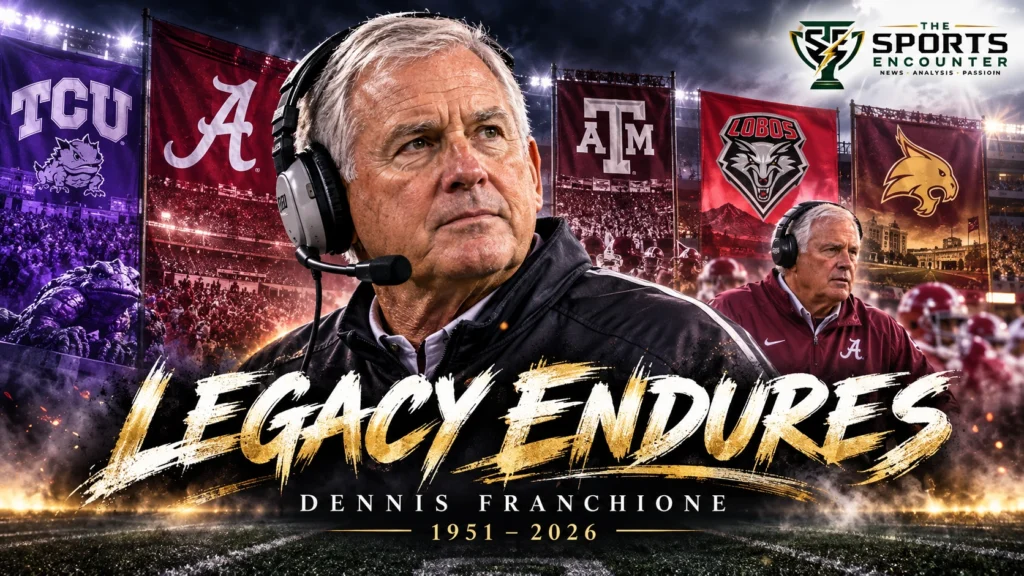
FORT WORTH, United States, October 6, 2026: Dennis Franchione, the veteran college football coach whose 213 career victories only partly explain his influence on programs from Pittsburg State and New Mexico to TCU, Alabama and Texas A&M, has died at the age of 75.
TCU confirmed Franchione’s death Tuesday, remembering the coach who inherited a 1-10 Horned Frogs team in 1998 and helped begin a revival that eventually transformed the program’s place in college football.
Franchione had battled cancer for years. The disease had previously been diagnosed in 2016 and again in 2021, while family-sourced reporting said it returned earlier in 2026 and that he had recently entered hospice care.
His career record finished at 213-135-2 across three decades as a college head coach. He worked at nearly every level of the sport, from smaller Kansas programs to the SEC, and became particularly associated with programs that needed direction, credibility or a different standard.
That is the most useful way to understand Franchione’s career.
The numbers were substantial. The rebuilds were more revealing.
Dennis Franchione’s Coaching Career at a Glance
| Program | Years | Defining Achievement |
|---|---|---|
| Southwestern College | 1981-82 | Began college head-coaching career |
| Pittsburg State | 1985-89 | 53-6 record and five consecutive conference titles |
| Southwest Texas State | 1990-91 | 13-9 across two seasons |
| New Mexico | 1992-97 | Led Lobos to first bowl appearance in 36 years |
| TCU | 1998-2000 | First bowl victory since 1957 and back-to-back WAC co-titles |
| Alabama | 2001-02 | 17-8 record and 10-win 2002 season |
| Texas A&M | 2003-07 | Three bowl appearances and consecutive wins over Texas |
| Texas State | 2011-15 | Helped guide transition from FCS to FBS |
The official TCU tribute to Franchione describes him as the coach who helped return the Horned Frogs to national relevance and credits his tenure with establishing the platform for much of what followed.
Why TCU May Be the Most Important Part of Franchione’s Legacy
Franchione coached at larger brands after leaving Fort Worth, but TCU provides the clearest example of what he did best.
He arrived after the Horned Frogs had gone 1-10 in 1997.
TCU had also gone more than four decades without winning a bowl game.
One season later, Franchione took the Frogs to the Sun Bowl and beat USC 28-19, ending a postseason victory drought that stretched back to the 1957 Cotton Bowl.
The turnaround continued.
TCU shared Western Athletic Conference championships in 1999 and 2000 and returned to the national rankings. LaDainian Tomlinson became the centerpiece of the offense, leading the country in rushing in consecutive seasons and winning the Doak Walker Award in 2000.
By then, the conversation around TCU had changed.
The program had moved from trying to recover from a one-win season to expecting postseason football and national recognition.
Sonny Dykes, the current TCU head coach, captured the historical significance in the school’s tribute, saying Franchione had “set the program on the path to all of the great success that has followed.”
That path later continued under Gary Patterson, who had worked as Franchione’s defensive coordinator before succeeding him at TCU.
The connection matters because strong programs are rarely rebuilt by one season or one coach in isolation. Franchione improved the competitive standard. Patterson then carried the project through another era.
Franchione Had Already Built His Reputation Before Reaching TCU
The Horned Frogs were not his first rebuild.
Franchione’s college head-coaching career began at Southwestern College in Kansas before he returned to his alma mater, Pittsburg State.
His five seasons there remain one of the strongest stretches of his career.
Pittsburg State went 53-6 under Franchione, won five consecutive conference titles and reached the postseason repeatedly. He was twice recognized as NAIA National Coach of the Year.
New Mexico then provided a different challenge.
The Lobos were not positioned as a national power, and Franchione’s first season finished 3-8. Progress was gradual rather than instant.
By 1997, New Mexico had reached nine victories, won the WAC Mountain Division and earned a bowl invitation for the first time in 36 years.
The National Football Foundation’s Hall of Fame ballot profile specifically highlights the New Mexico and TCU turnarounds as central achievements in Franchione’s coaching résumé.
Alabama Showed Franchione Could Rebuild Under Much Greater Pressure
Alabama created a different test.
Franchione arrived in Tuscaloosa after a 3-8 season and inherited a program operating under the pressure attached to one of college football’s most demanding brands.
His first Alabama team improved to 7-5 and won the Independence Bowl.
The second finished 10-3.
Across two seasons, Franchione went 17-8.
Texas A&M’s historical biography of Franchione noted that Alabama led the SEC in both total offense and total defense during his second season, while the defense ranked among the country’s best.
The Texas A&M archival biography provides the contemporary record of how rapidly Alabama improved under him.
Alabama remains one of the places where college coaching pressure is measured differently from almost anywhere else. TSE’s recent College Football Week 3 analysis showed how quickly results involving Alabama and Texas A&M still alter the national conversation in 2026.
Franchione experienced that pressure from both sides.
Why Did Franchione Leave Alabama for Texas A&M?
His departure from Tuscaloosa remains one of the defining decisions of his career.
Alabama was dealing with NCAA sanctions when Franchione accepted the Texas A&M job after the 2002 season.
The move shocked Alabama supporters because it came after a 10-win season and at a moment when Franchione appeared to have restored competitive momentum.
College coaching has always involved ambition, timing and institutional risk. Franchione’s move reflected all three.
Texas A&M offered another major program, another large fan base and another opportunity to build on his reputation as a turnaround coach.
The results were mixed.
Texas A&M Complicated an Otherwise Clear Rebuilding Narrative
Franchione coached the Aggies for five seasons and finished 32-28.
Texas A&M reached three bowl games during his tenure and went 9-4 in 2006. Franchione also beat rival Texas in consecutive seasons in 2006 and 2007.
He never produced the sustained breakthrough many expected when he arrived from Alabama.
His final year also brought controversy surrounding the “VIP Connection,” a subscription newsletter distributed to selected boosters that contained team information, including material related to players and injuries.
Texas A&M investigated the newsletter, publicly admonished Franchione and reported possible rules issues to the NCAA. He stepped down after the 2007 regular-season finale, a 38-30 victory over Texas.
A complete assessment of Franchione’s career cannot remove that episode simply because the larger story is now being viewed through the lens of his death.
It remains part of the record.
So do the three bowl appearances, the victory over Texas in his final game and the players he helped recruit and develop.
Texas State Gave Franchione One Final Rebuilding Job
Franchione eventually returned to coaching at Texas State in 2011.
By then, the assignment differed from his earlier jobs.
The Bobcats were preparing to move from the Football Championship Subdivision into the Football Bowl Subdivision. That transition involves more than changing schedules. Recruiting changes, roster depth becomes more important, facilities face greater expectations and the physical standard of weekly competition rises.
Franchione had already spent decades moving between different levels of college football.
Texas State used that experience during the transition.
He remained through the 2015 season and then retired, closing a coaching career that had begun at the high-school level more than four decades earlier.
213 Wins Explain the Length of the Career, Not All of Its Influence
Franchione finished 213-135-2 as a college head coach.
That number places the scale of the career in perspective, but totals can flatten the differences between jobs.
Winning at Pittsburg State did not require the same solution as rebuilding New Mexico.
New Mexico did not carry Alabama’s expectations.
TCU was not the national program it would later become.
Texas State’s FBS transition created a completely different type of challenge.
Franchione repeatedly changed levels, conferences, recruiting environments and institutional expectations.
The stronger thread running through those stops was adaptability.
TSE has explored similar questions of how football careers should be remembered in our 2026 Pro Football Hall of Fame analysis, where very different career paths still led to lasting historical significance.
Franchione’s career belongs to college football, but the same principle applies.
Legacy cannot be reduced to the largest number on a résumé.
His Coaching Tree May Be as Important as His Own Record
Franchione’s influence continued through coaches and players who later became significant figures elsewhere in football.
Gary Patterson worked with him before building his own long tenure at TCU.
Jerry Kill was recruited and coached by Franchione at Southwestern before developing his own coaching career.
At New Mexico, Franchione coached Brian Urlacher before Urlacher became an NFL star and eventual Pro Football Hall of Famer.
At TCU, Tomlinson developed into one of college football’s dominant running backs before producing a Hall of Fame NFL career.
His later programs also included future NFL standouts such as Evan Mathis, Martellus Bennett and Von Miller.
That movement from college development into professional football remains central to the American game. TSE continues to follow the same pipeline today through players such as the quarterbacks examined in our 2026 NFL preseason quarterback report and through first-round prospects such as former Arizona State receiver Jordyn Tyson.
Franchione’s generation helped build that bridge long before every practice, transfer and recruiting decision became a national digital story.
Why Franchione’s Era Feels Different From College Football in 2026
Franchione began coaching before modern conference realignment, the transfer portal, NIL collectives, expanded playoffs and social media reshaped the sport.
During much of his career, rebuilding often depended on recruiting patiently, developing players over several seasons and persuading athletes to believe in a program before the wider sport did.
Modern coaches still need those abilities, but they operate inside a faster system.
Players can move more freely.
Roster retention has become a year-round problem.
Donor influence has changed.
National expectations arrive earlier.
Football’s professional side has changed too. TSE’s report on the NFL ending the traditional Pro Bowl game illustrated how even long-established institutions are being redesigned, while our analysis of the NFL’s international expansion shows how far the audience for American football now extends beyond the regional world in which Franchione began coaching.
That evolution makes his career useful historically.
It crossed several versions of college football.
Franchione’s Hall of Fame Case Was Built on More Than Power-Conference Jobs
Franchione had appeared on the National Football Foundation’s College Football Hall of Fame coaches ballot.
The case was unusually broad.
He did not build his résumé around one championship dynasty or one famous university.
It stretched from Southwestern and Pittsburg State to New Mexico, TCU, Alabama, Texas A&M and Texas State.
His strongest argument rests on repeated program improvement, longevity and success across several competitive levels.
Pittsburg State became a lower-division powerhouse.
New Mexico returned to a bowl.
TCU rediscovered national relevance.
Alabama moved from three wins before his arrival to 10 during his second season.
Those changes are difficult to capture through one statistic.
Football’s halls of fame exist partly because careers need context beyond raw totals. The same idea underpins TSE’s coverage of players whose careers reached very different endings, from established Canton legends to Trystan Colon’s six-year NFL journey from undrafted lineman to trusted veteran.
Dennis Franchione Leaves a Complicated but Significant College Football Record
Franchione’s career does not need to be polished into something simpler than it was.
His move from Alabama angered supporters.
Texas A&M never became the national contender many imagined when he arrived.
The booster newsletter controversy damaged the final season of his Aggies tenure.
Those chapters belong beside the achievements.
So does TCU.
So does New Mexico.
So do five dominant seasons at Pittsburg State and the late-career challenge of helping Texas State move into the FBS.
Franchione spent decades accepting jobs where the next step was rarely obvious.
At his best, he gave programs a structure for reaching it.
That is why his passing resonates most strongly in Fort Worth.
TCU eventually reached heights far beyond those achieved during Franchione’s three seasons, but modern success did not emerge from nowhere. Someone first had to convince the program that a 1-10 season did not define what came next.
Dennis Franchione helped do that.
Frequently Asked Questions
How Old Was Dennis Franchione When He Died?
Dennis Franchione was 75 years old when his death was announced on October 6, 2026.
What Was Dennis Franchione’s Career Coaching Record?
Franchione finished his college head-coaching career with a 213-135-2 overall record.
Which Major College Football Programs Did Dennis Franchione Coach?
His major stops included New Mexico, TCU, Alabama, Texas A&M and Texas State. He also coached Southwestern College, Pittsburg State and Southwest Texas State earlier in his career.
What Did Dennis Franchione Accomplish at TCU?
Franchione inherited a team that had gone 1-10, led TCU to its first bowl victory since 1957 in his first season, and later guided the Horned Frogs to consecutive WAC co-championships.
What Was Franchione’s Record at Alabama?
He went 17-8 in two seasons at Alabama, including a 10-win season in 2002.
How Did Dennis Franchione Do at Texas A&M?
Franchione went 32-28 across five seasons, reached three bowl games and defeated rival Texas in both 2006 and 2007.
Why Did Dennis Franchione Leave Alabama?
Franchione accepted the Texas A&M job after the 2002 season while Alabama was dealing with NCAA sanctions. The decision became one of the most debated moves of his career.
Did Dennis Franchione Coach LaDainian Tomlinson?
Yes. Tomlinson played at TCU during Franchione’s tenure and led the nation in rushing in both 1999 and 2000.
Was Dennis Franchione in the College Football Hall of Fame?
Franchione had appeared on the National Football Foundation’s coaches ballot, but he had not been inducted at the time of his death.
When Did Dennis Franchione Retire From Coaching?
He retired after the 2015 season following his second stint at Texas State.