


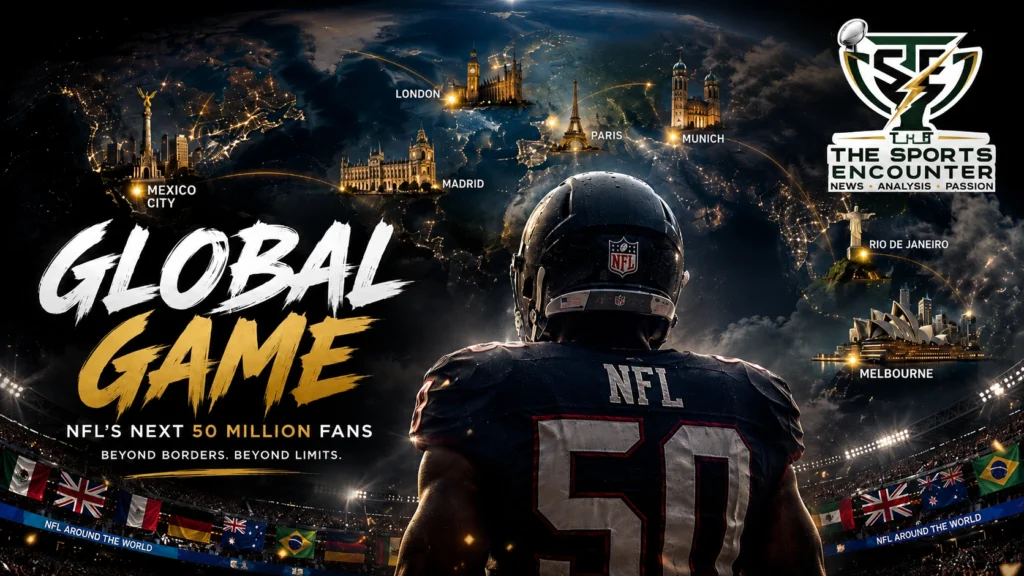
The NFL enters the 2026 season already operating from a position almost every sports league would envy. Its franchises are worth billions, its domestic television product remains enormously valuable, stadiums are full, sponsors compete for access and American football continues to dominate the U.S. sports economy.
Yet the league is looking increasingly far beyond the United States for its next major growth phase.
The target is ambitious: roughly 50 million additional international fans.
That ambition explains why the 2026 NFL season will feature a record nine regular-season games outside the United States, spread across four continents, seven countries and eight stadiums.
London remains the most mature overseas market. Madrid and Munich continue European expansion. Mexico City returns. Melbourne introduces regular-season NFL football to Australia. Paris joins the map. Rio de Janeiro gives the league another major Brazilian stage.
This is not simply an exercise in exporting nine football games.
The NFL is trying to build habits.
It wants fans in Australia to wake up for games even when the Rams are back in Los Angeles. It wants children in Germany to learn flag football before they understand every detail of an NFL playbook. It wants clubs such as the Kansas City Chiefs, Miami Dolphins, Philadelphia Eagles, San Francisco 49ers and Los Angeles Rams to develop meaningful identities thousands of miles away from their home markets.
Most importantly, it wants casual curiosity to become durable fandom.
That is much harder than selling 80,000 tickets for one spectacular international event.
The Sports Encounter’s analysis finds that the NFL’s real international challenge is therefore no longer proving that overseas audiences will attend a game. It is building enough year-round connection that international fans eventually subscribe, watch weekly, buy merchandise, follow individual franchises, play the sport and introduce another generation to American football.
If that conversion succeeds, the NFL will have created a growth engine that could reshape the economics of the league well beyond 2030.
By The Sports Encounter Editorial Desk
Published: September 2, 2026
Updated: September 2, 2026
NFL Global Expansion in 2026: Key Numbers
| Metric | 2026 Position | Why It Matters |
|---|---|---|
| International growth ambition | Roughly 50 million additional overseas fans | Shows the scale of the league’s long-term target |
| International regular-season games | 9 | Record for a single NFL season |
| Countries hosting games | 7 | Broadest geographic schedule in league history |
| Continents | 4 | Moves international strategy beyond Europe and the Americas |
| International stadiums | 8 | Creates multiple local entry points into the NFL product |
| New 2026 host cities | Melbourne, Paris, Rio de Janeiro | Extends NFL regular-season football into new major markets |
| Global Markets Program countries/markets | 22 international markets | Allows clubs to build year-round identities abroad |
| NFL teams in Global Markets Program | All 32 | International growth is now league-wide rather than experimental |
| Regular-season games outside U.S. before 2026 | 62 | Provides two decades of international-game experience |
| Australia self-identified NFL fan estimate | About 8.8 million | Explains why Australia has become a strategic priority |
The NFL’s official international-games program confirms that 2026 will feature nine games across Melbourne, Rio de Janeiro, London, Paris, Madrid, Munich and Mexico City.
The league has already played 62 regular-season games outside the United States heading into this season.
The important change is the acceleration.
The NFL Has Already Won America
The economics behind the overseas strategy are easier to understand when viewed from the league’s domestic position.
The NFL is not expanding internationally because its American business is weak.
It is expanding because the U.S. business has become so mature that the largest untapped audience sits elsewhere.
The Sports Encounter recently examined this financial dominance when the Dallas Cowboys reached an estimated $15.5 billion valuation while the average NFL franchise climbed to $9.34 billion.
Nine teams were valued at $10 billion or more.
Even the league’s lowest-valued franchise stood at approximately $7.4 billion.
Those numbers reveal something fundamental about the NFL’s international strategy.
The league has the financial capacity to be patient.
It does not need Melbourne, Paris or Rio to become profitable football markets overnight.
It can spend years building awareness, youth participation, sponsor relationships, streaming habits and club identities because the domestic business provides extraordinary financial stability.
This is why league executives repeatedly describe international expansion as a long game.
The Next 50 Million Fans Are More Valuable Than Nine Sold-Out Stadiums
A sold-out international game creates an impressive photograph.
It does not necessarily create a lasting NFL fan.
That distinction may be the most important issue in the entire international strategy.
A supporter can buy a ticket because the event is rare.
They may want to experience an American spectacle once without following the league every Sunday afterward.
The NFL needs something deeper.
A commercially valuable long-term fan might:
- watch multiple games every week;
- subscribe to an NFL streaming product or local rights partner;
- follow one franchise throughout the season;
- buy jerseys and other merchandise;
- attend future games or fan events;
- consume NFL content on social platforms;
- participate in fantasy football;
- introduce children to flag or tackle football;
- follow the draft, free agency and offseason;
- remain engaged even when no NFL game is being played locally.
That is where the next 50 million fans become economically meaningful.
They are not simply 50 million people who have heard of Patrick Mahomes.
The NFL needs millions of them to move deeper down the fandom funnel.
Australia Is the NFL’s Biggest New Experiment
No 2026 market captures the scale of the league’s ambition better than Australia.
The Los Angeles Rams and San Francisco 49ers will meet at the Melbourne Cricket Ground in the first NFL regular-season game staged in Australia.
The setting matters.
The MCG is one of the world’s great sporting venues and is deeply embedded in Australian sporting culture.
Bringing a regular-season NFL game there makes a different statement from staging an exhibition.
The game matters in the standings.
The players matter.
The result matters.
The Sports Encounter has already examined the football consequences surrounding the matchup following Aaron Donald’s sensational return to the Rams ahead of their Melbourne opener against San Francisco.
That development gives the Australian game another layer of star power.
Yet the NFL’s interest in Australia extends far beyond one Thursday night.
League research cited by international executives estimates approximately 8.8 million self-identified NFL fans in the country.
The challenge is defining what those 8.8 million people actually represent.
Some may watch the Super Bowl once a year.
Some may already follow a team every week.
Others may know several stars but rarely watch a complete game.
Turning that broad audience into habitual consumers is the real objective.
Why Australia Makes Strategic Sense Despite the Time-Zone Problem
Australia is both attractive and difficult.
Its sports culture is unusually strong.
Australian football, rugby league, rugby union and cricket already compete intensely for attention.
That means the NFL does not have to teach Australians why sport matters.
It must convince them that American football deserves a regular place within an already crowded sporting week.
The obstacle is time.
Most NFL Sunday games take place during difficult Australian viewing hours.
A fan in London can follow large sections of the Sunday schedule during the evening.
An Australian fan often faces games early Monday morning.
This limits the usefulness of conventional television habits.
Digital platforms become more important.
Highlights become more important.
On-demand viewing becomes more important.
Team-specific social media becomes more important.
The NFL’s international success in Australia may therefore depend on developing a different fan-consumption model than the one used in Europe.
London Shows What the NFL Wants Every New Market to Become
London provides the clearest model for long-term international development.
The first modern NFL regular-season game in London was played in 2007.
The league kept returning.
One game became multiple games.
Wembley became familiar territory.
Tottenham Hotspur Stadium provided a venue specifically designed to accommodate NFL football.
Fans stopped treating the league’s arrival as a one-off curiosity.
Different franchises developed local followings.
The Jaguars established an especially strong London presence through repeated games.
That is the model the NFL wants to reproduce elsewhere.
Not necessarily the exact number of games.
The habit.
Melbourne becomes strategically important only if Australian fans expect the NFL to return.
Paris becomes more valuable if the first game leads to another.
Rio becomes a true market when supporters begin planning NFL weekends before the schedule is announced.
Scarcity creates excitement.
Consistency creates culture.
The Global Markets Program May Matter More Than the International Games
The international schedule receives most of the attention because games are visible.
The NFL’s Global Markets Program may ultimately create the deeper structural change.
The official NFL Global Markets Program now gives all 32 franchises international marketing rights across 22 overseas markets.
That means teams no longer have to wait for the league office to build their international identities.
They can create local events.
They can build sponsorship relationships.
They can run fan experiences.
They can develop social content.
They can support NFL Flag programs.
They can build databases of supporters.
Most importantly, they can compete for emotional ownership of overseas fans.
That matters because generic NFL fandom has a commercial ceiling.
Team fandom is deeper.
A person who “likes the NFL” may watch the Super Bowl.
A person who considers himself a Packers fan may watch Green Bay in Week 5, follow an injury update in November, buy a jersey at Christmas and discuss the draft in April.
The Global Markets Program is designed to create more of the second type.
The UAE Is Already Part of the NFL’s International Map
For The Sports Encounter’s Middle East audience, one detail deserves particular attention.
The United Arab Emirates is now one of the NFL’s designated Global Markets Program territories.
The Las Vegas Raiders, Los Angeles Rams, San Francisco 49ers and Washington Commanders hold international marketing rights in the UAE in 2026.
That places the Gulf inside the league’s formal international-growth structure even though no regular-season NFL game has yet been announced there.
The move follows a familiar pattern.
Build the fan base first.
Develop franchise recognition.
Create commercial relationships.
Expand grassroots participation.
Then assess whether the market can support larger live events.
The UAE’s position as a global sports and events hub makes that development worth monitoring closely.
A future NFL game in the Gulf has not been confirmed.
The commercial infrastructure required to make the conversation credible is beginning to appear.
The NFL Is Learning From European Soccer’s Global Club Model
European soccer clubs have spent decades building international fan bases without playing domestic league matches abroad.
Manchester United supporters exist in Singapore.
Real Madrid shirts appear throughout the Middle East.
Barcelona has enormous support in Latin America, Asia and Africa.
Those relationships developed through television, iconic players, trophies, preseason tours, academies, sponsorships and repeated cultural exposure.
The NFL faces a harder challenge because American football historically travels less naturally.
The rules are more complicated.
The equipment creates participation barriers.
The sport has fewer deeply established professional leagues abroad.
Yet the NFL possesses one advantage soccer clubs do not.
It controls an entire league-wide international strategy.
The competition can coordinate franchises, television windows, international games, youth participation and commercial rights through one structure.
That central control gives the NFL unusual power to build markets deliberately.
Flag Football Could Become the NFL’s Most Powerful International Recruitment Tool
The NFL understands that watching a sport and playing it create very different emotional connections.
Tackle football is difficult to export at scale.
It requires helmets, pads, specialized coaching, large rosters and significant infrastructure.
Flag football removes many of those barriers.
The Sports Encounter’s detailed guide to how Olympic flag football works ahead of LA28 explains why the five-on-five format is easier for new sporting nations to adopt.
Players need less equipment.
Teams need fewer athletes.
The physical entry barrier is lower.
Schools can introduce the sport more easily.
Girls and boys can participate through similar developmental structures.
This matters commercially because participation often precedes fandom.
A child who plays flag football in Germany or Australia begins learning positions, routes, passing concepts and defensive reads.
Watching the NFL then becomes easier.
The sport stops looking like 22 players colliding unpredictably.
It begins to make tactical sense.
LA28 Gives the NFL a Global Marketing Opportunity Money Cannot Buy
Flag football will make its Olympic debut at the Los Angeles 2028 Games.
That gives American football exposure through a global sporting platform the NFL does not control.
The Olympics can introduce the game to viewers who would never deliberately select an NFL broadcast.
The Sports Encounter recently examined the intersection between the NFL and Olympic flag football when the league ended the traditional Pro Bowl game while preparing for a future in which NFL stars may chase Olympic medals.
More than 200 NFL players representing over 25 countries have reportedly expressed interest in potential Olympic participation.
If internationally recognizable NFL stars appear in national colors at LA28, the marketing effect could be enormous.
A player representing Germany, Australia, Mexico or another nation could connect NFL stardom directly to local national identity.
That is a much stronger emotional bridge than asking an overseas supporter to care about a random American franchise.
The NFL’s International Strategy Needs Players, Not Only Logos
Sports leagues become global more easily when overseas audiences can identify with individual athletes.
Basketball had Michael Jordan, Kobe Bryant, LeBron James and generations of international stars.
Soccer has always been driven by globally recognizable players.
The NFL traditionally sells teams and quarterbacks extremely well inside the United States.
Internationally, it may need to sell personalities more aggressively.
Patrick Mahomes is useful because extraordinary quarterback play translates across language.
Internationally connected players are even more valuable.
Australian-born Philadelphia Eagles tackle Jordan Mailata offers a direct cultural bridge into Australia.
Players with Nigerian, German, British, Mexican or Pacific backgrounds can create similar connections elsewhere.
The story becomes easier for a new fan to enter.
Instead of explaining the entire NFL immediately, introduce one player.
Then one team.
Then one rivalry.
Deep fandom can follow later.
The NFL Cannot Assume International Fans Will Copy American Fan Culture
One mistake would be expecting every overseas market to behave like the United States.
Fan cultures develop differently.
A German supporter may discover the NFL through a local broadcast.
A Brazilian teenager may first encounter it through social video.
An Australian fan may follow one star rather than one franchise.
A British supporter may attend London games every year without caring which teams appear.
A UAE fan may choose a franchise because it actively markets in Dubai or Abu Dhabi.
The league needs enough flexibility to allow those pathways to develop naturally.
Trying to force every fan immediately into the American model of inherited regional loyalty would be unrealistic.
The international market has no geographic draft.
A supporter in Paris can choose Kansas City, Philadelphia, San Francisco or Miami with no hometown obligation.
That creates enormous opportunity for franchises willing to earn that loyalty.
Merchandise Is Useful, but Media Rights Are the Bigger Prize
Jerseys create visible evidence of fandom.
Media consumption creates recurring economics.
If the NFL adds millions of genuine fans across Europe, Australia, Latin America, the Middle East and Asia, those audiences eventually affect the value of international broadcasting and streaming rights.
This is where international expansion can materially alter long-term league revenue.
A local broadcaster pays more when NFL audiences become reliably large.
A streaming platform values subscriptions differently when football drives retention.
Sponsors pay more when one NFL partnership reaches consumers across multiple continents.
Franchises gain additional opportunities through local commercial rights.
The financial upside compounds.
This connects directly to the extraordinary franchise valuations The Sports Encounter examined in our analysis of the NFL’s $9.34 billion average team value.
Investors are not valuing franchises purely on today’s ticket revenue.
They are paying for expectations around future media, commercial and global growth.
International Growth Could Raise the NFL’s Financial Floor Even Further
The Cowboys are already valued at $15.5 billion.
The Rams sit near the top of the league’s financial hierarchy.
The 49ers are another $10 billion-plus franchise.
These teams do not need international expansion to survive.
International growth can increase the value of the entire league ecosystem.
A larger global audience strengthens television demand.
It strengthens sponsorship.
It increases the scarcity value of NFL intellectual property.
It creates new event markets.
It creates commercial opportunities that may not exist today.
Even teams with relatively modest international profiles benefit because national league revenue is shared extensively.
This is one reason NFL owners can support a strategy that requires patience.
Growing the league internationally eventually increases the size of the economic pie.
Nine Games Are Only the Beginning
The 2026 schedule is historic because nine international regular-season games is a record.
The NFL is already thinking beyond nine.
League owners have authorized the possibility of increasing the international schedule further, and international executives have discussed ambitions that could eventually move substantially beyond today’s number.
That does not mean 16 international games are guaranteed by 2030.
It demonstrates the direction of travel.
The league wants international football to become a regular part of the NFL calendar rather than a special October side project.
That creates a fascinating future question.
At what point does an “international game” stop feeling unusual?
London has already moved some distance toward that point.
Munich may eventually get there.
Melbourne is beginning the process now.
More International Games Create a Competitive Problem the NFL Must Manage Carefully
The business case for global expansion is strong.
The football cost is real.
Teams traveling internationally face longer flights.
Players experience time-zone disruption.
Training schedules change.
Recovery routines change.
Families and support staff travel differently.
A team flying to Melbourne faces a challenge far beyond traveling from New York to London.
This matters because the NFL regular season offers very little room for competitive disadvantage.
Seventeen games can determine playoff qualification through one result.
The league therefore has to convince players and coaches that overseas assignments are competitively fair.
That requires careful scheduling, bye-week management, travel planning, medical support and facility quality.
Fans may see an international showcase.
Coaches see a football week that still has to produce a win.
The Rams-49ers Melbourne Game Will Test the Competitive Model Immediately
The NFL could hardly have chosen a more revealing Australian opener.
Los Angeles and San Francisco are NFC West rivals.
The result directly affects a division race.
The Rams enter the game with extraordinary expectations following Aaron Donald’s comeback.
The 49ers travel with a veteran roster containing players accustomed to postseason football.
The Sports Encounter has also been following San Francisco’s roster preparation, including the 49ers’ late-summer addition of offensive lineman Kion Smith.
This is precisely what makes the Melbourne experiment credible.
The NFL is not exporting a meaningless preseason exhibition.
It is asking two real rivals to begin their regular-season campaigns on another continent.
The Australian audience gets consequence.
The league gets its toughest possible operational test.
The NFL Must Avoid Becoming a Traveling Circus
There is a risk in rapid international expansion.
If every market receives one spectacular game and then waits years for another, the NFL can become an event brand rather than a local sporting culture.
People may attend because it is unusual.
That does not guarantee they will watch Tennessee against Indianapolis three months later.
The league appears aware of this problem.
Its push for recurring games in markets such as Australia reflects the belief that repetition matters.
London succeeded because the NFL kept coming back.
Germany has built momentum because games are now part of a longer strategy.
Spain has moved toward a multiyear relationship.
Australia will need something similar.
The event gets attention.
The calendar creates expectation.
Expectation helps build habit.
Youth Participation May Be the Best Measure of Whether a Market Is Really Working
Television ratings can fluctuate.
Ticket demand for rare international events can exaggerate long-term interest.
Youth participation provides another signal.
Germany offers an instructive example.
NFL Flag participation there has grown to more than 110,000 girls and boys, according to the league.
That number represents something different from an Instagram follower.
Those young players are learning football terminology.
They understand routes and positions.
Their families become exposed to the sport.
Schools interact with the NFL ecosystem.
Some will become lifelong supporters even if they never play tackle football.
The NFL’s international platform now connects games, tickets and local market activity across its expanding schedule.
The next stage is making that connection permanent between game weekends.
The NFL Is Also Exporting Its History
Global expansion becomes easier when a sport can sell more than its current season.
The NFL has a century of personalities, dynasties, rivalries and iconic moments available to new audiences.
The Sports Encounter’s coverage of the 2026 Pro Football Hall of Fame class featuring Drew Brees, Larry Fitzgerald, Luke Kuechly, Adam Vinatieri and Roger Craig illustrated how much narrative depth exists behind modern NFL fandom.
A new fan may arrive because of Mahomes.
Once engaged, that fan can discover Montana, Rice, Brady, Manning, Brees, Fitzgerald and decades of Super Bowl history.
This historical depth is commercially useful.
It gives supporters something to explore year-round.
It also helps franchises develop identity outside geography.
A 49ers supporter in Australia can connect to San Francisco history without ever having visited California.
The 2026 Preseason Shows Why the NFL Can Sell New Stars Every Year
International growth also benefits from the league’s constant renewal.
Every season creates new names.
Rookies become quarterbacks worth following.
College stars arrive.
Undrafted players become improbable success stories.
The Sports Encounter’s NFL preseason coverage of Fernando Mendoza, Drew Allar and Cam Ward showed how quickly new player narratives emerge before the regular season even begins.
This constant turnover is useful internationally because new fans do not need decades of knowledge before joining.
They can enter through the current generation.
A teenager discovering the NFL in 2026 can grow alongside the league’s new stars.
That creates emotional ownership.
The NFL’s Greatest Global Obstacle Is Still Complexity
American football is not immediately intuitive.
First down.
Third-and-seven.
Offside.
False start.
Holding.
Pass interference.
Two-minute warning.
Touchback.
Nickel defense.
Play action.
New viewers face a significant vocabulary before the tactical beauty of the sport becomes obvious.
This is a major difference from soccer.
A first-time soccer viewer understands the basic objective almost immediately.
Put the ball in the net.
An NFL broadcast often assumes the viewer already understands why a three-yard run on second-and-two can be a successful play.
International expansion therefore requires better educational content.
Short explainers, local-language commentary and beginner-friendly broadcasts may prove as important as celebrity marketing.
The League Must Localize Without Diluting the NFL Product
Global sports brands face a difficult balance.
Too little localization makes the product feel imported.
Too much can weaken what attracted people in the first place.
International fans want the NFL.
They also want an accessible version of it.
That means local-language commentary.
Local creators.
Local sponsors.
Locally relevant social content.
Regional fan events.
Local players and ambassadors.
What should remain intact is the competitive product.
The NFL’s greatest export is still an NFL game played at full intensity.
That is why real regular-season games matter more than exhibitions.
Player Health Could Become the Limit on International Expansion
Commercial appetite is unlikely to be the biggest constraint.
Player welfare may be.
The NFL already asks athletes to survive an extraordinarily physical schedule.
International travel adds another physiological burden.
The Sports Encounter’s continuing training-camp coverage has repeatedly shown how quickly injuries can change a team’s season.
A long-haul flight does not cause a torn ligament by itself.
Recovery quality matters across an entire season.
The league therefore cannot allow global growth to appear as though commercial ambition is outrunning concern for the athletes producing the product.
This is particularly important if the number of international games continues increasing.
International Growth and Franchise Values Are Becoming Connected Stories
The NFL’s commercial future is ultimately reflected in what investors believe teams will earn years from now.
That explains why global growth and franchise valuations should be analyzed together.
The Sports Encounter’s NFL valuation analysis found that the average franchise rose approximately 31% in one year.
Investors are effectively pricing future scarcity and future revenue.
International expansion enlarges both ideas.
There will still be only 32 franchises unless the league eventually expands.
Yet those 32 teams may one day serve an audience dramatically larger than today’s American-centered fan base.
A fixed supply of franchises serving a growing global audience is an attractive economic proposition.
This helps explain why owners remain willing to support international investment even when individual games create logistical complexity.
Could the NFL Eventually Put a Franchise Outside the United States?
This is the inevitable question whenever international expansion accelerates.
The league has not announced an overseas expansion franchise.
There are also enormous practical obstacles.
Travel would be difficult.
Player relocation becomes complicated.
Tax systems differ.
Competitive scheduling becomes harder.
Training facilities must meet NFL standards.
Medical support must be equivalent.
A London team would be easier geographically than an Australian franchise but still far more complicated than adding another U.S. market.
For now, international games provide the league with many of the commercial advantages without requiring permanent relocation.
The NFL can build fans in London, Germany, Spain, Mexico, Brazil, France and Australia while keeping all 32 franchises based in the United States.
That structure gives the league enormous flexibility.
Australia Could Tell the NFL Whether the Global Model Travels Beyond Europe
The strategic significance of Melbourne extends beyond Australia.
If the NFL can successfully build a durable market in a time zone far removed from the American broadcast schedule, it proves the international model is more flexible than previously assumed.
That matters for Japan.
It matters for South Korea.
It matters for other parts of Asia-Pacific.
It may eventually matter for the Middle East.
Europe is geographically easier.
Australia is the harder test.
If the harder test works, the map becomes much larger.
The Sports Encounter Verdict: The NFL Is No Longer Testing International Expansion
For years, overseas NFL games could reasonably be described as experiments.
That description is becoming outdated.
All 32 teams now hold rights through the Global Markets Program.
Twenty-two international markets are formally connected to NFL franchises.
Nine regular-season games will be played abroad in 2026.
Melbourne, Paris and Rio de Janeiro are entering the regular-season map.
London has already established a mature annual presence.
Germany has developed a meaningful football audience.
Spain is moving toward continuity.
Australia has become a strategic investment rather than a novelty.
The objective of approximately 50 million additional overseas fans reveals how far the league’s ambition now extends.
The next phase will be harder than the first.
Selling an NFL event is relatively easy when the product is rare, spectacular and surrounded by months of anticipation.
Creating a fan who watches Week 11 at 3:00 a.m. local time is much harder.
That requires emotional connection.
It requires team identity.
It requires accessible broadcasts.
It requires participation.
It requires recognizable players.
It requires the NFL to return often enough that fans stop wondering whether the league will come back.
The league has the money, the product and the patience to attempt it.
Its domestic business is already extraordinarily strong. Franchise values continue climbing. Live sports remain premium media inventory. Flag football creates a grassroots gateway. LA28 will expose the sport to another global audience.
What the NFL does not yet have is 50 million additional deeply committed international supporters.
The 2026 season may represent the point when finding them stopped being an aspiration and became one of the central business strategies shaping the future of American football.
Frequently Asked Questions About the NFL’s Global Expansion
How many international NFL games will be played in 2026?
The NFL will stage a record nine regular-season games outside the United States during the 2026 season.
Which countries will host NFL games in 2026?
International games are scheduled in Australia, Brazil, the United Kingdom, France, Spain, Germany and Mexico.
How many new international fans does the NFL want?
NFL international leadership has discussed an ambition to add roughly 50 million fans outside the United States as part of the league’s long-term global growth strategy.
Where is the first NFL regular-season game in Australia?
The Los Angeles Rams and San Francisco 49ers will play at the Melbourne Cricket Ground in Melbourne.
How many NFL fans are estimated to be in Australia?
League research referenced by NFL executives estimates approximately 8.8 million self-identified NFL fans in Australia, although levels of engagement vary substantially within that audience.
What is the NFL Global Markets Program?
The Global Markets Program grants NFL clubs international marketing rights in specific countries, allowing them to build fandom, commercial partnerships, events and grassroots football programs outside the United States.
How many countries or markets are part of the NFL Global Markets Program?
All 32 NFL teams now participate, with international rights held across 22 markets in 2026.
Does the NFL have marketing rights in the UAE?
Yes. The Las Vegas Raiders, Los Angeles Rams, San Francisco 49ers and Washington Commanders hold Global Markets Program rights in the United Arab Emirates in 2026.
Why is flag football important to NFL international growth?
Flag football requires less equipment and fewer players than tackle football, making it easier for schools and youth programs around the world to introduce the sport. It will also make its Olympic debut at Los Angeles 2028.
Will the NFL expand to 16 international games?
NFL executives have discussed significant further international growth, but a 16-game international schedule by 2030 is an ambition rather than a confirmed annual schedule.