


The New Orleans Saints spent the eighth overall pick in the 2026 NFL Draft on Jordyn Tyson because they believed he could become a major part of their offensive future.
Less than a month into training camp, the first serious concern surrounding that investment has returned.
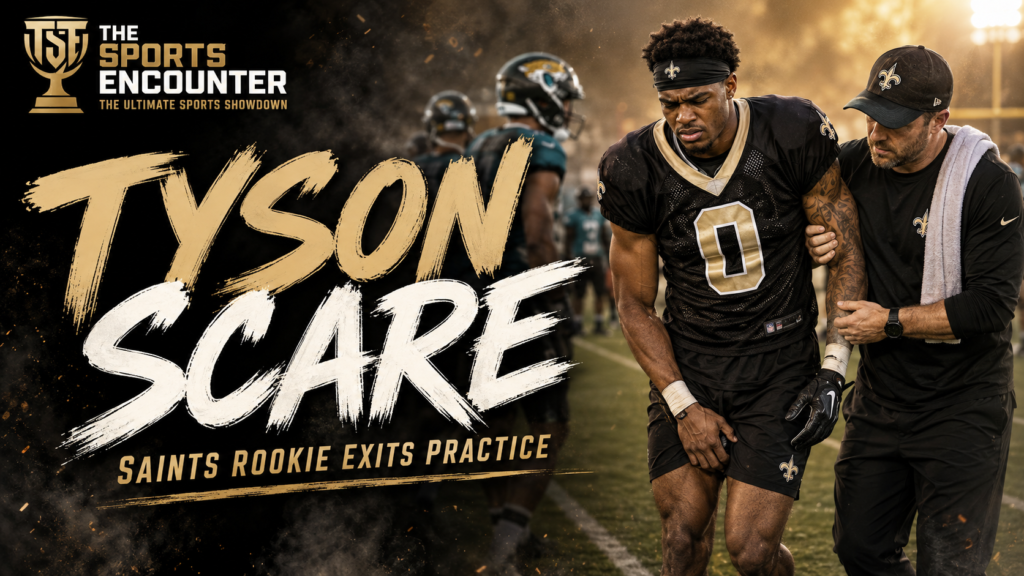
Tyson left Thursday’s joint practice with the Jacksonville Jaguars after suffering an apparent lower-body injury, with Saints head coach Kellen Moore saying the rookie receiver had experienced “something with his leg.” Early reporting indicated the problem may involve Tyson’s hamstring and was not considered especially serious, but the timing makes the situation more important than an ordinary August practice exit.
The Saints had already been managing a recurrence of a hamstring injury Tyson suffered before the draft. That history now places every new lower-body issue under greater scrutiny as New Orleans prepares for the regular season.
Readers can follow continuing developments through The Sports Encounter’s NFL coverage.
Jordyn Tyson Injury: What We Know
| Detail | Information |
|---|---|
| Player | Jordyn Tyson |
| Team | New Orleans Saints |
| Position | Wide receiver |
| Age | 22 |
| Draft position | No. 8 overall, 2026 NFL Draft |
| Practice | Joint practice vs. Jacksonville Jaguars |
| Initial concern | Lower-body / apparent hamstring injury |
| Immediate status | Further evaluation expected |
| College | Arizona State |
Kellen Moore Could Not Offer a Diagnosis Yet
Moore confirmed after practice that Tyson had left with a leg issue, while safety Terrell Burgess also departed because of a lower-body problem.
The Saints coach said he did not have enough information immediately after practice to provide a detailed diagnosis and expected greater clarity after further evaluation.
That uncertainty is common during training camp, when teams often wait for imaging, medical examinations and the player’s response over the following 24 hours before establishing a recovery timeline.
New Orleans therefore has no reason to panic yet.
There is, however, plenty of reason to be cautious.
The Hamstring History Changes the Meaning of This Injury
If Tyson were entering camp with a clean medical history, Thursday’s incident could be treated as another routine preseason scare.
His background makes that impossible.
The Saints themselves acknowledged before training camp that Tyson had experienced a recurrence of a hamstring injury that originally developed before the draft. The team planned to build his workload gradually rather than immediately expose him to a full practice load.
The Saints’ official training-camp update explained that the rookie would return to the field while being brought along carefully.
That approach now looks even more important.
The Sports Encounter has been tracking similar training-camp problems across the league, including our NFL injury roundup involving Josh Jacobs, Kenyon Sadiq and Elic Ayomanor, where availability rather than talent became the central preseason question.
Tyson’s College Career Was Brilliant but Frequently Interrupted
The Saints knew exactly what they were buying when they selected Tyson.
Talent was never the main concern.
Availability was.
Tyson caught 61 passes for 711 yards and eight touchdowns during his final season at Arizona State despite missing three regular-season games with a hamstring injury.
One year earlier, he produced 75 receptions for 1,101 yards and 10 touchdowns before a broken collarbone ended his season early.
His earlier career at Colorado also included a major knee injury that eventually contributed to a redshirt season after he transferred to Arizona State.
Across his two productive Arizona State seasons, Tyson established himself as one of the most polished and dangerous receivers in college football.
The medical history followed him into the draft process.
NFL evaluators still considered the upside substantial enough for New Orleans to select him eighth overall. The NFL’s official report on Tyson’s selection highlighted the Saints’ decision to make him a central piece of their offensive rebuild.
Why the Saints Were Willing to Take the Risk
Tyson’s football profile explains why New Orleans accepted the medical concerns.
He combines size, route-running quality, ball skills and the ability to create yards after the catch. Those qualities gave him the potential to become much more than a complementary receiver.
New Orleans needed another high-end receiving threat alongside Chris Olave.
Tyson offered that possibility.
The Saints were therefore making a calculated bet: if Tyson could remain healthy, his talent could justify the premium draft investment.
That is the same calculation teams make throughout the NFL when potential and medical risk collide.
The Sports Encounter examined how quickly training-camp uncertainty can alter roster planning in our NFL training camp roundup involving Luther Burden III and other injury concerns.
What Tyson Means to the Saints Offense
The importance of Tyson’s health extends beyond the rookie himself.
New Orleans wants to build an offense capable of creating explosive plays without forcing Olave to carry the receiving game alone.
Tyson can line up outside, attack intermediate areas and turn shorter receptions into significant gains.
That flexibility gives the Saints more ways to stress defenses.
It also gives the quarterback another receiver capable of winning individual matchups rather than relying entirely on scheme-created separation.
If Tyson misses extended time, New Orleans would not simply lose a rookie.
It would lose one of the major pieces around which the 2026 offense has been constructed.
Training Camp Availability Matters More for a Rookie
A veteran receiver can miss practice time and rely on years of NFL experience when he returns.
A rookie does not have that luxury.
Every training-camp repetition helps Tyson learn route adjustments, defensive leverage, timing with the quarterback, protection changes and the speed at which NFL coverages develop.
Missing several days can therefore have a larger developmental cost than the same absence would carry for an established starter.
That problem becomes even greater when a player’s workload is already being managed.
The Saints need Tyson healthy enough to practice, but they also need to avoid turning a manageable hamstring problem into something that follows him into September.
The Saints Are Living the NFL’s August Paradox
Training camp forces every team into the same uncomfortable calculation.
Players need physical repetitions before the regular season.
Those repetitions create injury risk.
The Sports Encounter explored that tension in our broader analysis of NFL training camp pressure involving Maxx Crosby, Kirk Cousins and Jaylin Noel.
Young players need those repetitions even more because coaches are still building their roles.
Tyson sits directly in the middle of that dilemma.
New Orleans cannot develop him effectively without allowing him to practice at NFL speed.
The Saints also cannot afford to repeatedly expose a vulnerable hamstring before games that actually count.
Jacksonville Joint Practices Were Supposed to Provide a Useful Test
Joint practices give teams something ordinary camp sessions cannot.
Players face unfamiliar opponents, different coverage tendencies and defenders who have not spent weeks learning the offense’s route combinations.
For Tyson, the Jacksonville sessions offered valuable preparation before preseason action.
Instead, Thursday ended with another medical evaluation.
The Jaguars have been involved in their own preseason roster reshaping, a process TSE covered in our report on how Jacksonville added offensive-line depth during a wider NFL training-camp shake-up.
The Saints Should Have No Reason to Rush Him
The temptation with a top-10 draft pick is obvious.
Teams want immediate evidence that the investment was correct.
August is not where that judgment should be made.
If Tyson’s latest issue is minor, the Saints would gain little by pushing him back into full work before the hamstring is ready.
Preseason statistics will not determine whether Tyson becomes a successful NFL receiver.
Being available when the regular season begins matters considerably more.
New Orleans should therefore treat every stage of his return as a long-term decision rather than an attempt to win a training-camp headline.
Tyson Is Part of a Larger New Orleans Transition
The Saints are building a new offensive identity after years in which the franchise was defined by Drew Brees.
That history still matters because New Orleans understands what a stable, productive offense can do for the entire organization.
The Sports Encounter revisited that legacy in our 2026 Pro Football Hall of Fame feature on Brees and his transformational Saints career.
The current team is obviously operating in a different era.
Tyson represents part of the attempt to create the next one.
What Happens If Tyson Misses Time?
New Orleans still has receiving talent, but the distribution of responsibility would change.
Olave would remain the primary target.
Other receivers would receive more practice repetitions and preseason opportunities.
The offensive staff could also lean more heavily on tight ends and running backs in the passing game.
Depth becomes especially important once injuries begin altering the original roster plan.
That principle has appeared across the league throughout August. The Sports Encounter recently examined it when San Francisco added Kion Smith as training-camp depth.
The Next Medical Update Matters More Than the Practice Exit
Thursday’s injury does not prove Tyson has a major problem.
It does not mean he will miss the start of the season.
Early reporting has suggested the issue may be relatively minor.
The important information will come from the next evaluation.
New Orleans needs to establish whether this is a new problem, a recurrence of the existing hamstring issue, or simply a short-term setback that can be managed with rest.
Until that is known, certainty would be premature.
The Bigger Question Is Durability, Not Talent
Tyson has already answered many of the football questions surrounding him.
He can run routes.
He can make contested catches.
He can create after the reception.
He produced at a high level in college and convinced the Saints that his ceiling justified the eighth overall pick.
The remaining question is the one that followed him into the NFL.
Can his body consistently allow that talent onto the field?
One practice injury cannot answer it.
Repeated hamstring problems would eventually make the question harder to ignore.
A Minor Injury Could Still Carry an Important Lesson
The best outcome for New Orleans is straightforward.
Further testing confirms that Tyson’s injury is minor, he receives enough recovery time, and he returns without allowing the problem to linger.
That would turn Thursday into little more than an August warning.
The Saints should still listen to it.
They invested the No. 8 pick because Tyson could become one of the defining players of their next offensive core.
Protecting that investment matters considerably more than maximizing his preseason workload.
New Orleans has spent the summer trying to build Tyson up.
The next few days may determine whether it needs to slow that process down again.
For more roster developments, injury reports and preseason analysis, follow The Sports Encounter’s NFL coverage and our report on the growing pressure surrounding the 2026 NFL preseason.
Frequently Asked Questions
What happened to Jordyn Tyson?
Tyson left the Saints’ joint practice with the Jacksonville Jaguars after suffering an apparent lower-body injury. Head coach Kellen Moore said the issue involved Tyson’s leg, while subsequent reporting pointed to the hamstring.
Is Jordyn Tyson’s injury serious?
Initial reporting suggested the injury was not considered especially serious, but the Saints were awaiting further medical information before establishing a timetable.
Has Jordyn Tyson had hamstring problems before?
Yes. Tyson dealt with a hamstring injury before the 2026 NFL Draft, and the Saints managed a recurrence of the issue before training camp. He also missed games at Arizona State because of a hamstring injury.
Where was Jordyn Tyson drafted?
The New Orleans Saints selected Tyson with the eighth overall pick in the 2026 NFL Draft.
Where did Jordyn Tyson play college football?
Tyson played at Colorado before transferring to Arizona State, where he became one of the top receivers in college football.
What were Jordyn Tyson’s 2025 statistics?
Tyson recorded 61 receptions for 711 yards and eight touchdowns despite missing three regular-season games.
Why is Tyson important to the Saints?
New Orleans drafted Tyson to become a major receiving option alongside Chris Olave and to add size, route-running ability and explosive-play potential to the offense.
Could Tyson miss the regular-season opener?
There was no confirmed indication immediately after the injury that Tyson would miss Week 1. His availability will depend on the medical evaluation and how quickly the lower-body issue responds to treatment.