


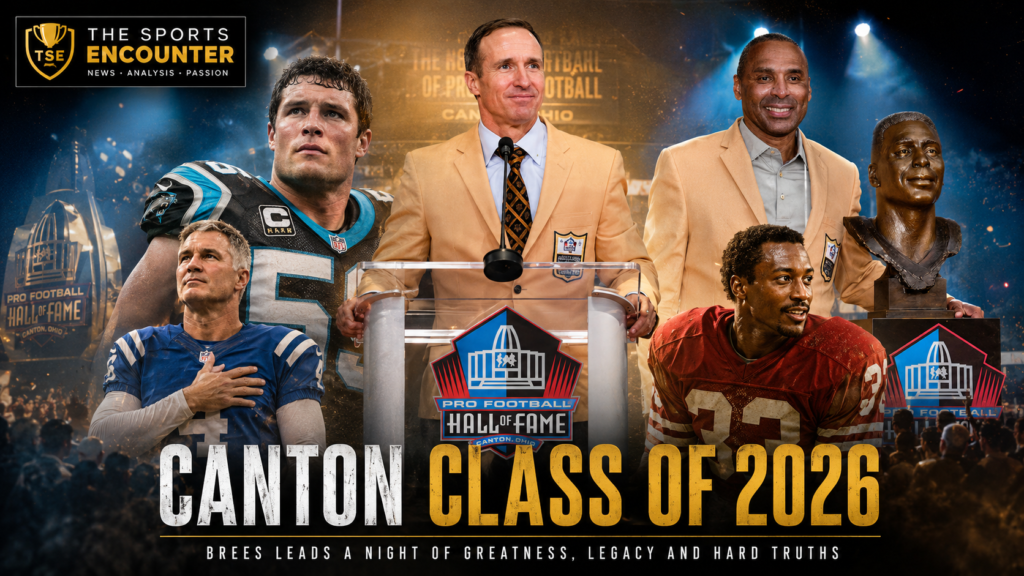
Canton spent Saturday celebrating five extraordinary football careers, but the 2026 Pro Football Hall of Fame ceremony ultimately became something larger than a collection of statistics, gold jackets and bronze busts.
Drew Brees represented perseverance and the transformation of a franchise. Larry Fitzgerald embodied consistency, loyalty and professionalism across 17 seasons. Luke Kuechly proved that greatness does not always require longevity. Adam Vinatieri finally carried one of football’s least appreciated positions into the sport’s highest room. Roger Craig waited nearly three decades for recognition and then used the biggest night of his football life to reveal that he is living with vascular dementia.
Together, they created one of the most revealing Hall of Fame classes in recent memory.
The Class of 2026 did not tell one version of NFL greatness.
It showed almost every version of it.
There was the undersized quarterback who was doubted, benched, injured and eventually became one of the most productive passers in history. There was the wide receiver who spent his entire career with one franchise and finished behind only Jerry Rice in two major receiving categories. A linebacker arrived in Canton at only 35 after walking away while still elite because his health mattered more than accumulating statistics.
The class also included the most accomplished clutch kicker of his era and a running back whose revolutionary versatility influenced offenses decades before the modern NFL fully embraced the idea.
Then Craig changed the emotional center of the afternoon.
His recorded speech ended with an intensely personal disclosure. The 66-year-old said doctors had diagnosed him with vascular dementia and believed concussions sustained during his playing career may have contributed to the condition.
The admission brought football’s greatest celebration into direct contact with one of the sport’s most difficult realities.
Football gave these men careers, friendships, championships, financial security, identity and memories that shaped entire cities.
The game also asked something of their bodies in return.
Canton celebrated both truths on Saturday.
Pro Football Hall of Fame Class of 2026 at a Glance
| Inductee | Position | Career | Defining Achievement |
|---|---|---|---|
| Drew Brees | Quarterback | 2001-2020 | 80,358 passing yards, 571 TD passes, Super Bowl XLIV MVP |
| Larry Fitzgerald | Wide receiver | 2004-2020 | 1,432 receptions, 17,492 yards, 11 Pro Bowls |
| Luke Kuechly | Linebacker | 2012-2019 | Defensive Rookie of the Year, Defensive Player of the Year, five first-team All-Pro selections |
| Adam Vinatieri | Placekicker | 1996-2019 | NFL-record 2,673 points and 599 field goals, four Super Bowl titles |
| Roger Craig | Running back | 1983-1993 | First NFL player with 1,000 rushing and 1,000 receiving yards in one season |
The five players were enshrined at Tom Benson Hall of Fame Stadium in Canton, Ohio. Brees and Fitzgerald entered as first-ballot selections, Kuechly and Vinatieri reached Canton in their second year of eligibility, while Craig entered through the Seniors category after 28 years of eligibility.
The contrasting paths made the class unusually compelling before anyone stepped to the microphone.
What Made the 2026 Hall of Fame Class Different
Hall of Fame ceremonies naturally encourage comparison.
Fans debate careers, championships, statistics, positions and eras. They ask who was the greatest player in the class and who waited too long. Canton invites those arguments because immortality is inherently selective.
The more useful way to understand the 2026 class is to examine what each player represented.
Brees represented doubt overcome.
Fitzgerald represented sustained excellence.
Kuechly represented brilliance compressed into eight seasons.
Vinatieri represented the importance of specialists.
Craig represented innovation, delayed recognition and, now, the consequences athletes can carry long after the cheering stops.
The ceremony therefore became an unusually complete portrait of professional football.
Saturday celebrated what players achieve between the lines while acknowledging that their lives continue long after the statistics become permanent.
Drew Brees Reached Canton by Refusing to Accept Other People’s Limits
Drew Brees spent much of his football life explaining why conventional expectations did not apply to him.
He was approximately six feet tall at a position where evaluators preferred larger quarterbacks. He entered the 2001 NFL Draft without the prototype physical profile associated with franchise passers and lasted until the first pick of the second round, where the San Diego Chargers selected him 32nd overall.
His NFL beginning hardly predicted Canton.
Brees struggled. He lost his starting job. San Diego drafted Philip Rivers in 2004, creating an obvious succession plan.
Brees responded with the first major reinvention of his professional career.
He threw for 3,159 yards in 2004, led San Diego to an 11-4 record in his starts and earned Comeback Player of the Year recognition.
Then his right shoulder suffered a devastating injury in the final game of the 2005 season.
The damage created another question about whether Brees could remain an NFL starter.
Miami considered signing him but had medical concerns. New Orleans took the chance.
That decision changed the Saints, changed Brees and eventually changed how an entire generation understood quarterback production.
Brees and New Orleans Became Bigger Than Football
Brees arrived in New Orleans in 2006 while the city was still recovering from Hurricane Katrina.
The Saints had never been one of the NFL’s enduring winners. They had gone decades without a playoff victory and had reached the postseason only sporadically.
Brees and head coach Sean Payton created a completely different standard.
The Saints won at least 10 games nine times during Brees’ 15 seasons in New Orleans. They never won fewer than seven games with him on the roster.
His statistical production became extraordinary.
Brees led the NFL in passing yards seven times and exceeded 5,000 yards in five seasons, a threshold that had previously seemed almost mythical for quarterbacks.
He retired with 80,358 passing yards and 571 touchdown passes. Both figures remain second in NFL history.
The numbers explain his Hall of Fame résumé.
The 2009 season explains his place in New Orleans.
Brees guided the Saints to their first Super Bowl championship and was named MVP of Super Bowl XLIV after defeating Peyton Manning and the Indianapolis Colts.
For a franchise that had spent much of its history searching for credibility, the championship became a civic memory as much as a sporting accomplishment.
That relationship followed him to Canton.
A large group of Saints supporters made the trip, prompting Brees to acknowledge the presence of the “Who Dat Nation” during his speech.
His most revealing comments, however, concerned teammates rather than records.
Brees explained that the desire to prepare, sacrifice and command an offense came from feeling responsible for giving teammates everything they deserved.
That idea helps explain his career better than the passing totals alone.
Brees mastered quarterback play as a technical discipline, but he treated leadership as an obligation.
Larry Fitzgerald Built Greatness Without Leaving Arizona
Larry Fitzgerald’s Hall of Fame career began long before he entered the NFL.
As a teenager working as a Minnesota Vikings ball boy, Fitzgerald watched players such as Randy Moss and Cris Carter from close range.
He saw what elite preparation looked like before he had the opportunity to become an elite professional himself.
Arizona selected Fitzgerald third overall in 2004.
He never left.
That fact matters because many superstar careers become defined partly by movement. Players chase quarterbacks, championships, contracts or favorable situations.
Fitzgerald spent 17 seasons with the Cardinals through good teams, rebuilding seasons, coaching changes and quarterback instability.
He still produced one of the greatest receiving careers in NFL history.
Fitzgerald retired with 1,432 receptions and 17,492 receiving yards, ranking second all time in both categories. His 121 receiving touchdowns rank among the league’s historic leaders, and he was selected to 11 Pro Bowls.
His career was defined as much by dependability as explosiveness.
Fitzgerald could win outside, operate through traffic, block, adjust to different quarterbacks and continue producing long after athletic decline normally begins to reduce a receiver’s value.
The 2008 Playoffs Showed Fitzgerald at His Most Dangerous
Arizona’s run to Super Bowl XLIII remains the clearest example of what Fitzgerald could become when the stakes increased.
He caught 30 passes for 546 yards and seven touchdowns during that postseason.
Defenses knew where the ball was going and frequently could not prevent it.
Kurt Warner played an enormous role in that transformation, something Fitzgerald openly acknowledged during his Hall of Fame speech.
Warner gave Fitzgerald the quarterback stability and confidence required to turn elite receiving talent into postseason dominance.
The relationship between them also captured one of Saturday’s recurring themes.
Every inductee arrived at Canton as an individual, yet almost every speech became an argument for collective achievement.
Fitzgerald spoke about teammates and mentors, then delivered the most emotional portion of his remarks when remembering his father, Larry Fitzgerald Sr., who died on June 1 at age 71.
He described his father as the foundation of the family and the standard against which he measured himself.
The speech transformed a football honor into a family moment.
Fitzgerald’s bronze bust will preserve the athlete.
His words preserved the people who helped create him.
Luke Kuechly Proved Eight Seasons Could Be Enough
Luke Kuechly’s career presents a completely different Hall of Fame argument.
He played only eight seasons.
There was no late-career statistical accumulation, no decade-plus pursuit of milestones and no farewell tour.
Kuechly retired in January 2020 at 28.
The decision followed multiple concussions and concern about his long-term health.
His career was short by Hall of Fame standards, but very little about his performance was ordinary.
Carolina selected him ninth overall in 2012. He immediately led the NFL in tackles and won Defensive Rookie of the Year.
One season later, he became Defensive Player of the Year.
Kuechly made seven Pro Bowls, earned five first-team All-Pro selections and exceeded 100 tackles in every season of his career.
His 18 interceptions from 2012 through 2019 were the most by any NFL linebacker during that span.
Those numbers still fail to capture the element that made him special.
Kuechly Played Linebacker Like a Quarterback
Great linebackers diagnose offenses rather than merely react to them.
Kuechly operated at an unusual level even by that standard.
He studied formations, personnel, motions and tendencies deeply enough to anticipate plays before blockers reached their assignments.
Television broadcasts regularly captured him directing teammates before the snap, adjusting alignments and identifying offensive concepts.
His athletic ability allowed him to finish the plays his mind had already recognized.
That combination made him dominant against both the run and pass.
Kuechly’s induction also arrives during a period when the NFL continues examining what longevity should mean when players make informed decisions about health.
A shorter career should not automatically become a weaker career if the peak was overwhelming.
The Hall’s voters ultimately agreed.
At 35, Kuechly became the second-youngest player ever enshrined and the first Hall of Famer to spend his entire career with the Carolina Panthers.
His Canton speech reflected gratitude more than regret.
He spoke about the people football brought into his life and the joy the sport gave him.
Kuechly did not need another five seasons to make his greatness clearer.
Eight were enough.
Adam Vinatieri Finally Put the Kicker at Center Stage
Football mythology normally belongs to quarterbacks, running backs, receivers and defenders.
Kickers spend most games outside the center of attention until an entire season suddenly depends on one swing of the leg.
Few players handled those moments better than Adam Vinatieri.
His career lasted 24 seasons.
He made 599 field goals, more than anyone in NFL history, and scored a league-record 2,673 points.
He won four Super Bowls, three with New England and another with Indianapolis.
More important than the volume was the timing.
Vinatieri’s kicks became permanent parts of NFL history.
His field goal through heavy snow against Oakland in the 2001 postseason helped keep New England alive in the game that became known for the Tuck Rule controversy.
He later kicked the winning field goal as time expired in Super Bowl XXXVI against the St. Louis Rams.
Two years later, he did it again against Carolina in Super Bowl XXXVIII.
Those moments helped turn the Patriots from an emerging team into the beginning of a dynasty.
Vinatieri’s Speech Let Canton Laugh
The 2026 ceremony carried grief, reflection and serious discussion about health.
Vinatieri supplied the comic relief.
Bill Belichick, Tom Brady and Peyton Manning all became targets during a speech filled with jokes about former teammates and coaches.
He teased Belichick, pretended Drew Bledsoe was the greatest quarterback in Patriots history and joked about Manning’s forehead providing enough space for a teleprompter.
The humor worked because Vinatieri’s résumé required no exaggeration.
He became only the third pure placekicker enshrined in Canton, joining Jan Stenerud and Morten Andersen.
Specialists rarely receive equal treatment in Hall of Fame debates because they participate in fewer plays.
Vinatieri’s career challenges the logic behind that bias.
If the objective is to identify players who changed championship outcomes, influenced NFL history and performed their responsibilities better than almost anyone else, his case becomes difficult to dispute.
He described Canton as the “pinnacle of greatness” and thanked football for giving back more than he had given to it.
That sentiment could have ended the afternoon comfortably.
Roger Craig’s message ensured it would not.
Roger Craig Waited 28 Years, Then Used Canton to Say Something More Important
Roger Craig had one of the longest journeys to the stage.
He had been eligible for the Hall of Fame for 28 years.
Arguments over his candidacy had become familiar to generations of fans.
His supporters pointed to championships, versatility and his role in Bill Walsh’s transformative San Francisco offense.
Others focused on traditional rushing totals that did not match the largest numbers produced by other Hall of Fame running backs.
The Seniors Committee eventually helped correct the delay.
Craig entered Canton at 66.
His career deserves historical context because much of what now looks normal for NFL running backs was unusual when he did it.
In 1985, Craig became the first player in league history to record at least 1,000 rushing yards and 1,000 receiving yards in the same season.
Only Marshall Faulk and Christian McCaffrey have matched the feat.
Craig was not simply catching checkdowns.
He functioned as a foundational part of Walsh’s passing system while carrying a conventional rushing workload.
In 1988, he rushed for 1,502 yards, exceeded 2,000 yards from scrimmage and won Offensive Player of the Year.
He also won three Super Bowl championships with San Francisco.
Craig’s Diagnosis Changed the Meaning of the Ceremony
Craig appeared on stage while a nine-minute recorded message played.
Near the end, he disclosed that he had been diagnosed with vascular dementia.
He explained that the changes developed gradually and were initially easy to dismiss as normal aging. His family eventually noticed enough differences to seek medical answers.
Craig said his doctors believe the condition may be related, at least partly, to concussions suffered during his football career.
That distinction must be preserved carefully.
Craig did not claim that football had been definitively established as the sole cause of his condition.
He relayed what his doctors had told him about a possible contribution from his concussion history.
According to the Mayo Clinic, vascular dementia is associated with damage to blood vessels that affects blood flow to the brain. Symptoms can include difficulties with reasoning, planning, focus, organization, language and memory.
Craig’s disclosure was therefore personal rather than theoretical.
He wanted current players, retired athletes and families to pay attention when changes begin to appear.
His central message was remarkably balanced.
Football gave him extraordinary opportunities.
He also believes athletes now know more about brain health than players understood during his era.
Roger Craig Refused to Let the Diagnosis Become His Identity
The most powerful portion of Craig’s statement came after the diagnosis.
He insisted that vascular dementia does not redefine who he is.
He remains a husband, father, teammate, friend and man who loves football.
That framing matters because health disclosures involving former players can easily reduce people to medical cases.
Craig resisted that treatment.
His career remains his career.
The championships remain real.
His influence on offensive football remains permanent.
His diagnosis is now another part of his life rather than a replacement for everything that preceded it.
Craig received a standing ovation while sitting onstage and was embraced by fellow Hall of Famers.
After waiting nearly three decades to hear Canton validate his football career, he used the platform to direct attention toward people who may never receive a gold jacket.
If another former player recognizes symptoms sooner because Craig spoke publicly, his induction will have created value beyond historical recognition.
Craig and Kuechly Connected Two Eras of Football’s Brain-Health Conversation
The presence of Craig and Kuechly in the same class created an important generational comparison.
Craig entered the NFL in 1983.
Players of that era competed in an environment with far less understanding of concussion management, neurological risk and return-to-play protocols.
Kuechly arrived nearly three decades later.
By the time he retired, conversations surrounding concussions had fundamentally changed.
Kuechly was still one of football’s premier linebackers when he stepped away.
He had enough talent to continue building statistics and adding years to his Hall of Fame case.
He chose health instead.
Craig played through an era when many athletes did not have comparable information or cultural permission to make that decision.
Saturday placed those realities beside one another without requiring anyone to simplify the sport into either celebration or condemnation.
The Sports Encounter recently examined another difficult intersection between an NFL career and long-term health after former Packers running back Ahman Green disclosed his Parkinson’s disease diagnosis.
These stories reinforce an uncomfortable responsibility for modern football.
The NFL can celebrate its history while continuing to improve how it protects the people creating that history.
A Hall of Fame Class Defined by Different Kinds of Longevity
The five careers also create an intriguing study in how long greatness lasts.
Brees played 20 seasons.
Fitzgerald lasted 17.
Vinatieri reached 24.
Craig played 11.
Kuechly stopped after eight.
There is no universal Hall of Fame timeline.
Longevity strengthens a case when performance remains meaningful, but longevity cannot replace peak dominance.
Kuechly demonstrates the point most clearly. He produced fewer seasons than many linebackers who will never reach Canton, yet his level during those seasons was so consistently elite that additional accumulation became unnecessary.
Vinatieri offers the opposite model.
His greatness included the ability to remain useful across multiple football generations. He began playing before Brady entered the NFL and remained active long enough to compete deep into the quarterback’s career.
Brees and Fitzgerald combined durability with extraordinary production.
Craig’s case required voters to look beyond raw longevity and understand positional evolution.
Roger Craig’s Long Wait Also Exposed How Hall of Fame Standards Change
Craig’s 28-year wait raises another important question.
How many Hall of Fame cases are affected because a player’s innovations become easier to appreciate only after the sport catches up?
Modern NFL offenses prize running backs who can create mismatches as receivers.
Christian McCaffrey’s versatility is treated as a tactical weapon rather than an unusual extra skill.
Craig was performing that role decades earlier.
His 1985 season established a statistical combination that has been matched only twice since.
The Hall eventually recognized that significance.
Historical evaluation should therefore consider how a player changed expectations for his position, not simply how he ranked under conventional standards of his own era.
Craig helped expand the definition of an NFL running back.
Canton took too long to acknowledge it, but the bronze bust makes the correction permanent.
The Class of 2026 Arrived During Another NFL Transition
Hall of Fame weekend sits at a fascinating point on the football calendar.
The ceremony honors careers that are complete while training camps across the country are filled with players attempting to begin their own.
The Arizona Cardinals and Carolina Panthers opened the preseason during Hall of Fame week, connecting Fitzgerald and Kuechly’s former franchises directly to the celebration.
The Sports Encounter’s recent NFL roster and Hall of Fame Game roundup examined how current teams were simultaneously managing young prospects, injuries and roster decisions while Canton prepared to honor the previous generation.
That contrast is central to the NFL.
Every August creates new careers while reminding fans how quickly old ones disappear.
Some players are trying to survive final roster cuts. Others are returning from injuries. Veterans are fighting age. Rookies are learning how different professional football feels from college.
Recent training-camp developments across the league, including the stories tracked in The Sports Encounter’s latest NFL training camp report, show how uncertain the journey remains even after a player reaches the league.
Very few of those careers will eventually end in Canton.
The Distance Between Making an NFL Roster and Reaching Canton
The Hall of Fame can make elite careers appear inevitable in retrospect.
They rarely felt inevitable while they were happening.
Brees nearly lost his path before New Orleans.
Vinatieri entered the league undrafted.
Craig waited almost three decades after retirement to receive the call.
Even players with far more modest careers understand the difficulty of surviving professional football.
The Sports Encounter recently explored that reality in its tribute to Trystan Colon after his retirement at 28. Colon did not build a Hall of Fame résumé, but his six-year career demonstrated how adaptability and trust can keep a player employed in a league constantly looking for replacements.
Canton celebrates the extreme end of that competitive spectrum.
Millions play football.
Thousands reach the NFL.
Only a tiny fraction eventually receive a bronze bust.
The official Pro Football Hall of Fame Class of 2026 record notes that the addition of Brees, Craig, Fitzgerald, Kuechly and Vinatieri brought the Hall’s membership to 387.
What Each 2026 Hall of Famer Changed
| Player | What His Career Changed |
|---|---|
| Drew Brees | Expanded expectations for undersized quarterbacks and helped normalize massive passing production. |
| Larry Fitzgerald | Established longevity, professionalism and franchise loyalty as defining parts of elite receiver value. |
| Luke Kuechly | Reinforced the importance of processing speed, coverage intelligence and complete linebacker play. |
| Adam Vinatieri | Strengthened the Hall of Fame argument for kickers and demonstrated how specialists can decide championships. |
| Roger Craig | Helped redefine running backs as multidimensional offensive weapons decades before the modern passing game. |
Today’s NFL Is Still Being Shaped by Their Examples
Brees’ career helped create greater openness toward quarterbacks who do not fit traditional physical measurements.
Fitzgerald’s longevity remains a standard for receivers trying to extend careers without losing reliability.
Kuechly’s diagnostic intelligence is now part of the model teams seek in modern linebackers who must survive against increasingly complex passing offenses.
Vinatieri strengthened the cultural understanding that kickers can become central figures in championship history.
Craig’s influence can be seen every Sunday when offenses move running backs into the slot, build option routes for them or create mismatches against linebackers.
Hall of Fame careers matter because they do not end when the player retires.
The ideas survive.
That is why the current NFL continues borrowing from previous generations even as roster construction changes rapidly.
The league’s 2026 offseason has already produced aggressive moves and experiments, from overlooked veteran acquisitions highlighted in The Sports Encounter’s analysis of underrated NFL offseason signings to the extraordinary possibility of Aaron Donald returning after two seasons away.
Donald, whose potential comeback became much more serious after an official Rams workout, represents another future first-ballot Hall of Fame discussion. The Sports Encounter’s analysis of Donald’s possible Rams return shows how even established legends can struggle with the decision about when competition should finally end.
Football’s Greatest Celebration Cannot Ignore Football’s Cost
The easiest version of Hall of Fame weekend is purely celebratory.
Fans remember championships. Television packages replay dramatic touchdowns, sacks, tackles and field goals. Families take photographs beside bronze busts. Former teammates return to honor shared history.
Craig’s announcement complicated that celebration in an important way.
Professional football involves controlled violence.
Players understand that injuries are possible, but medical knowledge surrounding long-term neurological health has changed significantly across generations.
Craig wants younger athletes to use that knowledge.
His message did not reject football.
He repeatedly described what the sport gave him.
That complexity is precisely why the disclosure carried so much weight.
Criticism of football’s health risks becomes easier to dismiss when presented as if athletes gained nothing from playing.
Blind celebration becomes equally incomplete when it ignores what some players experience decades later.
Craig held both realities together.
Football shaped his life positively.
He also wants families to recognize symptoms and seek medical help when something changes.
That may have been the most important contribution made from the Canton stage all afternoon.
The Sports Encounter Verdict
The Pro Football Hall of Fame Class of 2026 will be remembered for five outstanding careers.
It should also be remembered for what those careers collectively revealed about the sport.
Drew Brees showed how far persistence can carry a player who repeatedly heard reasons he should fail.
Larry Fitzgerald demonstrated that greatness can be built patiently, season after season, without abandoning the franchise that drafted you.
Luke Kuechly showed that excellence should be measured by impact rather than simply counting years.
Adam Vinatieri proved that a specialist can influence NFL history as profoundly as stars who touch the football on every possession.
Roger Craig finally received recognition for helping reshape offensive football long before the league fully understood what he represented.
His dementia disclosure then ensured the afternoon would carry meaning beyond achievement.
Canton exists to preserve football history.
History becomes more valuable when it preserves the complete story.
The touchdowns belong there.
The championships belong there.
The doubts, injuries, friendships, grief and family sacrifices belong there too.
So do difficult conversations about what happens to players after the stadium lights disappear.
The Class of 2026 gave the Hall five new bronze busts.
More importantly, it gave football five different ways to understand greatness and one powerful reminder that the people inside those busts remain human long after their final snap.
Frequently Asked Questions
Who was inducted into the Pro Football Hall of Fame in 2026?
The Class of 2026 consisted of quarterback Drew Brees, running back Roger Craig, wide receiver Larry Fitzgerald, linebacker Luke Kuechly and kicker Adam Vinatieri.
Where was the 2026 Pro Football Hall of Fame ceremony held?
The enshrinement ceremony was held on August 8, 2026, at Tom Benson Hall of Fame Stadium in Canton, Ohio.
Was Drew Brees a first-ballot Hall of Famer?
Yes. Brees entered the Pro Football Hall of Fame in his first year of eligibility.
Was Larry Fitzgerald a first-ballot Hall of Famer?
Yes. Fitzgerald was elected in his first year of eligibility after finishing his career with 1,432 receptions and 17,492 receiving yards.
How many years did Roger Craig wait for the Hall of Fame?
Craig was in his 28th year of Hall of Fame eligibility before being elected through the Seniors category.
What did Roger Craig reveal during his Hall of Fame speech?
Craig revealed that he has been diagnosed with vascular dementia. He said his doctors believe concussions sustained during his football career may have contributed to the condition.
Why did Luke Kuechly retire so young?
Kuechly retired after eight NFL seasons at age 28. His decision came after multiple concussions and concerns surrounding his long-term health.
How many career passing yards did Drew Brees record?
Brees finished his NFL career with 80,358 regular-season passing yards and 571 touchdown passes.
How many field goals did Adam Vinatieri make?
Vinatieri made an NFL-record 599 regular-season field goals during his 24-year career.
What record did Roger Craig set in 1985?
Craig became the first player in NFL history to record at least 1,000 rushing yards and 1,000 receiving yards in the same season.
How many players are now in the Pro Football Hall of Fame?
The Hall’s membership reached 387 with the addition of the Class of 2026.