


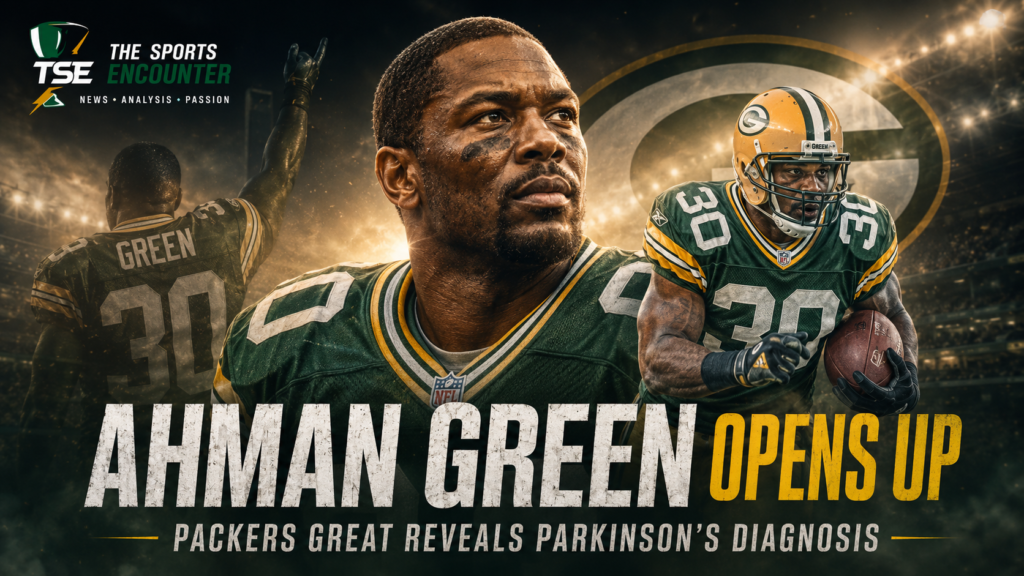
Ahman Green spent years powering through defenders, carrying the Green Bay Packers offense, and building one of the most productive careers in franchise history. Now, the former Pro Bowl running back is facing a challenge that has nothing to do with yards after contact or breaking free in the open field.
Green, the Packers’ all-time leading rusher, has publicly revealed that he is living with Parkinson’s disease. He said he was diagnosed with early-onset Parkinson’s in January 2025 and had, until now, only shared the news with family members and a small circle of trusted friends.
For football fans, the immediate instinct is to process the news through emotion. Green is not just another retired player. He is one of the defining runners in modern Packers history, the man who broke Jim Taylor’s long-standing franchise rushing record, and a player whose best years helped stabilize Green Bay’s offense in the post-Brett Favre peak era.
But this story should not be framed only through nostalgia.
It is also about dignity, control, vulnerability, and what happens when a former athlete who once looked almost indestructible chooses to speak openly about a serious neurological condition. Green’s announcement was deeply personal, but it also carried broader meaning for the football world and for any fan who has ever wondered what life looks like after the cheering stops.
Readers can continue exploring broader football coverage through The Sports Encounter’s NFL section and the site’s wider featured stories archive.
TL;DR
- Packers great Ahman Green has revealed that he is living with Parkinson’s disease.
- Green said he received an early-onset Parkinson’s diagnosis in January 2025.
- He first noticed signs such as feet twitching during sleep and pursued medical testing.
- The former running back said he feels he is ahead of the disease and staying disciplined with medication, diet, and routine.
- Green remains the Green Bay Packers’ career rushing leader with 8,322 rushing yards for the franchise.
- He retired with 9,205 rushing yards, 2,883 receiving yards, and 74 total touchdowns.
- His decision to speak publicly shifts the conversation from football legacy to long-term health, resilience, and support.
Ahman Green Parkinson’s Diagnosis: Key Information
| Detail | Information |
|---|---|
| Player | Ahman Green |
| Age | 49 |
| Diagnosis | Early-onset Parkinson’s disease |
| Diagnosis timing | January 2025 |
| Team most associated with him | Green Bay Packers |
| Packers rushing record | 8,322 rushing yards |
| Career rushing yards | 9,205 |
| Career receiving yards | 2,883 |
| Rushing touchdowns | 60 |
| Receiving touchdowns | 14 |
| Peak season | 1,883 rushing yards in 2003 |
| Pro Bowls | 4 |
| Core message from Green | He says he is in control and does not intend to let the disease control him |
Official league and team information can be found on the official NFL website and the official Green Bay Packers website.
This News Hits Differently Because Ahman Green Is More Than a Former Player
Every franchise has well-known players. Fewer have figures who come to represent a specific football identity.
For Green Bay, Ahman Green belongs in that conversation.
He arrived in 2000 after beginning his NFL career with the Seattle Seahawks and became one of the most explosive runners of his era. Between 2000 and 2006, he gave the Packers a consistent ground threat, a physical running style, and enough receiving ability to remain dangerous in different offensive structures. He later returned briefly in 2009 after two seasons with the Houston Texans.
His numbers still carry real weight. Green rushed for 8,322 yards in a Packers uniform and passed Hall of Famer Jim Taylor’s franchise mark of 8,207. His 2003 season, when he ran for 1,883 yards, remains one of the greatest individual rushing campaigns in team history.
That is why this announcement lands with so much emotional force. Fans are not hearing difficult news about a distant name from an old stat sheet. They are hearing it about one of the most important runners the franchise has ever had.
When supporters revisit Green’s legacy, they usually remember his cutback ability, his acceleration into the second level, and the punishment he absorbed while keeping the offense balanced. They remember the production. They remember the reliability. They remember the sense that, for several seasons, he was one of the NFL’s most complete backs.
Now they also have to confront the reality that a player who gave so much to the game is dealing with a degenerative condition that will shape the rest of his life.
What Green Actually Said Matters
Green did not announce his diagnosis with self-pity. He sounded focused, pragmatic, and unusually direct about how he is approaching it.
He said he had noticed symptoms, including feet twitching during sleep, before eventually seeking medical evaluation and going through the testing process that led to the diagnosis. He also made clear that he believes he has caught the disease early enough to act decisively.
That part of the story is important.
Green’s comments were not framed around helplessness. They were framed around awareness and response. He described staying on his medication protocol and treating food as part of his broader health discipline. He said he feels “ahead of it” and emphasized that he remains in control rather than allowing the condition to define him.
That does not make Parkinson’s any less serious. It does show how he wants to meet it.
And that perspective is worth highlighting because public discussions around major diagnoses often flatten the person involved. The condition becomes the whole story. The public sometimes forgets that the individual is still thinking, deciding, planning, and fighting to preserve agency.
Green’s language pushed back against that. He made it clear that the disease is part of his reality, but not the full story of who he is.
What Parkinson’s Disease Means in This Context
According to the Mayo Clinic, Parkinson’s disease is a progressive movement disorder of the nervous system. Over time, it can affect movement, coordination, gait, balance, and other physical functions.
That broad definition matters here because Green himself pointed to subtle physical signs that doctors identified more clearly once they evaluated how he walked and how his shoulders carried themselves. He said medical professionals noted early indicators that may not have been obvious to a casual observer.
That reality helps explain why the diagnosis can feel so unsettling in stories involving former athletes. These are people whose bodies once performed at a world-class level. When signs emerge, they are often processed against a mental image of strength and power that fans still carry.
It is also important to stay responsible here.
This article is not a medical guide, and it should not pretend to be one. The public does not need speculation or dramatic leaps. What matters most is what Green himself has disclosed: he was diagnosed in early 2025, he recognized signs that something was wrong, he pursued testing, and he believes he is managing the condition actively.
That is the accurate frame.
Why Going Public Took Courage
Many former athletes deal with health issues privately for as long as possible. That instinct is understandable.
Fame changes the emotional cost of illness. A public figure is not only dealing with the disease itself. He is also dealing with headlines, social media reactions, old highlights recirculating, public sympathy, unsolicited medical opinions, and the uncomfortable reality that strangers now see him through a lens of concern rather than performance.
Green said he had shared the diagnosis only with family and selected friends before speaking publicly. That tells you something important about the weight of the moment.
He did not casually drop the information into the public space. He kept it protected first. Then, when he was ready, he chose to speak.
That decision creates a different kind of leadership.
Athletes are often praised for leadership when they produce, take pain, or speak after a tough loss. There is another version of leadership in telling the truth about life after football, especially when the truth is difficult and deeply personal. Green’s announcement may help other former players, or even ordinary fans, take early warning signs more seriously and seek help sooner.
That does not make his diagnosis a lesson or a public service project. It remains his life. It does show that honesty at the right moment can have value beyond the individual.
Ahman Green’s Career Deserves Its Own Respectful Reframing
Whenever a legendary athlete shares major health news, the temptation is to turn the career summary into a quick obituary-style recap. That would undersell Green’s place in football history.
He was not simply good for a few years. At his best, he was one of the NFL’s most effective offensive weapons.
Green combined vision, contact balance, lower-body power, burst, and enough versatility as a receiver to stay relevant on passing downs. His style was never built around flash alone. He could grind out difficult yards, hit the edge, and punish a defense that had already spent four quarters dealing with Brett Favre and the Packers passing game.
His 2003 campaign remains the most iconic statistical expression of his talent. Rushing for 1,883 yards in a season is not a lucky spike. It is a statement of dominance. That year was the clearest evidence of how central he could be to an offense.
He also produced in the postseason, adding 521 rushing yards in eight playoff games. That part of his résumé matters because star running backs are often judged by whether they remain useful when games tighten and defenses improve. Green did.
The Sports Encounter often explores how sports history changes when new context arrives. A different kind of legacy conversation appeared recently in our feature on why Rodri’s World Cup greatness had to be understood beyond flashy statistics. Green’s story raises a similar challenge in a different sport: how do you discuss greatness once the player’s life after the spotlight becomes part of the public story?
The right answer is not to erase the achievements or allow the diagnosis to become the only thing remembered. It is to hold both truths together.
This Story Is Also About Life After Football
Professional football celebrates toughness in a way that can make retirement seem like a neat narrative finish. The player leaves, the records remain, the highlight packages live forever, and the public gradually moves on.
Real life is rarely that tidy.
Former players continue living with the physical consequences of elite competition. Their bodies do not retire just because the uniform does. Their routines change. Their identities change. Their relationships with pain, health, fitness, and public attention also change.
Green’s announcement forces that truth back into view.
It asks fans to look beyond franchise records and remember that the player they once cheered is a person managing medical appointments, symptoms, uncertainty, and long-term lifestyle adjustments. That should not turn into performative pity. It should become perspective.
The same broader human perspective shaped how The Sports Encounter approached the story of Ron Duguay’s hospitalization. In both cases, the most responsible sports writing had to move beyond the instant headline and consider the person at the center of the story.
Ahman Green’s announcement belongs in that category of sports stories that start with a recognizable name but demand a more mature response.
Fans Will Revisit the Packers Era Through a New Lens
One unavoidable effect of this news is that it will change how some fans remember Green’s playing days.
That change may be subtle, but it is real.
Supporters who watched him run through tacklers and carry the offense will now revisit those images with an added awareness of how fragile athletic certainty can be. They will remember the collisions differently. They may think more seriously about the cost of NFL careers. They may wonder, quietly and cautiously, about the long-term wear that professional football places on the body.
That conversation should remain careful. The public should not draw conclusions beyond what is known or make irresponsible claims about direct causation in Green’s case. His diagnosis deserves respect, not speculation.
Still, the emotional connection between football labor and post-career health is impossible to ignore. Every former star who goes public with a serious condition reminds fans that sports glory and private struggle often exist much closer together than the highlight reel suggests.
In that sense, Green’s diagnosis is not just Packers news. It is part of the wider ongoing story about what elite athletes carry with them after the game ends.
What Makes His Response So Compelling
The most striking part of Green’s announcement may be the way he talked about control.
He did not sound resigned. He sounded disciplined.
He said he has the reins. He said he is in control. He talked about medication and food, about following protocol, and about not allowing the diagnosis to dictate his identity. That mindset does not erase the seriousness of Parkinson’s. It does reveal something essential about his character.
Athletes who excel at the highest level often build their lives around routine, discipline, repetition, and accountability. Those habits do not automatically disappear after retirement. In Green’s case, they appear to be part of how he is approaching this chapter as well.
That can matter deeply for fans and families because stories like this often feel overwhelming at first glance. Hearing a former player speak in practical terms about management rather than surrender can provide a different emotional entry point into the story.
He is not pretending nothing is wrong. He is showing what determined response looks like.
The Football World Should Respond With Respect, Not Noise
There are moments in sports when the proper response is not hot takes, debates, or forced framing.
This is one of those moments.
Green’s diagnosis should not be used as a vehicle for shallow legacy arguments, crude speculation, or attention-seeking commentary. The appropriate public response is support, respect, and enough restraint to let the man at the center of the news remain human rather than symbolic.
That includes the media.
A responsible sports feature should not reduce Green to a condition. Nor should it strip the story of context. It should recognize his achievements, take his words seriously, explain why the news matters, and leave room for dignity.
That editorial balance matters across sports. The Sports Encounter has applied the same principle when writing about leadership changes, personal setbacks, and moments of vulnerability, whether in Joe Root’s return to England Test captaincy, the WNBA controversy involving teenage fans and institutional conduct, or the LeBron James documentary discussion. Different stories require different tones, but all demand the same basic standard: let the reporting stay grounded in the person and the moment.
Green’s Legacy Was Already Secure
One important truth in all of this is that Ahman Green did not need another football achievement to secure his place in Packers history.
That part of his life is already settled.
He remains the franchise’s career rushing leader. He was a four-time Pro Bowler. He produced across multiple seasons and helped define an important era of Green Bay football. He retired with 9,205 rushing yards, 2,883 receiving yards, and 74 total touchdowns in 148 career games.
Those are not marginal numbers. They belong to one of the better running back careers of his generation.
The announcement does not change that legacy. If anything, it humanizes it further.
It reminds fans that athletes are not museum pieces trapped forever in their best season. They continue aging, adjusting, and dealing with realities that the public only sees in fragments.
That is why stories like this can feel heavier than a normal sports update. They pull the athlete out of the past and place him back in the present, where admiration meets vulnerability.
What Comes Next for Ahman Green
No outsider can fully define what Green’s next chapter should look like. He has already given the clearest available guidance himself.
He intends to stay ahead of the condition. He intends to follow his protocol. He intends to stay in control.
That is enough for now.
There is no need to force a dramatic narrative about triumph or decline. Real life is usually more measured than that. Some days will be better than others. Public interest will spike now and likely fade. The actual work of living with Parkinson’s will continue long after the headlines move on.
That is why Green’s own discipline matters so much. He is the one who will live the routine, not the public.
Fans can support him, respect him, and remember him properly. They cannot live the process for him. What they can do is avoid reducing him to the diagnosis and continue honoring the full picture of who he is: a former star, a record-holder, a public figure, and now a man choosing openness while navigating a serious health challenge.
Final Analysis: This Is a Football Story, a Human Story, and a Reminder
Ahman Green’s announcement begins as sports news because his name carries football history. It becomes something more meaningful the longer you sit with it.
It is a football story because Green remains one of the greatest running backs in Packers history.
It is a human story because Parkinson’s does not care about rushing titles, Pro Bowls, or highlight reels.
And it is a reminder because fans so often consume sports as if the athletes exist only in the moments when they produce for us. Announcements like this reintroduce the person behind the performance.
Green’s words offered more than disclosure. They offered a tone. He spoke with seriousness, but also with control. He did not deny the challenge in front of him. He made it clear that he intends to meet it on his terms as much as possible.
That deserves admiration of a different kind.
Not the admiration reserved for a great running season or a record-breaking performance. A steadier kind. A more human one.
Ahman Green’s football legacy was already written in rushing yards, franchise records, and seasons that Packers fans still remember vividly. This new chapter does not erase any of that. It asks the public to see the man more fully.
And in the end, that may be the most respectful way to tell this story.
For more long-form sports features, athlete legacy stories, and major football coverage, visit The Sports Encounter’s NFL coverage section, the site’s sports features archive, and our broader American sports coverage.