


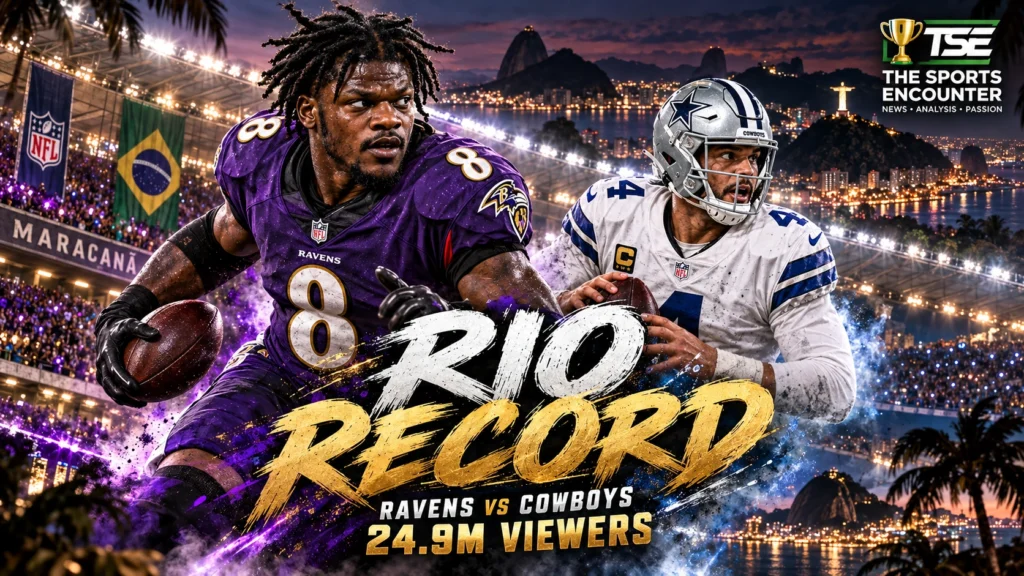
The NFL went to Rio de Janeiro looking for another international market.
It may have discovered something even more valuable: a way to take an international game abroad without sacrificing the television habits that make American football so commercially powerful at home.
Baltimore’s dramatic 34-31 victory over the Dallas Cowboys at Maracanã Stadium averaged 24.9 million viewers on CBS, making it the most-watched NFL international game on record.
The audience climbed above 30 million viewers during the closing stages, when Lamar Jackson connected with Zay Flowers to move Baltimore into field-goal range and Tyler Loop converted a 56-yard kick as time expired.
The ratings record, reported by Reuters, is impressive by itself.
But the number becomes much more revealing when compared with how most international NFL games are scheduled.
This was not a 9:30 a.m. Eastern Time game from London.
It was not a Thursday-night game from Australia available primarily through streaming.
It was the Dallas Cowboys against Lamar Jackson’s Baltimore Ravens in CBS’s traditional 4:25 p.m. ET Sunday window, played from a stadium thousands of miles outside the United States but only one hour ahead of the U.S. East Coast.
That combination may be the real breakthrough.
How Many People Watched Ravens vs Cowboys in Brazil?
| Metric | Ravens vs Cowboys |
|---|---|
| Average U.S. audience | 24.9 million |
| Peak audience | More than 30 million |
| Final score | Ravens 34, Cowboys 31 |
| Venue | Maracanã Stadium, Rio de Janeiro |
| Date | September 27, 2026 |
| U.S. kickoff | 4:25 p.m. ET |
| Broadcaster | CBS |
| Deciding play | Tyler Loop 56-yard field goal as time expired |
| Significance | Most-watched NFL international game on record |
The NFL’s own report confirmed that the game set a new international-game viewership benchmark and that the audience surpassed 30 million during the finish.
It also became CBS’s most-watched Week 3 game since 2014.
That gives the result significance in two different categories.
It worked as an international event.
It also worked as conventional American Sunday-afternoon television.
Does 24.9 Million Mean 24.9 Million International Fans Watched?
No, and this distinction matters.
The 24.9 million figure refers primarily to the measured U.S. television audience on CBS for a game being played internationally.
It should not be described as 24.9 million Brazilian viewers or 24.9 million viewers outside the United States.
The phrase “international-game record” describes the location and category of the NFL game, not the geographic composition of everyone watching the CBS broadcast.
That does not make the number less important.
It arguably makes the strategic lesson clearer.
The NFL managed to stage a major regular-season game abroad while still reaching an audience comparable with its biggest traditional U.S. Sunday broadcasts.
That is one of the league’s hardest international-expansion problems.
The Sports Encounter previously examined the NFL’s ambition to add roughly 50 million international fans. The challenge was never simply filling foreign stadiums.
It was figuring out how international football could become part of the league’s enormous weekly media machine.
Rio just supplied one possible answer.
Why Did Ravens-Cowboys Produce Such a Huge TV Audience?
Several forces aligned at the same time.
1. The Cowboys Remain the NFL’s Ultimate Television Brand
Dallas carries an audience regardless of its record.
The Cowboys entered Rio at 1-1 and left at 1-2. That did not reduce the commercial power of the matchup.
TSE recently examined why the Cowboys can be valued around $17 billion despite their long Super Bowl drought.
One of the central answers is attention.
Dallas remains one of the rare American sports franchises capable of turning an ordinary regular-season game into a national event.
That becomes even more valuable internationally.
The NFL does not need a new Brazilian fan to understand every defensive coverage immediately. A globally recognizable brand gives that fan an obvious entry point.
Dallas provides one.
2. Lamar Jackson Gave the NFL Another Global-Level Star
The other side of the field mattered just as much.
Baltimore brought Lamar Jackson, Derrick Henry and Zay Flowers.
Jackson is a multiple-time MVP whose style translates unusually well to audiences still learning the details of American football because his athleticism is immediately visible.
You do not need years of NFL tactical knowledge to understand why a quarterback escaping pressure, running into open space or creating a deep completion is spectacular.
Baltimore had already shown its offensive ceiling when Jackson, Henry and Flowers overwhelmed Indianapolis in TSE’s NFL Week 1 analysis.
Rio placed that offense opposite the league’s most commercially recognizable franchise.
That is premium inventory.
3. Brazil Solved the Time-Zone Problem
This may be the most important factor of all.
London is an established NFL market, but European games frequently begin at 9:30 a.m. Eastern Time.
Australia creates an even more complicated scheduling challenge.
Rio does not.
Brazil’s time-zone relationship with the eastern United States allowed Ravens-Cowboys to kick off at 4:25 p.m. ET, one of the NFL’s most valuable weekly television windows.
The league therefore did not have to choose between international expansion and American viewing convenience.
It got both.
That makes Brazil structurally different from almost every European or Asia-Pacific market the NFL is pursuing.
4. CBS Gave the Game Maximum Distribution
Platform matters enormously when comparing NFL audiences.
Ravens-Cowboys aired on CBS.
That meant broad network television distribution inside the United States rather than an international game confined primarily to NFL Network or a streaming platform.
The distinction helps explain why this record should not be interpreted as evidence that every international NFL matchup can suddenly produce 25 million viewers.
The NFL still needs the right broadcaster, window and teams.
Rio provided all three.
How Does the Rio Rating Compare With 49ers-Rams in Australia?
The comparison is useful, but it needs to be made carefully.
San Francisco’s 27-7 victory over the Los Angeles Rams in Melbourne earlier this season averaged 18.5 million U.S. viewers on Netflix and reached a reported 21.7 million global audience.
TSE examined those numbers in our analysis of the NFL’s opening-week television ratings and Melbourne audience.
Ravens-Cowboys reached 24.9 million on CBS in the United States.
Those figures demonstrate Rio’s enormous performance, but the measurements should not be treated as perfectly interchangeable.
One includes a CBS U.S. television average.
Another includes separate U.S. Netflix and global figures.
Different platforms, measurement systems, kickoff times and geographic reporting create unavoidable complications.
The cleanest comparison is the U.S. audience:
| 2026 International Game | U.S. Audience | Platform |
|---|---|---|
| 49ers vs Rams, Melbourne | 18.5 million | Netflix |
| Ravens vs Cowboys, Rio | 24.9 million | CBS |
Rio produced approximately 6.4 million more U.S. viewers.
That does not mean Brazil automatically has more NFL potential than Australia.
It means Brazil offered a much friendlier television environment for the American audience.
Why Australia’s NFL Experiment Still Matters
Melbourne tested something completely different.
Australia forced the league to move a meaningful divisional game almost 8,000 miles from the U.S. West Coast and manage one of the most difficult time-zone changes in professional sports.
TSE’s analysis of why the NFL chose Australia for Week 1 showed that the logistical problem was part of the experiment itself.
The game still drew 18.5 million U.S. viewers and became the most-watched NFL game in Australian history at the time.
Rio then broke the international-game audience record under dramatically different conditions.
Taken together, the games tell the NFL something more useful than choosing one “winning” market.
Different international territories can serve different strategic purposes.
Australia creates an Asia-Pacific gateway.
London provides a mature European fan base.
Germany continues demonstrating strong local demand.
Mexico gives the NFL geographic proximity and decades of existing fandom.
Brazil offers something uniquely attractive: huge market potential without forcing U.S. broadcasters out of familiar viewing windows.
Did the Quality of Ravens-Cowboys Help the Ratings?
Absolutely.
You can schedule the perfect television window and still lose viewers if the game is finished by halftime.
Rio delivered the opposite.
Dallas led 10-0.
Baltimore recovered.
The Cowboys produced more than 400 yards of offense.
The fourth quarter became a shootout.
Dallas had a chance to take the lead late, settled for a tying field goal and left Baltimore only seconds to respond.
Jackson then found Flowers for 27 yards.
Loop kicked from 56.
Game over.
The NFL’s official report on the ratings record said the audience climbed above 30 million during those closing moments.
That peak matters.
It suggests viewers did not merely tune in because Dallas and Baltimore were playing abroad. The game retained and accumulated attention because the competitive drama justified it.
Why the Finish Was Perfect for the NFL’s International Product
International games work best when the football itself provides the marketing.
Tyler Loop’s 56-yard winner supplied exactly that.
The ending produced an easily understood sporting moment:
- The score was tied.
- There was essentially no time remaining.
- One kick would decide the game.
- The kick came from significant distance.
- It went through as time expired.
That kind of moment travels well on highlights, social media and international sports programming.
The NFL does not have to explain a complicated fourth-down analytics decision to make it compelling.
One kick won the game.
For a league trying to convert curious international viewers into repeat consumers, memorable finishes matter.
What Does the Record Mean for the Cowboys’ Global Value?
Quite a lot.
Dallas is already the NFL’s biggest commercial asset.
TSE’s earlier examination of soaring NFL franchise valuations showed why scarce franchises with national and international recognition continue becoming more valuable even before new global markets fully mature.
Rio provides another practical example.
The Cowboys went to another continent and helped create a television audience larger than any previous NFL international game.
That is commercially useful regardless of who won.
Every successful international Cowboys appearance strengthens possibilities around:
- international sponsorships;
- merchandise;
- local commercial partnerships;
- media-rights demand;
- social-media audiences;
- future international ticket sales;
- and long-term franchise valuation.
The Cowboys’ enormous value is therefore connected not only to how many people watch them in Texas.
It is connected to how easily the Dallas brand travels.
What Does Rio Tell the NFL About Its Goal of Finding 50 Million New Fans?
It tells the league that location alone is not enough.
The NFL wants approximately 50 million more fans outside the United States as international expansion becomes one of its major long-term growth strategies.
But fandom develops through repetition.
One sold-out stadium does not create a football culture.
One record rating does not guarantee Brazilian fans will watch Cincinnati play Cleveland six weeks later.
The real test is conversion.
Do people who watched Dallas and Baltimore begin following the standings?
Do they choose teams?
Do they buy merchandise?
Do they watch NFL games that are not played in Brazil?
Do children begin playing flag football?
Do local sponsors invest?
Does Brazilian media coverage remain strong after the teams leave?
Those questions were central to TSE’s deeper investigation into the NFL’s global expansion strategy.
The Rio ratings record is therefore evidence of acquisition.
Retention remains the harder problem.
Is Brazil Now the NFL’s Most Important International Market?
Not necessarily.
London has decades of institutional advantage.
Germany has repeatedly shown enormous ticket demand.
Mexico has a deeply established NFL audience.
Australia creates access to a region the league has barely begun to develop.
Brazil nevertheless possesses an increasingly persuasive combination.
It has population scale.
It has a powerful sports culture.
It has major global cities.
It sits in a favorable time zone for U.S. broadcasts.
And now it owns the highest-rated international NFL game on record.
The league’s official 2026 international schedule includes a record nine games across seven countries and four continents.
Melbourne and Rio have already been played.
Seven international games remain.
That gives the NFL seven more opportunities to learn which parts of the Rio formula are repeatable and which belonged uniquely to Cowboys-Ravens.
Why the Next International Games May Not Match 24.9 Million
Expecting every remaining international game to chase the Rio number would be a mistake.
Several upcoming European games begin at 9:30 a.m. Eastern Time.
That puts them outside the traditional Sunday afternoon windows that routinely generate the NFL’s largest audiences.
Some will air on NFL Network rather than CBS, Fox or NBC.
Some matchups contain teams with smaller national fan bases than Dallas.
Those structural differences matter.
The NFL itself reported that six international games carried by NFL Network in 2025 averaged approximately 6.2 million viewers.
That enormous gap does not mean those games failed.
It shows how strongly distribution affects the ceiling.
Could the NFL Schedule More Brazil Games in Major Sunday Windows?
That may be the most consequential question to emerge from the record.
The 4:25 p.m. Sunday window gave the NFL almost everything it normally receives from a high-profile domestic matchup:
- a familiar start time;
- broad network television distribution;
- a national audience already accustomed to watching football;
- a marquee franchise;
- a superstar quarterback;
- and a competitive game.
The unusual part was the background.
Instead of Dallas or Baltimore, the imagery came from Maracanã and Rio de Janeiro.
That may represent a particularly powerful model for future international expansion.
The league gets the spectacle of entering another country without requiring millions of American viewers to alter their Sunday routine.
That is difficult to reproduce in London.
It is nearly impossible in Australia.
It is much easier in Brazil and other parts of the Americas.
Ravens-Cowboys Also Strengthened the NFL’s 2026 Ratings Story
The record arrives after an unusual opening to the season.
The Seattle-New England kickoff game averaged 25.1 million viewers but fell year over year.
Melbourne then produced 18.5 million U.S. viewers on Netflix and established a major Australian audience benchmark.
Rio has now delivered 24.9 million on CBS.
That progression strengthens the argument TSE made after opening week: individual percentage changes matter less than the scale of the NFL’s overall television ecosystem.
Most sports properties would celebrate reaching 10 million viewers.
The NFL can draw roughly 25 million and then debate whether the number should have been higher.
That is a fundamentally different commercial position.
The Record Also Came at the Perfect Time for Dallas
The television success contrasts sharply with what happened competitively.
Dallas fell to 1-2 despite moving the football effectively.
A week earlier, Dak Prescott had produced a historic performance against Washington, throwing four touchdowns and passing Tony Romo for the Cowboys’ franchise career touchdown-pass record, as covered in TSE’s NFL Week 2 analysis.
Against Baltimore, the offense again produced enough to win.
The Cowboys still lost.
That creates a strange but familiar Dallas contradiction.
On the field, the Cowboys are trying to solve a 1-2 start.
Off the field, they have just helped the NFL make international television history.
What Does Ravens-Cowboys Mean for the Rest of the NFL International Schedule?
The rest of the 2026 schedule now has a benchmark.
According to the NFL’s official international calendar, the league still has games scheduled in London, Paris, Madrid, Munich and Mexico City.
The objective should not be to demand another 24.9 million from each one.
The more useful questions are different:
- How many viewers does each platform attract?
- How much local interest remains after game day?
- Which franchises build durable followings?
- Which kickoff times work best?
- How well do local sponsors respond?
- Does youth participation increase?
- Which markets justify repeat visits?
The NFL is effectively running nine live international-market experiments during the same regular season.
Rio has just produced one of the most encouraging results.
The Sports Encounter Verdict: Rio Did More Than Break a Ratings Record
The easiest headline is 24.9 million viewers.
The more important story is how the NFL got there.
Dallas supplied the brand.
Baltimore supplied Lamar Jackson and an elite opponent.
Maracanã supplied the international spectacle.
CBS supplied mass distribution.
Brazil supplied the time zone.
And the players supplied a 34-31 thriller decided by a 56-yard field goal as time expired.
That combination produced the most-watched international game in NFL history.
It also exposed a crucial distinction in the league’s global strategy.
The NFL does not have to choose between expanding internationally and protecting its domestic television business.
In the right market, with the right kickoff time and the right matchup, it can do both at once.
Rio may therefore matter far beyond one ratings record.
It may have shown the NFL what its most commercially efficient international game looks like.
Ravens-Cowboys Ratings FAQs
How many viewers watched Ravens vs Cowboys in Brazil?
Baltimore’s 34-31 victory over Dallas averaged approximately 24.9 million viewers on CBS in the United States.
Was Ravens-Cowboys the most-watched NFL international game ever?
Yes. CBS and the NFL reported that the September 27, 2026 game at Maracanã Stadium established a new NFL international-game viewership record.
How many viewers watched the final minutes?
The audience peaked at more than 30 million viewers as Baltimore set up and converted Tyler Loop’s game-winning 56-yard field goal.
Who won Ravens vs Cowboys in Rio?
The Baltimore Ravens defeated the Dallas Cowboys 34-31.
Who kicked the winning field goal?
Tyler Loop made a 56-yard field goal as time expired after Lamar Jackson completed a 27-yard pass to Zay Flowers.
Where was Ravens-Cowboys played?
The game was played at Maracanã Stadium in Rio de Janeiro, Brazil.
Why were the ratings so high?
The game combined the Dallas Cowboys’ enormous national following, Lamar Jackson and the Ravens, broad CBS distribution, a competitive finish and a 4:25 p.m. ET Sunday kickoff that matched a traditional high-audience NFL television window.
How did the Rio ratings compare with 49ers-Rams in Australia?
Ravens-Cowboys averaged 24.9 million U.S. viewers on CBS. The 49ers-Rams Melbourne game averaged 18.5 million U.S. viewers on Netflix and reached 21.7 million globally. The figures are informative but are not perfectly comparable because the broadcasts used different platforms and audience measurements.
How many NFL international games are being played in 2026?
The NFL scheduled a record nine international regular-season games across seven countries and four continents during the 2026 season.
Where can readers follow more NFL coverage?
Follow The Sports Encounter’s NFL coverage for game analysis, contracts, injuries, ratings, international expansion, player performances and the developing 2026 playoff race.