


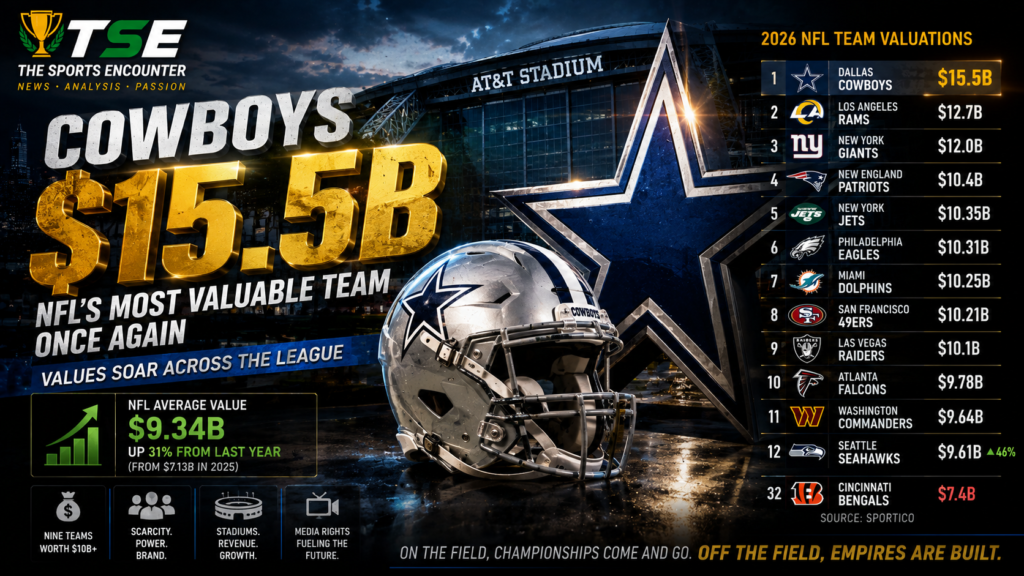
The Dallas Cowboys are still the NFL’s financial king, but the bigger story in Sportico’s 2026 franchise valuations is how quickly the entire league is becoming more valuable.
Dallas is now valued at $15.5 billion, up 21% from last year and comfortably ahead of the Los Angeles Rams at $12.7 billion and the New York Giants at $12 billion.
That headline is familiar.
The scale of the league around it is not.
The average NFL franchise is now worth $9.34 billion, up from $7.13 billion in 2025. That represents an increase of roughly 31% in a single year.
Nine teams are worth at least $10 billion. The Atlanta Falcons are already at $9.78 billion. The Washington Commanders are at $9.64 billion. The Super Bowl champion Seattle Seahawks have climbed to $9.61 billion after a 46% year-over-year increase.
Even the Cincinnati Bengals, ranked 32nd, are valued at $7.4 billion.
That changes the way these rankings should be understood.
This is no longer simply a story about which NFL owner has the most valuable team.
It is a story about the NFL becoming one of the most expensive collections of sports assets in the world.
Readers can follow contracts, team-building decisions, ownership developments and league business through The Sports Encounter’s NFL coverage.
2026 NFL Franchise Valuations: The Top 12
| Rank | Team | 2026 Valuation | 2025 Change |
|---|---|---|---|
| 1 | Dallas Cowboys | $15.50 billion | +21% |
| 2 | Los Angeles Rams | $12.70 billion | +22% |
| 3 | New York Giants | $12.00 billion | +17% |
| 4 | New England Patriots | $10.40 billion | +19% |
| 5 | New York Jets | $10.35 billion | +28% |
| 6 | Philadelphia Eagles | $10.31 billion | +22% |
| 7 | Miami Dolphins | $10.25 billion | +24% |
| 8 | San Francisco 49ers | $10.21 billion | +19% |
| 9 | Las Vegas Raiders | $10.10 billion | +28% |
| 10 | Atlanta Falcons | $9.78 billion | +39% |
| 11 | Washington Commanders | $9.64 billion | +30% |
| 12 | Seattle Seahawks | $9.61 billion | +46% |
The valuations were compiled by Sportico and reported by Reuters.
The Cowboys Are Worth $2.8 Billion More Than the Rams
Dallas is not barely holding first place.
The gap between the Cowboys and the second-ranked Rams is approximately $2.8 billion.
That difference alone is larger than the total value of many major sports clubs around the world only a few years ago.
Dallas is also valued roughly 66% above the current NFL average.
Against the Bengals, the comparison becomes even more dramatic.
The Cowboys are worth a little more than twice Cincinnati’s $7.4 billion valuation.
That financial gap exists inside a league specifically designed to create competitive balance through shared national revenue, salary-cap rules, the draft and schedule structure.
That is what makes NFL franchise economics unusual.
The teams compete under relatively equal football rules.
Their commercial ecosystems are anything but equal.
Dallas Keeps Winning the Business Championship
The most striking aspect of the Cowboys’ valuation is how disconnected it has become from recent championship success.
Dallas has not won a Super Bowl since the 1995 season, with its last title coming on January 28, 1996.
Three decades without another Lombardi Trophy have done little to damage the franchise’s commercial position.
That tells us something important about sports branding.
Winning matters enormously for fandom, history and short-term commercial momentum.
It is not the only way to build asset value.
Dallas operates as a national brand rather than simply a Texas football team.
The Cowboys have decades of television exposure, enormous merchandise reach, high-value sponsorship relationships and one of the NFL’s most recognizable identities.
AT&T Stadium also functions as more than an NFL venue, generating business through major sporting events, concerts and corporate activity.
Those assets help explain why the franchise can remain No. 1 even while its postseason record frustrates supporters.
Jerry Jones Bought the Cowboys for $140 Million
The long-term value creation is difficult to overstate.
Jerry Jones purchased the Cowboys in 1989 for approximately $140 million.
Sportico’s current $15.5 billion estimate puts the franchise at more than 110 times that purchase price in nominal terms.
That does not represent a simple investment return calculation because Jones has invested heavily in the team, stadium infrastructure and surrounding businesses over the decades.
It still illustrates how dramatically elite sports assets have appreciated.
The Cowboys were already a famous franchise when Jones bought them.
What followed was a transformation of how aggressively NFL clubs could commercialize their brands.
Dallas became a model for turning team identity into year-round business.
The Cowboys Have Gone From $10.32B to $15.5B in Two Years
The recent acceleration may be even more revealing than the long-term growth.
| Year | Sportico Valuation |
|---|---|
| 2024 | $10.32 billion |
| 2025 | $12.80 billion |
| 2026 | $15.50 billion |
Dallas became the first sports franchise to cross the $10 billion mark in Sportico’s 2024 ranking.
Two years later, another $5 billion has effectively been added to the estimate.
This is not normal inflation.
It reflects increasing confidence in the future cash-generating power of elite sports rights and scarcity.
Why NFL Teams Are Becoming So Expensive
There is no single reason.
The NFL benefits from several structural advantages working together.
National media rights provide long-term visibility
The league has long-term distribution agreements with Amazon, CBS, ESPN/ABC, Fox and NBC extending through the 2033 season.
Those contracts give teams unusual visibility into future national revenue.
Sports rights have also become more valuable because live games remain among the few forms of entertainment audiences still regularly consume in real time.
For official information on the NFL’s national media agreements, readers can visit NFL.com.
Revenue sharing protects every franchise
The NFL’s national model distributes major shared revenue streams across all 32 teams.
That helps explain why Cincinnati can rank last and still be worth $7.4 billion.
Buying a smaller-market NFL team does not mean buying an isolated local sports business.
It provides participation in a national entertainment machine.
There are only 32 teams
Scarcity matters.
There is no open market where a billionaire can simply create another NFL franchise whenever demand increases.
Expansion is controlled by the league.
Existing teams therefore become extraordinarily scarce assets.
There are far more billionaires who might want an NFL team than there are teams potentially available.
Stadiums have become entertainment businesses
Modern stadium economics extend well beyond eight or nine regular-season home dates.
Owners can generate revenue from concerts, college football, international soccer, sponsorships, naming rights, premium hospitality, retail, surrounding real estate and other events.
That helps teams in major metropolitan markets produce value even when the football itself underperforms.
Nine $10 Billion Teams Changes the Meaning of Elite
In 2024, crossing $10 billion was historic.
In 2026, more than a quarter of the NFL has reached that threshold.
Nine of 32 teams, or just over 28%, are now valued at $10 billion or more.
The Patriots, Jets, Eagles, Dolphins, 49ers and Raiders all join Dallas, the Rams and Giants above the line.
Several more are close enough that another strong valuation cycle could push them through.
Atlanta is already at $9.78 billion.
Washington sits at $9.64 billion.
Seattle is at $9.61 billion.
Houston and Chicago are also above $9 billion in the broader Sportico ranking.
What looked like a rare valuation milestone is quickly becoming the upper-middle class of NFL ownership.
Seattle’s 46% Surge Is One of the Most Interesting Numbers
The Seahawks provide the most dramatic recent example among the league’s leading franchises.
Seattle’s valuation jumped 46% from approximately $6.59 billion in 2025 to $9.61 billion.
The Seahawks also enter 2026 as defending Super Bowl champions after defeating New England 29-13 in Super Bowl LX.
Championship success does not automatically produce a 46% valuation increase, and franchise estimates incorporate much more than the previous season’s record.
The timing still matters.
Seattle’s national profile is at a high point, its football product is elite, and the organization sits inside one of the NFL’s strongest technology-driven regional economies.
The Sports Encounter recently examined another part of Seattle’s championship-era planning in its coverage of the Seahawks’ roster and contract decisions.
The challenge for championship teams is maintaining the football core while the commercial value around that success expands.
The Rams Show Why Market and Infrastructure Matter
The Los Angeles Rams sit second at $12.7 billion despite being almost $3 billion behind Dallas.
Their position illustrates the importance of market access and venue economics.
Los Angeles provides one of the largest media and commercial markets in the United States.
The Rams also benefit from their connection to SoFi Stadium and the wider Hollywood Park development.
The combination creates value beyond ticket sales.
That type of infrastructure-driven model has become increasingly important as owners attempt to transform franchises into broader entertainment platforms.
The Giants Remain a $12 Billion Team Without Recent Dominance
The New York Giants rank third at $12 billion.
Like Dallas, their commercial strength is not dependent on current title contention.
The Giants benefit from history, the New York market, league visibility and decades of brand recognition.
That reinforces the central lesson of the ranking.
Football success can accelerate value.
Established market position can protect it.
The Jets at $10.35B Show How Market Value Can Outrun Results
The New York Jets are another revealing case.
They rank among the $10 billion franchises despite a long period without sustained postseason success.
Market size, brand visibility, media attention and scarcity continue to support the asset.
The Jets’ position also shows why NFL team valuations should never be treated as simple reflections of standings.
Football performance is one input.
The commercial platform is much larger.
The Eagles Are Now Worth More Than $10 Billion
Philadelphia’s $10.31 billion valuation reinforces how strongly recent championship credibility can combine with an established fan base.
The Eagles have become one of the league’s most prominent modern franchises, with sustained relevance, a highly engaged regional following and regular national exposure.
The Sports Encounter recently explored the financial side of elite roster construction through Peter Skoronski’s record-setting guard contract, which moved him ahead of Dallas star Tyler Smith at the position.
Those player contracts exist within the same business ecosystem driving franchise values higher.
Player Salaries Are Rising, but Franchise Values Are Rising Faster
The NFL salary cap has also expanded dramatically.
The league projected the 2026 cap above $300 million per team after the 2025 figure reached $279.2 million.
That provides players with access to a growing share of football revenue.
Yet the franchise valuation numbers reveal something even larger.
Owners are benefiting from the expected long-term value of media rights, venues, sponsorships, scarcity and future commercial opportunities.
A player contract might reset a positional market by a few million dollars per year.
A franchise can add billions in estimated value during one valuation cycle.
That contrast is worth remembering whenever NFL economics become a debate about whether a star player is asking for too much money.
Private Equity Has Changed the Ownership Conversation
The NFL historically maintained some of the strictest ownership rules in major American sports.
That began changing in 2024 when owners approved limited private-equity investment.
Approved funds can own passive minority stakes of up to 10% in franchises under the framework announced by the league.
The change matters more as valuations rise.
A 10% stake in a $15.5 billion franchise would theoretically correspond to $1.55 billion before any minority-interest discount, transaction structure or other adjustment.
That illustrates how difficult liquidity can become even for extremely wealthy owners.
Minority sales allow ownership groups to unlock capital without surrendering control.
The NFL’s official explanation of its private-equity framework is available through NFL.com.
Green Bay Shows the Other Side of the NFL’s Financial Model
The Packers remain the league’s unique ownership case because they are publicly owned rather than controlled by a billionaire or family group.
That limits access to some capital tools available to other franchises.
Green Bay officials have acknowledged that privately held teams can sell minority equity stakes to raise substantial amounts of money while maintaining control.
The Packers cannot operate that way.
They therefore rely more heavily on operating revenue, reserves and other commercial initiatives.
The contrast becomes more important as the price of remaining competitive rises.
The Sports Encounter has been tracking those pressures across Green Bay and the wider NFL preseason.
The Bengals Being Last at $7.4B Tells You Everything
The Cincinnati Bengals rank 32nd.
Normally, last place implies weakness.
Here, last place means $7.4 billion.
That is perhaps the clearest illustration of the NFL’s financial power.
The league’s least valuable team is still an extraordinarily scarce multibillion-dollar asset.
Cincinnati also reportedly increased roughly 35% from last year’s valuation.
Being last in this ranking does not mean the franchise is losing value.
It means everyone else is rising too.
The NFL Average Jumped About 31% in One Year
The league-wide number may be the most important statistic in the entire report.
Average franchise value:
| Year | Average NFL Franchise Value |
|---|---|
| 2025 | $7.13 billion |
| 2026 | $9.34 billion |
| Increase | Approximately 31% |
That is an enormous single-year move for mature sports businesses.
It suggests investors are not simply paying more for the Cowboys or the largest markets.
The entire league is being repriced upward.
Why Valuation Is Not the Same as Sale Price
This distinction matters.
A valuation is an estimate of what a business is worth based on revenue, assets, market comparisons, transaction history and other financial assumptions.
It is not a guaranteed sale price.
If Jerry Jones decided to sell the Cowboys tomorrow, the final figure could be higher or lower than $15.5 billion depending on bidding, deal structure, included assets and league approval.
The same applies to every team on the list.
Actual franchise sales remain the strongest real-world test of these estimates.
The Washington Commanders’ $6.05 billion sale in 2023 became a major benchmark at the time.
Current valuations suggest the market has already moved far beyond it.
Sports Teams Are Becoming Scarcity Assets
The broader investment logic is increasingly straightforward.
There are thousands of publicly traded companies.
There are only 32 NFL franchises.
More teams cannot be manufactured simply because wealthy buyers want them.
That scarcity combines with long-term media contracts, powerful brands and highly predictable fan demand.
The result resembles the economics of rare real estate or unique infrastructure assets more than a conventional entertainment company.
Buyers are paying for present cash flow.
They are also paying for the possibility that there may never be another comparable asset available.
Dallas Proves Winning and Valuation Can Separate
There is an uncomfortable truth here for Cowboys fans.
From a business perspective, Dallas has been extraordinarily successful.
From a championship perspective, the franchise has spent 30 years trying to get back to the Super Bowl.
Those realities can coexist.
Jerry Jones has built a business strong enough that postseason disappointment has not undermined the Cowboys’ commercial position.
That does not make losing irrelevant.
It makes the brand unusually resilient.
The Sports Encounter’s recent NFL coverage involving former Cowboys quarterback Tony Romo is another reminder of how deeply Dallas personalities remain part of the league’s broader media conversation years after their playing careers end.
What Rising Franchise Values Mean for Owners
For existing owners, higher valuations create enormous paper wealth.
They can increase borrowing capacity, make minority equity stakes more valuable and strengthen the economics of generational ownership.
They also create succession challenges.
A franchise worth several billion dollars can become complicated to transfer through families because of taxes, estate planning and ownership requirements.
That is another reason minority stakes and institutional capital have become more relevant.
What Rising Values Mean for Fans
Fans do not receive a dividend because their favorite team became worth another billion dollars.
They can still feel the effects indirectly.
Higher commercial revenue can support better facilities, more expensive coaching structures, international marketing and increasingly sophisticated football operations.
It can also drive higher ticket prices, premium seating costs and sponsorship commercialization.
The business grows because demand is strong.
Fans often help pay for that growth.
What Rising Values Mean for Players
Players have their own economic stake through collectively bargained revenue sharing and the salary cap.
As league revenues increase, the player compensation pool generally grows with them under the collective bargaining agreement.
That is visible in the rapidly expanding cap and record contracts across positions.
The Sports Encounter has covered that escalation through Skoronski’s $100 million extension and other major contract stories.
The scale remains different.
Player earnings are compensation for performance during finite careers.
Ownership captures long-term appreciation of the underlying asset.
The Seahawks Show How Quickly the Hierarchy Can Move
Seattle’s 46% rise offers another useful lesson.
The top of these rankings is not frozen.
Market developments, stadium economics, ownership expectations and team success can change relative positions quickly.
Seattle now sits within $400 million of the $10 billion threshold.
A year ago, it was valued below $7 billion.
That is a dramatic reclassification.
The Sports Encounter has also been following Seattle’s efforts to preserve its championship core, including the unresolved long-term situation around Devon Witherspoon and other Seahawks developments entering the 2026 season.
Why the $10B Club Will Probably Keep Growing
Atlanta, Washington and Seattle are all close.
Houston and Chicago are not far behind.
If media economics remain strong and no major external shock disrupts sports valuations, it would not be surprising to see the number of $10 billion NFL teams increase again.
The league does not need every team to become Dallas.
It only needs the underlying economics to continue compounding.
TSE Verdict: The Cowboys Are No. 1, but the NFL Is the Real Winner
The easiest headline is that the Dallas Cowboys are worth $15.5 billion.
The more important conclusion sits underneath it.
The Cowboys are not separating from a weak league.
They are leading a league whose financial floor keeps rising.
The average team is now worth $9.34 billion.
Nine franchises have crossed $10 billion.
The lowest-ranked club is worth $7.4 billion.
Seattle increased 46% in a year.
Dallas itself has moved from $10.32 billion in 2024 to $15.5 billion two years later.
These numbers describe more than football popularity.
They describe scarcity, stable national revenue, premium live media rights, stadium economics and investor confidence in the NFL’s ability to keep monetizing attention.
The Cowboys remain the league’s most valuable team despite not winning a Super Bowl since January 1996.
That contrast would look embarrassing if this were only a sporting ranking.
It is not.
Dallas has spent three decades falling short of another championship while simultaneously building one of the strongest commercial brands in global sport.
Jerry Jones would unquestionably rather have both.
Financially, however, there is no debate over who sits first.
The Cowboys are worth $15.5 billion.
The remarkable part is how quickly the rest of the NFL is beginning to catch the same financial wave.
For more league business, roster strategy, contracts and preseason developments, follow The Sports Encounter’s NFL hub, our latest NFL training-camp analysis, the Lane Johnson and Bears camp roundup, and our 2026 Pro Football Hall of Fame feature.
Frequently Asked Questions
What are the Dallas Cowboys worth in 2026?
Sportico values the Dallas Cowboys at $15.5 billion in its 2026 NFL franchise rankings.
Are the Dallas Cowboys the most valuable NFL team?
Yes. Dallas ranks first ahead of the Los Angeles Rams at $12.7 billion and the New York Giants at $12 billion.
How much did the Cowboys’ value increase in 2026?
The Cowboys’ estimated value increased 21% from approximately $12.8 billion in 2025 to $15.5 billion in 2026.
What is the average NFL team worth in 2026?
The average NFL franchise is valued at $9.34 billion, up from $7.13 billion in 2025.
How many NFL teams are worth at least $10 billion?
Nine NFL franchises are valued at $10 billion or more in Sportico’s 2026 ranking.
Which is the second-most valuable NFL franchise?
The Los Angeles Rams rank second at $12.7 billion.
Which NFL team had the biggest highlighted increase near the top of the ranking?
The Seattle Seahawks rose 46% from their 2025 valuation to $9.61 billion in 2026.
What is the least valuable NFL team?
The Cincinnati Bengals rank 32nd at $7.4 billion.
When did the Cowboys last win the Super Bowl?
Dallas last won the Super Bowl following the 1995 season, defeating Pittsburgh in Super Bowl XXX on January 28, 1996.
How much did Jerry Jones pay for the Cowboys?
Jerry Jones purchased the Cowboys in 1989 for approximately $140 million.
Are NFL franchise valuations the same as sale prices?
No. Valuations are estimates based on financial and market factors. The actual price in a sale can differ depending on demand, included assets, transaction terms and league approval.
Can private equity invest in NFL teams?
Yes. The NFL approved limited passive private-equity investment in 2024, allowing approved funds to acquire minority stakes under specific league rules.