


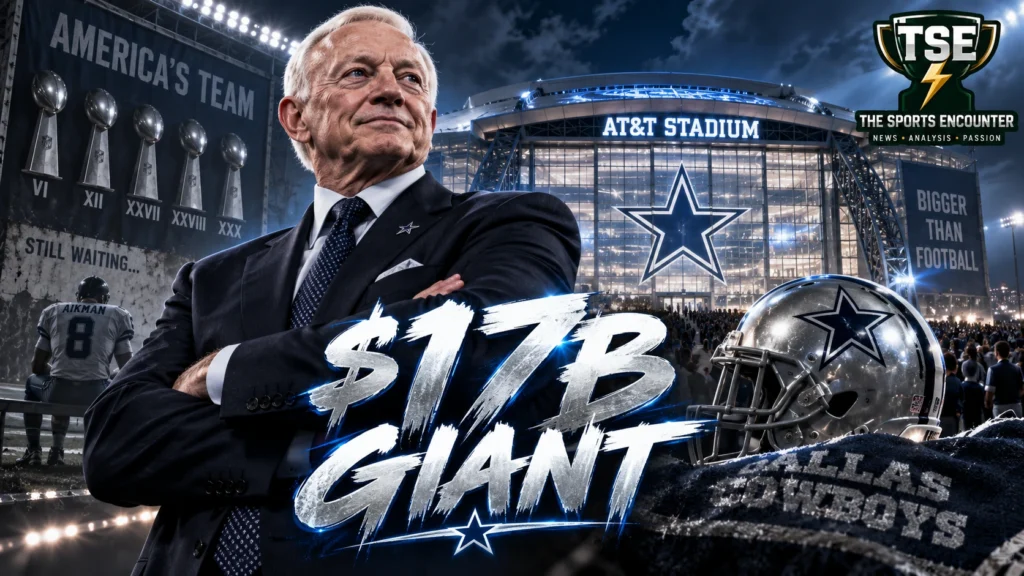
DALLAS, United States, September 10, 2026: The Dallas Cowboys have gone more than 30 years without reaching a Super Bowl, yet the franchise has just strengthened a championship streak of a completely different kind. Forbes estimates Dallas is now worth a record $17 billion, extending the Cowboys’ run as the NFL’s most valuable franchise to 20 consecutive years while widening the divide between football performance and commercial power.
The latest estimate represents a 31% increase from Forbes’ $13 billion valuation in 2025. Dallas also generated an estimated $1.278 billion in revenue last season, the highest figure Forbes has ever measured for a sports team, while operating income reached approximately $677 million.
The Cowboys therefore begin the 2026 season carrying two realities at the same time. Their last Super Bowl victory came in January 1996, creating one of the longest and most scrutinized championship droughts attached to an American sporting giant. Commercially, however, the organization has become more powerful during much of that same period.
That contradiction makes the $17 billion number more useful than another entry in a valuation ranking. It raises a larger question: how can a team go three decades without returning to its sport’s championship game and still become the most valuable sports franchise in the world?
The answer is found in the way Dallas has learned to monetize attention independently of January results.
The Sports Encounter explored the wider financial surge only weeks ago when Sportico valued the Cowboys at $15.5 billion. Forbes’ new $17 billion estimate does not mean the franchise suddenly added another $1.5 billion in value within a month. The publications use different methodologies, assumptions and financial models. What both estimates agree on is much more significant: Dallas sits comfortably at the top of an NFL whose franchises are becoming dramatically more expensive.
Dallas Cowboys $17 Billion Valuation: Key Numbers
| Metric | 2026 Forbes Estimate |
|---|---|
| Dallas Cowboys valuation | $17 billion |
| 2025 Forbes valuation | $13 billion |
| One-year increase | 31% |
| 2025 season revenue | $1.278 billion |
| Operating income | $677 million |
| NFL valuation rank | No. 1 |
| Consecutive years ranked No. 1 by Forbes | 20 |
| Second-most valuable NFL team | Los Angeles Rams, $13.5 billion |
| Gap between Dallas and Rams | $3.5 billion |
| Average NFL franchise value | $9.5 billion |
| League-wide franchise value | More than $300 billion combined |
| Lowest Forbes valuation | Cincinnati Bengals, $8 billion |
| Dallas’ last Super Bowl victory | January 1996 |
Why Are the Dallas Cowboys Worth $17 Billion?
The easiest explanation would be popularity, but popularity alone cannot explain a valuation $3.5 billion higher than the Los Angeles Rams and more than twice the estimated value of Cincinnati.
Dallas has built several commercial advantages on top of the shared economics available to every NFL franchise. The Cowboys possess one of the league’s strongest brands, an enormous national fan base, a major-market commercial operation, premium sponsorship inventory, valuable stadium economics and the ability to remain part of national sports conversation regardless of their record.
AT&T Stadium sits at the center of that commercial system. The venue opened in 2009 and can expand to more than 100,000 seats. It has hosted the Super Bowl, College Football Playoff championship, NCAA Final Four, NFL Draft, major boxing events, international soccer and large-scale entertainment events.
The Cowboys’ official AT&T Stadium information describes a venue designed to operate far beyond the team’s regular-season home schedule. That matters economically because modern stadiums no longer function solely as places where a team plays eight or nine NFL games each year.
They have become year-round entertainment businesses.
When concerts, college football, international soccer, corporate hospitality, sponsorship activation, tours and other events generate revenue around the same physical asset, the value of the franchise becomes less dependent on whether Dallas wins a divisional playoff game in January.
The Cowboys Are Worth $3.5 Billion More Than the Los Angeles Rams
The scale of Dallas’ lead becomes clearer when the numbers are placed beside the rest of the NFL.
| Rank | NFL Team | Forbes 2026 Valuation | One-Year Change |
|---|---|---|---|
| 1 | Dallas Cowboys | $17.0 billion | +31% |
| 2 | Los Angeles Rams | $13.5 billion | +29% |
| 3 | New York Giants | $12.0 billion | +19% |
| 4 | New England Patriots | $10.6 billion | +18% |
| 5 | San Francisco 49ers | $10.5 billion | +22% |
| 6 | Miami Dolphins | $10.4 billion | +39% |
| 7 | New York Jets | $10.35 billion | +28% |
| 8 | Las Vegas Raiders | $10.3 billion | +34% |
| 9 | Philadelphia Eagles | $10.25 billion | +23% |
| 10 | Atlanta Falcons | $10.1 billion | +59% |
The Cowboys are worth approximately 26% more than the Rams according to Forbes’ estimates. The $3.5 billion separating first and second place would itself have represented an enormous NFL franchise valuation only a few years ago.
Dallas is also approximately 79% more valuable than the league’s $9.5 billion average and more than twice the estimated $8 billion value of the last-ranked Bengals.
This is why the Cowboys’ position cannot be reduced to being slightly ahead of the competition. They occupy their own financial tier.
Dallas Generated Nearly $1.28 Billion Without a Super Bowl Run
The revenue figure may be even more revealing than the $17 billion valuation.
Forbes estimates Dallas generated nearly $1.28 billion during the 2025 season, despite the franchise once again failing to reach the Super Bowl.
According to Forbes, that exceeded Real Madrid’s approximately $1.27 billion in 2024-25 revenue and became the largest annual revenue figure the publication has ever measured for a sports team.
The comparison deserves care because leagues, seasons and accounting structures differ. Still, it illustrates the commercial scale Dallas now occupies.
The Cowboys are no longer merely a valuable American football club.
They operate inside the same economic conversation as the most commercially powerful sports institutions anywhere in the world.
The $677 Million Profit Figure Explains Why Investors Love NFL Teams
Forbes estimates the Cowboys generated $677 million in operating income during the latest measured season.
The number becomes more extraordinary when placed against the second-best figure in the league. Dallas reportedly produced $342 million more operating income than its nearest NFL rival.
This means the Cowboys are not achieving their record valuation through brand recognition alone. Their commercial machine is producing extraordinary cash-generation capacity.
The wider league structure helps.
National media rights provide a powerful revenue foundation. Revenue sharing reduces some of the financial risk attached to local market performance. The salary cap controls one of the largest cost categories. Franchise supply remains fixed at only 32 teams.
Those characteristics help explain why The Sports Encounter recently described NFL franchises as increasingly scarce global assets when the Seattle Seahawks changed ownership at a reported $9.612 billion valuation.
Seattle’s transaction also provides a useful real-world comparison with estimated valuations.
Forbes now values the Seahawks at $9.6 billion, almost exactly in line with the widely reported transaction figure. Yet that value ranks Seattle only 14th in the league.
A franchise changing hands for almost $10 billion would once have sounded like the ceiling of the NFL market.
In 2026, it places a reigning Super Bowl champion in the middle of the valuation table.
Why the Cowboys’ 30-Year Super Bowl Drought Has Not Damaged Their Business
Dallas has not played in a Super Bowl since winning Super Bowl XXX after the 1995 season.
For a team carrying the nickname “America’s Team,” that drought is impossible to separate from the public conversation around the franchise.
The expectation remains extraordinarily high. Cowboys quarterback Dak Prescott said during the summer that every Dallas season is treated as “Super Bowl or bust,” reflecting a standard created by five championships and decades of national attention.
Yet commercial value does not behave like a standings table.
Dallas can lose a playoff game and remain one of television’s most attractive properties. The team can enter another offseason without a championship and still generate months of national discussion about the roster, quarterback, coach, draft, owner and expectations.
That attention has economic value.
Advertisers care about audiences.
Networks care about audiences.
Sponsors care about audiences.
Premium-seat buyers care about access and experience.
Merchandise sales depend on identity and loyalty, not simply the previous season’s final result.
Dallas has become remarkably effective at retaining all of those things while football success fluctuates.
Jerry Jones Bought the Cowboys When Advisers Thought the Deal Could Ruin Him
The modern valuation becomes almost surreal when compared with the price Jerry Jones paid in 1989.
Jones purchased the Cowboys and Texas Stadium interests in a transaction valued around $140 million. An official Cowboys retrospective describes advisers warning that the acquisition could become financial suicide because the organization was losing money and required significant investment.
Jones committed roughly $90 million in cash and borrowed the remainder, putting much of his existing wealth at risk.
The Dallas Cowboys’ official profile of Jerry Jones credits his influence not only to the team’s three Super Bowl victories during the 1990s but also to sports marketing, stadium development and television negotiations that helped reshape the business of the NFL.
The contrast between approximately $140 million in 1989 and an estimated $17 billion today should not be treated as a simple investment-return calculation. The assets, stadium arrangements, league economics, revenue base and commercial environment have changed enormously.
Even with those qualifications, the transformation is staggering.
Dallas Has Increased More Than 120-Fold From the 1989 Purchase Price
Using the approximate $140 million acquisition figure purely as a nominal historical comparison, Forbes’ $17 billion valuation is more than 120 times greater.
That does not mean Jones has generated a conventional 120-times investment return. The comparison ignores inflation, capital invested into stadiums and facilities, debt, distributions, tax effects and numerous other financial variables.
What it does show is the scale at which elite American sports assets have appreciated.
The Cowboys existed before Jones.
What changed under his ownership was the commercial ceiling.
Why the Dallas Cowboys Became ‘America’s Team’ Without Needing to Win Every Year
The Cowboys entered the Jones era with a national identity already established through the Tom Landry years, Roger Staubach, repeated playoff appearances and two Super Bowl championships in the 1970s.
Jones then inherited and commercialized that history while adding another championship generation built around Troy Aikman, Emmitt Smith, Michael Irvin and a roster that won Super Bowls following the 1992, 1993 and 1995 seasons.
The official Cowboys history notes that Jones became the first NFL owner to oversee three Super Bowl championships in four years.
Those titles still matter financially three decades later because sports brands are built cumulatively.
A championship creates memories.
Memories create generational loyalty.
Loyalty survives losing seasons more effectively than temporary success creates it.
Dallas has inherited multiple generations of fans who began following the team under different stars, coaches and eras.
The Cowboys Have Turned Attention Into an Asset
This is where Dallas differs from many franchises whose financial performance moves more closely with on-field success.
The Cowboys remain interesting when they win.
They also remain interesting when they fail.
A controversial loss creates national conversation. A coaching decision creates national conversation. A contract negotiation creates national conversation. An offseason trade rumor creates national conversation.
That does not mean losing is good for business.
Winning another Super Bowl would almost certainly strengthen the franchise further.
The important point is that Dallas has developed enough cultural reach that attention does not disappear when championships do.
This year’s surging NFL player-contract market demonstrates how rapidly money is expanding throughout the sport. Dallas operates on the other side of the same economic system, where growing league revenue increases both the cost of elite talent and the value of owning the franchise employing it.
Why Forbes Says the Cowboys Are Worth $17 Billion While Sportico Said $15.5 Billion
This is one of the most important parts of the story because readers may remember seeing a different Cowboys valuation only weeks ago.
In August, Sportico estimated Dallas at $15.5 billion.
Forbes now estimates $17 billion.
The correct interpretation is not that the Cowboys gained $1.5 billion in several weeks.
Sportico and Forbes conduct separate valuation exercises using different assumptions, information sources, revenue adjustments and methodologies.
Forbes describes its 2026 valuations as enterprise values based on historical transactions and expectations around the future economics of the league and individual teams. The publication includes stadium-related economics attributable to ownership but excludes separately accounted businesses such as The Star, the Cowboys’ headquarters and entertainment development.
Sportico uses its own methodology.
The estimates should therefore be treated as independent assessments rather than consecutive measurements from one accounting system.
The valuable signal is where the two models agree.
Both identify Dallas as the clear No. 1 NFL franchise.
Both place its value deep into 11 figures.
Both show the overall NFL market rising rapidly.
The Average NFL Team Is Now Worth $9.5 Billion
The Cowboys may own the headline, but the league underneath them may be the more significant financial story.
Forbes estimates the average NFL franchise is now worth $9.5 billion, up 34% from $7.1 billion last year.
That average has more than doubled since 2022, when it stood at approximately $4.5 billion.
Every NFL franchise is now valued at at least $8 billion.
Ten teams have crossed $10 billion.
Those numbers show why our earlier Sportico-based valuation analysis reached a conclusion that remains valid even with different estimates: Dallas leads the ranking, but the NFL itself is experiencing the financial transformation.
The Last-Place Bengals Being Worth $8 Billion Tells Us More Than Dallas Being No. 1
Cincinnati sits 32nd on Forbes’ ranking at an estimated $8 billion.
That number deserves almost as much attention as Dallas reaching $17 billion.
The lowest-valued team in the NFL is worth more than the league’s most valuable franchise was estimated to be only a few years ago.
In 2022, Forbes’ highest NFL valuations were operating around the level that now defines the financial floor.
This is asset inflation across an entire league rather than one exceptional franchise running away from weak competitors.
Dallas is leading a market whose bottom is rising almost as dramatically as its top.
Scarcity May Be the NFL’s Most Valuable Product After Football Itself
There are 32 NFL franchises.
Controlling stakes rarely become available.
That creates a simple economic imbalance: there are far more wealthy individuals and investment groups capable of wanting an NFL team than there are teams available to purchase.
The Seahawks sale demonstrated what happens when one of those assets reaches the market.
The reported $9.612 billion transaction reset the NFL’s control-sale record only three years after Washington changed ownership for $6.05 billion.
The Sports Encounter’s analysis of the Seattle transaction calculated an increase of nearly 59% over the previous sale record.
The buyers were not purchasing only ticket revenue or a roster.
They were purchasing one of 32 positions inside the most commercially powerful sports league in the United States.
The NFL’s Global Expansion Could Make the Cowboys Even More Valuable
The NFL is already dominant domestically, which means a growing share of its long-term upside sits outside the United States.
The league is playing a record nine international games in 2026 across seven countries and four continents. Its official international program includes games in Australia, Brazil, the United Kingdom, France, Spain, Germany and Mexico.
The NFL’s official International Games program describes the 2026 schedule as the league’s widest global footprint yet.
Dallas has unusual advantages if American football continues growing internationally because the Cowboys already possess one of the league’s most recognizable names.
The Sports Encounter examined the league’s long-term ambition in our analysis of the NFL’s push to add tens of millions of fans outside the United States.
Every new international viewer creates potential value through broadcasting, merchandise, sponsorship, digital subscriptions and long-term fandom.
The Cowboys do not need to capture every new fan for the strategy to help them.
Expansion of the NFL audience raises the value of the league ecosystem in which Dallas already owns the strongest commercial position.
Dallas Shows Why Modern Sports Franchises Are Becoming an Asset Class
The profile of buyers entering professional sports has changed.
Franchises increasingly attract private-equity interests, technology billionaires, institutional capital and wealthy families treating sports properties as scarce long-duration assets.
The economics are attractive because elite leagues combine media rights, intellectual property, local monopoly characteristics, stadium revenue, sponsorships and emotional customer loyalty in ways few traditional businesses can reproduce.
The NFL adds another layer through shared national revenue and an exceptionally limited number of franchises.
Dallas represents the extreme version.
The brand is valuable locally, nationally and internationally.
Its stadium generates revenue beyond football.
Its history creates multi-generational loyalty.
Its league provides enormous shared economics.
Its owner has spent decades maximizing commercial exposure.
What the Cowboys’ $17 Billion Valuation Says About Winning
The obvious temptation is to conclude that championships no longer matter financially.
That would go too far.
Winning creates new fans, increases engagement, raises sponsorship visibility and generates postseason revenue. The reigning champion Seahawks have seen their own value surge and recently changed hands at an NFL-record reported price.
The Sports Encounter’s analysis of Seattle’s championship defense shows how a Super Bowl can reshape expectations around an entire organization.
Dallas demonstrates something different.
Winning is one source of sports-business value.
It is not the only source.
A franchise that has already accumulated enough history, loyalty, attention and commercial reach can remain extraordinarily valuable during long championship droughts.
Could Winning a Super Bowl Push Dallas Beyond $20 Billion?
The question sounds extreme only until the recent valuation progression is examined.
| Year | Forbes Cowboys Valuation |
|---|---|
| 2022 | $8.0 billion |
| 2023 | $9.0 billion |
| 2024 | $10.1 billion |
| 2025 | $13.0 billion |
| 2026 | $17.0 billion |
Dallas has added approximately $9 billion to its Forbes valuation in four years.
That is a 112.5% increase from the $8 billion estimate in 2022.
A continued rise at anything close to that rate would make $20 billion a realistic future threshold even without a championship.
A Super Bowl victory would add another commercial catalyst to an already powerful system.
The larger constraint may eventually be less about Dallas itself and more about how aggressively investors continue repricing the entire NFL.
The 2026 Season Gives the $17 Billion Cowboys an Uncomfortable Football Test
All of this money cannot make a tackle, protect Dak Prescott or win a playoff game.
Dallas begins the regular season against the New York Giants with the same fundamental football question that has followed the franchise for decades.
Can the Cowboys turn enormous resources, visibility and expectation into another championship run?
The wider 2026 landscape is already difficult. Seattle enters as defending champion, New England has strengthened after reaching Super Bowl LX, the Rams have invested aggressively, and the league’s competitive picture shifted throughout the offseason.
The Sports Encounter’s 2026 NFL season curtain-raiser showed how much the championship race changed before the first full Sunday of football had even arrived.
Dallas enters that environment as the richest brand in the league.
The standings still begin at 0-0.
Player Salaries Are Rising, but Franchise Values Are Moving Much Faster
The league’s financial growth is visible at player level as well.
Christian Gonzalez entered the 2026 season with a four-year, $135 million extension that made him the NFL’s highest-paid cornerback by average annual value. Peter Skoronski reset the guard market with a four-year, $100 million extension.
The Sports Encounter has tracked those trends through our analyses of the exploding cornerback market and Peter Skoronski’s record guard contract.
Those contracts are enormous by any normal standard.
Yet even a $135 million player deal represents less than 1% of the Cowboys’ $17 billion estimated franchise value.
The comparison shows how far ownership economics have separated from individual salary headlines.
Dallas Is the NFL’s Most Valuable Team, but the League May Be the Biggest Winner
The Cowboys lead Forbes’ ranking for the 20th consecutive year, but focusing exclusively on Dallas risks missing what has happened around them.
The Rams are worth $13.5 billion.
The Giants are at $12 billion.
Ten franchises have reached at least $10 billion.
The defending champion Seahawks are valued at $9.6 billion and rank only 14th.
The Bengals sit last at $8 billion.
The average has climbed 34% in one year.
League-wide franchise values have moved beyond $300 billion.
The Cowboys are the clearest symbol of the boom because they occupy the top.
The NFL itself created the conditions that allow the top to keep rising.
TSE Analysis: Dallas Has Built a Business That No Longer Needs January to Prove Its Value
For three decades, Cowboys seasons have repeatedly ended with the same uncomfortable comparison between expectation and achievement.
Five Super Bowl trophies remain in the organization’s history. None has been added since the 1995 team defeated Pittsburgh in Super Bowl XXX.
The drought affects football reputation because championships remain the ultimate competitive currency.
Commercially, Dallas has learned to operate under a different equation.
A season ending without the Lombardi Trophy does not erase national television demand.
It does not empty AT&T Stadium.
It does not make sponsors forget the star.
It does not remove Dallas from offseason conversation.
It does not stop another generation of supporters from inheriting the team from their families.
Most importantly, it does not reduce the scarcity of owning the Cowboys.
This is why $17 billion should not be interpreted simply as a reward for football success.
It is the estimated price of accumulated attention.
Jerry Jones purchased an iconic but financially troubled franchise in 1989 and spent the following decades turning its name, stadium, history, fan base and league position into one of the most powerful commercial systems in sport.
The championships of the 1990s helped build it.
The remarkable part is that the machine continued growing after the trophies stopped arriving.
Forbes now values Dallas $3.5 billion above its nearest NFL rival and approximately $9 billion higher than it did four years ago.
Whether the Cowboys can finally return to the Super Bowl remains a football question.
Whether they have already won the business contest is considerably easier to answer.
For continuing analysis of NFL finances, roster building, contracts, international expansion and the 2026 season, follow The Sports Encounter’s NFL coverage.
Frequently Asked Questions About the Dallas Cowboys’ $17 Billion Valuation
How much are the Dallas Cowboys worth in 2026?
Forbes estimates the Dallas Cowboys are worth $17 billion in 2026, making them the most valuable NFL franchise and the most valuable sports team in Forbes’ current rankings.
How much did the Cowboys’ value increase in one year?
Forbes valued Dallas at $13 billion in 2025 and $17 billion in 2026, representing a 31% one-year increase.
Are the Cowboys the most valuable NFL team?
Yes. Dallas has ranked first on Forbes’ NFL valuation list for 20 consecutive years.
What is the second-most valuable NFL team?
The Los Angeles Rams rank second in Forbes’ 2026 estimates at $13.5 billion, leaving a $3.5 billion gap between the Rams and Cowboys.
How much revenue did the Dallas Cowboys generate?
Forbes estimates Dallas generated approximately $1.278 billion in revenue during the 2025 season.
How profitable are the Dallas Cowboys?
Forbes estimates the Cowboys produced approximately $677 million in operating income, the highest figure in the NFL.
Why did The Sports Encounter previously report the Cowboys at $15.5 billion?
The earlier $15.5 billion figure came from Sportico’s 2026 franchise valuation study. The $17 billion figure comes from Forbes. The two publishers use independent valuation methodologies, so the difference should not be interpreted as a $1.5 billion increase within a few weeks.
How much did Jerry Jones pay for the Dallas Cowboys?
Jerry Jones acquired the Cowboys and associated Texas Stadium interests in 1989 in a transaction valued at approximately $140 million.
When did the Dallas Cowboys last win the Super Bowl?
Dallas last won the Super Bowl following the 1995 season, defeating the Pittsburgh Steelers in Super Bowl XXX in January 1996.
How many Super Bowls have the Cowboys won?
The Dallas Cowboys have won five Super Bowl championships.
What is the average NFL franchise worth in 2026?
Forbes estimates the average NFL franchise is worth approximately $9.5 billion, up 34% from the previous year.
What is the least valuable NFL team in 2026?
The Cincinnati Bengals rank 32nd on Forbes’ 2026 list at an estimated $8 billion.
How much are all NFL teams worth combined?
Forbes estimates the league’s 32 franchises now carry combined enterprise values exceeding $300 billion.
Could the Dallas Cowboys become a $20 billion team?
There is no guarantee, but the recent valuation trajectory makes the threshold plausible. Forbes’ estimate has risen from $8 billion in 2022 to $17 billion in 2026.