


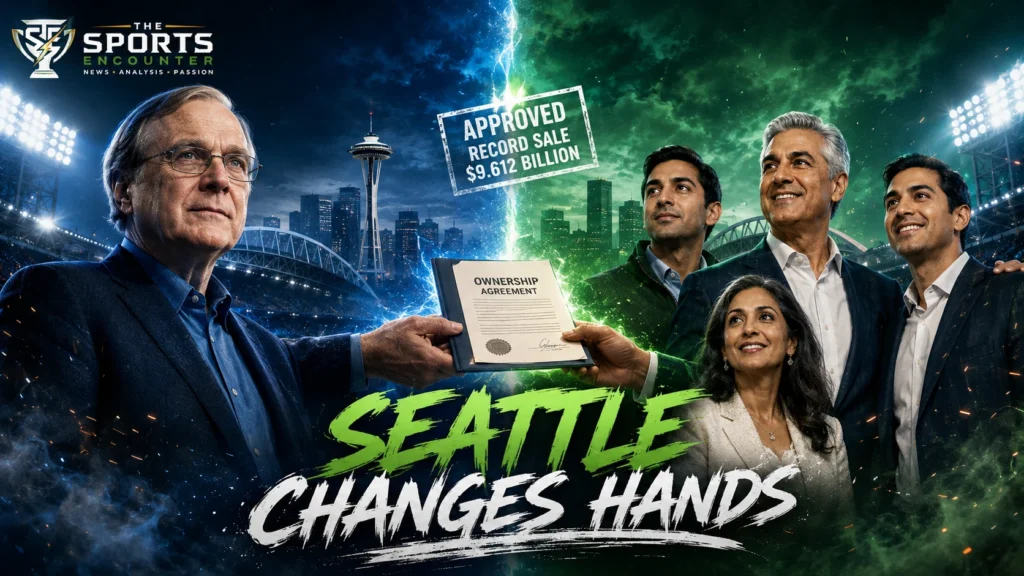
ATLANTA: The Seattle Seahawks are entering a new ownership era at almost the most extraordinary moment imaginable: as defending Super Bowl champions, valued at nearly $10 billion and coming off the most successful period in franchise history.
NFL owners voted unanimously Wednesday to approve the sale of the Seahawks from the Estate of Paul G. Allen to the Khosla family, clearing the decisive league hurdle in a transaction reported at a record $9.612 billion.
The Seahawks have not publicly disclosed the financial terms of the deal, an important distinction when discussing the reported price. What is official is that the ownership agreement was reached in July, the league has now approved it, and the franchise is moving from the stewardship established by Paul Allen in 1997 to a family that previously held a minority interest in NFC West rival San Francisco.
That alone would make this one of the biggest ownership stories in NFL history.
The numbers make it even more remarkable.
Allen acquired the Seahawks for approximately $194 million in 1997. The reported $9.612 billion price attached to the Khosla transaction is almost 50 times that amount in nominal terms.
The previous NFL sale record belonged to the Washington Commanders, whose $6.05 billion purchase was approved in 2023. Seattle’s reported figure is nearly 59% higher.
The transformation cannot be explained by inflation, winning or television money alone. It reflects what NFL franchises have become: scarce global sports assets with enormous media value, stadium economics, sponsorship power, digital reach and long-term demand from some of the world’s wealthiest investors.
For Seattle, however, the story carries another layer.
This is the end of an ownership structure that once helped prevent the Seahawks from leaving the city and ultimately delivered two Super Bowl championships.
Seattle Seahawks Sale: Key Facts
| Detail | Confirmed Information |
|---|---|
| Team | Seattle Seahawks |
| Incoming owners | Khosla family, including Vinod Khosla |
| NFL approval | Unanimous vote by NFL owners on August 26, 2026 |
| Reported sale price | $9.612 billion |
| Officially disclosed transaction price | No. The Seahawks and Paul G. Allen Estate have not publicly disclosed the financial terms. |
| Previous NFL sale record | Washington Commanders, $6.05 billion in 2023 |
| Paul Allen purchase price | Approximately $194 million in 1997 |
| Current football status | Defending Super Bowl LX champions |
| Super Bowl LX result | Seattle Seahawks 29-13 New England Patriots |
| Purpose of estate sale | Consistent with Paul Allen’s directive to sell his sports holdings and direct estate proceeds to philanthropy |
| Khosla family’s previous NFL connection | Minority ownership interest in the San Francisco 49ers |
The Seahawks confirmed the unanimous vote in their official ownership announcement.
Readers can follow the wider league through The Sports Encounter’s NFL coverage.
The NFL Has Approved the Khosla Family, but One Technical Step Still Matters
The phrase “Seahawks sold” captures where this process is heading, but the legal sequence deserves precision.
The Paul G. Allen Estate announced a formal agreement with the Khosla family on July 11. At that point, the transaction still required NFL approval.
That approval arrived Wednesday in Atlanta.
NFL commissioner Roger Goodell announced that owners had voted unanimously in favor of the transaction before introducing members of the Khosla family.
The Seahawks described the vote as bringing the sale “one big step closer to completion,” which means league approval and final transaction closing should not be treated as exactly the same event.
For practical football purposes, however, the central question has been resolved.
The NFL’s existing owners have approved the Khosla family as Seattle’s next ownership group.
The Reported $9.612 Billion Price Resets the NFL Sale Record
The reported valuation is where the wider sports-business implications become impossible to ignore.
Washington’s $6.05 billion sale to the Josh Harris-led group established an NFL record when owners unanimously approved that transaction in July 2023.
Three years later, Seattle is reportedly changing hands for $9.612 billion.
That represents an increase of approximately 58.9% over the Commanders benchmark.
| NFL Franchise Sale | Year | Price |
|---|---|---|
| Washington Commanders | 2023 | $6.05 billion |
| Seattle Seahawks | 2026 | $9.612 billion reported |
| Difference | Three years | Approximately 58.9% higher |
The significance becomes clearer when placed beside the broader rise in NFL franchise values.
The Sports Encounter’s recent analysis of 2026 NFL team valuations found the average franchise estimate had climbed to approximately $9.34 billion, while Seattle itself was valued at roughly $9.61 billion.
The reported transaction price of $9.612 billion lands almost exactly on that Seattle estimate.
That does not mean an estimated valuation and an actual sale price are interchangeable. Valuations are models. Transactions depend on bidders, financing, included assets, ownership structure, league rules and negotiations.
Actual sales remain the strongest test of what qualified buyers are prepared to pay.
Seattle has now provided that test.
Paul Allen Bought the Seahawks for $194 Million
The contrast with 1997 is enormous.
Paul Allen purchased the Seahawks for approximately $194 million after a period of uncertainty surrounding the franchise’s future in Seattle.
The team had temporarily moved operations to Anaheim in 1996 under previous ownership before community leaders approached Allen about helping keep the Seahawks in Washington.
A public-private stadium partnership was eventually approved, and Allen completed his purchase in 1997.
That decision altered the history of the franchise.
The reported Khosla purchase price is approximately 49.5 times Allen’s original acquisition price before accounting for inflation, subsequent investment, stadium economics or other financial factors.
It would be misleading to describe that difference as a simple investment return. NFL franchises today operate in a radically different commercial environment from the league Allen entered nearly three decades ago.
Still, the scale of the change is extraordinary.
Paul Allen’s Legacy Is Bigger Than the Increase in Franchise Value
The most important part of Allen’s ownership cannot be measured by comparing $194 million with $9.612 billion.
The franchise stayed in Seattle.
A modern stadium became part of its future.
The Seahawks developed one of the NFL’s strongest fan cultures around the 12s.
Most importantly, the team became a champion.
Seattle won its first Super Bowl following the 2013 season, defeating Denver 43-8 in Super Bowl XLVIII.
Allen died in 2018, with his sister Jody Allen subsequently serving as chair while the franchise remained under the Paul G. Allen Estate.
The organization then reached another summit in February 2026.
Seattle defeated New England 29-13 in Super Bowl LX, securing the second championship in franchise history.
That means the Allen ownership structure leaves the Seahawks at almost the opposite point from where Paul Allen found them.
He entered when the franchise’s future in Seattle had been uncertain.
His estate is selling a defending Super Bowl champion for an NFL-record reported price.
The Timing Makes This Sale Unlike a Normal Ownership Transition
New owners frequently inherit rebuilding projects.
They arrive with promises of investment, new executives, stadium development or a different competitive culture.
The Khosla family inherits something much harder to improve immediately.
A championship team.
Seattle went 14-3 during the 2025 regular season, earned the NFC’s top seed and defeated the San Francisco 49ers and Los Angeles Rams before beating New England in the Super Bowl.
That creates a different first responsibility for the incoming ownership group.
There is less pressure to tear down structures and much more pressure to avoid damaging what already works.
Vinod Khosla acknowledged that reality following the vote, explaining that his family’s initial approach would involve learning from the existing organization and taking a long-term view.
His simplest ambition was also the most difficult one: keep winning.
The Seahawks Are Already Dealing With the Cost of Staying on Top
Championships create their own financial pressure.
Successful players become more expensive. Assistants attract opportunities. Depth becomes harder to preserve. Expectations rise immediately.
Seattle has already experienced several versions of that problem this offseason.
Devon Witherspoon’s contract situation illustrated the challenge of retaining cornerstone talent after a championship season. Seattle knows how important Witherspoon is to its defense, but elite performance inevitably changes the economics of a long-term agreement.
Depth has also been tested.
Jake Bobo’s serious preseason injury removed a trusted receiver and special-teams contributor from Seattle’s immediate plans after he had played a role in the Super Bowl run.
The new owners therefore inherit a football operation that is successful but still subject to the same roster pressures every champion faces.
The smartest ownership move may initially be restraint.
Khosla Is Entering One NFC West Rivalry From the Other Side
The Khosla family’s existing familiarity with the NFL adds another unusual element to the transaction.
They previously held a minority ownership position in the San Francisco 49ers.
That interest must be relinquished as part of moving into control of Seattle.
The competitive symbolism is obvious.
San Francisco and Seattle share the NFC West and have produced one of the NFL’s most intense modern rivalries.
The Khosla family is moving from a passive financial position connected with one side of that rivalry into control of the other.
Their history around the 49ers should at least reduce the learning curve around NFL ownership structures, league relationships and the economic environment surrounding a major franchise.
Controlling ownership is still a completely different responsibility.
Buying a Team and Owning a Team Are Two Different Jobs
Winning the bidding process requires capital.
Running a successful professional sports organization requires judgment.
Owners influence executive appointments, long-term investment, facilities, commercial strategy, stadium planning, organizational culture and the level of autonomy given to football leadership.
The strongest ownership groups understand where their involvement creates value and where interference can damage a functioning operation.
Seattle offers a particularly clear test because the organization does not need a dramatic rescue plan.
The football side has just won a championship.
The brand is commercially strong.
The fan base is established.
The reported transaction price itself confirms investor confidence in the asset.
Khosla’s first success may therefore be measured by continuity rather than visible change.
The Sale Confirms How Scarce Elite Sports Franchises Have Become
The Seahawks transaction fits a much wider trend across professional sports.
Ownership stakes in major teams are increasingly treated as scarce long-duration assets rather than vanity purchases alone.
The Sports Encounter recently examined the same trend when Jets owner Woody Johnson expanded his sports investment portfolio, illustrating how established team owners increasingly look beyond a single league.
Similar valuation pressure is visible outside the NFL.
The reported Los Angeles Lakers ownership deal demonstrated how premium North American sports properties can command valuations well into 11 figures, while Liverpool’s recent minority investment showed the same global appetite reaching elite European soccer.
These transactions involve different leagues, ownership rules and revenue models.
The common feature is scarcity.
There are only 32 NFL franchises.
Controlling stakes become available rarely.
When a defending Super Bowl champion in a major technology market becomes available, wealthy bidders do not have the option of waiting for an identical asset next year.
Why NFL Teams Keep Becoming More Expensive
Several structural advantages make NFL ownership particularly attractive.
- National media revenue: The NFL’s enormous broadcast and streaming agreements distribute significant revenue across the league.
- Scarcity: Only 32 franchises exist, and controlling sales are uncommon.
- Audience scale: NFL games remain among the most watched television programs in the United States.
- Commercial reach: Teams generate sponsorship, premium seating, licensing, merchandise and digital revenue beyond ticket sales.
- League economics: Revenue sharing reduces some of the market-size disparity found in other sports.
- International growth: The NFL continues building regular-season and commercial presence outside the United States.
- Limited supply of comparable assets: Billionaires seeking control of major U.S. sports teams cannot simply create another NFL franchise.
Those forces help explain why franchise values can grow much faster than traditional businesses would normally expect.
They also explain why the Seahawks can change hands for a reported price approaching $10 billion without being the NFL’s most valuable franchise.
The Commanders Record Lasted Only Three Years
When the Washington Commanders sold for $6.05 billion in 2023, the number looked extraordinary.
It was a league record and a reminder of how much NFL ownership had appreciated.
Seattle has apparently moved the benchmark another $3.562 billion higher just three years later.
That pace matters.
A record sale does more than value the franchise being purchased. It becomes a comparison point every owner, banker and prospective investor can use when assessing other teams.
Seattle’s transaction therefore has consequences far beyond Seattle.
Owners of franchises that have no intention of selling can still point to the deal when evaluating minority investments, estate planning, financing arrangements and overall net worth.
The reported price strengthens the entire NFL valuation environment.
The New Owners Inherit a Team Built to Defend Its Championship
The business story may dominate the announcement, but the Khosla family is entering the NFL with a very immediate football responsibility.
Seattle opens the 2026 season as the reigning champion.
The organization has spent the offseason attempting to preserve the structure that produced the title while strengthening selected areas around it.
That process involves far more than headline acquisitions.
TSE’s analysis of underrated NFL offseason moves highlighted how championship rosters are often sustained through depth decisions that receive far less attention than superstar contracts.
Seattle’s ability to remain elite will depend on those margins just as much as its change in ownership.
The Khosla family can provide strategic direction and resources.
It cannot buy another Lombardi Trophy simply because it paid a record price for the franchise.
Paul Allen’s Final Ownership Instruction Gives the Sale a Different Meaning
The proceeds are also central to understanding why the Seahawks were sold.
The Paul G. Allen Estate announced in February that the sale process was being launched in accordance with Allen’s directive to eventually sell his sports holdings and direct estate proceeds to philanthropy.
This was therefore not a distressed transaction, a response to poor team performance or a sudden decision by an owner looking to cash out.
The sale was part of a long-term estate plan.
That makes the timing unusually powerful.
The estate carried the Seahawks through another championship season before beginning the formal process days after Super Bowl LX.
Six months later, NFL owners have approved the next ownership group.
What Seahawks Fans Should Watch Next
The biggest immediate question is how visible the new ownership group intends to become.
Vinod Khosla has publicly emphasized learning, continuity and long-term thinking.
Fans should therefore watch several areas rather than expecting instant dramatic changes.
- Whether the existing football leadership retains the same operational autonomy.
- How aggressively Seattle invests in facilities, technology and player development.
- How the new ownership approaches future stadium and Lumen Field planning.
- Whether commercial strategy expands internationally.
- How quickly the Khosla family establishes a public relationship with the 12s.
- Whether championship success changes the appetite for long-term roster spending.
The Seahawks already have enough football uncertainty to manage without manufacturing ownership drama.
Training camp has produced injuries, roster decisions and contract questions as the team prepares to defend its title. The wider NFL offseason has shown how quickly rosters can change even before Week 1 arrives.
Seattle’s new owners enter that environment with the rare luxury of inheriting a proven organization.
The Final Word: Paul Allen Leaves the Seahawks in a Place Few Could Have Imagined in 1997
The $9.612 billion reported figure will dominate the headlines because it resets the NFL’s ownership market.
The more important Seattle story stretches back almost three decades.
Paul Allen stepped in when the Seahawks’ long-term future in the city had become uncertain.
He purchased the franchise for approximately $194 million, helped anchor it to Seattle and presided over the transformation of an organization that eventually became one of the NFL’s most recognizable modern success stories.
The franchise won its first Super Bowl during his lifetime.
After his death, the ownership structure he left behind remained in place long enough to see Seattle win another.
Now the Seahawks are changing hands as defending champions at a reported valuation almost 50 times the nominal price Allen paid in 1997.
That is why this cannot be reduced to another billionaire buying another sports team.
The Khosla family is purchasing a mature football institution with an established identity, a passionate fan base, a championship roster and an ownership legacy that helped keep the team where it belongs.
The record price tells us how valuable the Seahawks have become.
What happens next will tell us whether the new owners understand why.
Frequently Asked Questions
Who is buying the Seattle Seahawks?
The Khosla family, including venture capitalist Vinod Khosla, has agreed to acquire the Seahawks from the Estate of Paul G. Allen.
Did NFL owners approve the Seahawks sale?
Yes. NFL owners voted unanimously on August 26, 2026, to approve the transaction.
How much are the Seattle Seahawks being sold for?
The transaction has been widely reported at $9.612 billion. The Seahawks and Paul G. Allen Estate have not publicly disclosed the official financial terms, so the figure should be described as reported rather than team-confirmed.
Is $9.612 billion an NFL record?
Yes, if the reported transaction value is used. It exceeds the $6.05 billion paid for the Washington Commanders in 2023.
How much did Paul Allen pay for the Seahawks?
Paul Allen purchased the Seahawks for approximately $194 million in 1997.
How much higher is the reported Seahawks sale price than Paul Allen’s purchase price?
The reported $9.612 billion price is approximately 49.5 times the nominal $194 million purchase price from 1997. That comparison does not adjust for inflation, subsequent investment or differences in the assets included in the franchise over time.
Why did the Paul Allen Estate sell the Seahawks?
The estate said the sale follows Paul Allen’s directive to eventually sell his sports holdings and direct estate proceeds toward philanthropy.
Did Paul Allen keep the Seahawks in Seattle?
Allen played a central role in keeping the franchise in the region after relocation concerns emerged in the 1990s. He purchased the team in 1997 following the development of a public-private stadium plan approved by Washington voters.
How many Super Bowls have the Seahawks won?
Seattle has won two Super Bowls. The Seahawks defeated Denver in Super Bowl XLVIII and New England 29-13 in Super Bowl LX.
Were the Khoslas already involved in the NFL?
Yes. The Khosla family previously held a minority ownership interest in the San Francisco 49ers. That interest must be relinquished as part of moving into ownership of Seattle.
Has the Seahawks transaction officially closed?
NFL owners have unanimously approved the sale, but the Seahawks’ official August 26 announcement described the vote as bringing the transaction one major step closer to completion. League approval and legal closing should therefore not be treated as identical events.
Where can readers follow Seattle and the rest of the NFL?
Follow The Sports Encounter’s NFL section for Seattle Seahawks coverage, league news, injuries, contracts, ownership developments and analysis throughout the 2026 season.