


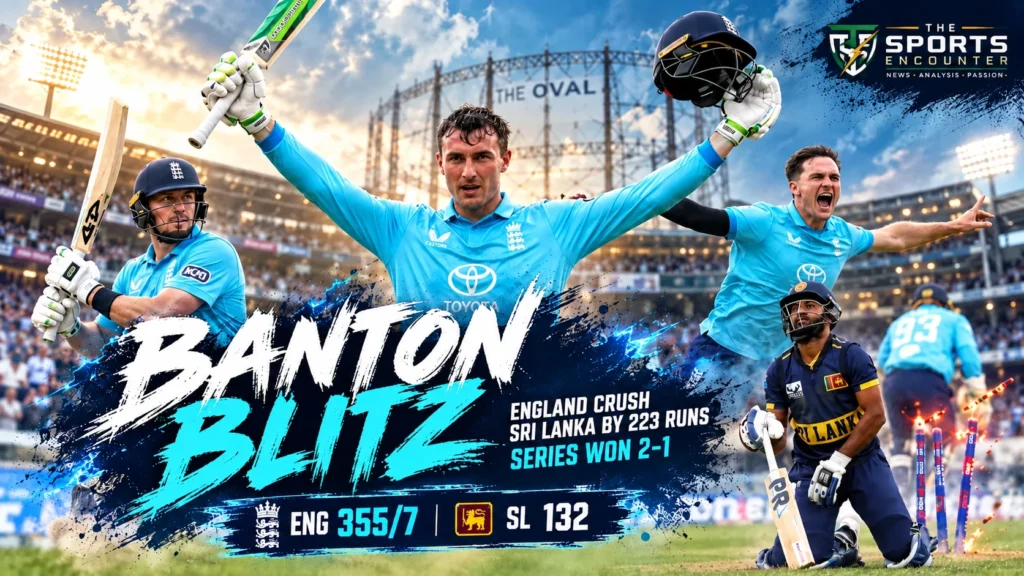
LONDON, England, September 27, 2026: England arrived at The Oval with an ODI series to save and several established names unavailable. By mid-afternoon, Tom Banton had produced the innings he had waited years for. By tea, Sri Lanka were disappearing under a 356-run chase they never came close to controlling.
Banton made 126 from 105 balls, his first international century, before Harry Brook’s 77 and Jordan Cox’s 76 drove England to 355/7. Liam Dawson then took 3/26 as Sri Lanka collapsed to 132 in only 29.1 overs, giving England a 223-run victory and a 2-1 series win.
The margin was England’s fifth-largest ODI victory by runs.
Yet the more important story, with the 2027 World Cup drawing closer, was who delivered it. Banton had spent years trying to rebuild his international career. Cox was playing only his fourth ODI and had returned to the side with Jos Buttler injured. Dawson came back into the XI and produced his best ODI figures.
England needed a decider. Their depth turned it into a rout.
The official ECB match highlights capture a performance that completed a home white-ball summer in which Harry Brook’s side won 11 of 13 matches.
England vs Sri Lanka 3rd ODI: Match at a Glance
| Match Detail | Information |
|---|---|
| Match | England vs Sri Lanka, 3rd ODI |
| Date | September 27, 2026 |
| Venue | The Kia Oval, London |
| Toss | England won the toss and batted |
| England | 355/7 in 50 overs |
| Sri Lanka | 132 all out in 29.1 overs |
| Result | England won by 223 runs |
| Series Result | England won 2-1 |
| Player of the Match | Tom Banton, 126 from 105 balls |
| Player of the Series | Will Jacks |
| England ODI Player of the Summer | Joe Root |
How Did Tom Banton Rescue England From 68/2?
England’s 355 did not begin like a 355 innings.
Dilshan Madushanka bowled Ben Duckett for a five-ball duck in the second over. Joe Root then spent 37 balls making 18 before Janith Liyanage trapped him lbw at 68/2.
For a side that had surrendered a winning position from 143/0 in the second ODI at Headingley, this was another test of whether England could manage a slower phase without losing the shape of their innings.
Banton did exactly that.
His first fifty required 51 balls. There was no rush to manufacture acceleration before the innings had earned it.
Once Harry Brook joined him, the tempo changed.
Banton reached his maiden ODI hundred from 95 balls with 13 fours and three sixes. He eventually made 126 from 105, finishing with 16 fours and five sixes at a strike rate of 120.
For a player whose international career began with enormous expectations before becoming increasingly uncertain, the innings carried obvious personal meaning.
“As a kid you dream of scoring a hundred for your country.”
Banton had already reminded England of his range during this tour. He finished the second T20I unbeaten on 52 from only 24 balls, and TSE recently included him among England’s most dangerous current power-hitters.
The Oval required something different. Banton gave England an ODI innings rather than a T20 innings stretched over more deliveries.
Banton and Brook Turn 68/2 Into a Winning Platform
Brook’s 77 came with one important warning for Sri Lanka.
Kusal Mendis dropped the England captain when he had seven.
Brook responded by adding another 70.
He reached fifty from 49 balls and shared a 150-run third-wicket stand with Banton. The partnership came from 116 deliveries and took England from 68/2 to 218/3.
That was the phase in which Sri Lanka lost their best chance of controlling the decider.
Their spinners did not bowl disastrously. Sachindu Colombage eventually removed Banton and finished with two wickets. The larger problem was the fielding support around them and England’s refusal to repeat the middle-over mistakes that had decided Headingley.
Brook later described the performance as close to complete because England accepted periods when scoring was difficult and trusted themselves to recover the rate later.
That adaptability has become one of the themes of his captaincy. His development as both batter and leader has been tracked by TSE from his PSL beginnings through his rise as an England mainstay.
Jordan Cox Gives England the Finish Sri Lanka Could Not Contain
Banton departed at 242/4 after 38 overs.
England still had to convert a strong platform into a total beyond Sri Lanka’s realistic reach.
Jordan Cox made sure they did.
With Buttler unavailable after the hamstring problem he suffered in the second ODI, Cox returned to the side and played an innings of immediate consequence.
He scored 76 from 52 balls at a strike rate of 146.15, striking six fours and two sixes.
England added 104 runs in the final 10 overs.
After Will Jacks fell at 287/5, Cox and Jamie Overton took the total all the way to 355 before Asitha Fernando removed Cox from the penultimate delivery.
Overton finished unbeaten on 21 from 14 balls.
The late acceleration was precisely what England had failed to manage at Headingley, where Sri Lanka’s spin and reverse swing had turned a dominant chase into a 16-run Sri Lankan victory.
Three days later, England showed they had absorbed the lesson.
Why Sri Lanka’s Fielding Errors Became So Expensive
Kusal Mendis identified fielding as one of Sri Lanka’s biggest failures afterward.
That assessment is hard to escape.
Brook’s chance on seven could have left England 80-something for three with two established batters already gone. Instead, the captain stayed long enough to help Banton build the partnership that decided the first innings.
Jamie Overton also survived a dropped chance late in the innings.
Neither miss can explain 223 runs by itself. Together, they represented a wider problem.
Sri Lanka had forced England into uncomfortable positions several times during the ODI series. In the opening ODI at Chester-le-Street, Sachindu Colombage helped reduce England to 211/7 before Will Jacks rescued the innings and then took five wickets.
At Headingley, Sri Lanka completed the job.
At The Oval, the chances came again but were not taken.
How Sri Lanka’s Chase Collapsed Before It Could Begin
A target of 356 required an aggressive start without reckless wicket loss.
Sri Lanka achieved neither.
Sonny Baker dismissed Pathum Nissanka for one in the second over. Gus Atkinson then removed Kamindu Mendis for 12 and captain Kusal Mendis for 35.
After nine overs, Sri Lanka were 53/3.
The asking rate was already climbing beyond eight runs an over.
Pavan Rathnayake and Charith Asalanka briefly tried to stabilize the innings, but one of the strangest dismissals of England’s summer ended that partnership.
What Happened in Pavan Rathnayake’s Bizarre Run-Out?
Rathnayake attempted a run with Jofra Archer fielding at short third.
Archer’s throw reached the wicket with Rathnayake well short, but wicketkeeper Jordan Cox had already accidentally dislodged the bails before the ball arrived.
The initial big-screen decision was not out.
Then the officials reviewed what had actually happened.
Archer’s direct hit had uprooted one of the stumps after the bails were already off. Rathnayake was still outside his crease when the stump was removed, which meant the wicket had been fairly put down and the batter was run out for 18.
The dismissal left Sri Lanka 77/4.
Four balls later, Joe Root dismissed Asalanka for seven.
Sri Lanka had moved from a difficult position into one from which the chase was effectively unrecoverable.
Liam Dawson Turns 77/5 Into a Complete Collapse
Dawson had already influenced Sri Lanka’s white-ball tour before the ODI decider.
In Cardiff, his wickets on consecutive balls triggered the collapse that allowed England to seal the T20I series with a match to spare.
At The Oval, he finished the ODI campaign with his best figures in the format.
Dawson dismissed Dunith Wellalage, stumped Sachindu Colombage through Cox, and removed Asitha Fernando to finish with 3/26 from eight overs.
| England Bowler | Overs | Runs | Wickets | Economy |
|---|---|---|---|---|
| Liam Dawson | 8 | 26 | 3 | 3.25 |
| Gus Atkinson | 5 | 26 | 2 | 5.20 |
| Jamie Overton | 3 | 10 | 1 | 3.33 |
| Will Jacks | 3.1 | 8 | 1 | 2.52 |
| Joe Root | 3 | 15 | 1 | 5.00 |
| Sonny Baker | 4 | 27 | 1 | 6.75 |
Six of England’s seven bowlers took at least one wicket.
Jofra Archer was the only bowler without a wicket in the bowling column, but his direct hit created the Rathnayake run-out.
That distribution of wickets captured why Brook was so pleased afterward. England did not need one attack leader to carry the innings.
England’s Fringe Players Won the Series Decider
Banton, Cox and Dawson were the clearest symbols of England’s afternoon.
Banton had spent several years outside the center of England’s plans.
Cox was making only his fourth ODI appearance.
Dawson continues to compete for places in a spin department that becomes increasingly important as England prepare for the 2027 World Cup.
Each solved a different part of the match.
Banton built the innings.
Cox accelerated it.
Dawson dismantled the chase.
The same depth had already been visible during England’s 3-0 T20I sweep of Sri Lanka. Brook and Baker dominated the 119-run Southampton opener, before England completed the clean sweep at Old Trafford.
By the end of the ODI series, England had won five of the six white-ball matches against Sri Lanka.
Why Will Jacks Was Player of the Series
The decider belonged to Banton, but the overall ODI series belonged to Will Jacks.
His defining performance came in the first ODI.
England were wobbling at 211/7 when Jacks made an unbeaten 46 to reach 265. He then took 5/22 as Sri Lanka were dismissed for 176.
He added 52 in the Headingley defeat and contributed another 25 in the decider.
His role with the ball also expanded throughout the summer, giving England another matchup option on surfaces where spin becomes increasingly important.
Jacks said afterward that the challenge over the next year will be adapting his role to the conditions England encounter in Pakistan, Australia and eventually at the World Cup.
That flexibility may matter as much as the raw numbers.
Joe Root Finishes as England’s ODI Player of the Summer
Root made only 18 in the decider, but his broader summer earned him England’s ODI Player of the Summer award.
His influence extended beyond his own runs.
England have spent much of the season trying to become better against spin, an area Brook and Kevin Pietersen have spoken about openly. Root remains one of the team’s best references for tempo, rotation and manipulation through the middle overs.
That was part of the broader improvement England demonstrated when they recovered from earlier white-ball uncertainty to beat India 2-1, including the series-clinching ODI at Lord’s.
How Significant Was England’s 223-Run Victory?
The result was England’s fifth-largest ODI win by runs.
| Rank | England ODI Winning Margin |
|---|---|
| 1 | 342 runs |
| 2 | 242 runs |
| 3 | 238 runs |
| 4 | 232 runs |
| 5 | 223 runs vs Sri Lanka, 2026 |
The size of the margin also completed an extraordinary reversal from three days earlier.
At Headingley, Sri Lanka had defended 321 and won by 16 runs after England collapsed from 143/0.
At The Oval, England made 355 and never allowed Sri Lanka a comparable foothold.
The difference between the two games was less about talent than execution.
England converted their platform.
Sri Lanka dropped chances and then lost wickets too quickly to create a chase.
England vs Sri Lanka 3rd ODI Full Scorecard
England Batting: 355/7 in 50 Overs
| Batter | Dismissal | R | B | 4s | 6s | SR |
|---|---|---|---|---|---|---|
| Tom Banton | c Malinga b Colombage | 126 | 105 | 16 | 5 | 120.00 |
| Ben Duckett | b Madushanka | 0 | 5 | 0 | 0 | 0.00 |
| Joe Root | lbw b Liyanage | 18 | 37 | 1 | 0 | 48.64 |
| Harry Brook (c) | c Wellalage b Fernando | 77 | 66 | 9 | 2 | 116.66 |
| Jordan Cox (wk) | b Fernando | 76 | 52 | 6 | 2 | 146.15 |
| Will Jacks | c Asalanka b Colombage | 25 | 21 | 2 | 1 | 119.04 |
| Jamie Overton | not out | 21 | 14 | 1 | 0 | 150.00 |
| Liam Dawson | b Fernando | 0 | 1 | 0 | 0 | 0.00 |
| Extras | 4 b, 3 lb, 1 nb, 4 w | 12 | ||||
| Total | 50 overs | 355/7 | Run rate: 7.10 | |||
Did not bat: Gus Atkinson, Jofra Archer, Sonny Baker.
Fall of wickets: 6/1 Duckett (1.2), 68/2 Root (15.1), 218/3 Brook (34.4), 242/4 Banton (37.6), 287/5 Jacks (43.6), 355/6 Cox (49.5), 355/7 Dawson (49.6).
Sri Lanka Bowling
| Bowler | O | M | R | W | Econ |
|---|---|---|---|---|---|
| Asitha Fernando | 9 | 0 | 64 | 3 | 7.11 |
| Dilshan Madushanka | 7 | 0 | 49 | 1 | 7.00 |
| Eshan Malinga | 9 | 0 | 65 | 0 | 7.22 |
| Dunith Wellalage | 9 | 1 | 62 | 0 | 6.88 |
| Janith Liyanage | 6 | 0 | 37 | 1 | 6.16 |
| Sachindu Colombage | 10 | 0 | 71 | 2 | 7.10 |
Sri Lanka Batting: 132 All Out in 29.1 Overs
| Batter | Dismissal | R | B | 4s | 6s | SR |
|---|---|---|---|---|---|---|
| Pathum Nissanka | c Cox b Baker | 1 | 3 | 0 | 0 | 33.33 |
| Kamindu Mendis | c Duckett b Atkinson | 12 | 19 | 2 | 0 | 63.15 |
| Kusal Mendis (c, wk) | c Banton b Atkinson | 35 | 26 | 2 | 3 | 134.61 |
| Pavan Rathnayake | run out (Archer) | 18 | 25 | 2 | 0 | 72.00 |
| Charith Asalanka | c Overton b Root | 7 | 19 | 0 | 0 | 36.84 |
| Janith Liyanage | c Cox b Overton | 19 | 20 | 1 | 1 | 95.00 |
| Dunith Wellalage | c Baker b Dawson | 5 | 6 | 1 | 0 | 83.33 |
| Sachindu Colombage | st Cox b Dawson | 4 | 19 | 0 | 0 | 21.05 |
| Eshan Malinga | c Root b Jacks | 14 | 19 | 2 | 0 | 73.68 |
| Asitha Fernando | c Overton b Dawson | 6 | 9 | 1 | 0 | 66.66 |
| Dilshan Madushanka | not out | 2 | 10 | 0 | 0 | 20.00 |
| Extras | 1 b, 4 lb, 4 w | 9 | ||||
| Total | 29.1 overs | 132 | Run rate: 4.52 | |||
Fall of wickets: 1/1 Nissanka (1.2), 36/2 Kamindu Mendis (6.4), 53/3 Kusal Mendis (8.6), 77/4 Rathnayake (14.6), 77/5 Asalanka (15.2), 82/6 Wellalage (16.2), 104/7 Colombage (22.3), 106/8 Liyanage (23.1), 120/9 Fernando (26.2), 132/10 Malinga (29.1).
England Bowling
| Bowler | O | M | R | W | Econ |
|---|---|---|---|---|---|
| Gus Atkinson | 5 | 0 | 26 | 2 | 5.20 |
| Sonny Baker | 4 | 0 | 27 | 1 | 6.75 |
| Jofra Archer | 3 | 0 | 15 | 0 | 5.00 |
| Will Jacks | 3.1 | 0 | 8 | 1 | 2.52 |
| Liam Dawson | 8 | 0 | 26 | 3 | 3.25 |
| Joe Root | 3 | 0 | 15 | 1 | 5.00 |
| Jamie Overton | 3 | 0 | 10 | 1 | 3.33 |
What Did the Captains Say After the Series Decider?
Brook called England’s performance close to complete and highlighted the side’s willingness to absorb difficult phases before accelerating later.
He was particularly pleased that players outside England’s established core had stepped directly into decisive roles.
“That’s the side we want to be, win when conditions aren’t in our favour.”
Kusal Mendis focused on the opportunities Sri Lanka failed to take.
“We dropped some catching, bad fielding cost us.”
His assessment captured the series decider accurately. Sri Lanka created moments in which England could have been placed under pressure. Too many of those moments disappeared without reward.
What Happens Next for England and Sri Lanka?
The teams will not wait long for another meeting.
England travel to Pakistan for an ODI tri-series involving Pakistan and Sri Lanka from October 18 to 31. The Pakistan Cricket Board’s official schedule has England facing Sri Lanka in Rawalpindi on October 22 and again at Lahore on October 29.
The tournament is part of all three teams’ preparation for the 2027 World Cup. The ICC has also described the Pakistan tri-series as an important step toward that tournament.
England leave their home summer with a clearer ODI structure than the one with which they began it.
Banton has forced himself back into the conversation.
Jacks has established a valuable two-skill role.
Cox has shown he can enter without a long settling period.
Dawson has again demonstrated that England’s spin depth extends beyond the first-choice names.
Sri Lanka leave with one excellent ODI victory at Headingley, but The Oval exposed how narrow their margin remains when catches go down and the top order fails.
England vs Sri Lanka 3rd ODI FAQs
Who Won the Third ODI Between England and Sri Lanka?
England won by 223 runs after scoring 355/7 and dismissing Sri Lanka for 132 in 29.1 overs.
Who Won the England vs Sri Lanka ODI Series?
England won the three-match ODI series 2-1.
Who Was Player of the Match?
Tom Banton was named Player of the Match after scoring 126 from 105 balls.
Was This Tom Banton’s First England Century?
Yes. The 126 at The Oval was Banton’s first international hundred for England.
Who Was Player of the Series?
Will Jacks was named Player of the Series after contributing with both bat and ball across the three ODIs.
What Were Liam Dawson’s Bowling Figures?
Dawson took 3/26 from eight overs, his best ODI figures.
How Many Runs Did Jordan Cox Score?
Cox made 76 from 52 balls, hitting six fours and two sixes.
Why Was Pavan Rathnayake Run Out After Initially Being Shown Not Out?
Jordan Cox had accidentally removed the bails before Archer’s throw arrived, but Archer’s direct hit then uprooted a stump while Rathnayake was still outside his crease. The wicket was therefore fairly put down and he was run out for 18.
Where Does the 223-Run Win Rank Among England’s Biggest ODI Victories?
It is England’s fifth-largest ODI victory by runs.
When Will England and Sri Lanka Play Each Other Again?
They are scheduled to meet in the Pakistan ODI tri-series on October 22 in Rawalpindi and October 29 in Lahore.