


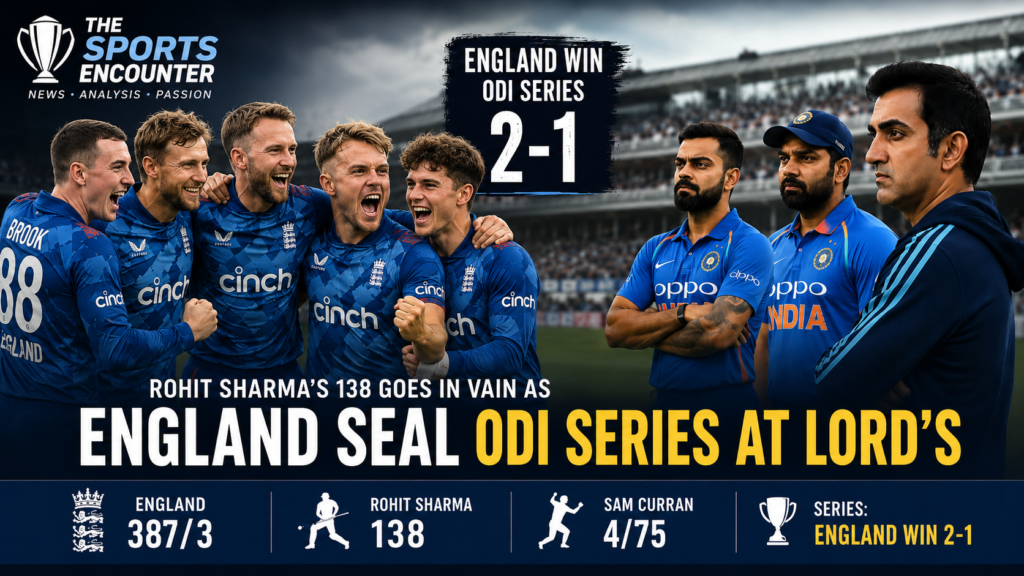
India’s senior batters carried the chase deep enough to keep hope alive, but England had already built too large a margin for individual brilliance to erase.
Rohit Sharma produced a superb 138, Virat Kohli contributed 74, and Shubman Gill added 77 as India pursued a daunting 388 at Lord’s. Their combined effort took India to 360 for seven, yet England still walked away with a 27-run victory and a 2-1 series triumph.
The decider exposed the difference between two batting units. England received decisive contributions throughout their lineup. India depended heavily on three established batters while another middle-order failure left them without enough support when the required rate became unforgiving.
TL;DR
- England beat India by 27 runs at Lord’s and won the ODI series 2-1.
- Ben Duckett scored a record 141 as England posted 387 for three.
- Jacob Bethell made 91 and later dismissed Rohit Sharma at a critical stage.
- Rohit scored 138, while Shubman Gill and Virat Kohli made 77 and 74.
- Sam Curran took four wickets to stop India’s late challenge.
- Ben Duckett received Player of the Match, while Joe Root was named Player of the Series.
England vs India Third ODI Scorecard
| Detail | Information |
|---|---|
| Match | England vs India, Third ODI |
| Date | July 19, 2026 |
| Venue | Lord’s Cricket Ground, London |
| England | 387/3 in 50 overs |
| India | 360/7 in 50 overs |
| Result | England won by 27 runs |
| Series Result | England won the three-match series 2-1 |
| Top England Batter | Ben Duckett, 141 |
| Top India Batter | Rohit Sharma, 138 |
| Top Bowler | Sam Curran, 4/75 |
| Player of the Match | Ben Duckett |
| Player of the Series | Joe Root |
| Turning Point | Jacob Bethell dismissed Rohit in the 39th over |
| What It Means | England secured their first bilateral ODI series win over top-ranked India since 2018 |
England’s 387 for three became the highest ODI total recorded at Lord’s, while Duckett’s 141 was also the highest individual ODI score at the venue.
Duckett and Bethell Take Control Early
England’s intent became clear through Ben Duckett and Jacob Bethell, who combined timing, aggression, and intelligent placement in a commanding opening partnership.
Duckett scored 141 from 135 balls, attacking India’s seamers whenever they missed their lengths and forcing Gautam Gambhir’s side to change plans repeatedly. Bethell supported him with 91 as the pair added 192 runs, England’s highest opening partnership against India in ODIs.
India lacked control with the new ball and never found a reliable method for slowing either left-hander. The absence of Jasprit Bumrah weakened the attack, but personnel alone did not explain the problems. India’s bowlers struggled with consistency, while the fields often reacted to England’s scoring rather than anticipating it.
The result was an innings in which England dictated almost every phase.
Readers can follow more international coverage through The Sports Encounter’s cricket hub and the website’s broader sports news and analysis coverage.
Root’s Control and Buttler’s Late Destruction
Joe Root continued an extraordinary series by remaining unbeaten for the third consecutive match.
His 74 not out gave England stability after the opening partnership ended. Root accumulated 249 runs across the three games without being dismissed and became the first England batter to record six consecutive ODI half-centuries.
That consistency followed his match-winning unbeaten 99 in Cardiff, where England capitalized on another Indian collapse to level the series. The full account of that contest is available in England Punish India’s Batting Collapse as Root Finishes on 99.
Jos Buttler then transformed an imposing score into a record one. His unbeaten 41 came from only 13 deliveries as England collected 82 runs from the final five overs.
India’s death bowling offered Buttler too many hittable deliveries. Yorkers were missed, slower balls became predictable, and defensive fields could not protect the boundaries. England reached 387 for three, leaving India with almost eight runs per over to chase from the beginning.
Rohit Sharma Keeps India Believing
A target of 388 demanded an exceptional start, and India received one.
Rohit Sharma and Shubman Gill added 147 for the opening wicket. Gill’s 77 provided fluency, while Rohit combined placement with the power that has defined his ODI career.
The former India captain struck 138 from 110 balls, including 17 fours and five sixes. His control prevented the chase from becoming a damage-limitation exercise and kept England under genuine pressure. Virat Kohli then scored 74, registering his first ODI half-century at Lord’s and ensuring India stayed within reach of the required rate.
Rohit and Kohli showed why India continue to rely on their ODI experience. Both understood when to absorb pressure and when to attack. Their performances deserved more support than they received.
India’s Middle Order Fails Again
Once England removed India’s leading scorers, the innings lost its structure.
Jacob Bethell bowled Rohit in the 39th over, ending the innings that had kept India’s chase alive. Sam Curran then removed key batters during a decisive spell and finished with four for 75.
India’s middle order could not replace the momentum created by Rohit, Gill, and Kohli. Batters entered with a steep required rate but appeared uncertain about their roles. There was little evidence of a clear finishing plan, stable partnerships, or an adaptable batting order.
The issue had already surfaced in Cardiff, where India fell from 178 for three to 233 all out. Repeating a similar weakness in the series decider makes it harder to dismiss as one poor day.
India’s problems now extend beyond execution. Gautam Gambhir and the team management must answer questions about selection, role clarity, workload planning, and the balance of the ODI lineup.
The decision-making around the bowling attack also lacked consistency. Without Bumrah, India needed greater control through collective planning. Instead, England found favorable matchups throughout the innings and punished every weak phase.
For wider discussion about how modern scheduling and selection affect fast bowlers, read Workload Management: Were Old Fast Bowlers Better at Surviving Test Cricket?.
England Leave Lord’s With More Than a Trophy
England’s series victory carried added value because it came after losing the opening ODI and entering the decider under pressure.
Harry Brook’s side responded with a controlled chase in Cardiff and a record batting performance at Lord’s. Duckett delivered the defining innings, Bethell strengthened his reputation as a high-level all-round option, Root remained untouchable, Buttler supplied the finishing power, and Curran delivered the wickets that decided the chase.
India still produced moments of quality, particularly through Rohit, Gill, and Kohli. Those performances cannot hide a repeated structural weakness. A team with India’s resources should not require its top three to carry nearly every difficult chase.
England finished the series with greater balance, clearer roles, and better execution under pressure. India leave England with gifted individuals, unresolved combinations, and serious planning work before their next major ODI assignment.