


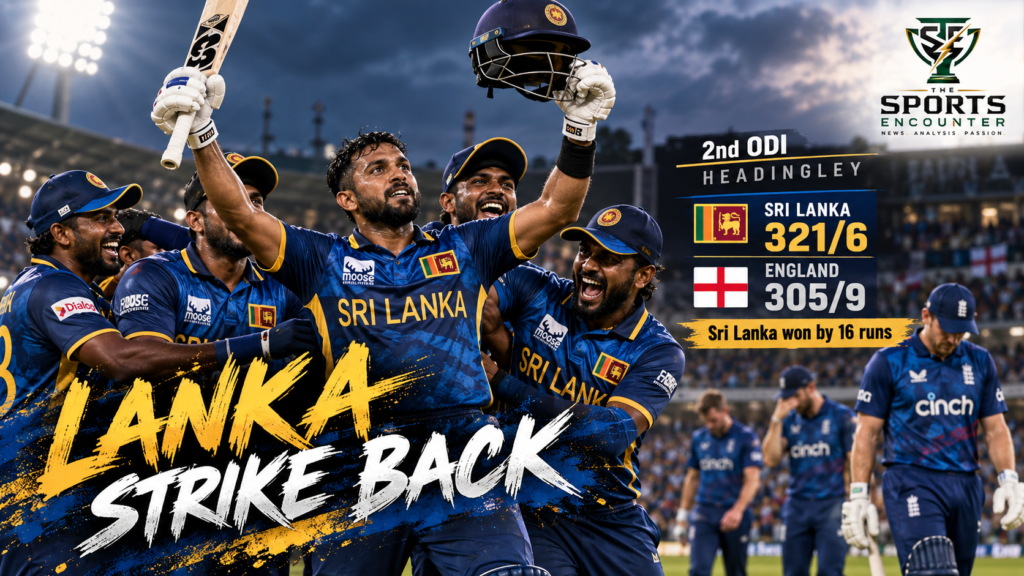
LEEDS, England, September 24, 2026: At 143 without loss in the 20th over, England had done the difficult part.
They needed 322 to win. Ben Duckett and Tom Banton had already removed almost half of the target. The pitch was good, the outfield was quick, and Sri Lanka had watched their attack disappear for more than seven runs an over without taking a wicket.
From there, England somehow lost.
Not because the target suddenly became unreasonable. Not because Sri Lanka produced one freak over. And not simply because Jos Buttler injured his hamstring.
England stopped reading the game.
Dunith Wellalage broke the opening partnership and then ripped through the top order. Kusal Mendis refused to retreat as captain. Sri Lanka’s fast bowlers waited for the older ball to become useful, then found reverse swing when England most needed clean contact. From the 37th over through the end of the innings, England managed only one four and one six.
By the time Buttler hobbled back to the crease in the closing overs, England had transformed a chase they controlled into one requiring something close to a miracle.
Sri Lanka finished the job.
Kusal’s magnificent 121 had earlier carried them to 321/6. England reached 305/9, falling 16 runs short and surrendering a series they had been positioned to seal after sweeping the T20Is and winning the opening ODI by 89 runs.
The series is now 1-1.
And what had looked like another comfortable England white-ball victory has become a pressure-filled decider at The Oval.
TL;DR
- Sri Lanka won the toss and made 321/6.
- Captain Kusal Mendis scored 121 from 100 balls.
- Kamindu Mendis contributed 54 and shared a 137-run stand with Kusal.
- England raced to 143/0 through Tom Banton and Ben Duckett.
- Dunith Wellalage removed Duckett, Banton and Harry Brook to reduce England to 157/3.
- Jos Buttler counterattacked with 69 from 49 balls.
- Buttler retired hurt with a left hamstring problem when England still needed 68 from 75 balls.
- Sri Lanka’s old-ball seamers then generated reverse swing and nailed their full lengths.
- England struck only one four and one six from the 37th over onward.
- Will Jacks made 52 but could not regain the earlier tempo.
- Sri Lanka restricted England to 305/9 and won by 16 runs.
- Kusal Mendis was named Player of the Match.
- England have now lost their last four completed ODIs at Headingley. Cricbuzz
England vs Sri Lanka 2nd ODI: Match at a Glance
| Detail | Information |
|---|---|
| Match | England vs Sri Lanka, 2nd ODI |
| Date | September 24, 2026 |
| Venue | Headingley, Leeds |
| Toss | Sri Lanka won the toss and batted |
| Sri Lanka | 321/6 in 50 overs |
| England | 305/9 in 50 overs |
| Result | Sri Lanka won by 16 runs |
| Player of the Match | Kusal Mendis |
| Sri Lanka top scorer | Kusal Mendis, 121 |
| England top scorer | Tom Banton, 73 |
| Best Sri Lanka bowling | Dunith Wellalage, 3/49 |
| Best England bowling | Gus Atkinson, 2/55 |
| Series position | 1-1 |
| Decider | September 27, The Oval |
The first ODI had gone completely the other way, with Will Jacks turning a competitive game into an 89-run England victory.
Two days later, Sri Lanka answered.
Kusal Mendis Builds the Victory Before England Even Begin Their Chase
Sri Lanka’s captain did more than make the biggest score of the match.
He gave his bowlers enough runs to survive the period when England appeared unstoppable.
Kusal arrived after Pathum Nissanka’s dismissal at 45/1 and joined Kamindu Mendis in the partnership that shaped Sri Lanka’s innings.
The pair added 137 for the second wicket.
Kusal survived an important early chance when Gus Atkinson dropped him on 17 at fine leg. He made England pay heavily for it.
The century arrived from 82 balls, and by the time Rehan Ahmed finally removed him for 121, Kusal had struck 14 fours and three sixes. His innings combined controlled accumulation with the ability to attack whenever England lost their lengths.
It was his seventh ODI hundred.
More importantly for this match, he had taken Sri Lanka to 222/3 with more than 14 overs still available.
Pavan Rathnayake then made 48 from 39 balls, Janith Liyanage added 32 from 26, and Sri Lanka collected 84 runs in the final ten overs to finish at 321/6.
Kusal later summed it up simply:
“I’m so happy winning and getting the hundred.”
He was Player of the Match, but his captaincy would become almost as important as his batting.
Kamindu Mendis Gives Kusal the Partnership Sri Lanka Needed
Kamindu’s 54 from 65 balls was quieter than Kusal’s century, but the partnership between the two prevented England from controlling the middle overs.
Sri Lanka had scored only 46 in the first ten overs.
There was no panic.
Kamindu provided the stability that allowed Kusal to grow into the innings, and their 137-run stand moved Sri Lanka from 45/1 to 182/2.
That foundation mattered because Headingley was clearly a far better batting surface than the one Sri Lanka had encountered at Chester-le-Street.
They recognized it.
England eventually did too.
The difference was that Sri Lanka used almost all 50 overs efficiently. England did not.
England Reach 143/0 and Make 322 Look Ordinary
Banton and Duckett were superb.
There is no need to rewrite that part of the chase simply because England eventually lost.
Banton made 73 from 62 balls, striking seven fours and three sixes.
Duckett made 67 from 63, with nine boundaries.
Their opening stand reached 143 from 118 balls. England were scoring comfortably above seven an over and required fewer than six per over for the remainder of the chase.
That is where the post-match analysis has to become tougher on England.
At 143/0, they did not need to keep winning the game.
They needed to stop losing it.
Instead, the innings began shedding wickets.
Dunith Wellalage Turns 143/0 Into 157/3
Wellalage gave Sri Lanka the opening.
England gave him the momentum.
Duckett went first at 143, bowled for 67.
Banton followed ten runs later, charging the spinner and being stumped for 73.
Then Harry Brook was trapped lbw for one.
England had gone from 143/0 to 157/3.
Three wickets.
Fourteen runs.
The target had not changed dramatically, but the structure of the chase had.
Wellalage eventually finished with 3/49 from ten overs, removing England’s two established openers and their captain.
This was Sri Lanka’s first genuine victory inside the match.
They had finally forced England to start again.
England’s Real Failure Was Not the Collapse, It Was the Failure to Reset
This is where describing England’s batting as simply “aggressive” becomes too generous.
The problem was decision-making.
England had already scored 143 without losing a wicket.
There was no required-rate emergency.
Once Wellalage removed both openers, the sensible ODI response was straightforward: rebuild for five or six overs, force Sri Lanka back into defensive fields, then attack the final 15.
England never properly made that transition.
Brook disappeared almost immediately.
Joe Root reached 15 but was caught at short cover trying to manufacture against Sachindu Colombage.
England were 203/4 after 28.1 overs.
They still needed 119 from 131 balls.
That was eminently manageable.
Yet the chase now depended on Buttler rescuing a position the first four batters should never have allowed to become dangerous.
The weakness was not intent.
It was game awareness.
Kusal Mendis Refuses to Abandon Colombage
One of Kusal’s better captaincy decisions came when Sachindu Colombage was under pressure.
The leg-spinner eventually conceded 55 from six overs.
His figures were expensive.
Kusal still found a moment to use him.
Colombage removed Root for 15, breaking a partnership that could otherwise have stabilized England after the initial Wellalage strikes.
That decision says something about Sri Lanka’s captaincy throughout the second innings.
Kusal did not chase pristine bowling figures.
He chased wickets and matchups.
Later, when the older ball began reversing, he leaned heavily on his seamers rather than automatically returning to spin.
The bowling plan changed because the ball changed.
England’s batting plan did not adapt nearly as well.
Jos Buttler Almost Repairs England’s Mistakes
Buttler was magnificent before his body intervened.
He made 69 from 49 balls, striking five fours and five sixes.
At his best, he made the chase look simple again.
He reached fifty from 36 balls and struck consecutive sixes off Colombage, changing Sri Lanka’s equation from containment back to survival.
This was the same Buttler who had demolished Sri Lanka only days earlier as England completed their 3-0 T20I sweep.
His power has remained central to England’s white-ball identity, which is why he featured prominently in TSE’s look at England’s most dangerous current power-hitters.
At Headingley, however, the innings changed again when he ran a second and pulled up with a hamstring problem.
England were 254/4.
They needed 68 from 75 balls.
Buttler retired hurt.
Even then, England should have been favorites.
That is what makes the finish so damaging.
The Old Ball Becomes Sri Lanka’s Best Bowler
The most interesting tactical element of the match arrived late.
It was also a reminder of why the ICC changed ODI ball regulations.
Under the playing conditions introduced in 2025, teams use two balls for the first 34 overs. After that, the fielding side chooses one of those balls for the remaining 16 overs. The change was specifically designed to restore more old-ball behavior late in ODI innings. icc
At Headingley, Sri Lanka showed exactly what that can mean.
Asitha Fernando, Eshan Malinga and Dilshan Madushanka began finding reverse swing with the scuffed ball.
The fuller deliveries started moving late.
Yorkers became harder to access.
Balls that England had driven cleanly earlier in the innings now tailed into the right-handers or arrived with enough late movement to make clean boundary hitting far more difficult.
Sri Lanka recognized the change immediately.
Kusal trusted his seamers.
England appeared much slower to recognize how dramatically the conditions of the chase had shifted.
One Four and One Six After the 37th Over Tells the Story
This may be the single most revealing statistic from the chase.
From the 37th over until the end of the 50th, England struck only one four and one six.
Think about what that means.
England had been 143/0 before the 20th over on an excellent batting surface.
They then went more than 13 overs at the business end of the chase while finding the boundary only twice.
Part of that came from Buttler leaving the field.
But injury does not explain everything.
Will Jacks was still batting.
Rehan Ahmed came in.
Gus Atkinson faced 28 balls.
Jamie Overton had power.
The lower order was capable of striking.
Sri Lanka simply bowled better than England batted.
They found the full length.
They reversed the ball.
They protected the right areas.
England repeatedly failed to manufacture strike rotation when the boundary option disappeared.
That is where the chase became aimless.
Will Jacks Battles, but England Lose Their Timing
Jacks made 52 from 61 balls.
In isolation, it looks like another useful ODI contribution after his match-winning all-round performance in the first ODI.
The context makes the innings more complicated.
Jacks was there when Buttler retired hurt.
He needed to become the controlling batter.
Instead, Sri Lanka’s reverse swing and slower balls repeatedly denied him clean contact.
He did eventually launch Asitha Fernando for six to complete his fifty.
But Eshan Malinga removed him for 52 with England on 303/8.
Nineteen had been required from eight balls.
The six briefly reopened the contest.
The wicket closed it again.
Buttler Comes Back, but Bravery Cannot Replace Mobility
By the time Buttler returned, England required 27 from 14 balls.
He was visibly restricted.
Running was difficult.
Sri Lanka knew boundaries were his only realistic route.
That made the field easier to set and the bowling plan easier to execute.
Buttler watched Jacks fall, then began the final over with England needing 19.
Madushanka went full.
Buttler connected with the first delivery, but found Kamindu Mendis at deep midwicket.
He was out for 69.
England were 303/9.
Jofra Archer and Josh Tongue could add only two.
Sri Lanka had completed a 16-run escape from a match they had once looked almost certain to lose.
Eshan Malinga and Dilshan Madushanka Win the Death Overs
Wellalage created the comeback.
The seamers completed it.
Eshan Malinga finished with 2/50 from nine overs, dismissing Atkinson and Jacks.
Madushanka took 2/54 from nine, removing Rehan Ahmed and finally Buttler.
Asitha Fernando’s figures of 1/68 look comparatively expensive, but his death-overs contribution mattered because Sri Lanka were now bowling as a unit rather than searching for individual wicket-taking deliveries.
The lengths were full.
The pace varied.
The reverse swing moved late.
The field reflected where England were likely to hit.
Sri Lanka did not defend 322 by hoping England missed.
They gradually removed England’s scoring options.
Player of the Match: Kusal Mendis Leads With Bat and Tactics
Kusal Mendis was the obvious Player of the Match.
His 121 from 100 balls laid the foundation for Sri Lanka’s 321.
His partnership with Kamindu gave the innings substance.
His attack against England’s seamers ensured the total reached genuine scoreboard-pressure territory.
Then came the captaincy.
He kept Wellalage attacking even after England’s extraordinary opening stand.
He trusted Colombage long enough to get Root.
He recognized the old-ball reverse swing and allowed his seamers to dominate the closing phase.
And when England threatened again through Buttler, he did not retreat into purely defensive cricket.
The captain who made 121 was still trying to win the match when England were 254/4.
That distinction mattered.
England Have Now Lost Four Consecutive ODIs at Headingley
Headingley has quietly become one of England’s least comfortable ODI venues.
Before this sequence, England had won six consecutive ODIs there.
They have now lost four completed ODIs in a row at the ground.
| Year | Opponent | Result |
|---|---|---|
| 2019 | Sri Lanka | Lost by 20 runs |
| 2024 | Australia | Lost by 68 runs |
| 2025 | South Africa | Lost by 7 wickets |
| 2026 | Sri Lanka | Lost by 16 runs |
There is no single tactical explanation connecting matches spread across seven years.
But the sequence is remarkable.
And Sri Lanka now account for both ends of it.
Sri Lanka Have Reversed the Entire Mood of the Tour
Only five days earlier, Sri Lanka had looked miles behind England.
They lost the T20 series 3-0.
England won the opening T20I by 119 runs, followed it with another emphatic chase in the second T20I, and completed the whitewash at Old Trafford.
The ODI opener brought more of the same.
England won by 89 runs.
Sri Lanka had therefore lost four consecutive internationals on the tour before arriving at Headingley.
Now they have a series decider.
That turnaround gives Sunday’s match a completely different psychological shape.
The wider tour began with TSE asking whether Sri Lanka could challenge England’s white-ball momentum.
For most of the first week, the answer looked obvious.
Headingley changed it.
What England Got Wrong From 143/0
Calling this simply a batting collapse does not fully explain it.
There were four separate errors.
They failed to reset after Duckett fell
A first wicket at 143 is not a crisis.
England treated the phase as if the earlier tempo had to continue uninterrupted.
Brook fell before rebuilding anything
The captain made one from six.
That left England at 157/3 and turned Wellalage’s intervention into a genuine collapse.
The middle order did not adapt to the changing ball
Once reverse swing appeared, England continued searching for strokes that had worked when the ball was newer.
Sri Lanka changed their bowling.
England were late changing their batting.
They became boundary-dependent
Once the fours and sixes disappeared, strike rotation became vital.
England could not manufacture enough of it.
That is why the one-four, one-six statistic after the 37th over matters so much.
The issue was not a lack of power.
It was a lack of answers.
Why the ICC Ball Change Deserves More Attention
This match offered one of the clearest demonstrations yet of how the ICC’s revised ODI ball rule can change a chase.
For years, using two balls throughout an ODI innings reduced how old either ball became.
Reverse swing became harder to generate consistently.
The revised rule now uses two balls for 34 overs before the fielding side selects one for the remaining 16. icc
At Headingley, that mattered.
The older chosen ball had enough wear for Sri Lanka’s quicks to generate late movement.
Instead of a final 15 overs dominated automatically by batting power, the bowlers acquired another weapon.
That is good for ODI cricket.
It also creates a new tactical question for batting teams:
Can you recognize when the ball has changed before the scoreboard forces you to?
England did not.
The 2027 World Cup Lesson Is Bigger Than One Defeat
England have spent much of 2026 trying to rebuild their 50-over identity.
Before this ODI series, Harry Brook spoke about England preparing for the 2027 World Cup and learning to handle spin and middle-overs pressure.
Headingley exposed another part of the problem.
England can attack.
That has never been the concern.
They need to know when attack is the right answer.
World Cups repeatedly produce situations where a team is comfortably ahead of the required rate but one cluster of wickets changes the entire chase.
England were given exactly that scenario here.
Brook acknowledged afterward that his side had “stalled a little bit” through the middle and lost too many wickets. He also framed pressure games like the upcoming Oval decider as useful preparation for where England want to be in 12 months. Cricbuzz
That is the right lesson.
The mistake would be dismissing Headingley as an unlucky defeat caused by Buttler’s hamstring.
The injury mattered.
England’s game management mattered more.
Buttler’s Injury Adds Another Problem Before the Oval
The immediate concern is Buttler.
England described the problem as a left hamstring twinge after he pulled up during the chase.
His willingness to return while clearly struggling said plenty about the match situation and his competitive instinct.
It did not save England.
More importantly, England now face a quick turnaround before the series decider.
The ECB schedule sends the teams to The Oval on September 27 for the final ODI.
With the series level, England must now assess whether one of their most destructive batters can play.
Complete Match Scorecard
Sri Lanka Batting: 321/6 in 50 Overs
| Batter | Dismissal | R | B | 4s | 6s | SR |
|---|---|---|---|---|---|---|
| Pathum Nissanka | lbw b Gus Atkinson | 25 | 33 | 3 | 1 | 75.76 |
| Kamindu Mendis | c Harry Brook b Gus Atkinson | 54 | 65 | 4 | 3 | 83.08 |
| Kusal Mendis (c/wk) | c Tom Banton b Rehan Ahmed | 121 | 100 | 14 | 3 | 121.00 |
| Pavan Rathnayake | run out (Joe Root/Jos Buttler) | 48 | 39 | 2 | 1 | 123.08 |
| Charith Asalanka | c Gus Atkinson b Rehan Ahmed | 11 | 18 | 2 | 0 | 61.11 |
| Janith Liyanage | c Joe Root b Jofra Archer | 32 | 26 | 4 | 0 | 123.08 |
| Dunith Wellalage | Not out | 16 | 15 | 1 | 0 | 106.67 |
| Sachindu Colombage | Not out | 3 | 4 | 0 | 0 | 75.00 |
| Eshan Malinga | Did not bat | |||||
| Asitha Fernando | Did not bat | |||||
| Dilshan Madushanka | Did not bat | |||||
| Extras | 1 bye, 3 leg byes, 7 wides | 11 | ||||
| Total | 6 wickets, 50 overs | 321 |
Fall of wickets: 45/1 (Nissanka, 9.1), 182/2 (Kamindu Mendis, 29.1), 222/3 (Kusal Mendis, 35.5), 236/4 (Asalanka, 39.4), 282/5 (Rathnayake, 44.4), 312/6 (Liyanage, 48.2). Cricbuzz
England Bowling
| Bowler | Overs | Maidens | Runs | Wickets | Economy |
|---|---|---|---|---|---|
| Jofra Archer | 10 | 0 | 68 | 1 | 6.80 |
| Gus Atkinson | 10 | 0 | 55 | 2 | 5.50 |
| Josh Tongue | 7 | 0 | 50 | 0 | 7.14 |
| Will Jacks | 5 | 0 | 33 | 0 | 6.60 |
| Jamie Overton | 10 | 0 | 63 | 0 | 6.30 |
| Rehan Ahmed | 8 | 0 | 48 | 2 | 6.00 |
England Batting: 305/9 in 50 Overs
| Batter | Dismissal | R | B | 4s | 6s | SR |
|---|---|---|---|---|---|---|
| Tom Banton | st Kusal Mendis b Dunith Wellalage | 73 | 62 | 7 | 3 | 117.74 |
| Ben Duckett | b Dunith Wellalage | 67 | 63 | 9 | 0 | 106.35 |
| Joe Root | c Pavan Rathnayake b Sachindu Colombage | 15 | 17 | 1 | 0 | 88.24 |
| Harry Brook (c) | lbw b Dunith Wellalage | 1 | 6 | 0 | 0 | 16.67 |
| Jos Buttler (wk) | c Kamindu Mendis b Dilshan Madushanka | 69 | 49 | 5 | 5 | 140.82 |
| Will Jacks | c Janith Liyanage b Eshan Malinga | 52 | 61 | 4 | 2 | 85.25 |
| Rehan Ahmed | c Kusal Mendis b Dilshan Madushanka | 0 | 5 | 0 | 0 | 0.00 |
| Gus Atkinson | c Pavan Rathnayake b Eshan Malinga | 16 | 28 | 0 | 0 | 57.14 |
| Jamie Overton | c Charith Asalanka b Asitha Fernando | 2 | 3 | 0 | 0 | 66.67 |
| Jofra Archer | Not out | 0 | 6 | 0 | 0 | 0.00 |
| Josh Tongue | Not out | 1 | 1 | 0 | 0 | 100.00 |
| Extras | 8 wides, 1 no-ball | 9 | ||||
| Total | 9 wickets, 50 overs | 305 |
Fall of wickets: 143/1 (Duckett, 19.4), 153/2 (Banton, 22.0), 157/3 (Brook, 23.3), 203/4 (Root, 28.1), 259/5 (Rehan Ahmed, 39.5), 288/6 (Atkinson, 46.5), 295/7 (Overton, 47.4), 303/8 (Jacks, 48.4), 303/9 (Buttler, 49.1). myKhel
Sri Lanka Bowling
| Bowler | Overs | Maidens | Runs | Wickets | Economy |
|---|---|---|---|---|---|
| Asitha Fernando | 10 | 0 | 68 | 1 | 6.80 |
| Dilshan Madushanka | 9 | 0 | 54 | 2 | 6.00 |
| Charith Asalanka | 6 | 0 | 29 | 0 | 4.83 |
| Eshan Malinga | 9 | 0 | 50 | 2 | 5.56 |
| Sachindu Colombage | 6 | 0 | 55 | 1 | 9.17 |
| Dunith Wellalage | 10 | 0 | 49 | 3 | 4.90 |
Seven Turning Points That Changed the Match
| Stage | Turning point | Why it mattered |
|---|---|---|
| Sri Lanka 45/1 | Kusal Mendis joins Kamindu | Their 137-run stand establishes the innings |
| Kusal on 17 | Atkinson drops him | Kusal goes on to make 121 |
| England 143/0 | Wellalage bowls Duckett | Sri Lanka finally break the opening stand |
| England 157/3 | Banton and Brook follow | Three wickets fall for 14 runs |
| England 203/4 | Root dismissed | England lose another potential stabilizer |
| England 254/4 | Buttler retires hurt | The chase loses its most dangerous boundary hitter |
| Final 13 overs | Reverse swing takes over | England manage only one four and one six from the 37th over onward |
Why This Defeat Should Trouble England
England were not bowled out for 180.
They did not fail against an impossible target.
They did not lose the game in the Powerplay.
They reached 143 without loss.
That distinction changes the entire diagnosis.
The batting talent is there.
The firepower is obvious.
What failed was the management of the chase.
For a team building toward a World Cup, that may be the more valuable warning.
Anybody can learn from being 20/4.
The harder lesson comes when you are 143/0 and still fail to understand when the match has changed.
Sri Lanka understood it first.
That is why they are going to The Oval with the series alive.
And England, after looking almost untouchable only a few days ago, suddenly have questions to answer.
Readers can follow the wider international cricket picture through The Sports Encounter Cricket Hub and revisit another memorable Sri Lanka-England ODI finish in A Celebration of 5000 ODIs Match 22.
Frequently Asked Questions
Who won the second ODI between England and Sri Lanka?
Sri Lanka won by 16 runs, defending 321/6 as England finished on 305/9.
Who was Player of the Match?
Sri Lanka captain Kusal Mendis was Player of the Match after scoring 121 from 100 balls.
How many runs did England score before losing their first wicket?
England reached 143/0 before Dunith Wellalage dismissed Ben Duckett for 67.
What were Dunith Wellalage’s bowling figures?
Wellalage took 3/49 from ten overs, dismissing Duckett, Banton and Brook.
What happened to Jos Buttler?
Buttler suffered what England described as a left hamstring twinge while running and retired hurt. He later returned, clearly restricted, and was eventually dismissed for 69.
How effective was Sri Lanka’s death bowling?
From the 37th over until the end of England’s innings, Sri Lanka conceded only one four and one six. Their seamers generated reverse swing with the older ball and repeatedly hit yorker and full lengths.
Why was reverse swing more important under the current ODI rules?
The ICC changed ODI playing conditions so two balls are used for the first 34 overs before one of them is selected for the final 16. That allows one ball to become older and more worn late in the innings, creating better conditions for reverse swing. icc
Has England struggled at Headingley recently?
Yes. England have lost their last four completed ODIs at Headingley, against Sri Lanka in 2019, Australia in 2024, South Africa in 2025 and Sri Lanka again in 2026.
When is the series decider?
The third ODI is scheduled for September 27 at The Oval in London.