


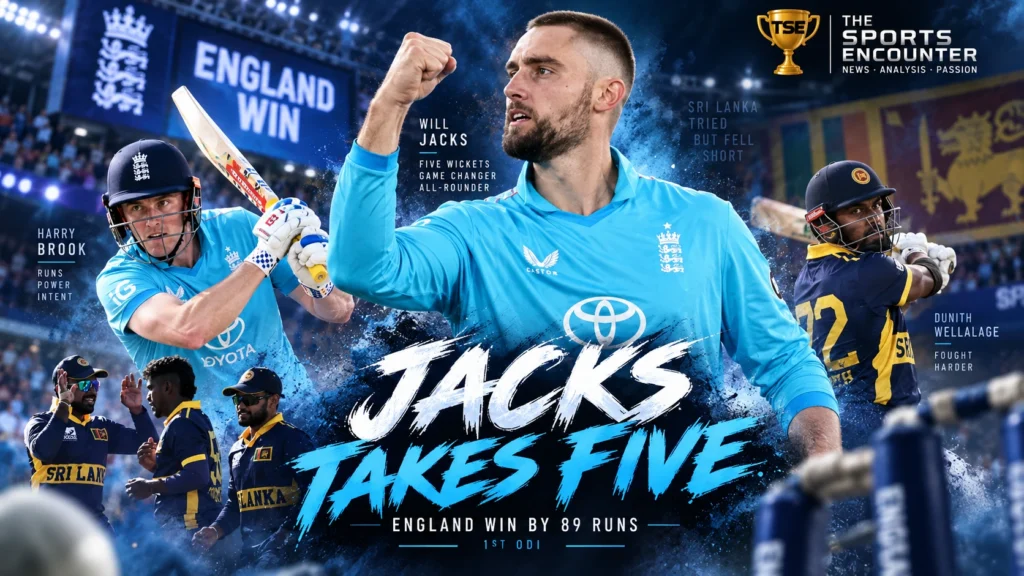
CHESTER-LE-STREET, England, September 22, 2026: For more than half of the first ODI, Sri Lanka had done something they rarely managed during their bruising T20I series against England.
They made the hosts uncomfortable.
Sachindu Colombage took three wickets on ODI debut. England slipped from 182 for three to 211 for seven. Harry Brook had already gone for 67. Jos Buttler had followed him. A total that once looked capable of pushing toward 300 was suddenly threatening to disappear well below it.
Then Will Jacks changed the match twice.
First, he made an unbeaten 46 from 47 balls to drag England to 265. Then he took five wickets for only 22 runs as Sri Lanka collapsed to 176 in 37 overs.
England won by 89 runs and moved 1-0 ahead in the three-match ODI series.
The margin looks comfortable.
The route to it was not.
Sri Lanka bowled far better than they had performed during the 3-0 T20I sweep that ended at Old Trafford. They kept England below 300, exposed the lower middle order and handed Colombage an excellent international debut.
What they could not do was turn that bowling effort into a controlled chase.
Once Jacks entered the attack, England transformed a competitive ODI into another one-sided result.
TL;DR
- England made 265 after being bowled out in 48.1 overs.
- Harry Brook top-scored with 67 from 69 balls.
- Will Jacks finished unbeaten on 46 before taking 5/22.
- Sachindu Colombage took 3/44 on ODI debut for Sri Lanka.
- Kusal Mendis made 42, while Dunith Wellalage top-scored for Sri Lanka with 45.
- Sri Lanka collapsed from 84/3 to 105/6 and were dismissed for 176.
- England won by 89 runs and lead the three-match series 1-0.
England vs Sri Lanka 1st ODI: Match at a Glance
| Match Detail | Information |
|---|---|
| Match | England vs Sri Lanka, 1st ODI |
| Date | September 22, 2026 |
| Venue | Riverside Ground, Chester-le-Street |
| Toss | England won and chose to bat |
| England | 265 all out in 48.1 overs |
| Sri Lanka | 176 all out in 37 overs |
| Result | England won by 89 runs |
| Top England batter | Harry Brook, 67 from 69 balls |
| Best England bowler | Will Jacks, 5/22 |
| Top Sri Lanka batter | Dunith Wellalage, 45 from 36 balls |
| Best Sri Lanka bowler | Sachindu Colombage, 3/44 |
The complete match details are available through the official ESPNcricinfo scorecard.
Sri Lanka Finally Made England Work
The T20I series had offered Sri Lanka almost no sustained control.
England won the opener by 119 runs, chased 146 in only 12.1 overs in Cardiff and completed the sweep at Old Trafford in 9.4 overs.
TSE documented that sequence from the beginning in our series preview, through the 119-run Southampton rout and the series-clinching Cardiff win.
The ODI opener looked different almost immediately.
Tom Banton fell for 10 in the third over. Ben Duckett attacked more successfully, making 32 from 29 balls, but Dunith Wellalage removed him at 67 for two.
Joe Root and Brook then rebuilt.
That partnership represented the phase Sri Lanka had struggled to create during the T20 series: a period in which England were scoring without completely dictating the match.
Root made 44 from 52 balls. Brook made 67 from 69.
England were stable.
They were not running away.
Harry Brook Adjusts From T20 Destruction to ODI Control
Brook’s 67 was nowhere near as spectacular as his 49-ball 114 against Sri Lanka a week earlier.
It may have been more useful as evidence of where his white-ball game is heading.
He scored seven fours, did not hit a six and operated at a strike rate of 97.10.
That matters because England’s ODI challenge is different from their T20 task.
Brook had spoken before the match about England wanting to pressure opponents with a higher-tempo approach, while also acknowledging that the side needed to improve its work against spin.
“We want more of the same. We’re trying to play a higher-octane style of cricket and put them under pressure with bat and ball,” Brook said before the series. The comments were reported as England continued working with specialist mentor Kevin Pietersen on playing spin. Reuters reported Brook’s pre-series comments.
Brook’s innings reflected that adjustment.
He did not spend 69 balls trying to reproduce Southampton.
He absorbed pressure, rotated strike and accelerated when the opportunity appeared.
TSE examined the wider development behind that batting maturity in our feature on Brook’s journey from PSL breakout talent to England white-ball captain.
Sachindu Colombage Turns an ODI Debut Into Sri Lanka’s Best Spell
Colombage could hardly have asked for a more meaningful first ODI.
The 28-year-old leg-spinner finished with three wickets for 44 runs from 10 overs.
His first international assignment came against an England batting lineup containing Root, Brook, Buttler, Duckett and Jacks.
He removed Root for 44.
He later trapped Buttler lbw for 31.
Jamie Overton became his third wicket.
England had named a powerful ODI group for the series, with Brook leading a squad that also included Root, Buttler, Jacks, Archer and Atkinson. The ICC confirmed England’s ODI squad and three-match schedule earlier this month.
Against that lineup, Colombage’s debut was not a token success created after the match had already gone.
He helped change its direction.
England Lose Four Wickets for 29 Runs
Brook’s dismissal at 182 for four opened the door.
Buttler fell at 196.
Rehan Ahmed was run out three runs later.
Overton departed at 211.
England had lost four wickets for 29 runs.
The game had shifted.
Sri Lanka were no longer merely trying to keep England below 300.
They had a realistic chance of dismissing the hosts for something much closer to 230.
That is where Jacks’ innings became decisive.
Will Jacks’ 46 Was More Important Than the Scorecard Makes It Look
Jacks finished unbeaten on 46 from 47 balls.
Five fours.
No sixes.
A strike rate just below 98.
It was not the kind of innings usually associated with a player celebrated for power hitting.
That is precisely why it mattered.
TSE recently included Jacks in our analysis of England’s evolving group of white-ball power hitters, but Chester-le-Street required a different skill.
England needed someone to stay.
Jacks did.
He helped take the score from 196 for five to 265, batting through the dismissals of Rehan, Overton, Atkinson, Archer and Tongue.
Gus Atkinson’s 14 offered the only substantial lower-order support.
Without Jacks, England might have left Sri Lanka a chase below 240.
Instead, the target was 266.
Sri Lanka’s Bowlers Deserved More From the Chase
Asitha Fernando took three wickets for 53.
Colombage returned 3/44.
Dilshan Madushanka gave away only 45 runs from his 10 overs.
Wellalage dismissed Duckett.
Dushmantha Chameera removed Brook.
Sri Lanka had therefore achieved something their T20 attack rarely managed during the previous week: different bowlers contributed across different phases.
England were dismissed with 11 balls unused.
That should have created belief.
Instead, Sri Lanka’s batting repeated one of the central problems from the T20 series.
Too many wickets fell before the chase had developed a stable structure.
England’s Seamers Create the First Cracks
Kamindu Mendis fell for 14 at 27.
Pathum Nissanka followed for 27 at 48.
Neither dismissal ended the chase.
They prevented Sri Lanka from building the kind of opening platform that would have allowed the middle order to attack the target later.
Kusal Mendis tried to stabilize the innings.
The captain made 42 from 60 deliveries.
At 84 for three, Sri Lanka remained mathematically comfortable enough to recover.
Then the innings collapsed.
84/3 Becomes 105/6
Pavan Rathnayake fell for 13.
Charith Asalanka made only one.
Janith Liyanage managed four.
Kusal Mendis was dismissed shortly afterward.
By the time Sri Lanka reached 105, six wickets were gone.
The target had not become impossible because of the required run rate.
It had become nearly impossible because the batting resources had disappeared.
Jamie Overton contributed two wickets for only 21 runs.
Jacks had already begun to take control.
Will Jacks’ Five-Wicket Haul Finishes the Match
Jacks’ bowling figures were extraordinary:
7 overs, 22 runs, 5 wickets.
He dismissed Kusal Mendis.
He removed Asalanka.
He ended Wellalage’s resistance.
Then he took the final two wickets, Asitha Fernando and Madushanka, from the final two balls of the innings.
Sri Lanka were all out for 176.
What makes the spell particularly important is that England did not require Jacks to operate merely as a holding sixth bowler.
He became the primary wicket-taking option.
That strengthens England’s flexibility considerably.
Jacks had already shown that two-way value at the T20 World Cup earlier this year. Against Sri Lanka at Chester-le-Street, his batting and bowling contributions belonged to the same match.
Dunith Wellalage Refuses to Let the Chase Disappear Quietly
Wellalage produced Sri Lanka’s best batting response.
He scored 45 from only 36 balls with five fours and two sixes.
His strike rate of 125 was the highest among Sri Lanka’s main batters.
More importantly, he attacked after the top and middle order had already collapsed.
Sri Lanka moved from 105 for six to 176 before his dismissal.
That did not bring them close enough to change the result.
It prevented the defeat from becoming even more severe.
Wellalage’s resistance also underlined how much Sri Lanka had lost through the earlier collapse.
Had one established batter remained alongside him, the final margin could have looked very different.
Complete England Innings Scorecard
| Batter | Dismissal | R | B | 4s | 6s | SR |
|---|---|---|---|---|---|---|
| Tom Banton | b Asitha Fernando | 10 | 12 | 2 | 0 | 83.33 |
| Ben Duckett | lbw b Wellalage | 32 | 29 | 5 | 0 | 110.34 |
| Joe Root | b Colombage | 44 | 52 | 5 | 0 | 84.61 |
| Harry Brook (c) | c Madushanka b Chameera | 67 | 69 | 7 | 0 | 97.10 |
| Jos Buttler (wk) | lbw b Colombage | 31 | 33 | 2 | 0 | 93.93 |
| Will Jacks | not out | 46 | 47 | 5 | 0 | 97.87 |
| Rehan Ahmed | run out (Asalanka) | 2 | 7 | 0 | 0 | 28.57 |
| Jamie Overton | b Colombage | 8 | 13 | 1 | 0 | 61.53 |
| Gus Atkinson | b Madushanka | 14 | 20 | 1 | 0 | 70.00 |
| Jofra Archer | b Asitha Fernando | 2 | 6 | 0 | 0 | 33.33 |
| Josh Tongue | b Asitha Fernando | 0 | 1 | 0 | 0 | 0.00 |
| Extras | lb 2, w 7 | 9 | ||||
| Total | 48.1 overs | 265 | 5.50 RR |
Fall of wickets: 16/1, 67/2, 135/3, 182/4, 196/5, 199/6, 211/7, 241/8, 247/9, 265/10.
Sri Lanka Bowling
| Bowler | Overs | Maidens | Runs | Wickets | Economy |
|---|---|---|---|---|---|
| Asitha Fernando | 9.1 | 0 | 53 | 3 | 5.78 |
| Dilshan Madushanka | 10 | 0 | 45 | 1 | 4.50 |
| Dushmantha Chameera | 9 | 0 | 61 | 1 | 6.77 |
| Dunith Wellalage | 10 | 0 | 60 | 1 | 6.00 |
| Sachindu Colombage | 10 | 0 | 44 | 3 | 4.40 |
Complete Sri Lanka Innings Scorecard
| Batter | Dismissal | R | B | 4s | 6s | SR |
|---|---|---|---|---|---|---|
| Pathum Nissanka | c Buttler b Tongue | 27 | 37 | 4 | 0 | 72.97 |
| Kamindu Mendis | c Duckett b Atkinson | 14 | 19 | 3 | 0 | 73.68 |
| Kusal Mendis (c/wk) | lbw b Jacks | 42 | 60 | 4 | 0 | 70.00 |
| Pavan Rathnayake | c Banton b Overton | 13 | 23 | 1 | 0 | 56.52 |
| Charith Asalanka | lbw b Jacks | 1 | 3 | 0 | 0 | 33.33 |
| Janith Liyanage | c Buttler b Overton | 4 | 8 | 0 | 0 | 50.00 |
| Dunith Wellalage | c Overton b Jacks | 45 | 36 | 5 | 2 | 125.00 |
| Sachindu Colombage | lbw b Rehan Ahmed | 14 | 14 | 3 | 0 | 100.00 |
| Dushmantha Chameera | not out | 7 | 19 | 0 | 0 | 36.84 |
| Asitha Fernando | c Banton b Jacks | 0 | 2 | 0 | 0 | 0.00 |
| Dilshan Madushanka | b Jacks | 0 | 1 | 0 | 0 | 0.00 |
| Extras | lb 1, w 8 | 9 | ||||
| Total | 37 overs | 176 | 4.75 RR |
Fall of wickets: 27/1, 48/2, 84/3, 85/4, 100/5, 105/6, 133/7, 176/8, 176/9, 176/10.
England Bowling
| Bowler | Overs | Maidens | Runs | Wickets | Economy |
|---|---|---|---|---|---|
| Jofra Archer | 6 | 1 | 38 | 0 | 6.33 |
| Gus Atkinson | 7 | 0 | 25 | 1 | 3.57 |
| Josh Tongue | 5 | 0 | 23 | 1 | 4.60 |
| Rehan Ahmed | 7 | 1 | 46 | 1 | 6.57 |
| Jamie Overton | 5 | 0 | 21 | 2 | 4.20 |
| Will Jacks | 7 | 0 | 22 | 5 | 3.14 |
Why This Win Matters More Than Another Comfortable Margin
England had spent the previous week overpowering Sri Lanka.
This match required them to solve a different problem.
Their batting lost momentum.
Sri Lanka’s spin worked.
A debutant took three wickets.
The lower order was exposed.
Instead of responding by trying to hit their way out of trouble, England found another route.
Brook constructed 67.
Jacks rebuilt the innings.
The seamers damaged Sri Lanka’s top order.
Then Jacks finished the chase with spin.
That versatility is more useful ahead of a 50-over World Cup cycle than another uncontested 300-plus total would have been.
England’s recent white-ball identity has been built around attacking depth, something TSE examined in detail when looking at the country’s current generation of explosive batters.
Chester-le-Street showed that the same side also needs players capable of slowing down without losing control.
Sri Lanka’s ODI Problem Is Now About Batting Conversion
Sri Lanka should take encouragement from their bowling.
Colombage looked international-class on debut.
Asitha took three wickets.
Madushanka controlled his economy.
England did not bat them out of the match.
But Sri Lanka still lost by 89 runs.
That is the part that should concern Kusal Mendis.
There were starts.
Nissanka reached 27.
Mendis reached 42.
Wellalage reached 45.
No one reached 50.
No partnership became large enough to change the chase.
The same broad issue has followed Sri Lanka through recent white-ball series. TSE saw it when the side lost control of the deciding T20I against West Indies, and it appeared again throughout the England T20I series.
The format has changed.
The inability to sustain control for long enough has not.
England and Sri Lanka Have Produced ODI Chaos Before
This rivalry has a history of matches decided by far smaller margins than 89 runs.
TSE’s A Celebration of 5000 ODIs feature on Sri Lanka’s famous final-ball World Cup win over England revisited one of the most dramatic examples.
Chester-le-Street threatened to become another tense chapter when England lost four wickets in quick succession.
Jacks prevented it.
What Happens Next?
England lead the three-match series 1-0.
The second ODI is scheduled for September 24 at Headingley before the series concludes at The Oval on September 27.
Sri Lanka’s immediate task is straightforward.
Keep the bowling standard.
Find a batter capable of turning 30 or 40 into an innings that controls the chase.
England have a different question.
Was Jacks’ five-wicket haul a spectacular one-off, or has England discovered another genuine ODI wicket-taking option before the 2027 World Cup?
That question may matter considerably more than the 89-run margin.
Follow The Sports Encounter’s cricket coverage for the second ODI, player analysis and the wider international cricket schedule.
Frequently Asked Questions
Who won the first England vs Sri Lanka ODI in 2026?
England won by 89 runs at Chester-le-Street. England scored 265 before dismissing Sri Lanka for 176.
How many wickets did Will Jacks take?
Will Jacks took five wickets for 22 runs from seven overs.
How many runs did Will Jacks score?
Jacks finished unbeaten on 46 from 47 balls and struck five fours.
Who top-scored for England?
Captain Harry Brook top-scored with 67 from 69 deliveries.
How did Sachindu Colombage perform on ODI debut?
Colombage took three wickets for 44 runs from 10 overs, dismissing Joe Root, Jos Buttler and Jamie Overton.
Who scored the most runs for Sri Lanka?
Dunith Wellalage top-scored with 45 from 36 balls, including five fours and two sixes.
What was Kusal Mendis’ score?
Sri Lanka captain Kusal Mendis made 42 from 60 balls before Will Jacks dismissed him lbw.
What is the England vs Sri Lanka ODI series score?
England lead the three-match series 1-0.
When is the second England vs Sri Lanka ODI?
The second ODI is scheduled for September 24, 2026 at Headingley.
Where is the third ODI?
The third and final ODI is scheduled for September 27 at The Oval.