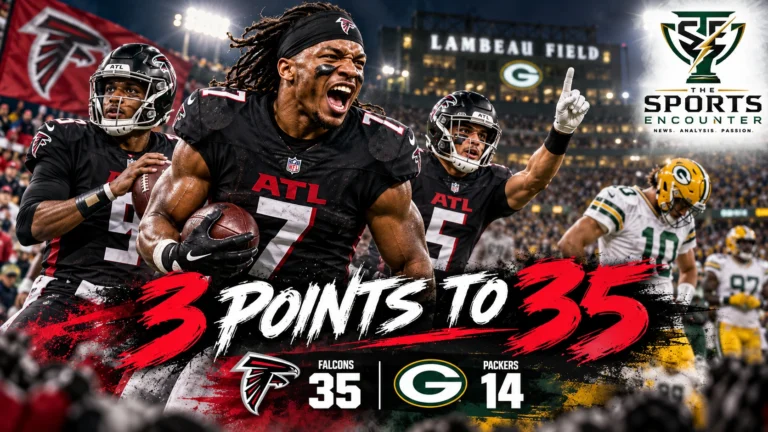
GREEN BAY, United States, September 24, 2026: The Atlanta Falcons arrived at Lambeau Field carrying one of the NFL’s ugliest early-season offensive statistics. Through two games, they had not run a single play inside an opponent’s 20-yard line.
By the end of Thursday night, that problem looked almost unrecognizable.
Bijan Robinson rushed for 194 yards and two touchdowns, Michael Penix Jr. returned from a torn ACL to give Atlanta stability at quarterback, and Drake London exploded for 194 receiving yards as the Falcons overwhelmed the Green Bay Packers 35-14.
Atlanta erased Green Bay’s early 7-0 lead with 27 unanswered points and finished with 498 total yards, including 242 on the ground. The Falcons moved to 1-2 after an 0-2 start that had included a 34-3 home defeat against Carolina in Week 2. Green Bay also fell to 1-2, but its problems may be harder to dismiss after being dominated at home in an area that had looked like a defensive strength.
Story at a glance
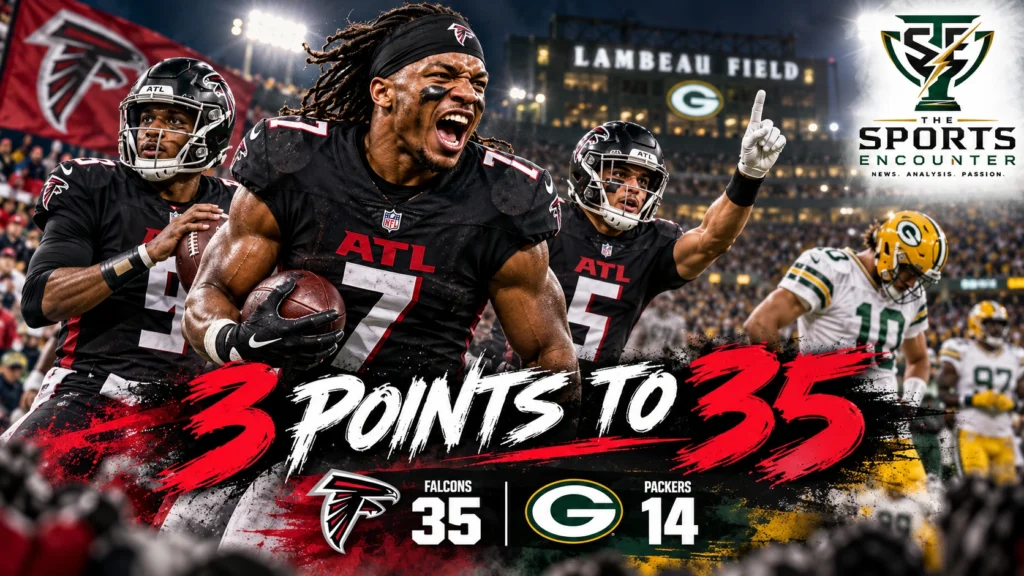
How Did Atlanta Go From 3 Points to 35 in Four Days?
The most revealing part of Atlanta’s win is where the offense had been before it arrived in Green Bay.
Michael Penix Jr. Gave Atlanta the Structure It Was Missing
Penix completed 18 of 25 passes for 256 yards, one touchdown and one interception, finishing with a 101.4 passer rating.
Bijan Robinson Destroyed What Had Been a Green Bay Strength
Green Bay entered Thursday allowing only 2.85 yards per rushing attempt through two games, the second-best mark in the NFL.
Drake London Finally Became the Vertical Problem Atlanta Needed
Robinson controlled the ground. London punished Green Bay whenever its defense had to respect it.
The Turning Point Came Before Halftime
Green Bay had a chance to prevent the game from breaking away.
TL;DR: Falcons vs Packers in Five Numbers
- 35-14: Atlanta’s final winning margin at Lambeau Field.
- 194: Bijan Robinson’s rushing yards on 29 carries.
- 242-17: Atlanta’s advantage in team rushing yards.
- 498-328: Atlanta’s advantage in total offense.
- 37:05: Falcons time of possession compared with Green Bay’s 22:55.
Falcons vs Packers 35-14 Score by Quarter
| Team | 1Q | 2Q | 3Q | 4Q | Final |
|---|---|---|---|---|---|
| Atlanta Falcons | 7 | 10 | 7 | 11 | 35 |
| Green Bay Packers | 7 | 0 | 0 | 7 | 14 |
How Did Atlanta Go From 3 Points to 35 in Four Days?
The most revealing part of Atlanta’s win is where the offense had been before it arrived in Green Bay.
Head coach Kevin Stefanski’s team opened the season with a 20-13 loss in Pittsburgh and then produced only three points against Carolina. Through those opening two games, Atlanta was the only NFL offense that had not taken a snap in the red zone.
The Sports Encounter’s NFL Week 1 analysis had already identified the underlying problem. Robinson generated 173 yards from scrimmage against Pittsburgh, but quarterback turnovers prevented Atlanta from turning his production into enough points.
Four days after the Panthers held the Falcons to three points, Atlanta went 4-for-5 in the red zone at Lambeau.
That transformation started with the quarterback change.
The Falcons announced Penix as their Week 3 starter after an 0-2 opening and months of rehabilitation from the ACL tear that ended his 2025 season. The Falcons’ official announcement described Thursday as his formal return to the starting role.
Penix did not need to carry Atlanta. That was part of why the offense worked.
Michael Penix Jr. Gave Atlanta the Structure It Was Missing
Penix completed 18 of 25 passes for 256 yards, one touchdown and one interception, finishing with a 101.4 passer rating.
Those numbers were important, but the distribution of responsibility mattered more.
Atlanta ran the football 41 times and asked Penix to throw only 25. He was not forced into the kind of obvious passing situations that had contributed to the Falcons’ offensive instability during the first two weeks.
His touchdown came late in the second quarter, when he found Austin Hooper from five yards to stretch Atlanta’s lead to 17-7.
The NFL’s official postgame analysis noted how Penix settled after a slow beginning and increasingly found Atlanta’s primary playmakers as the game developed.
Atlanta spent August working Penix back gradually after his knee injury, a process that fit into the wider roster and injury questions The Sports Encounter tracked in its 2026 preseason roster and injury report.
Thursday offered the first regular-season evidence that Atlanta’s offense may function differently with him back under center.
Bijan Robinson Destroyed What Had Been a Green Bay Strength
Green Bay entered Thursday allowing only 2.85 yards per rushing attempt through two games, the second-best mark in the NFL.
Robinson made that statistic irrelevant.
He carried 29 times for 194 yards, averaged 6.7 yards per rush and scored twice. He also caught two passes for 19 yards, giving him 213 yards from scrimmage.
| Bijan Robinson | Production |
|---|---|
| Rushing attempts | 29 |
| Rushing yards | 194 |
| Yards per carry | 6.7 |
| Rushing touchdowns | 2 |
| Receptions | 2 |
| Receiving yards | 19 |
| Total scrimmage yards | 213 |
Robinson first answered Christian Watson’s opening touchdown with a three-yard score late in the first quarter.
His second touchdown, a two-yard run with 3:35 remaining, finished the scoring at 35-14.
Brian Robinson Jr. added 50 rushing yards and another touchdown as Atlanta accumulated 242 yards on the ground at 5.9 yards per attempt.
The contrast with Green Bay was extreme.
The Packers ran nine times for 17 yards.
This was not simply Atlanta possessing a better running back. It was one team controlling the basic geometry of the game while the other became almost completely dependent on its quarterback.
Drake London Finally Became the Vertical Problem Atlanta Needed
Robinson controlled the ground. London punished Green Bay whenever its defense had to respect it.
The Falcons receiver caught nine of 10 targets for a career-high 194 yards, averaging 21.6 yards per reception. His longest catch went for 68 yards.
London did not score, but he repeatedly moved Atlanta into favorable field position and gave Penix a high-value target outside the short passing game.
That was especially significant after London’s quiet first two weeks, when he totaled only six catches for 80 yards.
The offense that appeared constrained against Pittsburgh and Carolina suddenly had two different ways to stress a defense. Robinson could punish lighter boxes. London could attack space created by the attention Atlanta’s backfield demanded.
For a league already showing how important offensive balance can be, Atlanta’s performance carried echoes of the formula The Sports Encounter examined when Kenneth Walker III transformed Kansas City’s attack alongside Patrick Mahomes.
The Turning Point Came Before Halftime
Green Bay had a chance to prevent the game from breaking away.
Trailing 10-7 late in the second quarter, the Packers moved into position for Trey Smack to attempt a 47-yard field goal. Atlanta blocked it.
The Falcons responded with an eight-play, 63-yard touchdown drive capped by Penix’s five-yard pass to Hooper.
Instead of potentially reaching halftime tied at 10, Green Bay entered the locker room trailing 17-7.
The Packers then opened the third quarter by driving to Atlanta’s 7-yard line and faced fourth-and-1. Matt LaFleur kept the offense on the field.
Atlanta covered Love’s available targets, the pass fell incomplete, and another opportunity disappeared.
The Falcons answered with an 87-yard touchdown drive and a 24-7 lead.
Those two sequences changed the game more decisively than any single explosive play.
Why Jordan Love’s 312 Passing Yards Did Not Mean Green Bay’s Offense Worked
Jordan Love finished with 312 passing yards and two touchdowns. On the surface, that looks productive.
He needed 53 attempts to get there.
Love completed 28 passes, threw one interception and finished with a 75.4 passer rating. Green Bay’s inability to run left the offense chasing the game almost entirely through the air.
Christian Watson caught a four-yard touchdown to give Green Bay its only lead.
Matthew Golden provided the clearest positive development. The second-year receiver caught five passes for 100 yards and scored his first regular-season NFL touchdown on a 15-yard reception in the fourth quarter.
Golden now has 253 receiving yards through three games, giving Green Bay at least one emerging answer inside an offense searching for consistency.
But the collective problem remained. Green Bay went three-and-out four times in the first half, failed on a major fourth-down opportunity after halftime and possessed the ball for fewer than 23 minutes.
Packers’ Offensive Line Problems Are Becoming Harder to Ignore
Green Bay entered Thursday without starting guard Aaron Banks and tackle Zach Bako-Bewele. Wide receiver Jayden Reed was also inactive.
The night created more uncertainty.
Guard Jacob Monk left with a quad injury, while linebacker Edgerrin Cooper exited to be evaluated for a concussion. The Packers’ official postgame report confirmed both developments.
Injuries alone do not explain 17 rushing yards or four first-half three-and-outs, but they reduce Green Bay’s margin for correcting those problems quickly.
The Packers had escaped New York with a 20-17 overtime victory in Week 2, a comeback covered in The Sports Encounter’s complete NFL Week 2 report.
Thursday provided a very different test. Green Bay could not rely on a late comeback because Atlanta controlled possession, the running game and the scoreboard for too long.
Green Bay’s 13-Game Home-Opener Streak Ends
The result also ended one of the NFL’s longest active home-opening runs.
Green Bay had won 13 consecutive home openers from 2013 through 2025, tied with the Miami Dolphins’ 1976-88 run for the longest such streak in league history.
The Packers had not lost a home opener since San Francisco beat them 30-22 in 2012.
Atlanta did more than end the streak. The Falcons did it by scoring 35 points after managing only 16 total across their first two games.
Falcons vs Packers Team Stats Show How Complete Atlanta’s Control Was
| Statistic | Atlanta | Green Bay |
|---|---|---|
| Total yards | 498 | 328 |
| Rushing yards | 242 | 17 |
| Passing yards | 256 | 311 |
| First downs | 25 | 18 |
| Third downs | 6/10 | 6/15 |
| Red zone | 4/5 | 2/4 |
| Turnovers | 1 | 1 |
| Time of possession | 37:05 | 22:55 |
What Does Atlanta’s First Win Mean for the NFC South?
Atlanta is only 1-2. One night does not erase the first two weeks.
What changed is the evidence available to Stefanski.
The Falcons now know what their offense can look like when Penix gives the passing game structure, Robinson does not have to create everything himself and London becomes a serious downfield threat.
Before Thursday, Atlanta belonged firmly among the struggling teams identified in The Sports Encounter’s Week 2 analysis.
The NFL’s opening fortnight had already produced dramatic changes elsewhere. Buffalo looked explosive in Josh Allen’s five-touchdown night against Detroit, while defending champion Seattle had already shown its resilience when Drew Lock rescued the Seahawks against New England.
Atlanta has not reached that level. Thursday gave it something more immediate: a credible offensive identity.
What Went Wrong for Green Bay?
Green Bay’s concern is broader because the failures crossed several areas.
- The Packers were outrushed 242-17.
- Atlanta converted six of 10 third downs.
- Green Bay failed to score in either the second or third quarter.
- The Packers surrendered 498 total yards.
- Love attempted 53 passes because the running game disappeared.
- Another two players left with injuries.
The Packers are three games into the season, so there is still plenty of time to recover.
But their 1-2 record has come with a 39-22 loss at Minnesota, an overtime escape against the Jets and now a 21-point home defeat.
The wider NFC already contains teams building stronger early cases. San Francisco, for example, opened the year with the kind of two-way control TSE first saw during its 27-7 victory over the Rams in Melbourne.
Green Bay’s immediate task is less ambitious. It needs to establish what its offense can reliably do before the schedule becomes less forgiving.
What Happens Next for the Falcons and Packers?
Atlanta receives an extended break before another prime-time road game. The Falcons travel to New Orleans to face the Saints on Monday, October 5.
That game will test whether Thursday represented the beginning of a genuine offensive reset or a single matchup in which Robinson overwhelmed Green Bay.
The Packers also get additional recovery time before visiting the Tampa Bay Buccaneers on Sunday, October 4.
The broader 2026 season began with questions about how dramatically the championship race had changed, something The Sports Encounter explored in its NFL 2026 season curtain-raiser.
Three weeks later, Atlanta and Green Bay have supplied another reminder that September can move quickly.
Four days ago, the Falcons looked like one of the NFL’s most dysfunctional offenses.
At Lambeau, they looked like a team that finally knew exactly how it wanted to play.
Continue the NFL Story



Frequently Asked Questions
Who won Falcons vs Packers in NFL Week 3?
The Atlanta Falcons defeated the Green Bay Packers 35-14 at Lambeau Field on September 24, 2026.
How many rushing yards did Bijan Robinson have against Green Bay?
Robinson rushed 29 times for 194 yards and two touchdowns. He added 19 receiving yards for 213 yards from scrimmage.
How did Michael Penix Jr. perform in his return?
Penix completed 18 of 25 passes for 256 yards, one touchdown and one interception, posting a 101.4 passer rating in his first start of the season.
How many receiving yards did Drake London have?
London caught nine of 10 targets for 194 yards, including a 68-yard reception.
How many rushing yards did the Packers have?
Green Bay finished with only 17 rushing yards on nine attempts, compared with Atlanta’s 242 yards on 41 carries.
How did Jordan Love play against Atlanta?
Love completed 28 of 53 passes for 312 gross passing yards, two touchdowns and one interception. He finished with a 75.4 passer rating.
What record did the Packers lose with the defeat?
Green Bay’s streak of 13 consecutive home-opening victories ended. The Packers had not lost their home opener since 2012.
What is Atlanta’s record after beating Green Bay?
The Falcons improved to 1-2 after losing their first two games to Pittsburgh and Carolina.
What is Green Bay’s record after Week 3?
The Packers also fell to 1-2 after losses to Minnesota and Atlanta and an overtime victory over the New York Jets.
Who do the Falcons and Packers play next?
Atlanta visits the New Orleans Saints on Monday, October 5. Green Bay travels to face the Tampa Bay Buccaneers on Sunday, October 4.