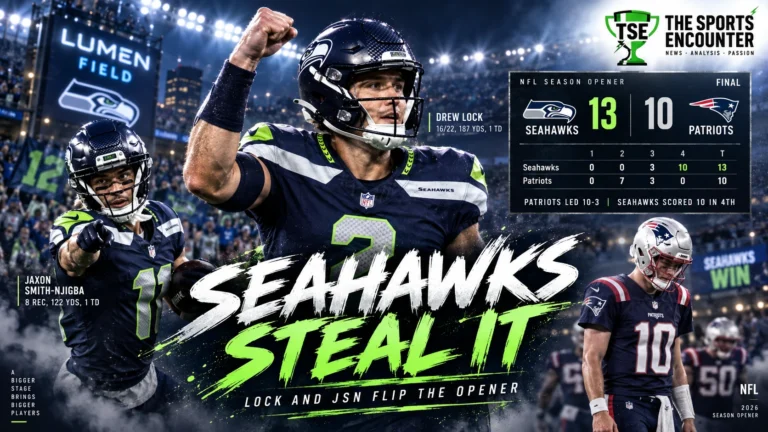
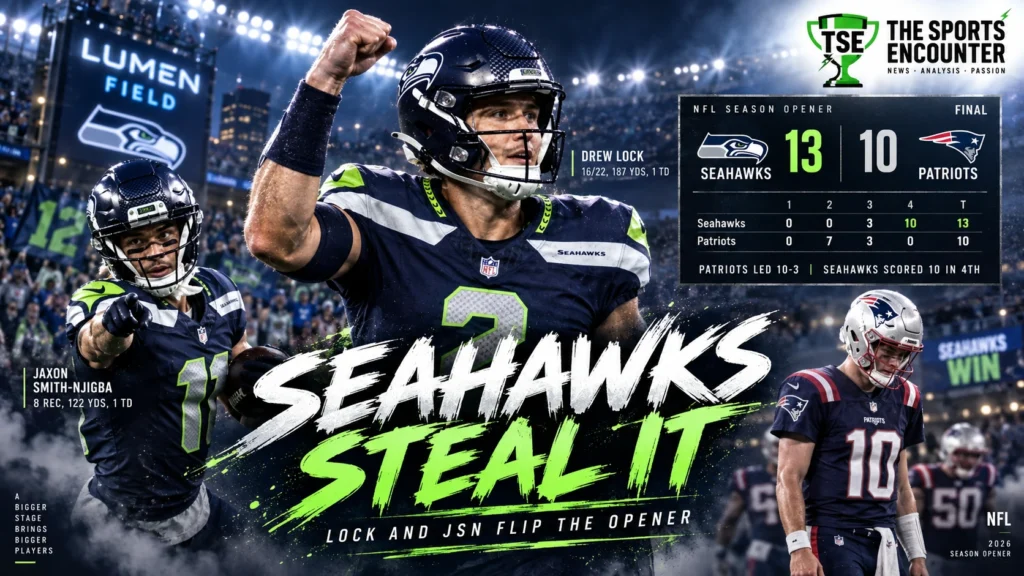
SEATTLE, United States, September 9, 2026: The Seattle Seahawks spent most of the 2026 NFL season opener looking like a defending champion trapped inside somebody else’s game. Sam Darnold was lost to a hip injury, New England controlled possession, Seattle committed 10 penalties, and the Patriots carried a 10-3 lead into the fourth quarter. Then Drew Lock found Jaxon Smith-Njigba for 45 yards, Jason Myers supplied the winning field goal, and Seattle’s defense intercepted Drake Maye for a third time to complete a 13-10 comeback at Lumen Field.
The Seahawks scored all 10 of their fourth-quarter points after failing to produce a touchdown through the first three periods, turning the highly anticipated Super Bowl LX rematch into a reminder of why championship teams are often hardest to beat when the game becomes ugly.
Seattle did not dominate the statistics that normally describe control. New England ran 67 offensive plays to Seattle’s 48 and possessed the ball for 34:17 compared with 25:24. The Patriots also rushed for 109 yards, eight fewer total yards than Seattle, and forced the Seahawks to overcome 98 penalty yards.
Yet the two numbers that ultimately mattered were far less flattering for New England: three turnovers to zero and 4.1 yards per play compared with Seattle’s 5.9.
Story at a glance
Seattle Seahawks vs New England Patriots 13-10: NFL Week 1 Result
The matchup opened the regular season seven months after Seattle defeated New England 29-13 in Super Bowl LX. The NFL selected Seattle to host the 2026 kickoff game as defending champion, while the Patriots arrived seeking the earliest possible answer to February’s defeat.
How Did the Seahawks Come Back From 10-3 Down?
New England entered the fourth quarter with the scoreboard exactly where it wanted it.
Drew Lock Changed the Game After Sam Darnold’s Injury
The most unexpected part of Seattle’s victory was the quarterback who finished it.
Jaxon Smith-Njigba Produced the Play Seattle Could Not Manufacture Elsewhere
Seattle finished with only 48 offensive plays.
Three Drake Maye Interceptions Cost New England More Than 34 Minutes of Possession Could Save
The Patriots possessed the football for nearly nine minutes longer than Seattle.
The Patriots had more football. Seattle did more with the football it had.
That difference decided the first game of the 2026 NFL season.
Seattle Seahawks vs New England Patriots 13-10: NFL Week 1 Result
| Game Detail | New England Patriots | Seattle Seahawks |
|---|---|---|
| Final Score | 10 | 13 |
| Record | 0-1 | 1-0 |
| First Quarter | 0 | 0 |
| Second Quarter | 7 | 0 |
| Third Quarter | 3 | 3 |
| Fourth Quarter | 0 | 10 |
| Total Yards | 277 | 285 |
| Passing Yards | 168 | 188 |
| Rushing Yards | 109 | 97 |
| Yards Per Play | 4.1 | 5.9 |
| Turnovers | 3 | 0 |
| Penalties | 7 for 50 yards | 10 for 98 yards |
| Possession | 34:17 | 25:24 |
| Venue | Lumen Field, Seattle | |
The matchup opened the regular season seven months after Seattle defeated New England 29-13 in Super Bowl LX. The NFL selected Seattle to host the 2026 kickoff game as defending champion, while the Patriots arrived seeking the earliest possible answer to February’s defeat.
The Sports Encounter had already examined what had changed between the Super Bowl and the Week 1 rematch. The answer after one night is complicated. New England looked more capable of controlling the game, but Seattle again proved better at controlling its decisive moments.
How Did the Seahawks Come Back From 10-3 Down?
New England entered the fourth quarter with the scoreboard exactly where it wanted it.
Drake Maye had thrown a two-yard touchdown pass to Elijah Raridon in the second quarter, and rookie kicker Andy Borregales extended the lead with a 50-yard field goal in the third. Seattle’s only response through 45 minutes was a 30-yard Myers field goal.
At 10-3, the Patriots did not need spectacular football. They needed to avoid giving Seattle a short, explosive route back into the game.
That is precisely what happened.
With 11:37 remaining, Lock connected with Smith-Njigba for a 45-yard touchdown. Myers converted the extra point and a game New England had spent three quarters controlling was suddenly tied at 10-10.
The touchdown mattered for more than seven points.
Seattle had struggled to sustain drives. New England had controlled the number of snaps. The Seahawks therefore needed one play capable of compressing an entire possession into seconds.
Smith-Njigba supplied it.
That is why his 122 receiving yards require context. Eight catches and 122 yards are impressive on their own, but the value of his night was concentrated in the moment Seattle needed offense without requiring a long series of successful plays.
One 45-yard connection erased the Patriots’ seven-point advantage.
Drew Lock Changed the Game After Sam Darnold’s Injury
The most unexpected part of Seattle’s victory was the quarterback who finished it.
Darnold suffered a hip injury after being sacked during Seattle’s opening possession and was eventually ruled out. He completed one of two passes for 13 yards before leaving, forcing Lock into a season opener that had been framed around Darnold and Maye revisiting their Super Bowl matchup.
The NFL confirmed Darnold was ruled out because of the hip injury, turning what was already a difficult night into an immediate test of Seattle’s quarterback depth.
Lock answered with 16 completions from 22 attempts for 187 yards, one touchdown and no interceptions.
His final numbers do not look overwhelming until they are placed beside the circumstances.
He entered unexpectedly. Seattle was trailing. The Patriots knew the backup quarterback had to generate the comeback. Lock still produced 8.5 yards per passing attempt and protected the football.
That last part became increasingly important because Maye could not do the same.
Our NFL 2026 curtain-raiser identified quarterback adaptation as one of the central questions around the rematch. Few expected that test to involve Seattle changing quarterbacks before halftime.
The defending champions passed it anyway.
Jaxon Smith-Njigba Produced the Play Seattle Could Not Manufacture Elsewhere
Seattle finished with only 48 offensive plays.
That makes Smith-Njigba’s production even more striking.
He caught eight passes for 122 yards and the fourth-quarter touchdown, accounting for almost two-thirds of Seattle’s passing production.
The Seahawks did not consistently move the chains, but Smith-Njigba gave Lock something more valuable than accumulation. He provided explosive yardage in a game where Seattle had very few possessions to waste.
His 45-yard touchdown was the clearest example.
New England had spent much of the night forcing Seattle to operate slowly. Smith-Njigba changed the scale of the field in one snap.
That ability was one of the reasons our pre-game analysis identified Smith-Njigba as central to Seattle’s reworked offense following offseason personnel changes.
The first game strengthened that argument considerably.
Three Drake Maye Interceptions Cost New England More Than 34 Minutes of Possession Could Save
The Patriots possessed the football for nearly nine minutes longer than Seattle.
They ran 19 more offensive plays.
They produced more rushing yards.
They still scored 10 points.
The reason was not difficult to identify.
Maye completed 23 of 33 passes for 178 yards and a touchdown, but he also threw three interceptions. The last one arrived with 26 seconds remaining and New England threatening to rescue the game.
Maye had driven the Patriots to Seattle’s 16-yard line. A touchdown would almost certainly have won the game. Even without one, New England remained close enough to create a potential tying opportunity.
Instead, his pass was intercepted in the end zone by Josh Jobe.
Seattle took over, Lock kneeled, and the opener was finished.
The final interception gives this game an uncomfortable similarity to the Super Bowl for New England. Seattle’s championship victory in February was also shaped by defensive disruption and Patriots turnovers.
New England spent the offseason attempting to give Maye better answers, including the addition of A.J. Brown. Our analysis of Christian Gonzalez’s record-setting contract also showed how aggressively the Patriots have invested around their young quarterback and championship window.
What Week 1 exposed is that better personnel cannot compensate for possession-ending mistakes.
Seattle Won Despite 98 Penalty Yards, and That Is Both Impressive and Dangerous
Seattle should celebrate the comeback without pretending the performance was clean.
Ten penalties for 98 yards would ordinarily be enough to lose a close game.
The Seahawks repeatedly gave New England help through field position, stalled sequences and self-inflicted setbacks. The Patriots committed seven penalties for 50 yards, meaning Seattle surrendered nearly twice as much field position through infractions.
That creates one of the clearest Week 1 warnings for Mike Macdonald.
Seattle cannot depend on winning the turnover battle 3-0 every week.
The encouraging part is that the Seahawks survived their own indiscipline because they remained structurally sound in other areas. They avoided giveaways, produced more yards per play and created the two defining defensive moments of the fourth quarter: pressure on Maye and the game-ending interception.
Championship resilience is useful.
Needing championship resilience because of nearly 100 penalty yards is less sustainable.
Jason Myers Quietly Scored the Points That Separated the Teams
Quarterbacks and interceptions will dominate the conversation, but Jason Myers scored seven of Seattle’s 13 points.
His 30-yard field goal in the third quarter prevented New England from carrying a two-score advantage deep into the game. After Smith-Njigba tied it, Myers returned with 5:53 remaining and converted from 26 yards to put Seattle ahead for the first time.
The winning kick came at the end of a game where neither offense produced sustained scoring.
That makes every special-teams point more valuable.
Seattle’s margin of victory was three.
Myers made both of his field goals.
Why Seattle’s 13-10 Win Means More Than a Super Bowl Rematch Victory
The emotional framing of this game was unavoidable.
Seattle raised its Super Bowl LX championship banner before kickoff. New England stood on the other sideline seven months after losing the championship game 29-13. The Patriots’ own official Week 1 preview confirmed the game was the first season-opening Super Bowl rematch since 2016.
But the more useful lesson concerns Seattle’s 2026 identity.
The Seahawks no longer have every component that carried them through last season. Their roster has changed, their offense has changed, and their opening night quarterback changed during the game itself.
Yet the traits that won the championship were still recognizable.
Protect the football.
Force the opponent to finish difficult drives.
Create pressure when the field becomes compressed.
Make one or two explosive plays count disproportionately.
Win the decisive snaps rather than worrying about who won the prettier statistical categories.
The Sports Encounter’s analysis of Seattle’s record franchise sale noted that the organization entered its new ownership era as a defending champion rather than a rebuilding asset. Opening night demonstrated why that context matters.
This remains a team that expects to win games it has not controlled.
What Does the 13-10 Loss Say About the Patriots?
New England is better than a 10-point offense looked on Wednesday night.
The Patriots showed signs of improvement in several areas that had mattered during Super Bowl LX. They generated 109 rushing yards, controlled possession and kept Seattle from building sustained offensive momentum for most of the night.
Those are meaningful positives.
The problem is that the Patriots spent an offseason trying to close the gap on Seattle and then lost because of one of the same fundamental issues that hurt them in February: they asked Maye to solve increasingly difficult situations after the offense failed to convert control into points.
Maye’s three interceptions transformed a game New England had largely dictated.
The last one erased the opportunity to change the result.
Our broader NFL Week 1 analysis emphasized how quickly roster changes, injuries and quarterback decisions can alter a team’s opening expectations. New England has now received its first reality check.
The Patriots did enough to prove they can compete with Seattle.
They did not do enough to prove they have learned how to finish against Seattle.
The Hidden Statistic: Seattle Needed 19 Fewer Plays to Gain More Yards
If one statistic deserves to survive beyond the final score, it is this:
Seattle gained 285 yards on 48 plays. New England gained 277 yards on 67.
That means the Seahawks gained eight more yards while running 19 fewer offensive plays.
Possession usually creates opportunity.
Efficiency determines what those opportunities become.
Seattle averaged 5.9 yards per play. New England averaged 4.1. The Seahawks therefore gained roughly 44% more yardage every time they snapped the football.
That helps explain why a team that spent less time on offense could still overturn a seven-point fourth-quarter deficit.
It also explains why Smith-Njigba’s touchdown mattered so much. Seattle did not need 12-play drives if one explosive completion could achieve what New England required multiple first downs to reproduce.
This is exactly the type of Week 1 indicator worth carrying forward. Total yardage says the teams were almost equal.
How they accumulated those yards says they were not.
What Comes Next for the Seahawks and Patriots?
Seattle begins its title defense at 1-0 with an immediate question surrounding Darnold’s hip injury. His availability will matter more than any celebration once the Seahawks begin preparing for Week 2.
Lock demonstrated that Seattle has a capable short-term answer if needed, but one strong relief performance should not be confused with certainty over a longer stretch.
New England falls to 0-1 and must immediately confront the turnover issue around Maye. The Patriots moved the football well enough to win this game. Their inability to turn control into touchdowns and protect possessions prevented them from doing so.
The rest of the league now takes the stage, including the historic Rams-49ers game in Melbourne. The Sports Encounter has examined why the NFL placed its first Australian regular-season game in Week 1 and how it fits into the league’s much larger international strategy.
We have also tracked the NFL’s push for tens of millions of additional international fans, which makes this opening week much larger than one rematch in Seattle.
For one night, though, the league belonged to the defending champions.
Seattle trailed for most of it.
Seattle lost its starting quarterback.
Seattle committed almost 100 yards in penalties.
Seattle still found the plays that mattered most.
That may be the most important thing we learned about the Seahawks on opening night.
Continue the NFL Story



Frequently Asked Questions
Who won Seahawks vs Patriots in NFL Week 1?
The Seattle Seahawks defeated the New England Patriots 13-10 at Lumen Field to begin the 2026 NFL regular season 1-0.
How did the Seahawks beat the Patriots 13-10?
Seattle scored 10 unanswered points in the fourth quarter. Drew Lock threw a 45-yard touchdown pass to Jaxon Smith-Njigba to tie the game before Jason Myers kicked the winning 26-yard field goal.
What happened to Sam Darnold?
Darnold suffered a hip injury during Seattle’s opening possession and was ruled out before halftime. Drew Lock replaced him at quarterback.
How did Drew Lock perform against the Patriots?
Lock completed 16 of 22 passes for 187 yards, one touchdown and no interceptions after replacing the injured Darnold.
How many interceptions did Drake Maye throw?
Maye threw three interceptions. His final interception came in the Seattle end zone with 26 seconds remaining as New England attempted to rescue the game.
How many receiving yards did Jaxon Smith-Njigba have?
Smith-Njigba caught eight passes for 122 yards and scored Seattle’s only touchdown on a 45-yard reception in the fourth quarter.
Why was Seahawks vs Patriots called a Super Bowl LX rematch?
Seattle defeated New England 29-13 in Super Bowl LX in February 2026. The same teams were matched again to open the 2026 regular season seven months later.
How many points did Seattle score in the fourth quarter?
The Seahawks scored 10 fourth-quarter points after entering the period trailing 10-3.
What was the biggest statistical difference between Seattle and New England?
Turnovers and efficiency were decisive. Seattle committed no turnovers while New England had three, and the Seahawks averaged 5.9 yards per play compared with 4.1 for the Patriots.
What are the Seahawks and Patriots records after Week 1?
Seattle begins the season 1-0, while New England falls to 0-1.