
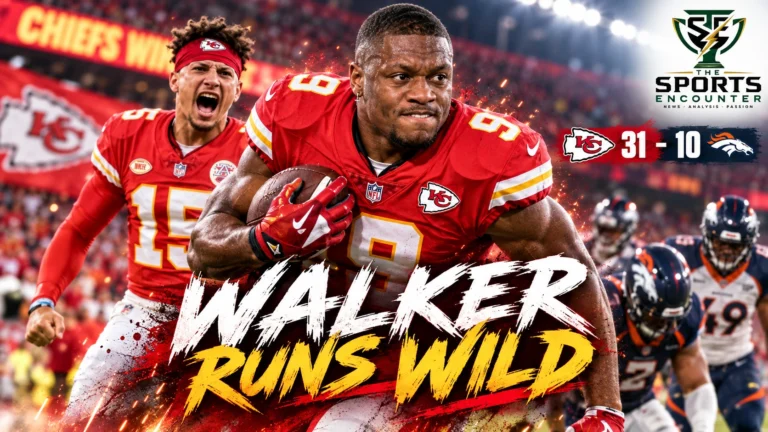
KANSAS CITY, United States, September 15, 2026: The story was supposed to be Patrick Mahomes and the surgically repaired left knee carrying him back into an NFL game exactly nine months after a major injury. By the end of Monday night, Kenneth Walker III had changed the conversation around the Kansas City Chiefs far more dramatically.
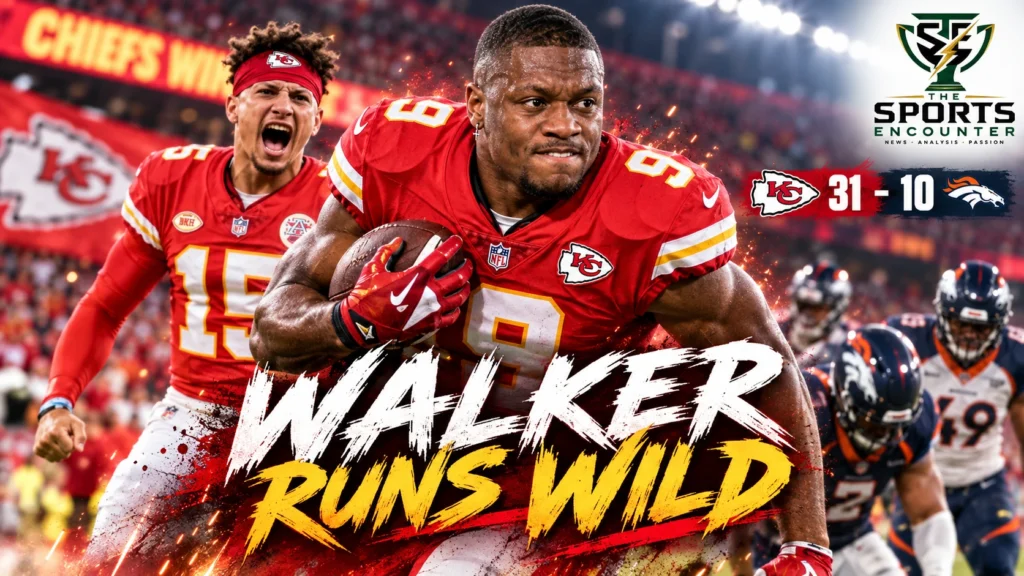
Walker rushed for a career-high 173 yards, produced 191 yards from scrimmage and scored twice as Kansas City overwhelmed the Denver Broncos 31-10 at GEHA Field at Arrowhead Stadium. Mahomes returned with three total touchdowns, the Chiefs rushed for 220 yards, and a Denver team that entered the season as reigning AFC West champion was held to 176 total yards.
For Kansas City, the result was bigger than a successful return for its quarterback. It offered the first real evidence that an offense that leaned too heavily on Mahomes last season may finally have another way to control games. That possibility was central to The Sports Encounter’s Week 1 preview of Mahomes’ return. Monday night supplied a much stronger answer than expected.
Chiefs vs Broncos 31-10: Key Facts
- Final score: Kansas City Chiefs 31, Denver Broncos 10
- Date: September 14, 2026
- Venue: GEHA Field at Arrowhead Stadium, Kansas City
- Kansas City record: 1-0
- Denver record: 0-1
- Kenneth Walker III: 23 carries, 173 rushing yards, 3 catches, 18 receiving yards, 2 total touchdowns
- Patrick Mahomes: 15-of-27, 184 passing yards, 2 passing touchdowns, 1 interception; 27 rushing yards and 1 rushing touchdown
- Bo Nix: 17-of-28, 131 passing yards, 1 touchdown, 1 interception; lost one fumble
- Total yards: Kansas City 392, Denver 176
- Rushing yards: Kansas City 220, Denver 61
Chiefs vs Broncos Scorecard
| Team | Q1 | Q2 | Q3 | Q4 | Final |
|---|---|---|---|---|---|
| Denver Broncos | 7 | 0 | 3 | 0 | 10 |
| Kansas City Chiefs | 7 | 7 | 10 | 7 | 31 |
Scoring Summary
| Quarter | Scoring Play | Score |
|---|---|---|
| 1st | Patrick Mahomes 15-yard rushing touchdown, Harrison Butker extra point | KC 7-0 |
| 1st | Evan Engram 19-yard touchdown reception from Bo Nix, Wil Lutz extra point | 7-7 |
| 2nd | Rashee Rice 13-yard touchdown reception from Patrick Mahomes, Butker extra point | KC 14-7 |
| 3rd | Kenneth Walker III 60-yard rushing touchdown, Butker extra point | KC 21-7 |
| 3rd | Wil Lutz 31-yard field goal | KC 21-10 |
| 3rd | Harrison Butker 28-yard field goal | KC 24-10 |
| 4th | Kenneth Walker III 2-yard touchdown reception from Patrick Mahomes, Butker extra point | KC 31-10 |
Kenneth Walker III Changed What the Chiefs Asked Mahomes to Do
Kansas City’s most encouraging development was not Mahomes proving that his knee could survive NFL contact. It was the amount of football he did not have to manufacture by himself.
Story at a glance
Kenneth Walker III Changed What the Chiefs Asked Mahomes to Do
Kansas City’s most encouraging development was not Mahomes proving that his knee could survive NFL contact. It was the amount of football he did not have to manufacture by himself.
Denver’s 28 Missed Tackles Explain the Chiefs’ Offensive Explosion
Walker’s numbers deserve credit, but Denver’s tackling was the hidden structural failure behind the result.
Patrick Mahomes’ Return Was Imperfect and Still Very Encouraging
Mahomes did not return with one of his vintage statistical performances. He completed 15 of 27 passes for 184 yards, threw two touchdowns and one interception, and was sacked twice.
Bo Nix and Denver Never Recovered From the First Possession
Denver’s offensive problems started almost immediately. Rookie cornerback Mansoor Delane intercepted Nix on the Broncos’ opening possession, giving Kansas City a short field that eventually produced Mahomes’ rushing touchdown.
Chiefs Defense Made Denver’s New Offense Look Smaller
Walker will dominate the headlines, but Kansas City’s defensive performance deserves almost equal attention.
Walker carried the ball on Kansas City’s first four offensive plays and seven times during the opening touchdown drive. That workload immediately forced Denver to defend the width of the formation, honor the run on early downs and hesitate before sending its pass rush after Mahomes.
The approach matched the question raised before the game. Kansas City signed Walker after his Super Bowl MVP season in Seattle because the Chiefs needed an offense capable of functioning without asking Mahomes to rescue every difficult down. TSE’s NFL 2026 season analysis identified Walker’s move from Seattle to Kansas City as one of the changes capable of reshaping the AFC race.
His Chiefs debut went beyond providing balance. Walker became the offense.
The 173 rushing yards were a career high and the most by a Chiefs runner since Jamaal Charles produced 226 against Indianapolis in 2012. Walker also added three catches for 18 yards, taking his total to 191 yards from scrimmage.
NFL Research reported that the 191-yard performance was the most scrimmage yardage produced in Week 1 by a reigning Super Bowl MVP, surpassing Jerry Rice’s 180 yards in 1989. His 173 rushing yards were also the second-most by a veteran player making his debut for a new team.
The 60-Yard Run Was the Moment Denver Lost Control
Kansas City led only 14-7 at halftime. Denver was still within one possession and had enough defensive talent to believe the game could be dragged back toward the type of low-scoring contest that had troubled the Chiefs in recent meetings.
Walker changed that on fourth-and-1 early in the third quarter.
Denver collapsed toward the expected interior run. Walker bounced outside, escaped the traffic and accelerated for a 60-yard touchdown. The Chiefs were suddenly ahead 21-7, and the Broncos could no longer play the game on their preferred terms.
The play mattered for more than six points. Denver entered Week 1 with a defense that had finished among the league’s best units in 2025. Once Walker broke that structure on short yardage, Kansas City had evidence that it could run against Denver even when the Broncos knew the run was coming.
Denver’s 28 Missed Tackles Explain the Chiefs’ Offensive Explosion
Walker’s numbers deserve credit, but Denver’s tackling was the hidden structural failure behind the result.
According to NFL Next Gen Stats, the Broncos missed 28 tackles and allowed 247 yards connected to those missed tackles, the highest total recorded by any defense since at least 2018. Eight Denver defenders missed multiple tackles.
That changes how the 31 points should be interpreted. Kansas City did not repeatedly solve Denver through elaborate passing concepts. Many of the most damaging plays became larger because the first defender failed to finish the tackle.
Rashee Rice’s 13-yard touchdown before halftime was another example. Mahomes delivered the ball underneath, and Rice turned a manageable gain into a score by surviving contact. Walker repeatedly produced additional yards after defenders reached him. Travis Kelce’s 59-yard reception in the third quarter included another major failure to end the play early.
The Broncos spent much of 2025 building their identity around defensive pressure and disruption. Against Kansas City, the problem occurred after they reached the ball carrier.
That should concern Denver more than allowing one explosive run. A busted assignment can be corrected in the film room. Twenty-eight missed tackles point toward a team-wide execution problem.
Patrick Mahomes’ Return Was Imperfect and Still Very Encouraging
Mahomes did not return with one of his vintage statistical performances. He completed 15 of 27 passes for 184 yards, threw two touchdowns and one interception, and was sacked twice.
His first touchdown may have mattered more psychologically than anything he produced through the air.
After a holding penalty wiped out an earlier run near the goal line, Mahomes scrambled up the middle for a 15-yard touchdown and absorbed the physical demands of cutting, accelerating and finishing the play with a brace protecting his left knee.
For a quarterback returning from ACL and LCL injuries, that sequence answered the first question quickly. Mahomes was willing to trust the leg in live competition.
There were rough moments. Brandon Jones intercepted him in the third quarter, and several throws lacked the accuracy normally associated with his best football. Kansas City never needed him to force the issue because Walker and the defense kept the game under control.
That is precisely why the night should encourage the Chiefs. The version of Kansas City examined in our Mahomes-Broncos preview needed to reduce its quarterback’s physical workload. Week 1 showed what that can look like when the running game actually commands the defense’s attention.
Bo Nix and Denver Never Recovered From the First Possession
Denver’s offensive problems started almost immediately. Rookie cornerback Mansoor Delane intercepted Nix on the Broncos’ opening possession, giving Kansas City a short field that eventually produced Mahomes’ rushing touchdown.
Nix recovered enough to hit Evan Engram for a 19-yard touchdown and tie the game, but Denver never produced another touchdown. He finished 17-of-28 for 131 yards, one touchdown and one interception, while also losing a fumble.
The fumble effectively closed the door.
After Brandon Jones intercepted Mahomes and returned the ball deep into Kansas City territory, Denver had an opportunity to turn the third quarter into a one-possession game. The Broncos instead moved backward and settled for a 31-yard Wil Lutz field goal.
Kansas City answered with Kelce’s 59-yard gain and a Butker field goal. On Denver’s next meaningful possession, Nix was sacked and fumbled. Chris Jones recovered, giving the Chiefs the field position they used to build the final touchdown drive.
Denver finished with only 61 rushing yards. J.K. Dobbins led the team with 36, while major offseason addition Jaylen Waddle was limited to one reception for two yards. Engram led Denver with four catches for 43 yards and the team’s only touchdown.
The Broncos’ own postgame coverage acknowledged that corrections are required after the 31-10 defeat. Readers can also review the Broncos’ official Week 1 analysis.
Chiefs Defense Made Denver’s New Offense Look Smaller
Walker will dominate the headlines, but Kansas City’s defensive performance deserves almost equal attention.
Denver produced only 176 total yards, nine first downs and 61 rushing yards. Nix faced pressure on 45.5% of his dropbacks according to NFL Next Gen Stats, one of the highest pressure rates of his career.
The Chiefs also received meaningful contributions from young defenders. Delane’s interception came on Denver’s first possession, while second-round rookie R Mason Thomas generated pressure and an increasingly aggressive front prevented Nix from settling into rhythm.
Kansas City’s roster had undergone meaningful change after a 6-11 season. TSE’s look at underrated NFL offseason signings highlighted the Chiefs’ attempt to rebuild defensive depth around familiar pieces such as L’Jarius Sneed. The Week 1 defense looked faster and more disruptive than the unit that finished last season.
TSE Analysis: Kansas City May Have Found a More Sustainable Mahomes Offense
The easiest takeaway is that Walker had a spectacular debut. The more important one is what his presence may allow Kansas City to become.
Mahomes has spent much of his career giving the Chiefs answers when structure breaks down. That ability remains invaluable. It became increasingly expensive last season because Kansas City’s conventional offense too often depended on him turning difficult situations into productive plays.
Walker changes the down-and-distance equation.
Efficient early-down rushing creates manageable third downs. Play action becomes more credible. Edge rushers cannot attack the same quarterback landmark on every obvious passing situation. Mahomes gets opportunities to scramble because he chooses to, rather than because protection or route timing has failed.
The NFL season remains too young to declare the Chiefs fully restored. Kansas City still needs to show that the offensive line can hold up against different fronts, that Mahomes’ accuracy improves as his return progresses, and that Walker can carry a major workload across an entire season.
Week 1 nevertheless provided evidence of a different offensive formula.
The wider league already looks fluid. Seattle opened its title defense with a dramatic win over New England, covered in TSE’s Seahawks-Patriots Week 1 report, while San Francisco made its own statement in a 27-7 victory over the Rams in Melbourne. Kansas City can now place itself inside that early championship conversation with evidence that its offense may be more balanced than the one that missed the playoffs last season.
What the Chiefs’ 31-10 Win Means for the AFC West
Denver entered the season having ended Kansas City’s nine-year run as AFC West champion. The Broncos had also beaten the Chiefs in three consecutive meetings.
Kansas City ended that streak emphatically.
The standings after one week do not decide the division, but the manner of the result matters. Denver was supposed to possess the defensive structure capable of making Mahomes uncomfortable and the continuity required to defend its division title. Instead, Kansas City controlled the line of scrimmage, ran for 220 yards and held Denver below 200 total yards.
The NFL’s broader competitive landscape has been changing quickly, something examined in TSE’s preseason roster and injury analysis. Kansas City’s Week 1 performance suggests its own offseason changes may have addressed problems that became impossible to ignore during the 2025 collapse.
What Happens Next for the Chiefs and Broncos?
Kansas City remains at Arrowhead Stadium for Week 2, hosting the Indianapolis Colts on Sunday Night Football. Denver returns home to face the Jacksonville Jaguars.
The Chiefs’ immediate question will be whether Walker’s workload and Mahomes’ improved comfort can carry into a second game. Denver has a more urgent task: restore basic defensive tackling and find a way to give Nix manageable possessions before another opponent turns pressure into turnovers.
The NFL’s opening week has already produced major shifts across the league, from the historic Australia game explored in TSE’s analysis of the NFL’s Melbourne strategy to the league’s wider international ambitions covered in our report on the NFL’s global expansion plans. Kansas City’s answer was much more local: run the football, protect its returning quarterback and make Denver tackle.
For a franchise coming off 6-11, that was enough to turn Week 1 into a statement.
Official Chiefs vs Broncos Sources
Match details, statistics and postgame context were checked against the NFL’s official Broncos-Chiefs Week 1 analysis, the Kansas City Chiefs official game center, and the Broncos’ official postgame analysis linked above.
For broader league context, The Sports Encounter has also examined the NFL’s extraordinary franchise-value growth through the Dallas Cowboys’ $17 billion valuation, another sign of how rapidly both the competitive and commercial landscape around the league is changing.
Continue the NFL Story

Frequently Asked Questions About Chiefs vs Broncos
Who won the Chiefs vs Broncos Week 1 game?
The Kansas City Chiefs defeated the Denver Broncos 31-10 at GEHA Field at Arrowhead Stadium on September 14, 2026. Kansas City moved to 1-0 while Denver fell to 0-1.
How many yards did Kenneth Walker III have against Denver?
Walker rushed 23 times for a career-high 173 yards and one touchdown. He also caught three passes for 18 yards and another touchdown, giving him 191 total yards from scrimmage.
How did Patrick Mahomes perform in his return?
Mahomes completed 15 of 27 passes for 184 yards, two touchdowns and one interception. He also rushed for 27 yards and scored on a 15-yard run in his first regular-season game since suffering ACL and LCL injuries in December 2025.
Why did the Broncos lose to the Chiefs?
Denver struggled in several areas at once. The Broncos managed only 176 total yards, turned the ball over three times, rushed for 61 yards and missed 28 tackles according to NFL Next Gen Stats. Kansas City also produced 220 rushing yards and controlled the game after halftime.
Who do the Chiefs and Broncos play next?
Kansas City hosts the Indianapolis Colts on Sunday Night Football in Week 2. Denver returns home to face the Jacksonville Jaguars.