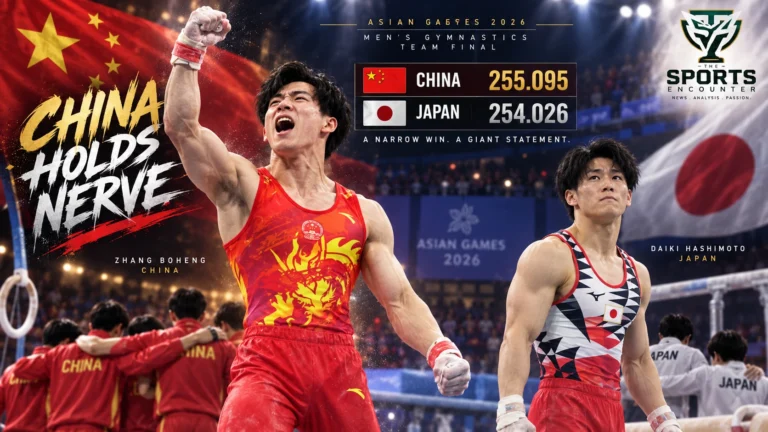
NAGOYA, Japan, September 23, 2026: Japan had one final chance. Daiki Hashimoto had just produced a spectacular 15.233 on horizontal bar, the home crowd was roaring, and China’s apparently comfortable path to another Asian Games men’s gymnastics team title had suddenly narrowed to one routine.
Zhang Boheng walked to the bar knowing exactly what China needed.
Anything better than 13.131 would secure gold.
He scored 14.200.
Story at a glance
China vs Japan: Men’s Gymnastics Team Final at a Glance
The Olympic Council of Asia’s official report confirmed China’s victory, Japan’s score, Chinese Taipei’s bronze and the dramatic horizontal-bar sequence that settled the title.
Hashimoto’s 15.233 Turned the Final Rotation Into a Real Contest
China entered horizontal bar with control of the competition, but gymnastics team finals rarely allow a team to assume the final apparatus will be routine.
Zhang Boheng Had Already Beaten Japan’s Stars Two Days Earlier
The pressure on Zhang carried extra context because this was already his second major victory over Japan’s leading gymnasts at these Games.
Lan Xingyu Changed the Competition on Rings
China’s victory should not be reduced to Zhang’s final routine.
Zou Jingyuan’s 15.400 Was the Performance Japan Could Not Match
If Lan gave China control, Zou Jingyuan reinforced it.
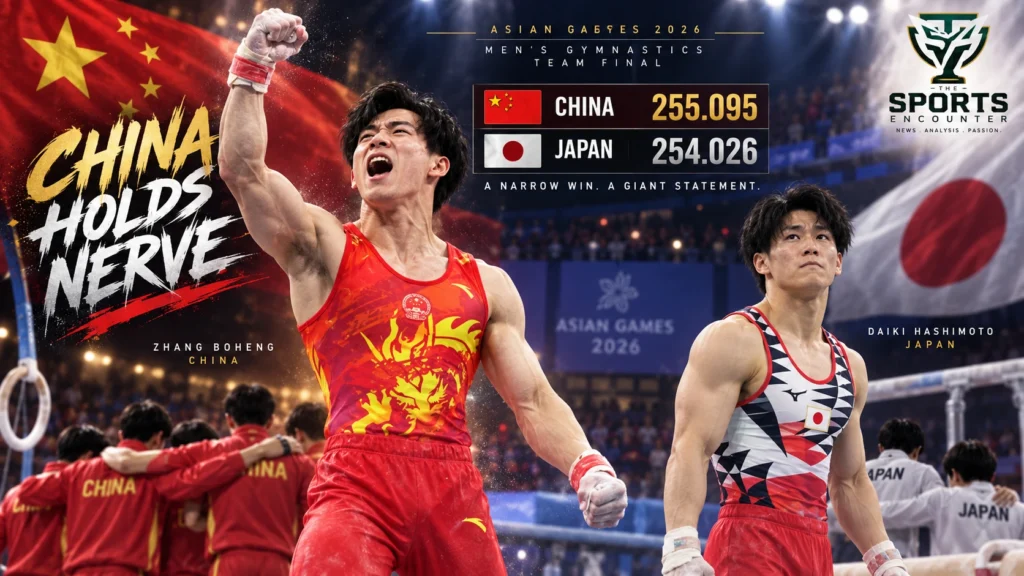
China finished on 255.095 points, holding off host Japan on 254.026 to retain the men’s artistic gymnastics team title by 1.069 points at Nagoya City General Gymnasium.
Chinese Taipei completed the podium with 239.896.
The finish provided one of the finest China-Japan competition narratives of Aichi-Nagoya 2026 because the result was never simply about accumulated difficulty or one dominant gymnast. China built its advantage through specialist excellence, survived mistakes on the final apparatus, absorbed Hashimoto’s late challenge and then asked its all-around champion to finish the job.
Zhang did.
For complete medal, record and championship coverage from Japan, follow The Sports Encounter’s Asian Games 2026 hub.
China vs Japan: Men’s Gymnastics Team Final at a Glance
| Position | Team | Score | Margin / Key Detail |
|---|---|---|---|
| Gold | China | 255.095 | Third consecutive Asian Games title |
| Silver | Japan | 254.026 | 1.069 points behind |
| Bronze | Chinese Taipei | 239.896 | Won three-way medal battle |
The Olympic Council of Asia’s official report confirmed China’s victory, Japan’s score, Chinese Taipei’s bronze and the dramatic horizontal-bar sequence that settled the title.
Hashimoto’s 15.233 Turned the Final Rotation Into a Real Contest
China entered horizontal bar with control of the competition, but gymnastics team finals rarely allow a team to assume the final apparatus will be routine.
Sun Wei proved why.
China’s leadoff gymnast fell from the bar and received 12.500. That opened a door Japan had not expected to see.
Japan initially failed to take full advantage. Olympic all-around champion Shinnosuke Oka also came off the bar and scored 12.666.
Then Hashimoto changed the atmosphere.
The Tokyo Olympic all-around champion and one of the greatest horizontal-bar gymnasts of his generation delivered a high-quality routine for 15.233, giving Japan one final surge and turning Zhang’s last performance into a genuine pressure routine rather than a ceremonial finish.
The requirement was clear.
Zhang needed more than 13.131.
He produced 14.200.
The margin became 1.069, and China had another team gold.
Zhang Boheng Had Already Beaten Japan’s Stars Two Days Earlier
The pressure on Zhang carried extra context because this was already his second major victory over Japan’s leading gymnasts at these Games.
On September 21, Zhang defended the men’s individual all-around title with 85.065, defeating Oka’s 84.698 and Hashimoto’s 83.865.
TSE examined that result inside its September 21 Asian Games report, where Zhang’s ability to beat two global champions on Japanese soil became one of the day’s central stories.
The OCA’s all-around report noted that Zhang arrived carrying an arm injury and still defeated both Japanese rivals.
Wednesday demanded something different.
The all-around title was about six events and individual consistency. The team final compressed the final consequence into one moment. Zhang did not need to win horizontal bar. He did not need a career-best score. He simply needed to produce the routine required by the scoreboard.
That is exactly what he did.
Lan Xingyu Changed the Competition on Rings
China’s victory should not be reduced to Zhang’s final routine.
The foundation was built much earlier by the specialists.
Lan Xingyu produced 15.200 on still rings, one of the highest scores of the afternoon and exactly the kind of advantage China expected its specialist lineup to create.
Lan entered the Games as a former world champion and the reigning Asian Games rings champion. His role was therefore highly specific: take an apparatus where China expected to outperform Japan and turn technical superiority into scoreboard separation.
He did that.
China moved into the lead after the rings rotation and never surrendered it.
That moment explains an important part of team gymnastics. The most visible athletes may be the all-arounders, but championships are often won by competitors whose value is concentrated on one or two apparatus.
Lan’s 15.200 was not simply an impressive individual score.
It changed the structure of the team final.
Zou Jingyuan’s 15.400 Was the Performance Japan Could Not Match
If Lan gave China control, Zou Jingyuan reinforced it.
Zou scored 15.400 on parallel bars, the highest individual score of the entire men’s team final.
That was hardly unexpected from a gymnast whose reputation on parallel bars has been built across Olympic Games and World Championships.
The difficulty for Japan was that knowing where China’s advantage might come from did not make it any easier to stop.
Zou’s routine created points rather than merely protecting them.
The combination of Lan on rings and Zou on parallel bars meant China could survive imperfections elsewhere because its specialists were producing scores that forced Japan to chase.
The Asian Gymnastics Union’s qualification report had already identified those two apparatus as Chinese strengths. Lan led rings qualification with 15.200, while Zou headed parallel bars qualifying with 15.333.
In the team final, Zou went even higher.
China’s Gold Was Built on Specialists and an All-Around Safety Net
| Chinese Gymnast | Key Team-Final Contribution | Score |
|---|---|---|
| Lan Xingyu | Still rings | 15.200 |
| Zou Jingyuan | Parallel bars | 15.400 |
| Tian Hao | Horizontal bar | 14.400 |
| Zhang Boheng | Final horizontal-bar routine | 14.200 |
| Sun Wei | Horizontal bar | 12.500 |
Zhang was the only Chinese gymnast to compete on all six apparatus.
That makes his contribution fundamentally different from Lan’s or Zou’s.
A specialist can be selected because one apparatus offers a clear scoring advantage. An all-arounder must provide usable scores wherever the team requires them and remain available if the competition begins to move unpredictably.
Zhang supplied that stability.
His final routine was therefore the most dramatic moment, but the title depended on the complementary structure of the entire Chinese lineup.
Japan Had the Home Crowd but Could Not Eliminate the Early Errors
Japan had one advantage China could never reproduce: the building.
Every clean landing generated another surge of noise inside Nagoya City General Gymnasium. That atmosphere became especially powerful during the final rotation as Hashimoto brought Japan back into the contest.
Home support could not repair earlier mistakes.
Oka, the reigning Olympic all-around champion, struggled on three apparatus and posted two of the three sub-13 scores recorded by the two leading teams during the afternoon.
He later described the result as frustrating and acknowledged that he had not been able to perform his routines as he wanted.
Those errors matter because a team final punishes them differently from an individual all-around competition.
One athlete’s mistake becomes everyone’s problem.
Japan ultimately came within 1.069 points despite those difficulties, which makes Hashimoto’s late charge more impressive but also reinforces how costly the earlier losses were.
This Was Another China-Japan Finish Decided Late
The men’s gymnastics final also fits a recurring theme at these Games.
China and Japan have repeatedly reached the decisive stage of major events with the result still open.
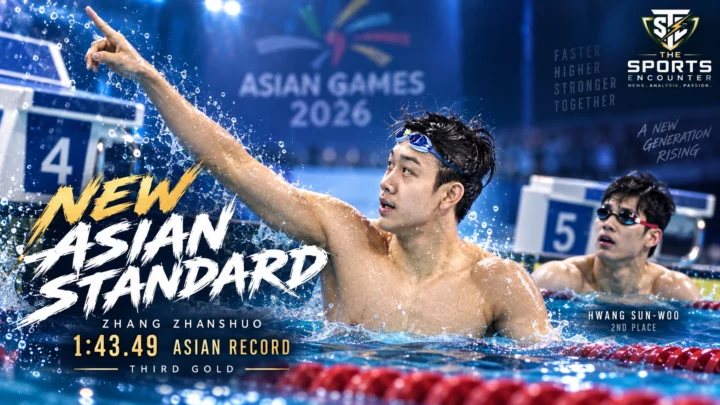
In swimming, Japan led China by 1.89 seconds before the final leg of the men’s 4x200m freestyle relay. Zhang Zhanshuo then produced a 1:42.92 anchor split to complete the comeback and give China an Asian-record 7:00.17 victory.
TSE’s full analysis of that China-Japan relay thriller showed how one final performance can reverse several minutes of accumulated advantage.
Gymnastics produced the opposite structure.
China entered the final apparatus ahead.
Japan attacked.
Hashimoto delivered the score required to create doubt.
Zhang answered it.
Different sport, different scoring system, same pressure: one athlete performing last with an entire team result resting on the outcome.
China Have Now Won 13 of 14 Asian Games Men’s Team Titles
The historical scale of the victory should not disappear behind the drama.
This was China’s third consecutive men’s artistic gymnastics team gold and its 13th title in the 14 Asian Games editions in which the event has been contested.
That level of dominance spans different generations, coaching staffs and scoring codes.
It also explains why one silver for Japan carries more frustration than the result might otherwise suggest.
Japan entered the Games with global champions, Olympic champions and home support. China still retained the continental team title.
TSE’s Aichi-Nagoya 2026 preview identified the China-Japan contest as one of the Games’ broader defining battles because both countries possess depth across multiple Olympic sports.
Men’s gymnastics offered one of the clearest examples yet.
China’s Medal Strength Is Coming From Very Different Sports
The gymnastics result also continues a wider Chinese pattern at these Games.
The first full medal day already showed China winning through swimming, shooting and other disciplines, detailed in TSE’s opening medal-day report.
One day later, China’s depth became even more obvious.
Sheng Lihao, Ma Sihan and Zhang Changhong set a world record in the men’s 10m air rifle team competition before Sheng won the individual title. TSE’s analysis of China’s air-rifle world record showed how the medal lead was being built through established Olympic-level performers.
In the pool, 13-year-old Yu Zidi broke the Asian and world junior records in the 200m individual medley. TSE’s full breakdown of Yu’s 2:06.10 swim captured the opposite end of the development curve: a teenager already reaching world-class senior times.
Gymnastics gives China another version of the same depth.
Zhang is an elite all-arounder. Lan and Zou are specialists. Sun Wei and Tian Hao provide additional event coverage.
There is no single athlete carrying the system.
Japan’s Home Games Have Made Every Chinese Victory Harder
The 2026 Asian Games officially opened with more than 11,000 athletes competing across 43 sports, as TSE documented in its Aichi-Nagoya opening ceremony report.
For Japan, that scale creates opportunity and pressure at the same time.
Home athletes are competing in familiar venues with crowd support unavailable to their opponents. Every major final against China therefore carries another layer of expectation.
Hashimoto used that atmosphere brilliantly on horizontal bar.
His 15.233 gave the crowd the moment it had been waiting for.
What Japan needed next was a Chinese mistake.
Zhang did not provide one.
Zhang’s Quote Explains Why the Team Title Matters Differently
After the competition, Zhang made clear that China did not treat the team event as secondary to the individual all-around title he had already won.
“Our final goal was the gold medal and I’m happy we could finish with a good result.”
That distinction matters.
Gymnastics rewards individual brilliance through all-around and apparatus medals, but team finals ask a different question: can five athletes absorb each other’s errors, maximize their specialties and keep the collective score alive until the last routine?
China answered yes.
The Specialist Finals Now Give Lan and Zou Another Opportunity
The team gold does not end the gymnastics program.
The men’s apparatus finals begin on September 24, with floor exercise, pommel horse and rings, before vault, parallel bars and horizontal bar conclude the men’s program on September 25.
Lan has already established himself as the leading rings qualifier, while Zou entered the team final after leading parallel bars qualification.
Qualification scores do not carry into the apparatus finals, so neither athlete begins with an actual points advantage.
The team competition has nevertheless provided a clear warning to the field.
Lan has already produced 15.200 under medal-round pressure.
Zou has gone higher still at 15.400.
Why This May Be One of the Best Team Finals of Aichi-Nagoya 2026
Record-breaking performances are easy to identify because the number itself explains the history.
Team competitions require more context.
This final had it.
China carried the dynasty.
Japan carried the home expectation.
Oka made mistakes.
Lan and Zou created separation.
Sun Wei’s fall reopened the contest.
Hashimoto attacked the opening with a 15.233.
Then Zhang went last with one routine between China and defeat.
He needed 13.131.
He scored 14.200.
That is why the 255.095 matters.
China’s 13th men’s team title was not simply another number added to a dominant historical record. For a few minutes on horizontal bar in Nagoya, Japan had a genuine path to stopping them.
China closed it.
Continue the Asian Games 2026 Story
 Asian Games 2026Yu Zidi Completes Stunning Individual Gold-Medal Hat-Trick With Third Asian Games Record
 AthleticsOhashi Smashes World Record as Yulo, Japan and Indonesia End Long Asian Games Waits
 SoccerAsian Games: North Korea Turn Elimination Night Into a Rout as Iran Crash Out and Japan Stay Perfect
Frequently Asked Questions
Who won the men’s gymnastics team final at the 2026 Asian Games?
China won the men’s artistic gymnastics team gold with 255.095 points.
What score did Japan receive?
Host Japan finished second with 254.026 points, 1.069 behind China.
Who won bronze?
Chinese Taipei took bronze with 239.896 points.
How did Zhang Boheng clinch the gold?
Zhang performed last for China on horizontal bar. He needed a score better than 13.131 to secure the title and produced 14.200.
What did Daiki Hashimoto score on horizontal bar?
Hashimoto scored 15.233, giving Japan a late chance to overtake China.
What did Lan Xingyu score on rings?
Lan scored 15.200 on still rings, helping China move into control of the team competition.
What did Zou Jingyuan score on parallel bars?
Zou scored 15.400 on parallel bars, the highest score of the men’s team final.
How many consecutive Asian Games team titles has China won?
China have now won three consecutive men’s artistic gymnastics team titles.
How many Asian Games men’s team gymnastics titles has China won overall?
China have won 13 of the 14 Asian Games men’s team titles contested.
Did Zhang Boheng also win the individual all-around?
Yes. Zhang won the 2026 Asian Games men’s all-around title with 85.065 points, ahead of Japan’s Shinnosuke Oka and Daiki Hashimoto.
When are the men’s gymnastics apparatus finals?
The first men’s apparatus finals are scheduled for September 24, with the remaining men’s finals on September 25.
Where was the men’s team final held?
The competition took place at Nagoya City General Gymnasium in Japan.
Japan
- Ohashi Smashes World Record as Yulo, Japan and Indonesia End Long Asian Games Waits
- Asian Games: North Korea Turn Elimination Night Into a Rout as Iran Crash Out and Japan Stay Perfect
- Zhang Boheng Holds His Nerve as China Edge Japan for Third Straight Asian Games Gymnastics Team Gold
- Zhang Zhanshuo Breaks Asian 200m Freestyle Record as 19-Year-Old Claims Third Gold
- Yu Zidi Completes Stunning Individual Gold-Medal Hat-Trick With Third Asian Games Record