


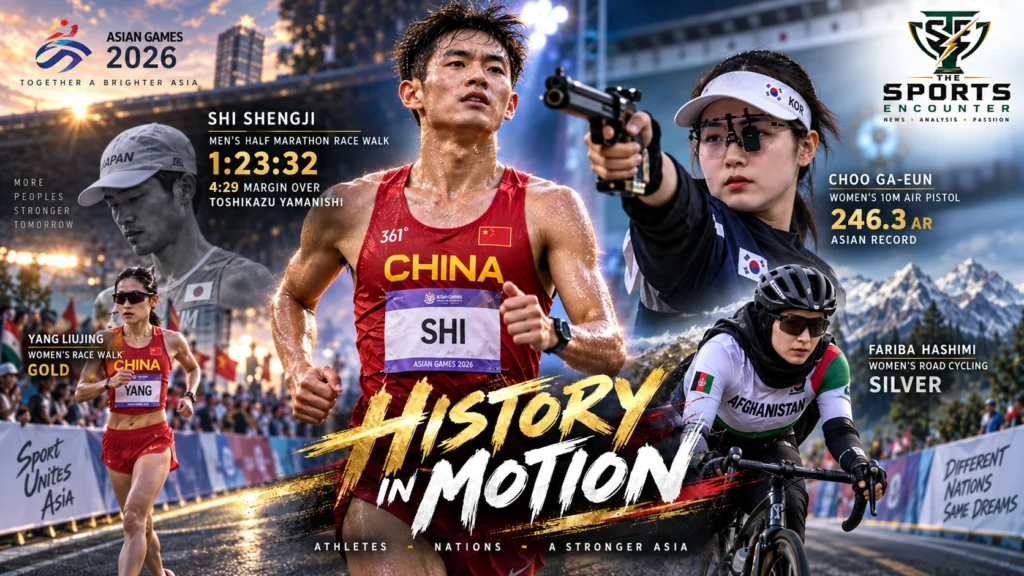
NAGOYA, Japan, September 23, 2026: The first athletics gold medal of Aichi-Nagoya 2026 did not go to the world-record holder racing on home roads. It went to China’s Shi Shengji, and it went to him by more than four minutes.
Shi won the inaugural Asian Games men’s half marathon race walk in 1:23:32 on Wednesday, finishing 4 minutes, 29 seconds ahead of Japan’s Toshikazu Yamanishi, the current 20km world-record holder. Hours earlier and elsewhere across the Games, China also claimed the first women’s title in the new race-walk format through Yang Liujing, while South Korea’s Choo Ga-eun produced one of the finest shooting performances of the competition by winning the women’s 10m air pistol with an Asian-record 246.3.
Wednesday also carried a story whose medal had been won a day earlier but whose significance extended far beyond Tuesday’s cycling results. Afghanistan’s Fariba Hashimi, silver medalist in the women’s road race, became the first Afghan woman to win an Asian Games medal since Busan 2002 after a journey that had included hiding her identity to continue cycling in Afghanistan and eventually leaving the country after the Taliban returned to power in 2021.
Together, those stories gave Wednesday a different shape from the record-heavy swimming and gymnastics narratives already defining these Games. Athletics began with a new event and an unexpected margin. Shooting produced a breakthrough for South Korea. Cycling supplied one of the most powerful human stories of the Games.
Follow The Sports Encounter’s complete Asian Games 2026 coverage for continuing results, records and athlete stories from Japan.
Asian Games 2026 Wednesday: The Defining Stories
| Event / Story | Result | Why It Mattered |
|---|---|---|
| Men’s Half Marathon Race Walk | Shi Shengji, China, 1:23:32 | First men’s title in the new Asian Games event; beat 20km world-record holder Toshikazu Yamanishi by 4:29 |
| Women’s Half Marathon Race Walk | Yang Liujing, China, 1:33:40 | First women’s Asian Games champion in the new format |
| Women’s 10m Air Pistol | Choo Ga-eun, South Korea, 246.3 | Asian record, Asian Games record and South Korea’s first gold of the Games |
| Women’s 10m Air Pistol Team | China, gold | China held off South Korea in the qualification-based team competition |
| Women’s Road Cycling | Fariba Hashimi, Afghanistan, silver on September 22 | First Afghan woman to win an Asian Games medal since 2002 |
Shi Shengji Turned a Historic Debut Into a Four-Minute Statement
The Asian Games had staged the traditional 20km race walk for decades. Aichi-Nagoya changed that program, replacing it with the half marathon race walk over 21.0975 kilometers.
That made Wednesday’s men’s race a piece of history before anyone crossed the finish line.
Shi made sure the first champion would be remembered for more than novelty.
The Chinese walker took control by the halfway stage and continued extending his advantage until the race had ceased to resemble the contest many expected against Yamanishi.
The Olympic Council of Asia’s official race report confirmed Shi’s 1:23:32 winning time, Yamanishi’s 1:28:01 silver and Choe Byeong-kwang’s 1:28:35 bronze.
Yamanishi finished 4:29 behind.
That margin is the story.
It would be misleading to compare Shi’s 1:23:32 directly with Yamanishi’s 1:16:10 20km world record because Wednesday’s new event is more than a kilometer longer. The significance comes from the opponent, not from comparing incompatible distances.
Yamanishi is a two-time world champion, Olympic bronze medalist and the athlete who lowered the global 20km standard to 1:16:10 in Kobe in February 2025.
He was racing at home.
Shi still finished more than four minutes ahead.
The Weather Slowed the Clock, but It Did Not Explain the Gap
The race began under overcast skies and light rain. OCA noted that finishing times were somewhat slower than expected, while also emphasizing the tactical nature of major championship race walking.
That context matters because Shi did not need to chase a record once he had broken the field.
He needed to win.
“It was tough, but I stuck to my pre-race plan,” Shi said after the race.
Yamanishi did not blame the weather or course conditions for the outcome. The Japanese star told OCA that he was frustrated and attributed the performance to his own level on the day.
That makes the margin harder to dismiss as a consequence of unusual conditions.
Shi was simply much better in the race that decided the first athletics gold of the Games.
Choe Byeong-kwang Turned His Final Asian Games Into a Medal
Behind the two favorites, South Korea’s Choe Byeong-kwang produced another important story.
The 35-year-old finished third in 1:28:35 in what he described as his final championship appearance.
It was Choe’s fourth Asian Games but his first medal.
He had been outside the podium places early in the race before moving into third with roughly nine kilometers remaining and holding the position to the finish.
For South Korea, the bronze became the country’s first athletics medal of Aichi-Nagoya 2026.
For Choe, it transformed what could have been a quiet final appearance into a podium farewell.
China Then Won the First Women’s Half Marathon Race Walk
China did not stop with Shi.
Yang Liujing completed the sweep of the inaugural half marathon race-walk titles by winning the women’s race in 1:33:40.
Kazakhstan’s Kristina Morozova finished second in 1:35:25, while China’s Jiang Yunyan took bronze only one second later in 1:35:26.
| Women’s Race Walk Medal | Athlete | Nation | Time |
|---|---|---|---|
| Gold | Yang Liujing | China | 1:33:40 |
| Silver | Kristina Morozova | Kazakhstan | 1:35:25 |
| Bronze | Jiang Yunyan | China | 1:35:26 |
For Yang, 28, it was a first Asian Games gold.
She also arrived with useful experience for the format. Yang said afterward that her background as a 20km specialist made the transition to the slightly longer half-marathon distance relatively manageable.
China therefore emerged from athletics’ first medal session with both race-walk golds and an additional women’s bronze.
The New Race-Walk Format Changed the Event Without Changing China’s Strength
Replacing the 20km with a half marathon is more than a cosmetic adjustment.
The distance grows from 20 kilometers to 21.0975 kilometers, introducing another 1.0975km of technical walking at the point where fatigue is already exposing flaws in posture, contact and rhythm.
Race walking also differs from conventional distance running because athletes must maintain legal technique throughout the race. Fatigue can therefore threaten both pace and eligibility.
China handled that transition immediately.
Shi controlled the men’s race.
Yang won the women’s race.
Jiang added bronze.
It was an emphatic opening to an athletics program that will eventually distribute a much larger block of medals than many of the sports that dominated the first days of competition.
That broader shift was anticipated in TSE’s complete Aichi-Nagoya 2026 preview, where the arrival of athletics was identified as one of the stages capable of reshaping national medal totals.
Choo Ga-eun Did More Than Stop China in the Individual Pistol Final
If athletics began with China taking both golds, shooting produced a different story.
South Korea’s Choo Ga-eun won the women’s 10m air pistol final with 246.3 points, defeating China’s Shen Yiyao by five points.
Jiang Ranxin, also representing China, took bronze with 221.6.
Choo’s 246.3 was a new Asian record.
It also shattered the previous Asian Games final record of 242.1 set by India’s Palak Gulia at Hangzhou 2023.
The Yonhap report from the final confirmed that Choo came within 0.7 points of the world record of 246.9.
Choo Was Chasing the World Record on Her Final Shot
The final had effectively become Choo’s before the last shot.
After 22 shots, she led Shen 225.9 to 221.8.
With only two shots remaining, the competitive question had shifted from who would win to how high Choo could push the score.
She fired a 10.6 on her 23rd shot, moving to 236.5.
A 10.5 on the final shot would have broken Zorana Arunovic’s world record.
Choo scored 9.8.
The world record survived.
The Asian record did not.
Her 246.3 also delivered South Korea’s first gold medal of these Asian Games and made her the country’s first champion in the women’s 10m air pistol since 2010.
One Day, Two Records for Choo Ga-eun
Choo had already made history before reaching the final.
She led qualification with 582 points, establishing a new Asian Games qualification record.
Those points also counted toward the team competition, where three shooters’ qualification totals are combined.
China won the team gold.
South Korea’s Choo, Kim Bo-mi and Olympic champion Oh Ye-jin combined for 1,730 points and took silver, five points behind China.
That created an unusual split in the day’s shooting story.
China retained collective superiority through the team event.
Choo then beat two Chinese shooters individually and produced the best final score ever recorded by an Asian woman.
The result adds another layer to a shooting competition China had dominated earlier in the Games. On Monday, Sheng Lihao, Ma Sihan and Zhang Changhong broke the men’s 10m air rifle team world record before Sheng won the individual event with an Asian record, a performance detailed in TSE’s analysis of China’s record-setting air-rifle day.
Wednesday Continued a Games Defined by Young Record Breakers
The first four full competition days have repeatedly produced athletes moving beyond medal-winning performances and into record territory.
China’s 13-year-old Yu Zidi broke the Asian, Asian Games and world junior records in the women’s 200m individual medley, covered in TSE’s full analysis of her 2:06.10 swim.
Zhang Zhanshuo then anchored China from 1.89 seconds behind Japan to an Asian-record victory in the men’s 4x200m freestyle relay. TSE’s breakdown of Zhang’s 1:42.92 anchor split showed how quickly China’s next generation is moving into senior championship roles.
The broader pattern was already visible in TSE’s September 21 consolidated Asian Games report, when swimming, shooting and gymnastics began producing new records and increasingly narrow China-Japan battles.
Choo added South Korea to that record-breaking conversation on Wednesday.
Fariba Hashimi’s Silver Became Bigger Than Tuesday’s Cycling Result
The medal itself was won Tuesday.
The full significance of Fariba Hashimi’s silver became one of Wednesday’s major Asian Games stories as the Olympic Council of Asia documented the journey that had brought the Afghan cyclist to the podium.
Hashimi finished second in the women’s road race and became Afghanistan’s first female Asian Games medalist since Busan 2002.
It was also Afghanistan’s first medal of Aichi-Nagoya 2026.
The OCA account of Hashimi’s journey describes how she and her older sister Yulduz first entered a cycling race in Afghanistan in 2017 after borrowing bicycles and teaching themselves to ride.
Fariba won.
Yulduz finished second.
What began as an unexpected victory became much more difficult once they tried to continue riding.
Hashimi Hid Her Identity to Keep Cycling
OCA reports that the sisters competed under false names and disguised themselves in clothing as they continued training and racing in Afghanistan.
Fariba recalled dressing like a man so she could train without attracting attention.
The sisters also faced hostility while cycling, including objects being thrown at them. In one incident described by OCA, Yulduz was struck by a rickshaw and suffered a broken wrist.
They joined Afghanistan’s national women’s cycling team in 2020.
A year later, after the Taliban returned to power and imposed extensive restrictions on women, Fariba and Yulduz left Afghanistan and relocated to Italy.
That sequence matters because it avoids simplifying Hashimi’s story into a single political moment. Her struggle to cycle publicly had begun before 2021, while the Taliban’s return subsequently made remaining in the country untenable for the sisters.
“This Silver Medal Can Show a Lot of Resilience”
Hashimi’s medal carried meaning she articulated herself.
“This silver medal can show a lot of resilience from Afghan women.”
She is now 23, a Paris Olympian and an Olympic Solidarity scholarship holder.
Her Asian Games medal therefore represents both elite sporting progress and the distance traveled from learning to ride a borrowed bicycle only nine years ago.
It deserves its own feature rather than being reduced to one row in a medal table.
Why Hashimi’s Story Should Remain Separate From Wednesday’s Results
The timing is important editorially.
Hashimi raced on September 22.
Shi, Yang and Choo won their medals on September 23.
Combining them without that distinction would incorrectly imply that the cycling road race occurred Wednesday.
The more accurate way to understand the day is that Hashimi’s medal remained part of Wednesday’s Asian Games conversation because the deeper story behind it emerged after the result.
That also gives the story a different shelf life.
The race result belongs to Tuesday’s competition record.
The athlete story reaches beyond one day.
China’s Dominance Is Becoming More Diverse by the Day
The race-walk sweep also reinforced a broader development in the medal table.
China’s advantage has not been built through one sport.
Shooting produced early world and Asian records.
Swimming created another major source of gold medals.
Gymnastics added elite all-around depth.
Now athletics has opened with two Chinese titles from the first version of a new event.
That diversification matters as the Games move deeper into their schedule. A country that leads through several sports is harder to catch than one relying on a short burst of dominance in a single discipline.
For comparison, India’s first major breakthrough came through cricket when Smriti Mandhana scored 79, crossed 11,000 international runs and helped defeat Sri Lanka by 147 runs. TSE’s full report on India’s women’s cricket gold showed how one team result could transform an entire delegation’s mood.
Smaller Delegations Are Finding Their Own Versions of Success
Hashimi’s silver demonstrates why the Games cannot be judged only through the countries at the top of the medal table.
For China, another gold adds to an enormous national total.
For Afghanistan, one silver can become a historic sporting marker.
The same principle has appeared elsewhere during the Games.
Singapore’s 16-year-old Russel Pang lowered his national 1,500m freestyle record to 15:22.16, a breakthrough TSE explored in our profile of Singapore’s emerging distance swimmer.
India’s badminton team also guaranteed another significant medal after Lakshya Sen won seven consecutive points from 14-19 down against Kodai Naraoka, setting up the 3-0 victory over Japan covered in TSE’s analysis of India’s dramatic badminton quarterfinal.
Different countries arrive with different definitions of a successful Asian Games.
That is one reason the strongest daily coverage must look beyond the raw gold-medal count.
Wednesday Showed Three Different Ways an Asian Games Performance Can Matter
Shi Shengji’s victory mattered because of the opponent and the margin.
He did not simply become the first men’s half marathon race-walk champion. He finished 4:29 ahead of the athlete who owns the 20km world record.
Choo Ga-eun’s performance mattered because the score itself rewrote the continental standard.
She won gold, set an Asian record, set an Asian Games record and came within seven-tenths of the world record.
Hashimi’s silver mattered for reasons a stopwatch alone cannot explain.
The medal connected elite sport with years of persistence, displacement and the fight to keep riding when doing so had carried personal risk.
Those stories do not belong in the same category of achievement.
They do belong in the same Asian Games.
What Comes Next for the Athletics Program?
The half marathon race walks opened athletics, but the sport will expand rapidly from here as track and field events begin distributing medals across sprints, middle distance, distance running, jumps, throws and relays.
That matters to the overall Games because athletics contains one of the largest medal inventories on the program.
The first impression belongs to China.
Shi became the first athletics champion of Aichi-Nagoya 2026.
Yang became the first women’s half marathon race-walk champion.
China also collected bronze through Jiang.
Whether that momentum extends from the roads to the stadium will help determine how much further the overall medal gap grows.
Frequently Asked Questions
Who won the first men’s half marathon race walk at the Asian Games?
China’s Shi Shengji won the inaugural men’s Asian Games half marathon race walk in 1:23:32.
Who finished second behind Shi Shengji?
Japan’s Toshikazu Yamanishi took silver in 1:28:01, finishing 4 minutes and 29 seconds behind Shi.
Is Toshikazu Yamanishi a world-record holder?
Yes. Yamanishi holds the men’s 20km race-walk world record of 1:16:10, set in Kobe in February 2025.
Why was the half marathon race walk significant?
The event made its Asian Games debut in Aichi-Nagoya 2026, replacing the traditional 20km race walk.
Who won the women’s half marathon race walk?
China’s Yang Liujing won the inaugural women’s title in 1:33:40.
Who won the women’s 10m air pistol gold?
South Korea’s Choo Ga-eun won gold with 246.3 points.
What record did Choo Ga-eun break?
Choo’s 246.3 was a new Asian record and Asian Games final record. She also set an Asian Games qualification record of 582 earlier in the day.
Who won silver and bronze in the women’s air pistol final?
China’s Shen Yiyao took silver with 241.3, while Jiang Ranxin won bronze with 221.6.
Who won the women’s 10m air pistol team title?
China won team gold, with South Korea taking silver.
What medal did Fariba Hashimi win?
Afghanistan’s Fariba Hashimi won silver in the women’s cycling road race on September 22.
Why was Fariba Hashimi’s medal historic?
She became the first Afghan woman to win an Asian Games medal since Busan 2002 and secured Afghanistan’s first medal of Aichi-Nagoya 2026.
Where is Fariba Hashimi based now?
Hashimi left Afghanistan with her sister after the Taliban returned to power in 2021 and relocated to Italy, according to the Olympic Council of Asia.