


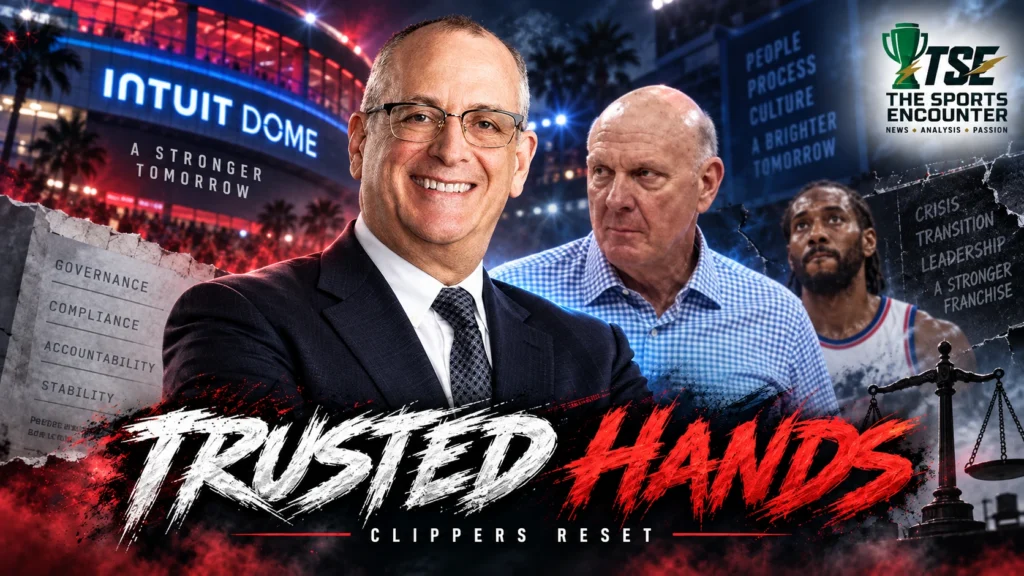
LOS ANGELES, United States, September 21, 2026: The Los Angeles Clippers did not respond to one of the most damaging governance crises of Steve Ballmer’s ownership by promoting a basketball lifer, elevating a commercial executive or searching for another high-profile sports CEO.
They turned to a lawyer.
John S. Gibson, a veteran Los Angeles trial attorney and longtime Clippers season-ticket holder, has been appointed interim chief executive officer and governor while Ballmer serves a one-year NBA suspension.
At first glance, the choice appears unusual. Gibson has not spent decades constructing NBA rosters, managing basketball operations or running an arena business.
Look more closely at his history with the franchise and the appointment becomes considerably easier to understand.
Gibson previously served as lead trial counsel for the Clippers during the Donald Sterling litigation, the legal confrontation that helped clear the path for Ballmer’s purchase of the franchise in 2014. More than a decade later, the organization has returned to someone who already understands what it means to protect the Clippers while their ownership structure is under intense public and league scrutiny.
That history matters because Gibson is entering at a moment when the Clippers require something different from normal executive leadership.
The franchise has been fined $30 million, lost five future first-round draft picks, placed under a five-year NBA compliance and monitoring program and temporarily lost several of the executives who would ordinarily provide its institutional leadership. Ballmer is suspended for a year, president of business operations Gillian Zucker for a year and president of basketball operations Lawrence Frank for six months.
Former franchise cornerstone Kawhi Leonard has also been traded back to Toronto, leaving the Clippers trying to rebuild their basketball direction while repairing their credibility away from the court.
This is not simply an executive vacancy.
It is a governance problem, a compliance problem, a trust problem and a basketball-transition problem arriving at the same time.
That is why John S. Gibson makes sense.
For continuing roster, business and league analysis, follow The Sports Encounter’s NBA coverage.
What Happened to the Clippers?
The NBA announced sweeping penalties against the Clippers on September 2 after an independent investigation concluded that the organization had violated salary-cap circumvention rules connected to off-court income opportunities for Leonard.
According to the NBA’s official findings, the investigation found that the organization helped facilitate endorsement arrangements involving companies doing business with the franchise, among several other violations.
The consequences were severe.
| Penalty | Clippers Consequence |
|---|---|
| Financial penalty | $30 million fine |
| Draft capital | Five first-round picks forfeited from 2029 through 2033 |
| Steve Ballmer | Suspended from team and league activity for one year |
| Gillian Zucker | Suspended without pay for one year |
| Lawrence Frank | Suspended without pay for six months |
| Organizational oversight | Five-year league compliance and monitoring program |
| Kawhi Leonard | Ordered to pay $700,000 |
The impact extends beyond punishment.
Ballmer has been the dominant figure in the Clippers’ modern identity. Zucker has overseen major business operations through the development and opening of Intuit Dome. Frank has directed basketball operations for nearly a decade.
Removing all three from their normal roles simultaneously creates an unusual leadership vacuum.
The Clippers therefore needed somebody who could immediately communicate credibility upward to the NBA, downward to employees and outward to sponsors, supporters and business partners.
They also needed somebody Ballmer trusted.
Gibson satisfies all four requirements.
Why John S. Gibson?
Gibson’s résumé explains part of the decision.
He was a litigation partner at DLA Piper in Los Angeles and co-chaired the firm’s business and commercial litigation practice. His work has included complex commercial disputes, antitrust matters, technology, healthcare and professional sports.
The more important qualification sits inside his Clippers history.
According to DLA Piper’s professional biography of Gibson, he served as lead trial counsel for the franchise in its litigation against former owner Donald Sterling following the release of Sterling’s racist remarks in 2014.
The litigation helped enable the eventual $2 billion sale of the Clippers to Ballmer.
That means Gibson is not entering the organization as a stranger who happens to understand corporate law.
He understands this particular franchise.
He understands Ballmer’s ownership origin story.
He understands what happens when league discipline, public outrage, employee anxiety and franchise control become intertwined.
Very few candidates could bring that combination into the building on their first morning.
1. Gibson Has Already Helped the Clippers Navigate an Ownership Crisis
The strongest reason for Gibson’s appointment is historical.
In 2014, the Clippers faced an existential problem after the NBA banned Sterling for life. Players were angry. Sponsors were distancing themselves. The ownership future was unclear.
The dispute then moved through litigation involving Sterling’s attempt to prevent the sale of the franchise.
Gibson was already there.
He represented the Clippers during that legal battle and helped the organization reach the point at which Ballmer could acquire the team.
That experience matters because today’s circumstances, although very different in substance, again involve league sanctions, ownership authority and uncertainty inside the organization.
The Clippers are effectively asking someone who helped them navigate the transition into the Ballmer era to protect the institution while Ballmer temporarily cannot run it.
2. The Clippers Need Governance More Than Basketball Expertise From Their Interim CEO
The title “CEO” can create confusion about Gibson’s role.
He does not need to design Tyronn Lue’s offense.
He does not need to determine whether Brandon Ingram should initiate a fourth-quarter possession or decide how many minutes Bradley Beal should play.
The Clippers already employ coaches, scouts and basketball executives for those jobs.
The immediate leadership problem exists above that level.
Someone must provide authority across business and basketball departments while senior leadership is suspended. Someone must represent the franchise in NBA governance matters. Somebody has to make sure employees understand where decisions now flow.
That type of work is much closer to corporate governance and crisis management than traditional roster construction.
Gibson’s legal and advisory background fits that need.
3. The NBA Needed to Be Comfortable With the Choice
Ballmer nominated Gibson, but the appointment also required NBA approval.
That distinction is important.
The league has just imposed an extraordinary punishment because it concluded that institutional failures occurred inside the Clippers organization.
An interim governor now represents the franchise within the NBA’s ownership structure.
The league therefore had an obvious interest in making sure the person stepping into that role was credible, experienced and capable of operating within the governance framework that the Clippers have been accused of violating.
Gibson arrives with decades of work in high-stakes litigation, competition matters and corporate disputes.
His legal background is particularly relevant because the organization will operate under league monitoring for five years.
Compliance is no longer a back-office consideration.
It is part of the Clippers’ competitive future.
4. Gibson Brings Institutional Memory Without Being Part of the Current Executive Chain
The appointment also solves a difficult balance.
The Clippers needed somebody who already understood the organization without simply elevating another executive from the hierarchy now under scrutiny.
Gibson offers familiarity without being an everyday member of the current basketball or commercial command structure.
He knows the franchise.
He has worked directly on its behalf.
He has a long-standing personal connection as a season-ticket holder.
Yet he arrives from outside the executive offices that produced the current crisis.
That combination gives him something valuable during a compliance reset: continuity without complete institutional entanglement.
5. Ballmer Clearly Trusts Him
There is another connection that should not be overlooked.
Gibson’s previous Clippers work helped facilitate the ownership transition that brought Ballmer into the NBA.
Ballmer now selected Gibson to assume the franchise’s highest temporary leadership role during his own suspension.
That says a great deal about the relationship.
Interim appointments made during crises require trust because the person receiving authority may be asked to make consequential decisions while the principal owner cannot participate normally.
This becomes particularly important with the Clippers entering another roster transition.
Kawhi Leonard has departed. Ingram and Gradey Dick have arrived, along with valuable future draft assets.
The Sports Encounter recently examined the Clippers’ willingness to continue betting on established talent when Bradley Beal received another opportunity in Los Angeles. Gibson now inherits responsibility for keeping the wider organization functioning while that basketball plan develops.
6. The Clippers Cannot Afford Another Compliance Failure
The five forfeited first-round selections may become the most damaging long-term part of the NBA punishment.
Draft capital is one of the league’s most important currencies.
Teams use first-round picks to select young players, trade for established stars or create flexibility around expensive veteran cores.
Losing five consecutive first-round selections dramatically reduces future options.
That makes the Clippers’ remaining assets more important and their margin for another organizational error much smaller.
TSE recently explored how aggressively teams use draft assets and roster flexibility in our breakdown of the Pelicans-Grizzlies trade. The Clippers are now operating from the opposite position: league sanctions have removed assets they would otherwise have controlled.
The organization consequently needs leadership obsessed with process, documentation, boundaries and compliance.
Those are areas where a high-level litigator naturally brings a different mindset.
7. The Kawhi Leonard Era Has Ended at Exactly the Wrong Time
Governance upheaval would be easier to absorb if the basketball team itself were stable.
It is not.
Leonard has returned to Toronto.
The Clippers received Ingram, Dick, future first-round selections, second-round selections and a first-round swap in the deal.
The trade effectively closes the defining player chapter of Ballmer’s championship push.
Leonard arrived in 2019 after winning the championship and Finals MVP with Toronto. The Clippers paired him with Paul George and built one of the league’s most ambitious veteran teams.
They reached the Western Conference finals in 2021 but never reached the NBA Finals.
Last season ended 42-40 without a playoff berth.
The franchise therefore enters 2026-27 between eras.
TSE’s analysis of the biggest NBA offseason gambles examined how aggressively rivals have reworked their championship timelines. The Clippers now face a more fundamental question: how competitive should they try to remain while rebuilding an asset base already damaged by league punishment?
Gibson does not have to answer that question alone.
He does have to keep the organization stable enough for the basketball department to answer it intelligently.
8. Intuit Dome Turns This Into a Major Business Responsibility
The Clippers are no longer simply an NBA tenant sharing an arena with the Lakers.
Intuit Dome changed the business scale of the franchise.
The arena represents one of Ballmer’s most ambitious investments and has become central to the Clippers’ commercial identity.
That means the interim CEO is responsible for much more than a basketball team’s public image.
Sponsorship relationships matter.
Premium hospitality matters.
Ticketing and fan experience matter.
Corporate partnerships matter.
Employee confidence matters.
All of those relationships can become harder to manage when the franchise has just received one of the NBA’s heaviest institutional punishments.
This is another reason a senior commercial litigator can make sense. Gibson has spent his career advising major organizations where legal risk, reputation and commercial relationships overlap.
9. Fan Confidence Is Now a Business Issue
Ballmer specifically identified fan confidence as a priority when acknowledging the league’s penalties.
That concern is understandable.
Clippers supporters have already lived through one ownership scandal.
They then watched Ballmer spend heavily, construct Intuit Dome and attempt to redefine the franchise’s place in Los Angeles.
Now the organization has been sanctioned for institutional misconduct during his ownership.
The emotional effect cannot be measured through a balance sheet alone.
Fans have to believe the franchise knows where it is going.
This is one area where Gibson’s season-ticket history becomes more than a public-relations detail.
He has experienced the Clippers from the supporter side as well as the legal side.
That does not automatically make him an effective CEO.
It does give him a more unusual connection to the organization than a conventional outside turnaround executive might possess.
10. The Clippers Have Used This Type of Crisis Leadership Before
There is a striking historical precedent.
During the Sterling crisis in 2014, the NBA installed veteran business leader Richard Parsons as interim CEO of the Clippers.
Parsons had previously led Time Warner and Citigroup and was brought in because the franchise needed steady institutional leadership while ownership questions were being resolved.
The Clippers’ own account of Parsons’ appointment in 2014 described his role in remarkably relevant terms: preserve the enterprise, calm employees and keep the organization functioning while the ownership crisis played out.
Gibson’s job in 2026 carries echoes of the same model.
The crises are not identical.
The principle is.
When a sports franchise faces instability above the basketball operation, the best temporary leader may be someone who understands complex organizations rather than someone whose résumé begins with scouting and roster construction.
Why Not Promote a Basketball Executive?
Because that would solve only part of the problem.
Lawrence Frank normally runs basketball operations, but he is suspended for six months.
Tyronn Lue remains responsible for coaching.
Other basketball personnel can continue evaluating players, preparing for training camp and handling day-to-day roster work within the authority available to them.
The CEO and governor role sits above those functions.
Gibson must help establish who can approve major decisions, maintain communication with the NBA, support business operations and prevent uncertainty from affecting the people who still have to run the franchise.
The appointment therefore should not be read as the Clippers deciding that a lawyer knows more basketball than an NBA executive.
They are deciding that basketball knowledge is not the biggest missing piece in the executive suite right now.
The Timing Makes Stability Even More Important
The Clippers do not have months to reorganize quietly.
The NBA calendar is moving.
Training camp is approaching, preseason follows in early October and the Clippers begin the regular season against Sacramento at Intuit Dome on October 21.
The complete national calendar, including the Clippers’ early-season window, is part of TSE’s 2026-27 NBA schedule guide.
Players will report while the organization is still processing the fallout from the investigation.
New players will enter the building.
Ingram and Dick must integrate.
Beal is attempting to give his Clippers chapter more value after an uneven recent period.
The coaching staff needs to prepare for Sacramento, the Lakers, Oklahoma City and the rest of a demanding Western Conference without being dragged into executive uncertainty.
Gibson’s first achievement may simply be making sure the organization becomes boring again.
For a franchise emerging from controversy, boring can be useful.
This Is Also About Protecting the Value of a Modern NBA Franchise
NBA teams now operate on a scale that would have been difficult to imagine when the Sterling family bought the Clippers for $12.5 million in 1981.
The league’s franchise valuations have entered another economic category entirely.
The Sports Encounter explored that shift when examining why the Lakers commanded a $12.5 billion valuation and what their ownership transition means for the franchise’s next era.
The Clippers operate in the same Los Angeles sports economy with a privately financed arena and significant commercial ambitions.
When organizations reach that scale, governance failures become financial risks as well as sporting ones.
A temporary CEO therefore has to protect enterprise value while maintaining confidence among sponsors, employees, league partners and supporters.
Gibson has spent decades operating in exactly the kind of high-stakes corporate environment where reputational damage can become commercial damage very quickly.
Why Gibson’s Legal Background Matters More Now Than It Would in a Normal Season
If Ballmer had simply taken a sabbatical, appointing a trial lawyer might have looked unnecessarily defensive.
These circumstances are different.
The NBA has placed the Clippers under five years of compliance monitoring.
The organization will need processes that withstand scrutiny.
Agreements involving players, sponsors and business partners will require careful boundaries.
Decision-making authority has to be clearly documented while suspended executives are absent.
Communication with the league matters.
That changes the skill profile of the person sitting at the top.
A lawyer accustomed to complex commercial litigation does not merely understand what rules say.
He understands what happens when companies cannot demonstrate that their people followed them.
That distinction sits at the center of the Clippers’ current problem.
Can Gibson Actually Run an NBA Franchise?
That remains the unanswered question.
A strong legal résumé does not guarantee executive success.
The responsibilities of a modern NBA franchise include media rights, sponsorship, ticket strategy, arena operations, basketball spending, organizational culture, community relations and league governance.
Gibson will have to rely heavily on experienced people already inside those departments.
His effectiveness may therefore be judged less by how many decisions he personally makes and more by whether the right people can continue making decisions without institutional drift.
That distinction is important.
Interim crisis leadership is often about creating clarity rather than redesigning everything.
TSE has examined similar questions around authority and ownership elsewhere in basketball, including the consequences when league discipline reaches franchise leadership.
The Clippers need clear lines now more than bold reinvention.
What Does Gibson Need to Accomplish?
His interim mandate can be reduced to six practical priorities.
Restore Organizational Confidence
Employees need to know who is making decisions and whether the franchise remains stable.
Keep the Clippers Aligned With NBA Compliance Requirements
After a case centered on circumvention rules, another governance failure would be extraordinarily damaging.
Protect Basketball Operations From Executive Distraction
Lue and his players need enough separation from the controversy to prepare for the season.
Maintain Commercial Relationships
Intuit Dome, sponsors, partners and premium customers all depend on institutional confidence.
Guide the Organization Through the Suspensions
Ballmer, Zucker and Frank return on different timelines. Gibson has to maintain continuity until normal leadership can gradually resume.
Leave the Franchise in Better Shape Than He Found It
The best interim tenure would not require Gibson to become the permanent face of the Clippers.
It would allow the eventual transition back to permanent leadership to happen without another crisis.
The Clippers Are Entering a Different Type of Rebuild
The basketball world usually uses “rebuild” to describe draft picks, young players and losing seasons.
Los Angeles is dealing with something wider.
The roster is changing after Leonard’s departure.
The future draft inventory has been damaged by sanctions.
The owner is suspended.
Two senior executives are unavailable.
The league will monitor compliance for five years.
Intuit Dome still has to operate as the centerpiece of Ballmer’s commercial vision.
Those pieces make this an institutional rebuild as much as a basketball one.
Recent NBA history has shown how quickly organizational decisions can change competitive direction. TSE’s analysis of roster flexibility and our broader look at the offseason moves shaping the 2027 title race both demonstrate how valuable optionality has become.
The Clippers have lost some of theirs.
The job now is to protect what remains.
The Most Important Reason Gibson Was Chosen
His legal expertise matters.
His corporate experience matters.
NBA approval matters.
His relationship with Ballmer matters.
His history as a Clippers supporter matters.
The strongest explanation, however, lies in 2014.
John S. Gibson has already seen the Los Angeles Clippers when ownership uncertainty threatened to overwhelm everything around the basketball team.
He helped the organization through that period.
The franchise eventually emerged with Ballmer as owner, a dramatically larger valuation, a new arena and ambitions that barely resembled the Sterling-era Clippers.
Twelve years later, Gibson is being asked to protect that progress during a crisis involving the owner whose arrival he once helped make possible.
There is an irony in that history.
There is also logic.
The Clippers do not need their interim CEO to become a basketball mastermind.
They need somebody capable of restoring order while basketball continues around him.
Frequently Asked Questions
Who is John S. Gibson?
John S. Gibson is a veteran Los Angeles-based trial lawyer who worked as a partner at DLA Piper. His practice has included complex commercial litigation, antitrust matters, technology, healthcare and professional sports.
Is John S. Gibson a former Los Angeles city attorney?
No. Gibson is a Los Angeles-based private trial attorney. He was not appointed from the Los Angeles City Attorney’s Office.
Why did the Clippers name Gibson interim CEO?
His crisis-management experience, history with the franchise, corporate legal background and previous role representing the Clippers during the Donald Sterling litigation make him well suited to provide temporary governance during Steve Ballmer’s suspension.
What role did Gibson play with the Clippers in 2014?
Gibson served as lead trial counsel for the Clippers in litigation connected to former owner Donald Sterling. The legal outcome helped enable the sale of the franchise to Steve Ballmer.
Why is Steve Ballmer suspended?
The NBA suspended Ballmer for one year after an investigation into salary-cap circumvention involving Kawhi Leonard and off-court business arrangements connected to companies doing business with the Clippers.
What other penalties did the Clippers receive?
The franchise was fined $30 million, forfeited five first-round draft picks from 2029 through 2033 and was placed under a five-year league compliance and monitoring program. Gillian Zucker and Lawrence Frank also received suspensions.
What happened to Kawhi Leonard?
Leonard was traded back to the Toronto Raptors. Los Angeles received Brandon Ingram, Gradey Dick and multiple future draft assets in the deal.
Will Gibson run basketball operations?
As interim CEO and governor, Gibson holds overarching organizational authority, but the Clippers retain coaches, scouts and basketball personnel responsible for day-to-day basketball work. His central challenge is maintaining governance, continuity and institutional stability.
How long will Gibson be interim CEO?
The Clippers have appointed him on an interim basis during Ballmer’s suspension. Ballmer’s NBA suspension lasts one year.