


Published: August 12, 2026
The Los Angeles Lakers have changed owners again.
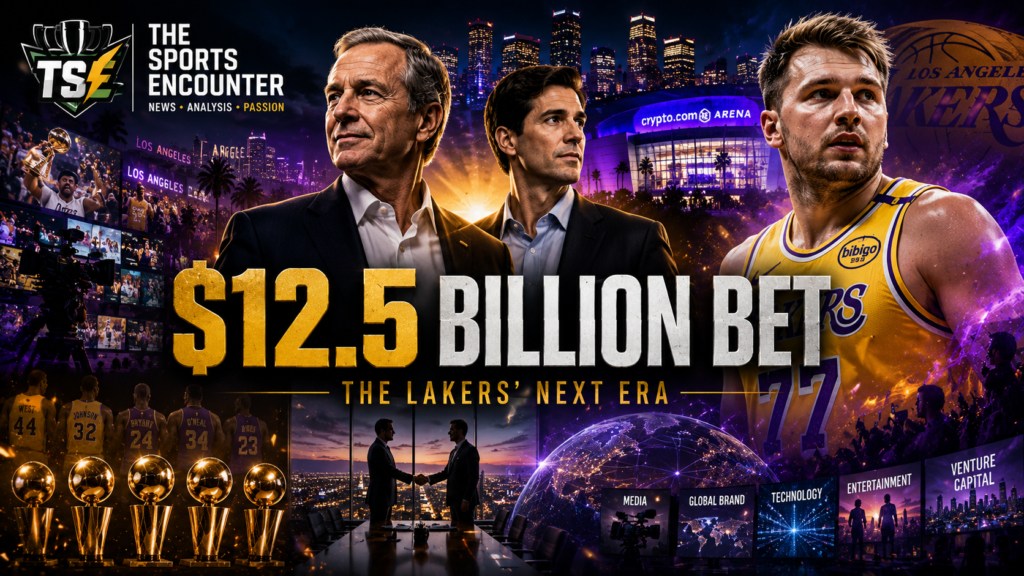
This time, the price is $12.5 billion.
Former Disney CEO Bob Iger and venture capitalist Josh Kushner have agreed to acquire the Lakers in a deal that would establish another record valuation for a United States professional sports franchise, according to Reuters and multiple reports published Wednesday.
The number is extraordinary by itself.
The timing is even more remarkable.
Less than one year ago, Mark Walter completed his acquisition of majority control of the Lakers at a valuation of approximately $10 billion. The NBA Board of Governors unanimously approved Walter’s purchase in October 2025, formally ending the Buss family’s 46-year run as majority owners while allowing the family to retain an ongoing interest.
Now the Lakers are changing hands again.
At $12.5 billion, the proposed Iger-Kushner transaction represents a 25% increase over the $10 billion valuation attached to Walter’s purchase less than a year earlier.
That alone tells us something important.
The Lakers are no longer valued primarily as a basketball organization.
They are being priced as a global entertainment asset.
A media brand.
A cultural institution.
A premium Los Angeles property.
A long-term content platform built around one of professional sport’s most recognizable names.
That is where the real story begins.
For continuing league coverage, franchise analysis, player movement and sports-business stories, visit The Sports Encounter NBA Hub.
Los Angeles Lakers Sale: Key Facts
| Detail | Information |
|---|---|
| Franchise | Los Angeles Lakers |
| Proposed buyers | Bob Iger and Josh Kushner |
| Reported valuation | $12.5 billion |
| Current majority owner | Mark Walter |
| Walter purchase valuation | Approximately $10 billion |
| Walter approval date | October 30, 2025 |
| Increase in headline valuation | 25% |
| NBA approval required | Yes |
| Basketball centerpiece | Luka Dončić |
| LeBron James status | Joined Philadelphia 76ers |
The proposed transaction is not yet final. As with other controlling NBA ownership changes, the deal must receive approval from the league’s Board of Governors before the ownership transfer can formally close. The NBA’s official ownership transaction archive shows that controlling sales are subject to league approval.
A $12.5 Billion Price Tag Changes the Conversation Around Sports Franchises
The headline number is difficult to comprehend within the historical context of sports ownership.
For decades, professional teams were often treated as prestige assets owned by wealthy individuals or families.
The economics have changed.
Top-tier sports organizations are now increasingly valued as combinations of media rights, intellectual property, live-event inventory, global licensing, data, advertising, sponsorship, hospitality, digital content, real estate opportunity and direct-to-consumer audience access.
The Lakers sit near the top of that hierarchy.
Their value extends beyond the number of tickets they sell at Crypto.com Arena or the number of games they win in a given season.
The Lakers name travels internationally.
The purple and gold uniform is recognizable far beyond the United States.
The franchise has existed at the center of NBA mythology through generations of superstars including Jerry West, Wilt Chamberlain, Kareem Abdul-Jabbar, Magic Johnson, Shaquille O’Neal, Kobe Bryant, LeBron James and now Luka Dončić.
That continuity has created a brand with enormous memory.
Iger and Kushner are paying for that memory as much as they are paying for the present roster.
The Lakers Have Gained $2.5 Billion in Headline Value in Less Than a Year
This may be the most striking business number in the deal.
Mark Walter’s transaction valued the Lakers at roughly $10 billion.
The proposed Iger-Kushner acquisition values them at $12.5 billion.
That is a difference of $2.5 billion.
In percentage terms, it represents a 25% increase.
The rise has occurred in less than one year.
That does not necessarily mean the underlying basketball business itself grew 25% during that period.
Transaction valuations can reflect strategic premiums, scarcity, control rights, ownership structure, expected future media economics and competition among wealthy buyers.
That distinction matters.
The Lakers did not suddenly become 25% better at basketball.
The asset became worth more to the next buyer.
That is how premium sports properties increasingly operate.
Mark Walter’s Lakers Era May End Almost As Soon As It Began
Walter’s tenure as majority owner has been extraordinarily brief.
In October 2025, the NBA formally approved his purchase after the Buss family agreed to transfer majority control.
The Lakers announced Walter’s completed acquisition as the beginning of a new ownership chapter.
NBA Commissioner Adam Silver described him at the time as an experienced sports owner and trusted steward.
Walter already had significant sports interests.
He is the principal owner of Major League Baseball’s Los Angeles Dodgers and has also been involved with the WNBA’s Los Angeles Sparks and other sports ventures.
His acquisition appeared to give the Lakers long-term financial stability and align them with one of the most aggressive ownership structures in American professional sports.
Instead, another transaction has arrived almost immediately.
Why Is Mark Walter Selling So Quickly?
This is one of the unavoidable questions surrounding the deal.
Reuters reported that Walter’s financial empire is facing federal scrutiny involving links between investments held by insurers and affiliated entities.
That investigation does not establish wrongdoing by itself.
It does, however, create an unusual backdrop for a franchise sale of this magnitude so soon after Walter obtained control.
For the Lakers, ownership stability matters because organizational direction affects everything beneath it.
Front-office authority.
Coaching decisions.
Player-development investment.
Analytics.
Facilities.
Commercial partnerships.
Salary willingness.
Long-term roster planning.
A second ownership transition in such a short period inevitably raises questions about continuity.
Bob Iger Is Not a Conventional Sports Buyer
Iger changes the profile of the ownership group immediately.
His reputation comes from entertainment rather than professional team ownership.
That may actually be the point.
As CEO of The Walt Disney Company, Iger spent years operating at the intersection of media, sports, film, television, streaming, consumer products, theme parks and global intellectual property.
Disney also owns ESPN, giving Iger decades of exposure to the economics of sports broadcasting, league relationships, audience behavior and premium live programming.
That background makes the Lakers a logical asset.
The NBA is no longer merely a sports league competing for television ratings.
It is a global entertainment ecosystem.
Players are creators.
Teams are media brands.
Games are live content.
Documentaries extend athlete stories.
Social platforms create daily engagement between games.
Streaming adds distribution flexibility.
International markets create new audiences.
Iger understands that world intimately.
The Lakers May Be the Perfect Media-Sports Asset for Iger
Few sports properties align more naturally with Iger’s experience.
The Lakers operate in Los Angeles, one of the world’s entertainment capitals.
The franchise has celebrity visibility built into its history.
Its courtside culture has long blurred the lines between basketball, Hollywood, music and popular culture.
That means the team possesses opportunities beyond conventional sponsorship.
Original content.
Global documentary projects.
International tours.
Premium digital memberships.
Brand collaborations.
Luxury hospitality.
Entertainment partnerships.
New distribution models.
Owning the Lakers gives Iger something far more powerful than a passive sports investment.
It gives him control of recurring live intellectual property.
Josh Kushner Brings a Different Kind of Capital
Kushner’s background is equally important, but in a different way.
He founded Thrive Capital and built his reputation in venture investing.
That experience creates a natural interest in technology, growth, platform economics and scalable consumer businesses.
His involvement therefore gives the ownership group a combination that may prove significant.
Iger understands media.
Kushner understands venture capital.
The Lakers understand attention.
Put those elements together and the franchise begins to look less like a team acquisition and more like a long-term entertainment-tech platform.
The Pair Were Previously Linked With NBA Expansion in Las Vegas
Iger and Kushner had previously been associated with a potential NBA expansion team in Las Vegas.
That possibility appears far less likely now.
Why wait for expansion?
Why spend years pursuing league approval, arena planning, market development, branding, front-office hiring and roster construction when the Lakers become available?
Expansion offers a blank page.
The Lakers offer 17 championships, one of basketball’s largest global followings and immediate cultural authority.
The comparison is almost unfair.
The NBA has formally begun exploring possible expansion into Las Vegas and Seattle, according to the league’s official Board of Governors releases.
If Iger and Kushner complete the Lakers deal, one of the most credible potential ownership groups for Las Vegas effectively exits that race.
The Deal Arrives During an NBA Ownership Arms Race
NBA franchise valuations have been climbing rapidly.
The Lakers are the clearest example, but they are not alone.
Recent ownership transactions involving the Boston Celtics, Portland Trail Blazers, Minnesota Timberwolves and other franchises have reinforced the perception that NBA teams have become scarcity assets.
There are only 30 teams.
Even if expansion adds two more, control opportunities remain extremely rare.
That scarcity matters.
Billionaires can buy hotels.
They can buy companies.
They can buy real estate.
They cannot easily buy the Lakers.
When the opportunity appears, strategic buyers may be willing to pay a premium that appears extreme under traditional valuation methods.
The Lakers Are Being Sold at the Exact Moment Their Basketball Identity Has Changed
The business transaction cannot be separated from the roster.
LeBron James is gone.
Luka Dončić is now the center of the franchise.
The Sports Encounter tracked the transition before it became final in our analysis of whether LeBron would remain with the Lakers.
The answer eventually became clear.
James left Los Angeles after eight seasons and joined Philadelphia for his record-extending 24th NBA season, a move we examined in our analysis of LeBron’s move to the 76ers.
That departure changed the Lakers structurally.
For the first time since 2018, they are not operating around LeBron’s timeline.
The team belongs to Luka now.
Luka Dončić Is the Most Important Basketball Asset Iger and Kushner Are Buying
Every ownership plan eventually has to meet the roster.
Dončić is where the business strategy becomes basketball strategy.
He gives the Lakers something every premium franchise needs.
A global superstar in his prime.
Dončić is young enough to define the next decade and established enough to carry commercial weight immediately.
He has international reach.
He creates highlights.
He drives television interest.
He gives the Lakers a central personality around whom the post-LeBron era can be built.
That matters enormously when a franchise is being valued at $12.5 billion.
Owners paying that amount are not buying nostalgia alone.
They need a future.
Luka is that future.
The LeBron Exit May Actually Make the Ownership Transition Cleaner
This sounds counterintuitive.
LeBron remains one of the most commercially powerful athletes in sports.
His move to Philadelphia immediately changed national television expectations, something The Sports Encounter examined in our analysis of the LeBron television effect.
Yet his departure also gives the new Lakers ownership group a clearer organizational timeline.
There is no need to balance a 41-year-old superstar’s final championship push against a long-term rebuild.
The question becomes simpler.
How do you build the best possible team around Luka Dončić?
That clarity has value.
Austin Reaves Becomes More Important in the New Structure
Dončić may be the centerpiece, but ownership decisions will also affect the players around him.
Austin Reaves remains one of the franchise’s important complementary pieces.
His value comes from versatility, shot creation and the ability to play on or off the ball.
The larger question is how aggressive the Lakers become in reshaping the roster.
New owners often arrive with ambitions to modernize.
That can mean changes in basketball operations.
It can mean increased spending.
It can mean greater investment in scouting, analytics, performance science and player development.
It can also mean impatience.
The danger is assuming ownership money can solve roster problems immediately.
The NBA’s collective bargaining agreement remains a constraint regardless of how wealthy the owners become.
Money Matters, but NBA Rules Still Matter More
A $12.5 billion purchase does not give the Lakers unlimited basketball flexibility.
The salary cap remains.
Luxury-tax rules remain.
Apron restrictions remain.
Trade rules remain.
Draft capital remains finite.
That means the greatest benefit of deep-pocketed ownership may appear outside direct player salary.
Player development.
Medical infrastructure.
Analytics.
Facilities.
Coaching support.
G League development.
International scouting.
Front-office depth.
Teams increasingly compete through those marginal advantages.
What Happens to Jeanie Buss?
This could become one of the transaction’s most sensitive questions.
When Walter’s majority purchase was approved in 2025, the NBA specifically stated that Jeanie Buss would remain the Lakers’ Governor for at least five years.
The NBA’s official 2025 announcement made that continuity explicit.
The Iger-Kushner deal now creates uncertainty around that arrangement.
Will Buss remain Governor?
Will her role become ceremonial?
Will the new ownership group seek operational control immediately?
Will the Buss family retain its minority stake?
Those answers have not yet been fully established publicly.
They matter because the Lakers’ identity has been tied to the Buss family since Dr. Jerry Buss purchased the franchise in 1979.
The Buss Legacy Is Still the Standard Every New Owner Has to Respect
Iger and Kushner acknowledged that directly in their statement.
They praised the leadership of Jerry and Jeanie Buss and described themselves as future stewards of the franchise.
The language was deliberate.
Buying the Lakers does not mean buying a blank organization.
The expectations are inherited.
Championships matter more in Los Angeles than playoff appearances.
Star players matter.
Entertainment matters.
Relevance matters.
The Buss family built the Lakers around the idea that basketball and spectacle could coexist.
Iger may be uniquely qualified to understand that tradition.
Jerry Buss Created the Original Sports-Entertainment Lakers
Long before franchises were described as media platforms, Jerry Buss operated the Lakers that way.
The Showtime era was basketball, but it was also theater.
Magic Johnson fit Los Angeles culturally as much as athletically.
Celebrity courtside culture became part of the brand.
The Forum became a stage.
Winning and entertainment became mutually reinforcing.
Iger’s challenge is not to invent a media-first Lakers.
It is to modernize a concept Jerry Buss understood decades ago.
The Lakers’ Cultural Value Helps Explain the $12.5 Billion Number
Traditional sports valuation looks at revenue.
The Lakers require something wider.
How much is global recognition worth?
How much is the ability to sell sponsorship in multiple continents worth?
How much is an arena full of celebrities worth to premium brands?
How much is decades of championship history worth?
How much is a franchise associated with Kobe, Magic, Kareem, Shaq and LeBron worth?
There is no perfect spreadsheet for that.
Scarcity and cultural relevance create premiums that ordinary cash-flow analysis struggles to capture.
The 2026 NBA Finals Show Why Elite Basketball Content Is Becoming More Valuable
The league itself is providing a strong commercial backdrop.
The 2026 NBA Finals between New York and San Antonio produced an enormous television response.
The Sports Encounter analyzed that surge in our report on the Knicks-Spurs ratings boom.
The series demonstrated that when the league gets the right teams, personalities and stakes, live basketball remains enormously valuable media inventory.
That matters for ownership.
Live sports are increasingly valuable because audiences watch them in real time.
Streaming has fragmented entertainment viewing.
Sports remains one of the few categories capable of gathering huge audiences simultaneously.
Iger understands that better than almost anyone entering team ownership.
Owning the Lakers Means Owning Premium Live Content
This may be the cleanest way to understand the transaction.
The Lakers play 82 regular-season games.
They may play additional NBA Cup and playoff games.
Each game generates content.
Each roster move generates content.
Every Luka performance generates global conversation.
Drafts, trades, injuries, uniforms, rivalries, anniversaries and documentaries extend the content cycle further.
Few entertainment properties produce new chapters that frequently.
A movie studio may release several major films per year.
The Lakers can create multiple global sports moments every week.
There Is Also a Documentary and Storytelling Economy Around the Lakers
Modern sports franchises no longer monetize only live games.
Historical archives have value.
Behind-the-scenes access has value.
Player documentaries have value.
The Sports Encounter recently examined this dynamic through the reported LeBron James documentary project.
LeBron’s story may have moved to Philadelphia, but the underlying principle remains relevant to the Lakers.
Every era of the franchise contains material that can be repackaged, retold and redistributed for new audiences.
Kobe.
Magic.
Showtime.
Shaq.
LeBron.
Luka.
This is an archive with extraordinary commercial depth.
Can the Lakers Become an Even Bigger International Brand?
Probably.
The franchise already has international recognition.
Dončić gives it an even stronger European bridge.
Iger’s global entertainment experience could encourage more aggressive international brand development.
That might include preseason tours, sponsorship partnerships, localized content, international merchandising, digital memberships and other global initiatives.
The NBA has spent years expanding internationally.
The Lakers are among the teams best positioned to benefit from that strategy.
Could the New Owners Eventually Seek Greater Control Over the Arena Experience?
Another long-term question involves infrastructure.
The Lakers play at Crypto.com Arena rather than owning a proprietary arena outright.
For a franchise valued at $12.5 billion, the ownership group may eventually examine how much control it wants over premium hospitality, game-day experience, commercial inventory and surrounding real estate opportunities.
No major arena plan has been announced as part of this transaction.
Still, sports ownership increasingly extends beyond the team itself.
Modern franchises often seek control over districts, entertainment zones, restaurants, retail, hotels and year-round fan experiences.
That makes physical infrastructure a strategic question worth watching over the longer term.
Why $12.5 Billion May Not Look Absurd Ten Years From Now
That may sound difficult to believe today.
Sports valuations have repeatedly made older purchase prices look tiny.
Jerry Buss purchased the Lakers, Los Angeles Kings, The Forum and related real estate interests in 1979 for a fraction of the Lakers’ current value.
Owners who paid hundreds of millions for elite franchises decades ago now control assets worth billions.
The logic behind the Iger-Kushner deal is presumably similar.
They are not paying $12.5 billion because they believe the Lakers are worth exactly that amount in 2026 operating income.
They are paying for decades of future scarcity.
The Deal Could Influence Every Other NBA Franchise Valuation
One record transaction does not remain isolated.
Comparable valuations move.
Owners look at their own teams differently.
Minority investors reevaluate stakes.
Lenders reassess collateral value.
Potential sellers raise expectations.
Expansion pricing rises.
If the Lakers are worth $12.5 billion, what is Golden State worth?
What are the Knicks worth?
What should an NBA expansion franchise in Las Vegas cost?
Those questions become more expensive immediately.
Las Vegas Expansion May Have Just Become More Expensive
Iger and Kushner leaving the expansion race could affect the market in another way.
The NBA now has an additional valuation benchmark before deciding what an expansion entry fee should look like.
A new Las Vegas team would not possess Lakers history.
It would, however, offer permanent membership in a league where the Lakers have just attracted a $12.5 billion valuation.
The price of entry will reflect that scarcity.
Josh Kushner’s Recent FIFA Experience Adds Another Layer
Kushner arrives at the Lakers during a period when his role in sports investment has already attracted international attention.
Weeks before the Lakers agreement, he was connected with a controversial private-equity proposal involving FIFA.
The concept involved selling minority stakes in a new commercial subsidiary associated with World Cup operations at a reported $20 billion valuation.
Kushner-founded Thrive Eternal was expected to play a significant role in the investment group.
The proposal generated intense criticism and FIFA ultimately abandoned it.
That episode matters here because it demonstrates the scale of sporting assets Kushner is targeting.
He is not entering sport through small investments.
He is positioning himself around some of the most valuable properties in global competition.
The Lakers Offer Something FIFA Could Not: Direct Control
A minority investment in a commercial FIFA vehicle would have been structurally different.
Buying the Lakers offers direct influence over a specific organization.
That creates clearer governance.
Clearer brand control.
Clearer capital allocation.
Clearer strategic accountability.
For an investor accustomed to backing businesses, that may be more attractive than navigating the political complexity of an international governing body.
TSE Analysis: This Deal Looks Like the Convergence of Sports, Media and Venture Capital
This is the part of the transaction that makes it historically interesting.
Sports teams used to be purchased primarily by industrialists, local business families and wealthy individuals who wanted prestige.
The new ownership class looks different.
Private equity.
Technology.
Media.
Venture capital.
Global investment platforms.
Entertainment conglomerates.
Iger and Kushner embody that convergence almost perfectly.
One built his career managing global entertainment intellectual property.
The other built his through technology-oriented venture investment.
They are now purchasing a basketball franchise that functions increasingly like both.
The Lakers Cannot Become a Corporate Content Machine at the Expense of Basketball
There is a danger here too.
Premium sports brands lose value when supporters begin feeling that the business matters more than winning.
Lakers fans do not primarily care about valuation multiples.
They care about banners.
They care about roster decisions.
They care about beating Boston.
They care about Luka having enough help.
They care about whether the team can win another championship.
Commercial innovation has to support that ambition rather than replace it.
Winning Remains the Simplest Brand Strategy
This sounds obvious because it is.
The Lakers became globally valuable because they won repeatedly with unforgettable players.
The Showtime Lakers were commercially magnetic because they were champions.
Kobe and Shaq became a global phenomenon because they dominated.
LeBron’s Lakers championship in 2020 added another generation to the story.
Winning turns games into history.
History turns players into legends.
Legends turn franchises into global brands.
The entire commercial machine begins there.
Dončić Is the First Great Test of the New Ownership Group
Iger and Kushner do not need to find a franchise player.
They already have one.
That makes the next challenge more difficult, not less.
They need to avoid wasting him.
Dončić’s presence gives the Lakers a championship window and a long-term identity.
The ownership group’s job is to build an environment capable of maximizing both.
That means front-office stability.
Smart roster construction.
Elite performance support.
Patience where necessary.
Aggression where opportunity appears.
LeBron’s Christmas Return Will Symbolize the Transition
One of the most emotionally revealing nights of the new era is already on the calendar.
LeBron will return to Los Angeles with Philadelphia on Christmas Day.
The Sports Encounter analyzed that matchup in our preview of LeBron’s Lakers return.
By then, the contrast may be unmistakable.
LeBron represents the previous Lakers era.
Dončić represents the next one.
Iger and Kushner could represent the ownership future.
Christmas may become more than a reunion.
It may look like a ceremonial handoff between three different versions of the franchise.
The Lakers Remain Central to the NBA’s Historical GOAT Conversation
The franchise’s commercial value also comes from how often it sits inside basketball’s greatest historical debates.
Kareem Abdul-Jabbar built much of his legacy in Los Angeles.
LeBron spent eight seasons there.
Kobe Bryant spent his entire career there.
Magic Johnson helped define modern basketball entertainment there.
Those historical connections keep the Lakers relevant even between championship years.
The Sports Encounter’s comparison of LeBron James, Michael Jordan and Kareem Abdul-Jabbar illustrates how deeply Lakers history remains woven into the NBA’s biggest legacy conversations.
What Should Lakers Fans Expect Immediately?
Probably less than the $12.5 billion headline suggests.
Ownership transactions take time.
The NBA must approve the deal.
Governance roles need clarification.
Existing executives remain in place unless changes are made.
Roster rules do not disappear.
The first months may therefore look more evolutionary than revolutionary.
The biggest early signals to watch will be organizational rather than dramatic.
- Who becomes the Lakers’ official Governor?
- What role does Jeanie Buss retain?
- Does the Buss family keep its minority interest?
- How much autonomy does basketball operations receive?
- Does ownership invest heavily in development, analytics and facilities?
- How aggressively is the roster rebuilt around Luka Dončić?
- Does the organization pursue broader international commercial expansion?
- Do Iger and Kushner explore new media or content strategies?
What Could Go Wrong?
The valuation itself creates expectations.
A $12.5 billion purchase invites a dangerous assumption that everything must become bigger immediately.
Bigger trades.
Bigger names.
Bigger spending.
Bigger commercial projects.
That can become destructive if ownership mistakes activity for progress.
The strongest sports organizations separate business ambition from basketball decision-making while ensuring both support the same long-term objective.
The Lakers need capital.
They also need basketball expertise to remain protected from short-term commercial pressure.
What Could Go Right?
The upside is enormous.
Iger and Kushner could combine sophisticated global business thinking with one of sports’ strongest existing brands.
If they invest in modern infrastructure while preserving basketball authority, the Lakers could become stronger commercially without compromising competitive identity.
Dončić provides the ideal centerpiece.
Los Angeles provides the ideal market.
The NBA provides a growing global platform.
The Lakers provide history.
Few ownership opportunities offer all four simultaneously.
Why the Lakers Remain Different From Almost Every Other Sports Team
Plenty of franchises are valuable.
Very few are culturally unavoidable.
The Lakers occupy a rare space with organizations such as Real Madrid, Barcelona, Manchester United, the New York Yankees and a handful of others.
The brand transcends its league.
People who do not follow the NBA recognize the Lakers.
People who have never been to Los Angeles recognize the colors.
That is not ordinary fandom.
It is global brand equity accumulated across generations.
TSE Verdict: Iger and Kushner Are Not Buying the Lakers at the Top of the Market
They may be buying them at the beginning of a new sports-ownership market.
That distinction matters.
$12.5 billion sounds enormous because it is.
Yet the economics of premium live sport are moving toward greater scarcity, stronger global distribution and increasingly integrated media ecosystems.
The Lakers sit in the middle of all three.
If NBA media rights continue growing, global fandom continues expanding and franchise scarcity remains intact, today’s record price may eventually look less aggressive than it appears.
That is the wager.
Final Analysis: The Lakers Have Entered Their Third Era in Less Than Two Years
The basketball world has been conditioned to think about the Lakers through players.
Magic.
Kobe.
Shaq.
LeBron.
Luka.
The past year has introduced another storyline.
Ownership.
The Buss family’s majority control ended after 46 years.
Mark Walter arrived at a $10 billion valuation.
Now Iger and Kushner are prepared to pay $12.5 billion.
That is an extraordinary amount of structural change for an organization whose greatest strength historically has been continuity of identity.
The challenge is therefore larger than simply closing the transaction.
The new ownership group has to prove that Lakers identity can survive ownership acceleration.
Winning still matters.
Superstars still matter.
Los Angeles still matters.
The difference is that the economics surrounding all three have become dramatically larger.
Iger and Kushner appear to understand the responsibility.
In their statement, they described themselves as stewards rather than simply buyers.
That word matters.
The Lakers are valuable because each generation inherited something worth protecting.
Jerry Buss inherited a franchise and transformed it into Showtime.
Jeanie Buss inherited that standard and eventually delivered another championship.
Walter briefly inherited the responsibility.
If the NBA approves this deal, Iger and Kushner inherit something even more expensive.
Expectation.
The $12.5 billion price tag will dominate the headlines.
What happens after the sale will determine whether it was merely the biggest sports transaction of its era or the beginning of the Lakers’ next great one.
Frequently Asked Questions
Who is buying the Los Angeles Lakers?
Former Disney CEO Bob Iger and venture capitalist Josh Kushner have agreed to acquire the Los Angeles Lakers, according to Reuters and multiple reports.
How much are Iger and Kushner paying for the Lakers?
The transaction values the franchise at approximately $12.5 billion.
Is the $12.5 billion Lakers sale final?
No. The transaction still requires approval from the NBA Board of Governors before the ownership transfer can formally close.
Who currently owns the Lakers?
Mark Walter is the current majority owner after the NBA approved his purchase of controlling interest from the Buss family in October 2025.
How much did Mark Walter pay for the Lakers?
Walter’s acquisition valued the Lakers at approximately $10 billion.
How much has the Lakers valuation increased since Walter’s purchase?
The proposed $12.5 billion valuation is $2.5 billion higher than the approximately $10 billion valuation attached to Walter’s purchase, representing an increase of about 25%.
Why is Mark Walter selling the Lakers so quickly?
No single definitive reason has been publicly established. Reuters reported that Walter’s broader financial empire is facing federal scrutiny involving insurer investments and affiliated entities, providing important context around the timing of the transaction.
Who is Bob Iger?
Bob Iger is the former longtime CEO of The Walt Disney Company. His career has centered on global media, entertainment, intellectual property, streaming and sports-media businesses.
Who is Josh Kushner?
Josh Kushner is a venture capitalist and founder of Thrive Capital. He has also recently been involved in major sports-investment discussions, including a proposed FIFA commercial investment structure.
Were Iger and Kushner trying to own an NBA expansion team?
Yes. They had previously been linked with a potential Las Vegas NBA expansion franchise before agreeing to acquire the Lakers.
Who is the Lakers’ franchise player now?
Luka Dončić is the centerpiece of the Lakers’ post-LeBron era.
Where is LeBron James playing in 2026-27?
LeBron James has joined the Philadelphia 76ers after eight seasons with the Lakers.
Will Jeanie Buss remain involved with the Lakers?
Her long-term role under the Iger-Kushner group has not yet been fully clarified. Under the Walter transaction approved in 2025, Jeanie Buss was expected to remain Lakers Governor for at least five years.
Does the Buss family still own part of the Lakers?
The Buss family retained an ongoing minority interest after Walter acquired majority control. The structure of that interest following the proposed Iger-Kushner acquisition has not yet been fully detailed publicly.
Why are the Lakers worth so much?
The Lakers combine championship history, global recognition, Los Angeles market power, premium sponsorship opportunities, major media value, international fan reach and one of professional sport’s strongest collections of historical stars.
Could the Lakers become worth even more?
Yes. Continued NBA media growth, international expansion, scarcity of team ownership opportunities and commercial development around digital content, sponsorship and premium experiences could support higher future valuations.
What is the biggest challenge for Iger and Kushner?
The central challenge is turning enormous commercial opportunity into a stronger basketball organization without allowing business ambition to interfere with roster construction and competitive decision-making.
What should Lakers fans watch next?
The most important developments are NBA approval of the transaction, Jeanie Buss’ future role, basketball-operations authority, roster investment around Luka Dončić and any major changes to facilities, front-office structure or global commercial strategy.